
The Tim Traveller
Published Jul 2, 2024In early 1968, Britain launched a revolutionary new form of sea transport: the giant SRN4-class hovercraft. They are the largest passenger hovercraft ever built, and they could fly between England and France in just 30 minutes — three times faster than anything else on the water. So why don’t we have anything like them any more?
MORE INFO
The Hovercraft Museum: https://www.hovercraft-museum.org/
The museum’s “Support Us” page, if you’d like to help them out: https://www.hovercraft-museum.org/sup…
October 23, 2024
The Last Surviving Giant Passenger Hovercraft
Comments Off on The Last Surviving Giant Passenger Hovercraft
QotD: Sheep shearing in the ancient and medieval world
Of course you have to get the wool off of the sheep and this is a process that seems to have changed significantly with the dawn of the iron age. The earliest breeds of sheep didn’t grow their coats continuously, but rather stopped growing their fleece in the spring and thus in the late spring the fleece begins to shed and peel away from the body. This seems to be how most sheep “shearing” (I use the term loosely, as no shearing is taking place) was done prior to the iron age. This technique is still used, particularly in the Shetlands, where it is called rooing, but it also occasionally known as “plucking”. It has been surmised that regular knives (typically of bone) or perhaps flint scrapers sometimes found archaeologically might have assisted with this process, but such objects are multi-purpose and difficult to distinguish as being attached to a particular purpose. It has also been suggested that flint scrapers might have been used eventually in the early bronze age shearing of sheep with continuously growing coats, but Breniquet and Michel express doubts (Wool Economy in the Ancient Near East and the Aegean (2014)). Another quirk of this early process and sheep that shed on their own is that unlike with modern sheep shearing, one cannot wash the sheep before removing the wool – since it is already being shed, you would simply wash it away. Plucking or rooing stuck around for certain breeds of sheep in the Roman sphere at least until the first century, but in most places not much further.
The availability of iron for tools represented a fairly major change. Iron, unlike bronze or copper, is springy which makes the standard design of sheep shears (two blades, connected by a u-shaped or w-shaped metal span called a “bow”) and the spring action (the bending and springing back into place of the metal span) possible. The basic design of these blade shears has remained almost entirely unchanged since at least the 8th century BC, with the only major difference I’ve seen being that modern blade shears tend to favor a “w-shape” to the hinge, while ancient shears are made with a simpler u-shape. Ancient iron shears generally varied between 10 to 15cm in length (generally closer to 15 than to 10) and modern shears … generally vary between 10cm and 18.5cm in length; roughly the same size. Sometimes – more often than you might think – the ideal form of an unpowered tool was developed fairly early and then subsequently changed very little.
Modern shearing, either bladed or mechanical, is likely to be done by a specialized sheep shearer, but the overall impression from my reading is that pre-modern sheep shearing was generally done by the shepherds themselves and so was often less of a specialized task with a pastoral community. There are interesting variations in what the evidence implies for the gender of those shearing sheep; shears for sheep are common burial goods in Iron Age Italy, but their gender associations vary by place. In the culturally Gallic regions of North Italy, it seems that shears were assumed to belong to men (based on associated grave goods; that’s a method with some pitfalls, but the consistency of the correlation is still striking), while in Sicily, shears were found in both male and female burials and more often in the latter (but again, based on associated grave goods). Shears also show up in the excavation of settlements in wool-producing regions in Italy.
That said, the process of shearing sheep in the ancient world wasn’t much different from blade shearing still occasionally performed today on modern sheep. Typically before shearing, the sheep are washed to try to get the wool as clean as possible (though further post-shearing cleaning is almost always done); typically this was done using natural bodies of moving water (like a stream or shallow river). The sheep’s legs are then restrained either by hand or being tied and the fleece is cut off; I can find, in looking at depictions of blade shearing in various periods, no consistency in terms of what is sheared first or in what order (save that – as well known to anyone familiar with sheep – that a sheep’s face and rear end are often sheared more often; this is because modern breeds of sheep have been selectively bred to produce so much wool that these areas must be cleared regularly to keep the fleece clean and to keep the sheep from being “wigged” – that is, having its wool block its eyes). Nevertheless, a skilled shearer can shear sheep extremely fast; individuals shearing 100-200 sheep a day is not an uncommon report for modern commercial shearers working with tools that, as noted, are not much different from ancient tools. That speed was important; sheep were generally sheared just once a year and usually in a fairly narrow time window (spring or very early summer; in medieval England this was generally in June and was often accompanied by a rural festival) so getting them all sheared and ready to go before they went up the mountain towards the summer pasture probably did need to be done in fairly short order.
Bret Devereaux, “Collections: Clothing, How Did They Make It? Part I: High Fiber”, A Collection of Unmitigated Pedantry, 2021-03-05.
Comments Off on QotD: Sheep shearing in the ancient and medieval world
October 22, 2024
A Conquering Hat: a History of the Bicorn
HatHistorian
Published Jul 1, 2022Emblematic of Napoleon Bonaparte and his age of conquest, the bicorn is a distinctive military hat that became part of the most formal of dress uniforms and remains to this day in certain ceremonial outfits
The bicorn I wear in this video comes from Theatr’Hall in Paris https://www.theatrhall.com. The uniform comes from thejacketshop.co.uk
Title sequence designed by Alexandre Mahler
am.design@live.comThis video was done for entertainment and educational purposes. No copyright infringement of any sort was intended.
Comments Off on A Conquering Hat: a History of the Bicorn
October 21, 2024
Romanian Model 1879 Martini-Henry Rifles & Carbines
Forgotten Weapons
Published Jul 5, 2024Following its experience in the Russo-Turkish War, the Romanian Army was quite impressed by the Martini-Henry rifle in Turkish service. Unlike so many Western observers who were taken by the Winchester repeating rifles that actually didn’t make much battlefield impact, the Romanians recognized the all-around quality of the Martini. So after the war when looking to equip their own newly independent army, they went to Britain for Martinis. They were not able to get rifles made in Britain, but did purchase a license to make the rifle in .45 Gatling, which they took to a factory in Witten, in the German state of Wurtemburg. This factory was newly opened, run in part by Friedrich von Martini himself — so what better place to get Martini rifles?
An initial contract for 60,000 rifles and 8,000 carbines was accepted by the factory and delivered fairly quickly. When the Romanians came back for more guns the factory had gone bankrupt, however. Subsequent orders were instead made from OEWG Steyr in Austria. In total, Romania acquired about 145,000 Martini long rifles and between 12,000 and 18,000 carbines. They were replaced by the Model 1893 Mannlicher in the 1890s, and thus were never used as a front-line rifle in any major combat. They served in World War One in a secondary role only.
Thanks to the King Ferdinand I Military Museum for giving me access to these examples and to A.N.C.A. for coordinating the visit! If you are in Bucharest, make sure to stop in and visit the museum:
https://www.muzeulmilitar.ro/en/
(more…)
Comments Off on Romanian Model 1879 Martini-Henry Rifles & Carbines
October 20, 2024
Nazi Conspiracies Everywhere – Rise of Hitler, April 1930
World War Two
Published 19 Oct 2024Join us for the May 1930 edition of the Weimar Wire, where we cover violent communist Youth Day demonstrations, a tough first month for new German chancellor Bruning, crazy Nazi conspiracy theories, and a whole lot more.
(more…)
Comments Off on Nazi Conspiracies Everywhere – Rise of Hitler, April 1930
Debunking the “Muslims saved the Graeco-Roman legacy” intellectual urban legend
In my weekly set of recommendations from Substack there was a link to A History of Mankind‘s debunking of what is described as an “intellectual urban legend”:
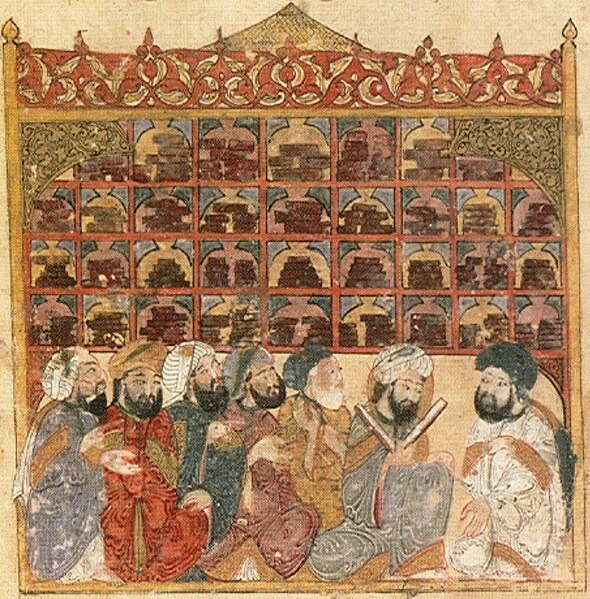
Islamic scholars at an Abbasid library in Baghdad.
Illustration by Yahyá al-Wasiti from 1237 via Wikimedia Commons.
Among the most popular of those legends, there’s one that can be summarized as “Arab scholars and translators saved the books of Graeco-Roman antiquity from being destroyed by the Christians and/or forgotten”. This a surprisingly widespread view. I’ve lived in several countries, and heard versions of this legend, often told in very simple terms over somewhat complicated drinks, from well-educated people often working in academia or the financial sector (which makes more sense than it appears — I’ve worked in the financial sector myself, and people there are highly educated as a rule).
I’ve even heard scholars (normally not Medievalists) express this view, and I’ve read views to this effect in multiple occasions. Just Google “did the arabs save graeco-roman books” and look at the top results, if you don’t believe me. Lots of well-educated people believe this, not to speak of history enthusiasts all over the Internet.
However, the truth is that Arab translators had only a modest impact on the transmission of Graeco-Roman texts to modern times. There are various reasons that explain this, but first let me provide some clarity on why Baghdad’s Medieval “House of Wisdom” — oft-cited, correctly, as the center of the Abbasid-era translation movement inasmuch as there was one — is one of history’s most misunderstood institutions.
The House of Wisdom functioned as a state library with a focus on the transcription and storage of manuscripts, and their translation to the court’s main language, Arabic. Based on a similar library patronized by the Sasanian emperors and staffed with some of its personnel from about the 8th century, the House of Wisdom employed Christian Greek speakers – very few Muslims spoke or read Greek fluently in this era and others, particularly Arabs – as well as Muslim and Zoroastrian Arabic or Syriac speakers who worked to translate and disseminate work.
[…]
Just to give a final touch of class to these absurd claims, Abu Sahl added the detail that the Greeks, dunces as they all are, forgot to actually steal many Iranian books, and simply memorized the contents before they torched them, so the actual Greek copies of Iranian greats are, by necessity, inferior versions diluted by the Greeks’ faulty memory.
Some Muslim scholars later came up with a new wrinkle that Byzantines were poor keepers of their own treasures, and their books were eaten by insects, as the bibliographer Al-Nadim (932-995) wrote in a second- or third-hand anecdote about some guy who visited Constantinople and was sad to see some ancient temple filled with neglected books, later widely quoted, and included in his Index of 987. The same Al-Nadim transmits from someone “trustworthy” that the Byzantines burned fifteen loads of books by Archimedes, which never happened.
Abdullah Ibn-abi-Zayd (922–998), a prolific North African writer on Islamic law, came up with a wrinkle for this wrinkle: that the Byzantine emperor gathered books and hid them in a secret building to prevent heresy among potential readers; and when Yahya, a prominent Bamarkid Persian in the Abbasid court, heard of the repository he asked if he could borrow the texts. The emperor agreed on the condition that they were never returned, so that they would never hurt the delicate Christian feelings of his subjects.
Others with less experience of the Christian West, like the Egyptian Arab Ibn Ridwan (988-1061), claimed that ancient sciences were forgotten there, and only survived in the Ummah because of the supreme wisdom and care displayed by Al-Mamun and their successors. Ridwan’s fable showing just how obscurantist and dumb Christians are proved particularly successful, being often retold with the kind of reverence typically reserved for hadiths:
The history of medicine begins with a brief account of the development in antiquity from Asclepius to Galen. After Galen, the community of the Christians emerged from and prevailed over the Greeks. The Christians considered it a fault to study intellectual matters and their kings cast away the care for medicine and failed to take care of its students. So its students ceased to commit themselves to the toilsome study of medicine and found reading Hippocrates’ and Galen’s works too tedious; thus, it fell into disorder and its condition worsened. Then came Oribasius, after the Christian kings’ lack of interest in the instruction [of medicine] was firmly rooted … When none of the kings any longer felt the desire to promote the teaching [of medicine] and the people found Hippocrates’ and Galen’s works on it too tedious and tended to compendia and abridgments, the most prominent Alexandrian physicians, afraid that the art would vanish altogether, asked those kings to retain the teaching [of medicine] in Alexandria and [to allow] only twenty books on medicine to be read, sixteen from Galen’s and four from Hippocrates’ works … The teaching stood on shaky ground until al-Ma’mun ‘Abd-Allah ibn-Harun al-Rashid became caliph, who revived and spread it and favored excellent physicians. But for him, medicine and other disciplines of the ancients would have been effaced and obliterated just as medicine is obliterated now from the lands of the Greeks, which had been most distinguished in this field.
I should also mention that it wasn’t just the Graeco-Romans who the Abbasid-era Muslims ripped off in bulk. The fact that Indian numerals came to be known in Europe as “Arabic” numerals, and chess was widely, and wrongly, believed to be an Arabic invention, gives an idea about the impact that Caliphate scholars had as synthesizers and popularizers of scientific knowledge.
Indeed, when the Iranian Al-Khwarizmi (780-850), head of the House of Wisdom from around 820, published the earliest Arabic text on Indian numerals, he chose a title of disarming honesty: “Addition and subtraction according to the Indian calculation”. Such honesty was rarely imitated by Al-Khwarizmi’s successors.
I think you are probably getting the gist of how the story about the Muslim salvage of Graeco-Roman antiquity came about, and was later embraced by every Atheist writer in the West, so that he or she could have nice laughs at the expense of those barbarian fools who never washed themselves, the Christians.
Comments Off on Debunking the “Muslims saved the Graeco-Roman legacy” intellectual urban legend
The True History of Deep Dish Pizza
Tasting History with Max Miller
Published Jul 2, 2024Deep dish cheese pizza with a bready crust
City/Region: Chicago
Time Period: 1945 | 1947The unsung hero of deep dish pizza is a woman named Alice Mae Redmond, who was the head chef at famous pizzerias like Pizzeria Uno and Gino’s. It seems like wherever she went, that was the best pizza place in town. She’s also the one who changed deep dish pizza crust from the bready version in this recipe to a butterier, more biscuit-like version that is found in modern deep dish.
This crust is still delicious, and the sauce is super flavorful. Be sure to cook the sauce down enough so that it’s nice and thick (mine was a bit too watery for my taste). In the 1940s, you could get cheese OR anchovies OR sausage, but not any of them together. I made a cheese pizza with my preferred ratio of about 50/50 cheese to sauce, but feel free to change things up however you like. You could even add more than one topping, though it won’t be quite as historically accurate.
(more…)
Comments Off on The True History of Deep Dish Pizza
October 18, 2024
Operation Keelhaul: The Allies’ Final War Crime
World War Two
Published 17 Oct 2024After the war, millions of Soviet citizens are left over in Germany. Some of them are traitors, some are prisoners, some women and children. Stalin wants them back and the Western Allies are happy to help.
(more…)
Comments Off on Operation Keelhaul: The Allies’ Final War Crime
Belton Repeating Flintlock: A Semiautomatic Rifle in 1785
Forgotten Weapons
Published Jul 1, 2024In 1785, Joseph Belton (an American inventor) and William Jover (an English gunmaker) sold 560 repeating flintlock rifles to the British East India Company. The guns were a very remarkable design which used a detachable magazine tube of 7 rounds stacked in series with a seven sequential touch holes. When the first round was fired, the flintlock ignited a piece of “portfire” slow match that would burn for about one minute. Pulling the trigger would move the portfire rearward one touch hole at a time, firing each in sequence as long as it remained burning. In this way, Belton advertised the gun as being able to fire 21 rounds in a single minute (using three preloaded magazine tubes). If the portfire burned out, it could be replaced and the flintlock reprimed and recocked. This was a truly impressive technological feat in 1785!
Belton had been working on firearms designs since 1758, and he actually got an order for 100 roman-candle-type repeaters from the American Continental Congress in 1777 — but there were pricing disputes and the order was never fulfilled. The British military examined the guns, but declined to purchase any. The 560 guns made for the East India Company (200 muskets, 160 carbines, and 100 pairs of pistols) were shipped from England in 1786, half to Madras and half to Bengal. Unfortunately, no further record of their performance has been found and we don’t know how well they worked in practice. This example is one of the muskets, with a .665″ bore and a 39 inch barrel.
(more…)
Comments Off on Belton Repeating Flintlock: A Semiautomatic Rifle in 1785
October 17, 2024
Democratic Germany considers banning 2nd-largest political party “to save democracy” of course
It’s totally a normal democratic urge to try to outlaw the second-largest political party in Germany and not in the least bit “authoritarian”, right?

This man is named Marco Wanderwitz. He is a member of the nominally centre-right Christian Democratic Union, and he’s been in the German Bundestag – our federal parliament – since 2002. He reached perhaps the apex of his career late in the era of Angela Merkel, when he was made Parliamentary State Secretary for East Germany. Wanderwitz has been complaining about Alternative für Deutschland for years, and his screeching only gained in volume and shrillness after he lost his direct mandate in the last federal election to Mike Moncsek, his AfD rival. Above all, Wanderwitz wants to ban the AfD, and he has finally gathered enough support to bring the whole question before the Bundestag. Thus we will be treated to eminently democratic debate about how we must defend democracy by prohibiting the second-strongest-polling party in the Federal Republic.
Now, I try not to do unnecessary drama here at the plague chronicle, so I must tell you straightaway that this won’t go anywhere. Even were the Bundestag to approve a ban, which it won’t, the whole matter would end up before the Federal Constitutional Court in Karlsruhe, where I suspect it would fail in any case. Basically, the AfD are accumulating popular support faster than our ruling cartel parties can summon their collective will for overtly authoritarian interventions, and as long as this dynamic continues, the AfD will scrape by.
A great many influential people nevertheless really, really want to outlaw the opposition and effectively disenfranchise 20% of the German electorate. Our journalistic luminaries in particular have become deeply radicalised over the past three years. They got everything they ever wanted in the form of our present Social Democrat- and Green-dominated government, only to have their political dream turn into an enormous steaming pile of shit. Because the establishment parties, including the CDU, have no answers to the crises besetting Germany, they have had to watch popular support for the AfD grow and grow. All their carefully curated talkshow tut-tutting, all their artfully coordinated diatribes about “right wing extremism”, all their transparently hostile reporting, has done nothing to reverse the trend. If establishment journalists were running the show, the AfD would’ve long been banned and many of their politicians would be in prison.
Today, Germany’s largest newsweekly, Die Zeit, has published a long piece by political editor Eva Ricarda Lautsch, in which she explains to 1.95 millions readers exactly why “banning the AfD is overdue“. The views she expresses are absolutely commonplace among elite German urbanites, and for this reason alone the article is sobering.
Let’s read it together.
Lautsch is disquieted that many in the Bundestag fear banning the AfD is “too risky”, “too soon” and “simply undemocratic”, and that “the necessary political momentum is not materialising”.
The problem … is not the lack of occasions for banning the AfD. Sayings like “We will hunt them down,” Sturmabteilung slogans, deportation fantasies: we have long since become accustomed to their constant rabble-rousing. And this is to say nothing of the most recent and particularly shocking occasion – the disastrous opening session of the Thuringian state parliament a week ago, in which an AfD senior president was able to effectively suspend parliamentary business for hours. Those with enough power to generate momentum don’t have to wait for it; what is missing across the parties is political courage.
What really distinguishes Lautsch’s article (and mainstream discussion about the AfD in general) is the constant grasping after reasons that the party is bad and unconstitutional, and the failure ever to deliver anything convincing. That “we will hunt them down” line comes from a speech the AfD politician Alexander Gauland gave in 2017, after his party entered the Bundestag with 12.6% of the vote for the first time. As even BILD reported, he meant that the AfD would take a hard, confrontational line against the establishment. He was not promising that AfD representatives would literally hunt down Angela Merkel, although the quote immediately entered the canonical list of evil AfD statements and has been repeated thousands of times by hack journalists ever since. As for the “Sturmabteilung slogans“, the “deportation fantasies” and the “opening session of the Thuringian state parliament” – I’ve covered all of that here at the plague chronicle. They are lies and frivolities, and what’s more, they are so obviously lies and frivolities that it is impossible to believe even Lautsch thinks very much of them. These are things that low-information readers of Die Zeit are supposed to find convincing; they aren’t real reasons.

Comments Off on Democratic Germany considers banning 2nd-largest political party “to save democracy” of course
Historian Reacts to Canada and the Scheldt Campaign
OTD Military History
Published 8 Oct 2024My reaction to the @LEGIONMAGAZINE’s video on the Battle of the Scheldt. This campaign was one of the toughest ever fought by Canada in World War 2.
Canada and the Scheldt Campaign from Legion Magazine
• Canada and the Scheldt Campaign | Nar…
(more…)
Comments Off on Historian Reacts to Canada and the Scheldt Campaign
Historian Answers Google’s Most Popular Questions About Ancient Sparta
History Hit
Published Jun 26, 2024Were the Spartans actually the best warriors? Did they really throw their babies off cliffs? Did they … HUNT their slaves? Ancient Greek historian Roel Konijnendijk answers your most googled questions about the Spartans.
00:00 Intro
00:35 When did the Spartans live?
01:00 Were the Spartans Greek?
01:30 Were the Spartans a professional army?
03:00 Were the Spartans the best warriors?
04:46 How did the Spartans train?
06:43 Did the Spartans throw babies off cliffs?
07:42 Did the Spartans practise eugenics?
09:55 Did the Spartans steal food?
10:21 Were the Spartans vegetarian?
11:18 Were the Spartans better than Athens?
12:54 Did Sparta have a navy?
13:15 Why didn’t Sparta have walls?
14:22 Did the Spartans hunt their slaves?
15:30 Did the Spartans get their slaves drunk?
16:42 Did the Spartans have a king?
17:57 Was Sparta a democracy?
19:13 Why did the Spartans fight at Thermopylae?
19:45 Why did the Spartans only send 300?
21:30 Were the Spartans betrayed at Thermopylae?
22:42 Did the Spartans beat the Persians?
24:00 Were the Spartans muscular?
25:40 Did the Spartans have long hair?
26:25 Did the Spartans have same sex relationships?
28:27 Were the Spartan women equal?
(more…)
Comments Off on Historian Answers Google’s Most Popular Questions About Ancient Sparta
QotD: Soldiers and warriors
[…]
But why? The etymologies of the words can actually help push us a bit in the right direction. Warrior has a fairly obvious etymology, being related to war (itself a derivative of French guerre); as guerre becomes war, so Old French guerreieor became Middle English werreior and because that is obnoxious to say, modern English “warrior” (which is why it is warrior and not “warrer” as we might expect if it was regularly constructed). By contrast, soldier comes – it has a tortured journey which I am simplifying – from the sold/sould French root meaning “pay” which in turn comes from Latin solidus, a standard Late Roman coin. So there is clearly something about pay, or the lack of pay involved in this distinction, but clearly it isn’t just pay or the word mercenary would suit just as well.
So here is the difference: a warrior is an individual who wars, because it is their foundational vocation, an irremovable part of their identity and social position, pursued for those private ends (status, wealth, place in society). So the core of what it is to be a warrior is that it is an element of personal identity and also fundamentally individualistic (in motivation, to be clear, not in fighting style – many warriors fought with collective tactics, although I think it fair to say that operation in units is much more central to soldiering than the role of a warrior, who may well fight alone). A warrior remains a warrior when the war ends. A warrior remains a warrior whether fighting alone or for themselves.
By contrast, a soldier is an individual who soldiers (notably a different verb, which includes a sense of drudgery in war-related jobs that aren’t warring per se) as a job which they may one day leave behind, under the authority of and pursued for a larger community which directs their actions, typically through a system of regular discipline. So the core of what it is to be a soldier is that it is a not-necessarily-permanent employment and fundamentally about being both in and in service to a group. A soldier, when the war or their term of service ends, becomes a civilian (something a warrior generally does not do!). A soldier without a community stops being a soldier and starts being a mercenary.
Incidentally, this distinction is not unique to English. Speaking of the two languages I have the most experience in, both Greek and Latin have this distinction. Greek has machetes (μαχητής, lit: “battler”, a mache being a battle) and polemistes (πολεμιστής, lit: “warrior”, a polemos being a war); both are more common in poetry than prose, often used to describe mythical heroes. Interestingly the word for an individual that fights out of battle order (when there is a battle order) is a promachos (πρόμαχος, lit: “fore-fighter”), a frequent word in Homer. But the standard Greek soldier wasn’t generally called any of these things, he was either a hoplite (ὁπλίτης, “full-equipped man”, named after his equipment) or more generally a stratiotes (στρατιώτης, lit: “army-man” but properly “soldier”). That general word, stratiotes is striking, but its root is stratos (στρατός, “army”); a stratiotes, a soldier, for the ancient Greeks was defined by his membership in that larger unit, the army. One could be a machetes or a polemistes alone, but only a stratiotes in an army (stratos), commanded, presumably, by a general (strategos) in service to a community.
Latin has the same division, with similar shades of meaning. Latin has bellator (“warrior”) from bellum (“war”), but Roman soldiers are not generally bellatores (except in a poetic sense and even then only rarely), even when they are actively waging war. Instead, the soldiers of Rome are milites (sing. miles). The word is related to the Latin mille (“thousand”) from the root “mil-” which indicates a collection or combination of things. Milites are thus – like stratiotes, men put together, defined by their collective action for the community (strikingly, groups acting for individual aims in Latin are not milites but latrones, bandits – a word Roman authors also use very freely for enemy irregular fighters, much like the pejorative use of “terrorist” and “insurgent” today) Likewise, the word for groups of armed private citizens unauthorized by the state is not “militia”, but “gang”. The repeated misuse by journalists of “militia” which ought only refer to citizens-in-arms under recognized authority, drives me to madness).
(I actually think these Greek and Latin words are important for understanding the modern use of “warrior” and “soldier” even though they don’t give us either. Post-industrial militaries – of the sort most countries have – are patterned on the modern European military model, which in turn has its foundations in the Early Modern period which in turn (again) was heavily influenced by how thinkers of that period understood Greek and Roman antiquity (which was a core part of their education; this is not to say they were always good at understanding classical antiquity, mind). Consequently, the Greek and Roman understanding of the distinction probably has significant influence on our understanding, though I also suspect that we’d find distinctions in many languages along much the same lines.)
Bret Devereaux, “Collections: The Universal Warrior, Part I: Soldiers, Warriors, and …”, A Collection of Unmitigated Pedantry, 2021-01-29.
Comments Off on QotD: Soldiers and warriors
October 16, 2024
Many of the posh pro-trans activists are objectively anti-gay
It’s starting to be a true wedge issue in the LGBT community, as the logic of the pro-trans activists leads quite directly to the suppression of the gay and lesbian parts of that community:
It was hardly a plague of locusts, but it was disruptive nonetheless. During the annual LGB Alliance conference at the Queen Elizabeth II centre in Westminster on Friday afternoon, teenage activists unleashed thousands of crickets into the auditorium. The inconvenience was only temporary. The crowd simply relocated to another room and the event went on as before.
As those responsible were apprehended, many people were struck by just how young and posh they were. By this point, it should surprise precisely no-one that anti-gay activism in its current form is a predominately bourgeois pursuit. The symbolism of the crickets was, of course, deliberate. It was an attempt to dehumanise those in attendance, to suggest that they were akin to parasites, vermin, spreaders of disease, a common trope of those who seek to demonise minorities.
Images via @leng_cath on X
The perpetrators were children, and so it would be unwise to speculate too much on their motives. It is likely they were being manipulated by the group that has claimed responsibility, calling itself “Trans Kids Deserve Better”. As Bev Jackson, co-founder of LGB Alliance said on my show last night:
Trans kids do deserve better. They deserve better than to be told lies that that they might have been born in the wrong body. They deserve better than to be told that these hormones and surgeries that they are clambering for will somehow solve all their problems. Many are on the autism spectrum. Many are struggling with their sexual orientation. We know that. They deserve better than to be told that we hate them. And they deserve better than to be labelled trans when they’re going through all the turbulence of adolescence, when your feelings about yourself are in constant flux.
Irrespective of the intentions of the teenagers involved, this was anti-gay activism. To attack a group of lesbian, gay and bisexual people who have assembled to discuss the ongoing threats to their civil rights could hardly be defined in any other way. Likewise, to refer to groups such as LGB Alliance as “anti-trans”, “transphobic” or “hateful” – as activist media outlets such as the Metro and the Guardian have been known to do — is also an anti-gay strategy. In order to address a problem, one needs to label it accurately.
Gender identity ideologues are, by definition, anti-gay. They are campaigning to force their pseudo-religious belief-system onto the rest of society, one that claims that same-sex attraction is a myth, and that a mysterious spiritual sense of “gender” is the defining feature of homosexuality. Even if they have convinced themselves that they are “pro-trans” and “compassionate” and “progressive”, the implementation of their demands would result directly in the demolition of gay rights. And so “anti-gay activism” is not only an accurate description, it also cuts to the heart of what is at stake.

Comments Off on Many of the posh pro-trans activists are objectively anti-gay
Roman Historian Rates 10 Ancient Rome Battles In Movies And TV | How Real Is It? | Insider
Insider
Published Jun 18, 2024Historian Michael Taylor rates depictions of ancient Rome in Gladiator, Spartacus, and Indiana Jones and the Dial of Destiny.
(more…)
Comments Off on Roman Historian Rates 10 Ancient Rome Battles In Movies And TV | How Real Is It? | Insider


