Quotulatiousness

September 6, 2019

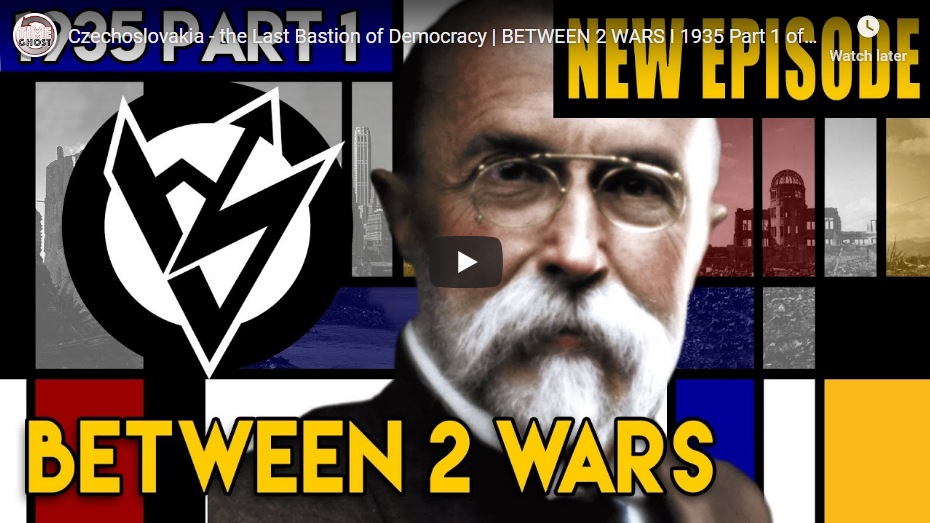
Germany Commits Suicide by Cancelling War Reparations | BETWEEN 2 WARS I 1931 Part 3 of 3

TimeGhost History
Published on 5 Sep 2019

Contrary to popular belief it is not so much reparations themselves that puts the first stepping stone in place for the Nazi to rise to power. Instead it is the cancellation of war reparations, or more correctly put; the measures that “The Hunger Chancellor” Heinrich Brüning implements to get reparations cancelled that pushes Germany over the financial brink and into the hands of Hitler and Goebbels.

Join us on Patreon: https://www.patreon.com/TimeGhostHistory

Subscribe to our World War Two series: https://www.youtube.com/c/worldwartwo…

Hosted by: Indy Neidell
Written by: Spartacus Olsson and Francis van Berkel
Directed by: Spartacus Olsson and Astrid Deinhard
Executive Producers: Bodo Rittenauer, Astrid Deinhard, Indy Neidell, Spartacus Olsson
Creative Producer: Joram Appel
Post-Production Director: Wieke Kapteijns
Research by: Francis van Berkel and Spartacus Olsson
Edited by: Wieke Kapteijns and Daniel Weiss
Sound design: Iryna Dulka
Colorization by Daniel Weiss

Thumbnail: Goebbels colorized bu Olga Shirnina, aka Klimbim

Archive by Reuters/Screenocean http://www.screenocean.com

A TimeGhost chronological documentary produced by OnLion Entertainment GmbH.

Sources:
Ruth Henig, The Weimar Republic 1919-1933
Theo Balderston, Economics and Politics in the Weimar Republic
Kolbe, The Weimar Republic
Harold James, The Causes of the German Banking Crisis of 1931
Feuchtwanger, From Weimar to Hitler

Sources images: Bundesarchiv

From the comments:

TimeGhost History
49 minutes ago (edited)

OK, so this video is about Naziism to some degree, it’s also a serious look at how Germany started transitioning into Naziism – this is not speculation, it’s not even very controversial, it just happens to not fit with many popular superficial misconceptions. Now, we love it when you guys debate under our videos, even when it’s in disagreement with something we or somebody else said, but before you do so please save us some time and read our rules and consider if your post is against our rules. If you think it might be, consider editing or just not posting it — otherwise you’re just wasting our time and your own — because no matter what, we will moderate this.

If your going to post that the Versailles Treaty was to blame you might want to read this instead: https://community.timeghost.tv/t/why-the-treaty-of-versailles-didnt-cause-naziism-answering-a-guy-on-youtube/1858 — that’s Indy’s extensive answer to that claim.

If you’re going to claim “Naziism was Left Wing” well you can do that, we don’t suppress opinions, not even silly ones, but we suggest that you read this instead: https://timeghost.tv/national-socialism-an-extreme-left-wing-ideology/ that’s Spartacus’s explanation why it is not considered so by historians (and why it’s not really that important).

If you’re going to praise Naziism or celebrate Communism, or propose that any other form of lethal extremism is a great idea — just don’t, we do remove any promotion for lethal anti-democratic ideologies, and will probably revoke your positing privileges.

If you’re going to start peddling conspiracy theories about Jews controlling [insert your crazy idea here] or “it was the Jews” — definitely don’t do that or it will be last thing you post here.

If you’re going to say that stopping German Communism is what caused Naziism — well you can do that … it’s pretty much wrong or at least a gross misrepresentation, and you’ll look like an idiot to anyone who knows their factual German history, but you can do that if publicly proclaiming ignorance is your thing — we would however suggest waiting for our next video on Germany’s elections in 1932 for a more correct take on that instead.

September 4, 2019

Viewing WW2 as “the Air-Sea Super Battlefield”

Filed under: Economics, Germany, History, Japan, Military, Russia, WW2 — Tags: , , — Nicholas @ 05:00

According to Phillips Payson O’Brien, it’s old-fashioned to view large land battles as being “decisive” in modern warfare:

Kombat (Russian: Комбат, lit. “battalion commander”) is a black-and-white photograph by the Soviet photographer Max Alpert. It depicts a Soviet military officer armed with a TT pistol who is raising his unit for an attack during World War II. This work is regarded as one of the most iconic Soviet World War II photographs, yet neither the date nor the subject is known with certainty. According to the most widely accepted version, the photograph depicts junior politruk (political officer) Aleksei Gordeyevich Yeryomenko, minutes before his death on 12 July 1942, in Voroshilovgrad Oblast, Ukraine.
Wikimedia Commons.

Allied victory in WWII is usually viewed through the lens of large land battles, from Stalingrad to Kursk to D-Day. However, battlefield losses of equipment in these “great” land battles were relatively small and easily replaceable. This column demonstrates that the real effort of the major powers was put into the construction of air and sea weapons. The Allies used their air and sea power to destroy the Axis’s in a multi-layered campaign. This was the true battlefield of WWII: a massive air-sea super battlefield that stretched for thousands of miles. Victory in this super-battlefield led to victory in the war.

Every aspect of WWII is discussed in a vast literature. Considering its diversity, explanations of why Germany lost the war are surprisingly predictable. It remains widely argued that the Nazis were beaten mostly by the Soviet Union’s powerful Red Army (Hastings 2005: 508, Kennedy 2013: 183).

From June 1941 to May 1945, German “power” was supposedly engaged and destroyed by the Russians. At some points, more than two-thirds of German infantry were engaged against the Red Army. The famous battles of the Eastern Front, such as Stalingrad and Kursk, supposedly caused the Germans’ crippling losses. The upshot of this lopsided deployment was that most German soldiers died in the East. Fighting against the Americans and British, conversely, is often portrayed as a secondary concern (Roberts 2010: 573).

What’s wrong with a focus on battles?

This battle-centric view, like much history of WWII, is old-fashioned. Historians of strategy have moved away from seeing battles as determinative. Nolan (2017) has argued that attrition losses are more important than battle losses in explaining outcomes.

The battle-centric analysis implies that infantry deployment is the best way to analyse effort. Yet, human-power was rarely the key factor in deciding combat in WWII. Equipment and specialised training mattered more. Possessing and operating the largest stores of modern weapons, not only tanks and artillery but also aircraft and naval vessels, determined the course of battles and the war.

If we reframe the discussion of the war to look not only at what equipment was made but also at how it was destroyed, it emerges that the war was decided far from the land battlefield (O’Brien 2015). The most striking sign of this is how little war production went to the land war and how much went to the combined air-sea war. This was the case for all the powers except the USSR.

September 3, 2019

An alternative end to the Molotov-Ribbentrop Pact?

Filed under: Germany, History, Military, Russia, WW2 — Tags: , , , — Nicholas @ 05:00

On the anniversary of the German invasion of Poland, Arthur Chrenkoff wonders if Stalin’s greatest miscalculation wasn’t refraining from attacking the Nazi forces after they’d been fighting the Polish army for three weeks in 1939:

Military situation in Poland, 14 September 1939 (map does not show Slovak Army activity in southern Poland).
United States Military Academy, Department of History via Wikimedia Commons.

In late August, the Soviet Union signed the infamous Ribbentrop-Molotov non-aggression pact with Germany, effectively green-lighting Hitler’s invasion of Poland a few days later. The secret protocols attached to the pact stipulated for the division of Central Europe between the two powers, with the Soviet Union being rewarded for its cooperation with the Nazis with the gift of eastern Poland, the Baltic states and Bessarabia, or the north-eastern Romania (as well as, it transpired later, the German non-interference during the Soviet invasion of Finland).

The Soviets were not naive (even if Stalin discounted all the indications of the coming German attack in 1941) to believe in a long-term friendship with Nazi Germany. There are strong indications that the Soviet Union intended to attack Germany, perhaps sometime in 1942, but Hitler beat it to the punch. The official Russian justification for the Ribbentrop-Molotov pact has certainly always been that the Soviet Union needed to buy itself extra time to prepare for this eventual showdown, since in 1939 it was still nowhere near ready (not least because of Stalin’s decapitation of the Red Army’s top leadership during the Great Terror a few years before).

But what if that was Stalin’s greatest miscalculation ever? By 17 September, when the Red Army crossed the eastern borders of Poland in accordance with the secret partition agreement, it was pretty clear to all that Poland was close to a military defeat (it would have hold on for longer, of course, without the Soviet stab in the back, but this would not have changed much without the Western allies’ military involvement, which never eventuated). While the German armed forces were winning, they were also overcommitted and overstretched. The German high command expected a quicker and easier victory and were taken aback by the ferocity of Polish resistance, despite clear German superiority in armour, air power and logistics. By the second half of September, some ammunition stocks were beginning to run low (particularly bombs) and motorised equipment, from tanks to trucks, has been significantly degraded through a combination of attrition and significant wear and tear in Polish autumn.

So what if the Red Army, instead of eventually coming to a halt along the previously agreed demarcation line, kept going west? There was no significant Polish military force to take into account and German army was tired and weakened after three weeks of hard fighting (losing a third of its tanks and 25 per cent of its air force in the process). While Wehrmacht had numerical advantage on the ground, this was only because the Red Army chose to invade Poland with half a million men, which was certainly enough to subdue the thinly-held eastern marches, but should they have needed it, the Soviets had reserves to draw upon to even out the field against the Germans. Even with their 33 committed divisions, the Red Army had a significant advantage over the German armed forces in the Polish theatre in terms of armour and air power (two to one for the former).

Who would have triumphed in this 1939 clash of the rival totalitarian war machines? We don’t know, of course, except that at the time of the invasion of Poland, Germany was militarily at its weakest point it would be until the final months of World War Two. Should the Red Army have proven victorious in September and October 1939, it would have likely ended up in Berlin in a matter of weeks, instead of years it eventually took. It’s a reasonable guess that Great Britain and France, faced with the Soviet invasion of the Reich and the looming defeat of Hitler, would have overcome their initial inertia and moved into Germany from the west so as to prevent having the communists proverbially water their horses in the Rhine. In this scenario, we would have ended up with a divided Germany and a divided Europe (though without much of the rest of Central and south-Eastern Europe in the Soviet camp) some six years earlier and without the tens of millions of dead, a ruined continent, and the Holocaust that accompanied World War Two as it actually unfolded.

Alas.

The Forgotten Soldiers of the Revolutionary War

Filed under: Britain, Europe, Germany, History, Military, USA — Tags: , , — Nicholas @ 04:00

Townsends
Published on 25 Jan 2018

Get the book here! ▶ https://www.amazon.com/Hessians-Three…

Visit Our Website! ▶ http://www.townsends.us/

Help support the channel with Patreon ▶ https://www.patreon.com/townsend

Sign up for the YouTube Mailing List! ▶ http://www.townsends.us/youtube_list.htm

September 1, 2019

366 Days of Crushed Hopes, Suffering and Death – WW2 – 053 – August 31 1940

Filed under: Britain, China, Germany, History, Japan, Military, WW2 — Tags: , , , , — Nicholas @ 04:00

World War Two
Published on 31 Aug 2019

As the war turns one year old, there seems to be no end in sight. The Luftwaffe starts targeting civilian areas of London, the peoples of Eastern Europe switch country without moving houses, in occupied territory the population continues to be terrorized, and an end to the Chinese war that has been raging on for years now seems ever further away.

Join us on Patreon: https://www.patreon.com/TimeGhostHistory
Or join The TimeGhost Army directly at: https://timeghost.tv

Follow WW2 day by day on Instagram @World_war_two_realtime https://www.instagram.com/world_war_t…
Join our Discord Server: https://discord.gg/D6D2aYN.
Between 2 Wars: https://www.youtube.com/playlist?list…
Source list: http://bit.ly/WW2sources

Written and Hosted by: Indy Neidell
Produced and Directed by: Spartacus Olsson and Astrid Deinhard
Executive Producers: Bodo Rittenauer, Astrid Deinhard, Indy Neidell, Spartacus Olsson
Creative Producer: Joram Appel
Research by: Indy Neidell
Edited by: Karolina Dołęga
Map animations: Eastory

Colorisations by Norman Stewart and Julius Jääskeläinen https://www.facebook.com/JJcolorization/

Sources:
Soviet occupation of Bessarabia and Northern Bukovina. Military parade in Kishinev on the 4th of July 1940, ANRM, Fototeca, 24950 from http://anr.infoideea.ro/basarabia1940…

Eastory’s channel: https://www.youtube.com/channel/UCEly…
Archive by Screenocean/Reuters https://www.screenocean.com.

A TimeGhost chronological documentary produced by OnLion Entertainment GmbH.

From the comments:

World War Two
6 days ago (edited)
Tomorrow, the war turns one year old, just like our channel. It doesn’t feel like a year, but when you think about what has happened all over the world since the Germans invaded Poland, it feels like a lifetime. Since then, our project has grown significantly, with new editors, community managers, and other people that help us out to make this series the best that it could be. We owe that to each and every one of you who stuck around and watched, shared, and engaged with our channel. We’re especially grateful to our supporters on Patreon and the TimeGhost website. It’s your support that makes this show possible and helps us to keep improving our quality. Our next goal is to raise enough money to go abroad and film on location, so that we can give you a real look of what it was like, and get in-depth knowledge from local historians. So please, support us on Patreon at https://www.patreon.com/TimeGhostHistory or at our website at https://timeghost.tv.

A big virtual hug from all of us,
The TimeGhost Team

August 31, 2019

Young Recruits, French Planes, and Graf Spee – WW2 – OOTF 003

Filed under: Britain, France, Germany, History, Military, WW2 — Tags: , , , — Nicholas @ 06:00

World War Two
Published on 30 Aug 2019

How young were British soldiers? Could Graf Spee have gotten away? What was the French air force like? Questions, questions, questions – from you no less! With answers from us Out of the Foxholes.

Join us on Patreon: https://www.patreon.com/TimeGhostHistory
Or join The TimeGhost Army directly at: https://timeghost.tv

Follow WW2 day by day on Instagram @World_war_two_realtime https://www.instagram.com/world_war_t…
Join our Discord Server: https://discord.gg/D6D2aYN.
Between 2 Wars: https://www.youtube.com/playlist?list…
Source list: http://bit.ly/WW2sources

Image sources:
Drawing Morane-Saulnier M.S.406 C1 and Dewoitine D.520 fighters : Kaboldy

Written and Hosted by: Indy Neidell and Nicholas Moran
Produced and Directed by: Spartacus Olsson and Astrid Deinhard
Executive Producers: Bodo Rittenauer, Astrid Deinhard, Indy Neidell, Spartacus Olsson
Creative Producer: Joram Appel
Research by: Indy Neidell, Nicholas Moran, and Joram Appel
Edited by: Wieke Kapteijns

Eastory’s channel: https://www.youtube.com/channel/UCEly…
Archive by Screenocean/Reuters https://www.screenocean.com.

A TimeGhost chronological documentary produced by OnLion Entertainment GmbH.

From the comments:

World War Two
39 minutes ago
One day before the war has being going on for a whole year, we look back at some stuff from 1939 and 1940. And once again Nicholas Moran, the Chieftain https://www.youtube.com/user/TheChieftainWoT joins us to answer your questions. This time he leaves his main turf (tanks) to dive into his other area of expertise; naval battles. Please remember that we can’t field questions from the comments so if you want submit a new question do it here: https://community.timeghost.tv/c/Out-of-the-Foxholes-Qs

Coming out with Out of the Foxholes has been a bit of a challenge as we try to master the crazy amount of stuff going on in our main episodes. But thanks to the fantastic collaboration of the TimeGhost Army on https://www.patreon.com/TimeGhostHistory and https://timeghost.tv we are constantly expanding our capacity and we hope to come out with these a bit more often now! For now, enjoy and remember that tomorrow our first anniversary episode comes out!

August 30, 2019

“Stalingrad” – World War Two – Sabaton History 030 [Official]

Filed under: Germany, History, Media, Military, Russia, WW2 — Tags: , , , , — Nicholas @ 04:00

Sabaton History
Published on 29 Aug 2019

The Sabaton song “Stalingrad” is about the devastating battle of the Russian city of Stalingrad, which lasted for 5 months from August 1942 till February 1943. The battle is infamous for its brutal street fighting and high casualties on both sides.

Support Sabaton History on Patreon: https://www.patreon.com/sabatonhistory

Listen to Primo Victoria (where “Stalingrad” is featured):
CD: http://bit.ly/PrimoVictoriaStore
Spotify: http://bit.ly/PrimoVictoriaSpotify
Apple Music: http://bit.ly/PrimoVictoriaAppleMusic
iTunes: http://bit.ly/PrimoVictoriaiTunes
Amazon: http://bit.ly/PrimoVictoriaAmzn
Google Play: http://bit.ly/PrimoVictoriaGooglePlay

Hosted by: Indy Neidell
Written by: Markus Linke and Indy Neidell
Directed by: Astrid Deinhard and Wieke Kapteijns
Produced by: Pär Sundström, Astrid Deinhard and Spartacus Olsson
Creative Producer: Joram Appel
Executive Producers: Pär Sundström, Joakim Broden, Tomas Sunmo, Indy Neidell, Astrid Deinhard, and Spartacus Olsson
Maps by: Eastory
Edited by: Iryna Dulka
Sound Editing by: Marek Kaminski

Eastory YouTube Channel: https://www.youtube.com/channel/UCElybFZ60Hk1NSjgCf7I2sg
Archive by: Reuters/Screenocean https://www.screenocean.com
Music by Sabaton.

Sources:
– Photo of Stalingrad field hospital – Natalia Bode
– Photo of the Soviet loudspeaker by Arkady Shaikhet
– Colorization by Klimbim: German soldier in Stalingrad, Soviet machine gunners
– IWM: TR 153

An OnLion Entertainment GmbH and Raging Beaver Publishing AB co-Production.

© Raging Beaver Publishing AB, 2019 – all rights reserved.

August 26, 2019

Russia attempts to retroactively “normalize” the Molotov-Ribbentrop Pact

Filed under: Germany, History, Military, Russia, WW2 — Tags: , , , , , , , — Nicholas @ 05:00

Just before the outbreak of World War II on the Polish-German frontier, the Soviet Union concluded a non-aggression pact with Hitler’s Germany that included a large slice of Polish territory and a free hand in the Baltic for Soviet expansion (only the early Finnish success prevented total Soviet domination of the eastern Baltic region). The current Russian government is conducting a public relations (propaganda) campaign to recast this pact as being unexceptional diplomatic activity by attempting to cast Britain, France, and all the other countries that had active diplomatic arrangements with Germany as being “just the same” as the infamous Molotov-Ribbentrop Pact. Wikipedia sums up the fate of the two chief diplomats:

Translation of the Russian caption for this image:
People’s Commissar of Foreign Affairs of the USSR V.M. Molotov signs a friendship and border treaty between the USSR and Germany. Among those present: I.V. Stalin, translator of the Ministry of Foreign Affairs V.N. Pavlov, German diplomat G. Hilger (“truncated” version of the photograph of M. Kalashnikov distributed on the net)
Photograph attributed to Mikhail Mikhaylovich Kalashnikov (1906-1944) via Wikimedia Commons.

The Pact was terminated on 22 June 1941, when Nazi Germany launched Operation Barbarossa and invaded the Soviet Union (thus as well executing the ideological goal of Lebensraum). After the war, von Ribbentrop was convicted of war crimes and executed. Molotov died aged 96 in 1986, five years before the USSR’s dissolution. Soon after World War II, the German copy of the secret protocol was found in Nazi archives and published in the West, but the Soviet government denied its existence until 1989, when it was finally acknowledged and denounced. Vladimir Putin, while condemning the pact as “immoral”, has also defended the pact as a “necessary evil”, a U-turn following his earlier condemnation

Ribbentrop arrives at Moscow airport, August 1939.
Photograph via Wikimedia Commons.

Arthur Chrenkoff explains why we should vigorously resist this attempt to “normalize” Molotov-Ribbentrop:

1. While the shameful Western appeasement of Hitler, culminating in the infamy of Munich, allowed the Reich to bloodlessly dismember the sovereign and democratic Czechoslovakia, neither Great Britain nor France participated in or benefited from Germany’s cannibalism of this “faraway country of which we know little”. The difference is that while the West remains ashamed of Munich (a name which quickly become synonymous with a craven sell-out), a few years back, Russia’s culture minister Vladimir Medinsky called the Ribbentrop-Molotov pact “a great achievement of Soviet diplomacy”.

2. Unlike all the other agreements signed with Germany during the 1930s, it was the Ribbentrop-Molotov pact that green-lit the armed German aggression and led to the outbreak of the deadliest war in human history. It’s difficult to blame Germany’s neighbours or countries threatened by the Soviet Union (like Poland, Romania and the Baltic states) for trying to stay on Germany’s good side. It was naive and in any case it didn’t work in the end, as they all later found out to their detriment and downfall. Soviet Union, on the other hand, not only climbed into bed with Nazi Germany but it fully and enthusiastically consummated this marriage of convenience.

3. Unlike other agreements cited above, thanks to the “secret protocols” attached to the Ribbentrop-Molotov pact, the Soviet Union was both a co-aggressor in and a co-beneficiary of the start of World War Two. Stalin has relatively bloodlessly acquired the by-then (mid-September) almost defenseless eastern Poland (subsequently incorporated into Belarussian and Ukrainian Soviet Republics; these historically Polish areas remain today parts of Belarus and Ukraine), Bessarabia from Romania (incorporated into the Moldovan Soviet Republic), the Baltic States of Lithuania, Latvia and Estonia, as well as being given a free hand in the invasion of Finland, a country which otherwise might have counted on German friendship and support. All these aggressive territorial gains were the consequence of the Ribbentrop-Molotov division of Eastern Europe between the Reich and the Soviet Union into the respective spheres of interest, soon confirmed as the “facts on the ground” by Wehrmacht and Red Army.

4. While Britain and France, their empires and their allies, fought Germany for almost two years after September 1939, first through the period of the “phony war”, then through the Blitzkrieg in the West and the Battle of Britain, the Soviet Union remained a de facto Nazi ally, continuing to cooperate in security matters and supplying Germany with food and raw materials. Grain trains were still rolling west across the border with the Reich as Wehrmacht was launching Operation Barbarossa in the morning of 22 June 1941. During the period of Nazi-Soviet cooperation, Germany conquered Poland, Norway, Denmark, Belgium, the Netherlands, Luxembourg, France, Yugoslavia and Greece. Soviet exports helped to feed and build up the German war machine before it was unleashed against the West in 1940; German troops surging into the Low Countries walked on their stomachs (to borrow from Napoleon) full of bread baked from Russian wheat or were carried on the tanks and trucks made with Russian coal and ores. Never forget that for Russia, World War Two – or the Great Patriotic War as it is called there – begins only in June 1941, not September 1939, as it does in all Western history books.

5. It’s true that the Ribbentrop-Molotov pact was partly defensive in nature as far as the Soviet Union was concerned, aiming to postpone the inevitable armed clash between the two rival totalitarianisms and in the meantime give Russia some essential breathing space to build up its army and strategic reserves (the top leadership of the Soviet armed forces was decapitated by Stalin during the purges in 1937-8, leaving them even more unprepared to face Germany than would have otherwise been the case). But as I pointed out above, it was also offensive and directly benefited Stalin’s territorial ambitions while it lasted. In some ways, the legacy of the pact lives on in the shape of Poland’s post-war borders, which have nothing to do with its thousand-year history. This is the real #TruthAboutWWII and this is why the Ribbentrop-Molotov pact remains singled out in the infamy of the interwar European democracy.

August 25, 2019

The Battle of Britain is a Bitch – WW2 – 052 – August 24 1940

World War Two
Published on 24 Aug 2019

This week, the communists attack the Japanese in the Battle of 100 Regiments. Meanwhile in Europe, the Battle of Britain enters phase three with the Luftwaffe actively targeting British airfields.

Join us on Patreon: https://www.patreon.com/TimeGhostHistory
Or join The TimeGhost Army directly at: https://timeghost.tv

Follow WW2 day by day on Instagram @World_war_two_realtime https://www.instagram.com/world_war_t…
Join our Discord Server: https://discord.gg/D6D2aYN.
Between 2 Wars: https://www.youtube.com/playlist?list…
Source list: http://bit.ly/WW2sources

Written and Hosted by: Indy Neidell
Produced and Directed by: Spartacus Olsson and Astrid Deinhard
Executive Producers: Bodo Rittenauer, Astrid Deinhard, Indy Neidell, Spartacus Olsson
Creative Producer: Joram Appel
Post-Production Director: Wieke Kapteijns
Research by: Indy Neidell
Edited by: Iryna Dulka
Map animations: Eastory

Colorisations by Norman Stewart and Julius Jääskeläinen https://www.facebook.com/JJcolorization/

Sources:
IWM: H7019, H005772, Q 7928
Color of Trotsky and Soviet leaders by Klimbim
Mercader picture from a public mural by Grahame Miller Ware, Wikimedia Commons
Icons by Sergey Tikhonov, Ely Wahib and Ivan Boyko from iconfinder.com

Eastory’s channel: https://www.youtube.com/channel/UCEly…
Archive by Screenocean/Reuters https://www.screenocean.com.

A TimeGhost chronological documentary produced by OnLion Entertainment GmbH.

From the comments:

World War Two
2 days ago
Last Sunday, we had our one year anniversary livestream in which we talked about the last year, our current challenges and the plans for the road ahead, and answered a lot of your questions. We explained how we want to increase our Patreon income to be able to travel to the known and unknown locations of World War Two. To do so, you can help us by supporting us on https://www.patreon.com/TimeGhostHistory or https://timeghost.tv. Literally every dollar counts. If you’d like to see the livestream I mentioned, you can check that out right here -> https://youtu.be/EKws1jNIAmE

Cheers,
Joram

August 19, 2019

QotD: Hitler’s “wonder weapons”

Filed under: Germany, History, Military, Quotations, Technology, WW2 — Tags: , , , , , , — Nicholas @ 01:00

Historians have generally thought of the Type XXI [submarine] — along with other systems like the Me 262, V-1 and V-2 rockets, and the Tiger tank — as an example of Wunderwaffen, wonder weapons. Since 1945 many have fixated on the revolutionary military technologies that the Third Reich developed in the last two years of the war. The cultural impetus behind the concept, as implicitly or explicitly acknowledged by historians in the uneven and largely enthusiastic literature on the subject, was an irrational faith in technology to prevail in operationally or strategically complex and desperate situations — a conviction amounting to a disease, to which many in the Third Reich were prone in the latter years of the Second World War. To the extent that it shaped decision making, faith in the Wunderwaffen was a special, superficial kind of technological determinism, a confidence in the power of technology to prevail over the country’s strategic, operational, and doctrinal shortcomings. To the extent that leaders, officers, engineers, and scientists after 1943 believed innovation to be the answer to Germany’s strategic dilemmas, they displayed a naive ignorance of how technology interacts with cultural and other factors to influence the course of events. In particular, they reflected a willful ignorance of the extent to which even substantial technological superiority has proved indecisive in human conflict throughout history.

Marcus Jones, “Innovation For Its Own Sake: The Type XXI U-boat”, Naval War College Review, 2014-04.

August 16, 2019

QotD: It’s not really accurate to call the French “cheese-eating surrender monkeys”

Filed under: Europe, France, Germany, History, Military, Quotations, WW2 — Tags: , , — Nicholas @ 01:00

It is a truth universally acknowledged that, en masse if not individually, E2 has a slight nagging tendency towards anti-French sentiment. For the Brits it’s sort of traditional/historic, dating back to the Hundred Years War and all that (in which the English gloriously won, as they will be sure to note, at Crecy and Agincourt; strangely, at the end of it all, the French owned all of France, including the bits that the English had owned previously) and quite a lot of subsequent ones, mainly fought in Belgium, while for the Americans it seems to be something to do with the fact that they needed French help to run a revolution properly, along with the proximity of uppity Quebeckers and the fact that the French are marginally less prepared than the rest of the world to roll over and be McDisneyfied™; not being one I can’t say definitively. But I digress.

When it comes to military history, this particular bias mostly comes out in references to three weeks in May 1940, and specifically one piece of particularly crap judgement by General Gamelin and one bypassed fortress line. The fact that that the allied participants — France, Britain, the Netherlands and Belgium — have spent most of the time since blaming each other and trying to work out who sold out whom has been allowed to mask the fact that this particular campaign was successful beyond all reasonable expectations for the Germans, and that when the French actually had troops in the right places, they were perfectly capable of fighting the advancing Panzers to a standstill at a tactical or operational level. Visitors to Paris may wish to note that the big — rather bigger than you think until you actually see it in the flesh — structure at one end of the Champs Elysées is called the Arc de Triomphe, and not the Arc de Defaite; it bears an admittedly tedious and tasteless, but indubitably long, list of battles at which the French did rather well. The fact that your school history lessons may have taught you rather more about Paul Revere or Clive of India than about Charles Martel is not relevant in the greater scheme of things.

Albert Herring, “Why neither the French nor the Italians are the worst military nation”, Everything2, 2002-01-07.

August 12, 2019

The Battle For Hungary: October – December 1944

Filed under: Europe, Germany, History, Military, Russia, WW2 — Tags: , , — Nicholas @ 04:00

Historigraph
Published on 10 Aug 2019

Join me in War Thunder! Use my link for a FREE premium aircraft, tank or ship and a three day account boost as a BONUS: https://gjn.link/Historigraph/190810 Also available for free on PlayStation®4 and Xbox One.

If you enjoyed this video and want to see more made, consider supporting my efforts on Patreon: https://www.patreon.com/historigraph

To chat history, join my discord: https://discord.gg/vAFTK2D

I’m indebted to some viewers for helping me out with pronounciation of Hungarian words:

https://www.youtube.com/watch?v=FApWW…
https://www.youtube.com/watch?v=nCG_w…

If you are Hungarian, please be charitable as I will still not have the word sounds 100% correct, as I am not a native speaker. I’m not about to put on a bad hungarian accent!
#WarThunder #BattleForHungary #Historigraph

Sources:

The Siege of Budapest and the battles that led to it have had precious little written about them (in English!), so the bulk of this video (and the next) comes from one book:

Krisztián Ungváry, Battle for Budapest: 100 Days in World War 2

This is by far the most detailed account of the battle that I could find.

At the Range with the Iconic MP5A3

Filed under: Germany, Technology, Weapons — Tags: , , — Nicholas @ 02:00

Forgotten Weapons
Published on 15 Jun 2019

http://www.patreon.com/ForgottenWeapons

Cool Forgotten Weapons merch! http://shop.bbtv.com/collections/forg…

The MP5 is widely considered the best submachine gun ever made, for its reliability, its handling, and its closed-bolt delayed-blowback action. It is so widely praised, in fact, that H&K’s efforts to replace it with less expensive polymer submachine guns have largely failed, as their customers simply insist on the MP5.

I have had only a brief bit of experience actually using the MP5 myself, and I wanted to take this opportunity while visiting H&K to fix that. So, does it live up to its reputation?

In a word, yes.

Many thanks to H&K USA for providing me access to this MP5A3, and to Trijicon for graciously providing use of their range!

Contact:
Forgotten Weapons
PO Box 87647
Tucson, AZ 85754

August 11, 2019

Hail Mussolini, Haile Selassie’s Usurper – WW2 – 050 – August 10 1940

Filed under: Africa, Britain, Europe, Germany, History, Italy, Military, Russia, WW2 — Tags: , , , , — Nicholas @ 06:00

World War Two
Published on 10 Aug 2019

This week, the war spreads to Africa, when the Italians invade the British Colony of British Somaliland. While this might seem trivial, it might have tremendous consequences on the remainder of the war.

Join us on Patreon: https://www.patreon.com/TimeGhostHistory
Or join The TimeGhost Army directly at: https://timeghost.tv

Follow WW2 day by day on Instagram @World_war_two_realtime https://www.instagram.com/world_war_t…
Join our Discord Server: https://discord.gg/D6D2aYN.
Between 2 Wars: https://www.youtube.com/playlist?list…
Source list: http://bit.ly/WW2sources

Written and Hosted by: Indy Neidell
Produced and Directed by: Spartacus Olsson and Astrid Deinhard
Executive Producers: Bodo Rittenauer, Astrid Deinhard, Indy Neidell, Spartacus Olsson
Creative Producer: Joram Appel
Post-Production Director: Wieke Kapteijns
Research by: Indy Neidell
Edited by: Iryna Dulka
Map animations: Eastory

Colorisations by Norman Stewart and Julius Jääskeläinen https://www.facebook.com/JJcolorization/

Eastory’s channel: https://www.youtube.com/channel/UCEly…
Archive by Screenocean/Reuters https://www.screenocean.com.

Sources:
Freepngimg.com
IWM: CH 3484
Sound effect: littlerobotsoundfactory

A TimeGhost chronological documentary produced by OnLion Entertainment GmbH.

From the comments:

World War Two
2 days ago
Last week, we saw how one of our flagship episodes was taken down by YouTube. It turned out that this was a mistake by a YouTube worker who erroneously identified our content as hate speech. While we contacted YouTube immediately to protest, they themselves noticed the mistake before we reached the right people. They have since apologized to us and reinstated the episode. You can watch it here: https://youtu.be/DLN8NHXiMy0. We welcome YouTube’s diligence in fighting against extremist hateful content, especially in light of the current tragic events in the US, and we have accepted their apology. However, this does not change the fact that we still face demonetization of many of our videos, connected to lower recommendation of these videos. This is a problematic situation that we deplore – we continue to believe that the best way to fight ignorance and hatred is by education and that is at the heart of what we do here, unfortunately YouTube’s monetization policies continue to stand in the way of that mission.

When the episode went down we saw a surge of support from many of you and we are humbly grateful for our dedicated community. The effort you all have made to share our content and support us on Patreon and timeghost.tv is what makes this show possible, and it’s an honor to have you all here. It is your support, both financially and in spirit that keeps us getting up in the morning to face yet another day of the war. Thank You!

Cheers,
The TimeGhost team

August 4, 2019

The Hippo vs. the Bulldog, Göring’s War – WW2 – 049 – August 3 1940

Filed under: Britain, Germany, History, Military, WW2 — Tags: , , , , , — Nicholas @ 06:00

World War Two
Published on 3 Aug 2019

As the Kanalkampf comes to a close, the Battle of Britain heats up. Hitler wants Britain out of the war. But before the Germans can invade Britain, it will have to deal with the Royal Air Force and the Royal Navy.

Join us on Patreon: https://www.patreon.com/TimeGhostHistory
Or join The TimeGhost Army directly at: https://timeghost.tv

Follow WW2 day by day on Instagram @World_war_two_realtime https://www.instagram.com/world_war_t…
Join our Discord Server: https://discord.gg/D6D2aYN.
Between 2 Wars: https://www.youtube.com/playlist?list…
Source list: http://bit.ly/WW2sources

Written and Hosted by: Indy Neidell
Produced and Directed by: Spartacus Olsson and Astrid Deinhard
Executive Producers: Bodo Rittenauer, Astrid Deinhard, Indy Neidell, Spartacus Olsson
Creative Producer: Joram Appel
Post-Production Director: Wieke Kapteijns
Research by: Indy Neidell
Edited by: Iryna Dulka
Map animations: Eastory

Colorisations by Norman Stewart and Julius Jääskeläinen https://www.facebook.com/JJcolorization/
Eastory’s channel: https://www.youtube.com/channel/UCEly…
Archive by Screenocean/Reuters https://www.screenocean.com.

Sources:
Colored portrait of Hugo Sperrle by Ruffneck88
Narodowe Archiwum Cyfrowe
IWM: HU 93055, CH 1535, CH 1533, A 18881, HU 76020
301 squadron insignia by Jakub Mikita
303 squadron insignia by Mrozo

A TimeGhost chronological documentary produced by OnLion Entertainment GmbH.

« Newer PostsOlder Posts »

Powered by WordPress