
Published on 7 Jan 2017
Chair of Wisdom Time! Indy answers your questions about World War 1 and this week we talk about espionage, opinion polls and conscription.
January 8, 2017
Spy Networks – Public Opinion – Conscription I OUT OF THE TRENCHES
Comments Off on Spy Networks – Public Opinion – Conscription I OUT OF THE TRENCHES
January 5, 2017
Canada’s military-industrial complex
Ted Campbell briefly outlines the three tiers of military logistics then discusses the most controversial tier, the national industrial base, in more detail:
Behind it all, unseen, misunderstood, unloved and, in fact, often actively disliked is the national defence industrial base.
There are a great many people, including many in uniform, who object to the cost ~ fiscal and political ~ of having a defence industrial base. Many people suggest that a free and open market should be sufficient to equip all friendly, and the neutral and even some not so friendly military forces.
They forget, first of all, that the defence industries of e.g. America, Britain, France, Germany and Israel are ALL heavily supported by their government and, equally, heavily regulated. It is not clear that we will always be in full political accord with those upon whom we rely for military hardware? What if one country wanted, just for example, to gain an advantage in a trade negotiation? Do you think they might not “decide” that since the government (a minister of the crown) has threatened to use military force against First Nations who protest against pipelines that they will not sell us certain much needed military hardware or licence its use in Canada?
It is always troubling when we see the costs of military hardware increase at double or even triple the general rate of inflation for, say, cars or TV sets or food and heating fuel, but that is not the fault of the Canadian defence industries … it is, in fact, the “fault” of too little competition in the global defence industry market: too few Australian, Brazilian Canadian and Danish defence producers, too many aerospace and defence contractors merged into too few conglomerates that control too much of the market. A robust Canadian defence industrial base, supported by extensive government R&D programmes and by a steady stream of Canadian contracts would help Canada and our allies.
[…]
I am opposed to government supported featherbedding by Canadian unions and companies but we do need to pay some price for having a functioning defence industrial base … the costs of our new warships, for example, are, without a doubt, higher than they would be if we had bought equivalent ships from certain foreign yards, but we need to be willing to pay some price for having Canadians yards that are ready and able to build modern warships when needed; ditto for aircraft, armoured vehicles, radio and electronics, rifles and machine guns, cargo trucks and boots and bullets and beans, too. AND, we need a government that will, aggressively, support that defence industrial base with well funded R&D programmes and by “selling” Canadian made military equipment around the world.
It’s one thing to accept that you’ll need to pay a premium over market cost for built-in-Canada equipment that can’t also be sold to other customers. What is disturbing is discovering that the premium can be up to 100% of the cost for equivalent non-domestic items. For example, this was reported in a CBC article in 2014:
Britain, for example, opted to build its four new naval supply ships much more cheaply, at the Daewoo shipyard in South Korea. The contract is for roughly $1.1 billion Cdn. That’s for all four. By contrast, Canada plans to build just two ships, in Vancouver, for $1.3 billion each. So Canada’s ships will be roughly five times more costly than the British ones.
But there’s a twist. Canada’s supply ships will also carry less fuel and other supplies, because they’ll be smaller — about 20,000 tonnes. The U.K. ships are nearly twice as big — 37,000 tonnes. Canadians will lay out a lot more cash for a lot less ship.
Everything is more expensive to build domestically if you don’t already have a competitive market for that item. The federal government’s long-standing habit of drawing out the procurement process makes the situation worse, as the costs increase over time (but the budget generally does not), so we end up with fewer ships, planes, tanks or other military hardware items that arrive much later than originally planned.
Comments Off on Canada’s military-industrial complex
January 2, 2017
“Honest scientific discourse and debate is often rendered impossible in the face of the ‘new catastrophism'”
It’s not your imagination — we really do seem to be careening from one ecological disaster to another, all caused by thoughtless human action … well, that’s what the activists are constantly saying:
What is patently obvious from reviewing Canada’s ancient history is that scientists still do not have an adequate understanding of Earth’s complex systems on which to base sound economic and environmental policy. From the upper reaches of the atmosphere to the depths of the oceans onwards to the deep interior of the planet our knowledge of complex earth systems is still rather rudimentary. Huge areas of our planet are inaccessible and are little known scientifically. There is still also much to learn from reading the rock record of how our planet functioned in the past.
In so many areas, we simply don’t know enough of how our planet functions.
And yet……
Scarcely a day goes past without some group declaring the next global environmental crisis; we seemingly stagger from one widely proclaimed crisis to another each one (so we are told) with the potential to severely curtail or extinguish civilization as we know it. It’s an all too familiar story often told by scientists who cross over into advocacy and often with the scarcely-hidden sub-text that they are the only ones with the messianic foresight to see the problem and create a solution. Much of our science is what we would call ‘crisis-driven’ where funding, politics and the media are all intertwined and inseparable generating a corrupting and highly corrosive influence on the scientific method and its students. If it doesn’t bleed it doesn’t lead is the new yardstick with which to measure the overall significance of research.
Charles Darwin ushered in a new era of thinking where change was expected and necessary. Our species as are all others, is the product of ongoing environmental change and adaption to varying conditions; the constancy of change. In the last 15 years or so however, we have seemingly reverted to a pre-Darwinian mode of a fixed ‘immutable Earth’ where any change beyond some sort of ‘norm’ is seen in some quarters as unnatural, threatening and due to our activities, usually with the proviso of needing ‘to act now to save the planet.’ Honest scientific discourse and debate is often rendered impossible in the face of the ‘new catastrophism.’
Trained as geologists in the knowledge of Earth’s immensely long and complex history we appreciate that environmental change is normal. For example, rivers and coastlines are not static. Those coasts, in particular, that consist of sandy strand-plains and barrier-lagoon systems are continually evolving as sand is moved by the waves and tides. Cyclonic storms (hurricanes), a normal component of the weather in many parts of the world, are particularly likely to cause severe erosion. When recent events such as Hurricanes Katrina and Sandy cause catastrophic damage, and spring storms cause massive flooding in Calgary or down the Mississippi valley, and droughts and wildfires affect large areas of the American SW these events are blamed on a supposed increase in the severity of extreme weather events brought about by climate change. In fact, they just reflect the working of statistical probability and long term climate cyclicity. Such events have happened in the past as part of ongoing changes in climate but affected fewer people. That the costs of weather and climate-related damage today are far greater is not because of an increased frequency of severe weather but the result of humans insisting on congregating and living in places that, while attractive, such as floodplains, mountain sides and beautiful coastlines, are especially vulnerable to natural disasters. Promises of a more ‘stable future’ if we can only prevent climate change are hopelessly misguided and raise unnatural expectations by being willfully ignorant of the natural workings of the planet. Climate change is the major issue for which more geological input dealing with the history of past climates would contribute to a deeper understanding of the nature of change and what we might expect in the future. The past climate record suggests in fact that for much of the Earth’s surface future cooling is the norm. Without natural climate change Canada would be buried under ice 3 km thick; that is it normal state for most of the last 2.5 million years with 100,000 years-long ice ages alternating with brief, short-lived interglacials such as the present which is close to its end.
H/T to Kate at SDA for the link.
Comments Off on “Honest scientific discourse and debate is often rendered impossible in the face of the ‘new catastrophism'”
December 31, 2016
“[Canadian] Republicanism is a pathology, a reflection of insecurity and ignorance”
The polling firm Ipsos did a year-end survey for Global News to find out how Canadians feel about the monarchy. Colby Cosh looks at the weak attraction of the republican option:
If you’re a serious monarchist you are of two minds about this sort of thing. You recognize the necessity of occasionally taking the pulse of the institution, just as a human of great age will have their vital signs measured from time to time. You also know that to present the Canadian monarchy to the public as a free choice, a fashion we can discard when it suits us, has the effect of encouraging republican fantasies.
Republicanism is a pathology, a reflection of insecurity and ignorance. In the past it was fostered by newspapermen who had served for a spell in Washington (or Moscow or Tokyo), and who were used to being asked why the hell we have a “foreign” Queen on our money and whatnot. The educations of these men had often involved nothing more than early saturation in great quantities of ink and booze, and many were incapable of a half-decent answer grounded in global history.
So our press elite consisted of men who had suffered chronic humiliation by their big brothers, the Americans. The psychic dissolution of the Empire in the postwar period left us unable to regard Americans the way we once had as a matter of course — as errant, troubled children. Our journalistic teachers thus embraced, as a defence mechanism, the idea that Canada’s thousand-year-old inner constitution was “immature” or less than “adult.”
[…]
The pathological nature of Canadian republicanism is apparent from the Ipsos poll itself. Respondents were asked to indicate whether they agree or disagree with the statement “When Queen Elizabeth’s reign ends, Canada should end its formal ties to the British monarchy.” Fifty-three percent of the sample agreed; the figure was 73 per cent within Quebec, 46 per cent elsewhere.
But why would the death of the Queen be considered an appropriate moment for constitutional revision? Ipsos’s republican push-pollsters do not even have the guts to say out loud what they are talking about. Even as they contemplate a Canadian republic as something to be perpetrated like a theft, when the right distraction happens along, they instinctively avoid lèse-majesté. They know people like the Queen: their own poll finds that 81 per cent of Canadians think she has done a good job (leaving us to wonder what hallucinated grievances the other 19 per cent might have).
December 24, 2016
Smug Canada has been lucky … so far
Chris Selley enumerates a few of the problems other western countries have been having with Islamic terrorism, and points out that Canada just been lucky not to have a greater share:
Here in Canada in 2016, meanwhile, we have endured … almost nothing. Aaron Driver hatched a plot to blow himself up in public somewhere, but police cornered him in his parents’ driveway, the bomb didn’t work and he’s dead now. I had forgotten his name.
Instead, some of us spent 2016 patting ourselves on the backs for accepting 25,000 Syrian refugees. It was a good thing to do. But heading into 2017, I think we might usefully recall demands to bring in five or 10 times that number, immediately, and perhaps finish their security screening on Canadian soil. European countries are struggling with failed asylum-seekers they can’t deport — to Tunisia, never mind Syria. Only someone from a decadently peaceful country like Canada would ever suggest running that risk voluntarily.
Some in my trade spent 2016 penning encomiums to Canada’s supposed new status as a beacon of sanity: while Europe and America devolve into simian nativism and xenophobia, here we are enlightened, welcoming, serene. Some of these pieces conceded that being protected from uncontrolled immigration by oceans to the east, west and north, and by 1,500 kilometres of a larger, warmer economy to the south, might help keep the peace. Heading into 2017, I think we might usefully ponder just how pampered we are by that geographic reality. Faced with the European situation — unstoppable flows of unknown people, regular acts of terror, frequent reports of young migrant men abusing women — would we really react with this patented Canadian equanimity?
December 19, 2016
Justin Trudeau’s actual role in the Trudeau Foundation
Ted Campbell finds an oddly charitable way to describe the Prime Minister’s efforts on behalf of the Trudeau Foundation, and a contrast with Hillary Clinton’s role in the Clinton Foundation’s work:
Let me be very, very clear: I do not doubt Prime Minister Trudeau’s personal honesty; nor so I actually think he is smart enough, devious enough to manage a “cash for access” scheme. The “cash for access” scandal is, as Professor Tom Flanagan says, something that all parties, Conservatives, too, both nationally and provincially, have always done. Prime Minister Trudeau is, rightfully, being hammered not for schmoozing with the wealthy, but, rather, for his own person hypocrisy about the issue. But the Trudeau foundation is a bit different and a bit more dangerous. I think the Trudeau Foundation was set up, using $125 Million of Canadian public (taxpayers’) money “donated” by then Prime Minister Jean Chrétien, as a mechanism to perpetuate a Liberal icon and to provide a sinecure for Justin Trudeau and, thereby, to help him shelter some of his substantial family wealth from zealous tax collectors; and he is rather like an employee … something akin to a Disneyland Princess who gets trotted out to pose with the paying customers. But the warnings from Candice Malcolm and Tony Keller are valid and Prime Minister Trudeau should pay heed. Americans forgave Donald Trump for his great wealth and tax evasion and a hundred other faults because he spoke to them about their own fears. They did not forgive Mrs Clinton because, I think, she talked at them, not with them, and she talked about people and issues that working class Americans thought had already received enough attention and even special treatment.
Justin Trudeau is perceived, already, as a pampered, privileged “trust fund kid” who, despite the rhetoric, doesn’t really understand middle class, much less working class Canadians. Prime Minister Trudeau won, in 2015, in large measure because Canadian were tired of Prime Minister Harper, and because he is genuinely “nice,” but not because Canadians think he is, in any way, “one of them.” He could lose, as Hillary Clinton lost, if Canadians decide that he is using his high office to feather his own already substantial nest with “dirty” foreign money while he sells out Canadians’ interests. It may be unfair but the media have this bit between their teeth and they are not likely to just let it go away.

Comments Off on Justin Trudeau’s actual role in the Trudeau Foundation
Ontario PC leader Patrick Brown and the “hidden agenda”
During the entire time Stephen Harper was Prime Minister, the opposition and the media kept frightening people about Harper’s “hidden agenda” that he was bound to implement at any moment. For a decade. It worked well enough that right up until the Liberals won the last federal election, the term “hidden agenda” worked to gin up fears about the “real” Harper plan for Canada. If it was bad for Harper it’s going to be much, much worse for Ontario’s PC party and their flexible leader Patrick Brown:
Any Tory leader would have this problem. Any Tory leader who was ever thought of as a social conservative would have it worse. Brown might have it worst of all: having bent like a palm tree in the wind on social issues, it will be easier than usual for the Liberals, New Democrats and media to portray any moderate stance he takes on anything as nothing more than a politically expedient façade on some kind of hidden agenda. For those who might support such an agenda, meanwhile, his record is an invitation to stay home: whatever he or one of his MPPs might promise them isn’t worth the sound waves that conveyed it. They might reasonably conclude he has no agenda at all, hidden or otherwise.
Stephen Harper had considerable trouble with his purported “hidden agenda,” despite the gymnastics that were necessary to pin it on him. Brown having inhabited every position imaginable on a perfectly reasonable sex-ed curriculum, he cannot inspire much confidence in anyone, on any side of any truly contentious social issue, that his stated positions during campaigns would bear any resemblance to his actions as premier.
Perhaps the Liberals are finally unpopular enough that they’ll lose in 2018 no matter whom they’re up against; perhaps Ontarians will deem Brown’s apparent lack of principles an acceptable replacement for the Liberals’ long-demonstrated lack of principles. But if I were Kathleen Wynne, I’d be considerably more confident than my 16 per cent approval rating suggested I should be.
Comments Off on Ontario PC leader Patrick Brown and the “hidden agenda”
December 13, 2016
“Canadian National was using Metrolinx as an automated teller machine”
The two big Canadian railway corporations have taken full advantage of the weak internal financial controls at Metrolinx:
For much of the past two decades Canadian National Railway Co. has been credited with revolutionizing the North American railroad industry.
The company’s former chief executive E. Hunter Harrison’s theory of “precision railroading” — a data-driven focus on charging customers a premium for superior on-time performance — made him an industry icon and his shareholders very happy.
But in railroading, as in life, how you get there matters.
Acting on a tip, the Southern Investigative Reporting Foundation began investigating Canadian National in the fall of 2014. Here’s what our reporting uncovered:
- For over 15 years Canadian National earned hundreds of millions of dollars in profit by marking up rail construction costs up more than 900 percent to a public-sector client.
- Canadian National regularly engaged in questionable business practices like charging internal capital maintenance and expansion projects to the same taxpayer-funded client and billing millions of dollars for work that was never done.
- A just-released auditor general investigation suggested a series of reforms that will reduce these profits.
- For years, train yard personnel, under intense pressure from management, have intentionally misreported on-time performance, helping it boost revenues by hundreds of millions of dollars.
[…]
Long before the Ontario auditor general’s office began its investigation, Canadian National was using Metrolinx as an automated teller machine, albeit one with no deposits required. Over 15 years executive teams have come and gone at Canadian National but the one constant has been the river of profit that its Toronto construction unit has been able to reliably wring from Metrolinx.
Determining how much Canadian National has billed Metrolinx over the past two decades is difficult but since 2010, adding up four separate land sales, the Lakeshore West construction discussed below and ongoing maintenance contracts it’s at least $1.1 billion, the majority of which likely went straight to operating income. In other words, Metrolinx’s long-running failure to properly scrutinize Canadian National emboldened it to charge prices so high that many of the construction and maintenance contracts amounted to almost pure profit.
The most audacious episode occurred from 2004 to 2008 when Canadian National’s construction managers developed a billing scheme that reaped hundreds of millions of dollars in profits and benefits by wildly inflating the cost of construction, according to documents obtained by the Southern Investigative Reporting Foundation and attached to ongoing litigation.
The project involved a track expansion project that Canadian National performed for Metrolinx’s Lakeshore West line, on a route that stretched about 40 miles from Hamilton, Ontario, to Toronto’s Union Station. The work was completed in 2012.
Windfall profits and bonus payouts weren’t the half of it. In numerous instances Canadian National billed Metrolinx for work that Canadian National did for its own capital maintenance and expansion projects, saving itself many millions of dollars in expenses.
From 2004 to 2008, Canadian National did track construction work for Metrolinx on a 4.5-mile stretch between the Burlington and Hamilton stations, referred to by Canadian National as Lakeshore West/West. On a separate stretch of the same track in late 2009, crews began adding track to the 9.1-mile stretch from the Port Credit station to Kerr Street, or the Lakeshore West/East line. (The Ontario auditor general’s annual report discussed an unnamed 9-mile track extension that cost $95 million to construct “on the Lakeshore West corridor” but did not identify the project’s location or its date of completion.)
The Lakeshore West/West project’s cost is unclear.
Based on this email, Metrolinx had originally approved a construction price tag of $45 million, but in short order the project’s chief engineer Daryl Barnett, in a bid to reduce costs, noted the price tag had quickly ballooned past $70 million. Metrolinx’s spokeswoman Aikins did not answer repeated questions on the matter but the Southern Investigative Reporting Foundation obtained an April 2015 internal audit Metrolinx conducted at the auditor general’s request that put the final tab for Canadian National’s 2004 to 2008 work on that stretch at “over $200 million.”
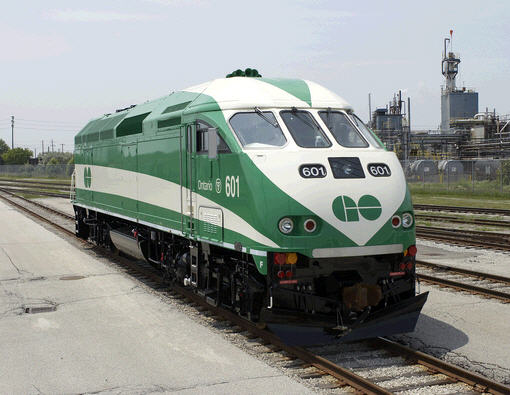
GO Transit operates bus and rail service in the Greater Toronto Area as part of Metrolinx
Comments Off on “Canadian National was using Metrolinx as an automated teller machine”
December 11, 2016
Re-negotiating NAFTA (and the Defence Production Sharing Program, too)
Ted Campbell is in favour of bringing NAFTA up-to-date and reminds us that there’s another diplomatic item that could use modernization at the same time:
In my opinion, if Prime Minister Justin Trudeau, or the next Conservative leader is really interested in restoring Canada to a leading position in real, practical, long term peacekeeping then (s)he will abandon the United Nations and, instead, turn Canada into a free trade powerhouse by dropping our remaining protectionist measures, as Maxime Bernier and Colin Robertson both advocate, and making deals with all comers. And it is important to remember that “deals” involve two sides and both sides must gain something which means that both sides probably “give” something, too, and that produces short term “losers” and it is politically important to try to “soften” the transition for those who are bound to lose in the short term. But, in the mid to long term most losses are “covered” by gains in new products and services and the utilitarian goal of “the greatest good for the greatest number” is achieved … most of the time.
One of the things Colin Robertson mentioned was shipbuilding and it leads me to consider that one of the things we want to renew if or when we must renegotiate NAFTA is the Defence development sharing agreement between Canada and the United States of America. The stated objective of the existing (since 1963) agreement are:
- To assist in maintaining the Defense Production Sharing Program at a high level by making it possible for Canadian firms to perform research and development work undertaken to meet the requirements of U.S. armed forces.
- To utilize better the industrial scientific and technical resources of the United States and Canada in the interest of mutual defense.
- To make possible the standardization and interchangeability of a larger amount of the equipment necessary for the defense of United States and Canada.
The Defence Production Sharing Program is, too often, hamstrung by US (and Canadian) protectionist measures and it needs to be brought more fully into the area of bilateral free trade. I am not suggesting that the Pentagon would ever let, say, a significant shipbuilding contract to a Canadian yard but it must be possible for Canadian shipyards and factories and service providers to bid on US defence contracts on at least a “near equal” basis and vice-versa, of course. This, free(er) trade in defence materiel and services is one area where we, North Americans, can learn from the Europeans. I am not suggesting that Canada should abandon the idea of having a national defence industrial base but, rather, that we should have a base that fits, neatly, into a larger continental base that is, somehow, connected to other allied defence production systems.
So, broadly, when (if) President elect Trump says he wants to renegotiate NAFTA we should, indeed, say “bring it on!” But we should go into negotiations with our eyes wide open, prepared to surrender some “losers,” as good bridge players do, in order to finesse some winners for ourselves.
Comments Off on Re-negotiating NAFTA (and the Defence Production Sharing Program, too)
QotD: Muzzling the comment section, for its own good
For some time now the trend du jour among many media outlets has been to ban news comments — then insult reader intelligence by proclaiming this is being done out of a deep-rooted love of “conversation” and “relationships.” You see, these websites aren’t banning comments because they’re too lazy or cheap to weed out spam and trolls, but because they love you. These sites aren’t outsourcing all human interactivity to Facebook because bean counters can’t monetize quality on-site discourse in a pie chart, they’re doing it because they care so very deeply about their community.
Why, oh, why can’t you people understand that giving the middle finger and a shiny new muzzle to your entire readership is an act of love?
Karl Bode, “The Globe And Mail Tries Something Revolutionary: Actually Giving A Damn About User Comments & Conversation”, Techdirt, 2016-11-30.
Comments Off on QotD: Muzzling the comment section, for its own good
December 9, 2016
The Trudeau government’s bad times
Chris Selley on the (largely self-inflicted) hard times of Justin Trudeau’s government recently:
It has been one hell of a couple of weeks for the Liberal Party of Canada: first Prime Minister Justin Trudeau’s bizarre encomium to dearly departed Fidel; then the approval of two pipelines projects, dashing the oil-free dreams of people who hadn’t been paying attention and producing thousands of barrels of fake outrage; and then, the inevitable collapse of the government’s electoral reform agenda.
It was always going to look bad. The Liberals were always going to break their promise to make 2015 the last first-past-the-post election. Perhaps they had even contemplated their members on the electoral reform committee recommending they break it, by adopting a go-slower approach. But no one, surely, anticipated Democratic Institutions Minister Maryam Monsef accusing the committee as a whole of not doing the job she had set out for them, which they had; mocking the Gallagher Index, an easily explicable formula for measuring proportionality in election results; and justifying herself with shameless bafflegab that would make Paul Calandra blush.
[…]
Monsef later apologized for accusing committee members of slacking, Manon Cornellier notes in Le Devoir, but not for misrepresenting their mandate, mocking mathematics — as an emissary of the party of “evidence-based policy,” no less — and generally behaving like a buffoon.
“(Monsef’s) beef with the Gallagher Index isn’t that it only measures proportionality. Her beef with the Gallagher Index is that it’s math, with its sums of squares and square roots and symbols that are literally Greek,” Fine fumes. It’s a worrying outburst of idiocy, she argues. Monsef and her ilk talk constantly of “engagement,” but that’s a very difficult thing to measure. “At the intersection of ‘affinity for engagement’ and ‘contempt for metrics’ is fertile breeding ground for leaders who wish to make up their own rules,” Fine trenchantly observes.
Comments Off on The Trudeau government’s bad times
QotD: Protest-theatre in Alberta
Protest-theatre is a creation of the political left, which uses it in an attempt to endow quotidian political fights with the dignity and importance of genuine popular struggles for fundamental rights. It is designed to endow debates over teacher pensions or hydraulic fracturing with the hysterical romance of revolution. In some cases, it is meant only to show that a movement is numerous enough to make trouble for own its sake.
It is, in other words, a form of cheap stakes-raising, with just a whisper of possible mob violence thrown in. The right, organized in this instance by Ezra Levant’s Rebel Media web-channel, is now borrowing the tactic. This was one of the Copernican political discoveries of the late Trump presidential campaign: a right-wing populist, if Trump is that, can use protest-theatre too.
The “lock her up” chant in Alberta’s capital was a sort of mangled, improvised collective allusion to Trump, whose crowds had chanted this about Hillary Clinton. They did that because Hillary Clinton has done a certain amount of stuff in her long political career that she probably could have been locked up for. I am not aware that this can be said of Premier Notley. She may have done unwise things, and has definitely made some inexplicable political errors, and may even have pursued unethical policies. But she has done it in legally legitimate ways, and her ministry has yet to face a major scandal in the traditional sense — an event that would have a reasonable person asking if the cops should be called.
Colby Cosh, “After the ‘lock her up’ fiasco, it seems Canada is fresh out of grown ups”, National Post, 2016-12-07.
Comments Off on QotD: Protest-theatre in Alberta
December 7, 2016
Self-protection for women – “making the carrying of mace and pepper spray a sex-linked legal privilege”
Colby Cosh discusses the proposal of federal Conservative leadership hopeful Kellie Leitch to legalize the use of non-lethal chemical weapons:
… Leitch’s Thursday announcement struck me as a potentially elegant move in a hopeless chess game. Noting that a large number of women suffer physical violence over the course of their lives, she proposes that Canadians should be allowed to carry chemical mace and pepper spray for self-defence. “Women should not,” she wrote in a Facebook posting, “be forced by the law to be victims of violence when there exist non-lethal means by which they can protect themselves.”
That’s a true statement, no? Leitch does not suggest that the carrying of chemical spray weapons should be a benefit reserved only to women — she just wants to legalize those weapons generally. Perhaps I am a little more feminist than she is: I would be comfortable making the carrying of mace and pepper spray a sex-linked legal privilege. Hell, I would consider extending it to very small firearms.
Activists for feminism are continually characterizing the world of women as one of terror, abuse, and uncertainty. For Leitch to take them at their word, applying a tough-on-criminals spin, is an authentic Trump touch. I do not wholly approve of the tactic, but, as much as I think some feminists are attention-hungry zanies, I recognize the kernel of truth in their image of the universe. I’ve never had a close female friend who could not tell of bizarre, creepy, threatening things happening to them — sights and encounters that, to a male with an ordinary upbringing, seem to have wriggled from the corner of a Hieronymus Bosch painting.
Leitch got exactly the response she must have wanted from the Liberal Status of Women Minister Patty Hajdu, who blurted that giving women extra self-defence options was “putting the onus on” them, and thereby “offensive.” I find this is an odd way to raise the status of women — suggesting that if some of them might like to carry a can of mace in their purses, and could even be trusted by the authorities to use it responsibly, they are thereby dupes of the patriarchy.
I also enjoyed Colby’s description of Leitch’s “Trump-flavoured” campaign: “it’s like a bag of boring snack chips with a chemical dash of Southern spice exhaled over it. And I can’t help suspecting that there is something slightly phony about the media panic surrounding her candidacy.”
Comments Off on Self-protection for women – “making the carrying of mace and pepper spray a sex-linked legal privilege”
December 6, 2016
Bowmanville, Ontario from 1984-2016 in Google Timelapse
Description from the Timelapse page:
Timelapse
Timelapse is a global, zoomable video that lets you see how the Earth has changed over the past 32 years. It is made from 33 cloud-free annual mosaics, one for each year from 1984 to 2016, which are made interactively explorable by Carnegie Mellon University CREATE Lab’s Time Machine library, a technology for creating and viewing zoomable and pannable timelapses over space and time.
Using Earth Engine, we combined over 5 million satellite images acquired over the past three decades by 5 different satellites. The majority of the images come from Landsat, a joint USGS/NASA Earth observation program that has observed the Earth since the 1970s. For 2015 and 2016, we combined Landsat 8 imagery with imagery from Sentinel-2A, part of the European Commission and European Space Agency’s Copernicus Earth observation program.
Comments Off on Bowmanville, Ontario from 1984-2016 in Google Timelapse
December 4, 2016
Canada’s Next Auxiliary Oiler Replenishment Ship – Episode 2
Published on Nov 28, 2016
The second installment of the documentary following the build of Canada’s new Auxiliary Oiler Replenishment Ship. Episode 2 follows the journey of Davie, its workers and partners from May to November 2016 as they build the largest ship that will operate in the Royal Canadian Navy fleet.


