Quotulatiousness

November 4, 2015

Sometimes the US Navy isn’t subtle

Filed under: Cancon, Military, USA — Tags: , , — Nicholas @ 03:00

At the RCN News site, a recent press release from the US Navy expresses just a bit more than most civilian readers will get:

U.S. and Canadian naval units began a Task Group Exercise (TGEX) off the coast of Southern California, Oct. 20.
Participating units from the Royal Canadian Navy include Canadian Fleet Pacific, Halifax-class frigates HMCS Calgary (FFH 335) and HMCS Vancouver (FFH 331), and Victoria-class ASW target HMCS Chicoutimi (SSK 879).

Emphasis mine.

November 2, 2015

The National Air Force Museum of Canada

Filed under: Cancon, History, Military, Technology — Tags: , , , , — Nicholas @ 03:00

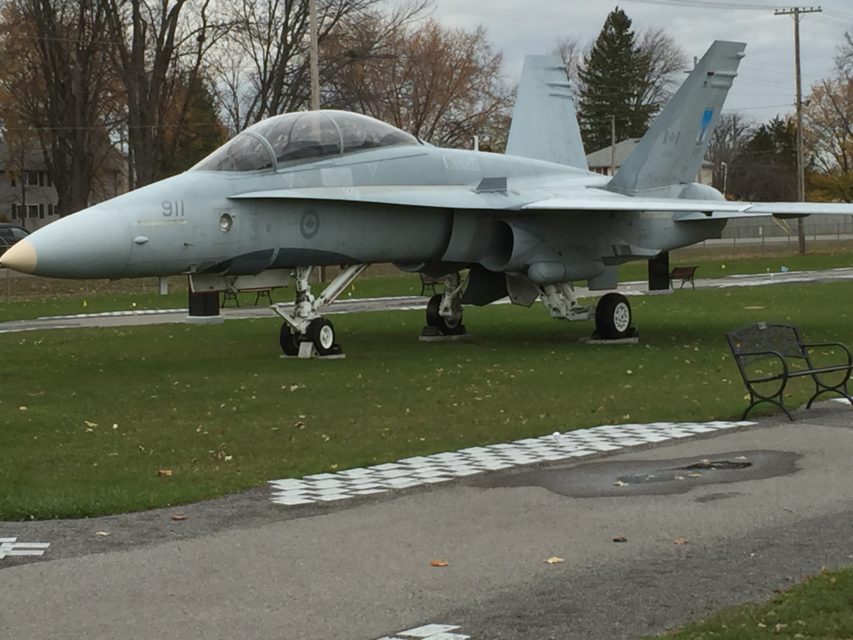
Elizabeth and I spent the weekend in the Bay of Quinte area, visiting Prince Edward County, Belleville, and Trenton. While we were in Trenton, we stopped in at the National Air Force Museum of Canada. While the Sea King may not be in the collection yet (at least, not in the collection visible to the public), many other Canadian Armed Forces aircraft are, including the prize of the museum, the Handley Page Halifax heavy bomber:

Handley Page Halifax 1

It’s a big enough aircraft that it’s hard to do it justice in a photograph.

Handley Page Halifax 2

This particular restored aircraft was shot down late in the war on a mission to deliver supplies to Norwegian resistance fighters and later recovered from a Norwegian lake.

Handley Page Halifax 3

Other aircraft in the collection include a replica of the Silver Dart, the first powered aircraft to fly in Canada (February 23, 1909), a replica of the Burgess-Dunne floatplane, the first aircraft purchased for the Canadian military (September, 1914), a CF-86 Sabre, a CF-100 Canuck, a CF-5 Freedom Fighter, a CF-104 Starfighter, a CF-101 Voodoo, a CF-18 Hornet, a CP-107 Argus, a CC-130 Hercules, and a CP-102 Tracker among other aircraft.

November 1, 2015

Rush | The Spirit of Radio – R40 LIVE

Filed under: Cancon, Media — Tags: , — Nicholas @ 02:00

October 29, 2015

For a change, a sensible trademark ruling

Filed under: Americas, Business, Cancon, Law — Tags: , , , — Nicholas @ 03:00

Timothy Geigner on a remarkably sensible trademark judgement from a BC court:

For this, we travel up to Canada, where a Federal Court judge presided over a trademark dispute between Pacific Western Brewing and Cerveceria del Pacifico over the branding of their brews. At issue was the labels on packaging for PWB’s Pacific Pilsner and Cerveceria’s Pacifico Clara. PWB argued at court that the branding and language was too similar and would confuse customers. Here are samples of each beer’s branding.

Pacific Pilsner vs Pacifico Clara Cerveza

So, yeah, other than roughly similar uses of the word “Pacific”, there’s not a whole lot of similarity here. Normally, this is about when we’d hold our collective breaths and wait to see if the court comes down with a sensible ruling based on the likelihood of customer confusion, or if the court instead chooses the over-protectionist route, focusing on the common language and nothing else. In this case, Justice Luc Martineau appears to have gotten every last bit of it right.

    Martineau said the first impression given by the label Cerveceria uses for its Pacifico brand “is of its obviously foreign origin” and that it’s “highly stylized, with many distinctive design elements, including strong and contrasting colours and font in red, gold, blue, green and yellow.” He further said the label “differs visually, phonetically, and semantically” from all of the marks PWB uses for its Pacific brands of beers.

    Martineau also dismissed as without merit PWB’s argument that contrary to a statement on the register, Cerveceria del Pacifico was not first sold in Canada as early as April 1986. He noted that an affidavit from Cerveceria stating the beer was introduced at Expo ’86, where it was sold at a Mexican restaurant called Ole Cantina, was not challenged by PWB counsel. By December 1989, Pacifico was listed with the B.C. Liquor Distribution branch and in August 1990, a registration protecting the mark was issued.

    “The delay of almost 25 years before attempting to invalidate the registration weighs heavily against a finding of confusion,” Martineau said of PWB’s action.

October 26, 2015

Consumers of porn have more feminist attitudes

Filed under: Cancon, Health, Media — Tags: , , , — Nicholas @ 02:00

We’ve all heard the claim that pornography desensitizes those who view it and dehumanizes women … except that doesn’t seem to be the case, if a recent study is accurate:

The study, published in The Journal of Sex Research, was conducted by researchers at the University of Western Ontario. “According to radical feminist theory, pornography serves to further the subordination of women by training its users, males and females alike, to view women as little more than sex objects over whom men should have complete control,” they wrote in the study abstract.

Yet after comparing people who watch porn with those who don’t, researchers found those who had watched an adult film at least once in the past year held more egalitarian ideas about women in positions of power and women working outside the home, along with more positive views toward abortion. The two groups did not differ significantly in attitudes about “traditional” families or self-identification as feminist.

“Taken together, the results of this study fail to support the view that pornography is an efficient deliverer of ‘women-hating ideology,'” study authors concluded. “While unexpected from the perspective of radical feminist theory, these results are consistent with a small number of empirical studies that have also reported positive associations between pornography use and egalitarian attitudes.”

Researchers relied on data collected between 1975 and 2010 for the General Social Survey, which asks Americans about a wide range of social issues and personal views (including gender equality and personal pornography consumption). For both men and women, viewing porn was associated with more positive attitudes toward women holding positions of power, less negative views of abortion, and less negative attitudes toward women in the workplace.

QotD: Canadian political journalism

Filed under: Cancon, Education, Media, Politics, Quotations — Tags: , — Nicholas @ 01:00

It is important to understand that, except a few, the journalists are not ideologues. They are, once again, typical products of our drive-in universities, and journalism schools which have, if possible, even lower intellectual standards. They know no history, nor anything much about the topics on which they write, and can be easily mesmerized by a narrative they have themselves written, by rote. Such is the nature of promotion within what has become a niche of the entertainment industry, that those of independent mind and moral fibre are quickly weeded out.

I’m inclined to use the term “progressive” rather than dwell on Left and Right wings, for there is some contrast between, say, MSNBC and Fox in the USA, between CBC and Sun News up here. There is a growing Right — an opposition within the media to itself — but it is not a significant improvement on the monotony that preceded it. The idea that, as a form of entertainment, news coverage should aspire to “tabloid” conditions, and avoid subjects which require knowledge, governed the rightwing impresarios from the start. The Right is fresher and feistier than the Left, and by its Pavlovian habit of reacting to Left agendas, sometimes traps itself in a principled position; but this is a random, not intended effect. Both sides continue to share the post-Christian worship of abstract “liberty,” “equality,” and material “progress.” They clash on who can deliver these empty buckets quicker. But the battle is fought from both sides with the same weaponry — platitudes and clichés — in a kind of unending spiritual Verdun. “Progress” invariably emerges as the victor.

David Warren, “Ottawa in the news”, Essays in Idleness, 2014-10-23.

October 25, 2015

Rush | Closer to the Heart – R40 LIVE

Filed under: Cancon, Media — Tags: , — Nicholas @ 04:00

Published on 23 Oct 2015

Pre-order “R40 LIVE” today!

Small talk in pubs

Filed under: Cancon, Politics — Tags: , , , — Nicholas @ 02:00

David Warren admits he’s not welcome at a few local drinking establishments nowadays:

There are at least two tables, within pubs in the Greater Parkdale Area, where, notwithstanding I was once quite welcome, I am not today. Some think this is because of my opinions, which are those of a rightwing fanatic and religious nutjob. But no: it is because I am willing to express them. This is a form of incontinence, one might argue; and like other forms, it may accord with increasing age. Yet I do not think that silence is invariably golden.

To hear me tell it — and whom else were you expecting, gentle reader? — it goes like this. In years past, I would sit quietly and ignore nonsense, especially political nonsense, spoken by my fellow imbibers. I can still do this. Many of the most ludicrous remarks, on any passing issue, are not actually opinions of the speaker. He simply echoes or parrots the views of the media and his own social class. I’ve been absorbing this “background music” for years; why revolt now? The noise is anyway not arguments but gestures.

Say, “Stephen Harper,” and watch the eyeballs roll. Say, “George Bush,” and still, ditto. Say “Richard Nixon,” however, and you don’t get much of a rise any more, for memories out there are short, very short.

(A Czech buddy, in the olden days, once performed this experiment in a pub. “I just love that Richard Nixon!” he declared, in his thick, Slavic accent, loud enough to afflict the Yankee draft-dodgers at the next table, who’d been prattling about Watergate too long. “Gives those liberals heart attacks,” he added. … Some bottle-tossing followed from that, and we were all banned together, so ended up as friends.)

On the other hand say, “Barack Obama,” and they will focus like attentive puppies. Or, “Justin Trudeau” to the ladies, to make them coo.

It is a simple Pavlovian trick, and might be done in reverse in a rightwing bar, except, there are no rightwing bars in big cities.

Yet everyone knows there are rightwing people, even in Greater Parkdale. And they are welcome anywhere they want to buy a pint, the more if they’re buying for the whole table. The one condition is that they must keep their “divisive” opinions to themselves.

October 20, 2015

Colby Cosh on the election results

Filed under: Cancon, Politics — Tags: — Nicholas @ 07:09

For the most part I agree with his take, although I’m a bit more worried that the new Liberal government is going to spend far more money than they should (after a decade away from the treasury, they’re going to be extra-enthusiastic to throw money at favourite causes):

As a civilization, we have largely abandoned churches, recoiled from traditional labour unions, psychically detached from our employers and anathematized even harmless forms of ethnic rivalry. The typical citizen no longer enjoys a lot of everyday opportunities to experience a sense of collective belonging. Elections provide one.

According to a famous principle of sociology, they become more convenient for this purpose, and increase in bitterness, as the actual stakes dwindle. As it happens, we are in a time of relatively inconsequential elections. The national-unity issue is mostly dormant. Our prime minister doesn’t carry a nuclear football or control the central bank. We discuss immigration knowing that every party will give us high levels of it, with minor differences in the sorting method; the wide Atlantic guarantees that there will be no uncontrolled deluge.

There is a free-trade deal on the table, raising the question whether the total number of countries we have such deals with shall be the existing 44, or something in the low 50s. Macroeconomists, appealed to for judgments on the programs of the major parties, issue the sophisticated equivalent of yawns. Tell me what world commodity prices will do, they say, and I will tell you how the Dominion fares.

Faced with a choice between two no-deficits parties and a small-deficit party, it is natural for voters to seize upon nugatory considerations of style — to reward, as we will on Monday, positivity and novelty and attitudinal correctness; to punish hints of callousness and cynicism. Overreacting to personalities and subtleties and infinitesimal linguistic cues is a luxury we have, and we use it. In truth, all our political parties are now prisoners of accountants; it is not a question of some sinister “neoliberal consensus” but of solvency. Ask the Greeks: a country can have just as much sovereignty as it can afford.

We are entering a period of demographic transition in which economic growth, as measured by traditional instruments like GDP, is likely to be low for awhile. At the same time, mind-shredding innovations are already reordering our lives in radical but less easily measured ways. The connected computer and the increasingly intelligent automaton have transformed the human condition without much permission or encouragement from politicians.

I have to admit, when I see a fellow columnist wringing his hands about the niqab or the Mike Duffy trial, my instinct is always to say: “Hey, you know they have self-driving cars now?”

Update: I missed Mark Steyn’s pre-election column that at least somewhat explains why even Conrad Black turned on Harper this time around:

Conrad actually makes a rather better case for Harper than the pro-Harper piece from Canadian Cincinnatus – before deciding it’s time to take a flyer on Justin. My old boss has (entirely legitimate) grievances against the Prime Minister that most of his critics do not. In recent weeks, two prominent conservative figures in the Canadian commentariat have remarked to me on Harper’s “coldness” even with friendly media types. That’s true, certainly when compared to his delightful and friendly missus, or to, say, the bonhomous Jason Kenney or Lisa Raitt, who manage to give the impression they enjoy even hostile interviews. Harper is a cold fish, and the coldness isn’t just a social affect. Last year, Harper had Conrad expelled from the Privy Council, as cold-hearted an act as one could devise to humiliate a man who played a crucial role in the glory days of The National Post in both the creation of the new Conservative Party and the rise of Harper to lead it. It was not merely unjust but unnecessary, coming years after Conrad’s stitch-up in a corrupt US court for a “crime” that does not exist in any other western nation. I have no idea why Harper felt he had to do it, and, all things considered, Conrad is extremely generous to him in his column. But I do wonder how many lesser known, broadly conservative persons are nursing various grievances against Harper this morning. That never helps in a close election.

In democratic societies, when a long governing party loses to its principal rival, it’s because the rival has been forced, in the interests of electoral viability, to meet you halfway – to steal at least some your clothes. Mrs Thatcher forced the Labour Party to change, and thus enabled it to anoint Tony Blair and return to power shorn of its worst impulses. Likewise, the Reagan-Bush years led to Bill Clinton and the “New Democrats”. Even in Canada, Brian Mulroney tamped down the Trudeaupian excesses of the Liberals and enabled Jean Chrétien to succeed as head a Nafta-supporting, debt-reducing ministry. Should tonight go badly, there will be no such consolations for Stephen Harper: Justin Trudeau, in all his shallow modish twerpery, represents everything he despises.

October 19, 2015

QotD: Justin Trudeau

Filed under: Cancon, Media, Politics, Quotations — Tags: , , — Nicholas @ 01:00

At the next election a young political huckster, who happens to be the son of the late Pierre Trudeau, and enjoys something of his father’s winning ways with the women, and a matching cynicism, is likely to win. Young Justin Trudeau is unlike his father, however, in having little in the way of an agenda, beyond power and prestige for himself. Like Obama, he is not an ideologue, only a typical product of our public universities: a mind half-baked with “progressive” platitudes and clichés. He has no discernible discernment, and there is still a chance that the electorate will see him for what he is. Nevertheless, he can already count on the protection and support of our liberal media, which, like musk-oxen detecting a threat, instinctively form a stomping circle around the little fellow, knowing he will be unable to defend himself.

(The situation is complicated by the existence of a socialist party, which itself displaced the Liberals in opposition at the last general election, thanks to a demagogue at their head, who knew how to pander to Quebec. This man has since died, but the party may still be attractive enough to split the opposition vote. In the past, Harper has been rather good at playing the two parties slightly to his left against each other, but after years of isolation in the prime minister’s office, he may have lost his edge.)

David Warren, “Ottawa in the news”, Essays in Idleness, 2014-10-23.

October 17, 2015

QotD: Stephen Harper

Filed under: Cancon, Media, Politics, Quotations — Tags: , , , — Nicholas @ 01:00

[Prime minister Stephen] Harper’s genius, as a power-seeking politician, is the opposite of Obama’s (the once popular USA president). He carries the “Conservative” label, of a party slightly to the right of the others in our Parliament. Therefore he has most of the liberal media machinery against him. Obama, as perhaps we all know, has enjoyed until recently a compliant and fawning media, that do not criticize their darling, nor hesitate to suppress news that would be unfavourable to him. Obama’s tactic has been to draw attention constantly to himself. He has something to say on every subject, empty of content, but dramatically insistent in its repetition of the first person singular. By contrast, Harper goes out of his way to distract attention from himself, and when he can’t, to avoid vehemence of any kind, or anything resembling drama.

This is not to say he isn’t ruthless, as a political operator, and backroom settler of scores. Anyone associated with Christian causes, such as the defence of human life, will know how he rules his pro-life backbenchers. His intention is to keep the party “on message,” with a message that will not excite media attention, so he can get on with normal administration. His strength is his reputation for management: he has not, like Obama, made a hash of everything he has touched. The Canadian budget is actually in surplus, and while our cumulative debt is substantial, and we face the same unfunded welfare liabilities to an aging population, we have not the bottomless debt and fiscal chaos into which Obama and other irresponsible politicians have delivered the United States. (Notwithstanding, when they crash, it will be right on top of us.)

But of course, this is a “democracy,” and the great majority of our population, as those in all other countries, are almost entirely ignorant of public affairs. Like children, they get bored with good government, but unlike children they have, collectively, the power to do something about it.

David Warren, “Ottawa in the news”, Essays in Idleness, 2014-10-23.

October 15, 2015

S.L.A. Marshall, Dave Grossman, and the “man is naturally peaceful” meme

Filed under: Books, Cancon, History, Military, USA — Tags: , , , , , — Nicholas @ 03:00

The American military historian S.L.A. Marshall was perhaps best known for his book Men Against Fire: The Problem of Battle Command in Future War, where he argued that American military training was insufficient to overcome most men’s natural hesitation to take another human life, even in intense combat situations. Dave Grossman is a modern military author who draws much of his conclusions from the initial work of Marshall. Grossman’s case is presented in his book On Killing: The Psychological Cost of Learning to Kill in War and Society, which was reviewed by Robert Engen in an older issue of the Canadian Military Journal:

As a military historian, I am instinctively skeptical of any work or theory that claims to overturn all existing scholarship – indeed, overturn an entire academic discipline – in one fell swoop. In academic history, the field normally expands and evolves incrementally, based upon new research, rather than being completely overthrown periodically. While it is not impossible for such a revolution to take place and become accepted, extraordinary new research and evidence would need to be presented to back up these claims. Simply put, Grossman’s On Killing and its succeeding “killology” literature represent a potential revolution for military history, if his claims can stand up to scrutiny – especially the claim that throughout human history, most soldiers and people have been unable to kill one another.

I will be the first to acknowledge that Grossman has made positive contributions to the discipline. On Combat, in particular, contains wonderful insights on the physiology of combat that bear further study and incorporation within the discipline. However, Grossman’s current “killology” literature contains some serious problems, and there are some worrying flaws in the theories that are being preached as truth to the men and women of the Canadian Forces. Although much of Grossman’s work is credible, his proposed theories on the inability of human beings to kill one another, while optimistic, are not sufficiently reinforced to warrant uncritical acceptance. A reassessment of the value that this material holds for the Canadian military is necessary.

The evidence seems to indicate that, contrary to Grossman’s ideas, killing is a natural, if difficult, part of human behaviour, and that killology’s belief that soldiers and the population at large are only being able to kill as part of programmed behaviour (or as a symptom of mental illness) hinders our understanding of the actualities of warfare. A flawed understanding of how and why soldiers can kill is no more helpful to the study of military history than it is to practitioners of the military profession. More research in this area is required, and On Killing and On Combat should be treated as the starting points, rather than the culmination, of this process.

(more…)

October 14, 2015

Canadian defence … a still-relevant view from ten years ago

Filed under: Cancon, History, Military, Politics, WW1, WW2 — Tags: , — Nicholas @ 03:00

Instapundit linked to a ten-year-old post at Albion’s Seedlings, and I noticed that the next post there is still pretty much dead-on in describing why Canada’s military is in the state we still see today. Spoiler: the post is titled “Was Canada Ever Serious? Militia and Military Since Confederation“:

Initial chapters [of Canadian Brass: The Making of a Professional Army 1860-1939 by Stephen Harris, 1988] consolidate the early periods of Canadian military history as the British military staff digested the new geopolitical realities demonstrated during the American Civil War. Canada was to be spun loose politically in 1867 but its foreign policy and defense were to remain a very strange hybrid well into the 20th century. The WW1 period in Canadian Brass is divided into pre-war, a Sam Hughes [Militia Minister] WW1 period, and a post-Hughes WW1 period. An interbellum period gets thorough coverage and then WW2 is broken out into separate Military Planning, and Training & Education chapters.

The rather shocking message of this book is that the Canadian military has been the constant butt of political interference during the last 150 years except for two brief periods: WW2 proper, and 1951-1964. During virtually all other periods of Canadian history, the permanent (professional) military forces have been starved of funds, denigrated in public by all and sundry, and then ignored completely during mobilization for wartime. The only time in Canadian history that professional pre-mobilization plans were actually used was WW2. In all other eras, professional plans were ignored and politicians turned to various militia cronies to assemble, train, lead, and transport Canadian troops.

[…]

The author suggests, therefore, that lack of professionalism in the organization of the military led to unnecessary political crises (specifically the split between Quebec and English-speaking Canada), and, in the case of the First World War, the needless slaughter of the initial Canadian divisions (because they were led by totally unqualified militia officers with political connections). The WW1 crisis created by Minister of Militia Sam Hughes was the result of a totally mythical and exaggerated memory of militia superiority in the War of 1812 and the Fenian raids of 1866, and careful news management out of the Boer War. Militia were held to be a superior in all ways to a professional force, moral and martial. Government money for militias (urban and especially rural) was a traditional source of political patronage in Canada, frustrating British military advisers and Governor-Generals for literally generations (and ruining many Brit careers in the process). Such patronage methodically starved the professional units in a nascent professional Canadian Army of training, equipment, facilities, pensions, wages and prestige. The result was a professional army that wasn’t and an oblivious overconfident citizen-soldier militia that was destined for a horrific introduction to modern war.

The casualty situation got so bad by the late fall of 1916 that Hughes was dismissed, and a new generation of Canadian officers (all political appointees but survivors of the savage Darwinian selection at the front) began to lead, and promote their junior officers out of the ranks. The impact on morale and military success from early 1917 to the end of the First World War were dramatic. Canadian reputations for combat effectiveness essentially came out of this period.

[…]

It’s clear, in retrospect, that Canadian politicians and the Canadian public have had a long-standing expectation that the British (and then the US) were going to bail them out in any serious military situation. As a result, the professional Canadian military was seen as simply another source of political largesse for the party in power. It never had to be effective, and post-1964, it actually was designed not to be used at all … unification of the three services (Army, Navy, Air Force), and endless UN peace-keeping missions were an effective way to strip combat effectiveness and combat equipment out of the Canadian military. Harris provides all the necessary context and information for that conclusion but is politic enough to avoid much further commentary.

He does writes an interesting epilogue that delicately skirts around those post-1939 issues … and avoids touching the “third rail” of military bilingualism introduced in the 60s, which further degraded esprit de corps and combat effectiveness. After all, Mr. Harris was essentially writing about his own Cold War employer at the time of publication (1988), and probably wanted to keep his job. Nonetheless, it’s pretty clear that the Liberal dismantlement of the conventional Canadian military (after tactical nukes appeared in Europe in the 60s) was yet another iteration of the political manipulation of the permanent military and a return of the good old days of “jobs for the boys.” The sorry state of today’s Canadian military (a small but excellent antiterrorist force [JTF2] to protect the elite in Ottawa, and a sprinkle of blue helmet cannon fodder without adequate air transport) is therefore very much part of a proud Canadian political tradition stretching back 135 years. It’s not a mistake. It’s on purpose.

Ten years on, we don’t do the UN peacekeeping stuff to any great extent, but even with a “pro-military” government in power for most of that time, the Canadian Armed Forces are still starved for resources and up-to-date equipment (and procurement is still seen as a way to spread government money around to “deserving” regions rather than a way of getting the best tools for the money). Thanks to our unique strategic situation, Canada can still be a military free-loader — and glories in it.

October 10, 2015

“We’re very inefficient … and proud of it”

Filed under: Business, Cancon — Tags: , , , , — Nicholas @ 02:00

Published on 3 Oct 2015

Craft Brewery tourism is on the rise. Ontario Craft Breweries are opening throughout the province; eventually there will be one in every community. These breweries are a catalyst for economic growth. They have become sought-after tourist destinations, event venues, culinary centres.

October 6, 2015

Jay Currie trolls the readers at Dr. Dawg’s blog

Filed under: Cancon, Politics — Tags: , , — Nicholas @ 05:00

Jay Currie has a bit of fun at the expense of poor folks suffering from sudden-onset Harper Derangement Syndrome:

Oh Dear the “yokels” and the “unwashed”, being thoroughly unenlightened, are failing in their duty to follow the lead of their betters and have noticed that there may be a few issues with mass Muslim immigration. Disgusting.

Worse, that spiv Harper doesn’t even have the grace and breeding to use dogwhistles in herding his flock. The dreadful man is throwing raw meat to the rubes and, to no one’s great surprise those Ill-educated reactionaries and rednecks are eating it up. There is, I fear, a very real danger that the 80% of bigoted Canadians (90% in the idiot reaches of Quebec) will take this opportunity to try to undo forty years of enlightened immigration and refugee policy by voting for those revolting CPC candidates.

The Wal-Mart classes are restless.Time to clutch the pink pearls and person the checkpoints surrounding the nicer, leafier, bastions of tolerance in Canada’s more sophisticated urban centers. Lock down the common rooms and charcuterie bars, disguise your Prius and avoid being seen with your Said (or books of any sort really): the proles are on the move.

[…]

The beast Harper looked vulnerable at the beginning of this campaign. After all, no one we knew would think of voting for the thug. But Harper has a low, animal, cunning. He is unafraid of the great white blob. He has been seen at hockey rinks at 6 in the morning and obviously buys his suits in some dreadful mall. His wife has stayed at home with the children. He is, obviously, one of them. He does not need to dogwhistle – the blob knows its own.

So, beware. The unwashed, the yokels, the bigots and the rubes have been summoned. All we can hope for is that, once they have vented their fury on niqab wearers they will resume their slumber. The alternative is simply too awful to contemplate.

« Newer PostsOlder Posts »

Powered by WordPress