
Canada geese have settled on the National Mall, and Canada geese, in the proud Canadian tradition of Tom Green and Celine Dion, spew excrement everywhere they go — up to three pounds per day per goose. (Celine Dion presented the scientific world with an interesting technical challenge: How to measure excrement in decibels.) Apparently, Canada is either still miffed about that unpleasantness in 1812 or — and this seems more likely — enraged about the acquisition of Tim Horton’s by Burger King.
Ergo, biologically engineered avian crap-bombs from Canada descend upon Washington.
Go ahead and draw up that treason indictment: I am siding with the enemy on this one.
If there is to be a plague of goose poop befouling an American city, it really could not happen to a more fitting municipality than our hideous national capital, and especially to the gallery of architectural malpractice and monumental grotesquery that is the National Mall, that eternal testament to the unfinished work of Major General Robert Ross, who had the good taste to put Washington to the torch but who tragically failed to salt the earth on his way out. General Ross later helped to establish what would become a proud American tradition: getting shot to death in Baltimore. His body was pickled in rum before being returned to Nova Scotia, an excellent end to a life well-lived.
Kevin D. Williamson, “Old threat: ISIS; new threat: geese”, National Review, 2015-03-29.
November 1, 2016
QotD: The goose-poop war
October 29, 2016
Is there a bright side to the sale of Constellation Brands for Ontario wine drinkers?
Michael Pinkus gets an uncharacteristic rush of optimism over the sale of Constellation Brands:
[W]hile it’s nice to see Canada’s Inniskillin and Jackson-Triggs back in Canadian hands what does all this say about the selling of wine in Canada? When the world’s largest holder of wine companies/brands decides to throw in the towel here and sell off their Canadian division, yet still holds the remainder of the wineries and brands they acquired with their 2006 purchase of Vincor to me speaks volumes. Now I’m just speculating here, as I do in many of my commentaries, but could it be that Constellation sees the writing on the wall: that making money in Canada (in general) and in Ontario specifically, will not be as easy as it once was under the Liberal’s new proposed “sharing the retail space plan”. Let’s face it, the real selling feature of Vincor’s Canadian holdings were those Ontario money makers: those off-site stores that were a license to print money in the province … and now if the world’s largest can’t figure it out how in the world are the rest of Ontario’s wineries supposed to do it? Are we about to embark down another rabbit hole of when it comes to the sale of booze in this province?
[…] Just last week, I was asked for my thoughts and I immediately went to the pessimistic side of things: “does not bode well for the selling of wine here in Ontario”; but then after some careful thought I decided there still might be room for optimism, especially if you look at the purchaser. At one point in the process it was rumoured that Peller was in the mix of buyers to take over the Constellation Canadian holdings, but in the end it was the Teachers’ Pension Plan that took it for $1.03 billion. Many on social media lamented that if the teachers do for booze what they did for Toronto sports teams we’re all in big trouble. But I thought of a better angle: Nobody is better at lobbying and twisting the arm of the provincial government to get what they want than the Teachers’ Union … and once they learn how difficult selling wine is, and the antiquated laws we have surrounding it, here in Ontario, they’ll set their sights on making changes, and while the fairly ineffectual Wine Council of Ontario seems to be a mouse nipping at the heels of the governmental elephant, the Teachers’ Union and their Pension Plan will seem like a pack of wolves and hyenas working together to wrestle the elephant to the ground. So while Peller (had they succeeded in their purchase efforts) would have become the largest Canadian winery by far, they would not have been any more effective at invoking change to the system; on the other hand, the Teachers’ Union could play a large and important role at getting laws passed that will loosen up our repressive and antiquated system up; because who is in more need of a drink at the end of the day than a teacher, and it should be easier for them to get it and sell it..
September 28, 2016
“… first I have to explain the Tragically Hip. I apologize in advance.”
Kathy Shaidle burnishes her street cred as the most anti-Tragically Hip writer of the year:
Foreign ears will likely mistake the Hip for a fairly capable R.E.M. cover band — very “Stuff White People Like,” nothing more. But up here during, yes, the 1990s, college students got maudlin drunk on this group’s unsingable songs, in part because the only words you can make out are Canadian place names and slang terms, and there will always exist a particular variety of parochial — the type who otherwise despises “patriotism” — who inevitably finds that sort of thing weirdly…I don’t know if “flattering” is quite the word, but it will have to do. It helps that, off stage, the Hip promote the usual “progressive” bunkum.
The Tragically Hip are hardly the Rolling Stones or the Who, or Smashing Pumpkins or Hole. The Tragically Hip will never make any Top 50, or even Top 500, Musical Groups of All Time List.
And yet, I’ve been duly informed, they are “Canada’s Band.” The announcement on May Two-Four that lead singer and songwriter Gord Downie had fatal brain cancer meant, for me, that (forget what I wrote last week) his gnomic lyrics finally had a pretext, and for everyone else, that the band was embarking on a national farewell tour.
The media covered every aspect of this cross-country excursion with that cloying, breathless boosterism normally reserved for the Olympics. Except even the Games’ critics are allowed to voice their dissent, and not a discouraging word was permitted as the Tragically Hip traipsed across the country all summer, their “songs” blaring on the radio even more than already demanded by CanCon.
The CBC broadcast their final gig live, calling it “an honour and a privilege.” Prime Minister Zoolander (later conspicuously absent from any 15th-anniversary commemorations of 9/11) attended, of course. Maclean’s put Downie on the cover of a special issue and devoted dozens of pages to the tour, analyzing each set list and quoting fans declaring the Hip’s songs “the soundtrack of our lives” and Downie “a genius” and a “shaman” and a “saint.”
I’d go on, but Canadian poet David Solway’s crabby take on this “orgiastic sobfest” cannot be bettered. (Not surprisingly, it was published by an American outlet.)
And then it was over. Finally.
Except until it wasn’t.
September 25, 2016
The Lorne Scots 150th anniversary
Yesterday I drove out to the wilds of Brampton to attend the Trooping of the Colours for the Lorne Scots (Peel, Dufferin and Halton Regiment). Given how hot this summer has been, they had a great day for the event. I’m sporting a bit of a sunburn on the right side of my head, but the temperatures were much more comfortable than they’d have been on pretty much any weekend since June. Elizabeth and I sat in the second row of seats, which meant that a lot of my photos were constrained (or even bookended) by the heads and shoulders of the folks sitting immediately in front of us. It was still a great trip down memory lane.
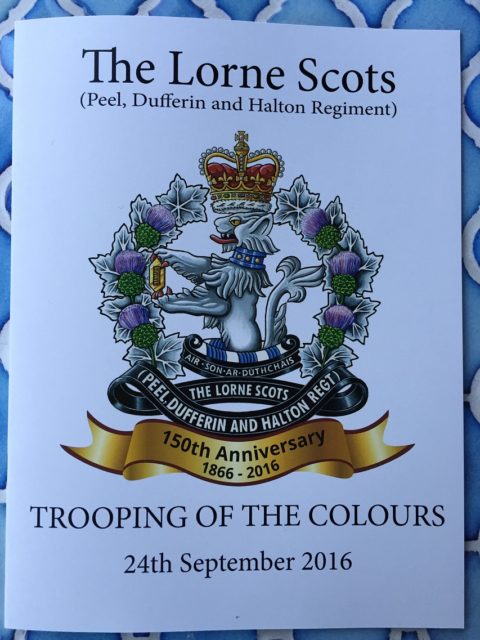
If you’re on Facebook, you can see a selection of photos from the event here (unless Facebook is making it awkward for non-members to see albums posted as “public”, which is always a consideration). If you can’t see ’em, let me know in the comments and I’ll repost at least a few of them here.
QotD: Canada’s “Potemkin village” tactics
Some of us, in another forum, were discussing why UN peacekeeping seems to go so very wrong, so very often ~ not always, I hasten to add, just usually ~ and I quipped, with just a wee bit of hyperbole, that “Simple human decency says that a country like Canada should have dropped a light brigade into South Sudan and destroyed the South Sudanese Army in a short, brutal campaign of exemplary speed and violence … should have if we could have, but, of course, the Canadian Army is a fat, overstaffed, poorly managed corporal’s guard, that cannot deploy any brigade anywhere because we don’t have any nearly fully staffed brigades and even if we did they don’t have enough logistical “lift,” so they are useless once they have marched more than 15 km out of the camp gate … unless a country with a real army (you know, one with trucks and people a to drive them) decides to support and sustain us.“
Sadly no one, not even officers who have, fairly recently, commanded brigades in the regular army, challenged my assertion that the Canadian Army has been hollowed out until, now, it is a sort of military Potemkin village in which bits and pieces are deployed and redeployed to create the (entirely false) impression that we, Canadians, are getting a real army for the $20 billion or so that we spend, year after year after year, on out national defences.
The process began, in earnest, in about 1970, when, in response to quite draconian cuts imposed by Pierre Trudeau (but not, it has been suggested, as deep as he wished) the Canadian Forces began to try to “make do” with a “pint sized” brigade in Germany ~ when a full sized (6,500± soldiers) one was need by promising (and practising) to augment it with “fly-over” troops from Canada who were trained and equipped and could move, fairly quickly on to “pre-positioned” equipment … if it was properly maintained. It worked well enough, in a peacetime/training situation, except for the fact that we, eventually (early 1980s), understood that we could not sustain a brigade in Germany with “fly overs” when we needed the same troops to “fly over” to Norway to keep another promise, made to try to placate our allies about our deep defence cuts, and by the late 1980s the Norway task (promise) was quietly shelved (broken) about twenty years after it was started, and after a quite disastrous “test” (Exercise BRAVE LION) proved to civilian planners and military commanders alike that the Canadian Army (which was much larger than it is today) simply did not have the where-with-all (especially the logistical “tail”) needed to sustain “fly over” missions to Europe. But the damage was done … in twenty years, almost a generation, the Army, especially, had gotten used to “faking” its combat effectiveness with Potemkin village tactics.
Ted Campbell, “A Canadian Potemkin Village”, Ted Campbell’s Point of View, 2016-09-15.
September 23, 2016
QotD: The media’s view of conservative leaders
Here’s an ironclad rule of politics: the latest conservative standard-bearer is always a scary fascist who’s going to end democracy as we know it. Meanwhile, the last conservative standard-bearer – preferably a defeated one – earns strange new respect from the commentariat.
(This isn’t just an American phenomenon. Mark my words: the Toronto Star columns declaring the next Conservative Party of Canada leader “more extreme than Stephen Harper” are already written, with just the name to be filled in.)
Damian Penny, “In 2016, there really is a wolf”, Damian J. Penny, 2016-07-22.
September 18, 2016
When you’re a monopoly, what’s your attitude to customers? “Sod the proles!”
Rick VanSickle vents about the LCBO’s amazingly tone-deaf marketing:
Sorry, LCBO, but I don’t get you. Such a lame-o release on the birthday of our great country July 1, with paltry few Canadian wines released to celebrate our big day, and presumably a few folks out there looking to party with local wines, and then suddenly in the middle of September, you drop the big one.
What up with that? I mean, the Sept. 17 issue of the Vintages mag, with pages and pages of features on Ontario wines and the biggest selection of local wines of the year — am I missing something? Is this some sort of key date for us in Ontario and Canada?
I want to be there during your obviously very detailed board meetings to listen in on the thinking behind your planning. When you get to, say, July 1, does anyone go: “Hey, that’s Canada Day, let’s flood the aisles with great Canadian wine. It’s what the people want, the people who pay for our largesse, the people we work for.” Well, no, of course not, that’s ridiculous.
Instead, as they count down the calendar, they go: “OK, what do we have for the week of Sept. 17? Why, there’s absolutely nothing going on, so let’s make it the biggest Ontario wine release of the year! Yes, perfect!”
Of course, what does it matter anyway? It’s not like the guy down the street is doing any better because there is no guy down the street. It’s the beauty of a monopoly — guilt-free decisions because there is no wrong decision if you are the only game in town.
For example (stay with me here, we’ll get to the wine), if the government decided it was going to force a shoe-store monopoly on its populace and came to the conclusion at a big swanky retreat where such decisions are made (pure speculation) that it would be so cool to put out a big display of Converse runners at all their stores on the first day of winter. No winter boots, no mukluks, just running shoes and sandals. Wouldn’t that be hilarious? lol.
It’s funny but not really funny. We just accept that it’s wrong and carry on like a monopoly is beyond reproach, beyond accountability.
For the record, the Canada Day Vintages release featured a cover story called: South Side Story: Wines of Southern France with 12 pages of spectacular photography and enticing bottles of French wine proudly displayed with glowing reviews and effusive praise for all.
August 22, 2016
Rona Ambrose reveals the secret to her AMAZING beer pong skillz
Sarah Boesveld interviews interim Conservative leader Rona Ambrose:
[…]
And how’s your beer-pong game?
Are you kidding me? My beer pong game is AMAZING. We had a huge beer-pong tournament at Stornoway [in May] for the university campus clubs, and they were all in their little suits and stuff. We were like, “Take off your ties! Relax!” We set up this huge beer-pong table in the kitchen and there must have been 60 people shoved in there. I kicked BUTT. I crushed them, those poor kids. They were like, “How are you so good at beer pong?”
How are you so good at beer pong?
I said to them, “Here’s the big secret: Don’t drink the beer.”
This interview has been condensed and edited.
H/T to Small Dead Animals for the link.
August 13, 2016
Harjit Sajjan: “Even using the terminology of peacekeeping is not valid at this time”
Our minister of national defence is on a tour of several African countries, looking at potential deployments for Canadian troops in troubled areas. A positive sign that the government is moving away from their long-standing infatuation with 70s-style “blue beret” peacekeeping missions is the message the minister communicated at the first stop of his tour, as reported in the Globe and Mail by Steven Chase:
Defence Minister Harjit Sajjan says what Canada will ask its soldiers to do in Africa can no longer be called peacekeeping because the term doesn’t reflect modern demands of stabilizing a conflict zone – something experts say could run the gamut from training other countries’ troops to counterterrorism.
Mr. Sajjan spoke from Ethiopia, the first stop in an eight-day fact-finding mission to Africa, as Ottawa tries to narrow where to deploy soldiers in what it promises will be a return to a major peacekeeping role for Canada.
The Defence Minister acknowledges the job in conflict-ravaged countries is potentially more dangerous these days and said he prefers the phrase “peace support operations” to describe the task Canada is preparing to embrace in one or more places in Africa.
“I think we can definitely say what we used to have as peacekeeping, before, is no longer. We don’t have two parties that have agreed on peace and there’s a peacekeeping force in between,” he told The Globe and Mail in an interview.
“Even using the terminology of peacekeeping is not valid at this time,” he said. “Those peacekeeping days, those realities, do not exist now and we need to understand the reality of today.”
Mr. Sajjan has been directed by Prime Minister Justin Trudeau to “renew Canada’s commitment to United Nations peace operations” – a campaign pledge made by the Liberals, who had accused the Harper government of turning its back on peacekeeping.
I strongly suspect that the Canadian Forces do not currently have the ability to engage in a significant role in Africa, given existing commitments to our NATO allies and the long list of equipment that needs to be replaced to maintain the Forces’ current capabilities. Aside from the big-ticket items for the RCN (replacing the current frigates, destroyers, and logistical support ships), the RCAF (the CF-18 is coming to the end of its service life so a new fighter aircraft is needed soon and we are still flying 1960s-era Sea King helicopters on our ships), there is a long list of boring, everyday equipment that also needs to be budgeted and ordered. The federal government is looking for economies in the defence budget, rather than looking to spend more. Foreign expeditions are very expensive, and Canadians are particularly sensitive to the risk of casualties in distant lands. Minister Sajjan may find a role that Canada can fill that would satisfy the PM’s desire to be seen to be doing more, yet does not run the risk of higher military spending and disproportional danger to our troops, but I don’t expect it to happen.
August 12, 2016
Good news! Electricity in Ontario is cheaper to produce than ever before!
The bad news? It’s more expensive to consume than ever before, thanks to the way the Ontario government has manipulated the market:
You may be surprised to learn that electricity is now cheaper to generate in Ontario than it has been for decades. The wholesale price, called the Hourly Ontario Electricity Price or HOEP, used to bounce around between five and eight cents per kilowatt hour (kWh), but over the last decade, thanks in large part to the shale gas revolution, it has trended down to below three cents, and on a typical day is now as low as two cents per kWh. Good news, right?
It would be, except that this is Ontario. A hidden tax on Ontario’s electricity has pushed the actual purchase price in the opposite direction, to the highest it’s ever been. The tax, called the Global Adjustment (GA), is levied on electricity purchases to cover a massive provincial slush fund for green energy, conservation programs, nuclear plant repairs and other central planning boondoggles. As these spending commitments soar, so does the GA.
In the latter part of the last decade when the HOEP was around five cents per kWh and the government had not yet begun tinkering, the GA was negligible, so it hardly affected the price. In 2009, when the Green Energy Act kicked in with massive revenue guarantees for wind and solar generators, the GA jumped to about 3.5 cents per kWh, and has been trending up since — now it is regularly above 9.5 cents. In April it even topped 11 cents, triple the average HOEP.
The only people doing well out of this are the lucky cronies of the government who signed up for provincial subsidies on alternative energy (primarily wind and solar), who reap rents of well over 100% thanks to guaranteed minimum prices for electricity from non-traditional sources.
August 11, 2016
QotD: The Great Vowel Shift and “Canadian Raising”
Linguists do not generally attempt to answer questions of causality. “Why? I can’t answer that,” said Dailey-O’Cain when I asked. “You can look at ongoing changes sometimes if you have the right kind of data but it’s very, very hard.” But there are theories. One particularly fascinating explanation has to do with what’s called the Great Vowel Shift. If you’ve ever wondered why English is such a legendarily horrible language to learn, a lot of the problems can be traced back to the Great Vowel Shift.
There is no firm date on the beginning and end of the Great Vowel Shift, but at most, we can say it happened between the 1100s and the 1700s, with probably the most important and biggest changes happening in the 1400s and 1500s. This coincides with the shift from Middle English to Modern English, and also with the standardization of spelling. The shift itself? Every single “long vowel” — ”ey,” “ee,” “aye,” “oh,” “ooh” — changed. (Nobody knows why. Linguistics is turtles all the way down.)
Before the Great Vowel Shift, “bite” was pronounced more like “beet.” “Meat” was more like “mate.” Everything just kind of slipped one notch over. This happened in stages; that first word, “bite,” started out as “beet,” then became “bait,” then “beyt,” then “bite.” You can hear a nice spoken-aloud rundown of those here.
If you’re wondering what the difference between “bait” and “beyt” is, well, there you have one possible origin of Canadian Raising. “Beyt,” one of the later but not the final stage of the Great Vowel Shift, is extremely similar to the Canadian Raised sound spoken today. There is a theory — not necessarily accepted by all — that Canadian Raised vowels are actually a preserved remnant of the Great Vowel Shift, an in-between vowel sound that was somehow stuck in amber in the Great White North.
Maybe a certain population of Englishmen from that particular time period, around 1600, landed in Canada and due to its isolation failed to observe the further changes happening in England. Maybe.
But I like this explanation. Canadians aren’t weird; they’re respecting the past. One very specific past, that everyone else skipped on by. It’s an awfully nice-sounding diphthong.
Dan Nosowitz, “What’s Going On with the Way Canadians Say ‘About’? It’s not pronounced how you think it is”, Atlas Obscura, 2016-06-01.
August 2, 2016
The Old Third Vineyards wins their appeal against the VQA
The Ontario government granted the Vintner’s Quality Alliance (VQA) some regulatory power to police the marketing and labelling of wines made in Ontario, including (the VQA thought) the rights to restrict the use of certain geographical designators like “Ontario” and “Prince Edward County” to VQA-compliant wineries. In a recent decision, a non-VQA winery located in Prince Edward County won an appeal against the VQA’s over-restrictive order:
Yesterday (July 28, 2016) was a big day for The Old Third Vineyards, a small, boutique winery located in Prince Edward County. The Licence Appeal Tribunal ruled in their favour against the Vintner’s Quality Alliance Ontario (VQAO) compliance order that they remove “Prince Edward County” from The Old Third website.
The Old Third Vineyard is located in Prince Edward County. It is owned and operated by winemaker Bruno François and Jens Korberg. They make Pinot Noir and Cabernet Franc wines, sold from their estates. Their wines have received ratings of 90 points or higher by esteemed wine experts Jamie Goode, John Szabo and Quench’s own Rick VanSickle. Each vintage – only one per year per variety – is bottled with a wine label that reads “Product of Canada”.
However, their website has a heading tagline that reads “Producers of fine wine and cider in Prince Edward County.” This is an issue for the VQA.
On February 3, 2016, VQA compliance officer Susan Piovesan emailed The Old Third with regards to the use of the geographic designation “Prince Edward County” on their website.
In other words, the VQA wanted to prevent the Old Third Vineyards from even revealing where in the country they were located because the legal designator for that area is also a restricted term for use by the VQA’s own wineries on wine bottle labels. Old Third wasn’t using it on a label, but as any common sense interpretation would agree, they have to indicate where customers can find them if they want to sell much of their wine … and they’re physically located in Prince Edward County, and said that on their website.
The VQA argued that The Old Third are trying to monopolize on the value the VQA has added to the term “Prince Edward County” by making it an official wine designation. The Tribunal disagreed: “The information conveyed in the banner … locates it geographically. Giving the words, in context, their ordinary meaning, they do not convey that the Appellant produces a Prince Edward County wine.”
The Tribunal’s ruling in favour of The Old Third shows that, even if an organization that regulates wine believes they own a term or regional name, it doesn’t mean they have the right to enforce their designations on those wineries that don’t wish to buy into the designation. The Old Third is a small vineyard in Prince Edward County and it will most likely remain that way.
And it’s these small wineries that first put Prince Edward County on the wine scene – there wouldn’t be a VQA designation for Prince Edward County if it weren’t for the wineries and estates that were producing quality wines long before the VQA came around in 2007: Waupoos Winery, The Grange of Prince Edward Vineyards and Winery, Casa-Dea Estates Winery, By Chadsey’s Cairns Winery, Sandbanks Estates Winery… the list goes on (and on).
August 1, 2016
A new flag for the Canadian Army
Chris Banks posted a link to this article in the Lorne Scots Facebook group:
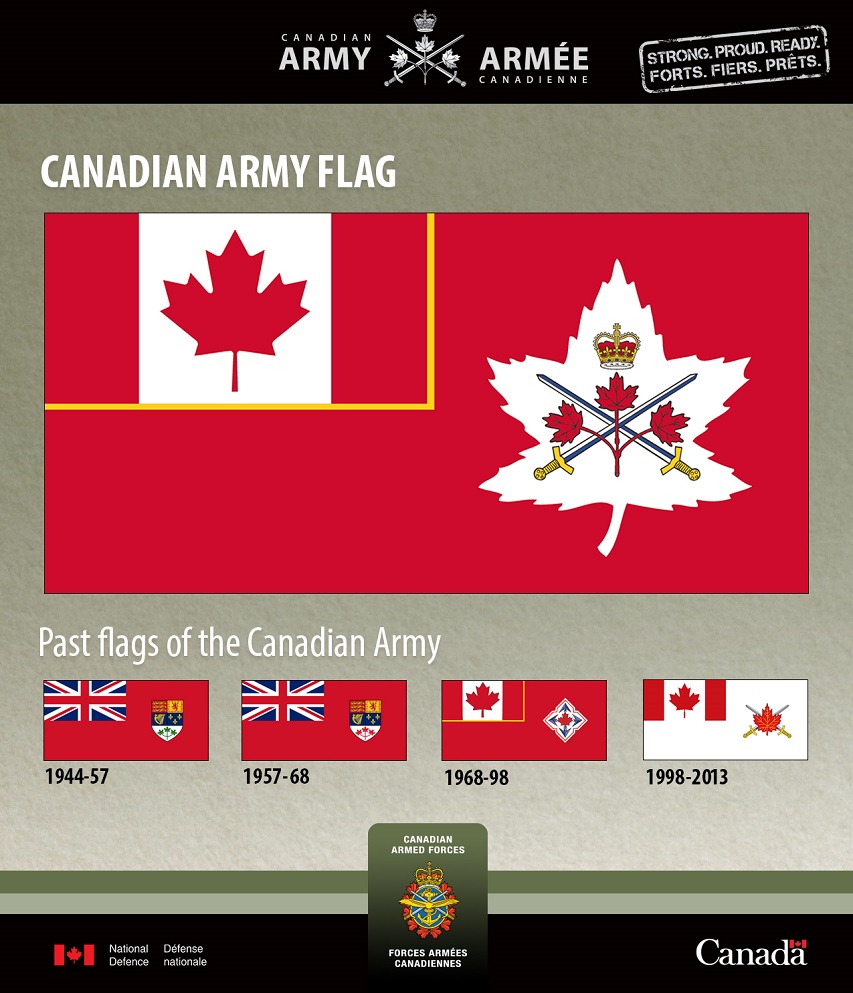
The Canadian Army (CA) will advance into the future under a new flag that nods to its proud past.
The flag was unveiled July 14, 2016, during a ceremony on Parliament Hill in which CA members welcomed their new Commander, Lieutenant-General Paul Wynnyk.
The new design features the Canadian flag and a white, stylized maple leaf against a red background. Superimposed on the white maple leaf is the badge that members used during the Second World War and the Korean conflict, consisting of three maple leaves over a pair of crossed swords. Sitting atop the centre leaf is an image of St. Edward’s Crown, a symbol that has been used in coronation ceremonies for over 300 years.
The maple leaf was worn on the collars of Canadian soldiers who fought in the Battle of Vimy Ridge during the First World War, and was included on the new flag to honour the 100th anniversary of the battle, which will be marked in 2017. The same maple leaf flew on the Headquarters flags of the fighting Divisions during the Second World War and still flies across Canada at the CA’s various Division Headquarters.
July 28, 2016
Canada’s National Heritage Digitization “Strategy”
Michael Geist explains why the federal government’s plans for digitization are so underwhelming:
Imagine going to your local library in search of Canadian books. You wander through the stacks but are surprised to find most shelves barren with the exception of books that are over a hundred years old. This sounds more like an abandoned library than one serving the needs of its patrons, yet it is roughly what a recently released Canadian National Heritage Digitization Strategy envisions.
Led by Library and Archives Canada and endorsed by Canadian Heritage Minister Mélanie Joly, the strategy acknowledges that digital technologies make it possible “for memory institutions to provide immediate access to their holdings to an almost limitless audience.”
Yet it stops strangely short of trying to do just that.
My weekly technology law column notes that rather than establishing a bold objective as has been the hallmark of recent Liberal government policy initiatives, the strategy sets as its 10-year goal the digitization of 90 per cent of all published heritage dating from before 1917 along with 50 per cent of all monographs published before 1940. It also hopes to cover all scientific journals published by Canadian universities before 2000, selected sound recordings, and all historical maps.
The strategy points to similar initiatives in other countries, but the Canadian targets pale by comparison. For example, the Netherlands plans to digitize 90 per cent of all books published in that country by 2018 along with many newspapers and magazines that pre-date 1940.
Canada’s inability to adopt a cohesive national digitization strategy has been an ongoing source of frustration and the subject of multiple studies which concluded that the country is falling behind. While there have been no shortage of pilot projects and useful initiatives from university libraries, Canada has thus far failed to articulate an ambitious, national digitization vision.
July 19, 2016
The Best Sniper Of World War 1 – Francis Pegahmagabow I WHO DID WHAT IN WW1?
Published on 18 Jul 2016
Francis Pegahmagabow was not only the most successful sniper of World War 1, but he is also among the most decorated aboriginal soldiers in history. He joined the Canadian Army in 1914 and quickly made a name for himself as a sniper during reconnaissance missions.


