Quotulatiousness

December 10, 2019

Warren Kinsella, the PPC, and “Operation Cactus”

Filed under: Cancon, Media, Politics — Tags: , , , — Nicholas @ 05:00

Kate at SDA linked to this interesting article by James Di Fiore on the Conservative Party’s contract with Warren Kinsella to smear Maxime Bernier and the PPC in the run-up to the Fall election:

If you were new to this country, or part of our sect of apathetic voters, there was a good chance you walked away from the election believing Bernier and his party were nothing but a bunch of racists who thought they finally found a home. From there, being branded the racist party in Canada, all the media had to do was either ignore the PPC, or only run negative stories, not wanting to be seen as an outlet giving positive coverage to what was deemed as obvious bigotry.

Enter Warren Kinsella.

I sometimes wonder how well-known Kinsella really is. Everyone in the Ottawa and Toronto bubble knows him. The media and party members know him. But he’s not exactly a household name, until now maybe. Kinsella, a throwback operative going back to the Chretien years, still manages to convince people to hire him, despite having a reputation of being hopelessly unsavoury, where the ends always justifies the means as long as you remind everyone along the way how great of a person you are.

Kinsella was hired by the Conservative Party of Canada to execute a campaign painting The People’s Party of Canada as a haven for bigotry and white nationalism. Secretly recorded by an employee, Kinsella was heard giving his team a pep talk on how to effectively destroy Bernier. He even tried to reinforce his motivational speech by bragging about falsely smearing three prominent politicians as racists when he knew they were not. He tries to catch himself by saying how easy it is to smear Bernier as a racist because, as Kinsella put it, “this guy actually is a racist.”

When a strong federal party hires a notoriously unethical operative to smear a new party as a gang of racists and bigots, it can be difficult to define your own brand. I asked Bernier if he thought there was a reason some racists did seem drawn to his party’s platform.

“It happened when Preston Manning started the Reform Party more than 25 years ago. People were saying that party was a racist party. The Conservative Party and Kinsella tried to do the same thing with us. That’s why I am looking at all my options to look at the legal procedures that we can do.”

Bernier might have a very strong case, especially now that Kinsella’s mask has been taken off by his own hand.

“The Conservative Party of Canada is morally and intellectually corrupt, and they proved that with their contract with Kinsella.”

It is still unknown how much the CPC and Kinsella impacted Bernier’s party, but it is reasonable to believe Kinsella was ultimately successful. On September 29th, at an event in Hamilton, several protestors accosted event attendees as they tried to get into the building at Mohawk College. The aggressiveness of the demonstrators was palpable as they screamed at seniors, calling them Nazis and preventing them from entering the building. Instances like this make Kinsella’s contract all the more mysterious. After all, his job, according to his own admission, was to activate Canadians against Bernier by stoking the flames of racial intolerance.

There are questions as to whether Kinsella’s fingerprints are on several other party missteps and controversies, including a rash of resignations earlier this year when former loyalists mysteriously began trashing the party publicly.

Operatives normally do not get caught bragging about having a track history of how their lies about other people’s bigotry have been successfully used to disrupt campaigns. In Bernier’s case, Kinsella, a self-proclaimed, lifelong fighter for racial justice, actually spent a career monetizing racial divisions he helped to stoke. When his shtick was exposed through his own accidental confessions, the hindsight view of Maxime Bernier became less blurry.

December 9, 2019

Nikki Haley, 2024?

Filed under: Cancon, Politics, USA — Tags: , , , — Nicholas @ 03:00

Ted Campbell looks at the US political scene and wonders if Nikki Haley will be the President after the 2024 federal election:

President Donald Trump and Ambassador Nikki Haley at the United Nations Headquarters in New York City, 24 September, 2018.
Official White House photograph by Shealah Craighead via Wikimedia Commons.

Following on from my previous post, I suspect that former Governor (South Carolina) and US Ambassador (to the United Nations) Nikki Haley might be President-elect of the United States five years from now. She is, right now, I think, the wholly unofficial but very clear voice of the post-Trump Republicans. She shares many of the Trumpian aims but she will campaign with a much different mixture of grit and grace, as the title of her recent book (campaign manifesto?) suggests.

It also seems pretty obvious to me, and to some other observers, that Justin Trudeau and the Liberal Party of Canada have decided that they can win a majority in (probably) 2021 by appealing even more strongly to the Laurentian Elites and thereby securing a half dozen more seats in each of Greater Vancouver and in urban Quebec and another dozen in (mainly) South-Western Ontario.

[…]

I think that Ambassador Haley’s comments are a shot across Canada’s bows made on behalf of the American establishment, not just Donald Trump. I suspect her remarks were very carefully crafted and even blessed by influential leaders in government, academe and in the huge array of think tanks in which America’s “government in waiting” resides. She is not speaking for Donald Trump; he can (likely will) speak for himself in his own, inimitable, bullying style. She is speaking for a larger, more permanent establishment, the “deep” administrative state that guards America’s permanent, vital interests.

Canadians need to pay attention. Nikki Haley matters; she (or someone very like her) is the future and she (or that similar someone) is the future to which we must accommodate ourselves for the 2020s and into the 2030s. We must remain a steadfast, trusted member of the US-led West. We, under Mackenzie-King and Louis St Laurent and John Diefenbaker, helped to build the US-led West, we even helped to lead it. Pierre Trudeau wanted to change Canada; he did, but not as much as he wished. His own Liberal ministers would not follow him all the way. Justin Trudeau is following in his father’s deeply flawed strategic footsteps which aim to make Canada irrelevant. He has a much tamer (weaker) cabinet allowing him and Chrystia Freeland to push Canada towards a strategic place where our country will be politically isolated, largely friendless and poor.

Liberals, by which, in the 2020s, I mean Conservatives, must speak out and offer Canadians a better, principled strategic vision which aims to secure our sovereignty, our prosperity and a respectable, responsible, leadership role ~ what Paul Martin called a role of pride and influence ~ in the world. Otherwise, Canada’s very sovereignty is in peril. If, as I expect, Donald Trump is re-elected next year and is then followed in 2024 by another, albeit “kinder, gentler” Trumpian, (which I believe is very likely because I think the Democratic Party in the USA will shatter after the 2020 election and will not be a real force again for a decade or more) then Canada must adapt. The importance of our bilateral relationship with America is to all other things as ten is to one.

December 8, 2019

The “Church of Atheism” doesn’t get charitable status … this time

Filed under: Cancon, Law, Religion — Tags: , , , , , — Nicholas @ 03:00

Colby Cosh on the recent court decision on the Church of Atheism’s attempt to qualify as a church — and receive the tax benefits — under Revenue Canada’s rules:

“The Descent of the Modernists”, by E.J. Pace, first appearing in his book Christian Cartoons, published in 1922.
Public domain via Wikimedia Commons.

Last week the Federal Court of Appeal upheld Revenue Canada’s rejection of an application for charitable status made by a “Church of Atheism” tucked away in Ontario’s Lanark Highlands. The idea of making a gesture like this has probably occurred to every atheist who looks around at a world of tax-exempt churches and wonders why his kind is excluded from the gravy train. (Clergymen pay tax on their income, but they have access to a generous residential deduction, and any professional expenses covered by the church go untaxed.)

The fact is that the “Church’s” efforts were a bit amateurish and confused. But they may, like a doomed military reconnaissance, have revealed weaknesses in the anomalous exclusion of atheists from religious tax exemptions.

These weaknesses cannot be any big secret. You probably remember the Supreme Court’s Mouvement laïque québécois v. Saguenay decision of 2015 — that’s the case in which the Quebec Court of Appeal had ruled that a statue of Christ with an electrically illuminated Sacred Heart was “devoid of religious connotation.” The Supreme Court, perhaps suppressing a chuckle or two, proceeded to unanimously overturn the Quebec ruling and expound the concept that the Canadian state has a Charter-based “duty of religious neutrality” (except, of course, where the constitution explicitly specifies otherwise, as with Catholic schools). Government, the SCC insisted, “must neither favour nor hinder any particular belief, and the same holds true for non-belief.”

Given that this is our law, what can be the problem with a “Church of Atheism”? Good question! Justice Marianne Rivoalen, writing on behalf of a three-judge Federal Court panel, confirmed the general point that there is a state duty of religious neutrality; in fact, even Revenue Canada, acting as the respondent, conceded this.

But the court simply ruled, without any logical elucidation, that “the Minister (of Revenue)’s refusal to register the appellant as a charitable organization does not interfere in a manner that is more than trivial or insubstantial with the appellant’s members’ ability to practise their atheistic beliefs. The appellant can continue to carry out its purpose and its activities without charitable registration.”

December 6, 2019

“‘The world needs more Canada’, some of us love to boast. Just not if it costs money”

Filed under: Cancon, Military, Politics, USA — Tags: , , , — Nicholas @ 03:00

In hindsight, President Trump let Justin Trudeau off rather lightly for his blatant disrespect on the world stage. Trump has all the cards in our bilateral trade relationship, and the Canadian economy isn’t in a healthy state at the moment. It’s not a risk any Canadian PM should be running when we are so “delinquent” on our NATO commitments, as Chris Selley points out:

Canadian soldiers set a perimeter position after disembarking a U.S. Navy landing craft during a simulated amphibious landing, 24 April 2009. The training exercise was part of the 50th iteration of UNITAS, a multi-national exercise intended to increase interoperability among participating navies. Other participating nations include Brazil, Peru, Mexico, Germany, Ecuador, Argentina and Chile.
U.S. Coast Guard photo by Petty Officer Seth Johnson via Wikimedia Commons.

The unfortunate thing is that the precipitating event for this little spat could have been useful: An American president publicly calling out Canada, in effect, as a deadbeat brother. At their media availability-cum-fireside chat, Trump accused Canada — again in remarkably diplomatic language, by his standards — of being “slightly delinquent” when it comes to military spending, particularly as it relates to our NATO obligations. The unofficial target for NATO countries is two per cent of GDP. In 2018, the World Bank pegged Canada at 1.25.

This is far from a unique state of affairs. “The world needs more Canada,” some of us love to boast. Just not if it costs money. As a percentage of gross national income, Canada’s foreign aid spending is 0.26 per cent — below the OECD average of 0.31 and a pale shadow of countries like Sweden and Norway, which spend quadruple that. During the last election campaign, no doubt having extensively focus grouped the idea, the Conservatives promised to cut aid spending by 25 per cent.

Canada routinely lobbies for a seat on the UN Security Council for reasons no one can quite articulate — I suspect because it’s a relatively inexpensive thing that we can then boast about. Trudeau’s Liberals orated furiously about Canada’s alleged peacekeeping imperative during the 2015 election, dithered for an eon about how to fulfil it, sent 200 soldiers and eight helicopters to Mali for a year, and then brought them home. Peace kept! Conservatives spent the previous decade talking up Canada’s hard-power credentials even as military spending fell, as a percentage of GDP, for five out of the nine years Stephen Harper was prime minister.

No Canadian government of any stripe can procure a new fighter jet, icebreaker or frigate to save its life — because at the end of the day, we can’t use them to save our lives. If things really go pear-shaped we’re basically begging at Uncle Sam’s feet anyway, so military procurement has become about buying votes and very little else. Military spending has risen under Trudeau’s Liberals, but it’s still less than the 2009 high point under Harper — 1.4 per cent of GDP, in 2009. It was above two per cent as recently as 1987.

Justin Trudeau meets with President Donald Trump at the White House, 13 February, 2017.
Photo from the Office of the President of the United States via Wikimedia Commons.

December 3, 2019

Canada and China

Filed under: Cancon, China, Economics, Politics — Tags: , , , , — Nicholas @ 05:00

Ted Campbell discusses Canadian foreign policies — or perhaps more accurately Canada’s lack of policies — on China:

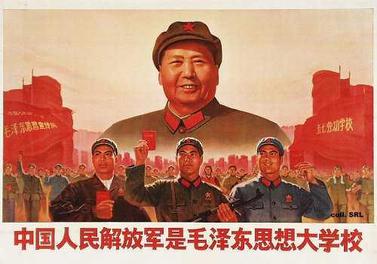
“The Chinese People’s Liberation Army is the great school of Mao Zedong Thought”, 1969.
A poster from the Cultural Revolution, featuring an image of Chairman Mao, published by the government of the People’s Republic of China.
Image via Wikimedia Commons.

There were many things that history might find regrettable about the Mulroney years but I doubt that it will fault him for having a principled and coherent foreign policy.

That all changed with Jean Chrétien, who was almost a neo-mercantilist, and for whom principle could never stand in the way of profit.

In the modern (Chrétien-Martin-Harper-Trudeau) era, Conservatives have been, broadly, anti-China, sometimes for reasons that are less than coherent or principled, and Liberals have been too prepared to “go along to get along” with China. This is because both parties reflect the incoherent views of the whole country. But political leaders shouldn’t (mustn’t) just reflect the views of their voters ~ that sort of populism is nonsensical ~ they must, as Edmund Burke said, bring his or her “unbiased opinion … mature judgment … [and] … enlightened conscience” to bear on each issue. But I’m afraid that too many (most?) modern Canadian political tacticians hold all those things in scant regard.

In the 2020s Canadians must listen to a few clear voices who will tell them that China is a competitor in many “markets” including in the marketplace of ideas, ideals, institutions and values. The current Chinese leadership is overtly hostile to Weterm liberal-democratic values and is not unwilling to punish any country with which it disagrees. It is protectionist, relatively rich and growing in military, political and economic power, but, still, somewhat cautious, and Xi Jinping’s China seems to be able to separate its own short-term political interests from its firm, long term, strategic goals. China, as Kevin Rudd reminded us just a few days agois contemptuous of weakness and prevarication,” which explains why it is so obviously contemptuous of Justin Trudeau’s Canadian government.

It is a fact that the Sino-Canadian relationship is “unbalanced:” China is a great power, Canada is not; China is an autocracy, Canada is a democracy; and so on but, as Kevin Rudd said (link just above) “China too has net strengths and weaknesses of which … [our] … strategists should be aware in framing our own strategy … [and we] … should be equally aware of our own strengths, weaknesses and vulnerabilities.” Canadian strategists need to educate Canadians about China so that a solid, informed majority will want a coherent and principled policy ~ one that puts our national vital interests first […]

Our policy towards China needs to be just one part of a coherent, principled foreign policy which Canadians understand and, broadly, support, and that, in turn, needs to be part of a Canadian grand strategy that aims to secure a place, as Paul Martin suggested, “of pride and influence in the world” ~ that, of course, was a place we enjoyed under St Laurent, Diefenbaker and Pearson, all of whom were acutely aware of the many and varied (and very divergent) views about Canada in the world that existed then and persist today in Canada’s many and varied communities.

December 2, 2019

Andrew Scheer’s Daisy connection

Filed under: Cancon, Politics — Tags: , , , — Nicholas @ 05:00

Jay Currie on the lingering stench of the spoiled Milk Dud’s campaign:

Andrew Scheer, paid tool of Big Dairy, chugs some milk during a Press Gallery speech in 2017. I’ve called him the “Milk Dud” ever since.
Screencapture from a CTV video uploaded to YouTube.

The sheer lack of ethics and paranoia hiring the Jackal demonstrates pretty much proves that Scheer is not fit to lead the CPC or to be Prime Minister. A fact which is dawning on the CPC itself as it struggles to figure out what to do with their present leader. Before Kinsellagate it was possible to say that Scheer was a decent, if uninspiring, leader. Now? It is indecent to hire a political mobster to beat up your opponents. Which leaves Scheer as merely uninspiring. I would be astonished if he survives a leadership review.

The revelation of Kinsella’s filth may sink Scheer but it burnishes Bernier’s reputation. Virtually all the accusations of “racism” levelled against the PPC and Max personally either were manufactured by Kinsella or occurred in a climate of hate created by the Jackal. I have never seen a credible accusation and now we have a pretty good idea why.

The PPC, even with Kinsella’s disinformation campaign, secured over 300,000 votes from a standing start a year before the election. If the CPC tears itself apart with a red/blue fight, a lot of thoughtful, conservative, people will give the PPC a second look. Conservative MPs looking for an alternative to the nastiness and vindictiveness of the Scheer people might well be tempted to join the PPC. Max had a lot of caucus support for his CPC leadership run. He was careful not to unfairly attack conservative positions, rather, during the campaign, he attacked CPC positions which were, in fact, Liberal-lite positions.

Political pundits, as they do after every election in which the Conservatives fail to win government, solemnly inform us that it was because the Conservatives failed to move towards the middle. The fact that only 30-35% of Canadians are even a bit right-leaning is trotted out to show how impossible it is for the Conservatives to win government unless they move left. I think this analysis is entirely incorrect. A solid, right of center party which had libertarian social views would hold that 30-35%. From there it is simply a matter of finding 3-5% in carefully targetted ridings. To do that a party would have to come up with policies which, while conservative, do not alienate middle-class voters, immigrant communities and women.

I don’t think there is a chance the CPC will manage that simply because they are too tied to establishment politics in Canada. Yeah multi-culti, boo climate change only echos the Liberal Party’s bland formula for success.

November 28, 2019

“The chickens are coming home to roost … but they are, actually, Pierre Trudeau’s chickens”

Filed under: Cancon, Government, Military, Politics, USA — Tags: , , , , — Nicholas @ 03:00

Ted Campbell looks at Justin Trudeau’s plight — needing to focus on policies that will increase his party’s chances of winning more seats in Quebec — with increasing demands from south of the border to get the Canadian commitment to higher military spending moved from “aspirational goal” to actual policy:

Justin Trudeau meets with President Donald Trump at the White House, 13 February, 2017.
Photo from the Office of the President of the United States via Wikimedia Commons.

Many in the media are saying, and I agree, that Justin Trudeau’s agenda for the next couple of years is about 99.9% domestic and focused, mainly, gaining seats in on Québec and holding on, at least, in Atlantic Canada and in urban and suburban Ontario and British Columbia. The overarching aim ~ the ONLY aim ~ of this government is to be re-elected with a majority.

As I mentioned a week or so ago, Donald J Trump is about to rain all over Justin Trudeau’s parade.

As Murray Brewster reports, for CBC News,

    The Liberal government is facing renewed political pressure from the administration of U.S. President Donald Trump to increase defence spending to meet the benchmark established by NATO [… and …] Robert O’Brien, the new U.S. national security adviser, said it is an “urgent priority” to get allies across the board to set aside military budgets that are equal to two per cent of the individual country’s gross domestic product [… while …] Speaking with journalists at the Halifax International Security Forum on Saturday, O’Brien rattled off a list of the world’s flashpoints, including Iran and Venezuela, as well as traditional adversaries such as Russia and China [… saying …] “There are very serious threats to our freedom and our security [… and adding that …] Canada made a pledge at [the 2014 NATO Summit in] Wales to spend two per cent. We expect our friends and our colleagues to live up to their commitments, and Canada is an honourable country; it’s a great country.”

Note the choice of words by Mr O’Brien, who is “a lawyer and former U.S. State Department hostage negotiator.” He doesn’t say that President Trump and the USA “asks” Canada to keep its word (although the Harper government said that spending 2% of GDP on defence was an “aspirational goal,” rather than a firm commitment) nor did he say something like “the US hopes Canada will change its ways and spend more on defence.” He said that Donald Trump’s America “expects” Canada to live up to its “pledge.” As I mentioned before, when President Trump negotiates with friends and allies he usually has both fists in the air and his knuckles are often reinforced with unfair trade tariffs and the like. Right now he is, for example, asking Japan and South Korea to pay much, much more to support American forces in their countries because, in his mind, he (America) is providing a “service” which is all for the Asians and is not, in any way, in America’s self-interest and, therefore, he wants to be reimbursed. It’s a very Trumpian notion. I am sure he sees NATO and NORAD in very much the same light.

[…]

The issue that worries some analysts is that while Canada is, in the final analysis, protected by the US because it is in America’s best interests to protect us, NATO provides a useful counter-balance and, in effect, helps us to at least pretend to be a little less than just another American colony. And that, having the status of being little better than a US colony, is what Pierre Trudeau willed upon Canada in the late 1960s and early 1970s when he wanted to leave NATO, entirely and saddled Canada with his, juvenile, nonsensical, neo-isolationist “Foreign Policy For Canadians” white paper in 1970. Although Brian Mulroney wanted Canada to be independent – think standing up to President Reagan and Prime Minister Thatcher on South Africa – and Stephen Harper did, too, the cumulative impact of Trudeau-Chrétien-Trudeau for 30 of the last 50 years has been too much to change. When our political leaders don’t care about Canada being a leader amongst the nations and don’t, in fact, even care about Canada being a truly sovereign state then we will sink, inevitably, into the status of an American colony.

November 26, 2019

The Avro Arrow

Filed under: Britain, Cancon, History, Military, Technology, USA — Tags: , , , , — Nicholas @ 04:00

The History Guy: History Deserves to Be Remembered
Published 25 Nov 2019

In the 1950s, Canada had one of the world’s most advanced aerospace industries. But the cancellation of the Avro CF-105 “Arrow” changed everything. The History Guy remembers the Avro Arrow and forgotten aviation history. It deserves to be remembered.
(more…)

November 23, 2019

What? No minister for socks? How will Justin decide what to wear?

Filed under: Cancon, Economics, Government — Tags: , , — Nicholas @ 03:00

Chris Selley on the quirky decision to appoint a “Minister of Middle Class Prosperity” to Justin Trudeau’s new cabinet:

Typical image search results for “Justin Trudeau socks”

Wednesday’s Cabinet shuffle featured the usual head-scratching reorganization of portfolios and outright invention of others, “bigger” being for some reason a stated goal. Joyce Murray, for example, becomes Minister of Digital Government. It has a very pre-Y2K ring to it, but then again the government in question accepts payment for access-to-information requests by cheque, and sometimes fulfills them (if at all) via CD-ROM, and it can’t manage a simple payroll system. So maybe it’s not such a bad thing to have someone on that job specifically.

Then there’s Ottawa-Vanier MP Mona Fortier’s new job. I literally assumed people were joking about the Liberals’ obsessive branding, but it’s true: No word of a lie, she is an Associate Minister of Finance and, specifically, the Minister of Middle Class Prosperity.

Should a government need a minister whose job is to ensure Canadians are prospering? One might reasonably hope that’s the goal of pretty much any minister when she rolls out of bed in the morning. But they sure don’t always act that way, so maybe a Minister for Making People Richer isn’t such a bad thing.

But the “middle class” flourish is so ridiculously on-brand that it turns the very idea into a joke. Recalling Trudeau’s 2015 catchphrase, many wags asked: “Shouldn’t it be the Minister of the Middle Class and Those Working Hard to Join It?” And they have a point. After four years in government, the Liberals have a good story to tell on social mobility: Poverty rates are at an all-time low. And yet they remain officially obsessed with a middle class that was never as imperilled as they claimed.

November 20, 2019

Activist court watch – Federal Court of Canada judge creates new website blocking rules

Filed under: Cancon, Law, Media — Tags: , , , , — Nicholas @ 03:00

Michael Geist on the precedent-setting decision from the Federal Court of Canada:

A Federal Court of Canada judge issued a major website blocking decision late Friday, granting a request from Bell, Rogers, and Groupe TVA to block access to a series of GoldTV streaming websites. The order covers most of the Canada’s large ISPs: Bell, Eastlink, Cogeco, Distributel, Fido, Rogers, Sasktel, TekSavvy, Telus, and Videotron. The case is an important one, representing the first extensive website blocking order in Canada. It is also deeply flawed from both a policy and legal perspective, substituting the views of one judge over Parliament’s judgment and relying on a foreign copyright case that was rendered under markedly different legal rules than those found in Canada.

Perhaps most troubling is that the judge has created a substantive new policy framework for site blocking, an issue that given the many complex policy issues (including copyright enforcement, freedom of expression, net neutrality, and telecom competition) is best left to Parliament. Indeed, the activist judicial approach explicitly engages in an analysis that considers many of the policy issues but arrives at its own conclusion about how best to balance competing interests. These are issues that are best left to elected officials. The Standing Committee on Industry, Science and Economic Development, which completed the comprehensive copyright review earlier this year, heard extensive submissions from groups calling for reforms to the law to include site blocking. It instead recommended:

    Following the review of the Telecommunications Act, that the Government of Canada consider evaluating tools to provide injunctive relief in a court of law for deliberate online copyright infringement and that paramount importance be given to net neutrality in dealing with impacts on the form and function of Internet in the application of copyright law.

In other words, the committee recommended holding off on a site blocking rule until further study is conducted. Moreover, it concluded that “paramount importance be given to net neutrality.” The judge in GoldTV acknowledged that there were net neutrality concerns (rejecting claims that “net neutrality is of no application where a site blocking order is sought.”), but concluded that the net neutrality issues did not tip the balance against granting the injunction. Not only is that inconsistent with the copyright review emphasis of paramountcy for net neutrality, but it represents the judge making a policy choice best left to elected officials.

The CRTC, which rejected a proposal for an administrative site blocking system in the FairPlay case, also thought the issue was best left to the government. Its ruling specifically cited the copyright review and the review of the Broadcasting and Telecommunications Act as avenues to address the issue. In other words, the appropriate venue to consider site blocking was government, not an administrative agency.

November 17, 2019

Book Review: Arms & Accoutrements of the Mounted Police 1873-1973

Filed under: Books, Cancon, History, Weapons — Tags: , , — Nicholas @ 02:00

Forgotten Weapons
Published on 15 Sep 2019

http://www.patreon.com/ForgottenWeapons

Cool Forgotten Weapons merch! http://shop.bbtv.com/collections/forg…

The Royal North West Mounted Police (later merged with the Dominion Police to become the RCMP — Royal Canadian Mounted Police) are an interesting and often overlooked element of the western frontier. We Americans tend to only think about the Old West up to northern Montana and Idaho, but of course things were not that much different on the other side of the border in Alberta, Saskatchewan, Yukon, and the other western provinces. Starting with their founding in 1873, law enforcement in western Canada was the domain of the RNWMP, and they used an interesting mixture of British Empire arms and American arms – Colts and Adams; Winchesters and Sniders.

Arms and Accoutrements of the Mounted Police, 1873-1973 covers the whole range or arms and accessories used by the Mounties. Handguns, rifles, shotguns, machine guns, swords, lances, and even artillery (yes, they had some artillery). This is a great book for any Canadian collector, and quite interesting for the rest of us as well — a window into a police agency we don’t often think about.

The book is generally out of print, but as of this writing still in stock for $35 at JoeSalter.com:

https://www.joesalter.com/category/pr…

Contact:
Forgotten Weapons
6281 N. Oracle #36270
Tucson, AZ 85704

November 14, 2019

Albertan separatism – “we don’t want to become Newfoundland”

Filed under: Cancon, Government, Politics — Tags: , , , — Nicholas @ 03:00

Colby Cosh discusses the hot topic in western Canada, separatism:

In trying to puzzle out the immediate future of Greater Alberta’s struggle with Confederation, one is naturally exposed to many varieties of the question “What are you blue-eyed sheiks complaining about?” Alberta is still a province with relatively high incomes despite a labour market that has been in the doldrums for years: why, people ask, is there separatist panic in a place that is still far wealthier than, say, Newfoundland? A good short answer to this would be “That’s why everybody here is going nuts: we don’t want to become Newfoundland.”

Newfoundland, unlike Alberta, was given the choice of joining Confederation on a bare majority vote; the result, in time, is that the province’s defining cod industry was permanently annihilated … thanks to expert, scientifically informed, completely well-intentioned centralized management from Ottawa. Hey, mistakes happen! One long-term consequence of this one is that a large fraction of the ethnic stock of Newfoundland now lives and works in Alberta. It might be that “Wexit” sentiment is especially strong in this expatriate community, though no one has any hard data to hand yet.

A crucial purpose of Alberta Premier Jason Kenney’s “Fair Deal Panel,” announced on the weekend, is to gather some. Kenney announced, in a speech which reaffirmed his own strong commitment to federalism, that Preston Manning will head a group of MLAs and academics whose job will be studying ideas for giving Alberta more autonomy within Confederation. The “Fair Deal Panel” is going to look at a number of concepts that have been swirling around for decades but which were ignored by Alberta’s Progressive Conservative governments. One notes, however, that the panel does have a mandate to sound out public opinion quantitatively, through polling and focus groups.

Some of the political concepts recommended to the Fair Deal Panel for study appeared in what is remembered as the Alberta “Firewall Letter,” authored by Stephen Harper and a group of Calgary School fellow-travellers (not including Kenney); the letter was first published in this newspaper in 2001. The firewall had five components: Alberta withdrawal from the Canada Pension Plan, Alberta withdrawal from the federal Tax Collection Agreement, the revival of an Alberta Provincial Police force, a request for tax points from the federal government in place of cash transfers for health and welfare, and a provincial referendum on Senate reform, which was still a thing back then.

November 11, 2019

Mark Knopfler – “Remembrance Day”

Filed under: Britain, Cancon, History, Military, WW1, WW2 — Tags: , — Nicholas @ 04:00

Bob Oldfield
Published on 3 Nov 2011

A Remembrance Day slideshow using Mark Knopfler’s wonderful “Remembrance Day” song from the album Get Lucky (2009). The early part of the song conveys many British images, but I have added some very Canadian images also which fit with many of the lyrics. The theme and message is universal… ‘we will remember them’.

November 9, 2019

The Milk Dud and “sin”

Filed under: Cancon, Media, Politics, Religion — Tags: , , , — Nicholas @ 03:00

Chris Selley believes that introducing the notion of “sin” as an appropriate thing to discuss with a politician will be a very bad idea for Canadian politics:

Andrew Scheer, paid tool of Big Dairy, chugs some milk during a Press Gallery speech in 2017. I’ve called him the “Milk Dud” ever since.
Screencapture from a CTV video uploaded to YouTube.

At a Wednesday press conference in Ottawa, a Globe and Mail reporter asked Andrew Scheer if he believes homosexuality is a “sin.” He didn’t answer, as has become his trademark on this file; instead he pledged, for the umpteenth time, simply to stand up for gay rights in all their forms.

It has been maddening to watch: Despite literally dozens of opportunities, he could never bring himself to explicitly support equal marriage. Bringing “sin” into the question is a novelty, though, and it’s one of which we need to be exceedingly leery.

[…]

The question of “sin” takes us into new and dangerous territory, however. There is what politicians do, and then there is what they think, and then — buried way down under many layers of irrelevance — there is their personal relationship, if any, with higher powers and their associated scriptures; there is the question of what they think that higher power would make of other people’s behaviour; there is what they believe will happen to those people’s immortal souls.

These are not topics the secular media should be concerning themselves with, and nor should the average voter. No one would approve of someone they like being put through such an inquisition. Liberals would be aghast if their avowedly Catholic leader were asked if his faith played a role in his government not eliminating restrictions on gay and bisexual men donating blood, for example. Liberals often speak glowingly of the days when politicians set aside religion and pursued the greater good — politicians like Pierre Trudeau, a devout Catholic who famously said “what goes on in private between two consulting adults is their own private business,” but who somewhat less famously spoke of “separating the idea of sin and the idea of crime.”

Trudeau Sr. was absolutely right that the state should have no dominion over sin, in any sense of the word. That should go for politics, too. Politicians of known faiths and devoutness have advanced many of progressive Canadians’ most cherished causes — public health care, most notably — and politicians of unknown faiths and devoutness have taken us down dark alleys. And vice versa. There is nothing we can do with information about a politician’s personal metaphysical views except raise new barriers to entry into a politics that needs fewer.

November 8, 2019

Cooey: The Unassuming Canadian Workhorse

Filed under: Cancon, History, Weapons — Tags: , , — Nicholas @ 04:00

Forgotten Weapons
Published 6 Nov 2019

http://www.patreon.com/ForgottenWeapons

Cool Forgotten Weapons merch! http://shop.bbtv.com/collections/forg…

Cooey is a brand name that will be immediately recognized by Canadians, but pretty much unknown everywhere else. Founded in 1903 by Herbert Cooey, the company would produce a series of simple and practical firearms that became hugely popular and common in Canada. The basic models were the single-shot .22 Model 39, the bolt action magazine-fed .22 Model 60, and the break action single-shot Model 84 shotgun (and the Model 64 semiautomatic .22, made after the company was sold out of the Cooey family). These are not particularly exciting firearms, but they are ubiquitous across Canada, having served Canadian families reliably for a
century now.

Contact:
Forgotten Weapons
6281 N. Oracle #36270
Tucson, AZ 85704

« Newer PostsOlder Posts »

Powered by WordPress