
First, company stores flourished in many parts of the USA, especially in the coal regions and other places with many isolated work sites, long before any legal minimum wages were put into effect. Second, Alchian is right that the workers understood perfectly how these stores worked (how could they not have when the stores were so common?): they provided basic consumption goods — flour, bacon, beans, kerosene, matches, cotton cloth — at the work-and-living site on credit, as advances against the workers’ future pay. Yes, the prices were higher than in, say, the closest towns. But the closest towns were often much too far away to allow the workers or their wives to go there easily, frequently, or cheaply. So, what the stores actually did was to reduce transaction costs for the workers, who otherwise would have been unlikely to accept employment in remote, isolated places far from stores.
Robert Higgs, letter to Don Boudreaux, 2016-11-06.
September 11, 2018
QotD: Debunking the “company store” story
September 9, 2018
Hunter S. Thompson, Jann Wenner and Rolling Stone
Darcy Gerow on the sudden rise and long, long decline of Rolling Stone:
The suffocating media bias of the 1960s was difficult to escape. A lethargic gray specter of middle-class America was distributed with cunning sterility through the generic, bogus smiles of cable news networks and traditional print. Despite the election and assassination of Kennedy and the signing of the Civil Rights Act, if you had turned on a T.V. this was still Eisenhower’s America: regimented, religious, conservative. And the cultural vacuum created by the Eisenhower years had began to suck even harder with Lyndon Baines Johnson at the helm.
American media was out of touch with this new generation. Elitist authoritarians were preaching their moral superiority stamped with stars and stripes to a generation of cynics. These kids didn’t have a fucking clue what they wanted, but they wanted no part of what they were being given. So rose Rolling Stone, a counterculture bible for babyboomers, co-founded by Jann Wenner.[…]
Things were different in the 1960s. The anti-war movement and the civil rights movement were a just cause. The catalyst for a just movement of equal rights for women and gays and minorities was free speech, of which Jann Wenner was a huge proponent. When students at U.C. Berkley marched in the streets in the 1960s, it was an attack on the elitist, authoritarians and an establishment hellbent on keeping opposing viewpoints and the ideas of personal liberty stifled. The gang of “cruel faggots” kept the official narrative running but no one under 30 was listening.
The whole goddamn world had had enough of the travesty of war in Southeast Asia. There was no ignoring the ineptitude of American politics. The only reasonable thing to do in 1969 was to drive out to Altamont for the weekend, load up on heinous chemicals, hunker down and rethink your approach to the political process.
Thompson, the then-young, liberal anti-hero, could often be found gobbling LSD and firing his guns (he was a lifetime member of the NRA) at propane bottles for a crowd of jeering burnouts or Bay area bikers at his fortified compound, Owl Farm, in Woody Creek Colorado.
It was Jann Wenner’s idea to put Hunter, with all of his fear and loathing, on to the campaign trail in 1972. Why not get the guy who wrote Hell’s Angels? Hunter was someone with a penchant for dealing with vicious thugs and sick freaks gone crazy on power, someone who could draw a parallel between Richard Nixon and Sonny Barger.
Thompson’s openly-biased, subjective and wild account of the 1972 presidential election was the red Chevy convertible of campaign coverage. ‘Sympathy for the Devil’ on repeat and at full volume, barrelling across the country at 110 miles an hour or so and in search of an honest politician. In Hunter’s eyes, the only one that even came close was George McGovern, the senator from South Dakota.
McGovern’s non-interventionist platform focused on a complete withdrawal from Vietnam, amnesty for draft evaders and a Milton Freidman-inspired, negative income tax meant to replace the bureaucratic burden of social welfare programs and a complicated tax code. Thompson’s version of events is the story of an idealistic underdog fighting against the odds only to be crushed by postmodern Americanism and the establishment incumbent, “Tricky Dick Nixon.” McGovern might have owed a White House win, in part, to Thompson’s and Rolling Stone’s relentless support had he not owed his White House loss to the mental distress of his vice-presidential pick, Thomas Eagleton.
There’s no way to properly explain how great Rolling Stone was in those early years. How well the magazine represented the anti-establishment culture, individual liberty and equality for everyone. It can’t be compared to anything else because there was nothing else, only the traditional mainstream garbage and Rolling Stone.

September 5, 2018
Mind Your Business Ep. 1: Breaking the Mold
Foundation for Economic Education
Published on 4 Sep 2018Join host Andrew Heaton as we profile the stories of interesting entrepreneurs from around the country for FEE’s newest series, Mind Your Business.
In this episode, we’ll meet Jeremy Umansky. He’s a chef with a true passion for unusual food and his unique brand of cuisine is making a big splash in the culinary world.
September 2, 2018
Amtrak service and the “takings” clause
Back in August, Fred Frailey reluctantly came to the conclusion that at some point American freight railways are going to have to challenge in court Amtrak’s legislated ability to pre-empt freight traffic on their networks:

Amtrak’s
Eastbound Empire Builder crossing Two Medicine Trestle at East Glacier MT on 20 July 2011.
Photo by Steve Wilson via Wikimedia Commons.
We all know about “taking the Fifth.” It’s our right under the Fifth Amendment to the U.S. Constitution not to be compelled to testify against ourselves. In other words, a court cannot force us to admit to driving 60 mph in a 45-mph zone (or something worse). That amendment has another, less-well-known clause, which says government cannot take away our property without just compensation. Lawyers know this as the “Takings Clause.” The Fifth came to mind the other day as I rode Amtrak’s Empire Builder from Seattle to Chicago. I’ll get to my point, but first the experience.
[…]
All of this did terrible things to our schedule-keeping. By the third morning, as the train approached Devils Lake, N.D., we were more than eight hours late (the next day’s eastbound Builder was even later). But imagine what the Empire Builder does to BNSF’s freights every day. The Amtrak Improvement Act of 1973 reads: “Except in an emergency, intercity passenger trains operated by or on behalf of [Amtrak] shall be accorded preference over freight trains in the use of any given line of track, junction, or crossing.”
BNSF appears totally committed to obedience of this law but doing so devours the capacity of this route. It’s not just that freights give way; whizzing along at a 79 mph versus 55 or 60 for the freights, the Empire Builder eats capacity as if it were two or three freights, Six high-priority Z trains prowl the northern Transcon every day, and I don’t think a single one of them that I observed was moving as we went by. One Z train was sandwiched between two stopped manifest trains, all making way for our Builder.
Obviously, Amtrak pays BNSF for the right to run trains over the freight railroad. But whatever it pays is but a fraction of the cost in delays to its own trains incurred by BNSF. Were the northern Transcon double-tracked all the way, these delays would obviously be minimized. But at $3 million or more a mile, double tracking consumes capital like a dry sponge, and it’s not Amtrak’s capital, either.
So now to my point: Isn’t it fair to say that Amtrak, which the U.S. Supreme Court in 2015 decreed to be an arm of government, is confiscating the property (track capacity) of host railroads? And if it is, shouldn’t the freight railroads be fairly compensated for the delays to their freights caused by the loss of this capacity? Try as I might to say otherwise, I am forced to answer “yes” to both questions.
September 1, 2018
The legal tangle around the Trans-Mountain pipeline approval process
Jay Currie suspects the process has been intentionally complicated to the point that there may not be a way out for this government:
What the Court essentially asked was, “Did the Federal Government consult enough?” and then concluded, “No, not enough.”
How much is “enough”? That is a question which this decision really does not answer. And I suspect it does not answer it because there is actually no answer which is even close to true.
In a normal process a reasonable level of public consultation would be reached when the public has been given an opportunity to comment on the matter at hand. Which is a bit vague but there is case law which fleshes out what such an opportunity might look like.
However, once environmentalists and First Nations are engaged it is not at all obvious that merely having the opportunity to comment is sufficient. Unlike a rezoning application, an application to build a pipeline (or, realistically, virtually any other large undertaking) creates the opportunity for First Nations to talk about everything from ancient hunting rights, to sacred grounds, to former village sites, to disruptions to present First Nation culture and so on. Having the environmentalists involved ensures that the relatively easy solution of simply paying the First Nations’ people for their consent, is off the table. That solution will be denounced by the enviros as cultural genocide and worse.
All of which creates, and might arguably have been intended to create, a Gordian knot when it comes to considering major projects. Consultation becomes an endless task and one which has no defined parameters. The decision today indicates that an extensive consultation process is not enough but it does not indicate what might be enough.
Delightfully, the shareholders of Kinder Morgan – which owns TransMountain – voted today to sell the project to Canada’s feckless Federal Government for several billion dollars.
I suspect the CEO danced a little jig relieved that he no longer had to guess at how far consultations have to go. But Canada is stuck with a completely dysfunctional system which is being exploited by environmentalists and First Nations to prevent infrastructure from being built. That will have to be fixed.
August 31, 2018
Farewell, buck-a-beer publicity stunt, we hardly knew ye
Chris Selley on the all-too-brief publicity stunt of cheaper beer for Ontario:
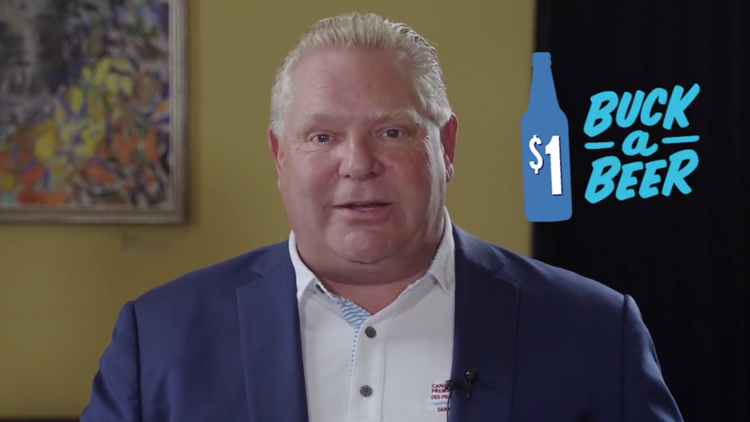
President’s Choice is ending its buck-a-beer promotion on Sept. 3, just days after it started: We get one week, one long weekend and then out of the pool, party’s over, back to class. PC-branded beer will rocket back up to $1.38 a bottle when you buy 24 at The Beer Store or $1.65 when you buy 12, which highlights just how steep — and presumably unsustainable — the discount really was. We shall see how long the two other participating breweries’ offers last, but they made it quite clear, as did PC, that this was a limited-time offer prompted by Doug Ford’s most shamelessly blunt populist pledge.
My goodness, though, what a commotion it will leave in its wake. Some brewers quite understandably took the opportunity to note the impact of aluminum tariffs on their bottom lines, to complain that Ford’s government was playing favourites by giving away expensive product placement in LCBO stores for $1 beer, and to note the government is actually raising taxes on beer.
Others, however, waxed utterly scandalized. “How about buck a pound of steak? Who would eat that?” asked one Toronto brewer who had perhaps not entirely thought through his rhetorical question. “We haven’t even given two thoughts about this,” Great Lakes Brewery’s communications manager, Troy Burtch, told the Toronto Star. “Why would anyone do this?” Burtch and Great Lakes have signalled their total uninterest by tweeting incessantly about it.
The Canadian Taxpayers’ Federation went after some of the affronted craft brewers for accepting taxpayer subsidies for their higher-end products. People on social media lined up for and against buck-a-beer, vowing to boycott the participants or those complaining about the program.
The whole thing was a dumb Ford Nation stunt, no question. But good grief. You can hardly blame the breweries, either for participating or for not: they were just trying to wring as much publicity as they could from the situation. No one is really any worse off, or at least not much. What we were really seeing among the chattering classes was a rerun-by-proxy of the June 6 election: to drink Ford’s swill was to vote Ford Nation; to boycott it was to stand bravely against their entire agenda.
August 30, 2018
Britain “forgets” to regulate e-cigarettes, youth smoking drops substantially
Last month, Matt Ridley sang the praises of the regulators who didn’t regulate:

A selection of e-cigarettes
Photo by Ecig Click via Wikimedia Commons.
Britain is the world leader in vaping. More people use ecigarettes in the UK than in any other European country. It’s more officially encouraged than in the United States and more socially acceptable than in Australia, where it’s still banned. There is a thriving sector here of vape manufacturers, retailers, exporters, even researchers; there are 1,700 independent vape shops on Britain’s streets. It’s an entrepreneurial phenomenon and a billion-pound industry.
The British vaping revolution dismays some people, who see it as a return to social acceptability for something that looks like smoking with unknown risks. Yet here, more than anywhere in the world, the government disagrees. Public Health England says that vaping is 95% safer than smoking and the vast majority of people who vape are smokers who are partly or wholly quitting cigarettes. The Royal College of Physicians agrees: “The public can be reassured that ecigarettes are much safer than smoking.”
Lots of doctors are now recommending vaping as a way of quitting smoking. It is because of vaping that Britain now has the second lowest percentage of people who smoke in the European Union. The youth smoking rate in the UK has fallen from 26% to 19% in only six years.
How did this happen here? It’s partly the fault of the advertising executive Rory Sutherland; he is the Walter Raleigh of this revolution. In 2010, he walked into an office in Admiralty Arch to see an old friend, David Halpern, head of David Cameron’s new “nudge unit”, formally known as the Behavioural Insights Team. Sutherland pulled out an electronic cigarette he had bought online, and inhaled. By then, several countries including Australia, Brazil and Saudi Arabia had already banned the sale of electronic cigarettes — usually at the behest of tobacco interests or public-health pressure groups. California had passed a bill banning them, though Arnold Schwarzenegger, then the governor, had vetoed it. It looked inevitable that Britain would follow suit.
“I was a very early convert,” Sutherland tells me now. “Partly because I was a longtime ex-smoker myself who found them much better than constant relapses; I was also interested in the placebo effect they offered by mimicking the act of smoking. But I was almost equally fascinated by the psychology of the people who instinctively wanted to ban them.”
Halpern took notice. He knew the theory of “harm reduction” — that it is more effective to give somebody the lesser of two evils than insist unrealistically on immediate abstinence. So he asked his nudge team to get digging. Over coffee at No 10, he was surprised to learn that even the anti-smoking group Ash was leaning in favour of ecigarettes. So when public-health nannies started calling for them to be banned, Halpern made sure the government resisted.
In his book Inside the Nudge Unit, Halpern wrote: “We looked hard at the evidence and made a call: we minuted the PM and urged that the UK should move against banning e-cigs. Indeed, we went further. We argued we should deliberately seek to make e-cigs widely available, and to use regulation not to ban them but to improve their quality and reliability.”
H/T to Rafe Champion for the link.
August 29, 2018
The Conservative convention, bought and paid for by the friends of supply management
Colby Cosh relates the details of how well stage-managed the Conservative convention in Halifax was … from the point of view of the beneficiaries of supply management:
A copy of a “briefing binder” that the Dairy Farmers of Canada had given to representatives of supply-managed agriculture was carelessly discarded, found by a Calgary delegate named Matthew Bexte, and splattered onto the internet. The contents of the binder describe the strategy and outline the available forces of the supply-management squad. The resolutions being discussed by the convention included one favouring the repeal of expensive tariff protection for Canada’s egg, dairy, and poultry cartels, and the binder lists the particular responses and tactics to be used depending on how far the offending free-trade resolution advanced in the debate.
Which it didn’t. The motion in favour of letting Canadian suckers buy foreign cheese in dangerous unregulated quantities died noisily in a “breakout session,” never even reaching a vote, much less the plenary session of the convention. As the National Post’s uncannily versatile Marie-Danielle Smith documented before the briefing book was leaked, free-trade delegates had already caught the scent of a rat, complaining that the motion had been suppressed through strategic delay by operatives working for party leader Andrew Scheer.
The Dairy Farmers of Canada briefing describes this motion-suppression tactic as “Scenario 2,” calling it a “sub-optimal” outcome: “It buys us (supply-managed farmers) a reprieve, but doesn’t put the issue to rest.” According to the briefing notes, if the motion had passed in the Friday breakout session, that would plunge the world into “Scenario 3.” Under Scenario 3, a Friday evening reception at an Irish pub, with free food and potables, would come into play: quota-sucking farmers and their public-relations goons would have been given a chance to mingle with well-lubricated CPC delegates, with “infographics on a slideshow” pulsing subliminally in the background.
The hope here would be to prevent a devastating “Scenario 5,” in which the destruction of supply management came before the whole CPC assembly for a vote and won it. The prospective talking points accompanying Scenario 5 warn that “Members of the Conservative Party of Canada have sent a clear signal that they do not support Canadian farmers” and they hiss menacingly that “Canadians will remember the position taken by Conservatives today.”
Fortunately, even in the event of a flat-out Scenario 5, there would still be what the book calls the “Safety Net.” The safety net is that annual party conventions are meaningless, expensive balderdash anyway. Or, as the Dairy Farmers of Canada (DFC) book puts it: “The powers of the Leader are far-reaching in preventing a policy from being in the party platform. DFC has been told by the Leader’s office that he will exercise this power … regardless of the outcome at convention.”
Good old Andrew … he knows who put him in his current position and has signalled in advance that he’ll “stay bought”. Too bad for Canadian consumers, but great news for the leeches who benefit from the market distortions of supply management.
August 24, 2018
From Software-as-a-Service to emerging Techno-Feudalism
The shift from selling software to selling software subscriptions was a major sea-change in the technology world. Here’s a bit of historical perspective from The Z Man to explain why this could be a very bad thing indeed for the average user:
Feudalism only works when a small elite controls the source of wealth. Then they can control the exploitation of it. In Europe, as Christianity spread, the Church acquired lands, becoming one of the most powerful forces in society. The warrior elite was exclusively Catholic, thus they had a loyalty to the Pope, as God’s representative on earth. Therefore, the system of controlling wealth not only had a direct financial benefit to the people at the top, it had the blessing of God’s representative, who sat atop the whole system.
That’s something to keep in mind as we see technology evolve into a feudal system, where a small elite controls the resources and grants permission to users. The software oligopolies are now shifting all of their licensing to a subscription model. It’s not just the mobile platforms. Developers of enterprise software for business are adopting the same model. The users have no ownership rights. Instead they are renters, subject to terms and conditions imposed by the developer or platform holder. The user is literally a tenant.
The main reason developers are shifting to this model is that they cannot charge high fees for their software, due to the mass of software on the market. Competition has drive down prices. Further, customers are not inclined to pay high maintenance fees, when they can buy new systems at competitive rates. The solution is stop selling the stuff and start renting it. This fits the oligopoly scheme as it ultimately puts them in control of the developers. Apple and Google are now running protection rackets for developers.
It also means the end of any useful development. Take a look at the situation Stefan Molyneux faces. A band of religious fanatics has declared him a heretic and wants him burned. The Great Church of Technology is now in the process of having him expelled from the internet. As he wrote in a post, he invests 12 years building his business on-line, only to find out he owns none of it. He was always just a tenant farmer, who foolishly invested millions in YouTube. Like a peasant, he is now about to be evicted.
How long before someone like this monster discovers that Google and Apple will no longer allow him to use any apps on his phone? Or maybe he is denied access to his accounting system? How long before his insurer cuts off his business insurance, claiming the threat from homosexual terrorists poses too high of a risk? Federal law prevents the electric company from shutting off his power due to politics, but Federal law used to prevent secret courts and secret warrants. Things change as the people in charge change.
August 23, 2018
Cultural Appropriation Tastes Damn Good: How Immigrants, Commerce, and Fusion Keep Food Delicious
ReasonTV
Published on 1 Aug 2018Writer Gustavo Arellano talks about food slurs, the late Jonathan Gold, and why Donald Trump’s taco salad is a step in the right direction.
———-Reason is the planet’s leading source of news, politics, and culture from a libertarian perspective. Go to reason.com for a point of view you won’t get from legacy media and old left-right opinion magazines.
—————————
The late Jonathan Gold wrote about food in Southern California with an intimacy that brought readers closer to the people that made it. The Pulitzer Prize–winning critic visited high-end brick-and-mortar restaurants as well as low-end strip malls and food trucks in search of good food wherever he found it. Gold died of pancreatic cancer last month, but he still influences writers like Gustavo Arellano, Los Angeles Times columnist and author of Taco USA: How Mexican Food Conquered America.
Arellano sat down with Reason‘s Nick Gillespie to talk about Gold’s legacy, political correctness in cuisine, and why Donald Trump’s love of taco salad gives him hope in the midst of all of the president’s anti-Mexican rhetoric. The interview took place at Burritos La Palma, named by Gold as home to one of the five best L.A. burritos.
August 15, 2018
Hotel security theatre meets DEF CON attendees in Las Vegas
Las Vegas hotels have a clear duty to be more vigilant about their security procedures, but the folks at the most recent DEF CON gathering were perhaps not the best-chosen group to try out a new “swaggering bully-boys security enforcement” policy:
In the wake of the mass shooting in Las Vegas in October of 2017, hotels in the city started drafting more aggressive policies regarding security. Just as Caesars Entertainment was rolling out its new security policies, the company ran head on into DEF CON — an event with privacy tightly linked to its culture.
The resulting clash of worlds — especially at Caesars Palace, the hotel where much of DEF CON was held — left some attendees feeling violated, harassed, or abused, and that exploded onto Twitter this past weekend.
Caesars began rolling out a new security policy in February that mandated room searches when staff had not had access to rooms for over 24 hours. Caesars has been mostly tolerant of the idiosyncratic behavior of the DEF CON community, but it’s not clear that the company prepared security staff for dealing with the sorts of things they would find in the rooms of DEF CON attendees. Soldering irons and other gear were seized, and some attendees reported being intimidated by security staff.
And since the searches came without any warning other than a knock, they led, in some cases, to frightening encounters for attendees who were in those rooms. Katie Moussouris — a bug bounty and vulnerability disclosure program pioneer at Microsoft, an advocate for security researchers, and now the founder and CEO of Luta Security — was confronted by two male members of hotel security as she returned to her room. When she went into the room to call the desk to verify who they were, they banged on the door and screamed at her to immediately open it.
Current status: two members of hotel security banging on my door after I asked to go into my room and verify them with hotel security. I'm on speaker phone with hotel security, asking for a supervisor to come verify. I'm terrified. What the hell is this @CaesarsPalace #DEFCON
— Katie Moussouris (@k8em0) August 11, 2018
In another case, a hotel employee—likely hotel security—entered the room of a woman attending DEF CON without knocking:
This evening, a man in a light blue collared shirt with a walkie talkie, entered my room with a key without knocking while I was getting dressed. He left when I started screaming. @CaesarsPalace is investigating whether it was a hotel employee. @defcon has also been alerted.
— Maddie Stone (@maddiestone) August 12, 2018
August 14, 2018
Ontario embraces online sales for marijuana, with retail stores to follow in 2019
Chris Selley on the Ontario government’s surprisingly sensible approach to phasing in retail sales of cannabis over the next eight months:

Ontario’s Progressive Conservative government called a brief truce in its multi-front war with the federal Liberals on Monday to give one of Prime Minister Justin Trudeau’s signature policies a major boost: as had been widely rumoured, the Tories will scrap the previous Liberal government’s tentative public marijuana retail scheme and instead hand out licenses to the private sector.
How many licenses and what kinds of stores are just two of many unresolved details. The government says it will consult widely to determine how best to proceed, with a target opening date for licensed brick-and-mortar stores of April 1, 2019 (with publicly run online sales to commence in October). But it seems safe to hope the cap, if any, will be significantly higher than the previous government’s laughably timid 150.
Thanks to Toronto’s reluctantly laissez-faire approach to illegal storefront (nudge-wink) “medical” marijuana “dispensaries,” we know 150 might not even satisfy a free market in the country’s largest city. Trudeau has always said the goal of legalization was to smash the illegal market and plunk down a legal one in its place. The Ontario Liberals’ plan seemed almost tailor-made to fail in that endeavour.
There remains ample room for the new government to screw this up. But if it gets pricing and regulation and enforcement halfway right, the country’s most populous province should now be well placed to give legalization a good shot at achieving what proponents have always said it should — which is, basically, to make it like booze. Of course kids still get their hands on booze, but at least it’s a bit of a chore. And at least when kids get drunk, they’re not drinking moonshine.
The need to claim the retail market from the existing extra-legal networks will hinge on quality, availability and (especially) the prices that the province sets. Price it too high (pun unintentional), and the legal market will not take over distribution and sales from the black market. Provide poor quality and get the same results. Restrict sales too stringently, and watch the profits go back to the current dealers … who are not noted for their sensibilities about selling drugs to the under-aged.
In the meantime, it’s interesting to ponder why they’re going in this direction. Fedeli and Attorney-General Caroline Mulroney were at great pains Monday to stress their primary concern was the children.
“First and foremost, we want to protect our kids,” said Mulroney. “There will be no compromise, no expense spared, to ensure that our kids will be protected following the legalization of the drug.”
“Under no circumstances — none — will we tolerate anybody sharing, selling or otherwise providing cannabis to anybody under the age of 19,” said Mulroney. Fedeli vowed that even a single sale to a minor would void a retailer’s license.
Yet, let’s be honest, kids well under the age of 19 can already get cannabis and other illicit drugs — more so in urban and suburban areas, but it’s hard to imagine that legalizing cannabis for 19-plus customers somehow magically renders the under-19s uninterested in getting access, too.
August 11, 2018
Second-hand bookshops
An old Theodore Dalrymple article on the disappearing treasures (to some of us, anyway) of the second-hand book trade:
My love of money is so far unrequited, perhaps because I do not love it quite enough, which is to say to the exclusion of all other possible objects of adoration and devotion. Likewise I remain firm in my admiration of those who do not work exclusively or even principally for money; and among the latter must surely be English provincial sellers of second-hand books
Theirs is indeed a dying trade, and entering their shops – now, alas, fewer and fewer – one cannot help but wonder whether it ever truly lived. As long as I can remember, which is now quite a long time, they have been cold with a kind of irredeemable cold, an absence of warmth upon which no paraffin heater, no pre-war single bar electric heater (of the kind favoured by booksellers), no clement weather, can make the slightest impression. When you take a book from a shelf of one of these bookshops you get a puff of cold air in the face, as well as of dust, as if you had opened a mediaeval tomb complete with a curse against grave-robbers. One associates dust with dry heat, but this, at least where English provincial second-hand bookshops is concerned, is a mistake. They contrive to be cold, dusty and damp at the same time.
It is all the more remarkable, then, that in so materialistic an age as our own people can be found who not only spend, but want to spend, and cannot conceive of not spending, their working lives in such conditions, and all for little monetary reward. True, they are more or less protected by their avocation from the seamier and more violent side of modern society; burglars and armed robbers in even the worst areas for crime do not think to break into second-hand bookshops; and the comings and going of governments do not trouble them. Not for them, either, the shadow-boxing of modern party politics, in which one political mountebank sets himself up as the last bastion against the depredations of another, in truth not very dissimilar, mountebank. Rather they concern themselves with the eternal verities of light foxing, cocking, small tears to dust jackets, and the like. The worst that can happen to them is a gentle slide into insolvency as rents rise (all such shops are now found in the unlikeliest places because they can survive only where rents are low) and readers decline – both in number and in discrimination. For my money (of which, incidentally, they have taken a lot down the ages) they are the unsung heroes of our culture.
Their lives are precarious. For example, the other day I went into one such bookshop in the North of England, run by a husband and wife team, and bought for a sum that nowadays no one – no bourgeois that is – would hesitate to lay out for lunch, a slimmish volume published in 1857, that was in almost pristine condition. The lady was almost pathetically grateful: she said that by my single purchase I had paid half her rent for the day. I felt as if I had almost done a good deed.

Image via Google Maps street view
The majority of my own collection has been bought at used book shops, especially Gryphon Books in Port Hope and Willow Books and Books Galore in Port Perry. I haven’t been travelling much outside my immediate local area for the last several years, so Abebooks has been a very useful addition to my virtual book-buying range. I note, with mild sorrow, a few of my other favourite book shops have disappeared: especially the best military used book store in Ontario, Grenadier Books in Port Perry (moved to Montreal after the death of the founder), and the Book Vault in Stratford (the seasonal tourist traffic wasn’t enough to cope with rising rent).
August 10, 2018
QotD: Demands for “fair” trade
Whenever you hear someone demand that trade be made “fair” – whenever you hear someone plead for trade to be conducted on a “level playing field” – you can bet your pension that you are hearing a domestic producer, or its spokesperson, soliciting the state for protection from competition. You are hearing sweet words mask a sour plea for monopoly power. You are hearing a greedy corporation or other politically powerful producer group appeal to those who hold power that that power be wielded against fellow citizens who dare to spend their own money in ways that promote their and their families’ best interests rather than in ways that promote the interests of the greedy corporation or other politically powerful producer group.
You are hearing, in short, a seeker of unfair privilege – a demander that the playing field be tilted against consumers’ and society’s broad interests and toward its own narrow interests.
Don Boudreaux, “Quotation of the Day…”, Café Hayek, 2016-11-01.
August 7, 2018
“[Trudeau’s] ideology is jeopardizing 20% of the Canadian economy”
Brandon Kirby on Prime Minister Justin Trudeau’s failing efforts to negotiate with the United States on trade:
Trade with Canada constitutes 2% of America’s GDP and trade with America constitutes a whopping 20% of Canada’s GDP. My home province of New Brunswick finds 50% of its private sector exporting to the U.S. – NAFTA is of vital importance to our economy.
The dwindling efforts of Trudeau’s cabinet to negotiate a deal with the Americans could become his government’s greatest failure. With tariffs already being imposed on steel and aluminum, NAFTA is potentially unraveling before our eyes and along with it, the Canadian economy.
Trudeau’s American counterpart isn’t known for his vocal support of trade and yet he handed Canada everything on a silver platter at the recent G7 summit. He offered to remove all tariffs and subsidies on imports and exports, provided Canada did the same. This is about as fair an offer as one could expect. Trudeau retaliated by insisting Canada had been insulted.
The trouble with Trudeau is precisely that. He was given a talking point. He developed rhetoric rather than substance. Akin to Marco Rubio’s disaster of a debate performance, who refused to go off script even when he was being called out for scripted answers, Trudeau had a talking point. It was a good one, Canadians and Americans died together in the mountains of Afghanistan to bring justice for Americans who died on September 11th. Trump alluded to our tariffs on their dairy farmers as a national security threat. But when Trump acquiesced, Trudeau kept to his talking points and refused to go off script, even when his talking points no longer made sense.
The initial renegotiation began with Trudeau’s government attempting to include a chapter on gender. The Americans weren’t enthusiastic about devoting a significant portion of their time at the negotiations to discussing an unenforceable chapter of the deal, but Trudeau pressed on.
The liberal rationale in the briefing notes was leaked, “Think back 20 years and remember the early discussions of labour and environment in the context of trade agreements.”
Environmental and labour standards were included in the negotiations of decades past because a country that has humane labour standards is at a trade disadvantage to countries that neglect their workers and their environment. Gender doesn’t have any bearing on trade. His ideology is jeopardizing 20% of the Canadian economy.


