Quotulatiousness

December 7, 2025

“Anglofuturism” – slogan or beacon of hope?

At Without Diminishment, Robert King argues for Anglofuturism as the most hopeful path forward from the morass all of the Anglosphere seems to be bogged down in:

(From the Ministry of Space, created by Warren Ellis, 2004.)

Born in the digital backwaters of podcasts and Substacks, Anglofuturism has climbed into public view like a rocket nearing the King Charles III Space Station, gathering both attention and indignation as it ascends.

The New Statesman mutters about it being rooted in “nostalgia“, while the far-left activist group Hope Not Hate insists it is something deeply sinister. Yet their agitation merely confirms a familiar sequence. First, they ignore you, then they laugh at you, then they fight you, and then you win.

At its essence, Anglofuturism is a project of civilisational renewal.

It begins with the conviction that Britain’s decline is not destiny but a decision, and the consequence of decades of political miscalculations that consider the national story to be over, Britain’s very own “end of history”.

Just turn on the news and you will see evidence for this everywhere. Strategic islands like the Chagos Islands surrendered to the vassals of hostile powers. A once-thriving energy sector crippled by the ritual self-flagellation of net zero policies, despite abundant North Sea oil resources.

The capital city of London, once envied for its composure, now deafened by the shrill chants of imported grievances, “From the river to the sea”. Britain was once a country whose streets were said to be paved with gold, according to the legend of Dick Whittington.

Today, they are paved with boarded banks, betting slips, and vape shops. The country’s future is already playing out in London, a place where the nation of Britain has faded into the idea of “the Yookay”. Britain is told that because it once colonised, it must now invite colonisation, that because it once conquered, it must now submit.

The result is a people bending ever lower in the hope of forgiveness from a self-appointed virtuous minority at home, and from the ever-growing numbers of strangers who now claim the country as their own.

Anglofuturism is the vanguard against this ideology. It insists that love of one’s civilisation is a duty, not a sin. It binds identity to optimism, and pride to ambition. It seeks to remind Britons that its best days may yet lie ahead, but only if it learns once more to have confidence in itself.

[…]

The policy of splendid isolation simply will not work for the twenty-first century.

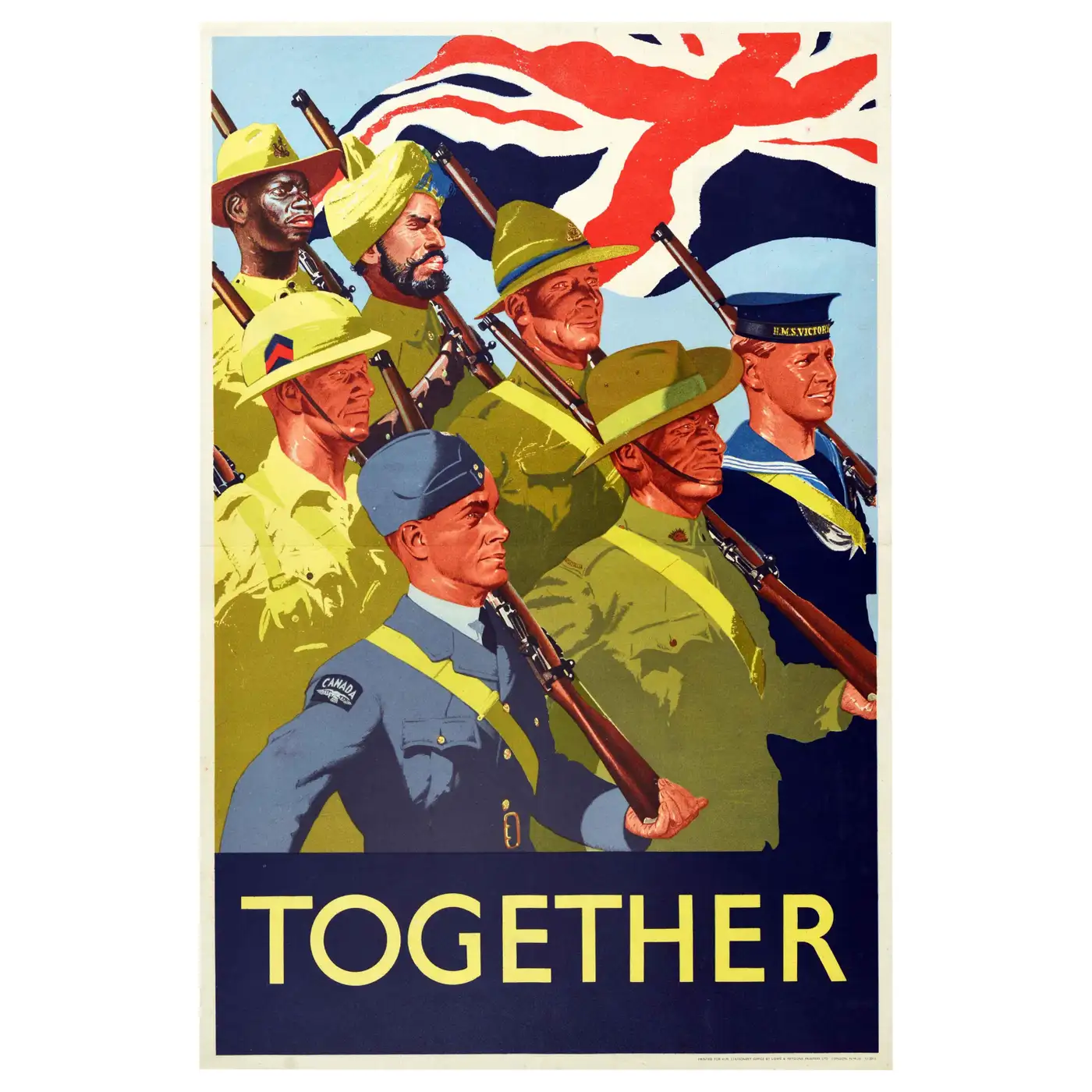
Enter CANZUK, the proposed alliance of Canada, Australia, New Zealand, and the United Kingdom. Four constitutional monarchies, four democracies, and four maritime powers linked by law, language, and lineage. Together they would represent over 140 million people and a combined GDP exceeding $6 trillion. It would be a realm on which, once again, the sun would never set.

Our shared day of remembrance on November 11 is a reminder that we partake in traditions born of shared sacrifice.

Such a bloc would not be a re-creation of empire, but a confederation of equals who share the responsibilities of defence and trade, coordinating space and science, and projecting stability from north to south and east to west.

It could stand apart from American turbulence, Chinese authoritarianism, and European stagnation, and be a new civilisational pole rooted in innovation and freedom under common law. It could even be a new contender to lead the free world.

Britain is still a nation successful at exporting ideas like capitalism, liberalism, and, regrettably, Blairism. Anglofuturism could be its most powerful export to the Anglosphere yet.

For those of us at the edge of that world, in Cape Town, Perth, or Vancouver, the message of Anglofuturism is that our story is not over. Our civilisation may be weak, even fading, but it can be revived. Doing this will demand the same courage that built it, in the spirit of the pioneers and soldiers, the engineers and thinkers who shaped continents and defended freedom when it was under siege.

Like this, but better.

November 20, 2025

QotD: What happened to the “Lucky Country” when the luck ran out?

I used to think that being born Australian was the greatest blessing in history.

Without thinking too deeply about it, I sensed we had inherited some of the best British qualities: we understood that a batsman should walk when he knew he was out, regardless of the umpire’s decision; and that the best hangover cure began with a cup of tea.

We ridiculed our friends because there was no greater compliment than offensive humour, but didn’t overdo it because brevity was the soul of our wit. (Google it, Abdul.)

Then I discovered that the British colony in Australia was founded 12 years after Americans declared that all men (not just American ones) are created equal, and with certain inalienable rights, and realised that their belief in liberty, too, was part of our precious heritage.

By developing in lockstep with them and marching to every subsequent war alongside them, we had been imbued with Americans’ rugged individualism, but cleverly managed to avoid their gullibility for life’s more superficial panaceas.

For a while, we even gave the Americans a run for their money in the pursuit-of-happiness caper. Our island continent had more room, stranger animals and nicer cities, and we had a bigger middle class, which confirmed to us that egalitarianism, the bedrock of our culture, worked.

Then, in 1983, the crew aboard the Australia II yacht showed the New York elite that their unlimited money was no match for our gritty ingenuity.

What a time to be alive! How brilliant were we! We were six-foot-four and full of muscle, and we thought it would last forever.

That it hasn’t is partly our fault. We constantly called ourselves The Lucky Country, conveniently forgetting that Donald Horne coined the name as a warning, that one day the luck would run out. That’s what luck is: it changes.

We revelled in our prosperity and mocked the idea, fundamental to our founders, that prosperity is a two-way deal.

And we lazily imported “vibrancy” instead of building on the sophisticated western civilisation, going back to Socrates and Aristotle, we were unbelievably fortunate to inherit.

But for all our complacency, at least we never deliberately sought our own demise, which, it is now clear, is what our own government is doing with grim determination and sinister skill.

As a free and prosperous nation with unlimited resources, Australia should have the pick of the richest, cleverest, most urbane migrants in the entire world. Instead, it has opened the door to millions of low-skilled peasants from Third World countries who aren’t even slightly interested in assimilating, if they don’t outright hate our culture and want to subjugate us.

There is more to this than Labor merely symbiotically importing freeloaders whose votes can be bought with unaffordable largesse. […]

As the brilliant Adam Creighton said on X last week, referring to our demographic transformation: “The Australia of your youth won’t remotely exist in 20 years. It will still have nice weather, at least”.

Our cultural suicide aside, this record intake of migrants reduces our already inadequate amount of available housing.

By how much? The Australian Bureau of Statistics isn’t saying. Its biennial Survey of Income and Housing was due out about now, but will not be released at all because of “data collection issues”.

In other words, ABS staff were unable to survey the people most affected by unprecedented levels of immigration because those people kept shifting between city laneways and homeless shelters.

Fred Pawle, “All They Can Manage is Decline”, Fred Pawle, 2025-07-21.

November 9, 2025

North Africa Ep. 7: Hitler says No! Rommel doesn’t care!

Filed under: Africa, Australia, Britain, Germany, History, Italy, Military, WW2 — Tags: , , , , — Nicholas @ 04:00

World War Two
Published 8 Nov 2025

Rommel is called to Berlin, where he’s told to wait until May and settle for Benghazi, but he rejects that plan and decides to strike sooner. In Cairo, Wavell reads ULTRA decrypts and realizes the Luftwaffe is preparing something, while admitting he has almost nothing left to hold Cyrenaica. On the ground, the Australians storm Giarabub in a sandstorm, El Agheila is snatched after a botched British ambush, and Rommel orders preparations to hit Mersa Brega before the British can dig in.
(more…)

October 29, 2025

Clankers on the bench

Filed under: Australia, Law, Technology, USA — Tags: , , — Nicholas @ 03:00

The cynic in me wonders if having AI judges would make the justice system any worse, given the ever-increasing pro-criminal bias on display in courtrooms across North America and Europe:

Grok generated this in response to my request for “Robbie the Robot as a judge”

It’s the question rattling through chambers and law schools. Are we in danger of a world where the solemn business of justice, liberty, livelihood, and who really owns the back fence is entrusted not to a human in robes but to a chirpy algorithm with a software bug and a 4,000-word disclaimer? Are we handing over judgment itself to machines, or simply giving them the photocopying and hoping they don’t start offering opinions?

Because, depending on whom you ask, AI in law is either (a) the long-delayed democratization of justice for ordinary people or (b) the first act of a constitutional farce in which courts drown beneath PDFs full of nonsense and fake footnotes.

The Machinery Arrives

Beneath the wood paneling and the reassuring thump of legal pomposity, something mildly heretical is afoot. Judges, clerks, and barristers — those high priests of precedent — are quietly feeding their briefs to generative AI, which now whirs away in the background, summarizing, drafting, and rummaging through case law while its human overlords wrestle with the biscuit tin and their consciences.

According to the Judicial Commission of New South Wales (NSW), the robots are already in the building. Their latest handbook cheerfully notes that AI is used for legal analytics, mass document review, “natural language” searching, and predictive modeling — all of which sound terribly sophisticated until you realize they’re essentially Excel spreadsheets with delusions of grandeur. A UNESCO survey adds the clincher: nearly half the world’s judges, prosecutors, and court staff have used generative AI for work, and only 9 percent have had what’s politely called safe-usage training. This is training where someone explains that you shouldn’t upload confidential evidence to a chatbot that lives in the cloud or take legal advice from a program that thinks Brown v. Board of Education was a musical.

The Law Society of NSW, in a rare fit of clairvoyance back in 2016, created something called the Future Committee — the sort of name that already sounds like a sci-fi tribunal convened to ban fun. Their brief was to consider what might happen when clients demanded more for less, junior lawyers were burnt to a crisp, and artificial intelligence started politely asking, “Shall I draft that for you?” The conclusion was simple: adapt or be eaten.

Meanwhile, in London, the Law Society of England and Wales skipped the warm-up act and went straight to the apocalypse. Its 2021 report, Images of the Future Worlds Facing the Legal Profession 2020–2030, envisioned a legal world in which routine advice would be swallowed whole by AI portals, full-time lawyers would be reduced to an endangered species, and the survivors would work alongside AI and be mandated to take “performance-enhancing medication in order to optimise their own productivity and effectiveness.” The whole thing reads like 1984 rewritten by a management consultant — right down to the faint violin of self-pity playing somewhere in the distance.

Oh, but those were in Australia and the UK, it’s not that bad in North America, surely? Uh, well …

Across the Atlantic, the award for Legal Farce of the Century goes to Mata v. Avianca, Inc. (S.D.N.Y. 2023). In this modern masterpiece of professional self-immolation, a team of lawyers filed court papers quoting three magnificent precedents: Varghese v. China Southern Airlines, Martinez v. Delta, and Zicherman v. Korean Air Lines. Unfortunately, none of them existed — not in Westlaw, not in Lexis, not even in the fever dreams of law students. When the judge asked, quite reasonably, to see the cases, counsel could only offer the look of people discovering gravity for the first time. Sanctions followed under Rule 11 for what the court delicately called “subjective bad faith”, which is American for “you made this up”. The ruling is now shown at continuing-education sessions under the optimistic title Let’s Not Do That Again.

The sequel writes itself:

  • Massachusetts: A lawyer submitted memoranda stuffed with phantom cases, blamed “the office AI”, and was fined. The judge, channeling divine exasperation, warned that blind acceptance of AI-generated content is not a defense — it’s a lifestyle choice.
  • Alabama: Attorneys for the state prison system filed citations to imaginary authorities and were sentenced to the most humiliating punishment known to the bar: writing apology letters to their law school deans and delivering public lectures on ethics.
  • California: One overzealous litigator managed to produce a brief in which twenty-one of twenty-three authorities were pure fiction. The court fined him, the press dined out on it, and AI-compliance seminars across America gained a new slide.

Thus, the first commandment of the digital age is: the robot may write it, but the Submit button still belongs to a human — and the human still gets to explain it to the judge.

October 15, 2025

The Korean War Week 69: Conquered … But At What Cost? – October 14, 1951

The Korean War by Indy Neidell
Published 14 Oct 2025

The Battle of Heartbreak Ridge ends with victory for the UN forces, though the casualty count is alarmingly high for both sides. One must wonder, is that sustainable? It’s a week of action, as Operation Commando continues further west. The Commonwealth Division takes Maryang-San, but taking it and holding it are two different things. A 9th Corps offensive kicks off as well, slowly grinding forward. There’s a breakthrough away from the battlefield, as both sides finally agree on a site for any future peace talks- Panmunjom.

Chapters
00:00 Intro
00:29 Recap
00:47 Operation Commando
03:01 Heartbreak Ridge Ends
07:44 Comparing the Two Ridges
10:25 9th Corps Attacks
11:24 The Belgians
12:17 Panmunjom
13:19 Summary
13:39 Conclusion

October 8, 2025

The Korean War Week 68: Aussies Take the Lead In Operation Commando – October 7, 1951

The Korean War by Indy Neidell
Published 7 Oct 2025

Omar Bradley, Chairman of the Joint Chiefs, arrives in Korea to see the war for himself. At the same time, UN forces launch new offensives — Operation Touchdown at Heartbreak Ridge and Operation Commando to the west. Both promise heavy fighting, but can they finally break the stalemate?

#KoreanWar #HeartbreakRidge #OperationCommando #OmarBradley

Chapters
00:00 Intro
00:54 Recap
01:16 Bradley and Bohlen
02:17 Operation Touchdown
05:07 Heartbreak Ridge
08:44 Operation Commando
11:20 The Cavalry Attacks
14:49 The Commonwealth Division
16:03 Summary
16:18 Conclusion
(more…)

October 5, 2025

North Africa Episode 2: Rommel Arrives in Africa

Filed under: Africa, Australia, Britain, Germany, Greece, History, Italy, Military, WW2 — Tags: , , , , , — Nicholas @ 04:00

World War Two
Published 4 Oct 2025

North Africa, February 1941. Operation Compass has shattered the Italian 10th Army, capturing over 100,000 men and pushing deep into Libya. But just as Britain celebrates its first major land victory of World War II, a new threat arrives: Erwin Rommel. Sent by Hitler to salvage the collapsing Italian front, the “Desert Fox” lands in Tripoli with orders to hold Libya — and immediately begins pushing east.

At the same time, British commanders face tough choices: should they secure North Africa, or divert their best troops to Greece as Churchill demands? With overstretched Commonwealth divisions left behind in the desert and fresh German forces arriving, a new campaign begins — one that will decide the future of the Mediterranean war.
(more…)

August 1, 2025

Australia saw Britain’s awful Online Safety Act and said “hold my beer”

In The Freeman, Nicole James discusses how Australia’s attempt to protect young, innocent eyes from the terrors of the internet seems to be having all kinds of unforeseen impacts on adults:

Commonwealth Coat of Arms of Australia (1912).
Quarterly of six, the first quarter Argent a Cross Gules charged with a Lion passant guardant between on each limb a Mullet of eight points Or; the second Azure five Mullets, one of eight, two of seven, one of six and one of five points of the first (representing the Constellation of the Southern Cross) ensigned with an Imperial Crown proper; the third of the first a Maltese Cross of the fourth, surmounted by a like Imperial Crown; the fourth of the third, on a Perch wreathed Vert and Gules an Australian Piping Shrike displayed also proper; the fifth also Or a Swan naiant to the sinister Sable; the last of the first, a Lion passant of the second, the whole within a Bordure Ermine; for the Crest on a Wreath Or and Azure A Seven-pointed Star Or, and for Supporters dexter a Kangaroo, sinister an Emu, both proper.

Once upon a time, not so long ago, children roamed freely through the pixelated wilderness of the Internet, posting dog memes, finding kindred spirits in weird little corners of Tumblr, and learning how to contour like Kylie Jenner. It was all chaotic, noisy, and entirely normal.

Now? Well, welcome to Australia in 2025, where the new Online Safety Amendment (Social Media Minimum Age) Bill has galloped through Parliament like a runaway Shetland pony, banning under-16s from social media. This is a full-blown digital eviction. And the ban isn’t limited just to TikTok and Snapchat. It also extends to YouTube (yes, YouTube), where apparently autoplay is now considered a gateway drug.

And how will they enforce this sweeping national grounding? Age verification, of course. Potentially through facial recognition. Not for the kids, mind you; they’ll simply be locked out. It’s everyone else who’ll need to prove they’re not children. Because nothing says “welcome to adulthood” like having to scan your actual face just to post a birthday shoutout or watch a slow-cooker recipe reel. All to reassure a tech platform that you’re not a rogue 14-year-old with strong opinions and a ring light.

The bill’s spiritual mother, eSafety Commissioner Julie Inman Grant, who, fun fact, once interviewed for a job at the CIA to analyze serial killers, gave a passionate speech at the National Press Club called “Swimming Between the Digital Flags”. It sounded very beachy and breezy until you realized she meant regulatory flags, and not the ones you’d use at Bondi. Her point was clear: the online world is full of rips and sharks and emotional jellyfish, and children must be protected from being dragged under.

Which is noble. Obviously. But somewhere between “protect the kids” and “build a biometric panopticon”, the line got a little smeared.

And where, you might ask, were parents in all this? Sitting quietly in the back, apparently, while Canberra (Australia’s Washington, DC) appointed itself Mum, Dad, the school principal, and possibly even the family dog. Because this isn’t just about safety; it’s about who decides what kids can see, say, share, and, in the case of a few bold young TikTokers, lip-sync while delivering motivational speeches to two mildly traumatized budgies.

The idea behind the project is that children are being harmed online, and honestly, yes, some are. The Internet is not all kittens and cake recipes. But rather than investing in education or digital literacy, the government has opted for a full blackout. It’s like banning scissors because one kid snipped their fringe into a reverse mullet.

And here’s the kicker. The bill had a consultation period of just 24 hours. That’s less time than it takes to read the terms and conditions you just agreed to without reading. (Don’t lie, we’ve all done it.)

In that tight little window, more than 15,000 submissions were made, and while some were supportive, the vast majority sounded the alarm. LGBTQIA+ organizations warned of disconnected teens losing safe spaces. Indigenous advocates pointed out the risks of further digital exclusion. Psychologists, educators, digital rights groups, and even a Community Soccer Club raised concerns.

July 22, 2025

Battle for Gaza 1917: The Palestinian Campaign of WW1

The Great War
Published 14 Feb 2025

The ongoing Israel-Palestine conflict has its roots in another war more than a century ago. When the First World War began in 1914, the territory of today’s Israel and Palestine was part of the Ottoman Empire. But in 1917 the British Empire began a campaign that would change history: there would be bitter fighting in Gaza, wild cavalry charges, even talk of a modern crusade. And it would lay the foundations for a century of violence.
(more…)

July 10, 2025

Was Matilda II the BEST Tank of WWII?

Filed under: Australia, Britain, History, Military, Pacific, Russia, Weapons, WW2 — Tags: , , , , — Nicholas @ 02:00

The Tank Museum
Published 21 Feb 2025

Forget the Sherman, forget the Panther, forget the T-34 … Should Matilda II be considered the best tank of WWII? 

Emerging from the request for a new and improved infantry tank, Matilda II debuted on the battlefield in France. The heroic actions of Matilda crews at Arras stopped Blitzkrieg in its tracks and allowed the British army to be evacuated from the beaches of Dunkirk.

The Matilda’s fighting peak was during the North Africa campaign, where the 2pdr gun was more than a match for any of the Italian armour it came up against. Despite some mechanical issues, the performance of Matilda II at this time would earn her the title “Queen of the Desert”. Once the Germans arrived in North Africa, Matilda started to become obsolete but remained useful as a testbed for experimental equipment that would eventually be used on D-Day.

Matilda II saw service in all theatres of the Second World War. Around 900 tanks were deployed by the Soviets in 1942, filling the gap as the Red Army increased its roster of T-34s. Matilda made great contributions to campaigns in the Pacific – its small and solid profile making it ideal for jungle bashing. The Australians made effective use of the Matilda, creating variants including a mortar launcher and a flamethrower.

Some say that if it wasn’t for Matilda II we would be speaking German right now. Watch this video to find out why …

00:00 | Introduction
00:36 | Heroics at Arras
03:29 | It Takes Two
06:00 | Matilda II – Inside and Out
13:03 | Queen of the Desert
18:14 | Soviet Service on The Eastern Front
19:49 | The Pacific – Welcome to the Jungle… 
(more…)

June 9, 2025

Q&A: British Small Arms of World War Two

Forgotten Weapons
Published 24 Jan 2025

Today’s Q&A is brought to you by the fine folks at Patreon, and by Penguin Brutality: https://www.varusteleka.com/en/search…

01:11 – Was the Vickers .50 any good, and why did the British use four different heavy cartridges instead of consolidating?
07:35 – The Sten and its single-feed magazine design
10:27 – Owen versus Sten, and German use of the Owen.
14:38 – British wartime work on an “assault rifle” sort of weapon?
15:44 – Why no British semiauto rifle during WW2? – Jonathan Ferguson on British semiauto rifle trials: Q&A 43 (feat. Jonathan Ferguson): Mil…
18:04 – EM2’s automatic bolt closure system
20:46 – Did the British use other allied weapons besides American ones?
23:15 – Is the PIAT a Destrucitve Device under US law and why?
26:07 – Bren vs Degtyarev
27:50 – Why not make the Sten in .45 to use Thompson ammo?
29:37 – Did the British get M3 Grease Guns?
31:01 – British SMG in .455?
32:03 – Sten vs Lanchester
33:26 – Was there an LSW version of the EM1/EM2 planned? EM1 Korsac: The Korsac EM1 – a British/Polish Bul…
34:25 – Why wasn’t the BESA in .303?
36:34 – Biggest British missed opportunity during the interwar period?
38:40 – British naval service small arms
41:45 – Did .280 cartridge development begin during the war?
43:24 – Impact of MP44 on British post-war small arms development?
44:25 – Gallilean sights on the Enfield
46:25 – Why is there a semiauto selector on the Sten?
49:17 – Did American soldiers use British small arms?
50:29 – Why did the British choose the Lee action over the Mauser action?
51:16 – Which was better, Sten or Grease Gun?
52:34 – Why did the whole Commonwealth not switch to the No4 Enfield?
(more…)

April 27, 2025

“[T]he practical reality of electoral politics throughout the west: the choice is between a Leftward Ho! party and a Ratchet party”

Filed under: Australia, Britain, Cancon, Media, Politics — Tags: , , — Nicholas @ 03:00

Mark Steyn on the steady leftward march of pretty much every western nation that never, ever stops and only rarely slows down:

A ratchet allows rotation in one direction, but prevents rotation in the other direction. That’s been a common explanation of most western governments for decades … leftward motion occurs, but can only be stopped, never reversed.

In a shrewd assessment of the current campaign Down Under, Paul Collits cites a certain “niche Canadian”:

    Mark Steyn says that we cannot vote our way out of the Western mess. The 2025 Australian election is living proof of the truth of his claim. Whoever wins here will inherit an unholy mess, and will not have the will to address it.

Of course, he could be talking about next week’s Canadian election or last month’s German election. As we have noted, Fred Merz, the incoming chancellor in Berlin, has yet to take office but what Americans call the honeymoon is over before the coalition has been officially pronounced man and wife. Hermann Binkert, head honcho of Germany’s INSA polling agency, says the country has never seen loss of approval on this scale between the election and the formation of the government. The so-called “far-right” AfD is now leading in multiple polls. Which would be super-exciting if voting hadn’t already taken place.

In America, the new administration certainly has the “will to address” the “unholy mess” but the Trumpian Gulliver is beset on all sides by District Court Lilliputians whose position is that what a Democrat president has done cannot “lawfully” be undone. This is a pseudo-“constitutional” recognition of the practical reality of electoral politics throughout the west: the choice is between a Leftward Ho! party and a Ratchet party. If the Left wins, they dissolve the border and trannify your kids. If the “Right” wins (Stephen Harper, Scott Morrison), they may pause some of the more obviously crazy stuff but they never actually reverse the direction of travel. Unless they’re the UK Tories (Cameron, May, Johnson, Sunak), in which case they stay in the leftie lane without even shifting down to third gear.

So “politics”, as increasingly narrowly defined, is less and less likely to save you. Because the gap between “politics” and reality grows ever wider. Consider the instructive example of one Hashem Abedi. Mr Abedi and his brother plotted the Ariana Grande concert bombing in Manchester. It was, from the Abedi viewpoint, a huge success: twenty-two dead, half of them kids, plus a thousand injured. It was a big deal at the time: lots of flowers, teddy bears, and heart-rending renditions of “Don’t Look Back in Anger”.

So you’d have thought even the British state would have at least pretended to take it seriously. Hashem Abedi was detained at His Majesty’s Pleasure, and under one of the three supposedly toughest prison regimes in England and Wales. Nevertheless, on April 12th he put three of his guards in hospital with what were described as “life-threatening injuries“. A fortnight later, two are still there. How did a maximum-security prisoner manage to do that? Well, he used boiling cooking oil and weaponised kitchen utensils.

So how did he get hold of boiling cooking oil? Was he a finalist for Maximum Security Masterchef? Ah, well. The details remain vague, and as usual the worthless UK media has shown not the slightest curiosity in how the Ariana Grande perp came close to bulking up his death toll by fifteen per cent.

April 17, 2025

Canadian labelling regulations save us from “too many vitamins”

Filed under: Australia, Britain, Bureaucracy, Cancon, Food, Government, Health — Tags: , , , , — Nicholas @ 03:00

In the National Post, Jesse Kline points out that Canadian food label regulations have become so nit-picky that they prevent safe and accurately labelled foods from Australia, Britain, and other countries from being sold here:

Marmite from the UK and Vegemite from Australia, two of the products at risk of Canadian over-regulatory twitches.

Shortly after winning the Liberal leadership, Mark Carney travelled to Paris and London to shore up our trading relationship with our European allies.

Yet it is noteworthy that Canada is one of only two countries that has not yet ratified the United Kingdom’s accession into the CPTPP, meaning that we don’t enjoy the benefits of free trade with the country with whom we share a system of government and a King. Meanwhile, France is one of a handful of countries that has yet to ratify the free-trade agreement between Canada and the EU.

If we can’t even agree to implement trade deals that have already been negotiated and agreed upon with countries that have such deep historical ties to Canada, what hope do we have of improving trade with our other partners around the world?

Part of the problem is that Canada refuses to follow the example of countries like Australia and New Zealand, which successfully phased out their own systems of supply management years ago with great success.

As a result, supply management has proven to be a sticking point in virtually every trade negotiation we’ve entered into, and is a constant source of tension even among countries we have free-trade deals with.

But we have also fallen into the trap, along with our European friends, of over-regulation. Modern bureaucratic states impose so many restrictions on commercial enterprises, it often becomes uneconomic to market their products in other countries.

Canada, for example, imposes stringent labelling requirements to ensure product information is available in both English and French, and that nutritional information conforms to our very specific requirements.

None of this is necessary, especially in an age in which we can hold a phone up to a box of French crackers to see what it says. But the problem extends far beyond language or disagreements over the recommended daily intake of fibre.

As the CBC reported on Monday, Leighton Walters, an expat from Down Under who owns several Australian-themed coffee shops in the Greater Toronto Area, was told earlier this year by the Canadian Food Inspection Agency (CFIA) that he was no longer allowed to sell the roughly $8,000 worth of Vegemite he had imported because it contains … too many vitamins.

Under current regulations, only a select list of products are allowed to contain added vitamins. Vitamin B-rich spreads like Vegemite and its British equivalent Marmite are not among them because … well, just because.

A similar situation arose a decade ago when reports that the government had ordered Marmite and the Scottish drink Irn-Bru to be taken off the shelves of a British supermarket in Saskatoon caused outrage on both sides of the pond.

The CFIA later clarified that only versions of those products formulated specifically to meet Canadian requirements — i.e., those that don’t contain added vitamins or a specific type of food colouring — are allowed to be sold in this country. Because heaven forbid we trust that other advanced Commonwealth nations would have reasonable enough food safety standards.

We have quite literally regulated ourselves into a corner. We can’t even import spreads like Marmite and Vegemite — which have been staples of British and Australian diets for decades — not because they’re unhealthy or unsafe, but because they don’t conform to our nit-picky regulations.

April 13, 2025

The Most Pointless Battle of WW1? – Passchendaele 1917

The Great War
Published 11 Apr 2025

For more than three long months in 1917, Allied and German soldiers fought tooth and nail over a battlefield churned into a sea of sucking mud and shellholes by the guns. Hundreds of thousands were killed and wounded, some of them drowning in the soupy ground — for Allied gains of just a few kilometers. So why did the Battle of Passchendaele happen at all, and was it the most pointless battle of the First World War? (more…)

February 26, 2025

Colonialism was so bad … that we have to make shit up about how evil it supposedly was

In the National Post, Nigel Biggar recounts some of the most egregious virtue signalling by western elites over the claimed evils of colonialism … even to the point of inventing sins to confess and obsess over:

Meanwhile, in Australia, there’s the extraordinary career of Bruce Pascoe’s 2014 book, Dark Emu. This argues that Aborigines, far from being primitive nomads, developed the first egalitarian society, invented democracy, and were sophisticated agriculturalists. Such was the morally superior civilization that white colonizers trashed in their racist greed. Named Book of the Year, Dark Emu has sold more than 360,000 copies and was made the subject of an Australian Broadcasting Company documentary.

Yet, it has been widely criticized for being factually untrue. Author Peter O’Brien has forensically dismantled it in Bitter Harvest: The Illusion of Aboriginal Agriculture in Bruce Pascoe’s Dark Emu (2020). And in Farmers or Hunter Gatherers: The Dark Emu Debate (2021) — described by reviewers as “rigorously researched”, “masterful”, and “measured” — eminent anthropologist Peter Sutton and archaeologist Keryn Walshe dismiss Pascoe’s claims.

Which bring us to Canada. The May 2021 claim by the Tk’emlúps te Secwépemc First Nation to have discovered the “remains of 215 children” of an Indian Residential School was quickly sexed up by the media into a story about a “mass grave”, with all its connotation of murderous atrocity. The Globe and Mail published an article under the title, “The discovery of a mass gravesite at a former residential school in Kamloops is just the tip of the iceberg,” in which a professor of law at UBC wrote: “It is horrific … a too-common unearthing of the legacy, and enduring reality, of colonialism in Canada”. Prime Minister Justin Trudeau ordered Canadian flags to be flown at half-mast on all federal buildings to honour the allegedly murdered children. Because the Kamloops school had been run by Roman Catholics, some zealous citizens took to burning and vandalizing churches, 112 of them to date. The dreadful tale was eagerly broadcast worldwide by Al Jazeera.

Yet, almost four years later, not a single set of remains of a murdered Indigenous child in an unmarked grave has been found anywhere in Canada. Judging by the evidence collected by Chris Champion and Tom Flanagan in their best-selling 2023 book, Grave Error: How the Media Misled us (and the Truth about the Residential Schools), it looks increasingly probable that the whole, incendiary story is a myth.

So, prime ministers, archbishops, academics, editors, and public broadcasters are all in the business of exaggerating the colonial sins of their own countries — from London to Sydney to Toronto. Why?

An obvious reason is the well-meaning desire to raise respect for indigenous cultures with a view to “healing” race relations. But that doesn’t explain the aggressive brushing aside of concerns about evidence and truth in the eager rush to irrational self-criticism.

« Newer PostsOlder Posts »

Powered by WordPress