Quotulatiousness

July 28, 2011

Signalling failure blamed for high speed rail crash

Filed under: China, Media, Technology — Tags: , , , — Nicholas @ 08:32

This sounds a bit fishy, as this kind of error has been known in railway signal systems for over 100 years: signals that fail to show stop as a default whenever power is lost:

After it was struck by lightning, the signaling device at the Wenzhou South railway station malfunctioned and failed to turn from green to red, An Lusheng, chief of the Shanghai Railway Bureau, told the news agency. He also said workers on duty were inadequately trained and failed to notice the malfunction.

Xinhua’s report, the first official explanation of the cause of the crash, raised further questions about China’s high-speed rail system, one of the world’s largest and most costly public works projects. The accident occurred when one high-speed train rear-ended another that had stalled on the tracks near Wenzhou in Zhejiang Province. High-speed rail has an excellent safety record elsewhere, especially in Japan, which has never had a fatality.

Chinese have flooded microblogging sites with furious complaints about breakneck development without heed to safety. Many also expressed fears of a cover-up, especially after reports that one train car was buried at the site despite the ongoing investigation and only later excavated.

July 27, 2011

Okay, everyone relax: China says aircraft carrier to be used for “research and training”

Filed under: China, Military, Pacific — Tags: , — Nicholas @ 07:44

That’s the latest story from China, which has finally acknowledged that they are rebuilding the former Soviet aircraft carrier Shi Lang:

China has officially acknowledged that it is rebuilding an aircraft carrier it bought more than a decade ago, but says the refurbished ship will be used only for research and training.

A defence ministry spokesman, Geng Yansheng, told reporters on Wednesday that work was under way on refitting an old carrier, a reference to the Varyag, whose stripped-down hull was towed from Ukraine in 1998 and has been under reconstruction for the best part of a decade.

“Building an aircraft carrier is extremely complex and at present we are using a scrapped aircraft carrier platform to carry out refurbishment for the purposes of technological research, experiments and training,” Geng said.

July 26, 2011

Chinese government announces safety review after high speed rail crash

Filed under: Bureaucracy, China, Media, Technology — Tags: , , , , — Nicholas @ 09:01

In the wake of the deadly collision between two high speed trains, China announced a safety review of the high speed railway system:

Mr Sheng said railway officials would be deployed at frontline rail operations across the country to overhaul maintenance standards and checks on power connections to pre-empt outages.

All local railway bureaux were to draw lessons from the accident, a statement on the railways department website said.

Public fury and scepticism have been expressed in China’s blogosphere, both about the death toll of 39 people — suggesting it is too low — and the safety of China’s rail network.

State newspapers have also expressed concern. The Global Times ran a headline: Anger mounts at lack of answers.

“As the world is experiencing globalisation and integration, why can’t China provide the same safety to its people?” an editorial read.

July 25, 2011

More on that Chinese rail crash

Filed under: China, Government, Media, Technology — Tags: , , , — Nicholas @ 12:49

The official story has changed a few times since the accident, and at least some Chinese feel they are entitled to the truth about the accident:

Internet users attacked the government’s response to the disaster after authorities muzzled media coverage and urged reporters to focus on rescue efforts. “We have the right to know the truth!” wrote one microblogger called kangfu xiaodingdang. “That’s our basic right!”

Leaked propaganda directives ordered journalists not to investigate the causes and footage emerged of bulldozers shovelling dirt over carriages.

Wang, the railways spokesman, said no one could or would bury the story. He said a colleague told him the wreckage was needed to fill in a muddy ditch to make rescue efforts easier.

But Hong Kong University’s China Media Project said propaganda authorities have ordered media not to send reporters to the scene, not to report too frequently and not to link the story to high-speed rail development. “There must be no seeking after the causes [of the accident], rather, statements from authoritative departments must be followed,” said one directive. Another ordered: “No calling into doubt, no development [of further issues], no speculation, and no dissemination [of such things] on personal microblogs!”

Electronic weapons to destroy other electronics

Filed under: China, Military, Technology, Weapons — Tags: , — Nicholas @ 12:05

Strategy Page looks at some interesting developments in the electronic weapons area:

A U.S. government report (from the National Ground Intelligence Center) indicates that China has developed useful weapons for disabling the electronics on American aircraft and warships. This is done using high-powered microwave (HPM) devices to create something like the EMP (Electromagnetic Pulse) put out by nuclear weapons, which damaged or destroys microelectronics.

[. . .]

Then there’s the EMP bomb, a legendary weapon that is much talked about, but has never actually been seen. Throughout the 1990s, information came out of Russia that a weapon had been developed that could generate a short range EMP (electromagnetic pulse) similar to that created by nuclear explosions. All computers within the range of the EMP bomb would be ruined. This is a truly devastating capability. Microprocessors are found everywhere these days; in automobiles, appliances, industrial equipment, medical devices and many other devices. Military microprocessors are often shielded to protect them against EMP, but the shielding is not thoroughly tested and even some military equipment will probably be disabled by an EMP attack.

A decade ago, a British military research team announced that they had duplicated the rumored Russian device and produced an EMP bomb that can fit in a 155mm artillery shell, small rockets or bombs. Such a device was supposed to be inexpensive and could be used to destroy civilian electronics that might be useful to nearby enemy troops. What is particularly worrisome about this new development is that, in the hands of terrorists, it could do a new kind of damage. While not killing people directly, the destruction of all electronics within an urban area could cause casualties and much economic loss. But none of these EMP bombs has ever actually reached the stage where they were actually ready to use. There was always some kind of flaw discovered in testing. Naturally, China is thought to have developed an EMP bomb.

July 24, 2011

No, that’s not suspicious at all . . .

Filed under: China, Government, Technology — Tags: , , , , , — Nicholas @ 11:39

. . . when you use backhoes to bury the wreckage before determining the cause of the high speed rail crash:

The wreck on Saturday night killed 35 and injured 210 after a high-speed train lost power for more than 20 minutes and then was rear-ended by another train, according to the Xinhua news agency. Six cars derailed and two fell off a viaduct near the city of Wenzhou.

[. . .]

Photos on the popular Weibo microblogging service showed backhoes burying the wrecked train near the site. Critics said the wreckage needed to be carefully examined for causes of the malfunction, but the railway ministry said that the trains contain valuable national technology and could not be left in the open in case it fell into the wrong hands.

Foreign companies maintain that some crucial technology was stolen from their imported trains. But more importantly to domestic audiences is the perception of a coverup. Initial reports of how the accident occurred are already being partly contradicted by reports in the official media.

July 21, 2011

Perhaps I’ll skip the tour of China after all

Filed under: China, Food — Tags: — Nicholas @ 13:39

I’ve always been a fussy eater, so David Sedaris’s account of a few meals during his visit to China have probably deterred me for good:

Most restaurants had quit serving lunch, so we stopped at what’s called a Farming Family Happiness. This is a farmhouse where, if they’re in the mood, the people who live there will cook and serve you a meal.

One of the members of our party was a native of Chengdu, and of the five Americans, everyone but Hugh and I spoke Mandarin. Thus we hung back as they negotiated with the farm wife, who was square-faced and pretty and wore her hair cut into bangs. We ate in what was normally the mah jong parlour, a large room overlooking the family’s tea field. Against one wall were two televisions, each tuned to a different channel and loudly playing to no one. On the other wall was a sanitation grade — C — and the service grade, which was a smiley face with the smile turned upside down.

As far as I know there wasn’t a menu. Rather, the family worked at their convenience, with whatever was handy or in season. There was a rooster parading around the backyard and then there just wasn’t. After the cook had slit its throat, he used it as the base for five separate dishes, one of which was a dreary soup with two feet, like inverted salad tongs, sticking out of it. Nothing else was nearly as recognisable.

Of course, after visiting Japan with their renowned degree of cleanliness, his arrival set the tone rather too well:

This was what I had grown accustomed to when we flew from Narita to Beijing International, where the first thing one notices is what sounds like a milk steamer, the sort a cafe uses when making lattes and cappuccinos. “That’s odd,” you think. “There’s a coffee bar on the elevator to the parking deck?” What you’re hearing, that incessant guttural hiss, is the sound of one person, and then another, dredging up phlegm, seemingly from the depths of his or her soul. At first you look over, wondering, “Where are you going to put that?” A better question, you soon realise, is, “Where aren’t you going to put it?”

I saw wads of phlegm glistening like freshly shucked oysters on staircases and escalators. I saw them frozen into slicks on the sidewalk and oozing down the sides of walls. It often seemed that if people weren’t spitting, they were coughing without covering their mouths, or shooting wads of snot out of their noses. This was done by plugging one nostril and using the other as a blowhole. “We Chinese think it’s best just to get it out,” a woman told me over dinner one night.

And that’s without quoting any of the learned discussion of bodily wastes . . .

July 20, 2011

Another aspect of China’s amazing economic growth

Filed under: China, Economics, Law, Technology — Tags: , , , — Nicholas @ 07:28

Steve Jobs might want to look at the Chinese market a bit more carefully . . . something’s happening that he may need to pay closer attention to:

The Western news media is replete with pithy descriptions of the rapid changes taking place in China: China has the world’s fastest growing economy. China is undergoing remarkable and rapid change. This represents a unique moment for a society changing as quickly as China.

You probably read such things in the paper every day — but if you have never been to China, I’m not sure you know quite what this means on a mundane level. As I’ve mentioned elsewhere on this blog, in the 2+ years that RP and I have been in our apartment, much of the area around us has been torn down, rebuilt, or gutted and renovated – in some cases, several times over. I had the thought, only half-jokingly, that when we returned from a couple months abroad, we might not be able to recognize our apartment building. Or that it might not be there at all.

As it turns out, my fears were baseless — our scrappy little home remains. The neighborhood, however, has definitely kicked it up a notch or seven. Starbucks has opened not one, but THREE branches (that I encountered) within a 10 minute walk of one another. An H&M has opened across from our apartment building. These are the kinds of major Western brands that were previously only represented in Kunming by fast food chains like McDonald’s and KFC. Our neighborhood has quickly become the swanky shopping center of the city.

Update, 21 July: Andrew Orlowski thinks I’ve been taken in by a non-story:

Some stories are so unusual, you immediately wonder if they’re too good to be true. On Tuesday, a Western NGO in China posted a remarkable tale, reporting that ingenious Chinese retailers in a medium-sized provincial city called Kunming had cloned an Apple Retail Store, faithfully reproducing the staff T-shirts, furniture, display material, and name tags.

[. . .]

But another 10 seconds with Google would reveal that in China, as in the UK and many other countries, Apple has a network of authorised resellers. Apple lays down very strict guidelines on how the resellers must present the gear. The sales material is Apple’s, and the specifications are extremely precise. And to be an Apple “Premium Reseller”, you have to look a lot like an Apple Apple Store, but naturally, you can’t call yourself one. There are hundreds of these, with Apple manufacturer Foxconn’s brother Gou Tai-chang planning 100.

[. . .]

Think of it like this: if you had a Jaguar showroom, anywhere in the world, would you operate from a dodgy lock-up and advertise it with a hand-painted sign? I thought not. You’d want it to look as slick and expensive as the real thing. I’m not sure why we expect Chinese Apple resellers not to do so, too.

July 2, 2011

“I remained somehow reluctant to conclude that the Communist Party of China would flat-out lie”

Filed under: China, History, Media, Politics — Tags: , , , , , — Nicholas @ 10:10

A tale of naivete about the Peoples’ Republic of China through the eyes of an American sympathizer:

The first time I tried to go to China was in 1967, the year after I graduated from college. My father was a radical leftist professor who admired Mao Zedong. And that influence, along with the Vietnam War protests — a movement in which I was not only a participant but an activist — led me to look at socialist China with very high hopes.

I was living in Hong Kong and wrote a letter to Beijing. A few months later I received a charming reply on two sheets of paper that looked like they had been labored over for days by a Red Guard with little English and a faulty typewriter. The letter explained that the Chinese people had nothing against me, but that I was from a predatory imperialist country and could not visit the People’s Republic. Before I left Hong Kong I bought four volumes of “The Selected Works of Mao Zedong,” and, rather grandiosely, ripped the covers off of them so that I might carry them safely back to the imperialist US.

In May, 1973, however, I got another chance. A year earlier, in April 1972, the Chinese ping-pong team had visited the US to break a twenty-three year freeze in diplomatic relations, and I had served as an interpreter. I made a good impression on Chinese officials on that US tour, in part because I led four of the six American interpreters in a boycott of the teams’ meeting with President Richard Nixon at the White House. (Nixon had ordered the bombing of Haiphong just the day before; to me, small talk in the Rose Garden just didn’t seem right.)

H/T to Tim Harford for the link.

June 21, 2011

Chinese high speed trains to run slower than planned

Filed under: China, Technology — Tags: , , , , — Nicholas @ 13:02

They’ll still qualify as high speed trains, but they’ll only travel at speeds up to 250kph instead of the 385kph they were designed to achieve. The problem is safety concerns:

The Chinese government has announced a significant lowering in the top speed its hallmark Beijing-to-Shanghai high-speed train will be allowed to run at when it opens later this month after a review of safety, shoddy workmanship and corruption.

The new service halving the 10-hour rail travel time between China’s political and business centres was meant to be the flagship project of a massive $400-billion program to give the country the most extensive bullet train network anywhere.

But the announcement last week by the Railway Ministry that trains on the new line will only be permitted to run at about 250 kilometres per hour instead of the projected 380 km/h has taken the bloom off the opening.

The restriction follows a review by officials stemming from the sacking in February of the railway minister, Liu Zhijun, and the deputy chief engineer of the department, Zhang Shuguang.

The concerns about safety are not at all unwarranted:

Contractors are said to have skimped on using expensive hardening agents when making the concrete for the rail bases. These ties are predicted to crumble within a few years. And there is said to have been a similar shortage of strengthening ingredients included in the concrete used to build bridges and their supporting columns.

A high speed train requires the right-of-way to be engineered to a much higher standard than ordinary passenger or freight rail lines. If too many corners have been cut in this construction, it would be insane to allow the trains to run at full speed until the entire line has been inspected, tested, and problems addressed. If there were even greater “economies” taken during construction, it might not be safe to run the trains at any speed.

And what’s a story like this without a bit of trash-talking from a rival high speed railway operator:

“The difference between China and Japan is that in Japan, if one passenger is injured or killed, the cost is prohibitively high,” he said. “It’s very serious. But China is a country where 10,000 passengers could die every year and no one would make a fuss.”

That’s a quote from the chairman of Central Japan Railway, which runs the Tokyo-Osaka Shinkansen service.

June 19, 2011

Cyber-espionage in theory and practice

Filed under: China, Government, Military, Technology, USA — Tags: , , , — Nicholas @ 09:50

An interesting article at Strategy Page discussing online espionage:

Firms with the most to lose, like financial institutions, guard their data most successfully. They do this the old-fashioned way, with layers and layers of security, implemented by the best (and most highly paid) people and pushed by senior managers who take the time to learn about what they are dealing with, and what it will take to stay on top of the problem.

It’s different in the defense business. If the Chinese steal data on some new weapon, there might be a problem years down the road, when the Chinese offer a cheaper alternative to an American weapon, for the export market. But even that problem has a silver lining, in that you can get away with insisting that those clever Chinese developed your technology independently. Meanwhile, everyone insists that there was no espionage, cyber or traditional, involved. As a further benefit, the American firm will get more money from a terrified government, in order to maintain the American technical edge. It’s the same general drill for military organizations. But for financial institutions, especially those that trade in fast moving currency, derivatives and bond markets, any information leaks can have immediate, and calamitous consequences. You must either protect your data, or die.

It’s not exactly a secret that China has been active in this area, but the extent of their official activity is hard to state. However, just as non-state actors take advantage of individuals who fail to use anti-virus software on their computers, ignorance and apathy are tools for state actors:

But the biggest problem, according to military Cyber War commanders, is the difficulty in making it clear to political leaders, and non-expert (in Internet matters) military commanders, what the cyber weapons are, and the ramifications of the attacks. Some types of attacks are accompanied by the risk of shutting down much, or all, of the Internet. Other types of operations can be traced back to the source. This could trigger a more conventional, even nuclear, response. Some attacks use worms (programs that, once unleashed, keep spreading by themselves.) You can program worms to shut down after a certain time (or when certain conditions are met). But these weapons are difficult, often impossible, to test “in the wild” (on the Internet). By comparison, nuclear weapons were a new, very high-tech, weapon in 1945. But nukes were easy to understand; it was a very powerful bomb. Cyber weapons are much less predictable, and that will make them more difficult for senior officials to order unleashed.

So the first order of business is to develop reliable techniques to quickly, and accurately, educate the senior decision makers about what they are about to unleash. This would begin with the simplest, and cheapest, weapons, which are botnets, used for DDOS attacks. In plain English, that means gaining (by purchase or otherwise) access to hundreds, or thousands, of home and business PCs that have had special software secretly installed. This allows whoever installed the software that turned these PCs into zombies, to do whatever they want with these machines. The most common thing done is to have those PCs, when hooked up to the Internet, to send as many emails, or other electronic messages, as it can, to a specified website. When this is done with lots of zombies (a botnet), the flood of messages becomes a DDOS (Distributed Denial of Service) attack that shuts the target down. This happens because so much junk is coming in from the botnet, that no one else can use the web site.

June 11, 2011

China finally admits to (some) problems at the Three Gorges megadam

Filed under: China, Environment, Government — Tags: , , — Nicholas @ 10:47

It’s been “officially” a wonderful thing with absolutely no negative attributes for so long that it’s almost refreshing that the Chinese government is finally admitting it’s not all good news around the massive Three Gorges dam and reservoir:

In private, officials have worried about the project for some time and occasionally their doubts have surfaced in the official media. But the government itself has refused to acknowledge them. When the project was approved by the rubber-stamp parliament in 1992, debate was stifled by the oppressive political atmosphere of the time, following the Tiananmen Square massacre three years earlier. Last July, with the dam facing its biggest flood crest since completion in 2006, officials hinted that they might have overstated its ability to control flooding. On May 18th, with the dam again in the spotlight because of the drought, a cabinet meeting chaired by the prime minister, Wen Jiabao, went further in acknowledging drawbacks.

Having called the dam “hugely beneficial overall”, the cabinet’s statement said there were problems relating to the resettlement of 1.4m people, to the environment and to the “prevention of geological disasters” that urgently needed addressing. The dam, it said, had had “a certain impact” on navigation, irrigation and water-supply downstream. Some of these problems had been forecast at the design stage or spotted during construction. But they had been “difficult to resolve effectively because of limitations imposed by conditions at the time.” It did not elaborate.

June 10, 2011

Cold War thinking on Chinese-US relations

Filed under: China, Economics, History, USA — Tags: , , — Nicholas @ 09:13

Brad Glosserman asks if China is using its new-found economic muscle to bankrupt the United States.

One popular narrative credits the end of the Cold War to a US strategy to bankrupt the Soviet Union. Well aware of the advantage conferred by its superior economic performance, Washington pushed Moscow into a military competition that drained the USSR of its resources. In this narrative, US President Ronald Reagan’s push to create a missile defence system — realistic or not — was the straw that broke the Soviet back.

Are Chinese strategists pursuing a similar approach to the United States? Is Beijing pushing US buttons, forcing it to spend increasingly scarce resources on defence assets and diverting them from other more productive uses? Far-fetched though it may seem — and the reasons to be sceptical are pretty compelling — there is evidence that China is doing just that: ringing American alarm bells, forcing the US to respond, and compounding fiscal dilemmas within the United States. Call it Cold War redux.

If that is indeed China’s strategy, then they’re wasting their efforts: without strong action in the very near term, the US government is going to bankrupt the country with no additional help from overseas required. The “popular narrative” Glosserman refers to handily glosses over the fact that the Soviet economy had been on a downward slide for decades. The Reagan-era military build-up merely hastened the end for Soviet economics, it did not bring it on in the first place. As Adam Smith famously noted, there is a lot of ruin in a nation, but eventually it does go smash — especially if no efforts are made to avert that nasty ending.

H/T to Jon, my former virtual landlord, for the link.

June 9, 2011

Is the Shi Lang a naval “Potemkin Village”?

Filed under: China, Military, Russia — Tags: , , , , — Nicholas @ 17:30

David Axe is not losing any sleep over the soon-to-be commissioned Chinese carrier Shi Lang:

Leaving aside her modest size compared to American carriers, her incomplete air wing and escort force and the fact that she’ll sail without the company of allied flattops, Shi Lang could be even less of a threat than her striking appearance implies. Shi Lang’s greatest potential weakness could be under her skin, in her Ukrainian-supplied engines.

Powerplants — that is, jet engines for airplanes, turbines for ships — are some of the most complex, expensive and potentially troublesome components of any weapon system. Just ask the designers of the Pentagon’s F-35 stealth fighter and the U.S. Navy’s San Antonio-class amphibious ships. Both have been nearly sidelined by engine woes.

China has struggled for years to design and build adequate powerplants for its ships and aircraft. Although Chinese aerospace firms are increasingly adept at manufacturing airframes, they still have not mastered motors. That’s why the new WZ-10 attack helicopter was delayed nearly a decade, and why there appear to be two different prototypes for the J-20 stealth fighter. One flies with reliable Russian-made AL-31F engines; the other apparently uses a less trustworthy Chinese design, the WS-10A.

For Shi Lang, China reportedly purchased turbines from Ukraine. Though surely superior to any ship engines China could have produced on its own, the Ukrainian models might still be unreliable by Western standards. Russia’s Kuznetsov, also fitted with Ukrainian turbines, has long suffered propulsion problems that have forced her to spend most of her 30-year career tied to a pier for maintenance. When she does sail, a large tugboat usually tags along, just in case the carrier breaks down.

If Shi Lang is anything like her sister, she could turn out to be a naval version of the mythical “Potemkin village” — an impressive facade over a rickety interior.

H/T to Nicholas “Ghost of a Flea” Packwood for the link.

June 8, 2011

China admits it’s hard to hide 1000ft-long aircraft carrier

Filed under: China, Military, Pacific — Tags: , , — Nicholas @ 07:44

China has finally gotten around to acknowledging that they’re rebuilding the former Soviet aircraft carrier for use by their navy:

Gen Chen Bingde refused to say when the carrier — a remodelled Soviet-era vessel, the Varyag — would be ready.

A member of his staff said the carrier would pose no threat to other nations.

The 300m (990ft) carrier, which is being built in the north-east port of Dalian, has been one of China’s worst-kept secrets, analysts say.

Gen Chen made his comments to the Chinese-language Hong Kong Commercial Daily newspaper.

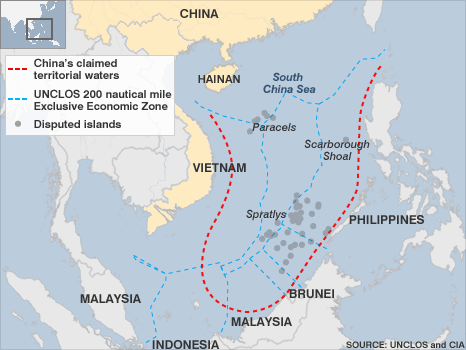
Although the Chinese say that the ship, once ready for operations, won’t enter other countries’ territorial waters, keep in mind that China doesn’t have the same idea about maritime rights as others in the South China Sea region:

Earlier posts about the Shi Lang (nee Varyag) here.

« Newer PostsOlder Posts »

Powered by WordPress