
Extra Credits
Published on 9 Feb 2019Writer Rob Rath talks about all the cool stories and facts we didn’t get to cover in the Sun Yat-sen series.
Join us on Patreon! http://bit.ly/EHPatreonRecommended reading – The Unfinished Revolution: Sun Yat-Sen and the Struggle for Modern China
3:42 – flag time!
7:59 – what are the Triads anyway?
16:13 – one man’s legacy can be very malleable…
19:05 – movies depicting the Chinese Revolution
20:16 – the Walpole Connection TM
21: 35 – what’s next on Extra History?
February 12, 2019
Sun Yat-sen – Lies – Extra History
Comments Off on Sun Yat-sen – Lies – Extra History
February 10, 2019
Stalemate in China, Bombs over Finland – WW2 – 024 – February 9 1940
World War Two
Published on 9 Feb 2019While the Winter War rages on in Finland, Japan is confronted with a dilemma. Keep fighting the Chinese and face huge problems feeding the populace in Japan and their newly conquered territories or withdraw and face your own populace to whom you’ve promised a glorious victory.
Follow WW2 day by day on Instagram @World_war_two_realtime https://www.instagram.com/world_war_t…
Join us on Patreon: https://www.patreon.com/TimeGhostHistory
Or join The TimeGhost Army directly at: https://timeghost.tvBetween 2 Wars: https://www.youtube.com/playlist?list…
Written and Hosted by: Indy Neidell
Produced and Directed by: Spartacus Olsson and Astrid Deinhard
Executive Producers: Bodo Rittenauer, Astrid Deinhard, Indy Neidell, Spartacus Olsson
Creative Producer: Joram Appel
Research by: Indy Neidell
Edited by: Iryna Dulka
Map animations: EastoryColorizations by Norman Stewart.
Thumbnail Colorization by Olga Shirnina aka Klimbim.Photos of the Winter War are mostly from the Finnish Wartime Photograph Archive (SA-Kuva).
Eastory’s channel: https://www.youtube.com/channel/UCEly…
Archive by Screenocean/Reuters https://www.screenocean.comA TimeGhost chronological documentary produced by OnLion Entertainment GmbH.
From the comments:
World War Two
2 days ago (edited)
New week, new video. A special one, since this one covers my birthday. Well, it would have if i were 54 years older… Anyhow, the Japanese are in trouble this week. At the same time, the Finnish are not as much in trouble as the Soviets would like them to be, but the pressure of the Soviet attacks is building up. Meanwhile, the Allied forces present a plan to actually intervene in the Winter War, in favour of Finland. A – for the Allies not at all unconvenient, side-effect would be an extra bonus. Talking about a convenient side-effect: If you support us on Patreon, we will be able to create ever more content. Right now, we’re working on the first biographies and more specials. We love to be able to bring those to you weekly, but we’re not there yet. Check out or Patreon page on https://www.patreon.com/TimeGhostHistory.Cheers,
Joram
Comments Off on Stalemate in China, Bombs over Finland – WW2 – 024 – February 9 1940
February 8, 2019
Smashing China to Pieces, the Background | Between 2 Wars | 1925 Part 1 of 2
TimeGhost History
Published on 7 Feb 2019The 19th century throws all kinds of terror and misfortune on China, which not long before was the most powerful nation in the world. While many other Western, Asian and even American nations seek to gain influence in China through politics, wars and trade, China itself tries to hold on to its glory days.
Join us on Patreon: https://www.patreon.com/TimeGhostHistory
Hosted by: Indy Neidell
Directed by: Spartacus Olsson
Written by: Spartacus Olsson
Produced by: Astrid Deinhard
Executive Producers: Bodo Rittenauer, Astrid Deinhard, Indy Neidell, Spartacus Olsson
Creative Producer: Joram Appel
Edited by: Wieke Kapteijns
Research by: Spartacus OlssonThumbnail depicts Ataturk colorised by Olga Shirnina aka Klimbim.
Colorized Pictures by Olga Shirnina and Norman Stewart
Olga’s pictures: https://klimbim2014.wordpress.com
Norman’s pictures https://oldtimesincolor.blogspot.com/Video Archive by Screenocean/Reuters http://www.screenocean.com
A TimeGhost chronological documentary produced by OnLion Entertainment GmbH
From the comments:
TimeGhost History
1 day ago (edited)Hey all!
After we decided to do Between Two Wars episodes on China in the 20’s, we quickly discovered that the historical context is necessary if you want to understand modern China. Therefore, we present to you a pre-war introduction of China. The end of the mighty empires is an exciting part of history that is often overlooked. That’s no longer the case.
Cheers,
Joram
Comments Off on Smashing China to Pieces, the Background | Between 2 Wars | 1925 Part 1 of 2
January 30, 2019
Sun Yat-sen – A Dream of China – Extra History – #5
Extra Credits
Published on 26 Jan 2019Sun’s attempts to found democracy in China were thwarted by the chaos of the authoritarian warlords who still stayed around. But, inspired by the youth of the New Culture Movement, and (surprisingly) Soviet Russia’s aid, he pressed on, and history would remember him as “the Forerunner of the Democratic Revolution.”
Join us on Patreon! http://bit.ly/EHPatreon
Comments Off on Sun Yat-sen – A Dream of China – Extra History – #5
January 29, 2019
The T-26 and Tank Warfare in Finland and China – WORLD WAR TWO Special
World War Two
Published on 28 Jan 2019The T-26 tank was one of the most frequently used tanks during the first battles of World War Two. It saw action in the Soviet Union, Finland and China. In our first collaborative video with the Tank Museum in Bovington, UK, David Willey and David Fletcher talk about the development, production and action of the this tank.
Check out the Tank Talk about the T-26 to hear David Fletcher explain some more about the T-26 on The Tank Museum YouTube Channel: https://youtu.be/EaBlg5pxe-4
Join us on Patreon: https://www.patreon.com/TimeGhostHistory
Or join The TimeGhost Army directly at: https://timeghost.tvFollow WW2 day by day on Instagram @World_war_two_realtime https://www.instagram.com/world_war_t…
Between 2 Wars: https://www.youtube.com/playlist?list…
Written and Hosted by: David Willey and David Fletcher
Produced by: Spartacus Olsson and Astrid Deinhard
Executive Producers: Bodo Rittenauer, Astrid Deinhard, Indy Neidell, Spartacus Olsson
Creative Producer: Joram Appel
Research by: The Tank Museum
Edited by: Joram Appel and Wieke KapteijnsPhotos of the Winter War are mostly from the Finnish Wartime Photograph Archive (SA-Kuva).
Archive by Screenocean/Reuters: https://www.screenocean.comA TimeGhost chronological documentary produced by OnLion Entertainment GmbH
Comments Off on The T-26 and Tank Warfare in Finland and China – WORLD WAR TWO Special
January 21, 2019
Sun Yat-sen – A Bombing in Wuchang – Extra History – #4
Extra Credits
Published on 19 Jan 2019Another group of revolutionaries in China, the Wuchang Uprising, accidentally kicked off their own plans earlier than expected, which lead to Sun starting an international diplomatic mission and then being appointed the head of the new republic. But Yuan Shikai, the current Prime Minister, had plans of his own…
Join us on Patreon! http://bit.ly/EHPatreon
Comments Off on Sun Yat-sen – A Bombing in Wuchang – Extra History – #4
January 14, 2019
Sun Yat-sen – An Army in Exile – Extra History – #3
Extra Credits
Published on 12 Jan 2019Sun Yat-sen spends the next ten years following his London adventures trying to organize the rebellion in Tokyo — and ends up not recruiting just Chinese reformers, but radical fighters from Japan and the Philippines too.
Join us on Patreon! http://bit.ly/EHPatreon
Comments Off on Sun Yat-sen – An Army in Exile – Extra History – #3
January 13, 2019
Canada’s role in India’s nuclear weapons development program
Canadian nuclear technology was critical to India for helping them develop their first nuclear weapons (although the Canadian reactor was supposed to be used only for civilian purposes):
Maybe you have heard the story of how India got the Bomb with Canada’s inadvertent help. We sold India a nuclear reactor called CIRUS in 1954 on an explicit promise that the facility would only be used for peaceful purposes. When India astonished the world with its first nuke test in May 1974, having upgraded the fuel output from CIRUS, it duly announced that it had successfully created a Peaceful Nuclear Explosive. The permanent consequence was, for better or worse, a nuclear-armed Subcontinent.
This is old news to enthusiasts of Cold War history. Here’s the new news: it almost happened twice. Canadian technology was almost used by another country to break into the nuclear club.
In November, historians David Albright and Andrea Stricker published a new book called Taiwan’s Former Nuclear Weapons Program: Nuclear Weapons On-Demand. The book pulls together the previously sketchy story of Nationalist China’s covert nuclear research, which had its roots in the postwar exodus of Chiang Kai-shek and the Kuomintang party (KMT). Albright and Stricker describe decades of effort by the offshore Republic of China on Taiwan to play a double game with nuclear weapons.
At first Taiwan engaged in sneaky nuclear research — it turns out that if you research nuclear safety you learn a lot about nuclear explosions — and it tried to create a plutonium stockpile on the sly. But their scientists left too many clues: a plutonium-based nuke requires processed plutonium metal, and that is hard to make without raising suspicions. The Indian test of 1974 was an important wake-up call to the world, and the nonproliferation establishment and the U.S. Department of State started to get nervous about Taiwan.
After a 1977 confrontation with American officials, who could hardly be ignored by the vulnerable Republic of China, the KMT deep state tried subtler methods to create the “on-demand” weapon described in the title. Taiwan committed formally to nonproliferation and full U.S. inspections of their facilities, but sought to be able to make low-yield nukes within three to six months in the event of a Communist invasion from the mainland.
Comments Off on Canada’s role in India’s nuclear weapons development program
January 6, 2019
The Finns Strike Again and Japan Strikes Back – WW2 – 019 – January 5 1940
World War Two
Published on 5 Jan 2019In Finland the invading Red Army suffers catastrophic casualties, while in China the Nationalists are divided as Japan uses diplomacy to strike back.
Follow WW2 day by day on Instagram @World_war_two_realtime https://www.instagram.com/world_war_t…
Between 2 Wars: https://www.youtube.com/playlist?list…
Join us on Patreon: https://www.patreon.com/TimeGhostHistory
Or join The TimeGhost Army directly at: https://timeghost.tvWritten and Hosted by: Indy Neidell
Produced and Directed by: Spartacus Olsson and Astrid Deinhard
Executive Producers: Bodo Rittenauer, Astrid Deinhard, Indy Neidell, Spartacus Olsson
Research by: Indy Neidell
Edited by: Iryna Dulka
Map animations by: Eastory
Community Manager: Joram AppelColorizations by Spartacus Olsson and Norman Stewart.
Photos of the Winter War are mostly from the Finnish Wartime Photograph Archive (SA-Kuva).
Eastory’s channel: https://www.youtube.com/channel/UCEly…
Archive by Screenocean/Reuters https://www.screenocean.comA TimeGhost chronological documentary produced by OnLion Entertainment GmbH
Comments Off on The Finns Strike Again and Japan Strikes Back – WW2 – 019 – January 5 1940
December 30, 2018
Stalin’s Unexpected Bedfellows – WW2 – 018 – 29 December 1939
World War Two
Published on 29 Dec 2018The Chinese Nationalists under command of Chiang Kai Shek is desperately looking to make new or restore old, allies to aid them in their fight against the Japanese. Meanwhile, the Soviets are still struggling to turn the Winter War against the Finnish in their favor.
Follow WW2 day by day on Instagram @World_war_two_realtime https://www.instagram.com/world_war_t…
Between 2 Wars: https://www.youtube.com/playlist?list…
Join us on Patreon: https://www.patreon.com/TimeGhostHistory
Or join The TimeGhost Army directly at: https://timeghost.tvWritten and Hosted by: Indy Neidell
Produced and Directed by: Spartacus Olsson and Astrid Deinhard
Executive Producers: Bodo Rittenauer, Astrid Deinhard, Indy Neidell, Spartacus Olsson
Research by: Indy Neidell
Edited by: Iryna Dulka
Map animations by: Mikk Tali aka Eastory
Community Manager: Joram AppelColorizations by Spartacus Olsson and Norman Stewart.
Photos of the Winter War are mostly from the Finnish Wartime Photograph Archive (SA-Kuva).
Eastory’s channel: https://www.youtube.com/channel/UCEly…
Archive by Screenocean/Reuters https://www.screenocean.comA TimeGhost chronological documentary produced by OnLion Entertainment GmbH
From the comments:
IMPORTANT POST SCRIPT NOTE: YouTube age restricted this video, which we find appalling — they also turned off monetisation (but that happens all the time). One of our most important tasks is to reach younger people with deep knowledge about history. While we are aware that some people might find war stories and images of the dead offensive, we cannot bow to that sentiment as it is of utmost important that any story of WW2 also displays the horrors of war. While we are fascinated by military history it is never or goal to glorify armed conflicts, to the contrary. Please help us get this resolved by voicing your opinion in a reply to this comment — we will forward your comments to YouTube.
This is the last World War Two video of 2018! We are looking forward to 2019/1940, which will be filled with many improvements, lots and lots of new content, the start of multiple new series within this channel and maybe even our first roadtrips to the real-life battlegrounds of World War Two. We’re very grateful to have you all onboard and even more so to have over 2000 of you supporting us on Patreon and timeghost.tv. What we do would not be possible without you!
Have a happy and safe New Years Eve and we’ll see you in 2019!
Cheers, Joram on behalf of Indy, Spartacus, Astrid, myself and everyone else at TimeGhost!
Note: Indy refers to a ‘Christmas cribs episode’ on the TimeGhost channel at the end of this video, but at the time of shooting this we didn’t realize that we were going to do a livestream instead. You can check that out on the TimeGhost channel.
Comments Off on Stalin’s Unexpected Bedfellows – WW2 – 018 – 29 December 1939
December 24, 2018
Sun Yat-sen – A Kidnapping in London – Extra History – #2
Extra Credits
Published on 22 Dec 2018Sun Yat-sen moves to a new city for safety, but it will not last long — a year after the Revive China society is destroyed and scattered, he is unwittingly kidnapped in London. He must rely on the ingenuity of his outside ally, Dr. James Cantlie…
Join us on Patreon! http://bit.ly/EHPatreon
Comments Off on Sun Yat-sen – A Kidnapping in London – Extra History – #2
December 23, 2018
Trouble in China – WW2 – 017 22 December 1939
World War Two
Published on 22 Dec 2018While the Winter War continues with a Soviet armoured attack at Summa and the Lähde Road and the British attack the Germans from the skies in the first official aerial battle of World War Two, there’s trouble in China. Chiang Kai Shek is looking for ways to gain a new advantage on the Japanese.
Follow WW2 day by day on Instagram @World_war_two_realtime https://www.instagram.com/world_war_t…
Between 2 Wars: https://www.youtube.com/playlist?list…
Join us on Patreon: https://www.patreon.com/TimeGhostHistory
Or join The TimeGhost Army directly at: https://timeghost.tvWritten and Hosted by: Indy Neidell
Produced and Directed by: Spartacus Olsson and Astrid Deinhard
Executive Producers: Bodo Rittenauer, Astrid Deinhard, Indy Neidell, Spartacus Olsson
Research by: Indy Neidell
Edited by: Iryna Dulka
Map animations by: Mikk Tali aka Eastory
Community Manager: Joram AppelColorizations by Spartacus Olsson and Norman Steward.
Photos of the Winter War are mostly from the Finnish Wartime Photograph Archive (SA-Kuva).
Eastory’s channel: https://www.youtube.com/channel/UCEly…
Archive by Screenocean/Reuters https://www.screenocean.comA TimeGhost chronological documentary produced by OnLion Entertainment GmbH
Comments Off on Trouble in China – WW2 – 017 22 December 1939
December 20, 2018
China’s Cultural Revolution
In Quillette, James David Banker describes the beginnings of Mao Zedong’s Cultural Revolution:
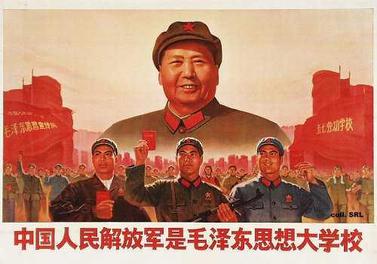
“The Chinese People’s Liberation Army is the great school of Mao Zedong Thought”, 1969.
A poster from the Cultural Revolution, featuring an image of Chairman Mao, published by the government of the People’s Republic of China.
Image via Wikimedia Commons.
“Nobody is more dangerous than he who imagines himself pure in heart,” wrote James Baldwin, “for his purity, by definition, is unassailable.” This observation has been confirmed many times throughout history. However, China’s Cultural Revolution offers perhaps the starkest illustration of just how dangerous the “pure in heart” can be. The ideological justification for the revolution was to purge the Chinese Communist Party (CCP), and the nation more broadly, of impure elements hidden in its midst: capitalists, counter-revolutionaries, and “representatives of the bourgeoisie.” To that end, Mao Zedong activated China’s youth — unblemished and uncorrupted in heart and mind — to lead the struggle for purity. Christened the “Red Guards,” they were placed at the vanguard of a revolution that was, in truth, a cynical effort by Mao to reassert his waning power in the Party. Nevertheless, it set in motion a self-destructive force of almost unimaginable depravity.
The Cultural Revolution commenced in spirit when Mao published a letter indicting a number of Party leaders on May 16, 1966. But it was a seemingly minor event nine days later that ignited the revolution in effect: a young philosophy professor at Peking University named Nie Yuanzi placed a “big-character poster” (a handwritten propaganda sheet featuring large Chinese characters) on a public bulletin board denouncing the university president and others in the administration as bourgeois revisionists. Mao immediately endorsed her protest, which set off a chain reaction of student revolt that swept through China.
That chain reaction was accelerated by “working groups” of ideologues sent to administer schools. Under their tenure, schools became centers of activism rather than learning. Students were encouraged to create big-character posters exposing their own teachers, officials, and even parents. The accused were humiliated in daily “struggle sessions” in which their students and colleagues interrogated them and demanded confessions. The viciousness of these sessions rapidly intensified. Students beat, spat upon, and tortured — in horrifically creative ways — their often elderly teachers and professors. In one case, students demanded their biology professor stare at the sun with wide open eyes. If he blinked or looked away, they beat him. Even middle and elementary school students participated in the struggle sessions, sometimes beating their teachers to death with sticks and belt buckles.
Students were also encouraged to turn on their classmates. As the sins of one generation passed to the next, a new hierarchy was born: the children of revolutionaries on top and the children of “landlords,” “capitalists,” and “rightists” at the bottom. These students were labeled “rotten eggs” and were fair game for the same treatment meted out to their parents. The current president of the People’s Republic of China, Xi Jinping, endured this fate. He was only 15 years old when his father, a loyal Maoist and one-time propaganda chief, was purged, his sister executed, and his own mother forced to denounced Xi as a reactionary. Amid the hysteria, teachers, professors, and intellectuals did not dare to stand up to the students or defend their colleagues lest they suffer similar fates. But they could not escape by being bystanders. With every word and action becoming potential evidence of capitalist sympathy, teachers and intellectuals enthusiastically joined their students in the struggle sessions and screaming rallies.
Comments Off on China’s Cultural Revolution
QotD: An “authentic” peasant diet
The fact is that you wouldn’t want to eat like a European peasant of yesteryear, or a Chinese peasant, either. Sure, peasants ate well when the garden was producing and the harvest was ripe. A lot of the year, they ate pretty meager, dull fare. Many of the spices we now take as ordinary — salt and pepper, for example — were pretty pricey. So were meat and cheese, which, like everything else, tended to get pretty scarce in winter. When you read about what people were actually eating most of the year, you realize that diets were dull, repetitive, and heavy on grains and legumes, lightly complimented by salted and dried things (home canning, like many of the other things we think of as traditional, was another Industrial Revolution contribution, and before modern farming practices, cows tended to be “dried off” in the winter to save the expense of the extra feed a milking cow needed). And this stayed true throughout the 19th century for large swaths of the population in both America and abroad.
The farther north you went, the more this was true — it’s probably no accident that Ireland and Scandinavia are not, let us say, renowned for their fantastic contributions to world cuisine. When your growing season is a short cloudy period between miserable winters, you don’t have the raw materials to construct amazing dining experiences. (Sure, every country has at least one or two really good fairly traditional foods. But the shorter the time fresh ingredients are available, the fewer culinary marvels you’ll be able to produce.)
Too, we must remember that not everyone was a good cook. Cooking was a job, not an absorbing hobby, and as with any other job, many people did it badly. Every farm wife could produce enough calories to feed her family (at least, if the raw materials were available). Not all of them could produce anything you’d want to eat. Modern food-processing technology has relieved us of that most “authentic” culinary experience: boring ingredients processed by an indifferent cook into something that you’d only voluntarily consume if you were pretty hungry. Even the memory of these cooks has fallen away, though you’ll encounter a lot of them if you read old novels.
Megan McArdle, “‘Authentic’ Food Is Not What You Think It Is”, Bloomberg View, 2017-02-24.
Comments Off on QotD: An “authentic” peasant diet
December 17, 2018
Sun Yat-sen – A Killing in Hong Kong – Extra History – #1
Extra Credits
Published on 15 Dec 2018Growing up in Honolulu, Sun Yat-sen had an expansive, exciting education, which would inspire him when he moved to Hong Kong as a young adult ready to change the world as a doctor — and as the leader of the “Revive China Society” interested in overthrowing the Qing government.
Sun Yat-sen was a dangerous man. The Qing were right to fear him. After all, he’d bring 2,000 years of imperial rule crashing down.
Join us on Patreon! http://bit.ly/EHPatreon
Comments Off on Sun Yat-sen – A Killing in Hong Kong – Extra History – #1


