
World War Two
Published on 20 Apr 2019The German Invasion of Norway is still very much in full swing. The German Wehrmacht is moving north from Oslo, where a Norwegian force is trying to halt them in anticipation of Allied reinforcements. The British do land in Norway, but don’t necessarily rush to relief the Norwegian army. Meanwhile, Norwegian “traitor” and “failure” Vidkun Quisling rises to be the new leader of Norway – only to get rejected by Hitler again. Numerous powers are now trying to grab, restore or consolidate military or political power in Norway. It’s a mess.
Join us on Patreon: https://www.patreon.com/TimeGhostHistory
Or join The TimeGhost Army directly at: https://timeghost.tvFollow WW2 day by day on Instagram @World_war_two_realtime https://www.instagram.com/world_war_t…
Join our Discord Server: https://discord.gg/D6D2aYN.
Between 2 Wars: https://www.youtube.com/playlist?list…
Source list: http://bit.ly/WW2sourcesWritten and Hosted by: Indy Neidell
Produced and Directed by: Spartacus Olsson and Astrid Deinhard
Executive Producers: Bodo Rittenauer, Astrid Deinhard, Indy Neidell, Spartacus Olsson
Creative Producer: Joram Appel
Research by: Indy Neidell
Edited by: Iryna Dulka
Map animations: EastoryColorisations by Norman Stewart and JuliusJaa (https://www.flickr.com/photos/juliusjaa/)
Eastory’s channel: https://www.youtube.com/channel/UCEly…
Archive by Screenocean/Reuters https://www.screenocean.comSources:
© IWM (N 159)
© IWM (HU 104676)
© IWM (HU 104684)A TimeGhost chronological documentary produced by OnLion Entertainment GmbH.
April 21, 2019
The Scramble For Norway – WW2 – 034 – April 20 1940
April 18, 2019
Chiang Kai-shek Plays it Like Stalin | Between 2 Wars | 1926 Part 3 of 3
TimeGhost History
Published on 17 Apr 2019In 1926 Chiang Kai-shek manages to turn the Kuomintang into his own private army, and the events are befuddling…
Join us on Patreon: https://www.patreon.com/TimeGhostHistory
Hosted by: Indy Neidell
Directed by: Astrid Deinhard
Written by: Spartacus Olsson
Produced by: Astrid Deinhard
Executive Producers: Bodo Rittenauer, Astrid Deinhard, Indy Neidell, Spartacus Olsson
Creative Producer: Joram Appel
Post Production Director: Wieke Kapteijns
Edited by: Wieke Kapteijns
Research by: Spartacus Olsson supported by Gabriel MatsakisColorized Pictures by Olga Shirnina
https://klimbim2014.wordpress.comVideo Archive by Screenocean/Reuters http://www.screenocean.com
A TimeGhost chronological documentary produced by OnLion Entertainment GmbH.
From the comments:
TimeGhost History
15 hours ago (edited)
First of all, many thanks to Gabriel Matsakis for helping out with the research for this episode! While writing about China and Chiang Kai-shek, Spartacus realised that he needed to make more than one script to explain The Northern Expedition (crucial to the developments that eventually lead to the World War in China), so we threw in another episode in 1926 to explain Chiang Kai-shek’s rise to power. In the next episode (1927 part 1) we will return to the United States and look at the economic boom and the Roaring Twenties. We will also return to China and the actual Northern Expedition in a 1927 episode after that. Enjoy the confusion that is China in the 1920s!?!
April 14, 2019
April 13, 2019
Canadian 8mm “Sterile” Bren Gun
Forgotten Weapons
Published on 12 Apr 2019This Bren is lot #1013 at Morphy’s April 2019 auction:
https://www.forgottenweapons.com/cana…The John Inglis company in Toronto first opened in 1859 as a metalworking shop, and grew steadily over the decades under first John Inglis, and then later his sons. Inglis did substantial amounts of military work during World War One, but the Great Depression hit it hard, and both William and Alexander Inglis died in 1935 and 1936 respectively. The company went into receivership but was purchased by one Major James Hahn (DSO) and a group of business partners in November of 1936. Hahn and his associates saw an opportunity to use this large manufacturing facility to make machine guns for the military, and they were successful – in October 1938 they were awarded a contract to make 5000 MkI Bren guns. More contracts would follow, and by the height of World War Two the company had some 15,000 employees and more than a million square feet of floor space.
Among many other projects, Inglis was contracted to make small arms for sale to the Nationalist Chinese government under Chiang Kai Shek – both High Power pistols and Bren guns in 8mm Mauser (to fit the Chinese standardization on that cartridge). A batch of 8mm ZB-30 light machine guns were brought in from the Far East to use as a pattern, and Inglis engineers were able to successfully redesign the Bren to use that cartridge and magazine.
Where the story gets hazy is in trying to determine how many were made and for whom. The Chinese guns are marked in Mandarin on the receivers, and have “CH” prefix serial numbers, like the Chinese contract High Power pistols. However, two additional variations exist without those Chinese markings. Some are marked “7.92 Bren MkI” and “Inglis 1943” (or 44 or 45), and others – like this one – are just marked “7.92 Bren MkI”. The dated ones are typically referred to as Resistance guns, intended to be supplied to European resistance units for whom 7.92mm ammunition was more readily available than .303 – although information on how many guns were supplied in this way (if any) is difficult to find. The last group is generally called “sterile”, and it is not clear what their purpose is. This particular example is one of 23 that were registered in the US in the early 1960s to Interarms, and it does appear that they were associated with some clandestine US military activities. The serial numbers of those 23 Interarms guns range from 1-5343 to 2-8045, suggesting a production of 13,000 or perhaps as many as 28,000 guns – that is quite a lot to be undocumented and missing.
Hopefully, more information will turn up in the future to shed light on the purpose and use of these 8mm Brens. We do know for sure that many thousands did go to Chinese forces, and some were brought into the UK, where in the 1960s they were used in the development of the 7.62mm NATO L4 version of the Bren.
http://www.patreon.com/ForgottenWeapons
Cool Forgotten Weapons merch! http://shop.bbtv.com/collections/forg…
Contact:
Forgotten Weapons
PO Box 87647
Tucson, AZ 85754
April 9, 2019
Blue’s Dumb History Tales
Overly Sarcastic Productions
Published on 8 Mar 2019Please check out That Works for the best blacksmithing on YouTube: https://goo.gl/vXsuFt
What do you get when you cross a month that has 5 Fridays with a historian who can’t do math? This nonsense, apparently.
PATREON: https://www.patreon.com/OSP
April 8, 2019
Comparing the economic performance of China’s private versus state-owned companies
If you’ve been following the blog for a while, you’ll know that I’ve long been skeptical of any official economic statistics coming out of China. The reasons for my skepticism are that vast areas of the Chinese economy were owned or controlled by the state and reporting from those entities was performed through layers of officials whose positions and personal well-being depended on those reports being as positive as possible. In a capitalist system, announcing false production or profit figures will eventually be detected (sometimes not as soon as we’d like), and the company loses the trust of customers, suppliers, and banks, making survival much more difficult. In a state-owned organization, everyone in the hierarchy has a vested interest in false information not being uncovered or reported. In a private firm, you could lose your job … in a state-run enterprise, you could be shot or sent to a “re-education camp” along with all your family. The incentive to lie is much stronger when your risks are that high.
Tim Worstall comments on a recent report that compares the performance over time of Chinese private companies, privatized state companies, and companies that are still state-run:
That China has relaxed the governmental grip upon industry in recent decades is true. That China has become very much richer in recent decades is also true. The two are not a coincidence, there’s causality there. However, we hear often enough that it’s the residual control over industry by the government that drives that success. Sure, OK, so the bureaucracy doesn’t specify prices or detailed actions but the general guidance provided by a politically driven bureaucracy explains the outperformance.
Except it doesn’t. Those former state industries still enjoying that government guidance perform worse than the free market firms sadly lacking it. State planning is keeping China poorer than it need be, not aiding its growth.
The report he’s commenting on:
Changing the tiger’s stripes: Reform of Chinese state-owned enterprises in the penumbra of the state
Ann Harrison, Marshall W. Meyer, Will Wang, Linda Zhao, Minyuan Zhao 07 April 2019The conventional wisdom that privatisation of state-owned enterprises reduces their dependence on the state and yields positive economic benefits has not always been borne out by empirical work. Using a comprehensive dataset from China, this column shows that privatised SOEs continue to benefit from government support in the form of low-interest loans and subsidies relative to private enterprises that have never been state-owned. Although there are clear improvements in performance post-privatisation, privatised SOEs continue to significantly under-perform compared to private firms.
Much of China’s economic growth has been driven by the emergence of a vibrant private sector, today accounting for approximately 60% of GDP and 80% of employment. Conventional wisdom holds that privatisation of state-owned enterprises (SOEs) reduces their dependence on the state and yields positive economic benefits including enhanced firm performance, productivity, and innovation. The pro-privatisation argument is that the state either cannot monitor managers properly or chooses not to pursue efficiency because state interests take precedence over financial results (Boardman and Vining 1989, Vickers and Yarrow 1991, Shleifer and Vishny 1994). Empirical work, however, has produced mixed results on privatisation. For example, DeWenter and Malatesta (2001) found that, among the 500 largest firms globally in 1975, 1985, and 1995, private enterprises had significantly lower costs and higher profits than SOEs. Yet, when they examined a sub-sample of privatised firms, they found inconsistent results – performance increased post-privatisation, while leverage and employment increased mainly pre-privatisation. Market returns from privatisation also differed across countries, positive in Hungary, Poland, and the UK but insignificant elsewhere.
Our research on privatisation in China (Harrison et al. 2019) is unique in several respects. We analyse an extremely large sample of industrial firms, more than 3.5 million firm-years from 1998 to 2013, drawing on the Annual Industrial Survey conducted by the China National Bureau of Statistics. We compare privatised firms with firms that remained state-owned and firms that had never been state-owned. Most importantly, we compare both the performance and dependence on the state of privatised firms with firms having no prior state ownership. Overall, our results indicate selective performance gains from privatisation – privatised firms have greater productivity and are more likely to file patents than firms remaining state-owned even though their return on assets barely improves. The performance effects notwithstanding, privatised firms remain dependent on the state. Subsidies, concessionary interest rates, and loans granted to privatised firms remain at nearly the same levels as those to SOEs. Privatisation changes the behaviour of firms but not firms’ dependence on the state.
A graphical portrayal of the differing performance of the three types of Chinese companies from the report:
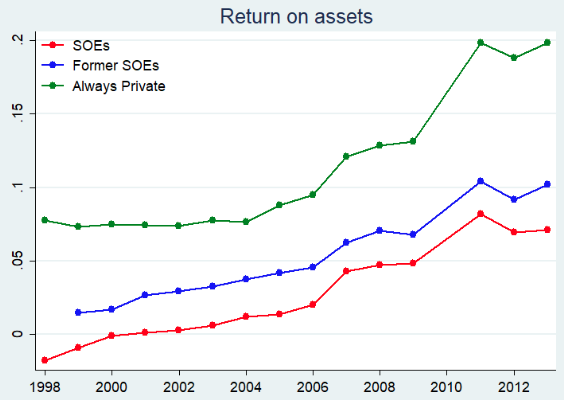
Return on assets of state-owned enterprises, privatised state-owned enterprises, and privately-owned enterprises
April 2, 2019
How Trains Changed China | Stuff That I Find Interesting
Jabzy
Published on 27 Mar 2016Thanks to Xios, Alan Haskayne, Lachlan Lindenmayer, William Crabb, Derpvic, Seth Reeves and all my other Patrons. If you want to help out – https://www.patreon.com/Jabzy?ty=h
Music by Derek Fiechter – https://www.youtube.com/channel/UCVRJ…
March 31, 2019
Allies Plan to Hit the Nazis Where it Hurts – WW2 – 031 – March 30 1940
World War Two
Published on 30 Mar 2019Newly appointed French Prime Minister Paul Reynaud and his British counterpart Neville Chamberlain spend the week looking for ways to harm the Germans. Not just by targeting their direct opponent directly, but also by exploring the idea of expanding the war into much bigger territory. In the meantime, the French prepare for the expected invasion and the Allies are laying the foundations of what might one time become a weapon of mass destruction.
Join us on Patreon: https://www.patreon.com/TimeGhostHistory
Or join The TimeGhost Army directly at: https://timeghost.tvFollow WW2 day by day on Instagram @World_war_two_realtime https://www.instagram.com/world_war_t…
Between 2 Wars: https://www.youtube.com/playlist?list…
Source list: http://bit.ly/WW2sourcesWritten and Hosted by: Indy Neidell
Produced and Directed by: Spartacus Olsson and Astrid Deinhard
Executive Producers: Bodo Rittenauer, Astrid Deinhard, Indy Neidell, Spartacus Olsson
Creative Producer: Joram Appel
Research by: Indy Neidell
Edited by: Iryna Dulka
Map animations: EastoryColorisations by Norman Stewart
Eastory’s channel: https://www.youtube.com/channel/UCEly…
Archive by Screenocean/Reuters https://www.screenocean.comA TimeGhost chronological documentary produced by OnLion Entertainment GmbH.
From the comments:
World War Two
9 hours ago (edited)
If the Allies and the Germans follow through with all their plans, the phoney war will surely soon come to a close. But who knows what will happen. If one thing is certain, it is that they all have made plans before that never made it into reality.A community member of ours set up a new Discord Channel. Come over to discuss the war, say hi to the community or share some memes. You can join right here: https://discord.gg/D6D2aYN
March 20, 2019
History Summarized: Medieval China (Ft Jack Rackam)
Overly Sarcastic Productions
Published on 15 Mar 2019Check out our website at http://www.OverlySarcasticProductions.com
Tale as old as time
Song as old as rhyme…
China broke agaiiinnnnnn — dammit china you only had one jobJack Rackam’s Channel: https://goo.gl/EgwpGu
PATREON: https://www.patreon.com/OSP
March 10, 2019
Finnish Winter is Almost Over – WW2 – 028 – March 9 1940
World War Two
Published on 9 Mar 2019The French promise to send troops to aid Finland, though the majority is planned to go to Norway or Sweden. In return, the Finns postpone their peace talks with the Soviets. It is at that moment that the Finns realise that the French are playing tricks and the Soviets are not to be messed with. It’s deal or no deal, and they need to decide quick.
Thumbnail depicts an unnamed Red Army PoW towards the end of the Winter War – colorisation by Jared Enos
Join us on Patreon: https://www.patreon.com/TimeGhostHistory
Or join The TimeGhost Army directly at: https://timeghost.tvFollow WW2 day by day on Instagram @World_war_two_realtime https://www.instagram.com/world_war_t…
Between 2 Wars: https://www.youtube.com/playlist?list…
Source list: http://bit.ly/WW2sourcesWritten and Hosted by: Indy Neidell
Produced and Directed by: Spartacus Olsson and Astrid Deinhard
Executive Producers: Bodo Rittenauer, Astrid Deinhard, Indy Neidell, Spartacus Olsson
Creative Producer: Joram Appel
Research by: Indy Neidell
Edited by: Iryna Dulka
Map animations: EastoryThumbnail and portrait colorizations by Norman Stewart.
Photos of the Winter War are mostly from the Finnish Wartime Photograph Archive (SA-Kuva).
Eastory’s channel: https://www.youtube.com/channel/UCEly…
Archive by Screenocean/Reuters https://www.screenocean.comA TimeGhost chronological documentary produced by OnLion Entertainment GmbH.
From the comments:
World War Two
2 days ago
It doesn’t look too good for the Finns this week. Peace talks are more and more becoming their only way out of this war. The Soviets are looking to gain as much leverage to benefit their position in the talks. Meanwhile, the Finnish try to do the same, and focus their defence on diplomatic key points instead of long term defensive strategies.Note that we have launched our first episode of the War Against Humanity this week, in which we will discuss the war crimes committed by all sides. The first episode covers the first six months of the war up until March 5 1940, the day on which Joseph Stalin and Beria order the Katyn Massacre. You can find that episode right here: https://www.youtube.com/watch?v=gd5YhhNcC44&
March 9, 2019
Old posts (from the old blog) about Chinese official economic statistics
This post at Continental Telegraph a few days back reminded me I wanted to get around to gathering some of my older posts about the reasons to take the official GDP numbers from the Chinese government with more than just a pinch of salt. Here’s my very first rant on the topic from 10 August, 2004 (original expired URL – http://bolditalic.com/quotulatiousness_archive/000323.html):
On my way in to work this morning, I heard a stock advisor doing his best to make reasonable assumptions about what the average listener needed to know about the economy. This guy has been pretty level-headed in the past, but this morning’s talk just got my head ready to explode.
The topic of discussion was the Chinese economy and how the Chinese central bank was having to take greater efforts to rein in economic expansion. He talked about how many different sectors of the North American economy were, to greater or lesser degree, depending more and more on Chinese growth to increase their own investments and output. The idea that the Chinese economy was "overheating" was bandied about. He closed by indicating that a slight drop in the official growth rate from 9.8% to 9.6% showed that the Chinese central bank was seeing some results from their intervention in the economy.
There are so many things wrong here that I’m almost at a loss where to start. While there is no doubt that China is a fast-growing economy, the most common mistake among both investors and pundits is to assume that China is really just like South Carolina or Ireland … a formerly depressed area now achieving good results from modernization. The problem is that China is not just the next Atlanta or Slovenia. China is still, more or less, a command economy with a capitalist face. One of the biggest players in the Chinese economy is the army, and not just in the sense of being a big purchaser of capital goods (like the United States Army, for example).
The Chinese army owns or controls huge sectors of the economy, and runs them in the same way it would run a division or an army corps. The very term "command economy" would seem to have been minted to describe this situation. The numbers reported by these "companies" bear about the same resemblance to reality as those posted by Enron or Worldcom. With so much of their economy not subject to profit and loss, every figure from China must be viewed as nothing more than a guess (at best) or active disinformation.
Probably the only figures that can be depended upon for any remote accuracy would be the imports from other countries — as reported by the exporting firms, not by their importing counterparts — and the exports to other countries. All internal numbers are political, not economic. When a factory manager can be fired, he has his own financial future at stake. When he can be sentenced to 20 years of internal exile, he has his life at stake. There are few rewards for honesty in that sort of environment: and many inducements to go along with what you are told to do.
Under those circumstances, any growth figures are going to be aggregated from all sectors, most of which are under strong pressure to report the right numbers, not necessarily corresponding with any real measurement of economic activity. So, if the economic office wants to see a drop in the economy, that’s what they’ll get.
Basing your own personal financial plans on numbers like this would quickly have you living in a cardboard box under a highway overpass. Companies in the soi-disant free world have shareholders or owners to answer to. Companies in China exist in a totally different environment.
I returned to the same topic on October 25, 2004, triggered by yet another talking head on the radio under the heading “More Economic Voodoo — or is that Feng Shui?” (original URL – http://www.bolditalic.com/quotulatiousness_archive/000580.html):
Again this morning, I was listening to my local jazz radio station on the way in to work. As usual, they had a broker from CIBC Wood Gundy giving portfolio advice at about 9:20 a.m. Today’s talk was about investing in China, and how the markets have been reacting to the recent small drop in the official GDP growth figures released by the Chinese central bank.
This time, the emphasis was on the idea that in spite of the breathtaking growth figures, Chinese firms still are not particularly profitable and that therefore there are better ways of investing your money to benefit from all that growth. Unlike the last time I addressed this issue, this time I thought that the advisor was actually making pretty good sense. The incredible transformation of China from a pure command-driven economy to a mixed economy will certainly provide lots of opportunities for people to get rich; it will also provide even more opportunities to lose big money.
Much of the problem is that even now, the Chinese economy is not particularly free: the official and unofficial controls on the economy provide far too many opportunities for rent-seeking officialdom to play favourites and cripple antagonists (and for once, "cripple" is not just a bit of hyperbole). Any numbers provided by the Chinese authorities cannot be depended upon, and should probably only be viewed as an indication of what the Chinese government wants the outside world to believe.
Even in a relatively free economy like Canada, the underground economy can be huge, with plenty of economic activity happening out of reach of the taxman. In China, where everybody was raised in an environment where providing the "wrong" answer to your leader could get you imprisoned (or executed) as an economic criminal, the numbers upon which the bankers and financial officials depend can only be described as extremely unreliable.
Update 26 October: The Last Amazon asks a highly pertinent and pointed question:
In the past week, the Globe and Mail has been featuring the economic engine that China has become. Its economy is thriving so much so that Chinese government owned companies like China Minmetals Corp (which had revenues in 2003 of USD$11.7 billion) is currently negotiating to buy outright 100% of the stock of the Canadian mining corporation, Noranda Inc. The total stock is estimated at approximately CDN$6.7 billion.
If the Chinese government can afford to buy Noranda Inc. why hasn’t anyone asked when China will reimburse the overburdened Canadian taxpayers of this fair land for the Cdn$65.4 million that has been given to China as foreign aid?
I managed to stay away from the topic until April 13, 2007, when I posted “The Chinese Economy”, which largely quoted from my first two posts (old URL – http://bolditalic.netfirms.com/quotulatiousness_archive/003649.html):
Everyone must have heard many different variations on how incredible the Chinese economy is: spectacular growth, innovations galore, etc., etc. And there’s much truth to it — China has been industrializing at a mind-croggling pace. At least, the visual evidence says so. The economic data coming out of China is, to be kind, not as dependable as similar data from most other countries. […]
Three years on, I must retract a tiny bit there … Enron’s and Worldcom’s figures, while deliberately misleading, were refutable (and the culprits taken to court). […]
Samizdata links to a brief Tyler Cowen post which includes this quote:
…of the 3,220 Chinese citizens with a personal wealth of 100 million yuan ($13 million) or more, 2,932 are children of high-level cadres. Of the key positions in the five industrial sectors – finance, foreign trade, land development, large-scale engineering and securities – 85% to 90% are held by children of high-level cadres.
That’s even higher than I expected. But it’s an excellent example of what I originally wrote about back in 2004: the economy isn’t free, and the beneficiaries are disproportionally those who are politically well-connected. Caveat investor.
And that was when I discovered that my “full” backup of files from the old site is actually missing nearly a year of posts from May 2008 to May 2009 (when I moved to the current site). I vaguely recall that Jon (my former virtual landlord) was having problems with limited storage on that site — I was just a freeloading guest — so perhaps one of the things we lost was the auto-archiving after we reached a certain capacity.
Thanks to the Wayback Machine, I found a couple of other entries but they were often just rehashes of the first two posts interspersed with quotations from articles I felt were being too Pollyanna-ish about the Chinese economic numbers, like this one from May 2, 2008:
Those untrustworthy Chinese economic numbers
Regular readers will know that I’ve been a long-term skeptic about the economic figures reported by the Chinese government (for example, here and here back in 2004). As a result, this post at the Economist is not very surprising:
As China’s importance in the global economy increases, investors are paying more attention to its economic numbers. Yet the country’s official statistics are notoriously ropy. Some commentators accuse China’s government of overstating GDP growth for political reasons, others complain that the official inflation rate is fraudulently low. So which data can you trust?
One reason to be suspicious of GDP figures is that China is always one of the first countries to report them, usually only two weeks after the end of each quarter. Most developed economies take between four and six weeks to produce them.
However, The Economist still feels that the Chinese economy is larger than reported. My sense of distrust in the figures argues for it being neither as big nor as robust as the reported figures indicate. They’re professional economic reporters … I’m a guy typing a blog entry. I wonder what the long-term odds are for either of us to be closer to the truth?
It’s tough to disagree with this, though:
The prize for the dodgiest figures goes to the labour market. The quarterly urban unemployment rate is meaningless because it excludes workers laid off by state-owned firms as well as large numbers of migrant workers, who normally live in urban areas but are not registered. Wage figures are also lousy. There has recently been much concern about the faster pace of increase in average urban earnings. But this series does not cover private firms, which are where most jobs have been created in recent years.
Now that China is such an engine of global growth, it urgently needs to improve its economic data. Only a madman would drive a juggernaut at full speed with a faulty speedometer, a cracked rear-view mirror and a misty windscreen.
By this point, Jon was referring to my obsession with bogus Chinese economic statistics as my “hobby horse” … yet it wasn’t unknown for him to send me links to articles on that very topic. Here’s another post, courtesy of the Wayback Machine, from January 23, 2009:
China’s economic situation
There’s an article at The Economist today that shows a touching belief in the magic of the Chinese economy. The reported Gross Domestic Product has fallen to “only” 5.8%. The Economist‘s writer spends much of the article worrying about this gloomy report:
New figures show that China’s GDP growth fell to 6.8% in the year to the fourth quarter, down from 9% in the third quarter and half its 13% pace in 2007. Growth of 6.8% may still sound pretty robust, but it implies that growth was virtually zero on a seasonally adjusted basis in the fourth quarter.
Industrial production has slowed even more sharply, growing by only 5.7% in the 12 months to December, compared with an 18% pace in late 2007. Thousands of factories have closed and millions of migrant workers have already lost their jobs. But there could be worse to come. Chinese exports are likely to drop further in coming months as world demand shrinks. Qu Hongbin, an economist at HSBC, forecasts that exports in the first quarter could be 19% lower than a year ago. 2009 may well see the first full-year decline in exports in more than a quarter of a century.
Economists have become gloomier about China’s prospects, with many now predicting GDP growth of only 5-6% in 2009, the lowest for almost two decades.
I’ve blogged about the Chinese economy on a few occasions (most recently here), generally with the same concern: that the numbers reported cannot be relied upon. The same is true here. Interestingly, the Economist article I linked to back in May makes this point quite well, yet today’s article appears to treat the Chinese government’s numbers as solid.
China has changed substantially from twenty years ago, and in many ways for the better. Most ordinary Chinese today are more free — economically anyway — than they were a generation ago, and there is a lot more opportunity for individuals to set up businesses and to succeed without needing Party connections. All this is indisputable … yet vast swathes of the Chinese economy are a legacy of the worst command-and-control period. It’s not an exaggeration to say that we can expect to discover the “official numbers” have absolutely no relationship to reality, because the numbers are compiled from various sources including both free-r quasi-capitalist companies and tottering government-owned (and often People’s Liberation Army-owned) conglomerates which cannot be depended upon to report anything accurately.
An example from this article: “a fall in electricity output of 6% in the year to the fourth quarter, down from average annual growth of 15% over the previous five years.” That’s not just a reduction in the rate of growth, that’s a reported drop in output of 6%. Imagine what the state of a European or Japanese/Korean economy running at only 94% of electricity … it’d be something you’d only see at times of severe economic contraction, not as a sign of a slow-down in growth.
Finally, on May 22, 2009, a final post on the topic at the old blog:
Official Chinese statistics
If you’ve read the blog for a while, you’ll know that I’m pretty skeptical about how believable the official statistics coming from the Chinese government may be. The Economist is somewhat undecided on the matter … sometimes publishing articles that treat the official numbers as legitimate and other times, showing more doubt:
Part of the recent optimism in world markets rests on the belief that China’s fiscal-stimulus package is boosting its economy and that GDP growth could come close to the government’s target of 8% this year. Some economists, however, suspect that the figures overstate the economy’s true growth rate and that Beijing would report 8% regardless of the truth. Is China cheating?
Economists have long doubted the credibility of Chinese data and it is widely accepted that GDP growth was overstated during the previous two downturns. In 1998-99, during the Asian financial crisis, China’s GDP grew by an average of 7.7%, according to official figures. However, using alternative measures of activity, such as energy production, air travel and imports, Thomas Rawski of the University of Pittsburgh calculated that the growth rate was at best 2%. Other economists reckon that Mr Rawski was too pessimistic. Arthur Kroeber of Dragonomics, a research firm in Beijing, estimates GDP growth was around 5% in 1998-99, for example. The top chart, plotting the official growth rate against estimates by Dragonomics, clearly suggests that some massaging of the government statistics may have gone on. The biggest adjustment seems to have been made in 1989, the year of political protests in Tiananmen Square. Officially, GDP grew by over 4%; Dragonomics reckons it actually declined by 1.5%.
Of course, The Economist doesn’t want to lose sales in China, so the last paragraph of the article blithely re-assures readers that things are improving and that the official numbers are much harder to fudge now than they used to be. That may well be true (I rather hope it is), but in the same way that you can get much more impressive growth from a very small base, you can become much more honest with your numbers when you’re starting from pure fiction.
[…] Let’s just say that I’m still unconvinced.
After that, my hobby-horse rides can be found by searching for “china economy” (or just click this link) on the current blog, or you can just peruse the China category.
March 7, 2019
Outbreak of the War Against Humanity – WW2 – WaH 001 – 5 March 1940
World War Two
Published on 6 Mar 2019When the Second World War breaks out, it is at first largely a war between one side of totalitarian aggressors against a portion of the democratic countries of the world defending other totalitarian states. From the first day of the war in Poland, as it already is in China, this will be a war against humanity.
Join us on Patreon: https://www.patreon.com/TimeGhostHistory
Or join The TimeGhost Army directly at: https://timeghost.tvFollow WW2 day by day on Instagram @World_war_two_realtime https://www.instagram.com/world_war_t…
Between 2 Wars: https://www.youtube.com/playlist?list…
Source list: http://bit.ly/WW2sourcesWritten and Hosted by: Spartacus Olsson
Produced and Directed by: Astrid Deinhard
Executive Producers: Bodo Rittenauer, Astrid Deinhard, Indy Neidell, Spartacus Olsson
Creative Producer: Joram Appel
Post Production Director: Wieke Kapteijns
Research by: Spartacus Olsson
Edited by: Spartacus Olsson and Wieke KapteijnsArchive by Screenocean/Reuters https://www.screenocean.com
A TimeGhost chronological documentary produced by OnLion Entertainment GmbH.
From the comments:
World War Two
47 minutes ago (edited)
READ THIS AND OUR RULES BEFORE COMMENTING Here it is with some slight delay – the first episode of War Against Humanity, written and hosted by Spartacus Olsson. Due to the delay, this video went public on YouTube and was not in Preview for the TimeGhost army – we apologise for this – the next WaH video will be given in advance. To be clear it is the support of the TimeGhost army that enables us to continuously expand and improve our coverage – if you haven’t already, consider signing up on timeghost.tv or https://www.patreon.com/TimeGhostHistory – Now, we have age-restricted this video of our own accord because of the extremely graphic content in some sections. While we are of the opinion that it should be available for anyone over the age of 15, YouTube does not offer us that possibility. We apologise to our viewers that are in that bracket, but we felt that it was more important to protect children from exposure to this kind of violence without the help of an adult to digest it.
February 20, 2019
Glueing back together the shards of China | Between 2 Wars | 1925 Part 2 of 2
TimeGhost History
Published on 19 Feb 2019One man tries to reunite China, he is Sun Yat Sen but he shall not see his work come to fruition.
Join us on Patreon: https://www.patreon.com/TimeGhostHistory
The Great War China during WWI Special https://www.youtube.com/watch?v=TofCR…
Hosted by: Indy Neidell
Directed by: Spartacus Olsson
Written by: Spartacus Olsson
Produced by: Astrid Deinhard
Executive Producers: Bodo Rittenauer, Astrid Deinhard, Indy Neidell, Spartacus Olsson
Creative Producer: Joram Appel
Edited by: Wieke Kapteijns
Research by: Spartacus OlssonColorized Pictures by Olga Shirnina and Norman Stewart
Olga’s pictures: https://klimbim2014.wordpress.com
Norman’s pictures https://oldtimesincolor.blogspot.com/Video Archive by Screenocean/Reuters http://www.screenocean.com
A TimeGhost chronological documentary produced by OnLion Entertainment GmbH
Here’s the Thing… we all worked with Sun Yat Sen!
TimeGhost History
Published on 19 Feb 2019Mao Zedong, Wang Jingwei, and Chiang Kai-shek – the Snap, Crackle, and Pop of 1920’s China.
Indy decided to write some lyrics about them, God alone knows why … but it’s a concise analysis of those three comrades and comrades in arms of Sun Yat Sen.
Join us on Patreon: https://www.patreon.com/TimeGhostHistory
A TimeGhost interlude produced by OnLion Entertainment GmbH
For context, I’ve posted a series of videos from Extra History on Dr. Sun Yat Sen, and TimeGhost is currently covering the history of China’s post-monarchy period (see the next video for more of that). I also have tags for Mao Zedong (aka Mao Tse-tung in my youth) and Chiang Kai-Shek, should you want to dig a bit deeper. I also denounce myself for laughing-out-loud at the Rice Krispies joke in the description.


