
World War Two
Published 28 May 2021German Grand Admiral Karl Dönitz orders the U-Boats to leave the Atlantic this week; the losses lately have just been too great for their patrols to continue there. There is active fighting in China, the Aleutians, and the Kuban, and there are special weapons tests in the skies over Germany.
(more…)
May 29, 2022
Black May, Nazi Subs Defeated – WW2 – 196 – May 28, 1943
Comments Off on Black May, Nazi Subs Defeated – WW2 – 196 – May 28, 1943
May 16, 2022
Heaviest Air Raid in Human History – WAH 060 – May 15, 1943
World War Two
Published 15 May 2022As the Warsaw Ghetto Uprising is being quashed, there are renewed Japanese atrocities in China, and the RAF sets a world record by bombing German civilians.
(more…)
Comments Off on Heaviest Air Raid in Human History – WAH 060 – May 15, 1943
QotD: The difference between surface meaning and actual intent
A basic truism is that languages don’t map exactly over each other and that’s the most likely explanation for this database from China detailing “BreedReady” women. That languages don’t map exactly should be obvious even to the most monolingual of English speakers. We all know that “Let’s have lunch sometime” when said by an American means “Hope to see you never and definitely not while eating”. Similarly, “That’s lovely” when said by a Brit does not necessarily mean it is lovely and “How quaint” isn’t praise for the cuteness of the thing. A Californian invocation to meet Tuesday is in fact a rumination on the possible non-existence of Tuesday.
Tim Worstall, “That Chinese ‘BreedReady’ Database – Check The Translation”, Continental Telegraph, 2019-03-11.
Comments Off on QotD: The difference between surface meaning and actual intent
May 15, 2022
The End of the War in Africa – WW2 – 194 – May 14, 1943
World War Two
Published 14 May 2022With the end of the Tunisian Campaign, the Allies have won the war for the African Continent. What next? They meet at the Trident Conference in Washington DC to try and figure that out. Meanwhile, the fight in the field continues — in Burma, the Aleutians, China, and the Kuban.
(more…)
Comments Off on The End of the War in Africa – WW2 – 194 – May 14, 1943
May 8, 2022
Kilroy was Here! The fall of Tunis – WW2 – 193 – May 7, 1943
World War Two
Published 7 May 2022Tunis falls to the Allies, but the Axis are still fighting back from their little corner of Tunisia. There is more of the seemingly endless fighting in the Kuban in the Caucasus, and the Chinese Theater comes to life with a new Japanese offensive.
(more…)
Comments Off on Kilroy was Here! The fall of Tunis – WW2 – 193 – May 7, 1943
April 27, 2022
“We’re healthy from the bottom up, and sick from the top down.”
Chris Bray has a bit of fun at David French’s expense:
In the 1830s, British merchants with trade routes from India had forced open an enormous market for opium in China, and were pouring the product into the country, producing a lucrative addiction crisis. (Queen Victoria, the first Sackler.) But the Qing Dynasty had run China with a firm hand since the first half of the 17th century, and the emperors of the dynasty had long regarded themselves as, to use an academic term from the field of political science, The Shit. In 1839, Commissioner Lin Zexu sent a huffy letter to the British monarch, warning her that her tedious little pissant country over there in Nowhereville was trifling with a vast and dangerous power:
Our celestial empire rules over ten thousand kingdoms! Most surely do we possess a measure of godlike majesty which ye cannot fathom! Still we cannot bear to slay or exterminate without previous warning …
The British responded with naval artillery, and the limits of the Qing Dynasty’s power were revealed with the greatest possible clarity. Commissioner Lin had an image of himself, an understanding of his place in the world and the meaning of his nation’s power, that couldn’t survive an encounter with reality.
So: David French. In his own version of Commissioner Lin’s letter, French warns this week that American institutions most surely do possess a measure of godlike majesty which ye cannot fathom, yet ye weak and depraved subjects of these potent institutions offer not thine gratitude. It’s insane. He doesn’t see the world he’s describing, so his description doesn’t have anything to do with the people he’s talking to, and he has no idea.
Before I say anything else, though, I have to point out that I recently described the American crisis like this: “We’re healthy from the bottom up, and sick from the top down.” French does the opposite, describing institutions that are undermined by the dreadful human material beneath them: “Our government is imperfect, but if this republic fractures, its people will be to blame.” Wreckers and saboteurs have undermined the otherwise successful five year plan, you see. The problem is bottom-up.
This is exactly the same beat patrolled by “real conservatives” like Max Boot and Tom Nichols, who endlessly warn that the fat dumb peasants lack the sense to lick the hands of their capable superiors. These are very strange men.
Here, watch French do his thing:
The people disproportionately driving polarization in the United States are not oppressed minorities, but rather some of the most powerful, most privileged, wealthiest people who’ve ever lived. They enjoy more freedom and opportunity than virtually any prior generation of humans, all while living under the protective umbrella of the most powerful military in the history of the planet.
It’s simply an astonishing level of discontent in the midst of astonishing wealth and power.
Tell me the comparison to Commissioner Lin isn’t perfect. Does not our wealth and power astonish you!?!?
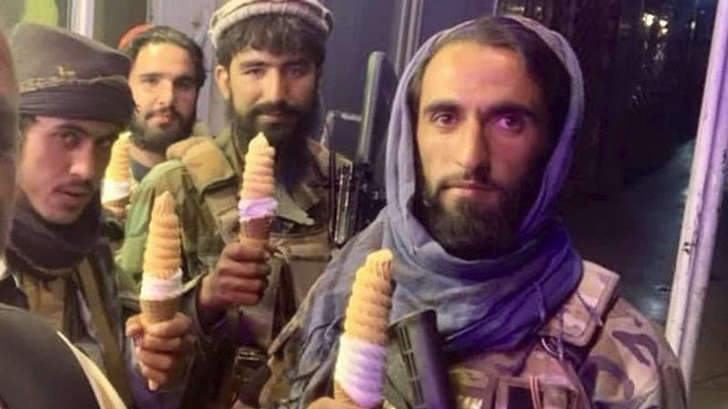
As French writes about the privileged creatures who live “under the protective umbrella of the most powerful military in the history of the planet,” the Taliban rules Afghanistan. A reminder: The Taliban controlled about half of that country in September of 2001; then the most powerful military in the history of the planet invaded, and fought the Taliban for two full decades, at the cost of thousands of lives and trillions of dollars, the result of which is that the Taliban now controls … all of the country. The implosion of the American effort in Afghanistan happened last fucking year, and we’ve somehow already taken care to forget the details of that goat rodeo. What was the plan?
Comments Off on “We’re healthy from the bottom up, and sick from the top down.”
April 25, 2022
The Jews Fight Back – WAH 057 – April 24, 1943
World War Two
Published 24 Apr 2022The war against Naziism is escalating on all fronts — in the War Against Humanity the main battleground is now the Warsaw Ghetto.
(more…)
Comments Off on The Jews Fight Back – WAH 057 – April 24, 1943
April 9, 2022
It wasn’t the Wuhan Coronavirus that crippled the world economy — it was government reaction to the pandemic
Dan Sanchez points out the undeniable truth that most of the economic damage we’ve sustained over the last two years wasn’t due to the pandemic itself, but to the incredibly disruptive public health measures almost every western government implemented in response (with huge connivance on the part of the legacy media and the social media companies):
… it will not be the coronavirus making us poorer, but the fallacy, embraced by officials from Beijing to DC, that central planners can manage society-wide problems, like “healing” a global pandemic or “fixing” a global supply chain.
As the great economists Ludwig von Mises and F.A. Hayek explained, societies and economies are inconceivably complex, and it is literally impossible for anyone to centrally plan something so far beyond their comprehension. To think otherwise is, as Hayek called it, a “fatal conceit”.
The fatal conceit of central planners is manifest in the very term “global supply chain”. The metaphor of a “chain” portrays the economy as something static and linear: something simple enough for a single mind to “fix”.
But, as Leonard Read vividly showed in his classic essay “I, Pencil”, even a seemingly simple good like a pencil is not the product of a single supply chain. Every good in the economy is descended from a vast “family tree” of innumerable factors of production. And all the family trees of all goods are intricately interconnected, making the economy, not a “chain”, but as economist Murray Rothbard depicted it, “a highly complex, interacting latticework of exchanges”.
This vast, dynamic latticework is self-healing and self-fixing: through the actions and interactions of its constituent individuals. Blundering, arrogant central planners only get in the way and make things worse.
That has been the lesson of free-market economists and social theorists going back to Adam Smith. The western world partly embraced that lesson, and it flourished as a result, becoming a beacon to the world. Starting in the 1970s, even Communist China emulated its example, opening up its markets. This was a humanitarian miracle for the Chinese people and a boon for us all. If not for Chinese manufacturing being integrated into the global division of labor, it is hard to imagine the west having the modern high-tech living standards and super-comfortable working conditions we enjoy (however precariously) today.
Whereas once China liberalized in emulation of the west, now the leaders of the “free world” are emulating (and, in the case of Canada’s prime minister, openly admiring) the authoritarianism of the CCP. As crises continue to mount, it is clear that this turn toward tyranny is putting our future at risk.
Comments Off on It wasn’t the Wuhan Coronavirus that crippled the world economy — it was government reaction to the pandemic
April 8, 2022
The structure of the Chinese government
Scott Alexander reviews The Third Revolution, by Elizabeth Economy, although as he says up front, “It’s a look through recent Chinese history, with The Third Revolution as a very loose inspiration.”:
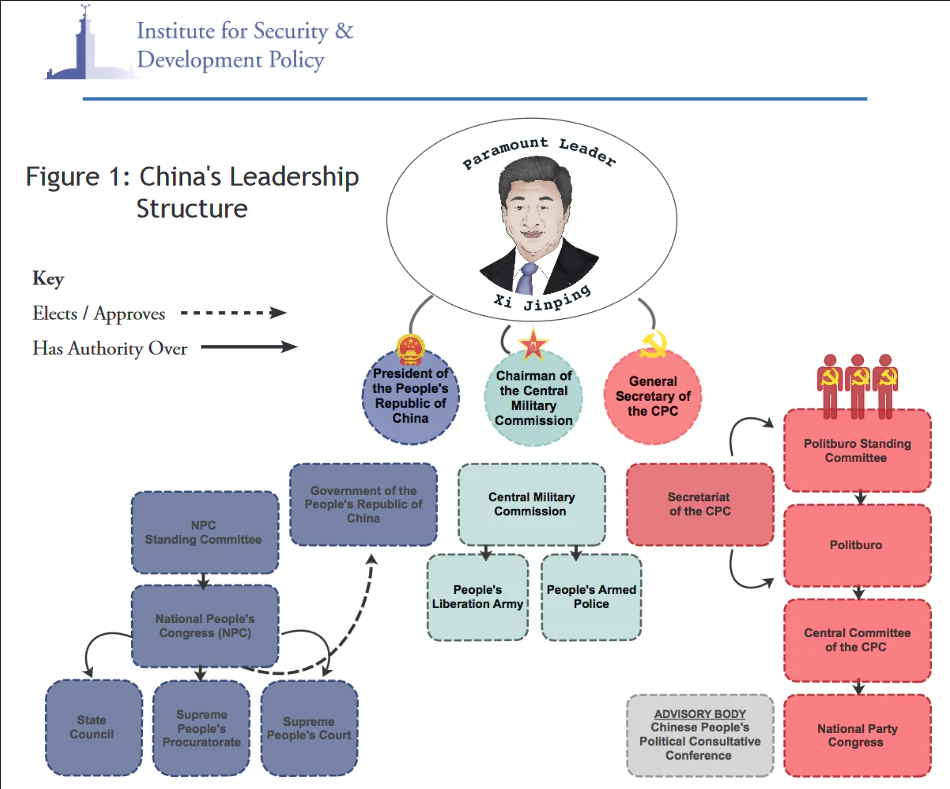
How Does China’s Government Work?
The traditional answer is a flowchart like this one (source):
But you could give a similarly convoluted flowchart for America, and it would tell people much less than words like “democracy” or “balance of powers”. What’s the Chinese equivalent?
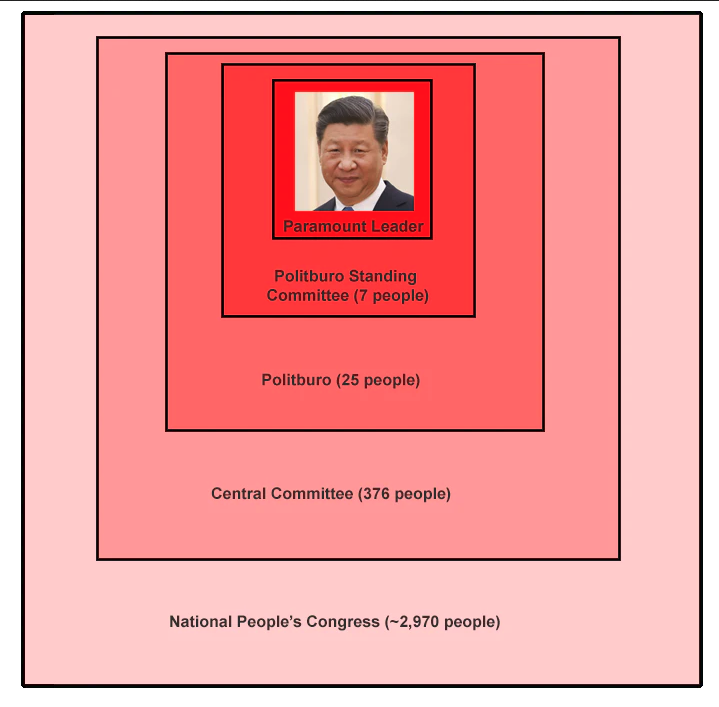
I found it a little more helpful to see it diagrammed it as a series of nested squares:
The inner levels have real power, and the outer layers are theoretically overseers but actually rubber stamps. Things get more and more rubber-stampy as you go out, culminating in the National People’s Congress, which recently voted to re-elect Xi by a vote of 2,970 in favor, 0 against — it’s so irrelevant that it’s literally called “the NPC”.
Who chooses the members of the inner groups? In theory, the outer groups; for example, the Central Committee is supposed to elect the Politburo Standing Committee. In practice, these selections tend to be of the “2,970 in favor, 0 against” variety, so they must be taking marching orders from someone. Who? The Chinese government doesn’t talk about it much, but probably the members of the Politburo Standing Committee hand-pick everyone, including the Paramount Leader and their own successors.
How do they pick? Mostly patron-client relationships. Every leading politician cultivates a network of loyal supporters; if he takes power, he tries to put as many of his people into top posts as he can. The seven Politburo members wheel and deal with each other about whose clients should get which positions, including any unoccupied Politburo seats.
If the two word description of US politics is “democracy, checks-and-balances”, then the two word description of Chinese politics is “oligarchy, patrons-and-clients”. If this seems exotic, it shouldn’t: it’s not much different from how the US fills unelected posts like “ambassador” and “White House staffer”. The Trump presidency put this into especially sharp relief, either because Trump did it more blatantly than usual or just because Trump’s clients were so obviously different from the normal Washington crowd. Consider eg the appointment of Jeff Sessions (among the first Congressmen to endorse Trump) as Attorney General.
In the US, this is a peripheral part of the system, checked by democracy. In China, it’s the whole game.
Comments Off on The structure of the Chinese government
Chinese C96 “Wauser” Broomhandle
Forgotten Weapons
Published 10 Nov 2016Cool Forgotten Weapons Merch! http://shop.bbtv.com/collections/forg…
The C96 Mauser was a very popular handgun in China in the 1920s and 30s, which naturally led to a substantial number of domestically-produced copies of it. These ran the full range of quality, from dangerous to excellent. This particular example falls into the middle, appearing to be a pretty fair mechanical copy of the C96 action. However, it does exhibit classic Chinese misspelled markings — the workers who made these guns often did not actually read English (or German), and made best-guess attempts at copying the markings on authentic firearms. The result was sometimes something like the Wauser.

Comments Off on Chinese C96 “Wauser” Broomhandle
April 2, 2022
QotD: The pre-modern farming household
At the same time that households were large (by modern standards), the farms they tilled were, by modern standards, very small. The normal size of a Roman household small farm is generally estimated between 5 and 8 iugera (a Roman measurement of land, roughly 3 to 5 acres); in pre-Han Northern China (where wheat and millet, not rice, were the staple crops), the figure was “one hundred mu (4.764 acres)” – essentially the same. In Languedoc, a study of Saint-Thibery in 1460 showed 118 households (out of 189) on farms of less than 20 setérée (12 acres or so; the setérée appears to be an inexact unit of measurement); 96 of them were on less than 10 setérée (about 6 acres). So while there is a lot of variation, by and large it seems like the largest cluster of household farms tend to be around 3 to 8 acres or so; 5 acre farms are a good “average” small farm.
This coincidence of normal farm size and family size is not an accident, but essentially represents multi-generational family units occupying the smallest possible farms which could support them. The pressures that produce this result are not hard to grasp: families with multiple children and a farm large enough to split between them might do so, while families without enough land to split are likely to cluster around the farm they have. Pre-modern societies typically have only limited opportunities for wage labor (which are often lower status and worse in conditions than peasant farming!), so if the extended family unit can cluster on a single farm too small to split up, it will (with exception for the occasional adventurous type who sets off for high-risk occupations like soldier or bandit).
Now to be clear that doesn’t mean the farm sizes are uniform, because they aren’t. There is tremendous variation and obviously the difference between a 10 acre small farm and a 5 acre small farm is half of the farm. Moreover, in most of the communities you will have significant gaps between the poor peasants (whose farms are often very small, even by these measures), the average peasant farmer, and “rich peasants” who might have a somewhat (but often not massively so) larger farm and access to more farming capital (particularly draft animals). […] Nevertheless, what I want to stress is that these fairly small – 3-8 acres of so – farms with an extended family unit on it make up the vast majority of farming households and most of the rural population, even if they do not control most of the land (for instance in that Languedoc village, more than half of the land was held by households with more than 20 setérée a piece, so a handful of those “rich peasants” with larger accumulations effectively dominated the village’s landholding […]).
This is our workforce and we’re going to spend this entire essay talking about them. Why? Because these folks – these farmers – make up the majority of the population of basically all agrarian societies in the pre-modern period. And when I say “the majority” I mean the vast majority, on the order of 80-90% in many cases.
Bret Devereaux, “Collections: Bread, How Did They Make It? Part I: Farmers!”, A collection of Unmitigated Pedantry, 2020-07-24.
Comments Off on QotD: The pre-modern farming household
March 23, 2022
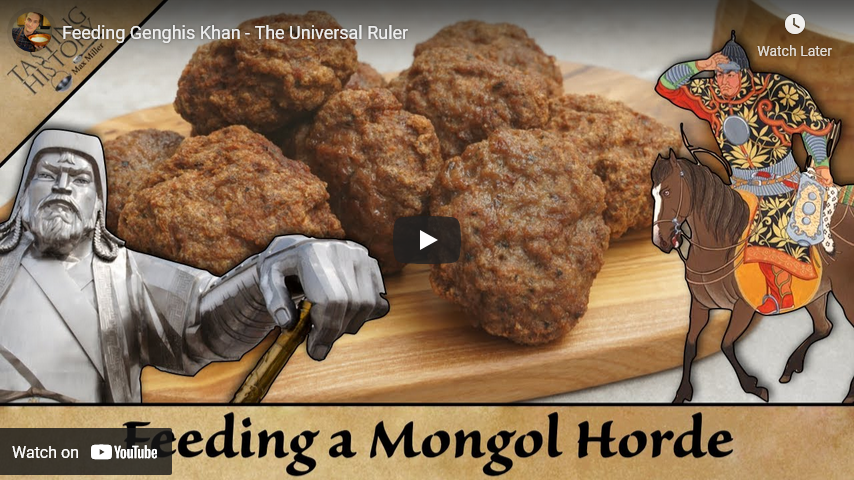
What did Genghis Khan eat?
Tasting History with Max Miller
Published 30 Nov 2021Support the Channel with Patreon ► https://www.patreon.com/tastinghistory
Merch ► crowdmade.com/collections/tastinghistory
Instagram ► https://www.instagram.com/tastinghist…
Twitter ► https://twitter.com/TastingHistory1
Tiktok ► TastingHistory
Reddit ► r/TastingHistory
Discord ► https://discord.gg/d7nbEpy
Amazon Wish List ► https://amzn.to/3i0mwGtSend mail to:
Tasting History
PO Box 766
Burbank, CA 91503LINKS TO INGREDIENTS & EQUIPMENT**
Sony Alpha 7C Camera: https://amzn.to/2MQbNTK
Sigma 24-70mm f/2.8 Lens: https://amzn.to/35tjyoW
Asafoetida: https://amzn.to/3DKCH4P
Long Pepper: https://amzn.to/2ZgFRhYLINKS TO SOURCES**
Soup for the Qan: https://amzn.to/3oXOpDk
Description of the World by Marco Polo: https://amzn.to/3xf5093
Genghis Khan and the Making of the Modern World: https://amzn.to/32fDmxm**Some of the links and other products that appear on this video are from companies which Tasting History will earn an affiliate commission or referral bonus. Each purchase made from these links will help to support this channel with no additional cost to you. The content in this video is accurate as of the posting date. Some of the offers mentioned may no longer be available.
Subtitles: Jose Mendoza | IG @ worldagainstjose
PHOTO CREDITS
Stones pressing curd: Taylor Weidman / The Vanishing Cultures Project#tastinghistory #genghiskhan
Comments Off on What did Genghis Khan eat?
March 14, 2022
Legends Summarized: Journey To The West (Part IX)
Overly Sarcastic Productions
Published 26 Nov 2021Journey to the West Kai, episode 6: Two Weddings And An Asskicking
FIRST EPISODE: https://www.youtube.com/watch?v=61nuX…
PREVIOUS EPISODE: https://youtu.be/xFD_0PIfHHA
FULL SERIES: https://www.youtube.com/playlist?list…Our content is intended for teenage audiences and up.
PATREON: https://www.Patreon.com/OSP
PODCAST: https://overlysarcasticpodcast.transi…
DISCORD: https://discord.gg/osp
MERCH LINKS: http://rdbl.co/osp
OUR WEBSITE: https://www.OverlySarcasticProductions.com
Find us on Twitter https://www.Twitter.com/OSPYouTube
Find us on Reddit https://www.Reddit.com/r/OSP/
Comments Off on Legends Summarized: Journey To The West (Part IX)
February 27, 2022
“Putin finally called our bluff. The question to me is when and if Xi will decide to do the same”
Andrew Sullivan on what Winston Churchill referred to as “the historic life-interests of Russia”, the inability (and unwillingness) of the western nations to do more than send hopes and prayers to Ukraine, and the parallels between the Russia-Ukraine situation and the China-Taiwan potential conflict:
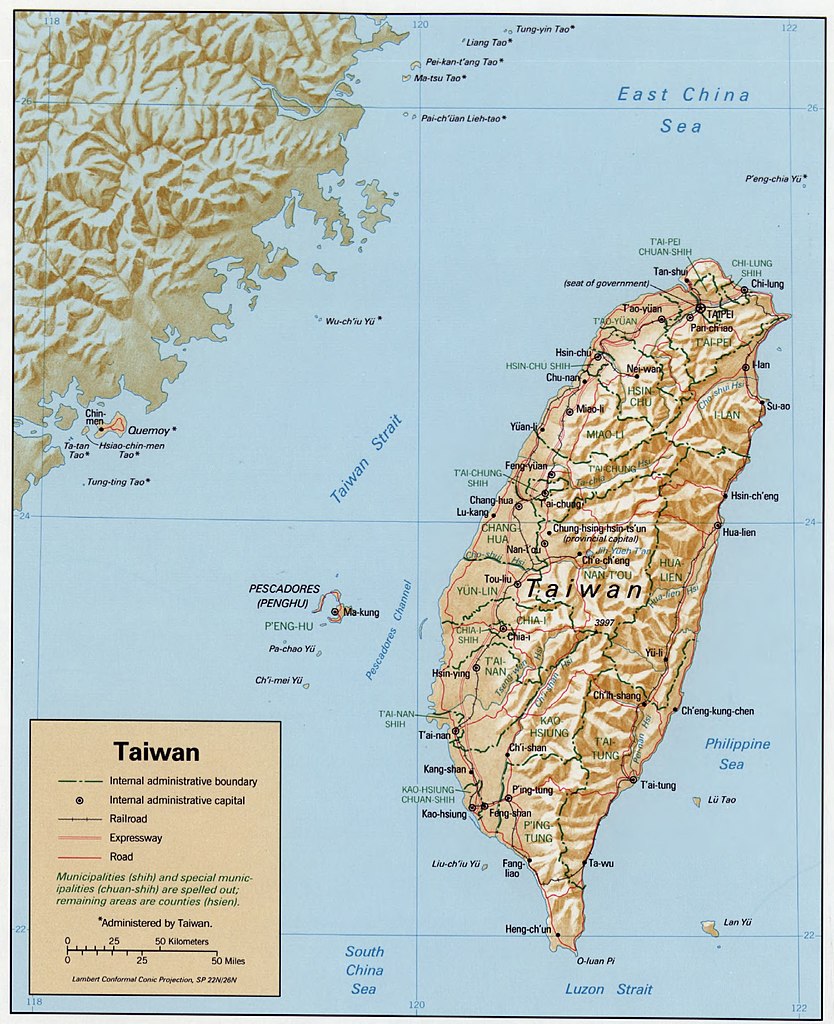
Taiwan relief map.
Library of Congress Geography & Map Division via Wikimedia Commons.
… in one crucial sense, Putin has already won a victory. A nuclear-armed great power has invaded and occupied a neighboring country in Europe, and there is nothing anyone else has been able to do to stop it. Many in the West assumed Putin wouldn’t go that far — surmising that international law, universal condemnation, economic sanctions, and the lack of any serious threat from Ukraine to Russia would restrain him. But he has called our bluff. He has even hinted at Russia’s nuclear capacity to intimidate other states from intervening. And so we have a precedent. Ukraine is a Russian possession. A fact on the ground. All we have been able to do is watch.
All of which brings us to what seems to me to be the larger dimension of this clash: how it will resonate in Beijing and Taiwan. With apologies to Mitt Romney, China is easily the greater geostrategic challenge. And the parallels with Russia are as striking as they are unnerving. China sees Taiwan as part of its national identity in a similar way to how Russia sees Ukraine as part of its. And we are committed to the defense of Taiwan the way we have committed to the defense of Ukraine: kinda, but not really. In the face of this underlying Western ambiguity, the fall of Kiev is news that Xi will be watching closely.
The parallels are not exact, but nonetheless striking. Taiwan is next door to and deeply entangled with China in its history and culture, just as Ukraine is uniquely entangled with Russia. Seeing Taiwan and China (like Ukraine and Russia) as simply random sovereign states with a right to self-determination under international law is correct, so far as it goes. It’s also moral — as majorities of both Ukrainians and especially Taiwanese want independence and have constructed nascent democracies in the wake of autocracy.
But the nationalist passion Russia feels about Ukraine and China feels about Taiwan is real, visceral, and hard for outsiders to understand intuitively. The sense of a rogue region that somehow got away from the homeland is vivid among Russian and Chinese nationalists. This kind of understanding — claiming a “sphere of influence” — is now deemed reactionary by the West’s foreign policy elites, as, perhaps, it should be. But that doesn’t mean that everyone, especially China and Russia, have actually moved past it. Even Americans have very different emotional responses to perceived threats in our own hemisphere compared with the rest of the world. So this is also a culture clash of sorts — globalism and the nation state vs nationalism and spheres of influence.
I’m not saying that this belief in a sphere of influence is a universal view in Russia or China — or that it is justifiable. I’m just saying it is real. And I’m not excusing Putin or Xi from taking a particularly zealous view of this irredentist nationalism, which they both do, for their own personal and political advantage. I’m just noting how national pride deeply informs them, that resentment of the West consumes them, that a sense of historical grievance spurs them on — and that they are not outliers among their compatriots. It is crazy to underestimate the power of this kind of revanchist nationalism — among rulers and ruled. And I fear we underestimated it in the case of Putin.
This means, as Barack Obama once insisted, that Russia will always care much more about Ukraine than we do; and China will always care much more about Taiwan than we do. In those cases, the last thing we should do is promise support that we do not seriously — truly seriously — intend to provide. The vague pledge by the Western powers not to rule out future NATO membership for Ukraine was the worst of all worlds: poking the bear, with no serious intention of fighting it.
The fall of Afghanistan was a margin call … and Ukraine is the point where airy western “guarantees” will have to be backed up with actual force. But western leaders have grown very comfortable in a world where gestures were taken seriously and few if any such gestures actually had to be followed-through with meaningful action. And now, the geopolitical pantomime is over and we’re back in a world where gestures are seen as signs of weakness and do nothing to deter adventurism.
Comments Off on “Putin finally called our bluff. The question to me is when and if Xi will decide to do the same”
February 25, 2022
Total War NOW – WAH 053 – February 1943, Pt. 2
World War Two
Published 24 Feb 2022Germany declares total (unconditional war) putting its economy on a full war footing over three years into the war. Given the unconditional war they are already waging, and the resistance and opposition they now face, it’s unclear what it shall mean.
(more…)
Comments Off on Total War NOW – WAH 053 – February 1943, Pt. 2


