
Like most of my contemporaries, I first read The Fountainhead when I was 18 years old. I loved it. I too missed the point. I thought it was a book about a strong-willed architect … and his love life … I deliberately skipped over all the passages about egoism and altruism. And I spent the next year hoping I would meet a gaunt, orange-haired architect who would rape me. Or failing that, an architect who would rape me. Or failing that, an architect. I am certain that The Fountainhead did a great deal more for architects than Architectural Forum ever dreamed.
Nora Ephron, The New York Times Book Review (1968), quoted in Reason Online
June 6, 2020
QotD: The Fountainhead
Comments Off on QotD: The Fountainhead
April 24, 2020
QotD: The best way to see Toronto (aka “Greater Parkdale”)
David Warren, “The scandal of interiors”, Essays in Idleness, 2018-01-25.
Comments Off on QotD: The best way to see Toronto (aka “Greater Parkdale”)
April 6, 2020
QotD: North American downtown “architecture”
The “downtowns” of cities in the eastern half of this American continent were built before the automobile, with pedestrian compactness. So prosperous did we become, so quickly, and so extensive was the building towards the latter end of the nineteenth century, that plentiful evidence remains. The ground-cover is still mostly older buildings, paradoxically thanks to rocketing property values: new buildings must accommodate phenomenal densities, upon tiny footprints. But ten-thousands of apparently “old houses” remain, going on and off market at a million apiece. The principles of money-management have “evolved” over the years, and the idea of “home” as a fungible investment has been universalized. All one needs to acquire one is a small saving and a large credit line. Then one is cut in for all subsequent rounds of poker.
You move in and “re-decorate,” less from personal taste than in anticipation of re-sale. After this process has been repeated a few times, nothing remains of the older building except its “historical” façade, itself somewhat tarted. Travelling about by foot and trolley, I have watched a likely majority of the city’s more attractive “landmark” buildings reduced to fronts only. These are propped by girders, while entirely new (and disproportionately larger) new constructions are bunged in behind.
Thus, nothing remains that is “authentic.” All continuities are destroyed, beyond this tip of the hat — the aesthetic equivalent of that homage which vice pays to virtue.
David Warren, “The scandal of interiors”, Essays in Idleness, 2018-01-25.
Comments Off on QotD: North American downtown “architecture”
March 30, 2020
Renaissance Antics – History Hijinks
Overly Sarcastic Productions
Published 27 Mar 2020The Italian Renaissance is known for its fancy art and ginormous domes, but what about the visionaries behind it? In this ~~fancy new series~~ we’ll discuss the antics of the period’s most famous artists.
Sources & Further Reading: Brunelleschi’s Dome by King, Leonardo Da Vinci by Isaacson, Benvenuto Cellini’s autobiography, and Artemisia Gentileschi by Garrard.
Our content is intended for teenage audiences and up.
This video was edited by Sophia Ricciardi, AKA “Indigo” https://www.sophiakricci.com/PATREON: https://www.Patreon.com/OSP
DISCORD: https://discord.gg/h3AqJPe
MERCH LINKS: https://www.redbubble.com/people/OSPY…
OUR WEBSITE: https://www.OverlySarcasticProductions.com
Find us on Twitter https://www.Twitter.com/OSPYouTube
Find us on Reddit https://www.Reddit.com/r/OSP/

Comments Off on Renaissance Antics – History Hijinks
February 15, 2020
QotD: Architecture’s lingering racism
In the 1920s, during the time he was a member of the French Fascist party, the seminal architect Le Corbusier said he was disgusted by the “zone of odours, [a] terrible and suffocating zone comparable to a field of gypsies crammed in their caravans amidst disorder and improvisation.” He also chimed in with Loos: “Decoration is of a sensorial and elementary order, as is color, and is suited to simple races, peasants, and savages … The peasant loves ornament and decorates his walls.”
More recently, indicative of architecture’s current race problem, in 2006 the aforementioned highly influential dean of Tulane’s architecture school, Reed Kroloff, wrote the embarrassingly tone-deaf, flat-footed essay “Black Like Me.” (As I discuss below, he collaborated with Betsky on a post-Katrina project.) Kroloff — the privileged, self-described gay white Jew from Waco, Texas — announced that he was now black, that the Hurricane Katrina disaster had made him feel first-hand the African-American predicament. His piece was subject to much ridicule. No wonder the Mods have chosen to insulate themselves from the un(brain)washed masses. Architecture has become a gated community.
Betsky, to his credit, doesn’t pretend that architects should even try to make outreach. Showing little sympathy for democracy, he says that appeals to the public are “mystical.” The people — the 99% — do not deserve a seat at the table. Yet Betsky would have us believe that he and the architecture he supports are “progressive.”
Justin Shubow, “Architecture Continues To Implode: More Insiders Admit The Profession Is Failing”, Forbes, 2015-01-06.
Comments Off on QotD: Architecture’s lingering racism
February 4, 2020
QotD: Brutalist “sincerity”
Unrefined concrete was an honest expression of [brutalist architects’] intentions, while plain forms and exposed structures were similarly sincere.
This is like saying that the Gulag was an honest expression of Stalin’s intentions. Sincerity of intentions is not a virtue irrespective of what those intentions are, and as a matter of fact those of the inspirer and founder of brutalism were clearly evil, as the slightest acquaintance with his writings will convince anyone of minimal decency. And what exactly is “sincerity of form and exposed structures”? Is it meant to imply that anything other than brutalism is insincere?
The same article continues:
Beyond their architectural function, Brutalist buildings serve other uses. Skateboarders, graffiti artists and parkour practitioners, for example, have all used Brutalism’s concrete surfaces in innovative ways.
Dear God! I have nothing against playgrounds — they are socially commendable, especially for children — but to regard the urban fabric as properly an extended playground is surely to infantilize the population. As for graffiti artists, to regard the extension of their “canvas” to large public buildings is an abject surrender to vandalism. No one, I presume, would say of a wall, “And in addition it would make an excellent place for a firing squad.”
Theodore Dalrymple, “The Brutalist Strain”, Taki’s Magazine, 2019-11-02.
Comments Off on QotD: Brutalist “sincerity”
January 23, 2020
QotD: The “great” modern architects
Moreover, claiming respectable ancestors is somewhat at variance with equal claims to be starting from zero (as Gropius put it), but such a contradiction is hardly noticed by the grand narrative history of modernism that Professor Curl attacks and destroys.
He is not unable or unwilling to praise where it is due, though it is due rarely enough; and he is particularly effective in tracing the opportunistic ideological divagations of the modernists, whose one constant predilection was for absolute power over others. Mies, for example, was attracted to socialist totalitarianism, and his only objection to Nazism was that the Nazis eventually rejected his desire to have everything built according to his prescriptions. He left Nazi Germany because he feared his previous pro-leftism made him permanently suspect in its eyes, not because he was appalled by its brutality. If only they’d let him build! But contrary to apologists for Mies, and to a legend constantly repeated, it was not the Nazis who closed the Bauhaus but Mies himself, and he left Germany only four years after their assumption of power.
Finding refuge in America, Mies quickly perceived that the power of patronage of megalomaniac building lay with giant corporations rather than with fascists or communists and persuaded many of them to build his preternaturally inhuman and uninspired monstrosities. By a strange quirk of history, and because of mankind’s perpetual propensity to make logical errors, Mies was able to pose dishonestly as anti-totalitarian and even as a friend of freedom precisely because he had fled Nazi Germany where they hadn’t patronised him. He was fortunate that soon afterwards the United States had another totalitarian enemy, the Soviet Union. Mies and his allies were thus able to claim that his totalitarian modernism was actually a manifestation of western freedom. There are many such ironies pointed up in this book that would be delicious had they not had such appalling consequences.
Corbusier was a fascist in the most literal sense of the word, and early during the Occupation advocated the removal by force of the majority of Paris’ population because it had no business to be living there. Can one wonder that a man with thoughts like that built monstrosities?
Theodore Dalrymple, “Architectural Dystopia: A Book Review”, New English Review, 2018-10-04.
Comments Off on QotD: The “great” modern architects
January 18, 2020
History Summarized: Classical India
Overly Sarcastic Productions
Published 17 Jan 2020Classical and Medieval Indian History is a tale of constant flux — but in between the dozens and hundreds of states at play across the peninsula, there are clear trends that arise. Let’s take this chapter of history as an opportunity to dig into different types of sources, and try and wrap our heads around a story that doesn’t fit neatly into a single chronology.
FURTHER SOURCES: The Discovery of India by Jawaharlal Nehru, “A History of India” by Michael H. Fisher (lecture courtesy of The Great Courses).
Our content is intended for teenage audiences and up.
PATREON: https://www.Patreon.com/OSP
DISCORD: https://discord.gg/y7uUnzJ
MERCH LINKS: https://www.redbubble.com/people/OSPY…
OUR WEBSITE: https://www.OverlySarcasticProductions.com
Find us on Twitter https://www.Twitter.com/OSPYouTube
Find us on Reddit https://www.Reddit.com/r/OSP/

Comments Off on History Summarized: Classical India
January 7, 2020
QotD: The cult of Le Corbusier
A dangerous cult may be defined as a kind of false religion, adoption of a system of belief based on mere assertions with no factual foundations, or as excessive, almost idolatrous, admiration for a person, persons, an idea, or even a fad. The adulation accorded to Le Corbusier, accorded almost the status of a deity in architectural circles, is just one example. It has certain characteristics which may be summarized as follows: it is destructive; it isolates its believers; it claims superior knowledge and morality; it demands subservience, conformity, and obedience; it is adept at brainwashing; it imposes its own assertions as dogma, and will not countenance any dissent; it is self-referential; and it invents its own arcane language, incomprehensible to outsiders.
Anyone who thinks this is an exaggeration has not read much Le Corbusier. (His writing is as bad as his architecture, and bears out precisely what Curl says.) Nor is it difficult to find in the architectural press examples of cultish writing that is impenetrable and arcane, devoid of denotation but with plenty of connotation. Here, for example, is Owen Hatherley, writing about an exhibition of Le Corbusier’s work at London’s Barbican Centre (itself a fine example of architectural barbarism). According to Hatherley, Le Corbusier was:
the architect who transformed buildings for communal life from mere filing cabinets into structures of raw, practically sexual physicality, then forced these bulging, anthropomorphic forms into rigid, disciplined grids. This might be the work of the “Swiss psychotic” at his fiercest, but the exhibition’s setting, the Barbican — with its bristly concrete columns and bullhorn profiles, its walkways and units — proves that even its derivatives can become places rich with perversity and intrigue, without a pissed-in lift [elevator] or a loitering youth in sight. … [T]hese collisions of collectivity and carnality have no obvious successors today.
Theodore Dalrymple, “Crimes in Concrete”, First Things, 2019-06.
Comments Off on QotD: The cult of Le Corbusier
January 4, 2020
Looking back at the ’20s … the 1620s
In the latest installment of Anton Howes’ Age of Invention, he takes us back to what he calls the “transformative 20s” of the seventeenth century:
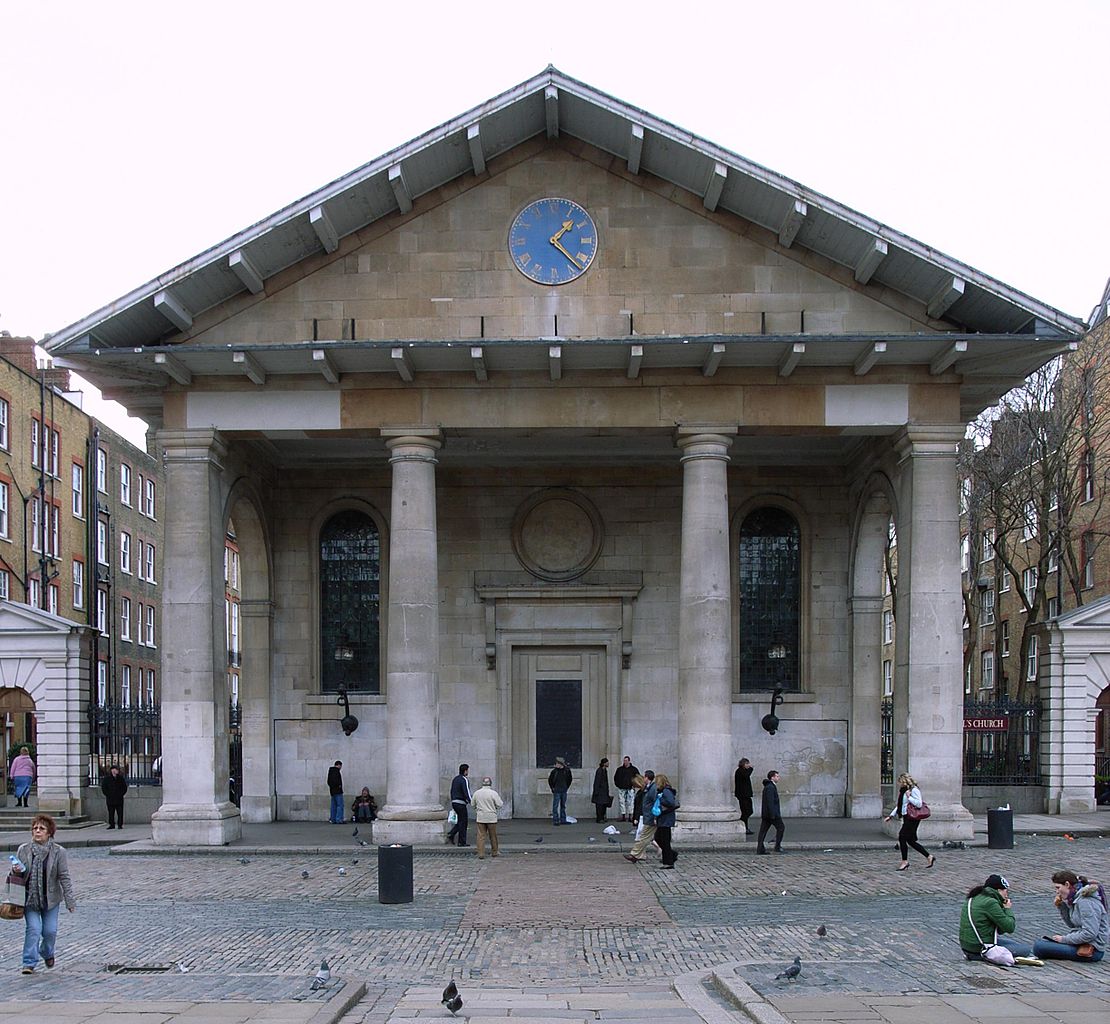
St. Paul’s Church in Covent Garden (built 1631-8) by Inigo Jones.
Photo by Steve Cadman via Wikimedia Commons.
The 1620s saw an upsurge in major projects to transform Britain’s landscape. Engineers from the Dutch Republic like Cornelius Vermuyden came to straighten its rivers, build canals, and even drain its marshes, converting them into pasturage and farmland — in the decades that followed, they would even begin to drain the Great Fens. The cityscapes changed too. The former theatre designer and architect Inigo Jones — by 1615 the Surveyor-General of the King’s Works — introduced classical architecture from the continent, drawing upon the rules of beauty and proportion that had been set down by Vitruvius in the first century BCE and resuscitated in Renaissance Italy by Andrea Palladio. Jones’s influence transformed England’s palaces, churches, cathedrals, and even Covent Garden square, to reflect his ancient Roman ideal.
But the environment, built or natural, would be most transformed by the experiments of a few individuals with fossil fuels. Dud Dudley, an illegitimate child of the 5th Baron Dudley, in the 1620s experimented with smelting iron with peat and coal. Dudley was not the first to do so — the patent on using coal instead of charcoal to work iron had been sold on from person to person since at least 1589 — but his experiments were among the most influential. The famous Abraham Darby, who achieved commercial success in applying coal to smelting metals in the early eighteenth century, was Dud Dudley’s great-great-nephew.
Sir Robert Mansell (1570/71–1652), by an unknown artist.
Image via Wikimedia Commons.The decade also saw major new attempts to use coal as a fuel in other processes, such as glass-making. Although the patent on using coal to make glass had been around since at least 1610, by the 1620s Sir Robert Mansell had bought out the partners who owned it and was pouring a fortune into setting up glassworks at Newcastle. In this case, the transformation was institutional. Mansell’s political connections allowed him to widen the terms of his patent, such that he even tried to ban all other kinds of glass in England, regardless of whether they were made using other fuels, or even imported. Usually, patents of invention were for things entirely new, and were not supposed to interfere with existing English industries. But over the course of the 1610s, various abuses like Mansell’s came to light. King James I, eager for cash, had sold monopolies on ancient trades, as well as the new — one crony was even awarded a patent for inns and alehouses. Mansell’s patent, along with the others, was attacked in Parliament in the 1620s, and even revoked. The outcry ultimately led to the Statute of Monopolies of 1624 — the earliest patent legislation in England, which sought to regulate the royal practice of granting them. (Ironically, Mansell was so well-connected that he managed to get his controversial glass-making patent renewed and then exempted from the new Act.) The Statute of Monopolies was the only English patent legislation in force during the Industrial Revolution — there was no more patent legislation until 1852.
Finally, the ’20s saw a transformation of science. It was the decade in which Francis Bacon published some of his most significant works, on how to collect, refine, and systematise human knowledge for the good of humankind. He set out a comprehensive programme for the organisation of science and invention, with his utopian work New Atlantis setting out his ideal R&D lab – “Salomon’s House”. (Despite these high-minded aims, Bacon was also Mansell’s brother-in-law, and as attorney-general had helped draft the controversial glass-making patent. In 1621 he was convicted, fined, and even briefly imprisoned in the Tower of London for his role in the corrupt early patent system, though he appears to have been a scapegoat.)

Comments Off on Looking back at the ’20s … the 1620s
QotD: “Starchitects”
One is the idea that an architect aspiring to greatness must also aspire to novelty. It is this imperative to “innovate” that underpins the diagrammatic design concepts of the Deconstuctivists. There is of course nothing wrong with innovation per se; it is the knee-jerk compulsion to innovate, or “reinterpret” — as a kind of moral imperative — that is the mid-20th-century aesthetic legacy. To be fair to the profession, I would come to the defense of much innovative public and commercial architecture, most of it by architects that the public has never heard of. Tragically though, these unpretentious and unsung essays in steel, glass, and masonry have been eclipsed in the public imagination by the “starchitect” bling that is currently turning the centers of our great cities into a collection of (in James Stevens Curl’s memorable phrase) “California-style roadside attractions”.
The other cancer is the idea that building design has sociological, psychological, and macro-economic dimensions that the architect — simply by virtue of being an architect — is competent to judge. What really matters to your average architecture student is drawing — which is fine, and just as it should be, until the vain idea emerges that their drawings represent some kind of implicit vision for mankind. At my school, any student’s design presentation had to include a verbal rationale — often post hoc and invariably half-baked — of how the form, massing, and materials of the design are expressive of such imponderables as the supposed psychological “needs” and “aspirations” of the users and the wider “community” that the building is to serve. The students were simply reciting the bogus language of their tutors — in which buildings might be said to be “fun,” “thought provoking,” “democratic,” “inclusive” and other such nonsense.
Graham Cunningham, “Why Architectural Elites Love Ugly Buildings”, The American Conservative, 2019-11-01.
Comments Off on QotD: “Starchitects”
December 8, 2019
History Summarized: Florence
Overly Sarcastic Productions
Published 6 Dec 2019Get 3 months of Audible for just $6.95 a month. That’s more than half off the regular price. Visit http://www.audible.com/overlysarcastic or text
overlysarcasticto 500 500.Can’t start a Renaissance without building a few *Domes* — You’ve seen the memes, now learn the history behind the magnificent city of Florence!
It may sound like sacrilege, but many years ago, Florence was the first Italian city that little Blue had a cartoonishly-overblown obsession for — move over, Venice. In fact, Florentine history is basically THE reason I ever started caring about History in the first place. So I hope that you find this exquisite chapter in world history as enjoyable as I do.
SOURCES & Further Reading:
Death in Florence — Paul Strathern https://www.audible.com/pd/Death-in-F…
Florence: The Biography of A City — Christopher Hibbert
Be Like The Fox: Machiavelli In His World — Erica BennerOur content is intended for teenage audiences and up.
DISCORD: https://discord.gg/sS5K4R3
PATREON: https://www.Patreon.com/OSP
MERCH LINKS: https://www.redbubble.com/people/OSPY…
OUR WEBSITE: https://www.OverlySarcasticProductions.com
Find us on Twitter https://www.Twitter.com/OSPYouTube
Find us on Reddit https://www.Reddit.com/r/OSP/

Comments Off on History Summarized: Florence
November 19, 2019
The “Carbuncle Cup” is good, but we need mandatory demolition because name-and-shame hasn’t worked
I like the cut of Peter Franklin‘s jib:
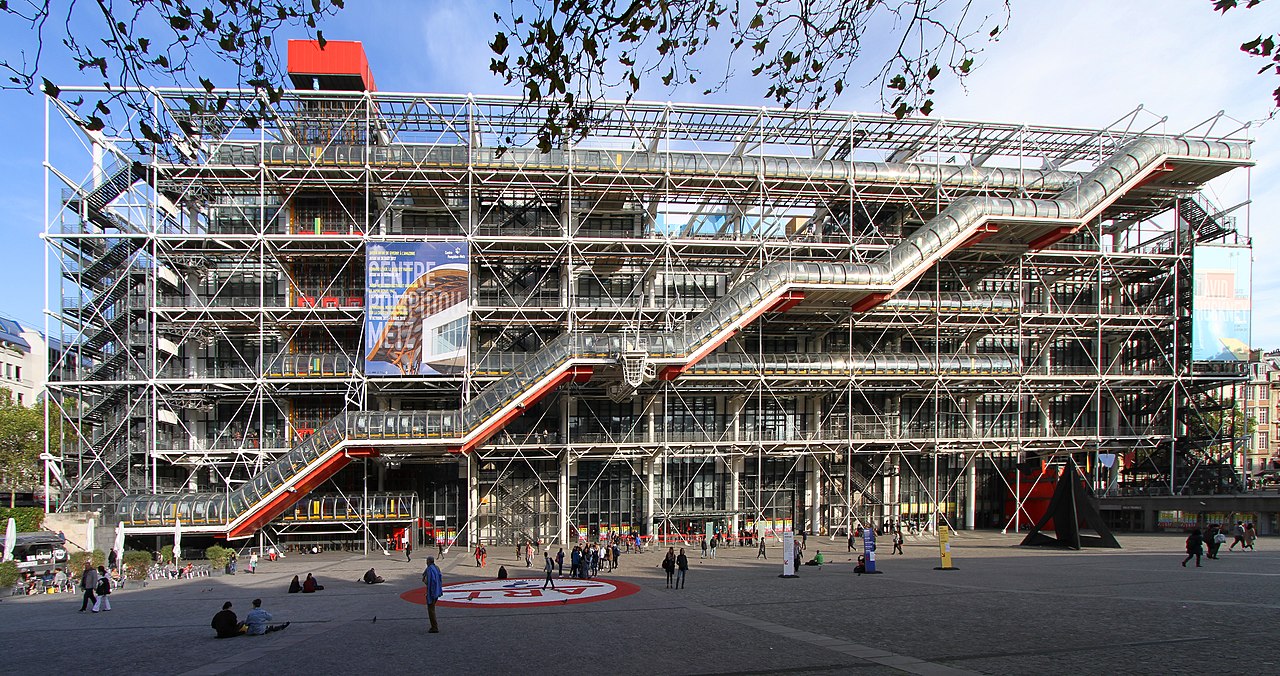
Centre Georges-Pompidou (no, this isn’t an under construction image … it’s from 2017)
Gerd Eichmann photo via Wikimedia Commons.
The Nobels, the Oscars, Pipe Smoker of the Year: glittering prizes all, but I prefer the Carbuncle Cup, which is awarded annually to the “the ugliest building in the United Kingdom completed in the last 12 months”.
Organised by the magazine Building Design, it has (in my aesthetic judgement) produced a worthy shortlist and a worthy winner every year since its inception in 2006.
But there’s a big problem with the prize — not its subjectivity, but the fact that the winning buildings still exist. Indeed, buildings like them are still being built. Name-and-shame is not working.
There’s an argument to be made that things are getting worse. We’ve swapped the horrendous, but interesting, brutalism of the post-war period for the offensively bland spreadsheet architecture of the 21st century. In an age in which Jane Jacobs has won the intellectual battle against Robert Moses, we really ought to know better. Yet we continue to fill up our towns and cities with inhumane, alienating architecture.
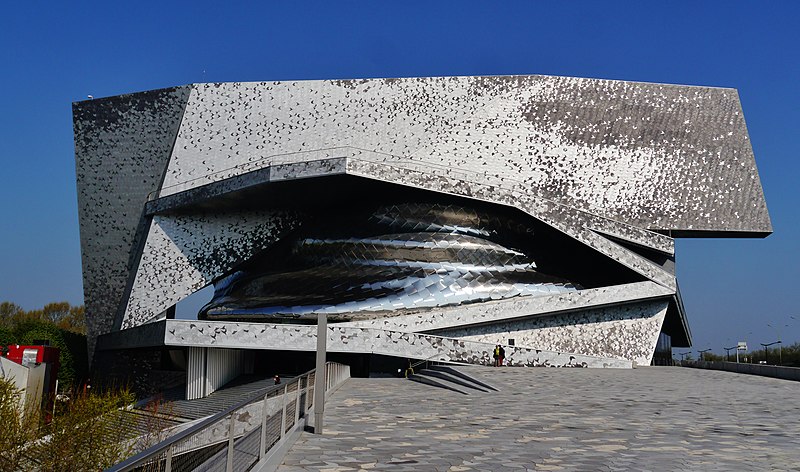
Philharmonie at the Parc de la Villette, Paris.
Photo by Zairon via Wikimedia Commons.
It might seem paradoxical, but to end the cycle of destruction, we need to accelerate it. Every year, there should be a public vote to choose the worst new building in the land. The winner wouldn’t get a cup, but a wrecking ball. Yes, that’s right, it would be physically demolished — immediately and without compensation. Indeed, the owner would be required to foot the bill for the building’s de-construction (though they would have the option of suing the architect and the planning authority).
This would concentrate minds wonderfully. Instead of competing among themselves to épater les bourgeois, starchitects would need to design with due regard to the common good. Meanwhile, developers whose sole objective is to squeeze as much profitable square footage into any site they can get their hands on, would have to contend with the possibility of financial (as well as literal) ruin. The planners would come under immense pressure to do a better job too. At the cost of sacrificing one new building, development across the land would be greatly improved.
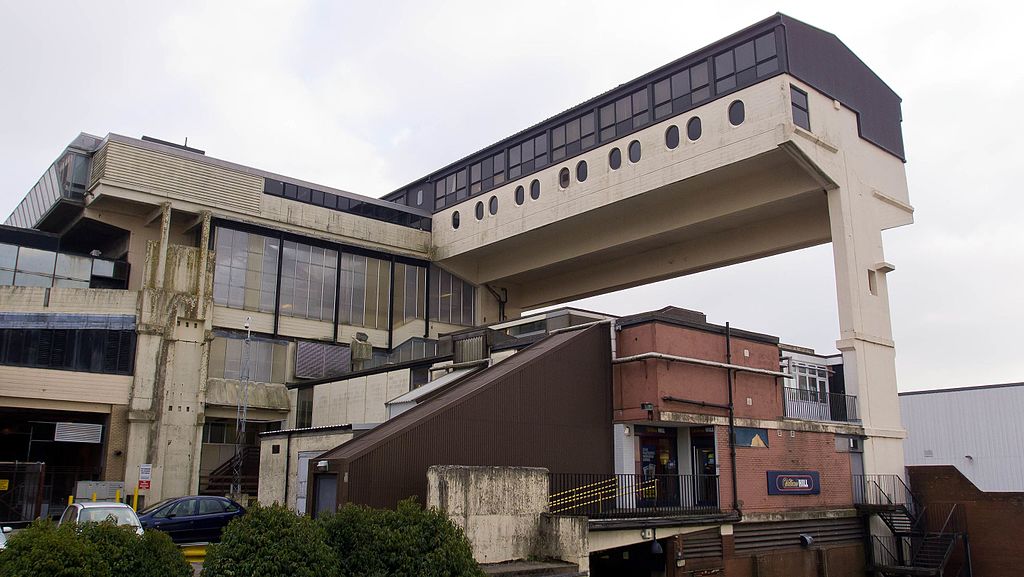
Cumbernauld Shopping Centre, voted as Britain’s most hated building.
Photo by Ed Webster via Wikimedia Commons.
H/T to Colby Cosh for the link.
Comments Off on The “Carbuncle Cup” is good, but we need mandatory demolition because name-and-shame hasn’t worked
November 3, 2019
Building Angkor – A Drowning City – Extra History – #4
Extra Credits
Published 2 Nov 2019Join us on Patreon! http://bit.ly/EHPatreon
We’ve talked about the magnificence of Angkor at its peak, but how did this sprawling metropolis become a city of ruins? The city of Angkor depended on the reliability of the seasonal monsoon. Several decades of drought left them with little choice than to modify the whole water system. But when the waters returned, they returned in force. As did enemy forces. Thus begins the death spiral of the city of Angkor.
From the comments:
Extra Credits
1 day ago
Always 👏 maintain 👏 your 👏 water 👏 infrastructure !!!

Comments Off on Building Angkor – A Drowning City – Extra History – #4
October 29, 2019
Building Angkor – A Clash of Gods – Extra History – #3
Extra Credits
Published 26 Oct 2019Join us on Patreon! http://bit.ly/EHPatreon
Jayavarman VII, a Buddhist pacifist, was forced to give up his pacifism and rise to the throne at the age of 60. But once seated on the throne, he built Angkor Thom. The architecture was a fusion of buddhist and hindu stylings and included a comprehensive medical system. But will Angkor be able to stand after Jayavarman VII has passed?
Jayavarman VII the Great may be known as the greatest ruler of the Khmer, but he also wins the award for history’s best son. Making your mom the face for the goddess of wisdom is quite the Mother’s Day gift.
(Since folks have been asking for the metric conversions on our videos, 9 miles = 14.5 km at 4:52)

Comments Off on Building Angkor – A Clash of Gods – Extra History – #3


