
The fact is, contemporary architecture gives most regular humans the heebie-jeebies. Try telling that to architects and their acolytes, though, and you’ll get an earful about why your feeling is misguided, the product of some embarrassing misconception about architectural principles. One defense, typically, is that these eyesores are, in reality, incredible feats of engineering. After all, “blobitecture” — which, we regret to say, is a real school of contemporary architecture — is created using complicated computer-driven algorithms! You may think the ensuing blob-structure looks like a tentacled turd, or a crumpled kleenex, but that’s because you don’t have an architect’s trained eye.
Another thing you will often hear from design-school types is that contemporary architecture is honest. It doesn’t rely on the forms and usages of the past, and it is not interested in coddling you and your dumb feelings. Wake up, sheeple! Your boss hates you, and your bloodsucking landlord too, and your government fully intends to grind you between its gears. That’s the world we live in! Get used to it! Fans of Brutalism — the blocky-industrial-concrete school of architecture — are quick to emphasize that these buildings tell it like it is, as if this somehow excused the fact that they look, at best, dreary, and, at worst, like the headquarters of some kind of post-apocalyptic totalitarian dictatorship.
Brianna Rennix and Nathan J. Robinson, “Why You Hate Contemporary Architecture”, Current Affairs, 2017-10-31.
May 31, 2021
QotD: Contemporary architecture hates you
May 26, 2021
QotD: Modern architecture is ugly … or worse
Take the Tour Montparnasse, a black, slickly glass-panelled skyscraper, looming over the beautiful Paris cityscape like a giant domino waiting to fall. Parisians hated it so much that the city was subsequently forced to enact an ordinance forbidding any further skyscrapers higher than 36 meters.
Or take Boston’s City Hall Plaza. Downtown Boston is generally an attractive place, with old buildings and a waterfront and a beautiful public garden. But Boston’s City Hall is a hideous concrete edifice of mind-bogglingly inscrutable shape, like an ominous component found left over after you’ve painstakingly assembled a complicated household appliance. In the 1960s, before the first batch of concrete had even dried in the mold, people were already begging preemptively for the damn thing to be torn down. There’s a whole additional complex of equally unpleasant federal buildings attached to the same plaza, designed by Walter Gropius, an architect whose chuckle-inducing surname belies the utter cheerlessness of his designs. The John F. Kennedy Building, for example — featurelessly grim on the outside, infuriatingly unnavigable on the inside — is where, among other things, terrified immigrants attend their deportation hearings, and where traumatized veterans come to apply for benefits. Such an inhospitable building sends a very clear message, which is: the government wants its lowly supplicants to feel confused, alienated, and afraid.
Brianna Rennix and Nathan J. Robinson, “Why You Hate Contemporary Architecture”, Current Affairs, 2017-10-31.
April 17, 2021
Neoclassical Architecture
Overly Sarcastic Productions
Published 16 Apr 2021You asked, I deliver: the Neoclassicism tangent receives the full-video spotlight it deserves. But there’s plenty more architectural and art-historical analysis where that came from. So if this kind of thing seems fun, please comment and let me know!
SOURCES & Further Reading: Francesco’s Venice by Francesco Da Mosto, A History of Venice by John Julius Norwich, “Renaissance Architecture” via Britannica, and many many many hours spent staring at buildings in Italy.
This video was edited by Sophia Ricciardi AKA “Indigo”. https://www.sophiakricci.com/
Our content is intended for teenage audiences and up.
PATREON: https://www.Patreon.com/OSP
PODCAST: https://overlysarcasticpodcast.transi…
DISCORD: https://discord.gg/osp
MERCH LINKS: http://rdbl.co/osp
OUR WEBSITE: https://www.OverlySarcasticProductions.com
Find us on Twitter https://www.Twitter.com/OSPYouTube
Find us on Reddit https://www.Reddit.com/r/OSP/
February 24, 2021
An antidote to the poison of modern architecture?
In The Critic, James Stevens Curl reviews a new work by Mark Alan Hewitt that he calls “a welcome breath of sound common sense in a field where expensive insanity seems to have ruled the roost for far too long”:
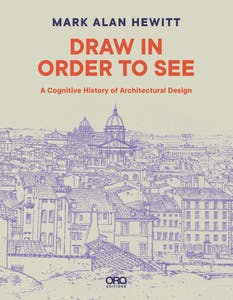
Draw in Order to See: A Cognitive History of Architectural Design
by Mark Alan Hewitt
That architecture and architectural education are in a terrible state is obvious to anybody in the field. The reasons for this catastrophe are many, but some of the primary causes have been the universal embrace of the cult of inhumane modernism devoid of ornament (“a crime”), beauty, or even fun; the arrogant ditching of history and disregard of architectural precedents; the devaluation of craftsmanship through the adoption of factory-made components; and the desensitisation of architectural students terrorised and bullied into acceptance of nonsense by means of design “juries”, and by the compulsory study of false “grand narratives” of modernism that are patently distorted.
One of the worst of those pernicious texts was Nikolaus Pevsner’s Pioneers of the Modern Movement from William Morris to Walter Gropius (1936), the title of which should have been enough to put off anyone who knew anything about art history. The creation of an entirely spurious connection between Arts-and-Crafts practitioners like Morris and modernists like Gropius was part of a campaign to create respectable father-figures for disreputable modernism; to legitimise the unspeakable by giving it a fabricated historical pedigree.
It says a lot about the flabbiness of the architectural world that it so readily accepted not only Pevsner’s sacred cowdom, but his enthusiastic endorsement of the Modern Movement in architecture as the “new style” of the twentieth century; a “genuine style as opposed to a passing fashion”, and one, moreover, that was, as Pevsner approvingly noted, “totalitarian”, a remark that did not even arouse a frisson of anxiety among the dimwits. Elizabeth Cumming and Wendy Kaplan put it neatly in their The Arts and Crafts Movement (1991 & 2002): they observed that few “now accept the view of Nikolaus Pevsner, put forward in his influential Pioneers … of Arts and Crafts as an antecedent of modernism”. Unfortunately, that is not true of “schools of architecture” in which falsehoods are still taught, and people like C.F.A. Voysey, who hated the modernists and everything they stood for, was held by Pevsner, in the teeth of objections by Voysey himself, to have been such a “pioneer”, a libel still perpetrated to this day in recent publications.
The widespread acceptance of untruths, obvious errors, and false attributions can only be explained if some cognitive functions have been shut down. To swallow the sort of twaddle peddled by Pevsner one would need to disengage what one actually sees from one’s understanding: in other words, instead of looking at something with care and forming sensible judgements based on careful comparisons and observations, one has one’s vision impaired by peering through Bauhaus-tinted spectacles, and therefore sees what Pevsner & Co. want one to see. In other words, whole generations have been brought up, not to see with their eyes, but to look with their ears.
Hewitt’s intelligent new book argues persuasively for the advantages of drawing in helping us to see. So often, the camera and the mobile phone are used to record something, but it is true (and I speak from many years of experience), that one can really only understand a building or an artefact by drawing it.
January 9, 2021
Three Dumb Italy Stories
Overly Sarcastic Productions
Published 8 Jan 2021If I had the time and energy, I’d have researched for a new video, but I have neither of those things right now, so you get Italy. Don’t worry, I made it extra snarky to compensate.
SOURCES & Further Reading: I, uh, well, most of the anecdotal information in this video came by way of tours I myself went on and somehow managed to retain 9 years later, but as always, you can find more on Florence & Venice in Florence: The Biography of A City by Christopher Hibbert and A History Of Venice by John Julius Norwich.
Our content is intended for teenage audiences and up.
PATREON: https://www.Patreon.com/OSP
PODCAST: https://overlysarcasticpodcast.transi…
DISCORD: https://discord.gg/osp
MERCH LINKS: http://rdbl.co/osp
OUR WEBSITE: https://www.OverlySarcasticProductions.com
Find us on Twitter https://www.Twitter.com/OSPYouTube
Find us on Reddit https://www.Reddit.com/r/OSP/

December 12, 2020
QotD: Modernism
Myron Magnet, “Free Speech in Peril: Trigger warning: may offend the illiberal or intolerant”, City Journal, 2015-04.
December 2, 2020
The History of the Colosseum (In LEGO!)
Overly Sarcastic Productions
Published 1 Dec 2020This video is sponsored by the LEGO Group. Learn more about the LEGO Colosseum here: https://lego.build/OSP
We’d like to thank our friends at LEGO for giving us this magnificent excuse to gush over some of the most beautiful architecture in history. This type of architectural-deep-dive is a little bit out of the ordinary for us, but it was lots of fun, so please do let us know if you found it interesting, as we’d be thrilled to do more!
Our content is intended for teenage audiences and up.
PATREON: https://www.Patreon.com/OSP
PODCAST: https://overlysarcasticpodcast.transi…
DISCORD: https://discord.gg/osp
MERCH LINKS: http://rdbl.co/osp
OUR WEBSITE: https://www.OverlySarcasticProductions.com
Find us on Twitter https://www.Twitter.com/OSPYouTube
Find us on Reddit https://www.Reddit.com/r/OSP/
November 12, 2020
The General Relativity of Revolution | BETWEEN 2 WARS: ZEITGEIST! | E.03 – Spring 1919
TimeGhost History
Published 11 Nov 2020It is a springtime of revolution throughout the world in 1919 and not just the political kind. Era-defining advances in science and technology and iconic cinematography are made this season.
Join us on Patreon: https://www.patreon.com/TimeGhostHistory
Hosted by: Indy Neidell
Written by: Indy Neidell and Francis van Berkel
Director: Astrid Deinhard
Producers: Astrid Deinhard and Spartacus Olsson
Executive Producers: Astrid Deinhard, Indy Neidell, Spartacus Olsson, Bodo Rittenauer
Creative Producer: Maria Kyhle
Post-Production Director: Wieke Kapteijns
Research by: Indy Neidell and Francis van Berkel
Edited by: Michał Zbojna
Sound design: Marek KamińskiColorizations:
Klimbim
Mikołaj Uchman
Wayne Degan
metacolor.orgSources:
Library of Congress
Bundesarchiv
Icons from The Noun Project:
– retro computer By Tinashe Mugayi, MY
– audio sound recorder By Vectors Point, PK
– Radio by Bill Denk
– Old TV By Pascal Heß, DE
– Radio Tower by Iris SunSoundtracks from Epidemic Sound:
– “British Royalty” – Trailer Worx
– “Flight Path” – Cobby Costa
– “Deflection” – Reynard Seidel
– “Flight Path” – Cobby Costa
– “A Single Grain Of Rice” – Yi Nantiro
– “Trapped in a Maze” – Philip Ayers
– “Symphony of the Cold-Blooded” – Christian Andersen
– “Rainy Landscapes” – Farrell Wooten
– “Ancient Saga” – Max AnsonArchive by Screenocean/Reuters https://www.screenocean.com.
A TimeGhost chronological documentary produced by OnLion Entertainment GmbH.
From the comments:
TimeGhost History
1 day ago
J’accuse is one of the many iconic films we’ll explore in this series. The interwar period is when European cinema really starts to hit its stride again after some serious setbacks during the Great War. In those years, American cinema rocketed to the mainstream both at home and abroad, with revolutionary filmmaking techniques being developed that we still see today such as close-ups, huge cast lists, and realistic set design.The post-Great War is set to be a great era in the history of cinema and not just because of the films themselves, J’accuse and other films are important as historical movers in their own right! They shape public perceptions, influence political change, and inspire whole social movements, so make sure you stay tuned to find out.
And in the meantime, are there any iconic interwar films you think deserve to be in this series?

October 10, 2020
QotD: McMansions
“McMansion Hell from A to Z: Part One (A-H)”, McMansion Hell, 2016-09-25.
September 30, 2020
New Orleans History 101
Atun-Shei Films
Published 2 Apr 2019A brief crash course in the history of the city, from the founding in 1718 to the 20th century.
Support Atun-Shei Films on Patreon ► https://www.patreon.com/atunsheifilms
#NewOrleans #Louisiana #AmericanHistory
Watch our film ALIEN, BABY! free with Prime ► http://a.co/d/3QjqOWv
Reddit ► https://www.reddit.com/r/atunsheifilms
Twitter ► https://twitter.com/alienbabymovie
Instagram ► https://www.instagram.com/atunsheifilms
Merch ► https://atun-sheifilms.bandcamp.com
August 28, 2020
Britain’s National Trust decides to go in a radically different direction
If you’ve ever visited the UK, you’ll almost certainly have seen some National Trust historic properties in your travels. Despite the name, it’s not a government-affiliated organization, so the Trust has its mission set by its own leadership … and the current leadership are apparently turning their back on the tradional role of the Trust “due to the pandemic”:
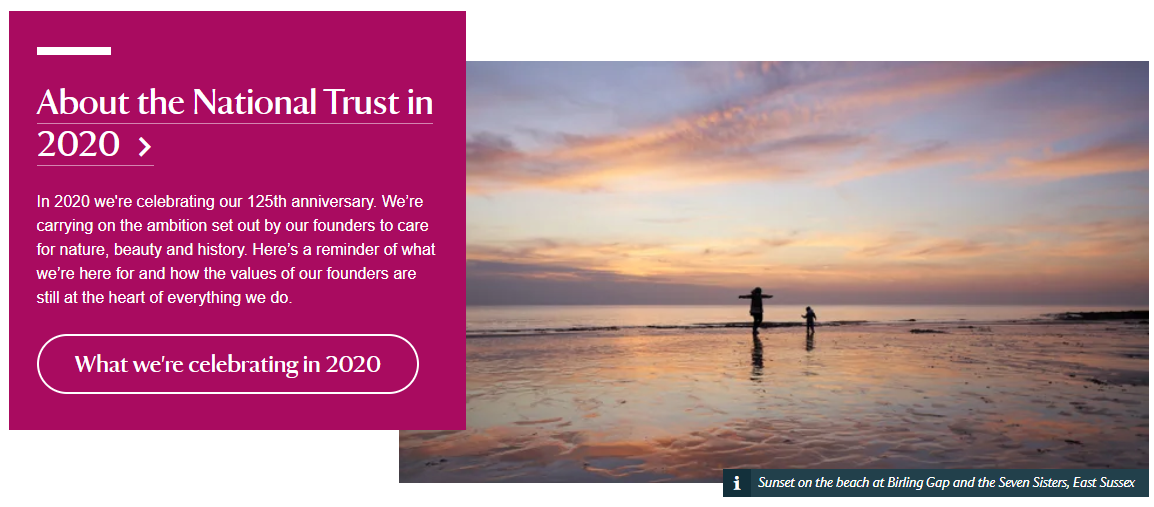
From its establishment in 1895 by Octavia Hill, Sir Robert Hunter and Hardwick Rawnsley “to promote the permanent preservation for the benefit of the Nation of lands and tenements (including buildings) of beauty or historic interest”, it has become the pre-eminent haunt of the tasteful middle classes, and is as much part of national life as that other much-lauded institution, the NHS. I have fond memories from my own childhood, and beyond, of walking round grand houses and of playing in their lavish and beautifully appointed grounds. Even their names produce a kind of Proustian rush in me – Felbrigg, Blickling, Stourhead, Dyrham Park, Kingston Lacy. In an uncertain and constantly changing world, the National Trust seemed to be almost a secular church, a rather well-appointed and comfortable Rock of Ages in its own right.
Yet we live in a time when a grubby little pandemic has turned all certainties upside down, and so even the National Trust has had to rethink its plans for the future. Unfortunately, its method of so doing seems to be both destructive and ill-considered. Some might call it woke, if it weren’t for the fact that its actions do not seem to be dictated by panicked social change, but instead by the reported £200 million loss that the coronavirus outbreak has occasioned. Despite having an endowment of over a billion pounds, and still retaining the annual memberships of over five million people, elements within the organisation that long for disruption seem now to have grasped the initiative, with potentially disastrous consequences for both the Trust and the country at large.
An internal briefing document that was leaked to the Times by a no doubt furious insider represents a chilling account of a cull of both heritage and expertise. It describes the status quo as “an outdated mansion experience”, and one that exists only to serve “a loyal but dwindling audience.” It plans to deal with this old-fashioned situation by firing dozens of its curators, placing large amounts of art and antiquities in storage, and by closing most of the properties to the public, instead letting them be hired by corporate entities and the well-heeled for private events, or “new sources of experience-based income”. As the document put it, the Trust wishes to “flex our mansion offer to create more active, fun and useful experiences.” Flex. Mansion Offer. We are, it seems, at the end of days.
I briefly considered, before writing this article, attempting to hold a séance to try and obtain James Lees-Milne’s views from beyond the grave, but eventually decided against interrupting his eternal rest to inform him of the disappointing and frightening news. Yet this situation does not need the phantoms of long-dead architectural historians to fan the flames. There are plenty of living people who are equally, and vocally, appalled, ranging from those who cancelled their memberships to the Trust when the institutional ties were no longer available in their gift shops to the curators, historians and architectural consultants who stand to lose both income and professional standing if these ill-considered and short-sighted reforms are brought about.
The art historian and broadcaster Bendor Grosvenor has been especially exercised by the revelation of the Trust’s plans. He has described their restructuring ideas in The Art Newspaper as “one of the most damaging assaults on art historical expertise ever seen in the UK.” Grosvenor has since been assiduously passing scathing commentary on the various public statements, of varying degrees of disingenuity, made by various high-up executives at the National Trust, none of which have denied that historic properties will be “repurposed”, that the specialist curator posts will be “closed” and the expert curators fired, nor, perhaps most chillingly of all, that the Trust will be seeking to “dial down” its status as a “major national cultural institution”.
About thirty years ago, when we could afford to travel more often, we had a family membership in the National Trust even though we’d only get to visit National Trust properties for two-to-three weeks in a given year. I’m very disappointed to hear about this planned change to the organization, but the chances of me visiting the UK anytime in the next few years are quite low, so I may not have to worry about it personally.
August 25, 2020
The Bronze Age Changes with Archeological Evidence
The Cynical Historian
Published 22 Feb 2019Check out the full collaboration playlist here: https://www.youtube.com/playlist?list…
Up until the 19th century, the Bronze Age was merely a time of legends, where the Bible and Iliad told fantastic tales of brutality and triumph. But archeology changed that, and that’s what I want to talk about today, how the Bronze Age was rescued from legend.
————————————————————
references:
Stephen L. Dyson, “Archaeology and Ancient History,” in A Companion to Ancient History, edited by Andrew Erskine (Malden, Mass.: Blackwell Publishers, 2002), 59-66. https://amzn.to/2PCf04XMarie-Henriette Gates, “Archeology and the Ancient Near East: Methods and Limits,” in A Companion to the Ancient Near East, edited by Daniel C. Snell (Malden, Mass.: Blackwell Publishers, 2005), 65-79. https://amzn.to/2BrsBqO
Alan B. Lloyd, “Chronology,” in A Companion to Ancient Egypt, vol. 1, edited by Alan B. Lloyd (Malden, Mass.: Blackwell Publishers, 2010), xxxii-xliii. https://amzn.to/2LqGZnM
John Marincola, “Historiography,” in A Companion to Ancient History, edited by Andrew Erskine (Malden, Mass.: Blackwell Publishers, 2002), 13-22. https://amzn.to/2PCf04X
John Van Seters, “Historiography in Ancient Israel,” in A Companion to Western Historical Thought, edited by Lloyd Kramer and Sarah Maza (Malden, Mass.: Blackwell Publishers, 2002), 15-34. https://amzn.to/2PAC5Vz
Tim Whitmarsh, “Ancient History through Ancient Literature,” in A Companion to Ancient History, edited by Andrew Erskine (Malden, Mass.: Blackwell Publishers, 2002), 77-86. https://amzn.to/2PCf04X
————————————————————
Support the channel through PATREON:
https://www.patreon.com/CynicalHistorian
or pick up some merchandise at SpreadShirt:
https://shop.spreadshirt.com/cynicalh…LET’S CONNECT:
Discord: https://discord.gg/Ukthk4U
Twitter: https://twitter.com/Cynical_History
————————————————————
Wiki: The Bronze Age is a historical period characterized by the use of bronze, and in some areas proto-writing, and other early features of urban civilization. The Bronze Age is the second principal period of the three-age Stone-Bronze-Iron system, as proposed in modern times by Christian Jürgensen Thomsen, for classifying and studying ancient societies.An ancient civilization is defined to be in the Bronze Age either by producing bronze by smelting its own copper and alloying with tin, arsenic, or other metals, or by trading for bronze from production areas elsewhere. Bronze itself is harder and more durable than other metals available at the time, allowing Bronze Age civilizations to gain a technological advantage.
Copper-tin ores are rare, as reflected in the fact that there were no tin bronzes in Western Asia before trading in bronze began in the third millennium BC. Worldwide, the Bronze Age generally followed the Neolithic period, with the Chalcolithic serving as a transition. Although the Iron Age generally followed the Bronze Age, in some areas (such as Sub-Saharan Africa), the Iron Age intruded directly on the Neolithic.
Bronze Age cultures differed in their development of the first writing. According to archaeological evidence, cultures in Mesopotamia (cuneiform script) and Egypt (hieroglyphs) developed the earliest viable writing systems
————————————————————
Hashtags: #history #TheBronzeAge #archeology #BronzeBonanza

August 24, 2020
MATERA – James Bond and the City of Beige
Lindybeige
Published 23 Aug 2020Get your first audiobook and a monthly selection of Audible Originals for free when you try Audible for 30 days visit https://www.audible.com/lindybeige or text
lindybeigeto 500 500.Matera is an city in Italy which has suddenly become famous. It is rather special and here I describe why.
Support me on Patreon: https://www.patreon.com/Lindybeige
Buy the music – the music played at the end of my videos is now available here: https://lindybeige.bandcamp.com/track…
Buy tat (merch):
https://outloudmerch.com/collections/…Lindybeige: a channel of archaeology, ancient and medieval warfare, rants, swing dance, travelogues, evolution, and whatever else occurs to me to make.
▼ Follow me…
Twitter: https://twitter.com/Lindybeige I may have some drivel to contribute to the Twittersphere, plus you get notice of uploads.
My website:
http://www.LloydianAspects.co.uk

July 26, 2020
Hagia Sophia
Lars Brownworth (author of the excellent Lost to the West: The Forgotten Byzantine Empire That Rescued Western Civilization) on the building of the Hagia Sophia by Eastern Roman Emperor Justinian in Constantinople:
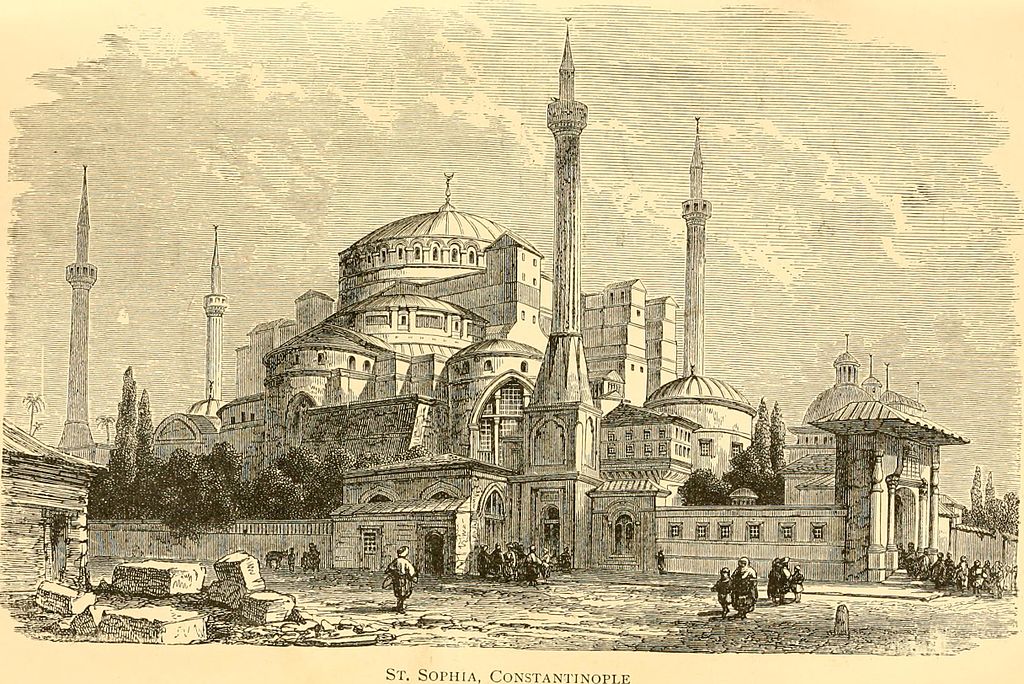
Illustration of the Hagia Sophia from European History: An outline of its development by George Burton Adams, 1899.
Wikimedia Commons
The Hagia Sophia was the brainchild of a unique figure in history. At birth, Justinian was a nobody among nobodies in a grindingly poor part of what is today North Macedonia. By his mid-40s, he was a Byzantine emperor. His appetites were large, his dreams larger. The man who knew what it was like to have nothing gave new meaning to the idea of luxury. For one memorable celebration, he spent almost two tons of gold on decorations.
Justinian had no time for small things. By the second year of his reign, he had decided to codify all of Roman law, founded several new cities, and had started construction on at least eight new churches.
The money for all these projects inevitably came from the public. And by the fifth year of his reign, his subjects had had enough. Already upset by rampant corruption, an inefficient bureaucracy, and crushing taxes, they hit the boiling point when Justinian severely restricted public games. A mob tore through the streets, overwhelming the unprepared police forces. Several stores were set on fire, and the wind quickly spread the flames to a nearby hospital, which burned down with its patients inside. An inferno raged. For five long days, Constantinople burned.
By the time Justinian reasserted control, more than 30,000 citizens were dead, and perhaps a third of the city was a blackened shell. It looked as if some barbarian horde had sacked the capital. The fact that its own people had inflicted such a wound hovered like a black cloud over the streets.
Characteristically, Justinian saw a perfect opportunity within the ashes. This was a blank canvas on which to create a new city in his image. The transformation would begin with the cathedral. The original building, known simply as the Magna Ecclesia — the Great Church — had been built by a son of Constantine the Great in the fourth century, but had burned down a few decades later. Since it was a standard Roman basilica — a large hall with square walls and angled wooden roof — it had been fairly easy to rebuild along the same lines.
But of course, Justinian had no intention of following the tired plans of an earlier age. This was a chance to remake the cathedral on a new scale, something worthy of the ages. It was to be nothing short of a revolution, equal parts art and architecture, the enduring grandeur of the emperor himself frozen in physical form.
Everything about this project was audacious, including his selection of architects. Instead of choosing a traditional builder, he picked two teachers who — like himself — had more vision than practical experience. This was a lifelong pattern with Justinian. He had a habit of plucking genius out of the common crush; his wife was a reformed prostitute, and his greatest generals were an elderly eunuch and a former bodyguard.
The emperor’s instructions to Isidore of Miletus, a physics teacher, and Anthemius of Tralles, a mathematician, should have terrified them. They merely had to design and successfully build a church unlike anything else the world had seen. Sheer scale wasn’t enough — the empire was full of grand monuments and immense sculpture. This had to be something different, something fitting for the new golden age that was dawning. Expense wasn’t an issue, but speed was. Justinian was already in his 50s, and he didn’t intend to have some successor apply the final coat of paint and claim the project as his own.
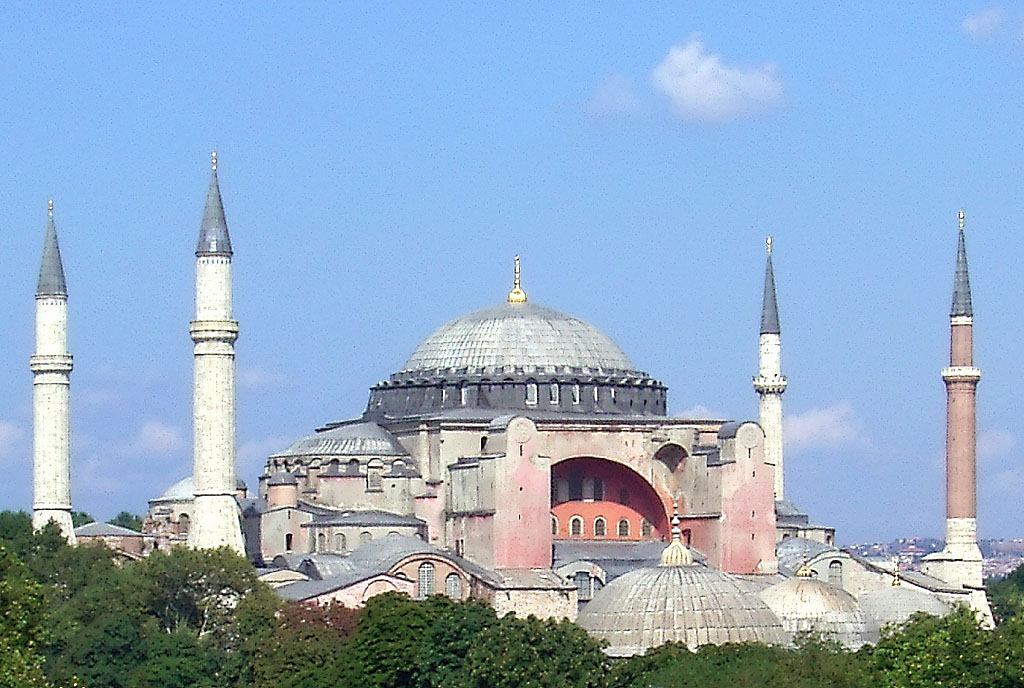
Hagia Sophia in the Faith district of Istanbul, 18 November 2004.
Photo by Robert Raderschatt via Wikimedia Commons.
July 12, 2020
Restoring Notre Dame – “The matter will be solved in a serene manner, and on time”
Andrew Sullivan breathes a sigh of relief that the French government is going to properly restore the fire-damaged cathedral rather than — shudder — re-imagine it:
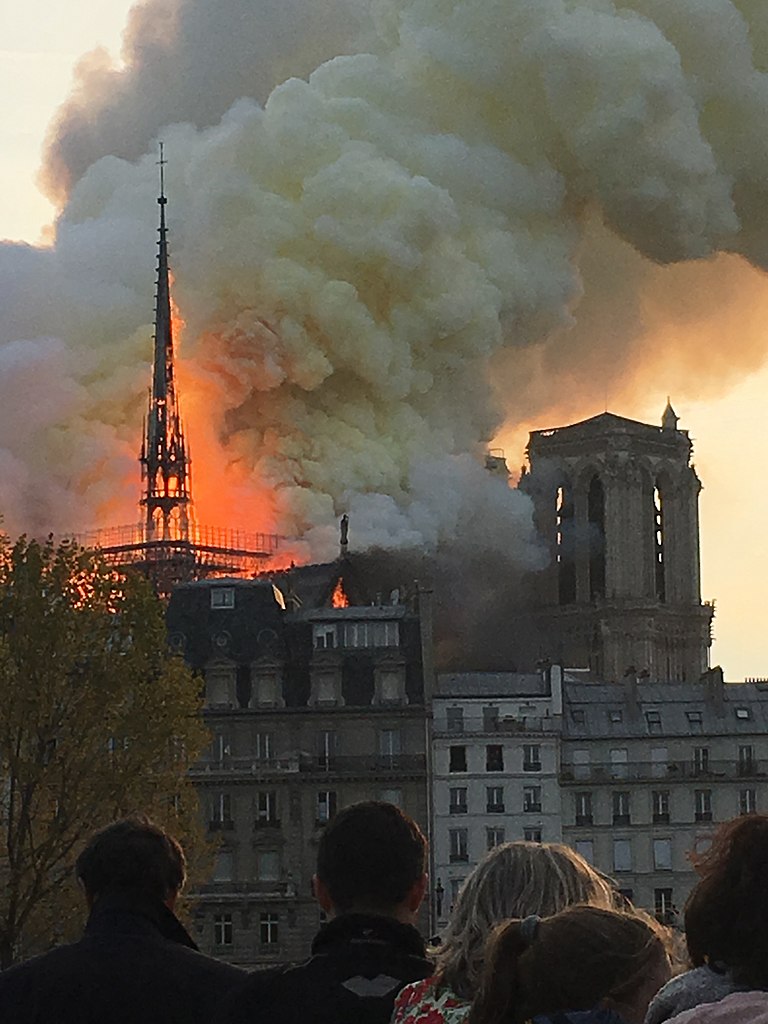
A small note of hope. The fiery destruction of the Notre-Dame Cathedral in Paris was one of the more searing occasions for acute depression these past couple of years, and it was not without some stiff competition. Yes, it’s just a building and not a human being. But it is also far more than a building. It’s a reminder to me of what the faith of Europe was once capable of; of a civilization proud, rather than ashamed, of itself; and of a lost world when beauty itself was a virtue and connected to a view of the whole of creation that made sense and provided hope and meaning.
Much of that has disappeared, of course, which is why the physical remains of a previous civilization are so precious. And so I was terrified, to be honest, that our own aesthetically squalid and spiritually devoid ideas of what architecture should be might ruin the rebuilding. And when you take a look at some of the original wackier proposed designs — you can see models for seven modernist monstrosities in this Architectural Digest compilation here — you can see what I was worried about. One tops the cathedral with a greenhouse; another with a swimming pool. One hideous version has the entire roof and new spire made out of stained glass; another re-creates a ball of fire in metallic form. Norman Foster’s design turned the place into a huge greenhouse, or as one Twitter wag put it, like “a conference center in Essex.” This was all because Macron himself hinted that he preferred a “contemporary architectural gesture.”
Mercifully, the chief architect put in charge of the restoration, Philippe Villeneuve, had some strong feelings on the matter. He wanted the original restored in its entirety, period. When I say “strong feelings,” I refer to the following statement he made on television last year: “I will restore it identically, and it will be me, or they will build a modern spire, and it won’t be me.” When President Macron’s somewhat more ambitious adviser on the project, General Jean-Louis Georgelin, testified on the matter to the National Assembly’s cultural-affairs committee, sparks flew when Villeneuve’s statement was brought up. Georgelin said: “The matter will be solved in a serene manner, and on time. I have already explained to the chief architect that he should just shut his big mouth, and I will do it again.” “On time” meant in time for Paris’s hosting of the Olympics in 2024.
And since that time is fast running out, and designing, approving and building a modernist tower would take too long, we found out yesterday that the restoration will be identical after all. It will copy the 19th-century Gothic design exactly. The contemporary gesture that Macron desired will instead be a giant Victorian single finger to all the modernists who would have destroyed it. And who knows how many generations in the future will be thankful.
Two of the “re-imagined” restorations:
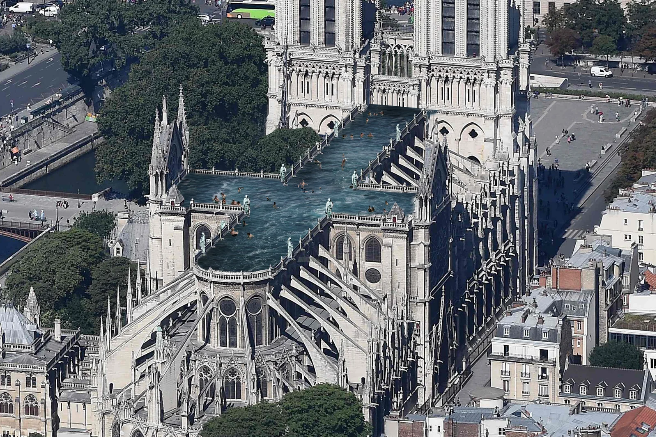
Feel like a refreshing dip? One proposal for restoring Notre Dame envisioned a rooftop pool.
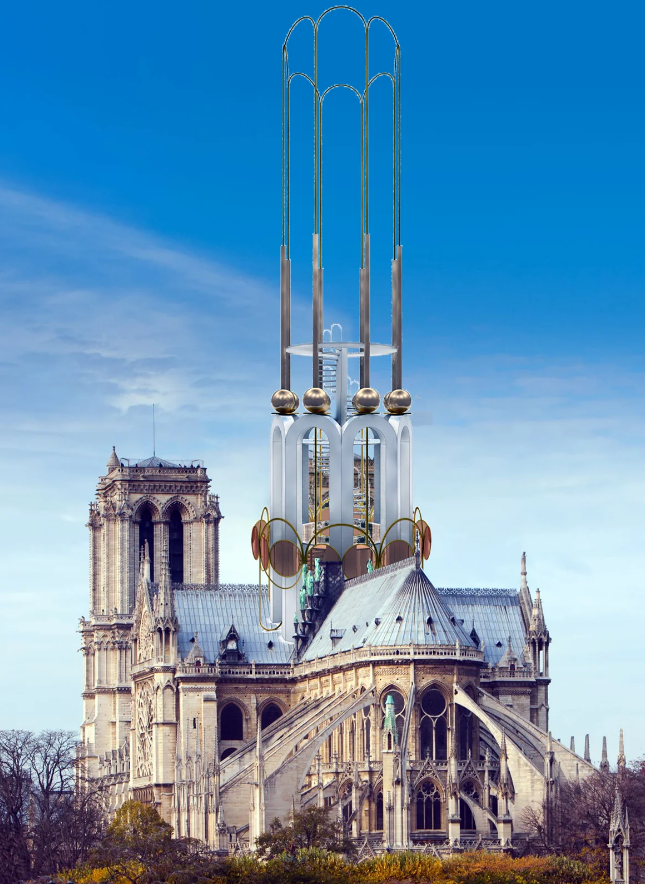
Still another proposal included this … thing … stuck on top.


