Quotulatiousness

September 9, 2012

Midway: the turning point of the Pacific War

Filed under: Books, History, Japan, Military, Pacific, USA, WW2 — Tags: , , , , — Nicholas @ 09:33

An interesting sketch of the importance of the 1942 Battle of Midway in the Spectator from Richard Freeman:

For many of us the Battle of Midway is just one more Hollywood spectacular in, to paraphrase Neville Chamberlain, a far-away sea of which we know little. But having recently taken a closer look at the battle I am struck both by what was at stake and what the consequences of the American victory were for the Allies at the time and geopolitics since then.

[. . .]

Because the Americans were the victors at Midway, it is easy to forget how near they came to losing the battle. On the day of the main action they attacked the Japanese carriers from dawn until 10.20 am without inflicting any serious damage. Then, between 10.20 am and 10.25 am, the American planes caught three of the Japanese carriers without adequate fighter protection. All three were completely disabled in just five minutes in what has been called ‘the miracle of Midway’.

[. . .]

Now suppose — and it almost happened — that the Japanese carriers, with their vastly superior fighter planes, had caught the American carriers off guard. The loss of those carriers and the destruction of the Midway airbase would have compelled America to give a much higher priority to the Pacific. A direct consequence of that would have been a slower build-up of American power in, first North Africa, and then Europe.

Shortly after the North African landings, there was the other great turning point of the war: Germany’s surrender at Stalingrad. From then on one of the great questions of the war was where the Russians would meet the Allies. Had America suffered a massive defeat at Midway, the Allies advance in Europe would have been slower. (As it was, D-day strained the Allies to the limit. Even a small reduction in ships, tanks, planes or men would have forced its delay.) In these circumstances it is not inconceivable that the Soviet Union would have taken the whole of Germany

I just finished reading one of the few accounts of the battle from the Japanese perspective, Midway: The Battle That Doomed Japan by Mitsuo Fuchida and Masatake Okumiya. Because I couldn’t remember Fuchida’s co-author’s name, I Google searched on the title of the book, only to find the top item after Fuchida’s Wikipedia entry was this:

The Western accounts of the Japanese side of the battle have heretofore been built around three primary sources: The after-action log of Admiral Nagumo (“The Nagumo Report”); the interviews with Japanese naval officers conducted after the war by the United States Strategic Bombing Survey (“USSBS”); and Mitsuo Fuchida’s book, Midway: The Battle That Doomed Japan, which was published in the United States in 1955. These three sources, augmented by fragmentary survivor accounts, have formed the backbone of the Japanese account for all Western histories up to this point.

Unfortunately, one of these sources — Fuchida’s Midway — is irretrievably flawed. Fuchida’s misstatements, which have lain undetected in the West until very recently, have had manifold negative effects on the veracity of the standard English-language battle accounts. His were not minor errors of omission that can be brushed off or explained away — they were fundamental and willful distortions of the truth that must be corrected. Intriguingly, Fuchida’s account was overturned and discredited in Japan more than twenty-five years ago. Yet in the West, he has remained as important as the day his book was first published.
August 24, 2012

Ukraine rejoins the submarine team

Filed under: Europe, Military — Tags: , , , — Nicholas @ 09:18

The only submarine in Ukraine’s navy is seaworthy again:

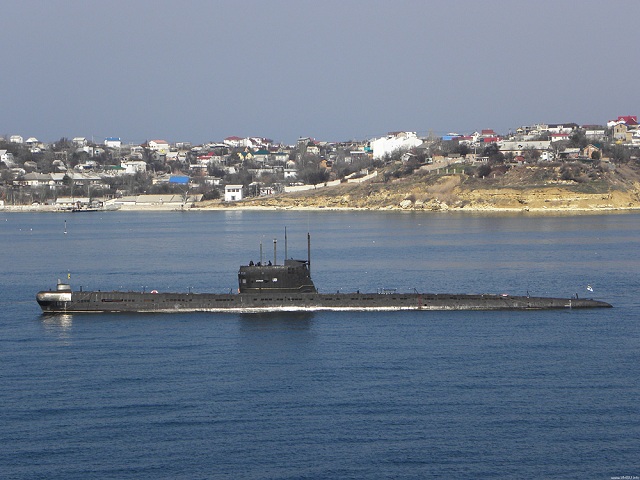
The Ukrainian Navy got its only submarine (the Zaporozhye) back into service. The 40 year old Foxtrot class boat has been out of action for 18 years and was recently refurbished. Zaporozhye is the only sub in the Ukrainian Navy, which mainly consists of small, Cold War era frigates (one) and corvettes (seven). There are also two amphibious ships and six minesweepers. The Foxtrot class diesel-electric subs were designed in the late 1950s and 58 were built until production ended in 1983. These are 1,900 ton boats with ten torpedo tubes and a crew of 78. Russia retired all of its Foxtrots by 2000, but they were all obsolete by the early 1980s. The Zaporozhye is the last Foxtrot still in service.

The Black Sea has not been kind to submarines. Three years ago the Russian Black Sea Fleet suffered a major blow when its only operational submarine, a 19 year old Kilo class boat, broke down at sea and limped back to port on partial power. The only other sub in the fleet, a 32 year old Tango class boat, was undergoing repairs (and still is, but will soon be scrapped.) During the Cold War, the Black Sea Fleet had thirty or more submarines.


Image from Navy Recognition.

Wikipedia says:

Zaporizhzhia (U-01) (Ukrainian: Запоріжжя) is a project 641 (“Foxtrot” class) submarine, the only submarine of the Ukrainian Navy at the moment. She formerly carried the Soviet Navy pennant number B435.

Zaporizhzhia is run by a naval crew of 78, commanded by 1st Rank Capt. Oleh Orlov.

August 21, 2012

Royal Navy faces shortage of trained submariners

Filed under: Britain, Military, Technology, Weapons — Tags: , , , — Nicholas @ 08:56

Thomas Harding in the Telegraph:

Internal documents warn that a lack of recruits for the Submarine Service may leave attack submarines and boats carrying the Trident nuclear missile stranded in port.

A separate threat comes from a predicted 15 per cent shortfall in engineers by 2015.

One in seven posts for weapons officers at the rank of lieutenant will also be vacant, raising operational questions over the boats equipped with nuclear and cruise missiles.

Many submariners are being poached by the civilian nuclear sector and those who remain are being forced to go to sea for longer and more frequently.

Adml Lord West, the former First Sea Lord, said the situation was “very worrying” and he hoped the Navy had mechanisms in place to make up for the shortfall.

[. . .]

The Navy has a fleet of six attack submarines and four Vanguard boats that carry the Trident nuclear missile, but the personnel issues could mean they cannot be deployed.

The report found that the recruiting and retention of submariners was also threatening operations. “Inability to recruit, retain and develop sufficient nuclear and submarine design qualified personnel will result in an inability to support the Defence Nuclear Programme,” the document said.

August 17, 2012

The plight of Russian submariners

Filed under: History, Military, Russia — Tags: , , , , — Nicholas @ 08:36

An update from Strategy Page on how far the Russian nuclear submarine threat has diminished from its peak during the cold war:

Three years ago two Akulas were detected (by the U.S. Navy) off the east coast of the United States, in international waters. Russia admitted two of its Akula class boats were out there. This was the first time Russian subs had been off the North American coast in over a decade. This spotlights something the Russian admirals would rather not dwell on. The Russian Navy has not only shrunk since the end of the Cold War in 1991, but it has also become much less active. In the previous three years, only ten of their nuclear subs had gone to sea, on a combat patrol, each year. Most of the boats going to sea were SSNs, the minority were SSBNs (ballistic missile boats). There were often short range training missions, which often lasted a few days, or just a few hours.

The true measure of a fleet’s combat ability is the number of “combat patrols” or “deployments” in makes in a year and how long they are. In the U.S. Navy, most of these last from 2-6 months. Currently U.S. nuclear subs have carry out ten times as many patrols as their Russian counterparts. Russia is trying to catch up, but has a long way to go.

Russia has only 14 SSNs (nuclear attack subs) in service and eight of them are 7,000 ton, Akulas. These began building in the late 1980s and are roughly comparable to the American Los Angeles class. All of the earlier Russian SSNs are trash, and most have been decommissioned. There are also eight SSGN (nuclear subs carrying cruise missiles) and 20 diesel electric boats. There is a new class of SSGNs under construction, but progress has been slow.

[. . .]

The peak year for Russian nuclear sub patrols was 1984, when there were 230. That number rapidly declined until, in 2002, there were none. Since the late 1990s, the Russian navy has been hustling to try and reverse this decline. But the navy budget, despite recent increases, is not large enough to build new ships to replace the current Cold War era fleet that is falling apart. The rapid decline of Russia’s nuclear submarine fleet needed international help to safely decommission over a hundred obsolete, worn out, defective or broken down nuclear subs. This effort has been going on for over a decade, and was driven by the Russian threat to just sink their older nuclear subs in the Arctic Ocean. That might work with conventional ships, but there was an international uproar over what would happen with all those nuclear reactors sitting on the ocean floor forever. Russia generously offered to accept donations to fund a dismantling program that included safe disposal of the nuclear reactors.

July 26, 2012

Wreck of WWII U-boat may be 100km up the Churchill River

Filed under: Cancon, Germany, History, Military, WW2 — Tags: , , — Nicholas @ 09:57

CBC News on the possible discovery of remains of a German WW2 submarine in Labrador:

The German government says it is possible, but added that it would be “sensational and unusual,” that a submarine could have ended up so far inland.

“We do know that German U-boats did operate in that region,” said Georg Juergens, the deputy head of mission for the German Embassy in Ottawa.

He notes that a Second World War-era, battery-operated weather station was found decades after being left in Labrador by a U-boat. It is now on display at the Canadian War Museum in Ottawa.

“We must brace ourselves for surprises,” Juergens told CBC News, while stressing that the submarine has yet to be positively identified.

More than a dozen U-boats may still be unaccounted for, he said.

If the mystery find is proven to be a submarine wreck, the German government does not favour bringing it to the surface.

“That would be against our tradition and our naval customs,” Juergens said. “This site then would be declared a war grave at sea.”

He said Canadian policy dovetails with German policy on such matters.

According to Juergens, the Newfoundland and Labrador government is now involved in efforts to authenticate the possible wreck.

July 22, 2012

HMCS Victoria torpedoes and sinks US Navy ship!

Filed under: Cancon, Military, Pacific, USA — Tags: , , — Nicholas @ 11:09

The word “decommissioned” should appear in that headline. Details here: http://www.liveleak.com/view?i=c51_1342677437

July 6, 2012

US Navy re-thinks their Pacific strategy options

Filed under: China, Military, Pacific, USA — Tags: , , , — Nicholas @ 08:07

Strategy Page discusses the historical uses of the submarine in the Pacific and why things would not be the same in the case of a Chinese war:

The U.S. Navy is rethinking how it will use its submarines in a future Pacific War. The problem is that a campaign against Chinese shipping is unlikely, in part because of what actually happened during the last great anti-shipping campaign, which occurred during World War II (1939-45). After the war, the U.S. analyzed its operations against Japanese shipping and found that submarines were important, but not the only weapon effective against shipping. Some 8.9 million tons of Japanese shipping was sunk or so seriously damaged (disabled) at the end of the war. Submarines accounted for 54.7 percent of this. But 16.3 percent was attributable to carrier-based aircraft, 14.5 percent to land- based planes and 9.3 percent to mines (most dropped by B-29s). Less than one percent was due to surface gunfire, and the balance of 4 percent was caused by accidents.

[. . .]

Meanwhile, the U.S. has adopted a new approach to any potential war with China. The U.S. Department of Defense has been told that, for the foreseeable future, there will be no more large-scale land campaigns. The air force, navy, and marines responded with a plan (AirSea Battle) that has been in the work for years. The new strategy is designed to cope with the rising power of China in the Pacific. AirSea Battle involves tighter planning and coordination of navy, marine, and navy forces, plus the development of some new weapons and tactics and cooperation with allies.

[. . .]

AirSea battle concentrates on military operations. But these will be heavily influenced by economic factors. For example, during World War II the United States was a largely self-sufficient “continental power.” We exported much (more than any other nation on the planet), but did not have to import much. That has changed. Now the U.S. has to import a lot of its oil, special raw materials (like “rare earths” from China) and a lot of manufactured goods. The U.S. is now like much of the rest of the world, China included. If there were a maritime blockade of China, the U.S. and many other Chinese trading partners would suffer severe economic disruptions. There would be massive unemployment for all concerned and that would happen despite energetic efforts by everyone to find alternative sources to goods no longer available because of the disruption of the China trade.

[. . .]

Meanwhile, the nuclear submarine community has done the math and found that their greatest contribution these days is not attacking enemy warships, but land bombardment with cruise missiles and intelligence collecting. Since the first nuclear subs showed up in the 1950s, only one, a British boat, has used a torpedo to sink a hostile warship. But hundreds of cruise missiles have been launched at land targets and uncounted (because they are highly classified) intelligence missions have been, and continue to be, carried out. All that is the recent past for subs, and is likely to be the future as well. World War II in the Pacific is not likely to be rerun. The U.S. Navy still expects its subs to go after enemy warships, and its surface and air forces to battle enemy subs. But a major war on shipping is much less likely.

June 17, 2012

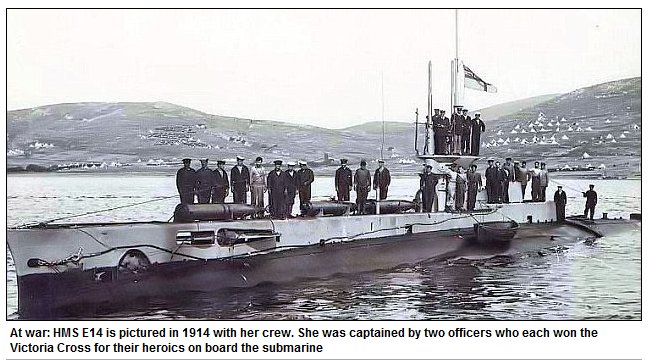
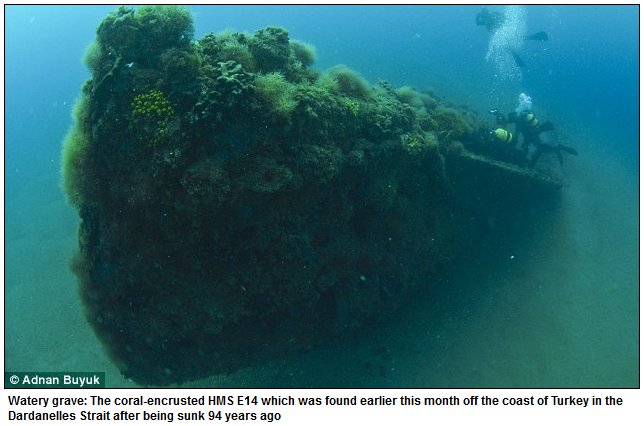
Royal Navy submarine wreck discovered in the Dardanelles

Filed under: Britain, History, Middle East, Military, WW1 — Tags: , , , — Nicholas @ 09:26

What appears to be the wreck of the E14 has been located just 800 feet offshore in the Straits of the Dardanelles:

Its precise location in the eastern Mediterranean remained a mystery until this month when a Turkish marine engineer and a diver detected it on the seabed off the town of Kumkale – just 800ft from the beach.

The wreck was discovered by marine expert Selçuk Kolay and film-making diver Savas Karakas, who had spent three years trying to find it.

After studying documents at the national Archives in Kew, west London, and surveying Turkish defences, they scanned an unusual object from a boat on the surface.

But they could not establish what it was because it was near the mouth of the straits — a sensitive military area where diving was forbidden.

It took two years to get permission from the military before their team were able to dive to the wreck and confirm it was the E14 earlier this month.

June 5, 2012

The US military’s SF research emporium

Filed under: Media, Military, Science, Technology, Weapons — Tags: , , , , , , — Nicholas @ 08:18

John Turner sent me a link to this amusing little survey of what the US military’s R&D organization is willing to admit they’re working on and how it might be helpful in case of an alien invasion:

As summer blockbuster season kicks into high gear, big-budget action movies like The Avengers, Battleship, and Prometheus remind us that there’s one thing that unites Americans: Our shared fear of an alien attack. They also remind us that when the invading space fleet arrives, humanity is not going to surrender without a fight to our intergalactic invaders. Instead, we will band together to fight off their incredibly advanced weaponry with our … well, with what, exactly? Are we really ready to battle our would-be alien overlords?

Luckily, the Pentagon’s Defense Advanced Research Projects Agency, better known as DARPA, as well as some of the world’s largest weapons manufacturers, are dreaming up the weapons of the future today. With the help of everything from lasers on jets to hypersonic planes to invisibility cloaks, we just might be able to make the battle for Earth a fair fight. You may think we’re joking, but why else would NASA be uploading The Avengers to the International Space Station if not as a training manual? Here’s a look at some of the most space-worthy inventions being cooked up now.

An issue for any unmanned, armed vehicle (whether land, sea or air) is the security of communications from the controller to the vehicle. Recent use of such devices has almost always been in combat against relatively low-tech opponents who did not have jamming or hacking capabilities (although the UAV forced down in Iran may signal the end of the easy period for combat UAVs). Earlier discussions of benefits and drawbacks to unmanned fighters are here, here, and here.

April 16, 2012

India’s long, twisting path to nuclear submarine capabilities

Filed under: India, Military, Russia, Technology — Tags: , , , — Nicholas @ 08:51

India would like to run their own nuclear-powered submarines, but it’s taken longer for them to achieve that than they’d hoped:

On April 4th the new Russian Akula II SSN (nuclear attack submarine) Nerpa, that was supposed to be delivered to India (which is leasing it) two years ago, was finally turned over. It’s worse than it sounds. Three years ago, during sea trials there was an equipment failure on Nerpa that killed 20 sailors and shipyard workers. This delayed sea trials for many months and the Russians found more items that needed attention. These additional inspections and repairs continued until quite recently.

[. . .]

Indian money enabled Russia to complete construction on at least two Akulas that were less than half finished at the end of the Cold War. This was another aftereffect of the collapse of the Soviet Union. Several major shipbuilding projects were basically put on hold (which still cost a lot of money) in the hopes that something would turn up. In this case, it was Indians with lots of cash. But money could not overcome the construction problems and poor design decisions the Russians made. The single Akula II India was leasing was delayed again and again. The 8,100 ton Akula II has a crew of 73. The one leased by India has eight 533mm (21 inch) torpedo tubes and 40 torpedoes.

Meanwhile, in 2009, India launched its first nuclear submarine, the INS Arihant (Destroyer of Enemies). This came after over a decade of planning and construction. What was not revealed at the times was that the Arihant was launched without its nuclear reactor, which was not installed until 2011. Arihant is supposed to be ready for service later this year.

April 11, 2012

HMCS Windsor scheduled to return to the water today

Filed under: Cancon, Military — Tags: , , , — Nicholas @ 00:07

One of the Royal Canadian Navy’s four submarines, HMCS Windsor, is supposed to be getting wet again later today:

Good news, of a sort: One of Canada’s four Victoria-class submarines is set to achieve a major milestone Wednesday. It’s going to be in the water. Huzzah!

After years of extensive refit work, HMCS Windsor is set to be lowered — lowered “extremely slowly,” but lowered — into the Atlantic Ocean. Assuming it does not instantly sink, explode or simply dissolve like a giant, oddly shaped sugar cube, the Windsor will then begin a long series of tests at sea. It is hoped that the sub will be fully operational by early 2013. Fingers crossed. Canada should have submarines. They are a useful part of a modern navy’s arsenal, and Canada has an enormous coastline. Although the subs have had an uneven history, to say the very least, they finally seem to be getting to a state where they’ll be useful to us. There had been speculation before last month’s federal budget that they’d be scrapped, but at this late point, that would be wasteful. It’s cost a lot to get these incredibly complicated machines as operational as they are (again, fingers crossed).

[. . .]

Purchased second-hand from the British for the rock-bottom price of $750-million in 1998, they’ve fallen well short of expectations. They only entered Canadian service in 2003, and have proven glitchy and outright dangerous — HMCS Chicoutimi caught fire during its maiden voyage in 2004. Lt. Chris Saunders was killed fighting the blaze, and the sub has been out of service undergoing repairs ever since. It, too, is hoped to be back in service next year. All told, the subs have been at sea, collectively, only 900 days since 2003, and have cost billions of dollars to bring up to spec — money the cash-strapped navy didn’t really have. Costly, under-performing, sucking up needed resources … sound familiar?

March 16, 2012

HMCS Victoria successfully test fired a torpedo

Filed under: Cancon, Military — Tags: , , — Nicholas @ 12:51

After all these years, we apparently will soon have torpedo-armed subs in the Royal Canadian Navy:

These torpedo firings are part of the technical and operational tests of Victoria‘s weapons systems and additional weapons system trials are scheduled for the spring of 2012. In the exercise version of the torpedo, the warhead module is replaced with electronics for gathering test data.

Victoria also participated in training with a naval task group while off the west coast of Vancouver Island, focussing on coordinated anti-submarine warfare tactics. Equipment and crew trials will continue throughout March as part of Victoria‘s program to being declared fully operational later this summer.

The submarine fleet will achieve steady state in 2013; at which point Canada will have three of four submarines continuously available for operations. As part of the ongoing submarine operational cycle, the fourth submarine will be with industry, undergoing necessary deep maintenance. Submarines are an essential component of a modern, first-class Navy with a balanced set of capabilities that can act in defence of Canada and Canadian interests above and below the sea.

Recent stories about the Victoria class submarines here and here.

March 2, 2012

At least one politician thinks we should keep the Victoria class submarines

Filed under: Cancon, Military — Tags: , , — Nicholas @ 11:41

In the National Post, Senator Pamela Wallin offers a counter-argument to John Ivison’s suggestion that the submarine fleet is a net drain on Canada’s military resources (linked from this post):

I’m with Vice-Admiral Maddison, who said, “For a G8 nation, a NATO country like Canada, a country that continues to lead internationally and aspires to lead even more, I would consider that [cancellation of the program] to be a critical loss of a fundamental capability and a very difficult one to regenerate at a future date.” Submarines provide Canada the ability to add to our knowledge of what’s happening at sea, a way of moving around without being noticed and, if fighting breaks out, a unique strike capability in support of Canadian or allied forces.

Most importantly, Canada has the longest coastline in the world. We need to be able patrol it and to guard our three enormous ocean approaches — quietly and unseen. As well, 90% of the world’s trade moves on ships. Canada is heavily reliant on maritime trade, especially through sensitive narrow waterways like the Straits of Hormuz and Malacca. Some of that trade is threatened by piracy, a growing concern for all trading nations, especially off Africa’s east coast where pirates now range all the way east to India. These are not the charmingly rakish pirates that Hollywood portrays — they are brutal, ruthless criminals. Canada, as a maritime nation, needs to know what’s going on in all domains, including underwater, and to be able to fight back.


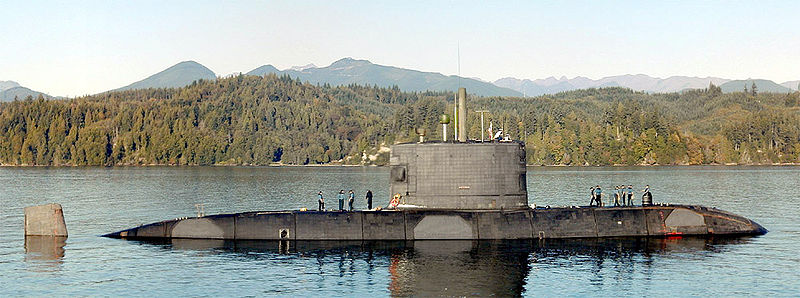
HMCS Victoria near Bangor. (Image from Wikimedia).

In spite of the tone of my comments in the earlier post (generally agreeing with Ivison’s criticisms), I’m pro-RCN and very much pro-submarine as part of our navy. But what we need are submarines that can perform the duties required, and ever since we acquired the Victoria class, they’ve signally failed to do this. Anyone who’s ever watched a WWII film or newsreel knows that submarines fire torpedoes — except the Victoria class, which still do not have effective torpedo armament. We bought these submarines in 1998. HMCS Victoria has been in commission since 2000 and we’re only just getting around to test-firing a torpedo later this year? This is insane.

Of course, it’s not fair to blame the RCN for all the problems: the government of the day bought the subs on the cheap and then didn’t fully fund the necessary repairs to bring the boats back into operation in a timely fashion (but the military may not have done proper due diligence before recommending the purchase, either). Today’s government may cut funding as part of the austerity budget we’re rumoured to be facing soon. If so, we can expect fewer days when any of our submarines are in the water, operational, and fully crewed.

February 29, 2012

Is it time to abandon the RCN’s submarine experiment?

Filed under: Britain, Cancon, Military — Tags: , , — Nicholas @ 00:05

John Ivison recounts the ill-fated story of the Royal Canadian Navy’s current submarines in the National Post:

The Liberal government bought four second-hand subs for $750-million from the British in 1998 and renamed them the Victoria class — HMCS Victoria, HMCS Windsor, HMCS Chicoutimi and HMCS Corner Brook.

Since then, billions more have been spent trying to “Canadianize” the subs, including thousands of dollars blown trying to stop pigeons roosting in them, such is the length of time they have been in dry-dock. At various times over the past 10 years, the whole fleet has been out of commission.

The history of Canada’s submarine fleet would be laughable, were it not so tragic. People in government at the time remember the surprise expressed by Liberal ministers that the Defence department accepted the British military’s statement of quality assurance, without doing their own due diligence. That the buyer should have been more wary quickly became apparent.

The Chicoutimi caught fire on her maiden voyage from Faslane in Scotland in October 2004, with the death of one sailor and smoke-inhalation injuries to nine others. The sub has been in dry-dock ever since and is scheduled to return to service in 2013, although some stories have suggested 2016 is more realistic and others that she may never again be operational.

I blogged about HMCS Chicoutimi at the old blog, when it was expected that she’d be back in service in 2010.

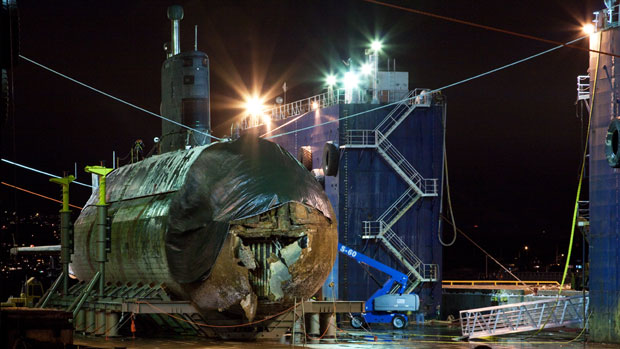
Last year, HMCS Corner Brook had what some wag at the Department of National Defence characterized as a “fender bender”:

Some fender. The CBC reported on the extent of the damage:

The Canadian navy admitted that the submarine crashed off British Columbia in June, but it never described the extent of damage or released a photograph.

“I was gobsmacked. I had no idea that this level of damage had occurred,” said Senator Colin Kenny, the former head of the Senate defence committee. “That may explain why the navy took it out of the water at night.”

[. . .]

Some familiar with the submarine say its pressure hull, the area in which the sailors are housed, may be heavily damaged and that would mean the sub will never go to sea again.

“Canada needs a submarine fleet, and to have this boat not be available would be tragic,” Kenny said

The RCN claimed that there was no cover-up and that they have been completely above-board and “transparent” about the incident. It’s an odd definition of “transparency” that requires you to submit a formal Access to Information request to get the report — and the photos of the damage to the hull were censored from the report anyway.

Back in 2004, it was reported that our submarines were without torpedo armament, but that they would be “fully armed” by 2006. The CBC report mentioned in passing that eight years later, they’re still lacking torpedoes:

The navy said HMCS Windsor is to undergo trials “in the coming months” and is also expected to be back in operation later in 2012.

Not one submarine is capable of firing a torpedo, however the navy said Tuesday that a test firing of a torpedo from HMCS Victoria is planned for the coming weeks and the submarine is supposed to be operational this year.

Back to John Ivison:

In all this time, the fleet has hardly been crucial to our defence. According to people familiar with its role, it has spent time at sea monitoring fishing fleets and acting as “prey” for U.S. forces, who don’t have diesel-electric subs of their own and like to use ours for hunting practice.

Peter MacKay, the Defence Minister, recently lamented the decision to buy the British diesel-electric subs, which are not capable of diving below ice in the Arctic. “In an ideal world, I know nuclear subs are what’s needed under deep water, deep ice,” he mused.

That we do not live in an ideal world was quickly made apparent by Government House Leader Peter Van Loan, who all but disowned the fleet in a response to a question in the House. “There is no plan to replace the diesel-electric fleet purchased by the Liberals,” he said.

But if there is no plan to replace the fleet, is there a plan to scrap it?

[. . .]

The Navy defines “full operational capability” as having a weapons-ready sub on each coast. It has yet to put one sub to sea that meets that standard, a decade after the first one was received.

The hope is that two boats will be fully operational within two years, with a “swing boat” available to take over when one goes for refit. That may prove wildly optimistic. Submarines may be a useful addition to our battery of defences — but only if they work. And not at any cost.

These subs have proven themselves to be lemons, they are already past mid-life and the odds are against us having even three boats with operational capacity at any one time.

February 14, 2012

Colombia looks to upgrade their submarine fleet

Filed under: Americas, Germany, Military — Tags: , , , — Nicholas @ 09:23

With relations in a parlous state between Colombia and Venezuela, Colombia is considering upgrading their navy:

Colombia is negotiating with Germany to buy up to six recently retired Type 206A coastal submarines. The 206As are meant to be an inexpensive counter to new Russian Kilo subs being purchased by neighboring Venezuela. Colombia still has two older (1,200 ton) Type 209 subs and nine miniature subs. All are over three decades old, and so are the Type 206As. But the 206As have been better cared for and were updated in the 1990s. Colombia already has sailors with lots of experience on German submarines and the Type 206s can be obtained cheap. Exactly how cheap is currently under negotiation.

[. . .] If there were a war with Venezuela (which has been acting very belligerent over the last few years), the Type 206s would be used to shut down Venezuelan ports and destroy oil facilities. Venezuela also has two 1970s era Type 209 subs, said to be in worse shape than their Colombian counterparts.


Bundesmarine Type 206A submarine U22 in December 2006

Wikipedia says of these submarines:

The Type 206 is a class of diesel-electric submarines (U-boats) developed by Howaldtswerke-Deutsche Werft (HDW). Its design is based on the preceding Type 205 submarine class. These small and agile submarines were built during the Cold War to operate in the shallow Baltic Sea and attack Warsaw Pact shipping if the war turned hot. The pressure hulls were built out of non-magnetic steel to counter the threat of magnetic naval mines and make detection with MAD sensors more difficult. The low emission profile allowed the submarines in exercises to intrude even into well protected opposing forces such as carrier formations with their screen.

[. . .]

A major mid-life modernisation was conducted on twelve of these submarines, the boats concerned now being officially designated Type 206A. The work started in mid-1987 and completed in February 1992, being carried out by Nordseewerke, Emden; this upgrade includes:

The STN Atlas DBQS-21D sonar has been fitted, together with new periscopes, and a new weapon control system (LEWA). The ESM system has been replaced and GPS navigation installed. The rebuilt submarines are armed with new torpedoes (Seeaal), and the propulsion system has been comprehensively refurbished, and improvements have been made to the accommodation.

« Newer PostsOlder Posts »

Powered by WordPress