Quotulatiousness

August 14, 2025

“Just war” theory and nuclear weapons practice

Filed under: History, Japan, Military, USA, Weapons, WW2 — Tags: , , , — Nicholas @ 03:00

On Substack, Nigel Biggar discusses the postwar argument about whether the use of nuclear weapons against Japan was justified or not:

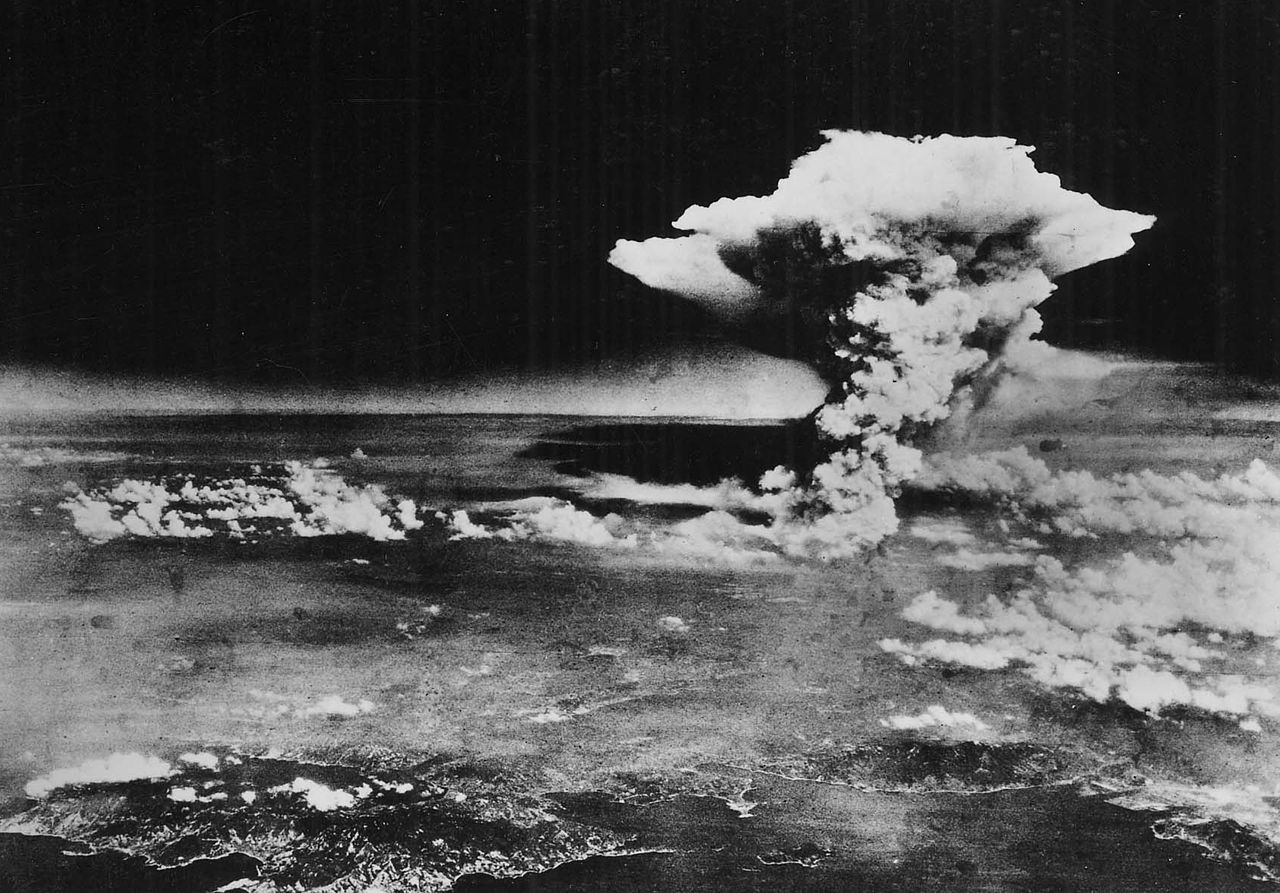
Atomic cloud over Hiroshima, taken from “Enola Gay” flying over Matsuyama, Shikoku, 6 August, 1945.
US Army Air Force photo via Wikimedia Commons.

For pacifists, Christian or otherwise, the answer is clear: since any deliberate killing is wrong, the dropping of atomic bombs on Hiroshima and Nagasaki on 6 and 9 August 1945 was wrong about two hundred thousand times over.

But that clear answer generates further questions whose answers aren’t so obvious. If killing is always wrong, then the United States should never have gone to war against Imperial Japan and therefore its ally, Hitler’s Germany. What, then, would have stopped the triumph of brutally racist Japanese imperialism in Asia and massively murderous Nazism in Europe? The noble witness of innocent non-violence?

Unfortunately, the historical evidence is that the kind of people who ran the slave-labour camps in Burma, and the likes of Dachau in Germany and Auschwitz in Poland, were not at all shamed by the face of vulnerable innocence; on the contrary, it excited their lust for domination and they fed upon it.

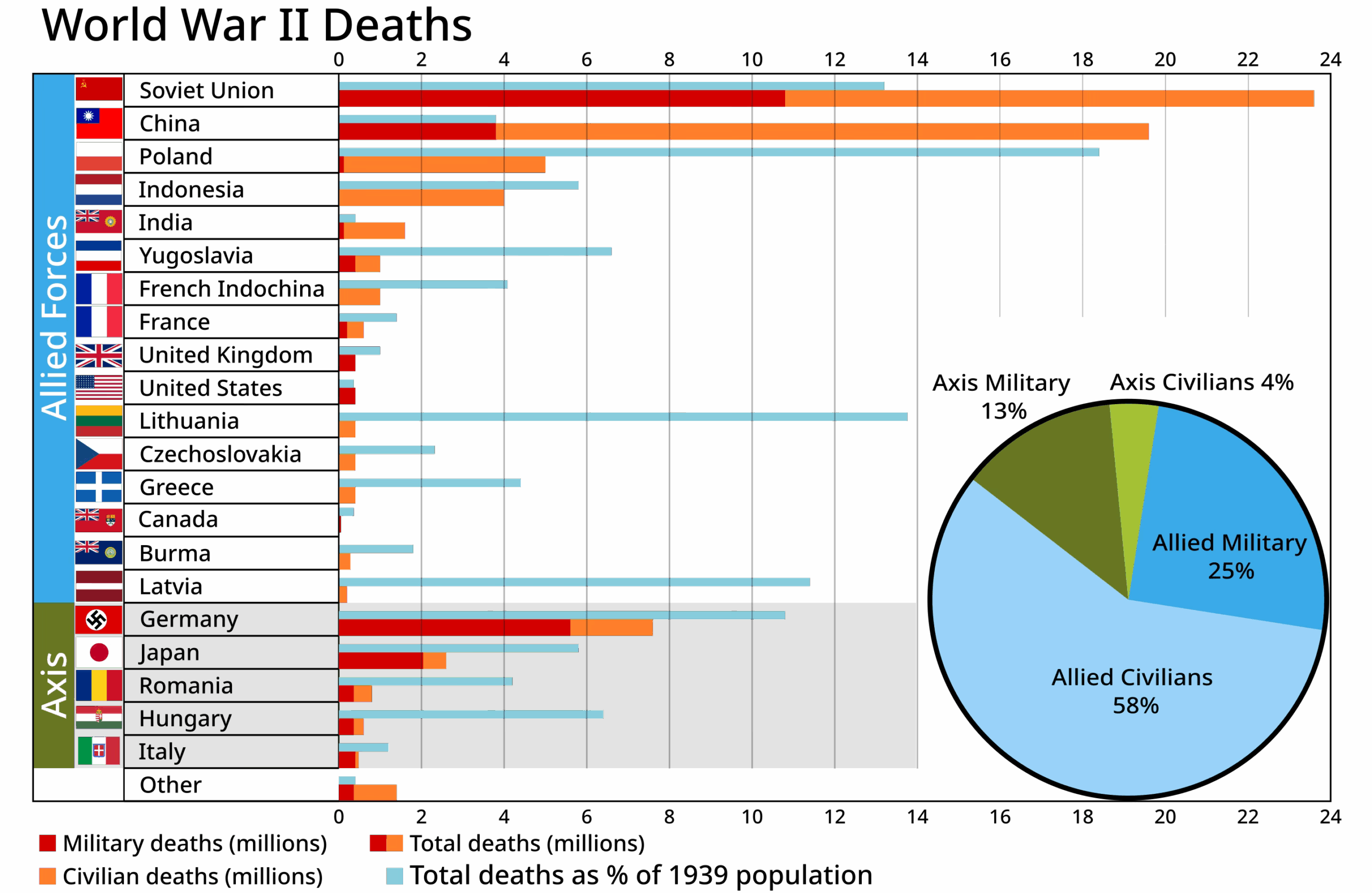
On the other hand, those who think that war can sometimes be justified, might judge that the mass killing of civilians by the atomic bombs was, simply by its massive extent, indiscriminate and therefore unjust. But there are two problems here. The first is that the vast majority of people, certainly in the UK and the USA, regard the war against Hitler and his allies as morally justified, notwithstanding the fact that that cost between 60 and 80 million deaths, well over half of them civilian.

Image credit – Wikipedia

And the second problem is that the ethical tradition of “just war” thinking doesn’t say that we may not kill civilians, even on a massive scale; it only says that we may not kill them intentionally. If a military objective can’t be achieved except by risking the possible or probable deaths of civilians, then it may still be attempted, provided that the objective is sufficiently important, militarily, and that all reasonable measures are taken to avoid or minimise the side-effect of civilian casualties. The reason for this permissiveness is that in most circumstances just war would be impossible to prosecute otherwise.

So, for the “just war” proponent, if the intention in dropping the atomic bombs on Japan was to destroy vital military or military-related targets, and if there was no more discriminate way of achieving that end, then the bombing was morally justified. It was deeply, deeply tragic—but nevertheless just.

May 11, 2025

The devastating toll of Trump’s reckless plan to dismiss transgendered members of the armed forces

Filed under: Government, Health, Media, Military, Politics, USA — Tags: , , , , , — Nicholas @ 05:00

Chris Bray called this to our attention back in November, as President-elect Donald Trump foolishly planned to purge the US military of transgendered troops, regardless of the vast impact it was predicted to have on military readiness:

We’ll practically have no military left! It would be like a whole infantry division suddenly just vanishing: 15,000-plus transgendered service members.

You’re going to see this number a lot in the weeks ahead. The New Republic, today: “Donald Trump’s plan to ban transgender people from the military would have a devastating effect: At least 15,000 members would be forced to leave.”

That number comes from a 2018 report by the now-defunct Palm Center, a pro-LGBT independent research institute in California, which reached this conclusion: “Transgender troops make up 0.7% (seven-tenths of one percent) of the military (Active Component and Selected Reserve)”. Their best guess about a total number: 14,707. The media is just rounding that number up to the next thousand.

And … Chris Bray follows up on his November post, documenting the huge, unimaginable scale of long-term damage to US military preparedness:

As the new Trump administration prepared to issue an order forbidding transgender people to serve in the armed forces, a bunch of profoundly stupid news stories issued panicked warnings that military readiness would DEVASTATED by a giant purge of at least 15,000 transgender servicemembers, the very core of our military strength. Warplanes grounded! Ships trapped in port as all their trans sailors were tossed out! Whole artillery batteries sitting silent! […]

The removal of trans servicemembers would inflict such a ghastly crisis on the armed forces that it would take twenty years to recover our military strength! Destruction and ruin and crisis and collapse!

[…]

Now the removal of transgender troops is actually underway, and guess what?

The number is “up to” 1,000. It’s in the hundreds.

So. When — quite recently! — dozens of panicked news stories reported as fact that 15,000-plus transgender servicemembers were about to be purged, the news was frankly and nakedly a complete invention. They made it up. They sold an invented panic. The “news” was entirely fake.

Remember that, and apply that lesson widely.

Will Amtrak survive the DOGE treatment?

Filed under: Economics, Government, Railways, USA — Tags: , , , — Nicholas @ 03:00

J.D. Wong outlines Amtrak’s never-ending financial difficulties:

“Amtrak” by Mike Knell is licensed under CC BY-SA 2.0 .

Founded 54 years ago, Amtrak set out on a bold adventure to see if passenger trains could be profitable. Fast forward to today, this experiment has been unsuccessful. Politicians have often crafted routes to win votes rather than attract riders. As a result, Amtrak has been squandering taxpayer money since its start in 1971.

Take, for instance, the Infrastructure Investment and Jobs Act of 2021. It allocated a monumental $66 billion to bolster passenger rail. Yet, even with this backing, Amtrak’s losses soared from $1.12 billion in FY2019 to $2.12 billion in FY2024. This financial drain isn’t new; America’s passenger trains have lost money for 79 years.

Amtrak asserts that it is “on-track to reach operational profitability”. Yet, this is a bald-faced lie. While Amtrak reported a loss of $705.2 million for FY2024, it didn’t include:

  1. $966.2 million in depreciation;
  2. $447.3 million in “Project Related Expenses”;
  3. $314.1 million in state subsidies, which it classified as “revenue”;
  4. $26.9 million in Office of Inspector General funding

By omitting these costs, Amtrak paints an optimistic view of its financial health. In reality, Amtrak needs larger subsidies than ever before. In fact, Amtrak has been deceiving Congress with its “path to profitability” since 1990.

Although Amtrak touted a “ridership record” for FY2024, this figure is misleading too. Ridership numbers don’t reflect the average length of each passenger’s trip. A more insightful metric is passenger-miles, which measures how far people are traveling. In fact, Amtrak only transported 6.54 billion passenger-miles in FY2024. This is a decrease of 3.40 percent since FY2013.

Amtrak often attributes its financial struggles to its long-haul routes. Yet, the outlook is even bleaker for its short-haul, state-supported routes. Amtrak reported a $251.5 million loss for these routes in FY2024. Yet, with $314.1 million in state subsidies included, the true loss hits $565.6 million. This represents a shocking 94 percent increase from the $291.7 million lost in FY2019.

Amtrak’s advocates often cite highway “subsidies” to explain its financial debacles. But Amtrak guzzles about 39 times more subsidies per passenger-mile than highways do.

Amtrak asserts that freight trains “interfere” with its passenger services. However, Amtrak often makes questionable route choices despite having legal priority over freight. Between Chicago and Los Angeles, the Desert Wind lost less money than the Southwest Chief. Despite this, Amtrak favored the Southwest Chief, which passed through more congressional districts. It discontinued the Desert Wind in 1997, leaving Las Vegas with no train service.

May 1, 2025

The economics of migration

Lorenzo Warby wonders if an entire discipline can commit suicide:

Can an academic discipline seriously decline? Yes. Disciplines which were once mainstays of universities have either vanished or shrunk to pale shadows of their former selves.

What about a social science? One can envisage a social science disappearing. The most obvious way is it gets utterly discredited and replaced. A less obvious way is its institutional bases could disappear. A final way is its entire social basis disappears.

The West is currently marked by two entirely different discourses on migration that seem unable to interact. One is migration-as-economic-boon. This is the outlook of mainstream Economics. Migrants add to the economic activity of societies and potentially retard the effect of an ageing population by replacing absent local children with foreign migrants. This discourse invokes the authority of Economic Theory and its statistical methods.

This outlook typically treats criticism of migration as economically illiterate, socially retrograde, or morally bankrupt; or some combination of thereof. It is protected by the Self-Righteous, Knowing scoff which is such a feature of the modern professional-managerial class. They are the Masters of Knowledge, and of Moral Concern, who the plebs should defer to.

The other discourse talks in terms of social and democratic decay, increased crime, threats of violence, increased fiscal stress, even the possibility of civil war.

This is the world where, in Sweden — due to the stress on social and fiscal order from migration — it has become policy to pay migrants to go away. This is the world where highly intelligent and informed folk quietly discuss how the performance of economists on migration has been so catastrophically bad, it may bring down the entire discipline.

The adherents of the second, problems-with-migration, discourse are well aware of what mainstream Economics has to say on migration, and judge it to be obviously and demonstrably — even catastrophically — false. That it is much harder for migrants to contribute positively to a society than mainstream Economics admits, and this gets worse the higher the rate of migration. A recent Dutch study (Jan van de Beek, Joop Hartog, Gerrit Kreffer, Hans Roodenburg, The Long-Term Fiscal Impact of Immigrants in the Netherlands, Differentiated by Motive, Source Region and Generation, IZA DP No. 17569, December 2024. https://docs.iza.org/dp17569) found that:

    Only 20% of all immigrants [to the Netherlands] make a positive lifetime net contribution to the public budget. Groups with large contributions come from Scandinavia, the Anglo-Saxon world and a few other countries like France and Japan.

The adherents of the first discourse seem either utterly unaware of the second discourse, or protected from even considering it by the Self-Righteous Knowing scoff. Their mastery of Theory is such, they cannot possibly be so catastrophically wrong.

The notion that migration could break a society along its existing fracture lines to the point of civil war would absolutely be treated with the Self-Righteous Knowing scoff, despite there being — as is discussed below — at least three historical examples of precisely that happening.

April 26, 2025

Lies, damned lies and government statistics

Filed under: Cancon, Economics, Food, Government, Media, Politics — Tags: , — Nicholas @ 03:00

Francisco at Small Dead Animals linked to this interesting examination of the difference between the official inflation rate and the actual inflation ordinary Canadians are coping with:

    Great news! We’ve brought inflation back under control and stuff is now only costing you 2.4 percent more than it did last year!

That’s more or less the message we’ve been hearing from governments over the past couple of years. And in fact, the official Statistics Canada consumer price index (CPI) numbers do show us that the “all-items” index in 2024 was only 2.4 percent higher than in 2023. Fantastic.

So why doesn’t it feel fantastic?

Well statistics are funny that way. When you’ve got lots of numbers, there are all kinds of ways to dress ‘em up before presenting them as an index (or chart). And there really is no one combination of adjustments and corrections that’s definitively “right”. So I’m sure Statistics Canada isn’t trying to misrepresent things.

But I’m also curious to test whether the CPI is truly representative of Canadians’ real financial experiences. My first attempt to create my own alternative “consumer price index”, involved Statistics Canada’s “Detailed household final consumption expenditure“. That table contains actual dollar figures for nation-wide spending on a wide range of consumer items. To represent the costs Canadian’s face when shopping for basics, I selected these nine categories:

  • Food and non-alcoholic beverages
  • Clothing and footwear
  • Housing, water, electricity, gas and other fuels
  • Major household appliances
  • Pharmaceutical products and other medical products (except cannabis)
  • Transport
  • Communications
  • University education
  • Property insurance

I then took the fourth quarter (Q4) numbers for each of those categories for all the years between 2013 and 2024 and divided them by the total population of the country for each year. That gave me an accurate picture of per capita spending on core cost-of-living items.

Overall, living and breathing through Q4 2013 would have cost the average Canadian $4,356.38 (or $17,425.52 for a full year). Spending for those same categories in Q4 2024, however, cost us $6,266.48 – a 43.85 percent increase.

By contrast, the official CPI over those years rose only 31.03 percent. That’s quite the difference. Here’s how the year-over-year changes in CPI inflation vs actual spending inflation compare:

As you can see, with the exception of 2020 (when COVID left us with nothing to buy), the official inflation number was consistently and significantly lower than actual spending. And, in the case of 2021, it was more than double.

Since 2013, the items with the largest price growth were university education (57.46 percent), major household appliances (52.67 percent), and housing, water, electricity, gas, and other fuels (50.79).

March 20, 2025

Everyday Life in the Roman Empire – Demography, Income, Life Expectancy

seangabb
Published 12 Sept 2024

Part seven in a series on Everyday Life in the Roman Empire, this lecture discusses demography and life chances during the Imperial period. Here is what it covers:

Introduction – 00:00:00
Our Statistical Civilisation – 00:00:24
Ancient “Statistics” – 00:08:05
How Many Roman Citizens? – 00:18:04
Population of the Empire – 00:21:36
City Populations – 00:27:45
Average Incomes – 00:36:27
Life Expectancy – 00:35:37
Country Life – 00:52:06
Population of Rome – 00:54:39
Feeding Rome – 00:57:40
Roman Water Supply – 01:00:44
Bathing and Sanitation – 01:04:16
Hygienic Value – 01:04:16
Bibliography – 01:06:17
(more…)

February 15, 2025

QotD: The absurdly high early expectations for genetic research

Filed under: Health, Media, Quotations, Science — Tags: , , , — Nicholas @ 01:00

For decades, people talked about “the gene for height”, “the gene for intelligence”, etc. Was the gene for intelligence on chromosome 6? Was it on the X chromosome? What happens if your baby doesn’t have the gene for intelligence? Can they still succeed?

Meanwhile, the responsible experts were saying traits might be determined by a two-digit number of genes. Human Genome Project leader Francis Collins estimated that there were “about twelve genes” for diabetes, and “all of them will be discovered in the next two years”. Quanta Magazine reminds us of a 1999 study which claimed that “perhaps more than fifteen genes” might contribute to autism. By the early 2000s, the American Psychological Association was a little more cautious, was saying intelligence might be linked to “dozens – if not hundreds” of genes.

The most recent estimate for how many genes are involved in complex traits like height or intelligence is approximately “all of them” – by the latest count, about twenty thousand. From this side of the veil, it all seems so obvious. It’s hard to remember back a mere twenty or thirty years ago, when people earnestly awaited “the gene for depression”. It’s hard to remember the studies powered to find genes that increased height by an inch or two. It’s hard to remember all the crappy p-hacked results that okay, we found the gene for extraversion, here it is! It’s hard to remember all the editorials in The Guardian about how since nobody had found the gene for IQ yet, genes don’t matter, science is fake, and Galileo was a witch.

And even remembering those times, they seem incomprehensible. Like, really? Only a few visionaries considered the hypothesis that the most complex and subtle of human traits might depend on more than one protein? Only the boldest revolutionaries dared to ask whether maybe cystic fibrosis was not the best model for the entirety of human experience?

Scott Alexander, “The Omnigenic Model As Metaphor For Life”, Slate Star Codex, 2018-09-13.

February 5, 2025

QotD: Economies and disasters

Filed under: Economics, Quotations — Tags: , , , , — Nicholas @ 01:00

Here’s a question: Are natural or manmade disasters good for the economy? Dr. Larry Summers, top economic adviser to President Obama, said about the Kobe, Japan, earthquake: “(The disaster) may lead to some temporary increments ironically to GDP as a process of rebuilding takes place. In the wake of the earlier Kobe earthquake Japan actually gained some economic strength.” After devastating Floridian hurricanes, it’s not uncommon to read newspaper headlines such as “Storms create lucrative times”, or “Economic growth from hurricanes could outweigh costs”, or “It’s a perverse thing … there’s real pain, but from an economic point of view, it is a plus”. Then there’s Nobel Laureate Paul Krugman who wrote in his New York Times column “After the Horror”, after the 9/11 attack, “Ghastly as it may seem to say this, the terror attack — like the original day of infamy, which brought an end to the Great Depression — could do some economic good”. He went on to explain that rebuilding the destruction would stimulate the economy through business investment and job creation.

One would never hear my colleagues in George Mason University’s economics department spouting such insanities. Just ask yourself whether the Japanese economy would have faced even greater opportunities for economic growth had the earthquake also struck Tokyo, Hiroshima, Yokohama and other major cities? Would the 9/11 terrorists have made a greater contribution to our economy had they also destroyed lives and buildings in Chicago, St. Louis, Los Angeles and Atlanta? The belief that a society benefits from destruction is sheer lunacy.

French economist Frederic Bastiat (1801-1850) explained it in his pamphlet “What is Seen and What is Not Seen”. He said, “There is only one difference between a bad economist and a good one: the bad economist confines himself to the visible effect; the good economist takes into account both the effect that can be seen and those effects that must be foreseen”. That’s why my George Mason University colleagues are good economists.

Walter E. Williams, “Economics Reality”, Townhall.com, 2020-02-04.

February 1, 2025

QotD: In a centrally planned economy, all that matters is meeting or exceeding the Gross Output Target

The mobbed-up oligarchs currently running Russia, for instance, were almost all members of an informal class whose name I forget, which translates as “brokers” or “wheeler-dealers” or something. They learned how best to manipulate the Soviet system of “gross output targets”. Back when he was funny, P.J. O’Rourke had a great bit about this in Eat the Rich, a book I still recommend.

When told to produce 10,000 shoes, the shoe factory manager made 10,000 baby shoes, all left feet, because that was easiest to do with the material on hand — he didn’t have to retool, or go through nearly as many procurement processes, and whatever was left over could be forwarded to the “broker”, who’d make deals with other factory managers for useful stuff. When Comrade Commissar came around and saw that the proles still didn’t have any shoes, he ordered the factory manager to make 10,000 pairs of shoes … so the factory manager cranked out 20,000 baby shoes, all left feet, tied them together, and boom. When Comrade Commissar switched it up and ordered him to make 10,000 pounds of shoes, the factory manager cranked out one enormous pair of concrete sneakers …

So long as Comrade Commissar doesn’t rat him out to the NKVD — and why would he? he’s been cut in for 10% — nobody will ever be the wiser, because on the spreadsheet, the factory manager not just hit, but wildly exceeded, the Gross Output Target. That nobody in Krasnoyarsk Prefecture actually has any shoes is irrelevant.

Severian, “The Finger is Not the Moon”, Rotten Chestnuts, 2021-09-14.

January 17, 2025

“… most of them can do simple low-IQ jobs like manual labor, basic retail, or writing for the New York Times

Filed under: Africa, Americas, Asia, Europe, Health — Tags: , , , — Nicholas @ 04:00

At Astral Codex Ten, Scott Alexander discusses the highly controversial national IQ estimates of Richard Lynn … I’m sure I don’t need to spell out exactly why they were (and continue to be) controversial:

Lynn’s national IQ estimates (source)

Richard Lynn was a scientist who infamously tried to estimate the average IQ of every country. Typical of his results is this paper, which ranged from 60 (Malawi) to 108 (Singapore).

People obviously objected to this, and Lynn spent his life embroiled in controversy, with activists constantly trying to get him canceled/fired and his papers retracted/condemned. His opponents pointed out both his personal racist opinions/activities and his somewhat opportunistic methodology. Nobody does high-quality IQ tests on the entire population of Malawi; to get his numbers, Lynn would often find some IQ-ish test given to some unrepresentative sample of some group related to Malawians and try his best to extrapolate from there. How well this worked remains hotly debated; the latest volley is Aporia‘s Are Richard Lynn’s National IQ Estimates Flawed? (they say no).

I’ve followed the technical/methodological debate for a while, but I think the strongest emotions here come from two deeper worries people have about the data:

First, isn’t it horribly racist to say that people in sub-Saharan African countries have IQs that would qualify as an intellectual disability anywhere else?

Second, isn’t it preposterous and against common sense to compare sub-Saharan Africans to the intellectually disabled? You can talk to a Malawian person, and talk to a person with Down’s Syndrome, and the former is obviously much brighter and more functional than the latter. Doesn’t that mean that the estimates have to be wrong?

But both of these have simple answers, which IMHO defuse the worrying nature of Lynn’s results. These answers aren’t original to me, but as far as I know, nobody has put them together in one place before. Going over each in turn:

1: Isn’t It Super-Racist To Say That People In Sub-Saharan African Countries Have IQs Equivalent To Intellectually Disabled People?

No. In fact, it would be super-racist not to say this! We shouldn’t conflate advocacy with science. But if we did, Lynn’s position would make better anti-racist advocacy than his detractors’.

The “racist” position is that all IQ differences between groups are genetic. The “anti-racist” position is that they’re a product of environment — things like nutrition, health care, and education.

We know that in the US, where we do give people good IQ tests, whites average IQ 100 and blacks average IQ 85.

If IQ was 100% genetic, we should expect Africans to have an IQ of 85, since American and African blacks have similar genes. This isn’t exactly right — US blacks have some intermixing with whites, and only some of Africa’s staggering diversity reached the US — but it’s close enough.

December 1, 2024

QotD: Recording and codifying the land that William conquered

Filed under: Britain, Bureaucracy, China, Government, History, Quotations — Tags: , , , , , — Nicholas @ 01:00

I hesitate to recommend academic books to anyone, but I’ll make an exception for James C. Scott’s Seeing Like a State. Subtitled “how certain schemes to improve the human condition have failed”, it’s the best long-form exposition I know of, that explains how process and outcome first deform, then negate each other.

[…]

In brief, Scott argues that the process of making a society “legible” to government officials obscures social reality, to the point where the government’s maps and charts and graphs take on a life of their own. It’s recursive, such that those well-intentioned schemes end up first measuring, then manipulating, the wrong thing in the wrong way, to the point that the social “problem” the process was supposed to address drops out entirely — all you have, at the end, is powerpoint girls critiquing spreadsheet boys because their spreadsheets don’t have enough animation, and vice versa.

Scott doesn’t use the Domesday Book as an example (IIRC from a graduate school class 20-odd years ago, anyway), but it’s one we’re probably all familiar with. The first thing William the Conqueror needed to know is: what, exactly, have I conquered? So he sent out the high-medieval version of spreadsheet boys to take a comprehensive survey of the kingdom. Turns out the Duke of Earl’s demense runs from this creek to that rock. He has five underlings, and their domains run from etc.

The point of all this, of course, was so that Billy C. could call the Duke of Earl on the carpet, point to the spreadsheet, and say “You owe me a cow, three chickens, and two months in the saddle as back taxes.” It worked great, except when — as, it seems, is inevitable — the high-medieval equivalent of the spreadsheet boys did the high-medieval version of “ctrl-c”; just copying and pasting the information over. Eventually the tax situation got way out of whack, as it did for most every pre-modern government running a similar system — one of the reasons declining Chinese dynasties had such fiscal problems, for instance, is that the tax surveys only got updated every two centuries or so, such that a major provincial lord was still only paying 20 silver pieces in taxes, when he should’ve been paying 20,000 (and his peasants were all paying 20 when all they could afford was 2).

In other words: unless the spreadsheet boys periodically go out and check that the numbers on their spreadsheets actually correspond in some systematic, more-or-less representative way to some underlying social reality, government policy is being set by make-believe.

Severian, “The Finger is Not the Moon”, Rotten Chestnuts, 2021-09-14.

November 27, 2024

Trump’s plan to dismiss transgender troops will apparently “gut” the US military

Filed under: Government, Health, Military, Politics, USA — Tags: , , , , — Nicholas @ 05:00

As if the US military services hadn’t suffered enough from their own government, it’s now being widely asserted in the media that Trump’s declared plan to get rid of all current transgender service members will be a desperately hard blow to an already over-stressed military structure:

The news media is calmly warning that Donald Trump is planning to ban transgender servicemembers from the American military, which will absolutely gut the armed forces.

Sample claim, from Newsweek, quoting the leader of an LGBT advocacy nonprofit:

    Abruptly discharging 15,000-plus service members, especially given that the military’s recruiting targets fell short by 41,000 recruits last year, adds administrative burdens to war fighting units.

    There would be a significant financial cost, as well as a loss of experience and leadership that will take possibly 20 years and billions of dollars to replace.

We’ll practically have no military left! It would be like a whole infantry division suddenly just vanishing: 15,000-plus transgendered service members.

You’re going to see this number a lot in the weeks ahead. The New Republic, today: “Donald Trump’s plan to ban transgender people from the military would have a devastating effect: At least 15,000 members would be forced to leave.”

That number comes from a 2018 report by the now-defunct Palm Center, a pro-LGBT independent research institute in California, which reached this conclusion: “Transgender troops make up 0.7% (seven-tenths of one percent) of the military (Active Component and Selected Reserve)”. Their best guess about a total number: 14,707. The media is just rounding that number up to the next thousand.

The Palm Center … extrapolated a lot, let’s say, in good part by multiplying their guess about a percentage, derived from a grossly inadequate survey of a select number of active duty troops, times the total number of servicemembers. Page 4:

    Assuming that the distribution of transgender men and women is roughly equivalent in the Active and Selected Reserve Components, it is possible to derive an estimate of the number of transgender troops in the Selected Reserve as follows. The number of transgender women is .0066 x 652,623 = 4,307 and the number of transgender men is .0091 x 156,080 = 1,420. The total number of transgender members of the Selected Reserve is 4,307 + 1,420 = 5,727. And, the total number of transgender troops is 8,980 (active) + 5,727 (reserve) = 14,707.

Assuming the distribution, it is possible to derive an estimate. That’s the basis of the 15,000 number that you’ll see in news stories. Remember that language.

Similarly, a 2016 RAND study offered these findings (among others), and note the remarkable thing that happens between the first and second paragraph:

    It is difficult to estimate the number of transgender personnel in the military due to current policies and a lack of empirical data. Applying a range of prevalence estimates, combining data from multiple surveys, and adjusting for the male/female distribution in the military provided a midrange estimate of around 2,450 transgender personnel in the active component (out of a total number of approximately 1.3 million active-component service members) and 1,510 in the Selected Reserve.

    Only a subset will seek gender transition–related treatment. Estimates derived from survey data and private health insurance claims data indicate that, each year, between 29 and 129 service members in the active component will seek transition-related care that could disrupt their ability to deploy.

So studies indicate that there are 3,960 transgendered servicemembers, and also that there are 14,707 transgendered servicemembers, and “between 29 and 129 service members in the active component” who will actively seek gender transition services in a typical year.

So it’s definitely somewhere between 29 and 15,000.

November 10, 2024

WW2 in Numbers

World War Two
Published 9 Nov 2024

World War II wasn’t just the deadliest conflict in history — it was a war of unprecedented scale. From staggering casualty numbers to military production and economic costs, this episode breaks down the biggest statistics that defined the global conflict.
(more…)

November 2, 2024

QotD: UBI discourages low-income workers

Filed under: Business, Economics, Quotations — Tags: , , , — Nicholas @ 01:00

Not only does it have a high cost, UBI drains the labour force by discouraging work and boosting leisure time, says one big-picture study

Earlier this month, a cross-border team of North American economists published the results of a landmark study, probably the best and most careful yet done, of how low-income workers respond to an unconditional guaranteed income. Not so long ago this would have been a plus-sized news item in narcissistic Canada, for the lead author of the study is a rising economics star at the University of Toronto, Eva Vivalt. The economists, working through non-profit groups, recruited 3,000 people below a certain income cutoff in the suburbs of Dallas and Chicago. A thousand of these, chosen at random, were given a thousand dollars a month for three years. The rest were assigned to a control group that got just $50 a month, plus small extra amounts to encourage them to stay with the study and fill in questionnaires.

That randomization is an important source of credibility, and the study has several other impressive methodological bona fides. If you have an envelope to scribble on the back of, you can see that the payments alone were beyond the wildest dreams of most social science: most of the money was provided by the AI billionaire Sam Altman. But the study also had help from state governments, who agreed to forgo welfare clawbacks from the participants to make sure the observed effects weren’t obscured by local circumstances. Participant households were also screened carefully to make sure nobody in them was already receiving disability insurance. (Free money doesn’t discourage work among people who can’t work — or who absolutely won’t.) And the study combined questionnaire data with both smartphone tracking and state administrative records, yielding an unusually strong ability to answer difficult behavioural questions.

The big picture shows that the free cash — a “universal basic income” (UBI) for a small group of individuals — discouraged paying work, even though everybody in the study was starting out poor. Labour market participation among the recipients fell by two percentage points, even though the study period was limited to three years, and the earned incomes of those getting the cheques declined by $1,500 a year on average. There is no indication that the cash recipients used their augmented bargaining power to find better jobs, and no indication of “significant effects on investments in human capital”, i.e., training and education. The largest change in time use in the experiment group was — wait for it! — “time spent on leisure”.

Colby Cosh, “Universal basic income is a recipe for fiscal suicide (for so many reasons)”, National Post, 2024-07-30.

October 7, 2024

The demographic impact of modern cities

Filed under: Education, Health, History — Tags: , , , , , , — Nicholas @ 03:00

Lorenzo Warby touches on some of the social and demographic issues that David Friedman discussed the other day:

US Birth Rates from 1909-2008. The number of births per thousand people in the United States. The red segment is known as the Baby Boomer period. The drop in 1970 is due to excluding births to non-residents.
Graph by Saiarcot895 via Wikimedia Commons

Cities are demographic sinks. That is, cities have higher death rates than fertility rates.

For much of human history, cities have been unhealthy places to live. This is no longer true: cities have higher average life expectancies than rural areas. But they are still demographic sinks, for cities collapse fertility rates.

The problem is not that more women have no children, or only one child, making it to adulthood. Such women have always existed, though their share of the population has gone up across recent decades.

The key problem is the collapse in the demographic “tail” of large families. Cities are profoundly antipathetic to large families, and have always been so. This is particularly true of apartment cities — suburbs are somewhat more amenable to large families, though not enough to make up for the urbanisation effect.

While modern cities do not have slaves and household servants who were blocked from reproducing as ancient cities did, various aspects of modern technology have fertility-suppressing effects. Cars that presume a maximum of three children, for instance. An effect that is worsened by compulsory baby car-seats. Or ticketing and accommodation that presumes two children or less. There is also the deep problems of modern online dating. Plus the effects that endocrine disrupters and falling testosterone may be having.

These effects also extend to rural populations: falling fertility in rural populations is far more of a mystery than falling fertility in urban populations. How much declining metabolic health plays in all this is unclear. Indeed, futurist Samo Burja is correct, we do not really understand the “social technology” of human breeding.

Be that as it may, cities as demographic sinks is a continuation of patterns that go back to the first cities.

Matters at the margin

There are factors at the margin known to make a difference. Religious folk breed more than secular folk, though that is in part because rural people are more religious and city folk more secular.

Educating women reduces fertility. This is, in part, an urbanisation effect, as more education is available in cities. It is also an opportunity cost effect — there is more to do in cities, both paid and unpaid.

Education increases the general opportunity cost of motherhood, by expanding women’s opportunities. This also makes moving to cities more attractive. Women having more career opportunities reduces the relative attractiveness of men as marriage partners, reducing the marriage rate.

Strong cultural barriers against children outside marriage can reduce the fertility rate, by largely restricting motherhood to married women. This makes the fertility rate more dependant on the marriage rate.

Educating women makes children more expensive, as educated mothers have educated children. Part of the patterns that economist Gary Becker analysed.

« Newer PostsOlder Posts »

Powered by WordPress