
Published on 20 Jun 2017
The Red Army suffered heavy losses during Operation Barbarossa, but it also inflicted heavy losses on the Wehrmacht. This means it was not just some helpless giant, but it also begs the questions, why were the losses so high? This video discusses several factors and refers heavily to current academic research namely from Alexander Hill and David Stahel.
Military History Visualized provides a series of short narrative and visual presentations like documentaries based on academic literature or sometimes primary sources. Videos are intended as introduction to military history, but also contain a lot of details for history buffs. Since the aim is to keep the episodes short and comprehensive some details are often cut.
September 10, 2017
Barbarossa: Why such high Soviet Losses? – Explained
Comments Off on Barbarossa: Why such high Soviet Losses? – Explained
September 6, 2017
QotD: Suicidalism
The most important weapons of al-Qaeda and the rest of the Islamist terror network are the suicide bomber and the suicide thinker. The suicide bomber is typically a Muslim fanatic whose mission it is to spread terror; the suicide thinker is typically a Western academic or journalist or politician whose mission it is to destroy the West’s will to resist not just terrorism but any ideological challenge at all.
But al-Qaeda didn’t create the ugly streak of nihilism and self-loathing that afflicts too many Western intellectuals. Nor, I believe, is it a natural development. It was brought to us by Department V of the KGB, which was charged during the Cold War with conducting memetic warfare that would destroy the will of the West’s intelligentsia to resist a Communist takeover. This they did with such magnificent effect that the infection outlasted the Soviet Union itself and remains a pervasive disease of contemporary Western intellectual life.
Consider the following propositions:
- There is no truth, only competing agendas.
- All Western (and especially American) claims to moral superiority over Communism/Fascism/Islam are vitiated by the West’s history of racism and colonialism.
- There are no objective standards by which we may judge one culture to be better than another. Anyone who claims that there are such standards is an evil oppressor.
- The prosperity of the West is built on ruthless exploitation of the Third World; therefore Westerners actually deserve to be impoverished and miserable.
- Crime is the fault of society, not the individual criminal.
- Poor criminals are entitled to what they take. Submitting to criminal predation is more virtuous than resisting it.
- The poor are victims. Criminals are victims. And only victims are virtuous. Therefore only the poor and criminals are virtuous. (Rich people can borrow some virtue by identifying with poor people and criminals.)
- For a virtuous person, violence and war are never justified. It is always better to be a victim than to fight, or even to defend oneself.
- But “oppressed” people are allowed to use violence anyway; they are merely reflecting the evil of their oppressors.
- When confronted with terror, the only moral course for a Westerner is to apologize for past sins, understand the terrorist’s point of view, and make concessions.
These ideas travel under many labels: postmodernism, nihilism, multiculturalism, Third-World-ism, pacifism, “political correctness” to name just a few. It is time to recognize them for what they are, and call them by their right name: suicidalism.
Eric S. Raymond, “Suicidalism”, Armed and Dangerous, 2005-09-13.
Comments Off on QotD: Suicidalism
August 28, 2017
QotD: Gramscian damage
Americans have never really understood ideological warfare. Our gut-level assumption is that everybody in the world really wants the same comfortable material success we have. We use “extremist” as a negative epithet. Even the few fanatics and revolutionary idealists we have, whatever their political flavor, expect everybody else to behave like a bourgeois.
We don’t expect ideas to matter — or, when they do, we expect them to matter only because people have been flipped into a vulnerable mode by repression or poverty. Thus all our divagation about the “root causes” of Islamic terrorism, as if the terrorists’ very clear and very ideological account of their own theory and motivations is somehow not to be believed.
By contrast, ideological and memetic warfare has been a favored tactic for all of America’s three great adversaries of the last hundred years — Nazis, Communists, and Islamists. All three put substantial effort into cultivating American proxies to influence U.S. domestic policy and foreign policy in favorable directions. Yes, the Nazis did this, through organizations like the “German-American Bund” that was outlawed when World War II went hot. Today, the Islamists are having some success at manipulating our politics through fairly transparent front organizations like the Council on American-Islamic Relations.
But it was the Soviet Union, in its day, that was the master of this game. They made dezinformatsiya (disinformation) a central weapon of their war against “the main adversary”, the U.S. They conducted memetic subversion against the U.S. on many levels at a scale that is only now becoming clear as historians burrow through their archives and ex-KGB officers sell their memoirs.
The Soviets had an entire “active measures” department devoted to churning out anti-American dezinformatsiya. A classic example is the rumor that AIDS was the result of research aimed at building a ‘race bomb’ that would selectively kill black people.
On a different level, in the 1930s members of CPUSA (the Communist Party of the USA) got instructions from Moscow to promote non-representational art so that the US’s public spaces would become arid and ugly.
Americans hearing that last one tend to laugh. But the Soviets, following the lead of Marxist theoreticians like Antonio Gramsci, took very seriously the idea that by blighting the U.S.’s intellectual and esthetic life, they could sap Americans’ will to resist Communist ideology and an eventual Communist takeover. The explicit goal was to erode the confidence of America’s ruling class and create an ideological vacuum to be filled by Marxism-Leninism.
Eric S. Raymond, “Gramscian damage”, Armed and Dangerous, 2006-02-11.
Comments Off on QotD: Gramscian damage
August 27, 2017
July 28, 2017
QotD: Soviet agitprop still echoes today
Stalinist agitprop created Western suicidalism by successfully building on the Christian idea that self-sacrifice (and even self-loathing) are the primary indicators of virtue. In this way of thinking, when we surrender our well-being to others we store up grace in Heaven that is far more important than the momentary discomfort of submitting to criminals, predatory governments, and terrorists.
The Communist atheists of Department V understood that Christian self-abnegation tends to inculcate a cult of self-sacrifice even among Westerners who are themselves agnostics or atheists. All the propagandists had to do was make the case that the value of self-abnegation applies to culture as well as individuals. By doing so, they were able to entrench the idea that suicidalists are morally superior to non-suicidalists.
They did this so successfully that at least one major form of Western self-abnegation seems to have developed as a secondary phenomenon: “deep environmentalism”. I can’t find any sign that this traces back to the usual Stalinist suspects, but it is rather obviously a result of generalizing suicidalism not just to culture but to species.
I think it’s important to understand that, although suicidalism builds on some pre-existing pathologies of Western culture, it is not a native or natural development. It is an infection that evildoers and their dupes created and then spread as part of a war against the West; their goal was totalitarian control, and part of their method was to talk the West into slitting its own throat.
Eric S. Raymond, “Suicidalism”, Armed and Dangerous, 2005-09-13.
Comments Off on QotD: Soviet agitprop still echoes today
July 11, 2017
RPG-7: How it Works and a Demo Shot
Published on 11 Oct 2015
The RPG-7 is pretty far from being a forgotten weapon, but I was not going to pass up an opportunity to take a closer look at a live one. This example is one of the few live and registered RPGs in the US, and it belongs to Movie Gun Services (if you saw Black Hawk Down, you saw it in use…).
The RPG is a rocket-propelled shaped charge antitank weapon that took its philosophical foundation from the German WWII Panzerfaust (although it shares little with that weapon mechanically). Over the course of WWII, the armor on tanks quickly because too heavy for man-portable anti-tank rifles to defeat. The solution to this dilemma was the development of shaped charge warheads, in which directed explosive energy could be used much more efficiently than simple high explosive or even simpler kinetic energy.
After several earlier developmental iterations, the RPG-7 was introduced in 1961 by the Soviet Union and would prove to be an extremely effective, inexpensive and simple weapon. Today they are found in virtually all third world conflict zones. A variety of rocket types have made them much more than a dedicated anti-tank weapon, and they will be found used against everything from personnel to aircraft.
Comments Off on RPG-7: How it Works and a Demo Shot
July 10, 2017
A Canadian Cold War innovation – “floppy” magnets as submarine detection tools
Steve Weintz on an experimental Canadian submarine detection device that was simple, effective, and too difficult to train with:
Desperate planners sought ways of making Soviet subs easier to hunt. Any technology that could speed up an undersea search was worth considering. “A submarine’s best defense is of course stealth, remaining quiet and undetected in the ocean deep,” Ballantyne notes. “Something that could rob the Soviets of that cloak of silence must have seemed irresistible and, at least initially, a stroke of genius.”
A Canadian scientist figured some kind of sticky undersea noisemaker would make a Soviet sub more detectable. He designed a simple hinged cluster of magnets that could attach to a submarine’s metal hull.
Movement would cause the flopping magnets to bang against the hull like a loose screen door, giving away the sub’s location to anyone listening. The simple devices would take time and effort to remove, thus also impairing the Soviet undersea fleet’s readiness.
At least that was the idea.
HMS Auriga against the New York City skyline in 1963. U.S. Navy photo.
In late 1962, the British Admiralty dispatched the A-class diesel submarine HMS Auriga to Nova Scotia for joint anti-submarine training with the Canadian navy. The British were helping Canada establish a submarine force, so Royal Navy subs routinely exercised with Canadian vessels.
Auriga had just returned to the submarine base at Faslane, Scotland after a combat patrol as part of the Cuban Missile Crisis. Other subs of the joint Canadian-British Submarine Squadron Six at Halifax had seen action during the crisis.
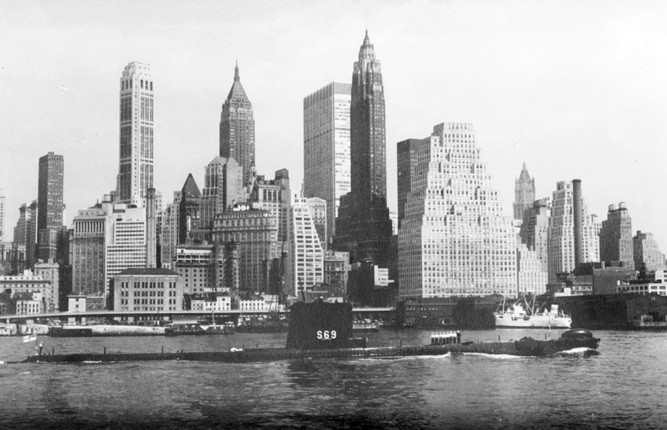
Did the device work? All too well:
As Auriga surfaced at the end of the exercise, the magnets made their way into holes and slots in the sub’s outer hull designed to let water flow. “They basically slid down the hull,” Ballantyne says of the magnets, “and remained firmly fixed inside the casing, on top of the ballast tanks, in various nooks and crannies.”
The floppy-magnets couldn’t be removed at sea. In fact, they couldn’t be removed at all until the submarine dry-docked back in Halifax weeks later.
In the meantime, one of Her Majesty’s submarines was about as stealthy as a mariachi band. No fighting, no training, no nothing until all those floppy little magnets were dug out of her skin at a cost of time, money and frustration.
The magnets worked on the Soviets with the same maddening results. The crews of several Foxtrots were driven bonkers by the noise and returned to port rather than complete their cruises.
Comments Off on A Canadian Cold War innovation – “floppy” magnets as submarine detection tools
June 9, 2017
QotD: The post-war world and (relative) peace
Between 1945 and about 1965, atom bombs and then hydrogen bombs were devised and demonstrated by the two biggest Great Powers, and then manufactured and attached to rockets in sufficient numbers to cause any all-out war between these two superpowers very probably to be a catastrophic defeat for both, to say nothing of being a similar catastrophe for all other humans, within a few hours. This new kind of destructive power also spread to a small club of lesser Great Powers.
This did not happen overnight. It didn’t all come about in 1945. But it happened pretty quickly, historically in the blink of an eye. It changed the world from a place in which Great Wars between Great Powers had to be prepared for, at all costs, to a place in which Great Wars between Great Powers had to be avoided, again, at all costs. That is a very big change.
I do not assert that all wars have ended. Clearly they have not, as one glance through a newspaper or news website will tell you. Small powers still have small wars, and Great Powers regularly join in, in small ways. Sometimes, Great Powers start small wars, like the one in the Ukraine now. But even these small wars have been getting less numerous and smaller in recent decades. Small wars can get big, so even small wars are now discouraged by Great Powers.
Nor do I assert that all preparations for war by Great Powers have ceased, or that they should. But more than ever, the purpose of such preparations is to enable mere confrontations to be emerged from victoriously or failing that satisfactorily, rather than for such preparations — such weapons — constantly to be “used”, in the sense of being fired, fought with, and so on. The purpose of weapons is to scare, as well as to win fights, and they are being “used” whenever anyone is scared by them. Great Powers will still spend lots of money on weaponry.
But what has not happened, for many decades now, and what still shows no sign of happening despite all kinds of diplomatic, ideological and financial turbulence, is an all-out fire-every-weapon-we-have war involving two or more Great — by which I of course mean nuclear — Powers. In this sense, countries like mine, and almost certainly yours too given that you are reading this, have become peaceful in a way that they have never experienced before in all of human history before 1945.
Brian Micklethwait, “From the Great Peace … to the ordeal of Adam Lyth at the Oval cricket ground”, Samizdata, 2015-08-20.
Comments Off on QotD: The post-war world and (relative) peace
June 5, 2017
What is Maskirovka? Russian Military Deception #Military 101
Published on 5 May 2017
A short introduction into Russian Military Deception – called Maskirovka. “Maskirovka is most simply defined as a set of processes designed to mislead, confuse, and interfere with accurate data collection regarding all areas of Soviet plans, objectives, and strengths or weaknesses.” (Smith, Charles L.: Soviet Maskirovka, in: Airpower Journal – Spring 1988)
Military History Visualized provides a series of short narrative and visual presentations like documentaries based on academic literature or sometimes primary sources. Videos are intended as introduction to military history, but also contain a lot of details for history buffs. Since the aim is to keep the episodes short and comprehensive some details are often cut.
» SOURCES «
Maier, Morgan: A Little Masquerade: Russia’s Evolving Employment of Maskirovka
http://cgsc.contentdm.oclc.org/cdm/singleitem/collection/p4013coll3/id/3507/rec/1Smith, Charles L.: Soviet Maskirovko, in: Airpower Journal – Spring 1988
http://www.airpower.maxwell.af.mil/airchronicles/apj/apj88/spr88/smith.htmlLindley-French, Julian: NATO: Countering Strategic Maskirovka. Canadian Defence & Foreign Affairs Institute. (2015)
Glantz: The Red Mask: The Nature and Legacy of Soviet Military Deception in the Second World War
https://en.wikipedia.org/wiki/Russian_military_deception
Keating, Kenneth: The Soviet System of Camouflage
http://www.dtic.mil/dtic/tr/fulltext/u2/a112903.pdfKrueger, Daniel: Maskirovka – What’s in it for us?
http://www.dtic.mil/dtic/tr/fulltext/u2/a190836.pdf
April 13, 2017
QotD: Soviet statistics
Being a correspondent in Moscow, I found, was, in itself, easy enough. The Soviet press was the only source of news; nothing happened or was said until it was reported in the newspapers. So all I had to do was go through the papers, pick out any item that might be interesting to readers of the Guardian, dish it up in a suitable form, get it passed by the censor at the Press Department, and hand it in at the telegraph office for dispatch. One might, if in a conscientious mood, embellish the item a little … sow in a little local colour, blow it up a little, or render it down a little according to the exigencies of the new situation. The original item itself was almost certainly untrue or grotesquely distorted. One’s own deviations, therefore, seemed to matter little, only amounting to further falsifying what was already false.
This bizarre fantasy was very costly and elaborate and earnestly promoted. Something gets published in Pravda; say, that the Soviet Union has a bumper wheat harvest – so many poods per hectare. There is no means of checking; the Press Department men don’t know, and anyone who does is far, far removed from the attentions of foreign journalists. Soviet statistics have always been almost entirely fanciful, though not the less seriously regarded fro that. When the Germans occupied Kiev in the 1939-45 war they got hold of a master Five Year Plan, showing what had really been produced and where. Needless to say, it was quite different from the published figures. This in no way affected credulity about such figures subsequently, as put out in Russia, or even in China.
Malcolm Muggeridge, Chronicles of Wasted Time, 2006.
Comments Off on QotD: Soviet statistics
March 27, 2017
2017 – the year of the Great Dissatisfaction
Kevin Williamson says that “our world is full of wonders, but not everyone finds a place in it”:
Once, the question the ambitious and dissatisfied asked themselves was: “How do I climb that ladder?” Current tastes run more toward smashing the ladder and the hierarchies for which it stands in the name of … whatever: feminism or anti-feminism, black liberation or white nationalism, global justice or national sovereignty.
We spend our days surrounded by great miracles and minor irritations. My friend Jay Nordlinger recently recounted how Joseph Stalin allowed the film The Grapes of Wrath to be shown in the Soviet Union, believing that to see an indictment of capitalism from within the beast itself would be salutary for the proletariat. The proletariat took another lesson from the film: The Joads, apparently the poorest people in America, had a Ford, a luxury no working man in the workers’ paradise could dream of. A similar story is told about the television series Dallas: The Soviets thought their subjects would recoil from the mischief of J. R. Ewing and his Texas oil cronies, but all the poor Russians could see was that American servants lived better than Soviet doctors and professors. If we could share our daily tales of woe with our great-grandparents — e.g., my complaints about the Wi-Fi on airplanes — they would not take from that the conclusion we intended.
We do not have a problem of privation in the United States. Not really. What we have is something related to what Arthur Brooks (“the most interesting man in Washington,” Tim Alberta calls him) describes as the need for earned success. We are not happy with mere material abundance. We — and not to go all Iron John on you, but I think “we” here applies especially to men — need to feel that we have earned our keep, that we have established a place for ourselves in the world by our labor or by other virtues, especially such masculine virtues as physical courage and endurance. I suspect that is a big part of the reason for the exaggeratedly reverential, practically sacramental attitude we current express toward soldiers, police officers, and firemen. Of course they are brave and deserve our gratitude, but if we had felt the need to ceremonially thank everyone for their service in 1948, we’d never have done anything else with our time. In 2017, there are many more jobs for courtiers than for soldiers, and the virtues earning the highest return are not bravery or toughness but conversational cleverness, skill in social navigation, excellence in bureaucracy, and keenness in finance.
[…]
And there is the paradox within our paradox: The world is wondrous and beautiful and exciting and rich, and many of us have trouble finding our place in it, in part, because it is wondrous and beautiful and exciting and rich, so much so that we have lost touch with certain older realities. One of those realities is that children need fathers. Another is that fathers need children.
But these are what my colleague David French calls the “wounds that public policy will not heal.” Our churches are full of people who would love to talk to you about healing, but many have lost interest in that sort of thing, too. And so they turn to Trump, to Le Pen, to Chavismo (which is what Bernie Sanders is peddling), and, perhaps, to opiate-induced oblivion. Where will they turn when they figure out — and they will figure it out — that there are no answers in these, either?
And what will we offer them?
Comments Off on 2017 – the year of the Great Dissatisfaction
March 26, 2017
QotD: Muggeridge on queues in the Soviet Union
We used to run a little contest among ourselves to see who could produce the most striking example of credulity among this fine flower of our western intelligentsia. Persuading church dignitaries to feel at home in an anti-God museum was too easy to count. So was taking lawyers into the people´s courts. I got an honourable mention by persuading Lord Marley that the queueing at food shops was permitted by the authorities because it provided a means of inducing the workers to take a rest when otherwise their zeal for completing the five-year plan in record time was such that they would keep at it all the time, but no marks for floating a story that Soviet citizens were being asked to send in human hair – any sort – for making of felt boots. It seemed that this had actually happened.
Malcolm Muggeridge, Chronicles of Wasted Time, 2006.
Comments Off on QotD: Muggeridge on queues in the Soviet Union
December 3, 2016
Capitalists and communists
David Warren notes an odd similarity:
The last generation of Communists in power, in the Soviet Union and elsewhere, suffered from a debilitating foible. They did not themselves believe in the ideology they were preaching. Their efforts were thus directed to getting around the realities their forebears had not anticipated. They thus became their own enemies, working against their own unworkable socialist principles, and in the course of their tireless if frazzled ministrations, the Berlin Wall came down.
Capitalism suffers from the same problem today. The principles of Adam Smith are not seriously believed by any of its nominal advocates. They are not even known. Nor could they be, for like Marx, Smith is not even read. I have derived pleasure, on many occasions, from pointing out to some ideological enthusiast for Capitalism, that its supposed author was refulgently opposed to joint-stock companies. Which is to say, to the form of business ownership that controls — oh, I don’t know — ninety-five percent of the so-called “private sector” economy today?
I observed that, apart from any consideration of morality (and he was, after all, only an amateur economist, but a professional Perfesser of Moral Philosophy), Smith believed that joint-stock companies were inefficient, because essentially bureaucratic. This is inevitable when ownership is separated from management. “Growth,” or Bigness, subtly replaces profit (both mercenary and non-mercenary) as the principal aspiration.
As a general rule of thumb, when you want to get something done, use the smallest possible organization to achieve your desired goal. I always found it a warning sign of future decline when small companies I worked for started to take on the trappings of bigger companies … when the bureaucratic rot began to set in. In some cases, just the transition to having an “HR Department” (rather than managers hiring directly) was enough to trigger bureaucracy growth and efficiency losses.
Comments Off on Capitalists and communists
November 29, 2016
The Godfather of Modern Espionage – Sidney Reilly I WHO DID WHAT IN WW1?
Published on 28 Nov 2016
Sidney Reilly is remembered as the Ace of Spies in popular fiction and Ian Flemming read his files as inspiration for James Bond. But even the best espionage novels are nothing against the life of the real Sidney Reilly who did it all. He worked as a double agent, turned the tide of wars and changed world history more than once.
Comments Off on The Godfather of Modern Espionage – Sidney Reilly I WHO DID WHAT IN WW1?
November 11, 2016
QotD: The amazing long-term success of Soviet subversion in the West
The Soviets consciously followed the Gramscian prescription; they pursued a war of position, subverting the “leading elements” of society through their agents of influence. (See, for example, Stephen Koch’s Double Lives: Stalin, Willi Munzenberg and the Seduction of the Intellectuals; summary by Koch here) This worked exactly as expected; their memes seeped into Western popular culture and are repeated endlessly in (for example) the products of Hollywood.
Indeed, the index of Soviet success is that most of us no longer think of these memes as Communist propaganda. It takes a significant amount of digging and rethinking and remembering, even for a lifelong anti-Communist like myself, to realize that there was a time (within the lifetime of my parents) when all of these ideas would have seemed alien, absurd, and repulsive to most people — at best, the beliefs of a nutty left-wing fringe, and at worst instruments of deliberate subversion intended to destroy the American way of life.
Koch shows us that the worst-case scenario was, as it turns out now, the correct one; these ideas, like the “race bomb” rumor, really were instruments deliberately designed to destroy the American way of life. Another index of their success is that most members of the bicoastal elite can no longer speak of “the American way of life” without deprecation, irony, or an automatic and half-conscious genuflection towards the altar of political correctness. In this and other ways, the corrosive effects of Stalin’s meme war have come to utterly pervade our culture.
The most paranoid and xenophobic conservatives of the Cold War were, painful though this is to admit, the closest to the truth in estimating the magnitude and subtlety of Soviet subversion. Liberal anticommunists (like myself in the 1970s) thought we were being judicious and fair-minded when we dismissed half of the Right’s complaint as crude blather. We were wrong; the Rosenbergs and Alger Hiss really were guilty, the Hollywood Ten really were Stalinist tools, and all of Joseph McCarthy’s rants about “Communists in the State Department” were essentially true. The Venona transcripts and other new material leave no room for reasonable doubt on this score.
While the espionage apparatus of the Soviet Union didn’t outlast it, their memetic weapons did. These memes are now coming near to crippling our culture’s response to Islamic terrorism.
Eric S. Raymond, “Gramscian damage”, Armed and Dangerous, 2006-02-11.
Comments Off on QotD: The amazing long-term success of Soviet subversion in the West


