Quotulatiousness

March 27, 2023

QotD: Homo electronicus and the problem of instant communications

Filed under: Media, Politics, Quotations, USA — Tags: , , , , , — Nicholas @ 01:00

There are lots of problems with instant communications, and they really need a whole post (or series, or book) to themselves, but one is particularly relevant here. As discussed above, it’s not the technology itself, it’s the application. The internet, like TV, is one of those gadgets that are almost impossible not to use. If it’s there, you’re going to log on – it takes serious, frustrating effort not to. Try it!

One obvious consequence of this is that it turns the whole world into a giant hen party. Karen has always been with us, probably with equal prevalence. But as late as the mid-1990s, she’d have to confine her scolding to PTA meetings and places like that. But now everyone has the Internet, and social media’s a thing, and it’s just sitting there, compelling you to use it. Woman’s natural role as the guardian of the tribe’s mores becomes Karen-ism on crack.

Severian, “Recent Evolution”, Rotten Chestnuts, 2020-09-28.

March 14, 2023

Social media, selfies, and depression

Filed under: Health, Technology, USA — Tags: , , , , , , — Nicholas @ 04:00

In The Free Press, Jonathan Haidt notes the inflection point at which young liberal women started to become depressed at a much higher rate than the rest of the population — a trend that has continued for over a decade:

In September 2020, Zach Goldberg, who was then a graduate student at Georgia State University, discovered something interesting in a dataset made public by Pew Research. Pew surveyed about 12,000 people in March 2020, during the first month of the COVID shutdowns. The survey included this item: “Has a doctor or other healthcare provider EVER told you that you have a mental health condition?” Goldberg graphed the percentage of respondents who said “yes” to that item as a function of their self-placement on the liberal-conservative 5-point scale and found that white liberals were much more likely to say yes than white moderates and conservatives. (His analyses for non-white groups generally found small or inconsistent relationships with politics.)

I wrote to Goldberg and asked him to redo it for men and women separately, and for young vs. old separately. He did, and he found that the relationship to politics was much stronger for young (white) women. You can see Goldberg’s graph here, but I find it hard to interpret a three-way interaction using bar charts, so I downloaded the Pew dataset and created line graphs, which make it easier to interpret.

Here’s the same data, showing three main effects: gender (women higher), age (youngest groups higher), and politics (liberals higher). The graphs also show three two-way interactions (young women higher, liberal women higher, young liberals higher). And there’s an important three-way interaction: it is the young liberal women who are highest. They are so high that a majority of them said yes, they had been told that they have a mental health condition.

Data from Pew Research, American Trends Panel Wave 64. The survey was fielded March 19–24, 2020.
Graphed by Jon Haidt.

In recent weeks — since the publication of the CDC’s report on the high and rising rates of depression and anxiety among teens — there has been a lot of attention to a different study that shows the gender-by-politics interaction — Gimbrone, Bates, Prins & Keyes (2022), titled: “The politics of depression: Diverging trends in internalizing symptoms among US adolescents by political beliefs”. Gimbrone et al. examined trends in the Monitoring the Future dataset, which is the only major U.S. survey of adolescents that asks high school students (seniors) to self-identify as liberal or conservative (using a 5-point scale). The survey asks four items about mood/depression. Gimbrone et al. found that prior to 2012 there were no sex differences and only a small difference between liberals and conservatives. But beginning in 2012, the liberal girls began to rise, and they rose the most. The other three groups followed suit, although none rose as much, in absolute terms, as did the liberal girls (who rose .73 points since 2010, on a 5-point scale where the standard deviation is .89).

Data from Monitoring the Future, graphed by Gimbrone et al. (2022). The scale runs from 1 (minimum) to 5 (maximum).

The authors of the study try to explain the fact that liberals rise first and most in terms of the terrible things that conservatives were doing during Obama’s second term, e.g.,

    Liberal adolescents may have therefore experienced alienation within a growing conservative political climate such that their mental health suffered in comparison to that of their conservative peers whose hegemonic views were flourishing.

The progressive New York Times columnist Michelle Goldberg took up the question and wrote a superb essay making the argument that teen mental health is not and must not become a partisan issue. She dismissed Gimbrone et al.’s explanation as having a poor fit with their own data:

    Barack Obama was re-elected in 2012. In 2013, the Supreme Court extended gay marriage rights. It was hard to draw a direct link between that period’s political events and teenage depression, which in 2012 started an increase that has continued, unabated, until today.

After examining the evidence, including the fact that the same trends happened at the same time in Britain, Canada, and Australia, Goldberg concluded that “Technology, not politics, was what changed in all these countries around 2012. That was the year that Facebook bought Instagram and the word ‘selfie’ entered the popular lexicon.”

QotD: Facebook’s entire structure is designed to prevent information “going viral”

Filed under: Business, Media, Quotations, USA — Tags: , , , — Nicholas @ 01:00

Imagine that you came up with something amazing to share with people. Let’s pretend that you created the most amusing video in the world. Or came up with the funniest joke anyone has ever heard. Or maybe you have just experienced something remarkable that millions of people would want to know about. Or let’s assume you took a photograph that would blow people’s minds. Or perhaps you have just composed the catchiest tune ever.

You might think that social media is where to go to share this very cool thing, and watch it go viral. And, in fact, that happens on Twitter and a few other platforms. I’m not always right in forecasting which things I post will go viral, but a few times every year I will share something on Twitter that grabs people’s attention so much that it gets tens of thousands of retweets and likes. Millions of people might see it.

That’s what going viral is all about.

Now here’s the kicker. I put up that same item on my Facebook author’s page, and the company will actively work to prevent people from seeing it. And adding insult (a company specialty), they will send me an alert telling me: This post could go viral if you pay us money for promoting it.

At first glance, this just seems another way to maximize profits. And who can blame Mark Zuckerberg for wanting to get a few more dollars in his bank account? Let’s feel some pity for a guy who just lost $100 billion.

But the real devastating part of this story is that Facebook is actually preventing users from sharing the funniest joke in the world. Facebook actually hates seeing some videos go viral, even if they are the most amusing things on the web. Every day they work to prevent folks from seeing a mind-blowing photo — and many other things that can’t be monetized.

This can’t be good for the user experience. This can’t be what users want, or what they would tell the company in a focus group or via market research.

And it certainly can’t be good for business.

So I’m amused when I hear how Facebook is envious of TikTok, which has much superior user engagement. Well, duh. Of course TikTok has greater engagement — that’s because Facebook has put systems in place to prevent entertaining things from going viral. They are now scrambling to work around this tiny detail, but they won’t succeed.

I’ve reduced my Facebook posts by at least 70%, and this was the main reason. I can’t be the only person who has responded in this way.

It’s not in the company’s DNA to promote interesting things on its platform. That’s why I wasn’t surprised when Facebook’s recent attempt to imitate Substack collapsed in total failure. I knew that would happen on day one — because Facebook will never let writers go viral on the platform. Mr. Z. wants to get paid before anything goes viral, and that’s the exact opposite of Substack’s successful formula — which rewards the creator more than the platform.

When Facebook initially launched this touted publishing platform, somebody asked me what I thought about it. “Facebook has the power to give a writer access to millions of readers,” I replied, “but they will never let it happen. The entire internal structure of the company is designed to prevent this.”

The speed of the collapse, however, was surprising. Facebook announced the launch of Bulletin on June 29, 2021. Facebook announced the termination of Bulletin on October 4, 2022.

Even King Henry VIII’s wives lasted longer than that.

Ted Gioia, “How Web Platforms Collapse”, The Honest Broker, 2022-12-05.

March 9, 2023

Want to feel more depressed? Spend more time with your smartphone

Filed under: Health, Media, Technology, USA — Tags: , , , , , — Nicholas @ 03:00

Freddie deBoer is convinced that much of the reason for widespread depression among teenagers can be traced directly to their obsessive devotion to the online world through their smartphones:

Are smartphones to blame for the mental health crisis among teens? The debate has picked up steam lately, in part because of the steady accumulation of evidence that they are indeed, at least partially. (As you know, I’m a believer.) Jonathan Haidt has done considerable work marshaling this evidence. But there’s an attendant question of how phones make kids miserable, if indeed they do. In this post I offer some plausible answers. This is mostly just speculation and I don’t know if the proffered explanations can be tested empirically.

I want to start by establishing a sort of meta-layer on which a lot of these problems rest. We might be inclined to say that these problems are inherently problems of the internet/online life/digital culture, rather than smartphones as such; you can be hurt by what I’m going to describe from a laptop as well as from a smartphone. And I think that’s right, except for one key difference: ubiquity. No matter how portable and light it is, you’re not reflexively checking your laptop on the subway platform or in the bathroom. The iPhone took all of the various pathologies of the internet, made it possible for them to be experienced repetitively and at zero cost morning and night, and dramatically scaled up the financial incentives for companies to exploit those pathologies for gain. You can certainly have an unhealthy relationship with the internet when it’s confined to your desktop. But phones make relentless conditioning and reflexive engagement a mass phenomenon.

The other overriding factor here is the fact that adolescents are still developing mentally, and thus are likely more susceptible to these problems.

Constant exposure to unachievable conditions. Back in my youth, you might watch an MTV show about how rich people lived, or leaf through a magazine like US Weekly, and be exposed to opulence and material excess. Or you might go on vacation and see how the other half lives if you took a tour of the Hollywood hills or whatever. You were perfectly well aware that rich people and their privileged lives existed. But then you turned off the show or you put down the magazine or your vacation ended, and unless you were born rich, you lived in an environment that of necessity was modest and real. Your friends might have lived in nice houses, but you didn’t see riches everywhere you looked, and your definition of what a hot girl looked like was mostly derived from the girls you went to school with. Your environment conditioned the scope of your desires.

Now, exposure to lifestyles that are completely unachievable is constant. Instagram is a machine for making you feel like whatever you’ve got isn’t enough. (That’s how it functions financially, through advertising idealized lives.) There are young people out there who have arranged their various feeds such that they’re always a few seconds away from seeing concerts they can’t attend, cars they can’t drive, houses they can’t live in, clothes they can’t wear, women they can’t fuck or whose bodies they can’t have, places they can’t travel to, food they can’t eat, and lives they can’t live. When I was young, if I wanted to see a picture of a Ferrari, I had to seek out a picture of a Ferrari. It was hard to see suggestive photos of intimidatingly hot women, which is why the Sports Illustrated swimsuit edition was a big deal. Mostly, the world around you was quotidian and its pleasures attainable. What can it be doing to these generations of young people, having completely unrealistic visions of what life is like being shoved into their brains all the time? How could their actual lives ever compare?

(Incidentally, I am thoroughly convinced that a majority of self-described incels are men who could find meaningful and fulfilling sexual and romantic success, both short-term and long, but who have developed such a wildly unrealistic idea about what actual human women look like that their standards are laughably high. And it’s easy to make fun of that, but I also think that the conditioning inherent to constantly looking at filtered and photoshopped pictures is powerful.)

March 6, 2023

How the powers-that-be got drunk on (practically unlimited) power with the pandemic lockdowns

Brendan O’Neill on the revelations from the release of British government officials’ informal chats on WhatsApp as the initial lockdowns were imposed:

“Covid 19 Masks” by baldeaglebluff is licensed under CC BY-SA 2.0

They were laughing at us. They didn’t only lock us down. They didn’t only suspend virtually every one of our civil liberties, including a right none of us ever expected to lose: the right to leave our own homes. They didn’t only spy on us with drones, and encourage us to snitch on that neighbour going for a sneaky second jog, and fine teenagers life-ruining sums of money for holding house parties. They also chuckled about it. It was funny to them. In one of the most startling WhatsApp chats revealed in the Daily Telegraph‘s Lockdown Files, a senior civil servant says the following about Brits returning from trips abroad who were forced to quarantine in a stuffy hotel room for 10 days: “Hilarious“.

It was Simon Case, the UK’s top mandarin. In February 2021 he had a breezy virtual chat with Matt Hancock, the then health secretary. A policy had just been introduced stipulating that any Briton returning from a “red list” country – which eventually included 50 states around the world, including India and vast swathes of Africa – would have to quarantine in a hotel at a cost of £1,750 per person, later rising to £2,285. A total of 200,000 British citizens and residents endured this painful, expensive quarantine. To Hancock and his civil-service pals it was all a big laugh. “I just want to see some of the faces of people coming out of first class and into a premier inn shoe box”, chortled Mr Case. He later asked Hancock: “Any idea how many people we locked up in hotels yesterday?” Locked up in hotels. Hancock replied that 149 people “are now in Quarantine Hotels due to their own free will!”. “Hilarious”, said Case.

Hilarious? Tell that to the people whose lives were ruined by this policy. The idea that it was just reckless rich folk jetting off to exotic destinations that were on the “red list” is ridiculous, as academic Aleksandra Jolkina has explained. Consider the NHS worker who travelled to Ethiopia to visit his dying uncle and look after his sick mother. While he was there Ethiopia was added to the “red list”, meaning he could not return to the UK; he couldn’t afford to. Or the Briton who travelled to Pakistan to visit his terminally ill father. He was forced to raid the family savings to pay the return quarantine fee. As a result, his “family’s ability to survive financially” was put “at risk”. Or think about the many Brits who did not go abroad, to one of those supposedly toxic countries, because they didn’t have the funds for that stay in a “premier inn shoe box”. People who, as Jolkina describes it, could not “visit their ill relatives or wish them a final farewell”. Hilarious, right?

The sinister cruelty of lockdown is laid bare in this grotesque vision of officials laughing over a policy that caused so much heartache and hardship among often low-earning Brits whose only crime is that their families live overseas. You couldn’t have asked for a better snapshot of the feudalistic authoritarianism that underpinned the ideology of lockdown. Civil servants working from their plush homes having a giggle about a policy that inflicted severe financial pain on the diverse working classes. A health secretary breaking his own guidelines to snog his mistress while sending snide WhatsApp messages about a policy that prevented poorer citizens from kissing the cheek of a dying relative. For me, this is the most important thing about the Lockdown Files – their revelation of just how morally cavalier and even inhuman the political elites can become when they are drunk on power, when they are liberated from democratic accountability to pursue whatever extreme policies they like.

The Telegraph‘s Lockdown Files are based on more than 100,000 WhatsApp messages sent and received by Matt Hancock in the pandemic years. Hancock gave the messages to Isabel Oakeshott when she was co-writing his book, Pandemic Diaries, and now Ms Oakeshott has given them to the Telegraph. They provide only a partial insight into the machinations of lockdown, of course. Hancock is not the centre of the universe, whatever he might think to the contrary. And he says some of the messages are being taken out of context. Perhaps. Nonetheless, the Lockdown Files represent our first serious reckoning with lockdown, our first glimpse at what was happening behind the scenes of this unprecedented exercise in social control. And it’s not a pretty picture.

March 5, 2023

“Natural Woman” – classic hit song or hate crime in progress?

Filed under: Media, Politics, USA — Tags: , , , , , , — Nicholas @ 03:00

Janice Fiamengo on the hoax “cancellation” attempt on the late Aretha Franklin’s hit song:

For at least a few hours, it looked as if the 1960s soul classic “(You Make Me Feel Like a) Natural Woman“, memorably performed by Aretha Franklin, was imperiled by woke attack. Various conservative and right-wing media reported in late January that a trans awareness group was demanding via Twitter that the song be canceled because of its exclusionary emphasis on “natural” womanhood. It was dutifully noted that this was the latest salvo in the trans “assault on women”, and a women’s activist was reported as saying, “I don’t think many women really know how much we’re hated”.

It turned out that the complaint about “Natural Woman”, which received well over one million views and provoked thousands of responses, had been made by a parody account. Aretha Franklin was safe — at least for now. But commentary on the song has a surprising history, as we’ll see, that complicates the standard claims about the trans erasure of women.

The Twitter account at the center of the faux controversy was TCMA, the Trans Cultural Mindfulness Alliance, which began tweeting in January of 2023 to highlight the lunatic fringe of trans advocacy. Many of the tweets by TCMA exaggerate actual trans activist positions so adroitly that even on a second or third reading, they seem plausible. On January 20, for example, TCMA tweeted that “Many children learn gender from their pets”, and advised parents that “Just because you bring home a ‘gendered’ pet, allow your child to choose the gender of the pet — don’t assign it one ‘at will’.”

A day later, TCMA tweeted that it would be petitioning the Norwegian government “to no longer include gender on birth certificates” and it condemned media, in another tweet, for emphasizing child abuse by same-sex couples while failing to cover the “wonton abuse” (steamed or deep fried?!) in the church.

The purpose of the account seems fairly clear: to show how dogmatic statements by activists are often hard to tell apart from parodies of the same. Something strange is going on when people in positions of cultural power not infrequently express themselves in a manner indistinguishable from parody.

March 3, 2023

Progressives have steadily transitioned to the movement that denies that any personal conduct rules should apply

Filed under: Law, Liberty, Media, Politics, USA — Tags: , , , , , — Nicholas @ 05:00

Freddie deBoer challenges his fellow leftists to identify who were the theorists that introduced the notion that personal responsibility is an anti-socialist position:

The woman whose account appears at the top of this picture started a Twitter storm, somehow, by publicly wishing that she could take her child onto the subway without exposing them to secondhand smoke. She was beset by a certain online species of ostensible leftist who is against ever trying to enforce any kind of rule, anywhere, ever. See, rules are the hand of oppression, or something, and since most of society’s rules are meant to be enforced by the police, trying to enforce them (merely wishing that they be enforced) is an endorsement of the police and their violence …

I find this attitude has become inescapable. It’s not just the attitude that the enforcement of societal rules and norms is bad, but that this is the default assumption of all right-thinking people — it’s not just a left-wing perspective but the left-wing perspective. Like so much else in contemporary left-of-center discourse, it demonstrates the total ideological poverty we’re working with. Nobody has read anything, so nobody knows anything, so you’re constantly getting yelled at by self-described radicals who have no solid footing in any systematic approach to left politics at all. Like I said before, we’re living in definitional collapse; the struggle right now is not merely that socialism can’t win but that so many self-described socialists have no deeper ideological moorings than whatever they’ve absorbed from Tumblr and “breadtube”. They think that to be a socialist means to disdain all rules because there is no substance to their socialism at all.

Chris Hayes considered the subway smoking problem last year.

Conceptually, I don’t think these problems are hard at all: the left, the socialist left, has never advocated for a system in which there are literally no expectations on personal behavior. It’s quite bizarre to suggest that this was ever a thing! Only certain extreme forms of anarchism have ever implied that society should have no rules. Go back through the history of socialist theorists and number all of the ones who believed that there should be no laws and no police to enforce them. You won’t find many! Instead you’ll find people who believed in the need for both laws that govern human behavior and constabulary forces to enforce those laws. That’s the solution to the conundrum, my friends — you have rules and you have police that enforce those rules. The belief, and the hope, is that a socialist society is one with far less need for aggressive policing, thanks to far greater economic equality, and maybe someday, after the end of material need, we can consider a policeless society. But not having any social rules or people who enforce those rules is not a socialist concept and never has been. What I would ask Chris Hayes and people like him is … what is the leftist tradition that you’re drawing from that implies that there should be no enforcement of behavioral norms? What thinker? What book? What philosophy? Or, could it be that you’ve developed this totally substance-free approach to basic order because you’ve been habituated to talking this way through exposure to people on social media who know nothing about anything in particular?

Of course, there’s big problems with American policing. Very big problems indeed. So what we do is reform policing. (I address this at length in my next book, coming this fall from Simon & Schuster.) Alternatively, if you’re really committed to this “no rules, no enforcement” thing, you become an anarchist of a very particular stripe — most versions of anarchism have both rules and enforcement mechanisms for them — and you and your compatriots can try to change the system. All twelve of you. In the house your wealthy parents bought for you.

March 1, 2023

Our modern age of “squishy totalitarianism”

Filed under: Media, Politics, USA — Tags: , , , , , — Nicholas @ 05:00

Chris Bray on the odd controlling habits of our “great and good”, our “moral and intellectual superiors” to urge us to follow their directives “for our own good” (or else):

The anarchist philosopher Crispin Sartwell describes our political culture as one of “squishy totalitarianism”, a term I like quite a bit. (See the third page of this document.) You can disagree and refuse to comply, and the secret police won’t show up at your door (with maybe a growing list of exceptions). We don’t have a gulag. We don’t have the “culture of the disappeared“. You just … maybe find yourself with fewer friends, and some family that stops talking to you, and maybe your employer lets you know that hey, you know what, this doesn’t seem to be working out.

It’s not the Great Terror, it’s just a kind of low-grade grind of social decredentialing that lets you know you’re not making the right choices. We need to rethink Thanksgiving this year, because we’re very disappointed in you. (Don’t you want to be safe?) The way Google searches are working these days is a pretty good example of squishy totalitarianism: Oh, I’m sorry, we have no results for that widely known piece of wrongthink, but here are some results that debunk the conspiracy theory you’re searching for. Wouldn’t you prefer to read a correct search result?

[…]

We can debate the origins and the motive force behind the constant parade of error that has plagued us over the last three years: useless mask mandates, aggressively harmful school closures, insanely damaging vaccine mandates, ludicrous closures of beaches and parks, the pearl clutching over all those conspiracy theories about a lab leak.

You know the terms of the debate: Is the world led by idiots who are screwing it all up, or is this a plan that they’re executing on purpose?

But whichever answer turns out to be correct, one thing that seems extremely clear to me is that this perpetual reign of error couldn’t possibly go on without the unthinking enforcement activity of a distributed commissariat, the slogan-repeating upper-middle-class-aligned cultural apparatus that endlessly lawn signs their compliance. No one has to tell journalists to scold Woody Harrelson: they already know. The moment the Woodster engaged in crimethink, the Rolling Stone writer Marlow Stern started salivating like a trained dog hearing a bell. Vast armies of professors and HR specialists and marketing executives and bureaucrats and Hollywood functionaries and school board wokescolds and on and on and on already know their roles without being assigned to them. It is not correct for you to fail to comply with Current Thing; you are spewing conspiracy theories.

    Doctor, the symptoms began shortly after I received the second dose of the Covid vaccine.

    No, that is not possible, vaccines do not cause injuries. Let us not discuss this conspiracy theory any further. Here are some pills.

We have an enforcement apparatus made up of people who volunteered for the job. In terms of social class, we have the lower class, the lower-middle-class, the middle class, the Stasi, and the upper class.

February 22, 2023

“Billions use it, including me, but it feels like the dying Rust Belt city of the internet. Facebook makes me feel the way I feel when I’m in a hospital.”

Filed under: Media — Tags: , , , — Nicholas @ 05:00

I got locked out of my Facebook account quite some time ago and I haven’t bothered trying to jump through the tech support hoops to get back in … and from what Freddie deBoer says, I’m not missing anything at all:

The video, shot on a cellphone from a first-person view, takes place in a bathroom. Embedded at the bottom are the words “what every teenager hides from their parents”. The person holding the phone takes a golf ball and briefly runs it under water from the sink. They then rub the golf ball against a roll of toilet paper, leaving a light impression of moisture. And that’s it; the video ends and starts over again, an infinite empty loop. If you’re wondering what exactly it is that “every teenager hides from their parents”, the answer is nothing. The video is nonsensical, not in some avant garde way but to fulfill its economic purpose. Leaving the viewer confused as to what exactly is being conveyed is a feature, not a bug — the more people are baffled by the video, the more they’ll comment on it to register their confusion, the more times they’ll send it to friends to try and figure out that which cannot be figured out. It is “content”, to use that wretched term, that is devoid of content, a human centipede of virality, monetizing fleeting interest. It’s the inevitable outcome of every bad incentive we’ve created online.

For reasons that are known only to God, for a couple weeks I reflexively watched Facebook Reels videos. It’s something like the bottom of the barrel for internet video, attached to a notoriously uncool social network that has devolved for almost everyone into a never-ending stream of spam, memes, viral bilge, and people that you don’t remotely know. Facebook still boasts a vast user base, but the level of engagement of those users is disputed and the network has become famously unattractive to the youth. Billions use it, including me, but it feels like the dying Rust Belt city of the internet. Facebook makes me feel the way I feel when I’m in a hospital.

The Reels service does do what these platforms are supposed to do in the most basic sense, though — provide brief videos for momentary distraction. I mostly watch shark videos, so it gives me a lot of shark videos. And, in the way of these things, it also serves me videos of crocodiles and orcas, as well as a discouraging amount of ordinary fishing videos. These are of less interest to me than the shark videos, but this is the nature of automated recommendations online. There’s also a lot of unfunny comedy videos, some boring video game clips, videos of animals fighting that sadden me, and of course a lot of hot girl videos, given that this is the internet. There are also many videos that satisfy a particular genre’s conventions, but only just. For example, there’s a mini-genre of big hits from football games (typically captioned “want to see a dead body?”), except that many of the Reels feature perfectly ordinary tackles that no one could mistake for a big hit. But all of these videos attempt, at least, to offer some coherent value proposition, so they aren’t the kinds of videos I’m talking about.

No, the videos I’m talking about here are those that drive people to click and, crucially, to linger through the video until it finishes through confusion and unsatisfied expectations. I’m not talking about bad videos or stupid videos or poorly made videos or videos that I generally find unworthy of being watched; low-quality online content is just the nature of the beast. I’m talking about videos in which the purpose is to drive “engagement” through a given clip’s lack of sense and meaning and nothing else. They’ve taken the monetization of attention to a certain logical endpoint: their creators understand that there are few things people like less than the feeling of being confused, and that most of us will seek help to understand something we can’t figure out on our own. Seeking that help by sharing or commenting gooses the algorithm.

About a decade ago I used to post to a message board a lot, a typical meme and argument repository. A very common prank was to post this one picture of a lizard and say “when you see it!” And tons of people who were in the know would post stuff like “took me forever, but WOW when I found it!” Meanwhile newcomers would be driving themselves absolutely crazy looking for something that wasn’t there, sometimes even confidently announcing that they had found the answer without saying what it was. It was a very effective prank, no matter how many times it was pulled, because we hate, hate, hate “not getting it”. Now some evil geniuses out there have begun to exploit this feeling in pursuit of virality and money. Versions of these tactics have been around forever, but these videos are an immaculately pure form. It’s true, for example, that the “curiosity gap” headline is quite old now. But while curiosity gap headlines at places like Upworthy could be manipulative and misleading, there were actual articles attached to the headlines. These videos are only the headlines, the enticement to click with nothing on the other side.

February 18, 2023

QotD: The rise of the “demisexuals”

Filed under: Health, Media, Quotations, Technology — Tags: , , , , , , — Nicholas @ 01:00

For those not in the know, demisexuality refers to the state of not experiencing sexual attraction or desire without a strong emotional bond. The term originated on a role-playing forum back in the early Noughties, where a teenage girl assigned it to one of her fictional characters. But after it migrated onto Tumblr in 2011, it was adopted in earnest by extremely young and terminally online users who collected identity markers like they were baseball cards. Outside Tumblr, the reaction was largely sceptical; as many a snarky commenter pointed out in the moment, the whole idea of demisexuality also described the normal sexual experience of, if not everyone, then an awful lot of people, most of whom never felt the need or desire to append a label to their sexual preferences. The delighted self-discovery of the teen who wrote the aforementioned letter was only slightly tempered by this concern: “[Some] people are saying it’s people trying to be ‘special snowflakes’ by putting a label on this kind of attraction,” she wrote.

But if the whole thing seemed frankly silly and, okay, snowflakey, it also seemed pretty harmless. Gender and sexuality were just the latest lens through which young people were trying to understand their place in the world; “demisexuality” was to 2013 what being a little goth-curious was for a teen in 1995, more or less — except that with so much of life happening online, this identity was less about how you moved through the world than about finding just the right flag to affix to your social media profile. But unlike shopping at Claire’s Accessories, demisexuality didn’t stay a teenage conceit; a combination of creeping identitarianism in mainstream culture plus a general obsession with What The Youths Are Into eventually made the concept irresistible to adult millennial women.

“IT HAPPENED TO ME: I’m A Demisexual,” read the headline on a 2015 essay on the site XOJane, where the author boldly proclaimed that her inability to feel sexual attraction toward strangers made her “not quite heterosexual”.

The essay was met with a fair amount of ridicule, for all the obvious reasons — “they want to be oppressed so bad” was the unkind but not entirely untrue thrust of the critiques — but there was something about the way it lamented “the many struggles of living in such a sexually charged culture” that spoke to the anxieties of digital natives trying to navigate a post-sexual revolution dating scene. Hookup culture, dating apps, the endless sorting and filtering of potential suitors in a manner that resembled online shopping more than human connection: it’s no surprise that people struggling in this system jumped on a term, a hard-wired identity, that offered an explanation as to why. The young women who adopted a “demisexual” label as a means of opting out were less angry than their closest analogue, the young male incel, but both shared a sense that the system was broken. If male incels were made miserable by the spectre of the sex they wanted but could have, the demisexuals were perhaps equally tormented by the pressure to want, full stop.

Seven years after the XOJane essay, demisexuality remains a contested notion but also a far more visible one, in everything from beer marketing to dating guides, as with this recent dispatch from the dating app Hinge. A hypothetical demisexual dater asks, “What’s the best way to set expectations around waiting to get sexual?”, prompting a supportive but altogether unintelligible response from the app’s resident therapist that is short on actionable information and long on inscrutable axioms like: “Boundaries are bridges, not fences.” (Are they, though?)

Demisexual visibility seems to have less to do with a grassroots shift in human sexuality, and more to do with its corporate profitability. In a world of identity-driven marketing, a massive piece of the pie awaited any advertiser who figured out how to make young, male-attracted women (the group that includes most demisexuals) feel special and seen — and, of course, not quite heterosexual, thus saving them from the curse of being just another basic cishet bitch.

Kat Rosenfield, “Demisexuals are scared of sex”, UnHerd, 2022-11-07.

February 16, 2023

The mass spell to destroy Hogwarts Legacy turns out to be a squib

Filed under: Business, Gaming, Media, Politics, USA — Tags: , , , , , — Nicholas @ 05:00

All the angry people on social media had a new thing to be angry about: the release of a new online game based on the works of she-who-must-not-be-named (that’d be J.K. Rowling if you haven’t been keeping up with the woke’s ledger book of cancelled persons). They’d gather in their mighty legions, denounce the evil woman and the tech company would shiver and shake and then apologize for offending them and pull the game from the market, just like so many other companies had fallen to their online rage before.

It hasn’t quite worked out that way, as Tom Knighton relates:

The extreme left, those we term as “woke”, like to think they have a great deal of power. They think they’re the majority of the nation, and that they can shift the world based on their own whims.

And, in the past, it sure looked like it.

They’d get on Twitter and scream in outrage and brands would back down. They’d issue apologies and capitulate with the mob.

Then JK Rowling got on their bad side. She doesn’t think transwomen are women, that they haven’t lived with the struggles that women grow up with.

So, they decided to destroy anything they can associate with her.

That included the new video game, Hogwarts Legacy. Before the game came out, they tried to sabotage it on Steam, describing it as a “genocide simulator”.

I’ll be honest, that made me want to play the game. Apparently, I was far from alone.

    Hogwarts Legacy has got off to a very big start at UK games retail, and is comfortably the No.1 game of the week (GfK data).

    It is the biggest launch for any Harry Potter game ever, with sales 64% higher than the previous best — Harry Potter and the Philosopher’s Stone from 2001. In fact, the biggest week for a Harry Potter game wasn’t a launch week at all, it was the second week of the Philosopher’s Stone (due to hype around the movie). Even compared to that week, Hogwarts Legacy was still bigger by 2%.

    This result is more impressive when you consider this is just for physical sales. Hogwarts Legacy would have received a substantial number of digital downloads (that data will come later in the week), whereas Philosopher’s Stone didn’t have any digital sales back in 2001. Therefore, the success will be even more pronounced once all the data is in.

In other words, the woke don’t have the pull they like to believe they do.

In a rational world, companies would see this and take it to heart: despite their apparent popularity on some social media sites, the very very woke are a tiny layer of froth on the ocean of non-woke customers. It’s often said that the terminally online think that Twitter is the real world — which is why Elon Musk taking over their preferred online megaphone was so traumatic to so many of them — but they’re mostly bellowing at one another, not at the population as a whole.

A modern irregular verb: I mis-spoke. You spread misinformation. He has been banned from social media

I derive my headline from the original words of Bernard Woolley: “That’s one of those irregular verbs, isn’t it? I give confidential security briefings. You leak. He has been charged under section 2a of the Official Secrets Act.” It was a joke in Yes, Minister, but as Jon Miltimore shows, it’s a model for how the powers-that-be want to treat how information is shared on social media:

As Reuters reported in a recent fact-check, Mr. Gore was guilty of misrepresenting scientific data — or “spreading ‘misinformation'”.

In 2009, many responded playfully to Gore’s faux pas.

“Like most politicians, practicing and reformed, Al Gore has been known to stretch the truth on occasion”, NPR noted, adding that Gore had also claimed he’d helped create the internet.

Today, misinformation is treated in a much different way — at least in some instances. Throughout the COVID-19 pandemic, many writers and scientists who questioned the government’s use of lockdowns, mask mandates, enforced social distancing, and vaccine mandates were banned from social media platforms while others lost their jobs.

San Francisco attorney Michael Senger was permanently banned from Twitter after calling the government’s pandemic response “a giant fraud”. Prior to him, it was former New York Times reporter Alex Berenson who got the boot after questioning the efficacy of vaccines in preventing COVID-19 transmission. Months earlier it was author Naomi Wolf, a political advisor to the presidential campaigns of Bill Clinton and Al Gore.

All of these accounts were reinstated after Elon Musk purchased the company. Twitter is hardly alone, however. Facebook and YouTube also announced policies banning the spread of COVID misinformation, particularly information related to vaccines, which is what got Drs. Peter McCullough and Robert Malone ostracized and banned.

Some may argue these policies are vital, since they protect readers from false information. However, there is nothing that says Big Tech can only ban information that is false. On the contrary, in court proceedings Twitter has claimed it has “the right to ban any user any time for any reason” and can discriminate “on the basis of religion, or gender, or sexual preference, or physical disability, or mental disability”.

Facebook, meanwhile, has argued in court that the army of fact-checkers they employ to protect readers from false information are merely sharing “opinions”, and are therefore exempt from defamation claims.

[…]

What Big Tech is doing is concerning, but the fact that this censorship is taking place in coordination with the federal government makes it doubly so.

In July, in arguably the most anti-free speech pronouncement made at the White House in modern history, White House press secretary Jen Psaki noted the White House is “flagging problematic posts for Facebook”.

“We are in regular touch with these social media platforms, and those engagements typically happen through members of our senior staff, but also members of our COVID-19 team”, Psaki explained. (Today we know that these companies are staffed with dozens of former CIA and FBI officials.)

All of this is being done in the name of science, but let’s be clear: there’s nothing scientific about censorship.

February 6, 2023

TikTok – threat and menace

Filed under: China, Media, Technology — Tags: , , , , , — Nicholas @ 04:00

At Wrong Side of History, Ed West linked to this post by Gurwinder on the TikTok threat to western civilization:

For thousands of years, humans sought to subjugate their enemies by inflicting pain, misery, and terror. They did this because these were the most paralyzing emotions they could consistently evoke; all it took was the slash of a sword or pull of a trigger.

But as our understanding of psychology has developed, so it has become easier to evoke other emotions in complete strangers. Advances in the understanding of positive reinforcement, driven mostly by people trying to get us to click on links, have now made it possible to consistently give people on the other side of the world dopamine hits at scale.

As such, pleasure is now a weapon; a way to incapacitate an enemy as surely as does pain. And the first pleasure-weapon of mass destruction may just be a little app on your phone called TikTok.

[…]

Other platforms, like Facebook and Twitter, use recommendation algorithms as features to enhance the core product. With TikTok, the recommendation algorithm is the core product. You don’t need to form a social network or list your interests for the platform to begin tailoring content to your desires, you just start watching, skipping any videos that don’t immediately draw your interest. Tiktok uses a proprietary algorithm, known simply as the For You algorithm, that uses machine learning to build a personality profile of you by training itself on your watch habits (and possibly your facial expressions.) Since a TikTok video is generally much shorter than, say, a YouTube video, the algorithm acquires training data from you at a much faster rate, allowing it to quickly zero in on you.

The result is a system that’s unsurpassed at figuring you out. And once it’s figured you out, it can then show you what it needs to in order to addict you.

Since the For You algorithm favors only the most instantly mesmerizing content, its constructive videos — such as “how to” guides and field journalism — tend to be relegated to the fringes in favor of tasty but malignant junk info. Many of the most popular TikTokers, such as Charli D’Amelio, Bella Poarch, and Addison Rae, do little more than vapidly dance and lip-sync.

Individually, such videos are harmless, but the algorithm doesn’t intend to show you just one. When it receives the signal that it’s got your attention, it doubles down on whatever it did to get it. This allows it to feed your obsessions, showing you hypnotic content again and again, reinforcing its imprint on your brain. This content can include promotion of self-harm and eating disorders, and uncritical encouragement of sex-reassignment surgery. There’s evidence that watching such content can cause mass psychogenic illness: researchers recently identified a new phenomenon where otherwise healthy young girls who watched clips of Tourette’s sufferers developed Tourette’s-like tics.

A more common way TikTok promotes irrational behavior is with viral trends and “challenges”, where people engage in a specific act of idiocy in the hope it’ll make them TikTok-famous. Acts include licking toilets, snorting suntan lotion, eating chicken cooked in NyQuil, and stealing cars. One challenge, known as “devious licks”, encourages kids to vandalize property, while the “blackout challenge”, in which kids purposefully choke themselves with household items, has even led to several deaths, including a little girl a few days ago.

The Chinese government — not wishing this kind of insanity spreading among their own people — have ensured that it’s only foreigners getting the full TikTok experience:

Last month FBI Director Chris Wray warned that TikTok is controlled by a Chinese government that could “use it for influence operations”. So how likely is it that one such influence operation might include addicting young Westerners to mind-numbing content to create a generation of nincompoops?

The first indication that the Chinese Communist Party is aware of TikTok’s malign influence on kids is that it’s forbidden access of the app to Chinese kids. The American tech ethicist Tristan Harris pointed out that the Chinese version of TikTok, Douyin, is a “spinach” version where kids don’t see twerkers and toilet-lickers but science experiments and educational videos. Furthermore, Douyin is only accessible to kids for 40 minutes per day, and it cannot be accessed between 10pm and 6am.

Has the CCP enforced such rules to protect its people from what it intends to inflict on the West? When one examines the philosophical doctrines behind the rules, it becomes clear that the CCP doesn’t just believe that apps like TikTok make people stupid, but that they destroy civilizations.

February 3, 2023

Who will be the first ones to lose their jobs to ChatGPT? The confidence men

Filed under: Media, Technology — Tags: , , , , — Nicholas @ 03:00

Ted Gioia somehow manages not to fall for the ChatGPT con:

The fast-talking hero of the TV show Sneaky Pete hates it when he’s called a con man.

“I’m not a con man”, he insists, “I’m a confidence man.” And that’s actually how the term originated — as “confidence man”. The scam only works because of that happy and confident relationship between criminal and victim.

“I give them confidence,” Pete explains. “They give me money.”

In the ultimate con, victims don’t even know they’ve been conned. They really think they’re sending cash to some gorgeous babe in Moscow, or bought a genuine Rolex, or whatever.

The confidence game is a real art — more than just cheating or lying. Those are boring and pathetic vices by comparison. A con job requires something grander, a fast-talking sureness that always seems to be right, even when it’s dead wrong.

If you’re caught in a lie, you just build a bigger lie to hide it.

Which brings us to the subject of ChatGPT, the AI bot that’s the hottest thing in tech right now.

Judging by my Twitter feed, ChatGPT is hotter than Wordle and Taylor Swift combined.

It’s even hotter than its predecessor Sam Bankman-Fried, who was doing something similar 12 months ago. ChatGPT is just better than SamFTX in every way. It can’t even be extradited — because it’s just a bot.

People love it. People have confidence in it.

They want to use it for everything — legal work, medical advice, term papers, or even writing Substack columns. If I believed half of what I heard about ChatGPT, I could let it take over The Honest Broker, while I sit on the beach drinking margaritas and searching for my lost shaker of salt.

But that’s exactly what the confidence artist always does. Which is:

  • You give people what they ask for.
  • You don’t worry whether it’s true or not — because ethical scruples aren’t part of your job description.
  • If you get caught in a lie, you serve up another lie.
  • You always act sure of yourself — because your confidence is what seals the deal.

Am I exaggerating? Is the hottest AI chatbot in the world really doing this?

Instead of offering up my opinions on this, I’ll just share some tweets from knowledgeable observers who are starting to suspect the con.

I’ll let you decide for yourself whether this measures up to a confidence game.

January 25, 2023

The “everyone is literally Hitler” expert

Filed under: Media, Politics, USA — Tags: , , — Nicholas @ 03:00

Chris Bray helpfully points out that Benito Mussolini combed his hair, which is also what Emmanuel Goldstein does:

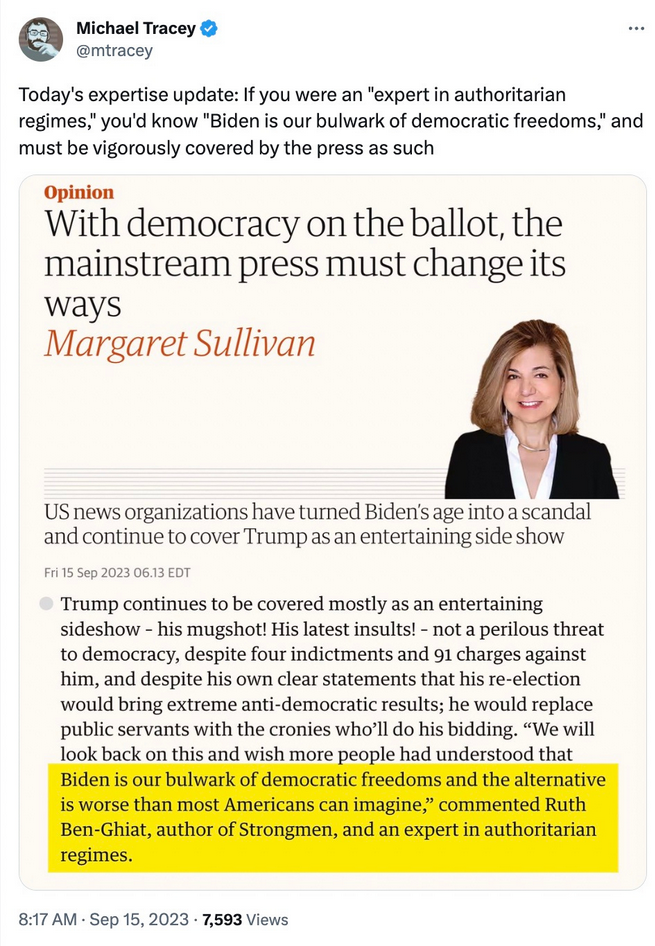
We’re overproducing hysterical expert-scolds. I keep finding more of them in social media, loud and weirdly nasty, like feral cats in a hay pile. Here comes a shrewd take from Ruth Ben-Ghiat, a history professor at NYU who has a highly marketable sideline as an expert on authoritarianism, responding to some genius-level political analysis from a guy with the requisite Ukrainian flag in his profile:

Observation: Marjorie Taylor Greene wore makeup on television.

Analysis: “That’s what Fascists do.”

See, members of Congress usually go on television in just an old pair of gym shorts and a dirty Schlitz Lite t-shirt, but this one particular person is trying to be Literally Adolf Hitler, so she wore a necklace and some lipstick. Textbook fascism!

Meanwhile, the governor of Florida just said that students in schools should put their phones away until recess, so they can focus on learning. This, too, is precisely identical to blackshirts marching on Rome:

Spend five minutes with this person’s social accounts, if you must, because this is what she does. It’s fascinatingly random, like a lady who lives on a bus bench wandering around the neighborhood describing random objects as Nazis. That’s a Nazi tangerine! That scrap lumber invaded Poland! Discarded juice boxes are Francisco Franco!

Eventually, if you make enough completely random angry noise, you get tenure and a book deal.

« Newer PostsOlder Posts »

Powered by WordPress