Quotulatiousness

May 14, 2014

Not fewer entrepreneurs – fewer resources for entrepreneurs

Filed under: Bureaucracy, Business, USA — Tags: , , , — Nicholas @ 13:51

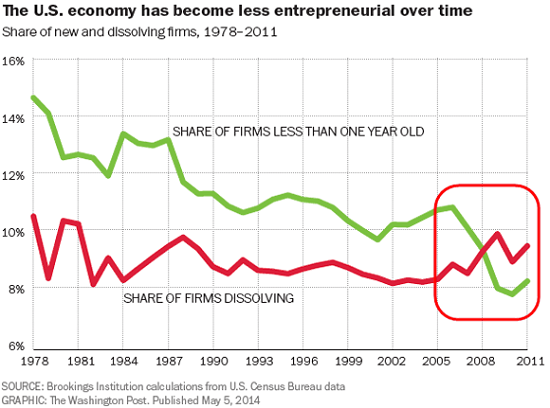
This image showed up in a post at Coyote Blog a couple of days ago, and it’s an indication of the decline in new business formation in the United States:

US becoming less entrepreneurial 1978-2011

Increasing bureaucracy — especially at the state level — undoubtedly contributes to that depressing chart, but it’s far from the whole story:

Home equity has historically been an important source of capital for small business formation. My first large investment in my company was funded with a loan that was secured by the equity in my home. What outsiders may not realize about small business banking nowadays is that it is nothing like how banking is taught in high school civics. In that model, the small business person goes to her local banker and presents a business plan, which the banker may fund if they think it is a good risk.

In the real world, trying to get such an unsecured loan from a bank as a small business will at best result in laughter. My company is no longer what many would call “small” — we will do millions in revenue this year. But there is no way in the world that my banker of over 10 years will lend to my business unsecured — they will demand some asset they can put a lien on. So we can get financing of equipment purchases (as a capital lease on the equipment) and on factored receivables and inventory. But without any of that stuff, a new business that just needs cash for startup cash flow is out of luck — unless the owner has a personal asset, typically a house, on which the banker can place a lien.

So, without home equity, one of the two top sources of capital for small business formation disappears (the other top source is loans from friends and family, which one might also expect to dry up in a tough economy).

May 11, 2014

Market disruption and innovation

Filed under: Bureaucracy, Business, Government — Tags: , , , , — Nicholas @ 10:19

Innovation often leads to challenges to established markets. Existing players in those established markets have three choices when faced with a disruptive new competitor or technological change: they can innovate themselves, they can retrench and avoid direct competition, or they can do what most incumbents do — get the government regulators to fight their battles for them.

Market incumbents do not like disruption. Uber, the ride-sharing service that has loosened the stranglehold of the taxi cartels, has been the object of government attacks and vigilante attacks both. Various regulatory agencies have tried with varying degrees of success to shut it down, London’s taxi drivers are even as we speak promising “chaos” in response to the firm’s success, French vigilantes have attacked its drivers, and in Seattle — blessed Seattle! — self-styled anarchists are targeting its cars and drivers. “Anarchists” for state-enforced cartel economics to increase private profit — somebody is unclear on the concept, it seems.

A great deal of the program of the old Left — from its full-on Marxist wing to its Proudhonian anarchist wing — is in the process of being accomplished by 21st-century capitalism. The means of production have been radically democratized, with multi-billion-dollar firms springing up out of garages and dorm rooms. The privileged position of dominant old-line financiers is being undermined rapidly by innovations such as Kickstarter, which blurs the line between the altruistic and the consumerist. The life expectancy of large corporations has collapsed, from about 75 years in the 1960s to 15 years and declining today. When Pierre-Joseph Proudhon called for “a war of labor against capital; a war of liberty against authority; a war of the producer against the non-producer; a war of equality against privilege,” he certainly did not have in mind Uber or Outbox; his most famous motto was, after all, “Property is theft.” (I think there is rather more to his idea of property than that simplistic formulation communicates, but this is not the place for that particular essay.) But the characteristics of those firms — relatively modest capital requirements, subverting various kinds of political authority in the form of licensure and regulation enacted in the interests of market incumbents, empowering efficient producers to compete with rent-seeking non-producers, and, above all, undermining the privileged place of state-sanctioned monopolies and cartels — looks a lot more like what the 19th-century revolutionaries had in mind than the USPS does. If what you mean by “capitalism” is the East India Company, then capitalism is not very attractive; if what you mean by “capitalism” is Kickstarter, then it is.

Not that a man transported from the 19th century to our own time would recognize that. If we could transport M. Proudhon or any of his contemporaries to the here and now, their eyes would not register any economic system with which they were familiar at the sight of the daily wonders we take for granted. They wouldn’t see capitalism; they’d see magic. But the DMV, the USPS, the housing project, and the prison would all be familiar to their 19th-century eyes. Our choice is not really between neat ideological verities with their roots in Adam Smith or Karl Marx, but between the DMV and the Apple store. Each model has its downsides, to be sure, but it does not seem like a terribly difficult choice to me.

May 4, 2014

How to start a wine cellar (not applicable in Ontario)

Filed under: Business, Cancon, Wine — Tags: , , — Nicholas @ 10:21

In rational jurisdictions — where you don’t have a government-mandated monopoly supplier — following the advice of Will Lyons makes a lot of sense. For obvious reasons, wine fans in Ontario can only stare in envy at the concept of competitive pricing for wine and not being limited to what the government chooses to bring in for sale:

IF YOU ENJOY WINE, are starting to take more than a passing interest and have perhaps bought the odd reference book about vino varieties, it might be time to think about beginning your very own wine cellar.

The worst habit you can get into is to stop off at your local wine shop once a week and pick up the odd few bottles. A much better approach is to buy by the dozen or a six pack, as most wine merchants will offer a discount on a mixed case. Better still is to select two or three wine merchants, order their catalogs or look online and, when you’re in the mood, spend some time selecting your favorite wines and comparing prices. I like to do this on the weekend, with a cup of tea and all the catalogs spread out over the kitchen table.

But a cellar isn’t just a few cases of your favorite wine. It may sound like a cliché but a good cellar requires a bit of forethought and planning to provide pleasurable drinking over the long term. I like to break wine collecting into three categories: wines for immediate drinking, wines to lay down that will improve with age, and investment wines — those special bottles whose value will steadily increase year on year.

I started my own cellar soon after I left university and began working in the wine trade. I well remember buying a case of northern Rhône Syrah to lay down — I still have four bottles — and six bottles of a well-known New Zealand Sauvignon Blanc producer. I now buy most of my wine twice a year: during the bin end sales at the beginning of the year, when merchants are unloading old stock at discounted prices, and when a wine is offered En Primeur (wine futures). This is where the wine is put up for sale from the barrel, months before it is bottled and shipped. The advantages are that you can guarantee an allocation of your chosen wine, you can choose the size of the bottle it is shipped in and also secure it at a discounted price. However, the latter isn’t always guaranteed — Bordeaux 2010 being a case in point. Many of the wines are cheaper now than when they were when released En Primeur.

May 2, 2014

Calling BS on the Beer Store ad campaign

Filed under: Business, Cancon — Tags: , , , , — Nicholas @ 08:09

Michael Pinkus takes a short pause from his usual wine reviews (and decrying the LCBO for their stone-age approach to selling wine) to throw some scorn at the foreign-owned multinational oligopoly that runs our beer retail business in Ontario:

Not sure which [of the two TV ads] I object to more, the lies of the first or the total misrepresentation of variety store owners in the second. The biggest lie to me in #1 is the implication of impeccable customer service: the visual of a beer store employee (Glenn Howard) showing a customer to her beer selection (can woman not find the beer they are bringing home to their man on their own? Is that another implication here?) or is he giving a recommendation of what beer to serve? Either way it’s a complete falsehood: I have been to plenty of Beer Stores in my day and NO ONE HAS EVER ‘showed me’ to the beer I was looking for, in fact, Beer Store employees are some of the surliest bunch in the customer service world, second only to LCBO and Home Depot staff for the most un-helpful in retail.

Ad #2 makes variety store owners look complacent in the act of minors buying alcohol in their stores, the only thing the Beer Store did not do was put an ethnic minority behind the counter (that should be your first clue that the Beer Store is out of touch with corner stores) … But seriously what a load of absolute garbage that ad is. I was thinking that a good acronym for the Beer Store is “The B.S.” which is exactly what they are peddling to the public with their ads and “beer facts” campaign … hopefully you see right through it: all they are trying to do is protect their bottom line through the guise of social responsibility. Heck the LCBO has been using that excuse for years and look at the monopoly they’ve built.

When it comes to the illegal sale of booze to minors, no one is protected more than the liquor store employees of this province. First, both LCBO and Beer Store employees are protected by unions, so if they were to sell to minors that employee would continue to keep their job. A sting by reporter David Menzies for SunMedia proved that not only can minors get alcohol at the LCBO but nothing befell the employees who sold to that minor.

On the other hand, a variety / corner store would face harsh penalties, stiff fines and I am sure the loss of their license to sell booze and quite possibly lose their store, their livelihood, everything they’ve worked for – not to mention the civil lawsuit that might be a consequence of their actions. Most variety store owners are hardworking, law abiding people who work long hours in their own stores, and usually rely on their family members to help out. They aren’t about to give up their way to make a living to sell a couple extra bottles of Blue to 15-year-old Joey Ripkin. Now, I’m not saying there aren’t any rotten eggs in the basket, but you’ve had LCBO workers sell booze out the back door of stores and warehouses and clerks sell to friends – there’s always someone who takes advantage of the system, but to paint them all with this absurd brush is clearly ridiculous. The BS the Beer Store is pushing is practically see-through.

The loss of one’s business and livelihood is a bigger price to pay than the slap on the wrist a Beer / LCBO store employee would see.

May 1, 2014

Rethinking Canadian broadcast regulation

Filed under: Bureaucracy, Business, Cancon, Media — Tags: , , , , , — Nicholas @ 07:27

On Google+, Michael Geist posted a few thoughts on hitting the reset button in Canadian broadcast regulation:

The Broadcasting Act is a complex statute that lists more than twenty broadcasting policy goals. Yet for decades, Canadian policy has largely boiled down to a single objective: Maximizing the benefits from the broadcasting system for creators, broadcasters, and broadcast distributors such as cable and satellite companies.

Consumers were nowhere to be found in that objective and it showed. Creators benefited from Canadian content requirements and financial contributions that guaranteed the creation of Canadian broadcast content. Broadcasters flourished in a market that permitted simultaneous substitution (thereby enabling big profits from licensing U.S. content) and that kept U.S. giants such as HBO, ESPN, and MTV out of the market for years in favour of Canadian alternatives. Cable and satellite companies became dominant media companies by requiring consumers to purchase large packages filled with channels they did not want in order to access the few they did.

As I mentioned in a conversation last night, the Canadian market for broadcast, telecommunications, and internet providers has been carefully managed by the government to minimize the whole messy “competition” thing and ensure quasi-monopoly conditions in various regions across the country. The regulators prefer a small number of players in the market: it makes it easier to do the “regulation” thing when you can fit all the regulated players around a small table, and it also provides post-civil service career opportunities for former regulators. Having a larger number of competing organizations makes the regulation game much more difficult and reduces the revolving door opportunities for former regulators.

April 30, 2014

Inheritance taxes actually perpetuate the 1%

Filed under: Britain, Economics, USA — Tags: , , , — Nicholas @ 08:18

Here’s Tim Worstall’s counter-intuitive post at the Adam Smith Institute blog from last week:

… Note “family foundation” there. Because of that inheritance tax rich people do tend to (and they have to be very rich for it to work) stick all of the money into a foundation. This wealth can then be maintained by professional money managers down the generations. Tax free, of course, as it’s inside a foundation. The stipulation is that said foundation must give away 5% of its assets each year. But such “giving away” obviously includes employing family members to run it. At pretty much any salary desired.

This obviously wouldn’t happen if the money could just be left directly to children without tax being due. And the effect of it going into such a foundation where the professional money managers can maintain it, rather than the heirs blow it, is that we’ve lost one of the major forces that disperses wealth through the society. The feckless heir.

So, we end up with the imposition of the tax leading to the continued concentration of old wealth, as the avoidance of the tax reduces the ability of the inheritors to waste it.

As an example, who thinks that any of the Kennedys would still be rich if they’d been able to get their hands on old Joe’s money directly?

I rest my case.

As one of the comments on that post points out, it’s not just the inheritance tax: it’s the interaction between the tax and the rules governing family foundations that create this unexpected-to-most-of-the-99% situation. I’m sure the 1% who can benefit from this are fully aware of it. This could be fixed either way, but the very people who benefit are the ones who would be pivotal in whether the changes could be made. So, it’s technically possible but not at all likely.

April 27, 2014

Soaring English house prices due to “discriminatory zoning, keeping the urban unwashed out of the home counties”

Filed under: Britain, Bureaucracy — Tags: , , — Nicholas @ 10:19

This wasn’t in the Torygraph, it was actually reported in the Guardian:

More of Surrey is now devoted to golf courses than housing, according to provocative new research that claims to dispel many of the myths associated with Britain’s housing boom.

A study by the Centre for Economic Performance at LSE suggests soaring house prices are not caused by an influx of foreign buyers but are down to restrictive planning policies that have ensured the country’s green belt is a form of “discriminatory zoning, keeping the urban unwashed out of the home counties”.

Paul Cheshire, professor emeritus of economic geography at LSE and a researcher at the Spatial Economics Research Centre, has produced data showing that restrictive planning laws have turned houses in the south-east into valuable assets in an almost equivalent way to artworks. He points out that twice as many houses were built in Doncaster and Barnsley in the five years to 2013 than in Oxford and Cambridge.

As a result of the policy that specifically safeguards green belts, Cheshire claims houses have not been built where they are most needed or most wanted – “in the leafier and prosperous bits of ex-urban England”.

[…]

“We have a longstanding and endemic crisis of housing supply and it is caused primarily by policies that intentionally constrain the supply of housing land,” Cheshire claims. “It is not surprising to find that house prices increased by a factor of 3.36 from the start of 1998 to late 2013 in Britain as a whole and by a factor of 4.24 over the same period in London.”

Once inflation is discounted, house prices have gone up fivefold since 1955. But the price of the land for houses has increased in real terms by 15-fold over the same period.

As a result, houses are becoming like investment assets, creating incentives to hold on to them in expectation of future price rises.

April 9, 2014

Being “pro-business” does not mean the same as being “pro-market”

It’s a common misunderstanding (especially with people who don’t know what laissez faire actually means):

For years, Republicans benefited from economic growth. So did pretty much everyone else, of course. But I have something specific in mind. Politically, when the economy is booming — or merely improving at a satisfactory clip — the distinction between being pro-business and pro-market is blurry. The distinction is also fuzzy when the economy is shrinking or imploding.

But when the economy is simply limping along — not good, not disastrous — like it is now, the line is easier to see. And GOP politicians typically don’t want to admit they see it.

Just to clarify, the difference between being pro-business and pro-market is categorical. A politician who is a “friend of business” is exactly that, a guy who does favors for his friends. A politician who is pro-market is a referee who will refuse to help protect his friends (or anyone else) from competition unless the competitors have broken the rules. The friend of business supports industry-specific or even business-specific loans, grants, tariffs, or tax breaks. The pro-market referee opposes special treatment for anyone.

[…]

GOP politicians can’t have it both ways anymore. An economic system that simply doles out favors to established stakeholders becomes less dynamic and makes job growth less likely. (Most jobs are created by new businesses.) Politically, the longer we’re in a “new normal” of lousy growth, the more the focus of politics turns to wealth redistribution. That’s bad for the country and just awful politics for Republicans. In that environment, being the party of less — less entitlement spending, less redistribution — is a losing proposition.

Also, for the first time in years, there’s an organized — or mostly organized — grassroots constituency for the market. Historically, the advantage of the pro-business crowd is that its members pick up the phone and call when politicians shaft them. The market, meanwhile, was like a bad Jewish son; it never called and never wrote. Now, there’s an infrastructure of tea-party-affiliated and other free-market groups forcing Republicans to stop fudging.

A big test will be on the Export-Import Bank, which is up for reauthorization this year. A bank in name only, the taxpayer-backed agency rewards big businesses in the name of maximizing exports that often don’t need the help (hence its nickname, “Boeing’s Bank”). In 2008, even then-senator Barack Obama said it was “little more than a fund for corporate welfare.” The bank, however, has thrived on Obama’s watch. It’s even subsidizing the sale of private jets. Remember when Obama hated tax breaks for corporate jets?

April 2, 2014

Comparing scandals – Toyota’s phantom acceleration and GM’s ignition switches

Filed under: Business, Government, USA — Tags: , , , , , — Nicholas @ 08:10

David Harsanyi offers this comparison and says it’s another reason governments shouldn’t own businesses:

In February 2010, the Obama Administration’s Transportation Secretary Ray LaHood told America, without a shred of evidence, that Toyota automobiles were dangerous to drive. LaHood offered the remarks in front of the House Appropriations subcommittee that was investigating reports of unintended-acceleration crashes. “My advice is, if anybody owns one of these vehicles, stop driving it,” he said, sending the company’s stock into a nosedive.

Even at the time, LaHood’s comments were reckless at best. Assailing the competition reeks of political opportunism and cronyism. It also illustrates one of the unavoidable predicaments of the state owning a corporation in a competitive marketplace. And when we put LaHood’s comment into perspective today, it’s actually a lot worse. Not only did the Obama administration have the power and ideological motive to damage the largely non-unionized competition, it was busy propping up a company that was causing preventable deaths.

[…]

The National Highway Traffic Safety Administration’s acting chief David Friedman testified that GM never told them that faulty switches were at the root of the airbag problem. Fine. Before plowing billions of tax dollars into saving the United Automobile Workers, did the Car Czar or any other Obama officials take extra care to review DOT records to insure that taxpayers would not be funding the preventable deaths of American citizens? Would DOT or Holder exhibit the same zealousness for safety when it came to GM as they did when it came to Toyota? In the midst of the bailout debate and subsequent “turnaround,” news of a coverup and major recall would have been a political disaster.

So it’s difficult to understand why this isn’t a huge scandal. If every obtuse utterance by an obscure Republican congressman gets the media juices flowing, surely the possibility of this kind of negligence is worth a look. Can anyone with access to the administration ask some of these questions? Because if you take credit for “saving” a company (actually, an “industry,” as no one would ever driven again if Obama hadn’t saved the day) you also get credit for “saving” the real-life unscrupulous version of the company. “I placed my bet on American workers,” Obama told union workers in 2012. “And I’d make that same bet again any day of the week. And now, three years later that bet is paying off.” Betting $80 billion of someone else’s money to prop up sympathetic labor unions isn’t exactly fraught with political risk. Unless it turns out that your administration was less concerned about the safety defects of the company you owned than the company you disliked. That would be corruption.

March 30, 2014

State occupational licensing is out of control

Filed under: Bureaucracy, Business, Politics, USA — Tags: , , , — Nicholas @ 08:58

Ramesh Ponnuru discusses some examples of ridiculous state occupational license requirements:

Melanie Armstrong wanted to be an African hair braider, practicing a skill passed down from generation to generation. In Tupelo, Mississippi, where she lived, government licensing rules meant she had to take 300 hours of course work to start her salon: 300 hours, she notes, “none of which covered hair braiding.”

In testimony before a U.S. House subcommittee on Wednesday, Armstrong explained that her “ultimate goal” was to teach others how to braid. Getting the needed licenses to do that would have taken 3,200 hours. None of them taught students how to braid hair, either. That’s more hours than it would have taken her to get licenses to become a firefighter, emergency medical technician, hunting instructor, ambulance driver or real estate appraiser. It’s longer than it would have taken her to get licenses for all those things combined.

The subcommittee — led by New Yorkers Richard Hanna, a Republican, and Grace Meng, a Democrat — was considering the excesses of state occupational licensing. More and more jobs fall under these regulations. In the 1950s, according to one study, only about one in 20 jobs required a license. By 2006, about 29 percent did.

While Armstrong helped get her state to scale back the requirements for hair braiders, the trend is toward more stringent regulation. Patti Morrow, who runs an organization fighting licensing for interior designers, says, “These bills come back year after year like zombies.”

March 16, 2014

QotD: American “cheese”

Filed under: Bureaucracy, Europe, Food, France, Health, Humour, Quotations, USA — Tags: , — Nicholas @ 10:05

Everyone thinks America Alone is about Islam and demography, but in fact it has a whole section in it on cheese, called “The Pasteurization is Prologue”. Page 181:

    I’ve never subscribed to that whole “cheese-eating surrender-monkey” sneer promoted by my National Review colleague Jonah Goldberg. As a neocon warmonger, I yield to no one in my contempt for the French, but, that said, cheese-wise I feel they have the edge.

    When I’m at the lunch counter in America and I order a cheeseburger and the waitress says, “American, Swiss or Cheddar?” I can’t tell the difference. They all taste of nothing. The only difference is that the slice of alleged Swiss is full of holes, so you’re getting less nothing for your buck. Then again, the holes also taste of nothing, and they’re less fattening. But, either way, cheese is not the battleground on which to demonstrate the superiority of the American way.

Most of the American cheeses bearing European names are bland rubbery eunuch versions of the real thing. I wouldn’t mind if this were merely the market at work, but it’s not. It’s the result of Big Government, of the Brieatollahs at the United States Department of Agriculture:

    In America, unpasteurized un-aged raw cheese that would be standard in any Continental fromagerie is banned. Americans, so zealous in defense of their liberties when it comes to guns, are happy to roll over for the nanny state when it comes to the cheese board… The French may be surrender monkeys on the battlefield, but they don’t throw their hands up and flee in terror just because the Brie’s a bit ripe. It’s the Americans who are the cheese-surrendering eating-monkeys — who insist, oh, no, the only way to deal with this sliver of Roquefort is to set up a rigorous ongoing Hans Blix-type inspections regime.

I’m not exaggerating about that. Nothing gets past their eyes, and everything gets pasteurized. That’s why American “cheesemakers” have to keep putting stuff into the “cheddar” — sun-dried tomatoes, red peppers, chocolate chips — to give it some taste, because the cheese itself has none. And, if you try to bring in anything that does taste of something, the US Government’s Brie Team Six seizes it:

    The US fate of the bright-orange, mild-tasting French cheese has been in jeopardy for months and the Food and Drug Administration has blocked all further imports.

    Why? Because US regulators determined the cantaloupe-like rind of the cheese was covered with too many cheese mites, even though the tiny bugs give mimolette its unique flavor.

    No formal ban has been put in place, but 1.5 tonnes (3,300 pounds) of cheese were blocked from being imported, and nothing is going through US customs.

“No formal ban has been put in place” — because that would involve legislators passing laws in a legislature and whatnot. So they just banned it anyway.

Mark Steyn, “Live Brie or Die!” SteynOnline.com, 2014-03-13

February 28, 2014

Corporate welfare bums

Filed under: Business, Government, USA — Tags: , , — Nicholas @ 08:38

David Sirota says that in at least some high-profile cases, President Obama was quite right to say they didn’t build that:

Remember when President Obama was lambasted for saying “you didn’t build that”? Turns out he was right, at least when it comes to lots of stuff built by the world’s wealthiest corporations. That’s the takeaway from this week’s new study of 25,000 major taxpayer subsidy deals over the last two decades.

Titled “Subsidizing the Corporate One Percent,” the report from the taxpayer watchdog group Good Jobs First shows that the world’s largest companies aren’t models of self-sufficiency and unbridled capitalism. To the contrary, they’re propped up by billions of dollars in welfare payments from state and local governments.

Such subsidies might be a bit more defensible if they were being doled out in a way that promoted upstart entrepreneurialism. But as the study also shows, a full “three-quarters of all the economic development dollars awarded and disclosed by state and local governments have gone to just 965 large corporations” — not to the small businesses and start-ups that politicians so often pretend to care about.

Of course, anyone who thinks major corporations as a whole are “models of self-sufficiency and unbridled capitalism” doesn’t spend much time in the real world. Far too many spend as much time trying to use their market position to exclude smaller competitors and lobbying for regulations that will prevent new entrants into their respective fields of business. As with anything, when you subsidize certain kinds of activity, you’ll inevitably get more of it — and governments compete with one another to offer sweet deals to corporations in terms of tax breaks, direct subsidies and other inducements to set up or expand their operations in a given state or country.

February 27, 2014

OQLF now monitoring social media for language

Filed under: Cancon, Law, Media — Tags: , , , — Nicholas @ 10:32

No, not coarse language … the English language:

The agency in charge of enforcing the primacy of the French language in Quebec apparently has a new target — social media.

Eva Cooper, the owner of a small retail boutique in Chelsea, Que., has been notified by the language agency that if she doesn’t translate the shop’s Facebook page into French, she will face an injunction that will carry consequences such as a fine.

“Ultimately, to me, Facebook has nothing to do with Quebec,” said Cooper, who uses the social media site to inform customers of new products in her boutique north of Ottawa. The shop — Delilah in the Parc — has an all-bilingual staff of fewer than 10 people.

“I’m happy to mix it up, but I’m not going to do every post half in French, half in English. I think that that defeats the whole purpose of Facebook,” said Cooper, who has requested the agency send her their demands in English.

Cooper’s case represents a new frontier for the language agency, the Office québécois de la langue française (OQLF). The agency says probes of social media complaints, which started only recently, are “not frequent.”

February 20, 2014

Anti-tobacco campaigners – “a great bunch of puritanical Cnuts”

Filed under: Britain, Business, Health, Technology — Tags: , , , , — Nicholas @ 08:37

In sp!ked, Rob Lyons looks at the way e-cigarettes are being marketed in the UK and how it’s driving anti-tobacco campaigners absolutely insane:

For the tobacco-control lobby, an advert like Dorff’s is an absolute nightmare. It makes no health claims. It is clearly targeted at adults. It plays to the fact that even smokers dislike aspects of old-fashioned cigarettes, and are happy to compromise in order to get most of the pleasure of smoking without the hassle or the irritation to others. And then – God forbid – it even plays to the annoyance of smokers at the health fanatics. The last thing smoke dodgers want is for anyone to be able to take their freedom back. Even the existence of the sanitised offer from Vype’s say-nothing advert is anathema.

This was made abundantly clear in a report published by Cancer Research UK last year, The marketing of electronic cigarettes in the UK [PDF]. The authors are forced to admit that e-cigs ‘are accepted as being much safer than their conventional equivalents, so if smokers can be encouraged to switch there is the potential for significant public health gain’.

However, this message is quickly lost in a cloud of public-health cant. The threats, say the authors, include concerns that ‘hard-won tobacco-control policies (smokefree public places, the ad ban, age restricted sales, tobacco industry denormalisation, POS [point-of-sale] restrictions) are being undermined’ and that ‘there is evidence that young people, who have always been the key to the long-term viability of the tobacco industry, may be being pulled into the market’. The danger, say the authors, is that tobacco companies don’t want you to give up your addiction, just switch to a different delivery system. The problem with this argument is that the new delivery system is much, much safer. Why shouldn’t corporations try to sell us safe products?

[…]

In reality, what the anti-tobacco lobbyists (and their fans in Westminster and Whitehall) are really afraid of is the loss of their power and influence over our lives. They fear they will be helpless against the tide of e-cigs, like a great bunch of puritanical Cnuts. (Note to sub-editor: that’s definitely ‘Cnuts’, as in the Danish king who famously – probably apocryphally – tried to turn back the sea. Honest.)

E-cigs are a safe, practical alternative to smoking. For all the huffing and putting-a-stop-to-puffing, tobacco control has been an illiberal failure. E-cigs are encouraging smokers to switch, cut down or stop altogether far more successfully than all the bans, taxes, restrictions and useless nicotine-replacement therapies that have gone before. ‘Vaping’ is an unexpected but nonetheless happy success story.

February 15, 2014

In one stroke, Connecticut becomes the state with the highest proportion of criminals

Filed under: Law, Liberty, USA — Tags: , , , — Nicholas @ 10:54

In a development that absolutely nobody could have seen coming, Connecticut has the highest known population of (technical) criminals in the United States:

In a massive display of civil disobedience, tens of thousands of state residents have refused to register what the left calls assault weapons, instantly making them criminals guilty of a felony.

The legacy of the Connecticut residents who used their privately owned firearms to help overthrow the tyrannical colonial rule of King George III, who probably considered their muskets the military-style assault weapon of the day, apparently lives on.

Connecticuters in the tens, perhaps hundreds, of thousands have refused to comply with a law, adopted after the December 2012 massacre at Sandy Hook Elementary School, requiring them to register what gun-control advocates consider assault weapons by the end of 2013.

As the Hartford Courant reports, as of Dec. 31 some 47,916 applications for assault weapons certificates had been received by state police. By some estimates, this represented as little as 15% of the rifles classified as assault weapons owned by Connecticut residents.

Estimates by people in the industry, including the Newtown-based National Shooting Sports Foundation, place the number as high as 350,000.

Update, 19 February: The editorial board of the Hartford Courant thinks that the solution to this problem is to just ignore the deadline or even scrap the law. No, wait, that’d be a sensible reaction. They actually want the state to round up the scofflaws en masse:

Some people actually tried to comply with the registration law, but missed the deadline. The state’s official position is that it will accept applications notarized on or before January 1, 2014 and postmarked by January 4. But, says Dora Schriro, Commissioner of the Department of Emergency Services and Public Protection, in a letter to lawmakers [PDF], anybody sufficiently law-abiding but foolish enough to miss that slightly extended grace period will have to surrender or otherwise get rid of their guns.

This, of course, is the eternally fulfilled fear of those who oppose registration of things governments don’t like — that allowing the government to know about them will result in their eventual confiscation. Such confiscation, despite assurances to the contrary, occurred in New York, California, and elsewhere. Connecticut has accomplished something special, though, by making “eventual” a synonym for “right now.”

You know who won’t have to surrender their weapons? People who quietly told the state to fuck off.

This successful example of mass defiance horrifies the editorial board of the Hartford Courant, which shudders at the sight of the masses not obeying an order that, history, tells us, never had a shot at wide compliance. According to them:

    It’s estimated that perhaps scores of thousands of Connecticut residents failed to register their military-style assault weapons with state police by Dec. 31….

    …the bottom line is that the state must try to enforce the law. Authorities should use the background check database as a way to find assault weapon purchasers who might not have registered those guns in compliance with the new law.

    A Class D felony calls for a maximum sentence of five years in prison and a $5,000 fine. Even much lesser penalties or probation would mar a heretofore clean record and could adversely affect, say, the ability to have a pistol permit.

    If you want to disobey the law, you should be prepared to face the consequences.

Such shock! Such outrage!

« Newer PostsOlder Posts »

Powered by WordPress