Military History Visualized
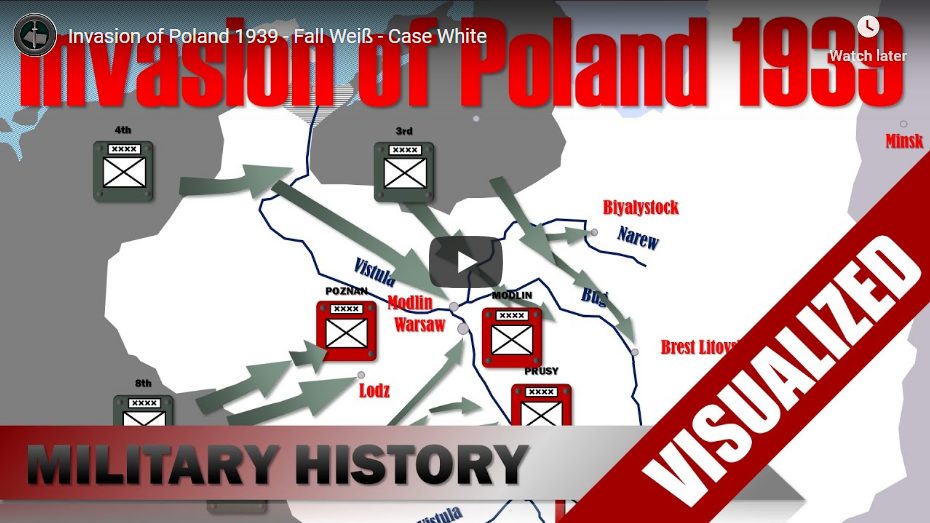
Published 30 Aug 2016The German Invasion of Poland in 1939 started the Second World War in Europe. The German name of operation was “Fall Weiß” meaning “Case White”. In this video I will take a look at the major German troop movements, the Soviet invasion of Poland, the losses and a final assessment.
» HOW YOU CAN SUPPORT MILITARY HISTORY VISUALIZED «
(A) You can support my channel on Patreon: https://www.patreon.com/mhv(B) You can also buy “Spoils of War” (merchandise) in the online shop: https://www.redbubble.com/people/mhvi…
(C) If you want to buy books that I use or recommend, here is the link to the Amazon Store: http://astore.amazon.com/ytmh-20 which has the same price for you and gives a small commission to me, thus it is a win/win.
» SOURCES & LINKS «
Maier, Klaus; Rohde, Horst; Stegemann, Bernd; Umbreit, Hans: Die Errichtung der Hegemonie auf dem europäischen Kontient. Das Deutsche Reich und der Zweite Weltkrieg (DR2WK), Band 2.
Müller, Rolf-Dieter: Hitler’s Wehrmacht, 1935-1945
Zaloga, Steven J.: Poland 1939 – The Birth of Blitzkrieg
Wettstein, Adrian: Wehrmacht im Stadtkampf
http://www.cgsc.edu/CARL/nafziger/939…
http://niehorster.org/029_poland/1939…
http://www.westpoint.edu/history/Site…
https://en.wikipedia.org/wiki/Soviet_…
» CREDITS & SPECIAL THX «
Song: Ethan Meixsell – “Demilitarized Zone”The Counter-Design is heavily inspired by Black ICE Mod for the game Hearts of Iron 3 by Paradox Interactive
https://forum.paradoxplaza.com/forum/…» DISCLAIMER «
Amazon Associates Program: “Bernhard Kast is a participant in the Amazon Services LLC Associates Program, an affiliate advertising program designed to provide a means for sites to earn advertising fees by advertising and linking to amazon.com.”
November 26, 2019
Invasion of Poland 1939 – Fall Weiß – Case White
November 22, 2019
“Inmate 4859” – Witold Pilecki – Sabaton History 042 [Official]
Sabaton History
Published 21 Nov 2019Join Indy and Joakim as they dive into the out-of-life story of Witold Pilecki during the Second World War, that has made for this awesome song.
Support Sabaton History on Patreon: https://www.patreon.com/sabatonhistory
Listen to Heroes (where Inmate 4859 is featured):
CD: http://bit.ly/HeroesStore
Spotify: http://bit.ly/HeroesSpotify
Apple Music: http://bit.ly/HeroesAppleMusic
iTunes: http://bit.ly/HeroesiTunes
Amazon: http://bit.ly/HeroesAmz
Google Play: http://bit.ly/HeroesGooglePListen to Sabaton on Spotify: http://smarturl.it/SabatonSpotify
Official Sabaton Merchandise Shop: http://bit.ly/SabatonOfficialShopHosted by: Indy Neidell
Written by: Markus Linke and Indy Neidell
Directed by: Astrid Deinhard and Wieke Kapteijns
Produced by: Pär Sundström, Astrid Deinhard and Spartacus Olsson
Creative Producer: Joram Appel
Executive Producers: Pär Sundström, Joakim Broden, Tomas Sunmo, Indy Neidell, Astrid Deinhard, and Spartacus Olsson
Post-Production Director: Wieke Kapteijns
Edited by: Iryna Dulka
Sound Editing by: Marek KaminskiEastory YouTube Channel: https://www.youtube.com/channel/UCEly…
Archive by: Reuters/Screenocean https://www.screenocean.com
Music by Sabaton.An OnLion Entertainment GmbH and Raging Beaver Publishing AB co-Production.
© Raging Beaver Publishing AB, 2019 – all rights reserved.
From the comments:
Sabaton History
23 hours ago (edited)
Witold Pilecki is one of those larger-than-life characters, and listen to Joakim and Indy talk about this amazing song as well as the historical background behind it. Now thanks to all of you we have ben able to film the history part of this in a new studio which is both bigger and better. This is 100% thanks to the Patrons whose generous contributions made this possible. Do you want to be a part of this as well? Make sure to support us on Patreon: https://www.patreon.com/sabatonhistory
Cheers, The Sabaton History Team
November 16, 2019
War Exiles: Kaiser Bill, Polish Forces, and US Volunteers – WW2 – OOTF 006
World War Two
Published 14 Nov 2019What happened to Kaiser Wilhelm II after World War One? How did Polish soldiers flee to Allied territories after the 1939 invasion? And did any American volunteers serve in the war in 1939 and 1940? We answer all of this in this episode of Out of the Foxholes.
Join us on Patreon: https://www.patreon.com/TimeGhostHistory
Or join The TimeGhost Army directly at: https://timeghost.tvFollow WW2 day by day on Instagram @World_war_two_realtime https://www.instagram.com/world_war_t…
Join our Discord Server: https://discord.gg/D6D2aYN.
Between 2 Wars: https://www.youtube.com/playlist?list…
Source list: http://bit.ly/WW2sourcesHosted by: Indy Neidell
Produced and Directed by: Spartacus Olsson and Astrid Deinhard
Executive Producers: Bodo Rittenauer, Astrid Deinhard, Indy Neidell, Spartacus Olsson
Creative Producer: Joram Appel
Post Production Director: Wieke Kapteijns
Research by: Rune Vaever Hartvig
Edited by: Mikołaj Cackowski
Map animations: EastoryEastory’s channel: https://www.youtube.com/channel/UCEly…
Archive by Screenocean/Reuters https://www.screenocean.com.A TimeGhost chronological documentary produced by OnLion Entertainment GmbH.
From the comments:
World War Two
2 days ago (edited)
We get a ton of questions about the war on a daily basis. A lot of them are already answered in the YouTube comments to you all directly, but because some questions are very interesting indeed, we like to showcase some of them on the channel. Because the YouTube comments are hard to navigate, we have made a section on our forum where you can submit questions to be covered in Out of the Foxholes. You can do that here: https://community.timeghost.tv/c/Out-of-the-Foxholes-QsCheers,
The TimeGhost team
September 25, 2019
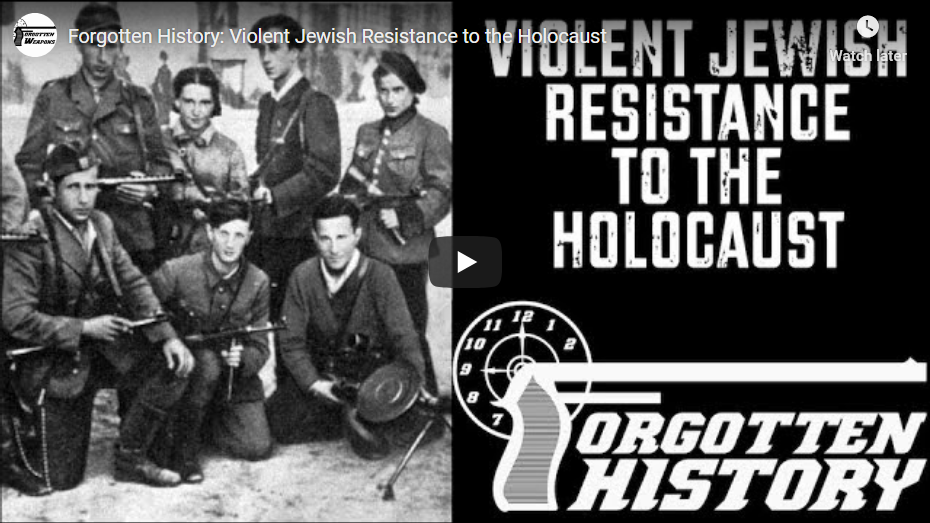
Forgotten History: Violent Jewish Resistance to the Holocaust
Forgotten Weapons
Published 24 Sep 2019http://www.patreon.com/ForgottenWeapons
Cool Forgotten Weapons merch! http://shop.bbtv.com/collections/forg…
I wrote this paper back in 2003 or 2004 for a college class I was taking (HIST 595 – The Holocaust And Genocide). Today, it sounds a bit amateurish — but I suppose that is to be expected of something written by someone barely out of their teens. I think it could be much better written today, and its subject matter deserves much greater depth, but I believe its conclusions are sound. In particular, I would not be so casual in identifying the perpetrators simply as “the Germans”, as this is an unfair simplification of the guilt for the crimes of the Holocaust.
Some people will interpret this paper though narrow political viewpoints today, which is unfortunate. I shouldn’t have to say it, but obviously such interpretations are certainly not reflective of my own beliefs.
Bibliography:
Ainsztein, Reuben. Jewish Resistance in Nazi-Occupied Europe. Paul Elek Ldt, London: 1974.
Arad, Yitzhak. Ghetto in Flames. Holocaust Library, New York: 1982.
Berenbaum, Michael. The World Must Know. New York: Little, Brown, and Co, 1993.
Donat, Alexander. The Death Camp Treblinka. New York: Holocaust Library, 1979.
Gutman, Yisrael. The Jews of Warsaw, 1939-1943. Indiana University Press, Bloomington:1982.
Mark, Ber. Uprising in the Warsaw Ghetto. Schocken Books, New York: 1975.
Novitch, Miriam. Sobibor: Martydom and Revolt. Holocaust Library, New York: 1980.
Rotem, Simha. Memoirs of a Warsaw Ghetto Fighter. New Haven: Yale University Press, 1994.
Zuckerman, Yitzhak. A Surplus of Memory. University of California Press, Berkeley: 1993.
Contact:
Forgotten Weapons
6281 N. Oracle #36270
Tucson, AZ 85704
September 3, 2019
An alternative end to the Molotov-Ribbentrop Pact?
On the anniversary of the German invasion of Poland, Arthur Chrenkoff wonders if Stalin’s greatest miscalculation wasn’t refraining from attacking the Nazi forces after they’d been fighting the Polish army for three weeks in 1939:

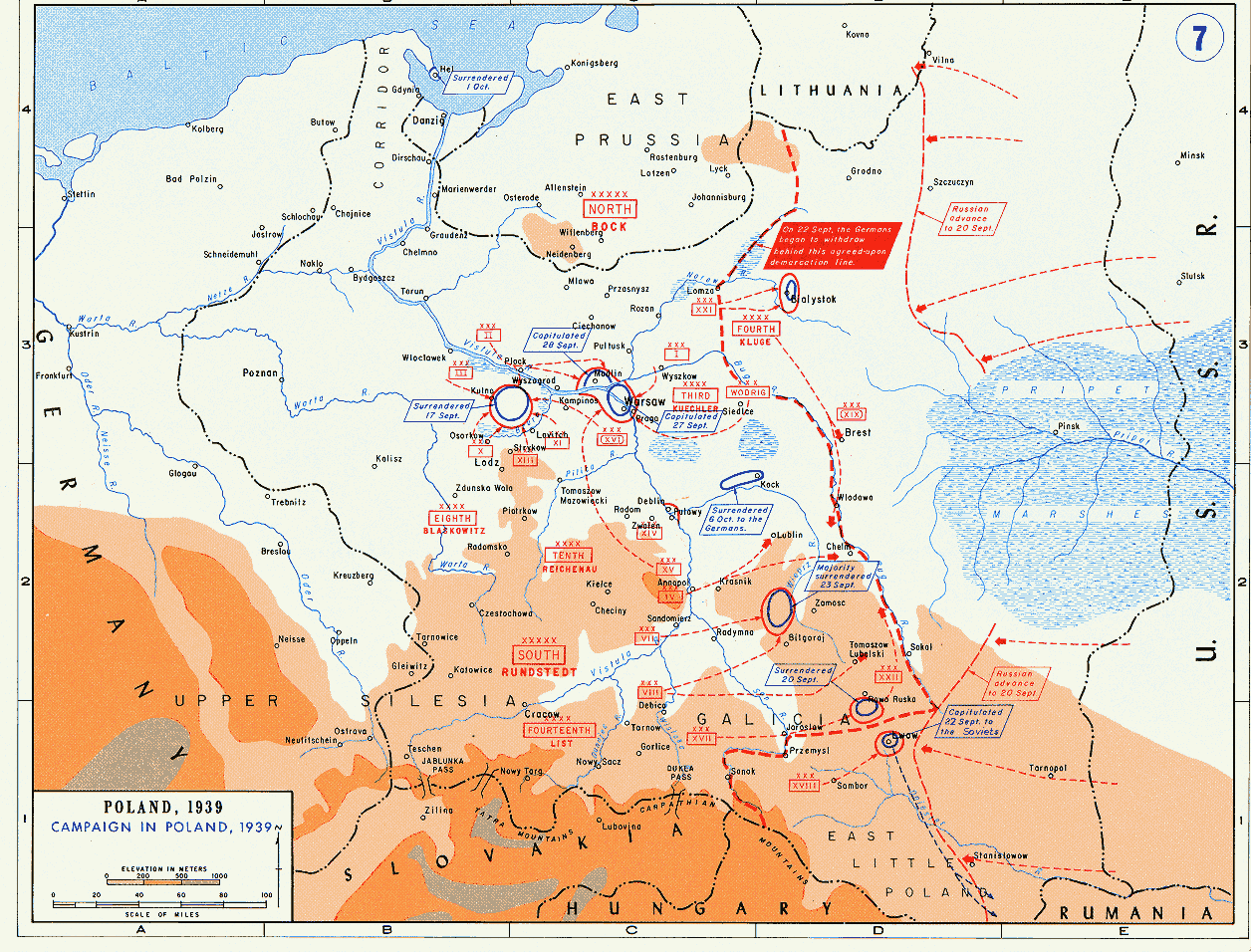
Military situation in Poland, 14 September 1939 (map does not show Slovak Army activity in southern Poland).
United States Military Academy, Department of History via Wikimedia Commons.
In late August, the Soviet Union signed the infamous Ribbentrop-Molotov non-aggression pact with Germany, effectively green-lighting Hitler’s invasion of Poland a few days later. The secret protocols attached to the pact stipulated for the division of Central Europe between the two powers, with the Soviet Union being rewarded for its cooperation with the Nazis with the gift of eastern Poland, the Baltic states and Bessarabia, or the north-eastern Romania (as well as, it transpired later, the German non-interference during the Soviet invasion of Finland).
The Soviets were not naive (even if Stalin discounted all the indications of the coming German attack in 1941) to believe in a long-term friendship with Nazi Germany. There are strong indications that the Soviet Union intended to attack Germany, perhaps sometime in 1942, but Hitler beat it to the punch. The official Russian justification for the Ribbentrop-Molotov pact has certainly always been that the Soviet Union needed to buy itself extra time to prepare for this eventual showdown, since in 1939 it was still nowhere near ready (not least because of Stalin’s decapitation of the Red Army’s top leadership during the Great Terror a few years before).
But what if that was Stalin’s greatest miscalculation ever? By 17 September, when the Red Army crossed the eastern borders of Poland in accordance with the secret partition agreement, it was pretty clear to all that Poland was close to a military defeat (it would have hold on for longer, of course, without the Soviet stab in the back, but this would not have changed much without the Western allies’ military involvement, which never eventuated). While the German armed forces were winning, they were also overcommitted and overstretched. The German high command expected a quicker and easier victory and were taken aback by the ferocity of Polish resistance, despite clear German superiority in armour, air power and logistics. By the second half of September, some ammunition stocks were beginning to run low (particularly bombs) and motorised equipment, from tanks to trucks, has been significantly degraded through a combination of attrition and significant wear and tear in Polish autumn.
So what if the Red Army, instead of eventually coming to a halt along the previously agreed demarcation line, kept going west? There was no significant Polish military force to take into account and German army was tired and weakened after three weeks of hard fighting (losing a third of its tanks and 25 per cent of its air force in the process). While Wehrmacht had numerical advantage on the ground, this was only because the Red Army chose to invade Poland with half a million men, which was certainly enough to subdue the thinly-held eastern marches, but should they have needed it, the Soviets had reserves to draw upon to even out the field against the Germans. Even with their 33 committed divisions, the Red Army had a significant advantage over the German armed forces in the Polish theatre in terms of armour and air power (two to one for the former).
Who would have triumphed in this 1939 clash of the rival totalitarian war machines? We don’t know, of course, except that at the time of the invasion of Poland, Germany was militarily at its weakest point it would be until the final months of World War Two. Should the Red Army have proven victorious in September and October 1939, it would have likely ended up in Berlin in a matter of weeks, instead of years it eventually took. It’s a reasonable guess that Great Britain and France, faced with the Soviet invasion of the Reich and the looming defeat of Hitler, would have overcome their initial inertia and moved into Germany from the west so as to prevent having the communists proverbially water their horses in the Rhine. In this scenario, we would have ended up with a divided Germany and a divided Europe (though without much of the rest of Central and south-Eastern Europe in the Soviet camp) some six years earlier and without the tens of millions of dead, a ruined continent, and the Holocaust that accompanied World War Two as it actually unfolded.
Alas.
August 26, 2019
Russia attempts to retroactively “normalize” the Molotov-Ribbentrop Pact
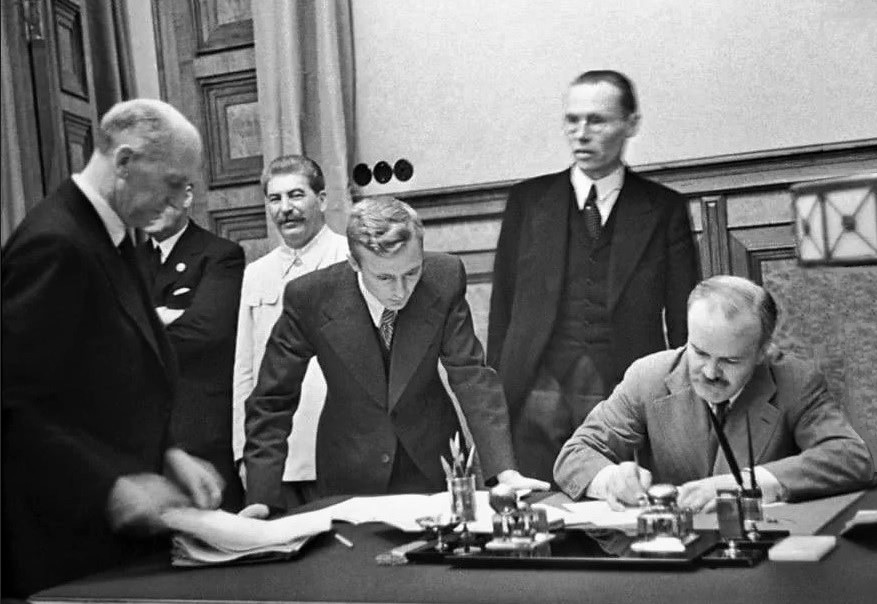
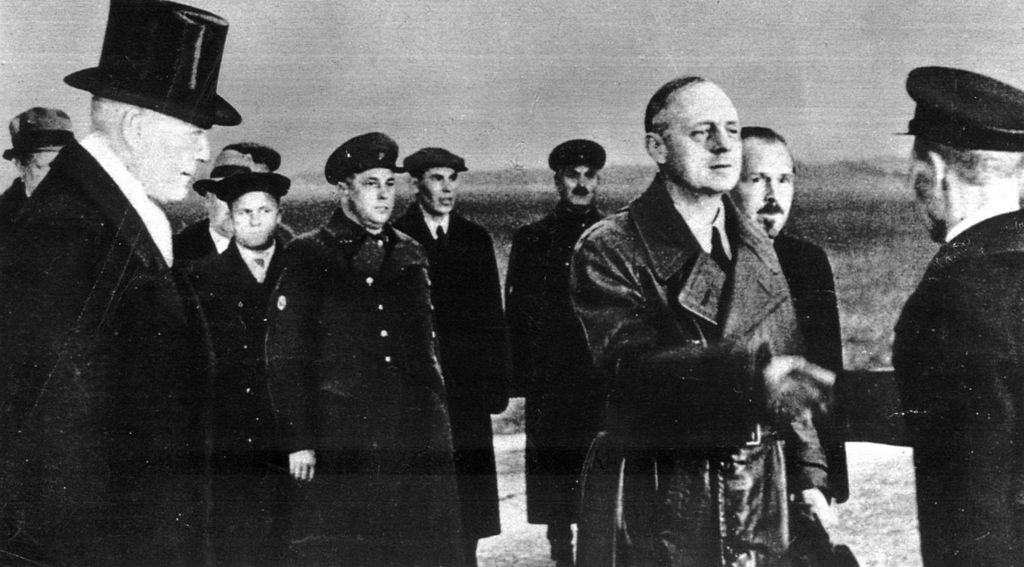
Just before the outbreak of World War II on the Polish-German frontier, the Soviet Union concluded a non-aggression pact with Hitler’s Germany that included a large slice of Polish territory and a free hand in the Baltic for Soviet expansion (only the early Finnish success prevented total Soviet domination of the eastern Baltic region). The current Russian government is conducting a public relations (propaganda) campaign to recast this pact as being unexceptional diplomatic activity by attempting to cast Britain, France, and all the other countries that had active diplomatic arrangements with Germany as being “just the same” as the infamous Molotov-Ribbentrop Pact. Wikipedia sums up the fate of the two chief diplomats:

Translation of the Russian caption for this image:
People’s Commissar of Foreign Affairs of the USSR V.M. Molotov signs a friendship and border treaty between the USSR and Germany. Among those present: I.V. Stalin, translator of the Ministry of Foreign Affairs V.N. Pavlov, German diplomat G. Hilger (“truncated” version of the photograph of M. Kalashnikov distributed on the net)
Photograph attributed to Mikhail Mikhaylovich Kalashnikov (1906-1944) via Wikimedia Commons.
The Pact was terminated on 22 June 1941, when Nazi Germany launched Operation Barbarossa and invaded the Soviet Union (thus as well executing the ideological goal of Lebensraum). After the war, von Ribbentrop was convicted of war crimes and executed. Molotov died aged 96 in 1986, five years before the USSR’s dissolution. Soon after World War II, the German copy of the secret protocol was found in Nazi archives and published in the West, but the Soviet government denied its existence until 1989, when it was finally acknowledged and denounced. Vladimir Putin, while condemning the pact as “immoral”, has also defended the pact as a “necessary evil”, a U-turn following his earlier condemnation
Arthur Chrenkoff explains why we should vigorously resist this attempt to “normalize” Molotov-Ribbentrop:
1. While the shameful Western appeasement of Hitler, culminating in the infamy of Munich, allowed the Reich to bloodlessly dismember the sovereign and democratic Czechoslovakia, neither Great Britain nor France participated in or benefited from Germany’s cannibalism of this “faraway country of which we know little”. The difference is that while the West remains ashamed of Munich (a name which quickly become synonymous with a craven sell-out), a few years back, Russia’s culture minister Vladimir Medinsky called the Ribbentrop-Molotov pact “a great achievement of Soviet diplomacy”.
2. Unlike all the other agreements signed with Germany during the 1930s, it was the Ribbentrop-Molotov pact that green-lit the armed German aggression and led to the outbreak of the deadliest war in human history. It’s difficult to blame Germany’s neighbours or countries threatened by the Soviet Union (like Poland, Romania and the Baltic states) for trying to stay on Germany’s good side. It was naive and in any case it didn’t work in the end, as they all later found out to their detriment and downfall. Soviet Union, on the other hand, not only climbed into bed with Nazi Germany but it fully and enthusiastically consummated this marriage of convenience.
3. Unlike other agreements cited above, thanks to the “secret protocols” attached to the Ribbentrop-Molotov pact, the Soviet Union was both a co-aggressor in and a co-beneficiary of the start of World War Two. Stalin has relatively bloodlessly acquired the by-then (mid-September) almost defenseless eastern Poland (subsequently incorporated into Belarussian and Ukrainian Soviet Republics; these historically Polish areas remain today parts of Belarus and Ukraine), Bessarabia from Romania (incorporated into the Moldovan Soviet Republic), the Baltic States of Lithuania, Latvia and Estonia, as well as being given a free hand in the invasion of Finland, a country which otherwise might have counted on German friendship and support. All these aggressive territorial gains were the consequence of the Ribbentrop-Molotov division of Eastern Europe between the Reich and the Soviet Union into the respective spheres of interest, soon confirmed as the “facts on the ground” by Wehrmacht and Red Army.
4. While Britain and France, their empires and their allies, fought Germany for almost two years after September 1939, first through the period of the “phony war”, then through the Blitzkrieg in the West and the Battle of Britain, the Soviet Union remained a de facto Nazi ally, continuing to cooperate in security matters and supplying Germany with food and raw materials. Grain trains were still rolling west across the border with the Reich as Wehrmacht was launching Operation Barbarossa in the morning of 22 June 1941. During the period of Nazi-Soviet cooperation, Germany conquered Poland, Norway, Denmark, Belgium, the Netherlands, Luxembourg, France, Yugoslavia and Greece. Soviet exports helped to feed and build up the German war machine before it was unleashed against the West in 1940; German troops surging into the Low Countries walked on their stomachs (to borrow from Napoleon) full of bread baked from Russian wheat or were carried on the tanks and trucks made with Russian coal and ores. Never forget that for Russia, World War Two – or the Great Patriotic War as it is called there – begins only in June 1941, not September 1939, as it does in all Western history books.
5. It’s true that the Ribbentrop-Molotov pact was partly defensive in nature as far as the Soviet Union was concerned, aiming to postpone the inevitable armed clash between the two rival totalitarianisms and in the meantime give Russia some essential breathing space to build up its army and strategic reserves (the top leadership of the Soviet armed forces was decapitated by Stalin during the purges in 1937-8, leaving them even more unprepared to face Germany than would have otherwise been the case). But as I pointed out above, it was also offensive and directly benefited Stalin’s territorial ambitions while it lasted. In some ways, the legacy of the pact lives on in the shape of Poland’s post-war borders, which have nothing to do with its thousand-year history. This is the real #TruthAboutWWII and this is why the Ribbentrop-Molotov pact remains singled out in the infamy of the interwar European democracy.
August 4, 2019
The Hippo vs. the Bulldog, Göring’s War – WW2 – 049 – August 3 1940
World War Two
Published on 3 Aug 2019As the Kanalkampf comes to a close, the Battle of Britain heats up. Hitler wants Britain out of the war. But before the Germans can invade Britain, it will have to deal with the Royal Air Force and the Royal Navy.
Join us on Patreon: https://www.patreon.com/TimeGhostHistory
Or join The TimeGhost Army directly at: https://timeghost.tvFollow WW2 day by day on Instagram @World_war_two_realtime https://www.instagram.com/world_war_t…
Join our Discord Server: https://discord.gg/D6D2aYN.
Between 2 Wars: https://www.youtube.com/playlist?list…
Source list: http://bit.ly/WW2sourcesWritten and Hosted by: Indy Neidell
Produced and Directed by: Spartacus Olsson and Astrid Deinhard
Executive Producers: Bodo Rittenauer, Astrid Deinhard, Indy Neidell, Spartacus Olsson
Creative Producer: Joram Appel
Post-Production Director: Wieke Kapteijns
Research by: Indy Neidell
Edited by: Iryna Dulka
Map animations: EastoryColorisations by Norman Stewart and Julius Jääskeläinen https://www.facebook.com/JJcolorization/
Eastory’s channel: https://www.youtube.com/channel/UCEly…
Archive by Screenocean/Reuters https://www.screenocean.com.Sources:
Colored portrait of Hugo Sperrle by Ruffneck88
Narodowe Archiwum Cyfrowe
IWM: HU 93055, CH 1535, CH 1533, A 18881, HU 76020
301 squadron insignia by Jakub Mikita
303 squadron insignia by MrozoA TimeGhost chronological documentary produced by OnLion Entertainment GmbH.
August 3, 2019
The Warsaw Uprising – The Unstoppable Spirit of the Polish Resistance – Extra History
Extra Credits
Published on 1 Aug 2019Thanks to the Polish National Foundation for sponsoring this video. https://www.pfn.org.pl/
The Polish are determined to make Poland matter on the world stage, and they will not wait for whatever mercies may come from the Russians. So the Home Army stages their own uprising to liberate Warsaw, and for some 60-odd days, their strongest members, the Grey Ranks, tragically held steadfast.
Join us on Patreon! http://bit.ly/EHPatreon
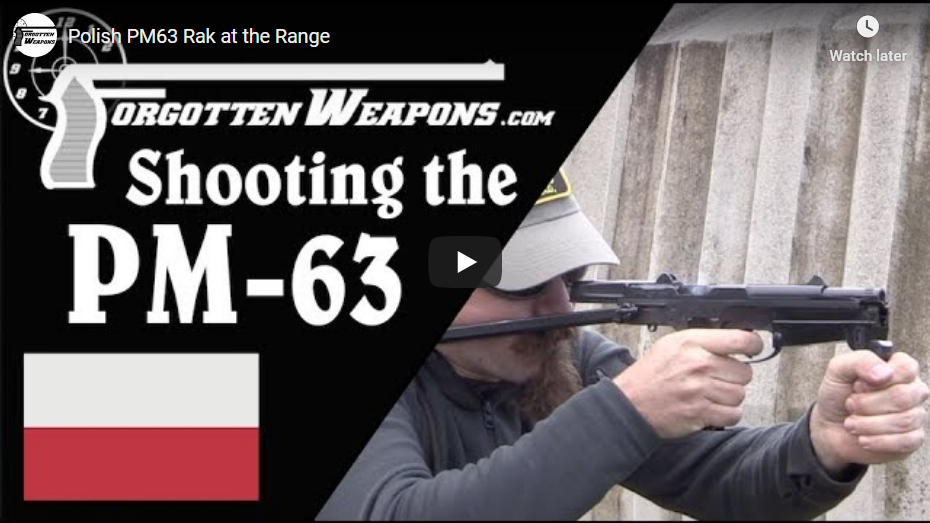
Polish PM63 Rak at the Range
Forgotten Weapons
Published on 8 Jun 2019http://www.patreon.com/ForgottenWeapons
Cool Forgotten Weapons merch! http://shop.bbtv.com/collections/forg…
Whether it is described as a machine pistol, a submachine gun, or a personal defense weapon, the PM63 Rak is really not the best examples of this sort of thing to actually shoot. The open-bolt/slide mechanism is very cool from an engineering and design perspective, but does in fact have a tendency to hit one in the face, as inadvertently demonstrated by my high-speed video shooting volunteer. Even if it doesn’t do that, the sights reciprocating on the slide make it a difficult gun to shoot accurately.
Thanks to Movie Armament Group in Toronto for giving me the opportunity to take this to the range! Check out MAG on Instagram: https://instagram.com/moviearmamentsg…
Contact:
Forgotten Weapons
PO Box 87647
Tucson, AZ 85754
August 2, 2019
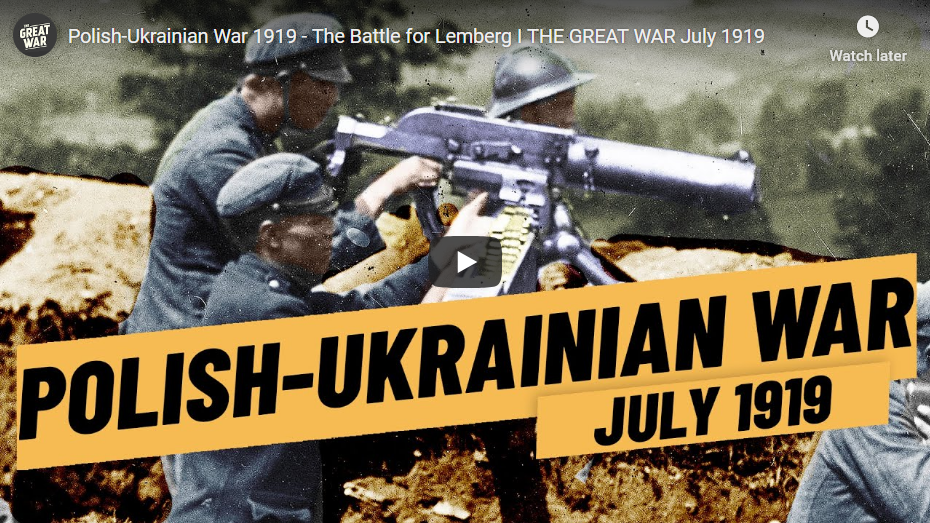
Polish-Ukrainian War 1919 – The Battle for Lemberg I The Great War July 1919
The Great War
Published on 1 Aug 2019Lviv or Lwów are two names for the same city that was known as Lemberg until 1919. The Poles considered it as one of their most important cultural and political centers, the Ukrainians too. And so, in the aftermath of the dissolution of the Austro-Hungarian Empire, the question of who would control this city led to conflict: The Polish-Ukrainian War.
» SUPPORT THE CHANNEL
Patreon: https://www.patreon.com/thegreatwar
Merchandise: https://shop.spreadshirt.de/thegreatwar/» SOURCES
Smele, Jonathan. The “Russian” Civil Wars 1916-1926 (London: Hurst, 2015).Mawdsley, Evan. The Russian Civil War (New York: Pegasus Books, 2005).
Leonhard, Jörn. Der überforderte Frieden. Versailles und die Welt 1918-1923 (CH Beck, 2018).
Macmillan, Margaret. The Peacemakers: Six Months That Changed the World (London: John Murray, 2001)
Dudko, Oksana: “Polish-Ukrainian Conflict over Eastern Galicia”, in: 1914-1918-online. International Encyclopedia of the First World War, ed. by Ute Daniel, Peter Gatrell, Oliver Janz, Heather Jones, Jennifer Keene, Alan Kramer, and Bill Nasson, issued by Freie Universität Berlin, Berlin 2014-10-08 https://encyclopedia.1914-1918-online…
Kutschabsky, W. Die Westukraine im Kampfe mit Polen und dem Bolschewismus in den Jahren 1918–1923 (Berlin, 1934)
Davies, Norman. White Eagle Red Star (Random House, 2003 (1972))
Sharp, Alan. The Versailles Settlement. Peacemaking and the First World War, 1919-1923 (Basingstoke: Palgrave Macmillan, 2008)
Judson, Pieter. The Habsburg Empire: A New History (Belknap Press, 2016)
Böhler, Jochen. Civil War in Central Europe, 1918-1921 (Oxford University Press, 2019)
Timothy Snyder. The Reconstruction of Nations. (New Haven: Yale University Press, 2003)
»CREDITS
Presented by: Jesse Alexander
Written by: Jesse Alexander
Director: Toni Steller & Florian Wittig
Director of Photography: Toni Steller
Sound: Toni Steller
Editing: Toni Steller
Mixing, Mastering & Sound Design: http://above-zero.com
Motion Design: Christian Graef – GRAEFX
Maps: Daniel Kogosov (https://www.patreon.com/Zalezsky)
Research by: Jesse Alexander
Fact checking: Florian WittigChannel Design: Alexander Clark
Original Logo: David van StepholdA Mediakraft Networks Original Channel
Contains licensed material by getty images
All rights reserved – Real Time History GmbH 2019
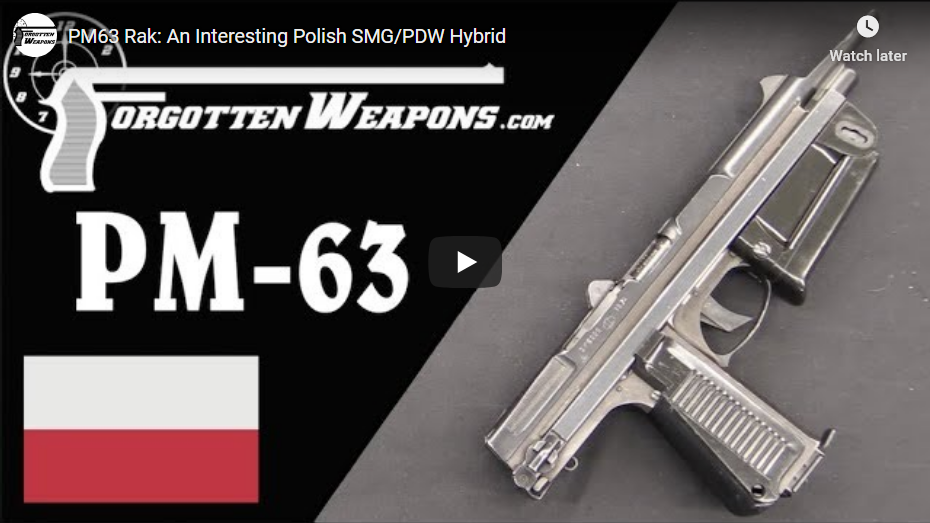
PM63 Rak: An Interesting Polish SMG/PDW Hybrid
Forgotten Weapons
Published on 7 Jun 2019http://www.patreon.com/ForgottenWeapons
Cool Forgotten Weapons merch! http://shop.bbtv.com/collections/forg…
The PM-63 Rak is a pretty interesting Polish Cold War machine pistol or personal defense weapon. It fires from an open bolt, but uses a slide like a pistol rather than a bolt in an enclosed receiver like a typical SMG. There are several other interesting elements to the design, so let’s take a closer look…
Thanks to Movie Armament Group in Toronto for giving me the opportunity to bring you this video! Check out MAG on Instagram: https://instagram.com/moviearmamentsg…
Contact:
Forgotten Weapons
PO Box 87647
Tucson, AZ 85754
July 18, 2019
Andrew Coyne interviews NATO Secretary General Jens Stoltenberg
In the National Post, Andrew Coyne discusses NATO, Donald Trump, and Russia with the current Secretary General of NATO, Jens Stoltenberg:

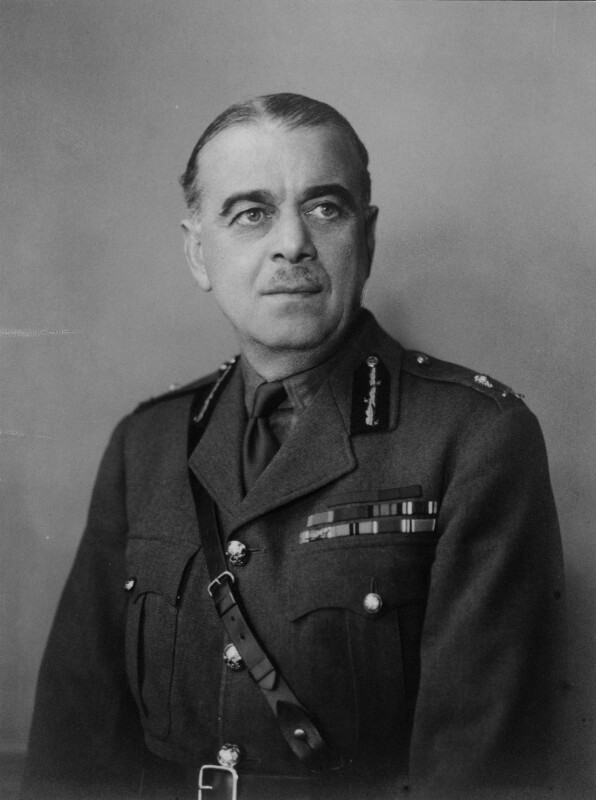
General Hastings “Pug” Ismay, later the first Secretary General of NATO during his military service as Winston Churchill’s chief military assistant in 1941.
Official British government photograph via Wikimedia Commons.
Throughout their term in government — and especially since Donald Trump’s victory in America’s 2016 election — Prime Minister Justin Trudeau’s Liberals have taken every opportunity to pay tribute to the “rules-based international order,” the consensus among countries that everyone’s interests are best served by following a set of rules and guiding principles that have evolved through the decades, expressed through things such as trade agreements and international alliances like the United Nations. If this consensus has a face it may be that of Jens Stoltenberg. The urbane former prime minister of Norway has been Secretary General of the North Atlantic Treaty Organization (NATO) since 2014, and through tough times for the international consensus he’s been one of the loudest voices defending it. This week he was in Canada to meet with Trudeau, to tour the Canadian Forces’ Garrison Petawawa and to discuss Canada’s NATO deployments in Latvia and Iraq. He sat down for an interview with the National Post‘s Andrew Coyne.
Q. Lord Ismay, NATO’s first secretary-general, famously defined the alliance’s mission as “keeping the Soviet Union out, the Americans in, and the Germans down.” When you hear some of the things Donald Trump says about NATO, about Article 5 (the collective defence provision) — are the Americans still in?
A. Yes. And they are more in now than they have been for a long time — meaning that they are actually increasing their NATO presence in Europe. After the end of the Cold War, Canada and the United States, for natural reasons, reduced their military presence in Europe. Because tensions went down, there was less need… Now tensions are increasing again, and both Canada and the United States are now increasing their military presence in Europe: Canada with a Canadian-led battle group in Latvia, and the United States with a battle group in Poland and also with a new armoured brigade. So what we see is that the United States is actually investing more in NATO, more military presence in Europe, more U.S. investments in infrastructure, in pre-positioned equipment, more exercises. So the message from the United States is that they are committed to NATO and we see that not only in words but also in deeds.
Q. But when you see Trump questioning the value of multilateral institutions, asserting “America First,” his chumminess with Putin, does it risk sending a signal that, if push came to shove — if Russia got up to no good in the Baltics or what have you — that America’s resolution to resist that would be less than certain?
A. For me the strongest possible signal to send is the presence of U.S. forces in Europe. The fact that we now, for the first time in the history of NATO, have U.S. troops in the eastern part of the alliance, in Poland and the Baltic countries. There is no way to send a clearer signal than that. And the Canadian troops because they are part of the picture. To have American troops in the Baltic countries sends a very clear signal that if a Baltic country is attacked it will trigger a response from the whole alliance… It’s not possible to imagine a stronger and clearer signal than that.
July 12, 2019
The European Migration Crisis – WW2 – WaH 004 – June 1940
World War Two
Published on 11 Jul 2019When the Nazi German Reich invades western and northern Europe this creates a massive refugee and forced migration crisis all across Europe. In eastern Europe, The Nazis and the Soviets have already been forcing families out of their homes to be relocated, incarcerated and murdered for nine months by now.
Join us on Patreon: https://www.patreon.com/TimeGhostHistory
Or join The TimeGhost Army directly at: https://timeghost.tvFollow WW2 day by day on Instagram @World_war_two_realtime https://www.instagram.com/world_war_t…
Join our Discord Server: https://discord.gg/D6D2aYN.
Between 2 Wars: https://www.youtube.com/playlist?list…
Source list: http://bit.ly/WW2sourcesWritten and Hosted by: Spartacus Olsson
Produced and Directed by: Spartacus Olsson and Astrid Deinhard
Executive Producers: Bodo Rittenauer, Astrid Deinhard, Indy Neidell, Spartacus Olsson
Creative Producer: Joram Appel
Post Production Director Wieke Kapteijns
Research by: Spartacus Olsson
Edited by:Spartacus Olsson
Map animations: EastoryEastory’s channel: https://www.youtube.com/channel/UCEly…
Archive by Screenocean/Reuters https://www.screenocean.com.A TimeGhost chronological documentary produced by OnLion Entertainment GmbH.
June 10, 2019
Bomb the Children – WW2 – WaH 003 – May 1940
World War Two
Published on 9 Jun 2019When WW2 breaks out, the belligerents promise to not bomb civilians. The promise is broken, literally within minutes by the Nazis and within weeks by the Soviets. Now, nine months later the Allies are about to follow suite.
Join us on Patreon: https://www.patreon.com/TimeGhostHistory
Or join The TimeGhost Army directly at: https://timeghost.tvFollow WW2 day by day on Instagram @World_war_two_realtime https://www.instagram.com/world_war_t…
Join our Discord Server: https://discord.gg/D6D2aYN.
Between 2 Wars: https://www.youtube.com/playlist?list…
Source list: http://bit.ly/WW2sourcesWritten and Hosted by: Spartacus Olsson
Produced and Directed by: Spartacus Olsson and Astrid Deinhard
Executive Producers: Bodo Rittenauer, Astrid Deinhard, Indy Neidell, Spartacus Olsson
Creative Producer: Joram Appel
Post Production Director: Wieke Kapteijns
Research by: Spartacus Olsson
Edited by: Wieke KapteijnsArchive by Screenocean/Reuters https://www.screenocean.com.
A TimeGhost chronological documentary produced by OnLion Entertainment GmbH.
From the comments:
World War Two
16 hours ago
Strategic Bombing is what it’s called, but in reality the strategic part is just theory – the simple reality is that people not involved in the fighting are going to die. This is a hot topic to this day. Who started? Was it justified to retaliate? Is it an acceptable method because the end justifies the means, that it might help win the war by breaking an enemy country? Does one strategic bombing of civilians make another murder of a thousand innocent victims less atrocious? Pretty absurd questions when you think about it. No matter who did it, no matter why they did it, no matter who started it, it’s really hard to justify the murder of children and unarmed adults – individuals that could not have any real influence on the outcome of the war.
May 16, 2019
Remembering Monte Cassino … and Wojtek the Bear, a Polish war hero
At the Daily Chrenk, Arthur Chrenkoff remembers the Polish soldiers who finally took Monte Cassino from the Germans in 1944, after earlier allied attempts by soldiers of many other nations (including Canada) had failed:

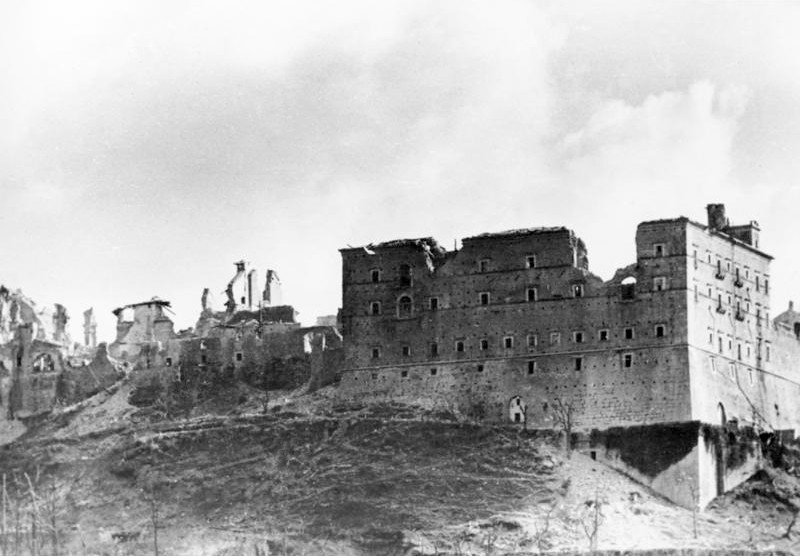
The ruins of the abbey at Monte Cassino after the 1944 battle.
Photograph credited to “Wittke” in the German Federal Archive (Bundesarchiv) via Wikimedia Commons.
On May 18, the day Australia goes to the polls, on the other side of the world we will be commemorating the 75th anniversary of the end of the bloodiest and hardest fought battle of the Italian campaign if not the whole of the Western front of WW2. On that day, a patrol from the 12th Podolian Cavalry Regiment raised the Polish flag above the ruins of the Benedictine monastery on top of Monte Cassino, bringing to an end four months and four Allied offensives against the heavily fortified Gustav (or Winter) Line, manned by crack German divisions across the entire width of the Italian boot about 100 miles south of Rome. Some of the German troops, veterans of the Eastern front, thought the fighting was worse than at Stalingrad. Others, on the Allied side, compared the conditions to Verdun. Unlike Russian cities or French fields, most of the fighting around Monte Cassino took place over an unimaginably difficult terrain of steep mountain slopes, deep valleys, wild rivers and landscape stripped bare by the artillery. It was a truly world battle in a world war: pitted against the Wehrmacht were the units from Great Britain, including British India and Rhodesia, the United States, France and its north African colonies like Morocco, Canada, Australia, New Zealand, including Maori troops, South Africa, Italy and Poland. Since the start of the Allied offensive in January 1944, waves after waves of troops of the 5th US and the 8th British armies smashed themselves against the rocks, unable to dislodge the well dug-in Germans. Finally, the fourth battle code-named Operation Diadem, which commenced with a massive bombardment on May 16, threw the British 13th Army Corp and the 2nd Polish Corp against the very linchpin of the Gustav Line at Monte Cassino and its monastery. Two days later it was over.
[…]
Churchill, right from the time of the Gallipoli disaster, remained obsessed about the vulnerability of the continental powers – primarily Germany – through what he called “the soft underbelly of Europe”. The war records are full of his harebrained schemes to attack the Axis through Italy, the Balkans or Greece and knock them out of the fight by a sharp thrust into the Central Europe. This was to be a masterstroke in place of the Normandy invasion, which Churchill strenuously opposed, and later in addition to it, to draw some of the German troops away from the northern France and indeed to get to Austria and southern Germany before the Red Army.
The problem with the soft underbelly of Europe is that it’s anything but. In fact it’s the hardest part of Europe; all rock, no roll. It’s mountains and deep valleys, fast rivers and vast forests, rudimentary roads and virtually no useful infrastructure. Unlike the northern European plains, this is the defender’s country where the Allies lost all the advantage of their numbers, their maneuverability and their armour. The two years of arduous slogfest from the southern Sicily to the Emilia-Romagna in the north might have indeed drawn valuable German troops from the other theaters of war but it was a bloody dead end. Poles were still stuck taking Bologna in April 1945, while only days later the patrols from Patton’s 3rd US Army were reaching the outskirts of Prague.
And Wojtek?
Monte Cassino is on my mind today, because entirely coincidentally I’m reading a delightful war book (that’s an oxymoron if there is one) titled Wojtek the Bear: Polish War Hero. It tells the surreal but entirely true story of a bear cub adopted by the Polish troops in northern Iran in 1942, towards the start of their anabasis from Stalin’s Siberia all the way to Italy and eventually Scotland. Accompanying the Poles through all their service in the Middle East and then southern Europe, Wojtek grew up to be a 6-foot, 500-pound ursine, who always thought he was a human. Quintessentially Polish (if only by adoption), he loved beer and cigarettes (he also ate them, but only if lit), taking showers with the troops and riding shotgun in army trucks. Some of his war-time exploits included capturing an Arab spy in Iraq and stealing underwear from a female support unit. But Wojtek truly became a legend during the battle of Monte Cassino, when to his comrades’ amazement he volunteered to carry ammunition in his paws. He was eventually made a Private in the Polish Army, and lived until 1963, continuing to win hearts in Scotland, where the Polish troops were repatriated after the war.