Historigraph
Published 26 Oct 2019Buy Historigraph Posters here! https://teespring.com/en-GB/surrender…
Support the channel on Patreon: https://www.patreon.com/historigraph#SurrenderOfTheHighSeasFleet #OperationZZ #Historigraph
►Twitter: https://twitter.com/historigraph
►Instagram: https://www.instagram.com/historigraph
►Patreon: https://www.patreon.com/historigraph
►Discord: https://discord.gg/vAFTK2DMusic:
Crypto, Incompetech https://incompetech.com
Rynos Theme, Incompetech https://incompetech.com
Britain’s Naval March, “Hearts of Oak”
Kaiserlicher Marinemarsch “Gruß an Kiel“
October 28, 2019
The Surrender of the Imperial German High Seas Fleet
October 25, 2019
The World Takes Advantage of American Isolationism | BETWEEN TWO WARS | 1933 part 3 of 3
TimeGhost History
Published 24 Oct 2019America is very unprepared for rising tensions in the Pacific and in Europe. US President Franklin Roosevelt tries his best to re-arm the American Army and Navy, but the isolationist opposition is a fierce obstacle.
Join us on Patreon: https://www.patreon.com/TimeGhostHistory
Subscribe to our World War Two series: https://www.youtube.com/c/worldwartwo…
Hosted by: Indy Neidell
Written by: Joram Appel
Directed by: Spartacus Olsson and Astrid Deinhard
Executive Producers: Bodo Rittenauer, Astrid Deinhard, Indy Neidell, Spartacus Olsson
Creative Producer: Joram Appel
Post-Production Director: Wieke Kapteijns
Research by: Rune Vaever Hartvig, Sietse Kenter and Joram Appel
Edited by: Daniel Weiss
Sound design: Marek KaminskiPicture colorizations by: Norman Stewart, Julius Jääskeläinen, Daniel Weiss and Joram Appel
A TimeGhost chronological documentary produced by OnLion Entertainment GmbH.
From the comments:
TimeGhost History
1 day ago (edited)
This episode is very much about the global ramifications of the US’s foreign policy. American inaction and isolationism left room for other nations to develop imperialist ambitions. There are of course a lot of other factors that influenced the rise of expansionist and militarist governments in Europe and East-Asia, many of which are explained in our other Between Two Wars episodes. In no way does this video have any connection to current-day events or our opinion on them. This is what happened, our future episodes will be about what followed. We’re historians and that’s all we want to do here.
Cheers,
Joram
October 18, 2019
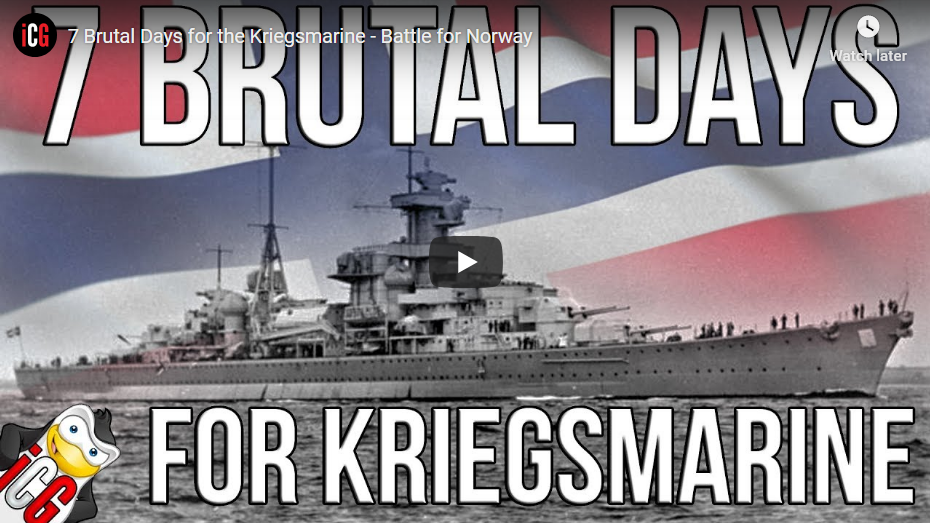
7 Brutal Days for the Kriegsmarine – Battle for Norway
iChaseGaming
Published on 9 Sep 2019The first few days of Operation Weserübung, the invasion of Norway, cost the Kriegsmarine‘s surface fleet dearly. While the invasion and occupation was successful the German Navy would be hampered for the remainder of the war.
♥ Connect with me ♥
Discord: https://discord.gg/ichasegaming
Twitch: http://www.twitch.tv/ichasegaming
Twitter: https://twitter.com/iChaseGaming♦ Become my Patron at https://www.patreon.com/iChaseGaming ♦
To contact me via e-mail send it to chasegamingtv@gmail.com
October 12, 2019
“Midway” – The Battle of Midway – Sabaton History 036 [Official]
Sabaton History
Published 11 Oct 2019The Battle of Midway in June 1942 was one of the decisive battles on the Pacific front during World War Two. The Sabaton song “Midway” is about that battle and the men who sailed, flew, fought and died there.
Support Sabaton History on Patreon: https://www.patreon.com/sabatonhistory
Listen to Coat of Arms (where “Midway” is featured):
CD: http://bit.ly/CoatOfArmsStore
Spotify: http://bit.ly/CoatOfArmsSpotify
Apple Music: http://bit.ly/CoatOfArmsAppleMusic
iTunes: http://bit.ly/CoatOfArmsiTunes
Amazon: http://bit.ly/CoatOfArmsAmzn
Google Play: http://bit.ly/CoatOfArmsGooglePlayWatch the Official Lyric Video of Midway here: https://www.youtube.com/watch?v=0WAfB…
Listen to Sabaton on Spotify: http://smarturl.it/SabatonSpotify
Official Sabaton Merchandise Shop: http://bit.ly/SabatonOfficialShopHosted by: Indy Neidell
Written by: Markus Linke and Indy Neidell
Directed by: Astrid Deinhard and Wieke Kapteijns
Produced by: Pär Sundström, Astrid Deinhard and Spartacus Olsson
Creative Producer: Joram Appel
Executive Producers: Pär Sundström, Joakim Broden, Tomas Sunmo, Indy Neidell, Astrid Deinhard, and Spartacus Olsson
Maps by: Eastory
Edited by: Iryna Dulka
Sound Editing by: Marek KaminskiEastory YouTube Channel: https://www.youtube.com/channel/UCEly…
Archive by: Reuters/Screenocean https://www.screenocean.com
Music by Sabaton.Sources:
National Security Agency
Letter icon by Mochammad Kafi from the Noun Project
Ship icon by Edward Boatman from the Noun ProjectAn OnLion Entertainment GmbH and Raging Beaver Publishing AB co-Production.
© Raging Beaver Publishing AB, 2019 – all rights reserved.
September 28, 2019
The Freikorps Fights On – Estonia and Latvia War For Independence I THE GREAT WAR 1919
The Great War
Published 27 Sep 2019Support 16 Days in Berlin: https://realtimehistory.net/indiegogo
After the Battle of Cesis it seemed the situation in Latvia and Estonia was about to quieten down. But the German soldiers in the region and the ongoing conflict with Bolshevik Russia meant the 2nd half of 1919 saw even more fighting in the Baltics.
» SUPPORT THE CHANNEL
Patreon: https://www.patreon.com/thegreatwar
Merchandise: https://shop.spreadshirt.de/thegreatwar/»CREDITS
Presented by: Jesse Alexander
Written by: Jesse Alexander
Director: Toni Steller & Florian Wittig
Director of Photography: Toni Steller
Sound: Toni Steller
Editing: Toni Steller
Mixing, Mastering & Sound Design: http://above-zero.com
Maps: Daniel Kogosov (https://www.patreon.com/Zalezsky)
Research by: Jesse Alexander
Fact checking: Florian WittigChannel Design: Alexander Clark
Original Logo: David van StepholdA Mediakraft Networks Original Channel
Contains licensed material by getty images
All rights reserved – Real Time History GmbH 2019
QotD: Ship availability in the Royal Navy
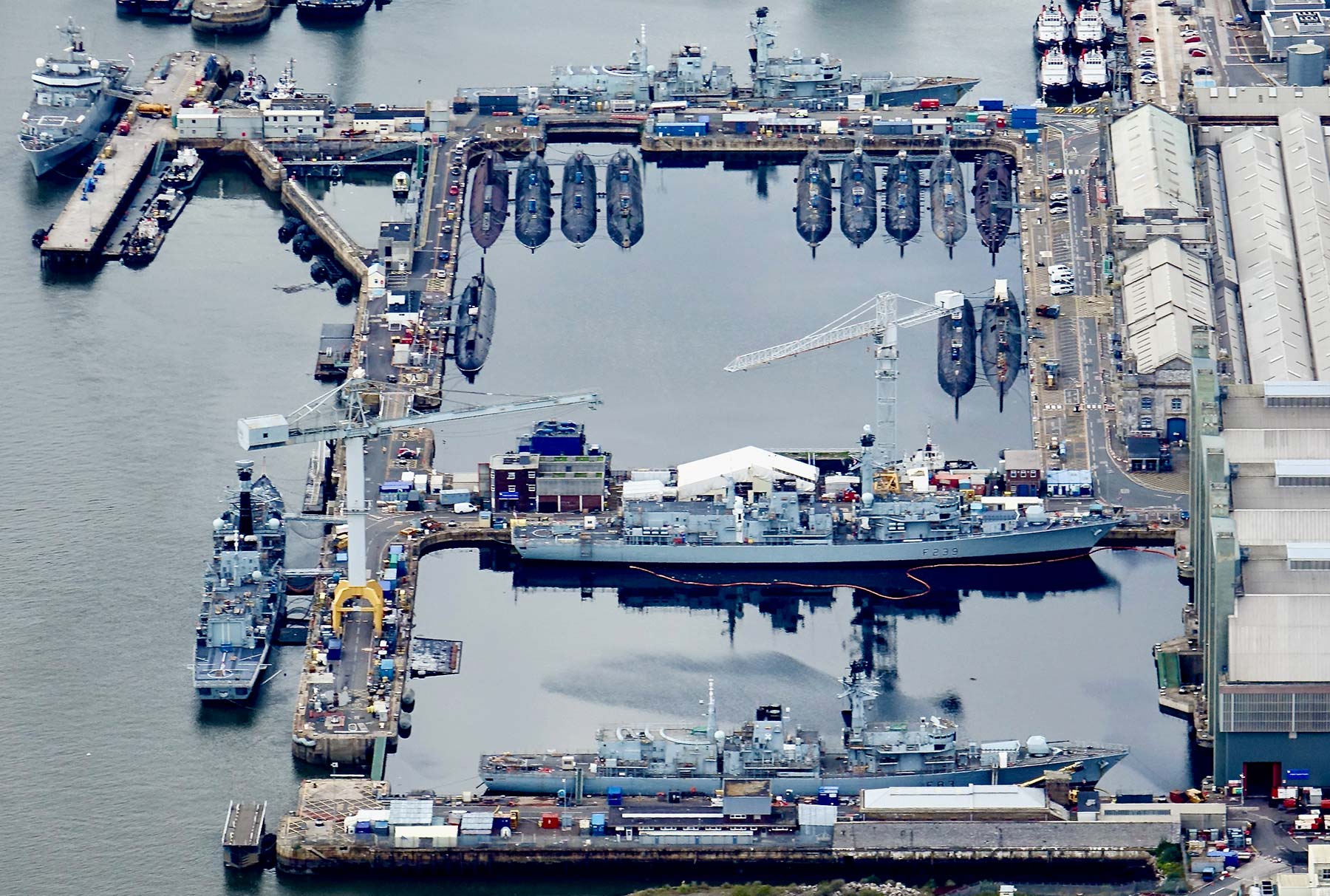
[T]he traditional metric of how a navy can deploy is that it requires a roughly 3:1 ratio to sustain a vessel on a task indefinitely — in very rough terms this means that when a ship is deployed on OP KIPION, her successor is nominated and working up through to being on passage to join her (e.g. HMS Daring saw HMS Monmouth sail sometime before being relieved). At least one more ship is going to be somewhere in the refit system requiring essential maintenance, upkeep and life extension work too. This 3:1 ratio is something which can be broken, and availability can vary over time — but as a general rule if you want to keep a ship on task for the long haul, you’ll need three ships to do this.
In the case of the current RN, the force of 19 hulls is actually 17, with two in long term “harbour training ship” (NOT reserve which has a specific and different meaning) roles to save on manpower levels. This means the RN is sweating its assets incredibly hard to keep ships on task for the long haul — particularly at a point when the T23 fleet is starting to show its age, and also go through a complex Mid Life Update process — at its simplest, ships designed for 18 years of life will be nearly 40 before they leave service, and it’s showing.
But, the risk is that in looking at the headline figure of “only” 6 escorts, we lose the ability to explain that this is actually pretty good by any navy’s standards. If you look at the world’s navies right now, there are very few which are able to deploy and sustain more than one or two ships at distance from home — the USN, occasionally the French and Russians and that’s about it. Others can do some quite impressive training deployments, more for showing the flag than delivering effect. Other navies may deploy escorts, but to do so occupies a big chunk of their naval training and output for the year to deliver this, at the hidden cost of keeping other ships alongside.
Don’t make the lethal mistake of assuming that because the RN “only” has 6 ships out there that every other navy is laughing at it. In fact the RN’s ability to sweat its force so hard remains a real point of awe for other nations, who are amazed at how much the RN can do at one time.
Sir Humphrey, “Lies, Damned Lies and Statistics”, Thin Pinstriped Line, 2017-07-09.
September 4, 2019
Viewing WW2 as “the Air-Sea Super Battlefield”
According to Phillips Payson O’Brien, it’s old-fashioned to view large land battles as being “decisive” in modern warfare:

Kombat (Russian: Комбат, lit. “battalion commander”) is a black-and-white photograph by the Soviet photographer Max Alpert. It depicts a Soviet military officer armed with a TT pistol who is raising his unit for an attack during World War II. This work is regarded as one of the most iconic Soviet World War II photographs, yet neither the date nor the subject is known with certainty. According to the most widely accepted version, the photograph depicts junior politruk (political officer) Aleksei Gordeyevich Yeryomenko, minutes before his death on 12 July 1942, in Voroshilovgrad Oblast, Ukraine.
Wikimedia Commons.
Allied victory in WWII is usually viewed through the lens of large land battles, from Stalingrad to Kursk to D-Day. However, battlefield losses of equipment in these “great” land battles were relatively small and easily replaceable. This column demonstrates that the real effort of the major powers was put into the construction of air and sea weapons. The Allies used their air and sea power to destroy the Axis’s in a multi-layered campaign. This was the true battlefield of WWII: a massive air-sea super battlefield that stretched for thousands of miles. Victory in this super-battlefield led to victory in the war.
Every aspect of WWII is discussed in a vast literature. Considering its diversity, explanations of why Germany lost the war are surprisingly predictable. It remains widely argued that the Nazis were beaten mostly by the Soviet Union’s powerful Red Army (Hastings 2005: 508, Kennedy 2013: 183).
From June 1941 to May 1945, German “power” was supposedly engaged and destroyed by the Russians. At some points, more than two-thirds of German infantry were engaged against the Red Army. The famous battles of the Eastern Front, such as Stalingrad and Kursk, supposedly caused the Germans’ crippling losses. The upshot of this lopsided deployment was that most German soldiers died in the East. Fighting against the Americans and British, conversely, is often portrayed as a secondary concern (Roberts 2010: 573).
What’s wrong with a focus on battles?
This battle-centric view, like much history of WWII, is old-fashioned. Historians of strategy have moved away from seeing battles as determinative. Nolan (2017) has argued that attrition losses are more important than battle losses in explaining outcomes.
The battle-centric analysis implies that infantry deployment is the best way to analyse effort. Yet, human-power was rarely the key factor in deciding combat in WWII. Equipment and specialised training mattered more. Possessing and operating the largest stores of modern weapons, not only tanks and artillery but also aircraft and naval vessels, determined the course of battles and the war.
If we reframe the discussion of the war to look not only at what equipment was made but also at how it was destroyed, it emerges that the war was decided far from the land battlefield (O’Brien 2015). The most striking sign of this is how little war production went to the land war and how much went to the combined air-sea war. This was the case for all the powers except the USSR.
August 31, 2019
Young Recruits, French Planes, and Graf Spee – WW2 – OOTF 003
World War Two
Published on 30 Aug 2019How young were British soldiers? Could Graf Spee have gotten away? What was the French air force like? Questions, questions, questions – from you no less! With answers from us Out of the Foxholes.
Join us on Patreon: https://www.patreon.com/TimeGhostHistory
Or join The TimeGhost Army directly at: https://timeghost.tvFollow WW2 day by day on Instagram @World_war_two_realtime https://www.instagram.com/world_war_t…
Join our Discord Server: https://discord.gg/D6D2aYN.
Between 2 Wars: https://www.youtube.com/playlist?list…
Source list: http://bit.ly/WW2sourcesImage sources:
Drawing Morane-Saulnier M.S.406 C1 and Dewoitine D.520 fighters : KaboldyWritten and Hosted by: Indy Neidell and Nicholas Moran
Produced and Directed by: Spartacus Olsson and Astrid Deinhard
Executive Producers: Bodo Rittenauer, Astrid Deinhard, Indy Neidell, Spartacus Olsson
Creative Producer: Joram Appel
Research by: Indy Neidell, Nicholas Moran, and Joram Appel
Edited by: Wieke KapteijnsEastory’s channel: https://www.youtube.com/channel/UCEly…
Archive by Screenocean/Reuters https://www.screenocean.com.A TimeGhost chronological documentary produced by OnLion Entertainment GmbH.
From the comments:
World War Two
39 minutes ago
One day before the war has being going on for a whole year, we look back at some stuff from 1939 and 1940. And once again Nicholas Moran, the Chieftain https://www.youtube.com/user/TheChieftainWoT joins us to answer your questions. This time he leaves his main turf (tanks) to dive into his other area of expertise; naval battles. Please remember that we can’t field questions from the comments so if you want submit a new question do it here: https://community.timeghost.tv/c/Out-of-the-Foxholes-QsComing out with Out of the Foxholes has been a bit of a challenge as we try to master the crazy amount of stuff going on in our main episodes. But thanks to the fantastic collaboration of the TimeGhost Army on https://www.patreon.com/TimeGhostHistory and https://timeghost.tv we are constantly expanding our capacity and we hope to come out with these a bit more often now! For now, enjoy and remember that tomorrow our first anniversary episode comes out!
August 27, 2019
H&K Mk23 SOCOM .45 Development
Forgotten Weapons
Published on 28 Jun 2019http://www.patreon.com/ForgottenWeapons
Cool Forgotten Weapons merch! http://shop.bbtv.com/collections/forg…
The H&K Mk 23 pistol was developed in the 1990s for the US Special Operations Command and US Navy. The goal was to produce an “offensive handgun” that could serve as a primary armament for a special forces operator as well as a backup arm. It was required to be no more than 12 inches long, fit a suppressor and aiming module with laser and illumination options in both visible and IR spectrum, have at least 10-round magazines, chamber .45 ACP (specifically a 185gr +P loading), and pass a 30,000 round endurance test.
Only two companies were able to supply acceptable initial pistols; H&K and Colt. The Colt pistol failed to pass the 1st phase testing. H&K presented a gun based on the recently-developed USP design, was ultimately chosen as the project winner; adopted as the Mk 23 pistol in 1996. The testing this pistol went through during development is really quite remarkable.
Contact:
Forgotten Weapons
PO Box 87647
Tucson, AZ 85754
August 19, 2019
QotD: Hitler’s “wonder weapons”
Historians have generally thought of the Type XXI [submarine] — along with other systems like the Me 262, V-1 and V-2 rockets, and the Tiger tank — as an example of Wunderwaffen, wonder weapons. Since 1945 many have fixated on the revolutionary military technologies that the Third Reich developed in the last two years of the war. The cultural impetus behind the concept, as implicitly or explicitly acknowledged by historians in the uneven and largely enthusiastic literature on the subject, was an irrational faith in technology to prevail in operationally or strategically complex and desperate situations — a conviction amounting to a disease, to which many in the Third Reich were prone in the latter years of the Second World War. To the extent that it shaped decision making, faith in the Wunderwaffen was a special, superficial kind of technological determinism, a confidence in the power of technology to prevail over the country’s strategic, operational, and doctrinal shortcomings. To the extent that leaders, officers, engineers, and scientists after 1943 believed innovation to be the answer to Germany’s strategic dilemmas, they displayed a naive ignorance of how technology interacts with cultural and other factors to influence the course of events. In particular, they reflected a willful ignorance of the extent to which even substantial technological superiority has proved indecisive in human conflict throughout history.
Marcus Jones, “Innovation For Its Own Sake: The Type XXI U-boat”, Naval War College Review, 2014-04.
July 29, 2019
Life and love aboard HMS Pacific Princess
Sir Humphrey is not amused at the stories in the British press about pregnant Royal Navy sailors needing to be flown back to the UK from some of Her Majesty’s deployed ships:
Life in the Royal Navy is less about preparing for war, and more like spending time on the loveboat. That seems to be the gist of quite a few stories in the media today which breathlessly relate to the news that since 2005 35 women sailors from 18 different ships have been airlifted to shore as a result of becoming pregnant and discovering this while they were at sea.
This news has been met with shock and horror by some commentators online, some of whom give the distinct impression that they are not intimately familiar with the process by which babies are made. At least one Daily Mail reader suggested that Chasity belts should form part of naval uniform for female members of the naval service (presumably in the RN kit record book it would be recorded as a “Torpedo Protection Belt”?).
Is the nation being let down by a bunch of serial shaggers in uniform or is perhaps the truth of the matter a little more complex than originally conceived?
The specific FOI that was referred to in the article, which looks like it originated in the Daily Star (alongside another story suggesting that the 2003 Iraq war occurred due to Saddam possessing “stargate” technology and the US and allies wanting to prevent various aliens attacking the Earth) asked for the total number of females aeromedically evacuated between 2005 and 2019. Confusingly though there is also some suggestion that the Sun also got the story as an exclusive – to be honest, its rather hard to tell.
To start with, a sense of context is perhaps useful. This FOI is a well worn question which seems to have been asked quite a few times over the years. Humphrey has found similar articles from 2015 and 2017 and 2018, so its not exactly breaking news that the RN has had to occasionally return sailors ashore when they find out they are pregnant.
The numbers involved sound dramatic – a whole 35 women flown at public expense due to getting pregnant. In 2015 the number was 25, so in the last four years a whole 10 additional women sailors have discovered they were pregnant while onboard a ship.
Given that the Royal Navy consists of about 3,000 women at any one time (roughly 10% of the Naval Service) and that each year roughly 3000 people join the Royal Navy (lets assume 300 women based on the above figure), then in very big handfuls between 2005 and 2019 roughly 7500 women have served in the Royal Navy at different times. The figure is likely to be even higher still, but it’s a useful, albeit very rough, “guesstimate”.
This means that of the 7500 women, a total of 35 have discovered they were pregnant while at sea during this period. That works out at, roughly, 0.5% of the total force spread over 14 years. This doesn’t sound quite as dramatic as first made out to be.
July 28, 2019
“Fantasy Fleet” notions for the RCN
I hate to use the term “fantasy fleet” when linking to a Ted Campbell article … he’s far from being an obsessive who loves amassing lists of cool, gosh-wow hardware, as he’s a retired former army officer who actually does know what he’s talking about on military matters. I apply the term because no matter how sensible and practical these suggestions are (and I largely agree with them on those terms), there is no chance the current government or even a Conservative government under the Milk Dud could stand the political heat they’d take for devoting the kind of ongoing investment a fleet renewal and expansion like this would generate:

The Kingston-class Maritime Coastal Defence Vessel (MCDV) HMCS Moncton in Baltimore harbour for Sailabration 2012.
Photo by Acroterion via Wikimedia Commons.
… Canada’s 25 years old Kingston class vessels have a range of up to 5,000 nautical miles and can carry unmanned aerial vehicles, but they are slow and are designed for underwater warfare, being fitted with specialist payloads to look for mines and other things on the seabed … The Royal Canadian Navy has said, in the past, that it needs 25± surface combatants (the Navy uses the term “bottoms” when it means surface ships) and Canada has, now, 12 of the 30-year-old (but still lethal) Halifax class frigates and we also have, right now, 12 very useful little Kingston class ships, too. Canada plans (hopes?) to have 12 of the new Type 26 ships in the future, plus 5 of the very large (6,500+ tons) Harry DeWolf class Arctic patrol ships … so we are going from 24 down to 17?

A Chilean navy boarding team fast-ropes onto the flight deck of RCN Halifax-class frigate HMCS Calgary (FFH 335) during multinational training exercise Fuerzas Aliadas PANAMAX 2009.
US Navy photo via Wikimedia Commons.
My guesstimate is that a proper Canadian Navy needs, in addition to supply/support ships, at least:
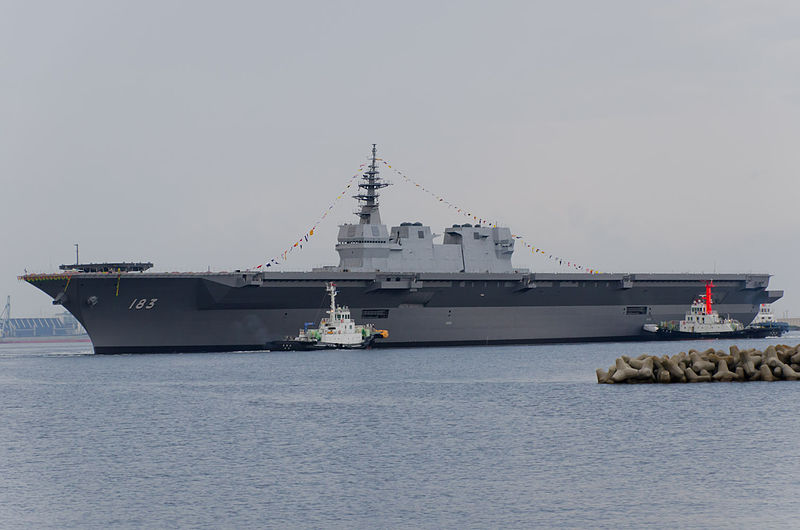
- 2 or 3 large (25,000± tons) helicopter carrying “destroyers,” (in fact, small aircraft carriers) perhaps like the modern Japanese Izumo-class multi-purpose “destroyers” (pictured below) to conduct multi-purpose operations, including carrying combat-ready specialized amphibious warfare trained soldiers, on a global basis;
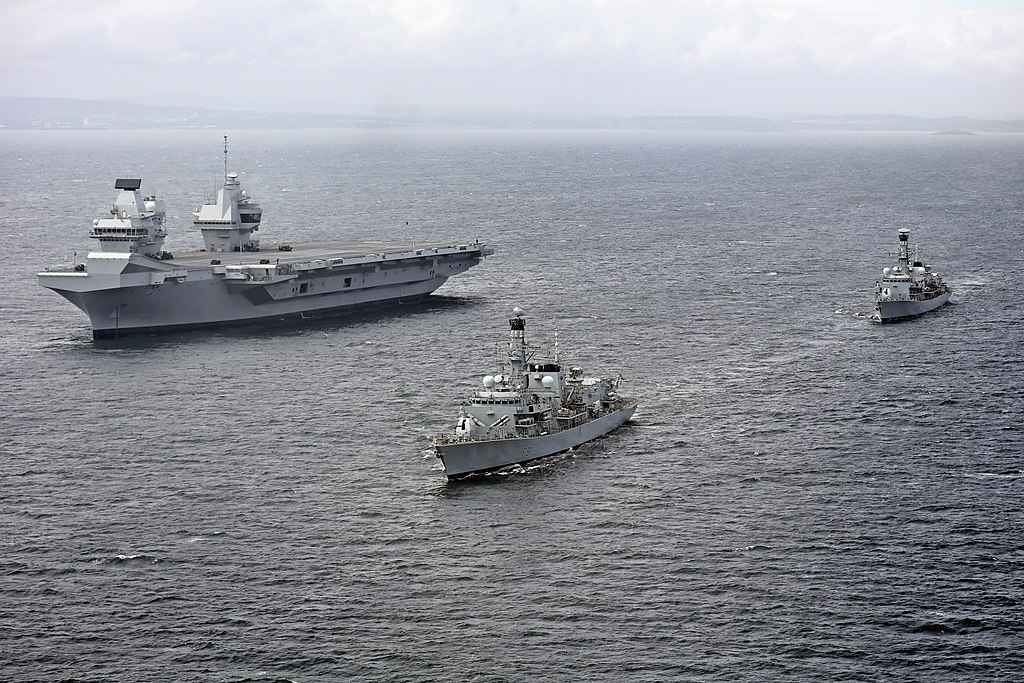
- 8 to 12 Type-26 destroyer-frigates (below) ~ I believe (guess) they will also be named for Canadian provinces, cities or rivers or something;
- 6 to 10 modern corvettes (a modern Dutch design is pictured below), 1,500-ton to 2,500-ton vessels, with a 5,000± nautical mile range, each able to carry a helicopter or, at least, a large unmanned aerial vehicle;
KRI Diponegoro (pennant number 365) of the Indonesian navy. The Sigma (Ship Integrated Geometrical Modularity Approach) class is a Dutch modular design that can be built in OPV, corvette, or frigate variants. In 2019, ships of this class are in service with Indonesia, Morocco, and Mexico.
Photo by Wim Kosten via Wikimedia Commons.- 6 to 10 special purpose, ocean-going (i.e. with a range measured in thousands, not hundreds of nautical miles) underwater warfare vessels to replace the Kingston-class ships; and
The lead vessel of the Orca-class in the Gulf Islands on officer training in August, 2007. She is not a commissioned naval ship, so does not bear the HMCS designation. Orcas are not generally armed, but the foredeck has been strengthened to allow an M2 12.7mm machine gun to be mounted if necessary.
Photo via Wikimedia Commons.- 8 to 12 armed “training” ships, about 250 tons (about the same as the Finnish Hamina class) to replace the (fairly new) Orca class vessels, which are not warships. These ships would be, primarily, training vessels, for which there is, always, a pressing need but they could, in emergencies, be used for coastal, constabulary patrol and search and rescue duties, too. The important thing is that they would be real warships, in commission, armed about as well as the Harry DeWolf class ships (which would enhance their training value, too) and, therefore, able to “fight.”
In his ideal world (i.e., not the one we’re living in at the moment), that would be the RCN’s combat fleet. Submarines, logistical support vessels, and (lots of) helicopters would also be required, which would further put this shopping list out of consideration for a Canadian peacetime government.
One thing to keep in mind for most of us civilians, is that warships operate in very rough environmental conditions even in peacetime, and require much more in the way of maintenance and service than your car or pleasure boat. This is why, even if you have a dozen ships “in commission”, you’ll likely only have eight of them available for deployment as the others will be in various states of maintenance and repair. For operations far from home, you really need three ships for each one actually deployed on active service, to account for the back-shop work to keep the ships afloat, fully staffed, and fully capable, plus transit time for the ship itself getting to and from the area of operations, and adequate leave and out-of-combat rest and recreation for the crews.
No Deal… Herr Hitler! – WW2 – 048 – July 27 1940
World War Two
Published on 27 Jul 2019Hitler searches for ways to force Britain out of the war, but the British sit safely behind their cliffs, their channel and their Royal Navy. Engaging the navy and invading Britain would require a major air-superiority. As a result, the Germans plan to knock the British out of the skies. This is the Battle of Britain.
Join us on Patreon: https://www.patreon.com/TimeGhostHistory
Or join The TimeGhost Army directly at: https://timeghost.tvFollow WW2 day by day on Instagram @World_war_two_realtime https://www.instagram.com/world_war_t…
Join our Discord Server: https://discord.gg/D6D2aYN.
Between 2 Wars: https://www.youtube.com/playlist?list…
Source list: http://bit.ly/WW2sourcesWritten and Hosted by: Indy Neidell
Produced and Directed by: Spartacus Olsson and Astrid Deinhard
Executive Producers: Bodo Rittenauer, Astrid Deinhard, Indy Neidell, Spartacus Olsson
Creative Producer: Joram Appel
Post-Production Director: Wieke Kapteijns
Research by: Indy Neidell
Edited by: Iryna Dulka
Map animations: EastoryColorisations by Norman Stewart and Julius Jääskeläinen https://www.facebook.com/JJcolorization/
Eastory’s channel: https://www.youtube.com/channel/UCEly…
Archive by Screenocean/Reuters https://www.screenocean.com.A TimeGhost chronological documentary produced by OnLion Entertainment GmbH.
From the comments:
World War Two
1 week ago (edited)
World War Two is a very complex topic, and even with one or more videos a week, there is a lot of information or context that we don’t get to cover on this channel. That’s why are doing series on the interwar years (1919-1939) called “Between Two Wars” on our TimeGhost History channel. We’re currently in 1929, and we’ll be making generally two thematic episodes for each year of the interwar period. If you want to understand what led up to this massive and destructive conflict, do make sure to check the channel out here: https://www.youtube.com/channel/UCLfMmOriSyPbd5JhHpnj4NgCheers,
Joram
Sea Lion: Why not just invade the UK in 1940?
Military History Visualized
Published on 13 Oct 2017Quite often people remark Hitler should just have finished off the UK before attacking the Soviet Union. Well, there are many problems with that assumption.
»» SUPPORT MHV ««
» patreon – https://www.patreon.com/mhv
» paypal donation – https://www.paypal.com/cgi-bin/webscr…Military History Visualized provides a series of short narrative and visual presentations like documentaries based on academic literature or sometimes primary sources. Videos are intended as introduction to military history, but also contain a lot of details for history buffs. Since the aim is to keep the episodes short and comprehensive some details are often cut.
July 24, 2019
Sinking Ship Simulator: The Royal Navy’s Damage Repair Instructional Unit
Tom Scott
Published on Sep 7, 2015http://tomscott.com – with many, many thanks to the Royal Navy and everyone at HMS Excellent! http://royalnavy.mod.uk
How do you train sailors to save a sinking ship? Sure, you can teach them the theory, but there’s no replacement for having to hammer softwood wedges into deck and bulkhead splits that are spraying cold, high-pressure water in your face.
At HMS Excellent in Portsmouth sits Hazard, a Royal Navy Damage Repair Instructional Unit (DRIU). Every Navy recruit who’s going out to sea will have to go through something like this — and on a much harder level than we did! But then, they’ll have had months of training and teamwork beforehand…
DIRECTED BY Matt Gray: http://mattg.co.uk – @unnamedculprit – see behind-the-scenes video at https://www.youtube.com/watch?v=zwlnb…
WITH:
Paul Curry – @cr3
Melinda Seckington – http://missgeeky.com – @mseckingtonAnd again, with many thanks to all the Navy team who were so generous with their time and effort: http://royalnavy.mod.uk – http://twitter.com/royalnavy