
May 30, 2011
Cory Doctorow: “Every pirate wants to be an admiral”
May 29, 2011
Ace declares his lust for Christina Hendricks
I dropped by Ace of Spades H.Q. to steal borrow their nifty little “DOOM” graphic to slap on to the last post about the coming collapse of the US dollar, when I happened to read a paean to the lovely Christina Hendricks by Ace. He out-and-out declares his lust for her.
No, I mean he really does:
By The Way: Christina Hendricks Is Hot
I guess I didn’t telegraph this enough, but I was kidding when I said I might not “hit” Christina Hendricks.
I mean: Seriously.
It looks like two polar bears in a Greco-Roman wrestling match.
I didn’t have an “I’d hit that like…” joke so I went the other way and pretended she wasn’t hot. I thought it would be obvious I was kidding.
I’ve written fan fic for an attempted Firefly spin-off series I call Saffron: Intergalactic Space Whore (Moderate Content Warning).
I know I didn’t telegraph this because people are still asking, “Dude, do you not think she’s hot?” So it’s on me.
So, for the record: She’s hot.
I’d hit that with the berserker fury of a dozen Norsemen. I’d hit that so hard she’d sing the aaa-aaa chorus of The Immigrant Song.
As the cool kids used to say . . . THIS.
May 25, 2011
Netflix now the 500lb gorilla sitting on your internet bandwidth
In a shocking display that if you make something legally accessible, people are willing to pay for it (who’d ever have expected that?), Netflix has supplanted Bittorrent as the largest user of peak-time internet traffic:
Is solving the copyright “wars” really so difficult? New traffic research shows that Netflix has overtaken Bittorrent as America’s favourite internet application, knocking http into third place. “P2P is here to stay,” note the authors in Sandvine’s Global Internet Report, Spring 2011 edition, which shows that demand for legal, paid-for stuff is the single biggest internet traffic trend.
Copyright-holders who are slow to bless legal services, by contrast, find themselves being swamped by pirates.
Netflix now accounts for 24.71 per cent of peak time aggregate traffic in the US, pushing Bittorrent into second place with 17.23 per cent. By contrast, the Sandvine numbers show that in markets where there are no legal services, pirate services flourish. In Latin America, file-sharing program Ares grabs 15.48 per cent of peak-time (fixed line) internet traffic, behind http. In Europe, Bittorent rules, with 28.4 per cent of peak-time traffic, ahead of http. Here, YouTube grabs third place, with almost 12 per cent of peak-time traffic.
We signed up for a month-long trial of Netflix (on the recommendation of Dark Water Muse) and have been quite happy with the service. In fact, it was a major factor in our buying a PS3 over the weekend, as our existing Blu-Ray player was incompatible with Netflix.
May 9, 2011
Gadgets from science fiction
Caleb Cox rounds up ten geeky gadgets from science fiction shows and movies that he thinks we’d all like to have:
Tomorrow is always round the corner in the world of tech, and gadgets that started life in the imaginations of mad folk are starting to become a possibility.
Tools that give us superpowers may seem impossible, but ultramobile computing is a reality these days, with commonplace kit that seems more capable than devices Gene Roddenberry dreamt up.
As we’ve already looked at fantasy blades you wished you owned, it’s about time we talked-up the fantasy tech, after all, we are Reg Hardware. So here’s ten of our favourite gadgets from popular culture that may or may not be the tech of the future.
Let us know if there’s anything you think we’ve missed and give us your views on its commercial prospects in the comments section at the end.
His choices are:
- Cloaking device — Predator
- Holodeck — Star Trek: The Next Generation
- Hologram communication — Star Wars
- Orgasmatron — The Sleeper
- Peril Sensitive Sunglasses — The Hitchhiker’s Guide to the Galaxy
- Personality glasses — Joe 90
- Sonic Screwdriver — Doctor Who
- Timebooth — Bill & Ted’s Excellent Adventure
- Telepathic Lens — The Lensman series
- Teleportation belt — The Tomorrow People
April 27, 2011
The xkcd Guide to Making People Feel Old
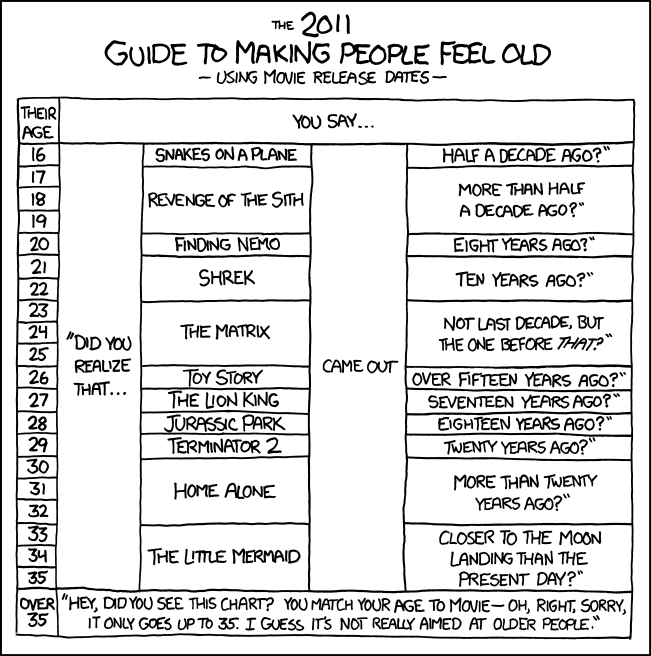
Original here.
April 20, 2011
What will Smartphones kill off next?
When you look at their track record, Smartphones are technological hit-men, taking down category after category of stand-alone electronic devices:
Cisco’s recent announcement that it was closing its Flip mini-camcorder business got us thinking. It’s pretty clear that today’s smartphones, with their excellent HD video cameras, are partly to blame for the Flip’s demise. But how many other consumer products and services — digital or analog — are being killed off by the big, bad smartphone?
We’ve assembled a list of likely victims here. If you know of other smartphone-induced casualties, please tell us in the Comments section — or contact your local law enforcement authorities. Let’s start with the most obvious victims…
The only two items on their list I disagree with are stand-alone GPS units and paper maps. Paper maps because the portable GPS units are excellent for what I think of as tactical directions — take this turn, drive this distance, etc., but are not as useful for strategic purposes. Paper maps aren’t dead yet.
And the reason I don’t think GPS units are quite dead isn’t technological, but financial: I can’t afford to use my iPhone for GPS because of the insanely high data costs when I’m roaming, especially if I’m in the United States.
April 17, 2011
Atlas Shrugged has good opening day in the theatres
No, I haven’t seen the movie. But that’s more because I’m not much of a moviegoer. Others have seen it:
Let’s look at the numbers first. According to BoxOfficeMojo.com, Atlas Shrugged: Part 1, which was filmed with a meager $5 million budget, brought in $683,000 on Friday, the film’s opening night. It placed 13th overall in total box office receipts for the day. Not too shabby.
There is another interesting metric that BoxOfficeMojo.com provides. It breaks down a film’s estimated gross on a per theater basis. This is a fair thing to do considering Atlas Shrugged was only shown in 300 theaters and, say, Rio, the number one grossing film for the day, was shown in 3,826.
Atlas Shrugged’s per theater gross was $2,277, ranking third for the day. Rio’s per theater gross, on the other hand, was $2,666. One has to wonder, then, if Atlas Shrugged’s opening day would have grossed more if it would have received a wider release. After all, it’s per theater take was very near the number one grossing film for the day.
The critics have generally panned the movie, but the RottenTomatoes.com users have given it a 3.8 out of 5, which is quite positive.
April 8, 2011
The economics of Falcon Heavy
Charles Stross runs the numbers on the new SpaceX Falcon Heavy:
SpaceX announce Falcon Heavy. It’s been expected for some time — it’s been on their road map for a few years — but it’s worth repeating: man-rated and with a payload of 53 tons to Low Earth Orbit, Falcon Heavy has the largest payload of any space launcher since Energiya and the Saturn V, and it’s dirty-cheap by EELV standards at $80M-120M per launch. Moreover, it can’t easily be dismissed as vapourware because it’s an evolutionary development of a real, flying launch vehicle (Falcon 9) — a Falcon 9 core with two extra first stages strapped to the sides as boosters (and some fancy cross-stage plumbing to run the central core motors off fuel bled from the strap-ons, so that at BECO the central stage still carries a full fuel load). With the giant Iridium NEXT contract SpaceX have landed (the largest commercial launch contract in history), not to mention the ISS resupply contract, SpaceX looks likely to have the cash flow to build and fly this thing.
[. . .]
Note that these days the budget for a big Hollywood blockbuster — Avatar, for instance — can push over the $0.3Bn mark. It’s hard to say what the media rights to the second! ever! manned Moon program! would be, but it’s hard to see them going for much less than a major blockbuster movie. I think it unlikely that the expedition could be run entirely on the media rights, but they should certainly make a double-digit percentage contribution to the budget. Add the opportunity to tout for the science budget of some major agencies (by carrying lunar orbiter packages as payload, perhaps?) and it might be possible to raise $250-500M towards the costs of a $600-1000M expedition.
Is Elon Musk planning on being the 13th man on the moon?
More on Falcon Heavy at The Register.
April 7, 2011
When to drink a wine
Michael Pinkus tries to answer the inevitable question “When should I drink this wine?”
What I find myself telling people-who-ask sounds like a huge cop-out. I end up turning it around and asking them whether they like their wines fresh and fruity or with a little age on them, edging more towards the dried fruit or foresty floor.
Truth is, most people prefer their wines to have fruit rather than floor, which explains why new world producers, especially those in Chile, Argentina and Australia, do so well, their fruit is fresh, full and mouth-filling, especially at the time when most people drink them. Studies have shown that 90% of all wine is drunk within 24 hours of purchase, and 95% within 48 hours. That means that only 5% of you are lying your wines down for any length of time. That also means that you’re missing out on the best part of wine, its never-ending change-ability.
I trust that most of you have seen the movie Sideways — I seem to stick it into the DVD player (now Blu-ray) every year, it’s like catching up with old friend (granted they seem stuck in a Groundhog Day-like cycle — but until a sequel comes along I’m stuck with them). Anyway, I’m not ruining anything (for those who haven ‘t seen it) when I quote Maya here on the allure, and never-ending change-ability, of wine:
“It’s a living thing.” She begins. “… I like how wine continues to evolve, like if I opened a bottle of wine today it would taste different than if I’d opened it on any other day, because a bottle of wine is actually alive. And it’s constantly evolving and gaining complexity. That is, until it peaks … And then it begins its steady, inevitable decline.”
It’s rare for me to open a bottle of wine within 48 hours of purchase, unless I’m travelling, but I’ve seen this stat quoted frequently. I think it’s sad that so many people are missing out on the (in my opinion) greater pleasure of tasting wines that have been given an opportunity to mature. On the other hand, 90% of the wine that is made today isn’t intended to mature: wine makers respond to economic incentives just as much as everyone else does, and if that kind of wine sells well, that’s what they’ll end up producing.
Friend of Randian cultists afraid to say what he really means
The victim of Objectivist intimidation is poor little P.J. O’Rourke, who has to be very careful how he reviews Atlas Shrugged:
Atlas shrugged. And so did I.
The movie version of Ayn Rand’s novel treats its source material with such formal, reverent ceremoniousness that the uninitiated will feel they’ve wandered without a guide into the midst of the elaborate and interminable rituals of some obscure exotic tribe.
Meanwhile, members of that tribe of “Atlas Shrugged” fans will be wondering why director Paul Johansson doesn’t knock it off with the incantations, sacraments and recitations of liturgy and cut to the human sacrifice.
But that’s about as far as he dares to go, risking retribution from Randian cultists. Oh, wait . . . he does go a tiny bit further towards martyrdom after all:
But I will not pan “Atlas Shrugged.” I don’t have the guts. If you associate with Randians — and I do — saying anything critical about Ayn Rand is almost as scary as saying anything critical to Ayn Rand. What’s more, given how protective Randians are of Rand, I’m not sure she’s dead.
The woman is a force. But, let us not forget, she’s a force for good. Millions of people have read “Atlas Shruggged” and been brought around to common sense, never mind that the author and her characters don’t exhibit much of it. Ayn Rand, perhaps better than anyone in the 20th century, understood that the individual self-seeking we call an evil actually stands in noble contrast to the real evil of self-seeking collectives. (A rather Randian sentence.) It’s easy to make fun of Rand for being a simplistic philosopher, bombastic writer and — I’m just saying — crazy old bat. But the 20th century was no joke. A hundred years, from Bolsheviks to Al Qaeda, were spent proving Ayn Rand right.
March 20, 2011
Graphic: History of Science Fiction
It’s huge: click on the image to see the full-size version:

March 10, 2011
March 8, 2011
QotD: Don’t look forward to the summer crop of movies
. . . let’s look ahead to what’s on the menu for this year: four adaptations of comic books. One prequel to an adaptation of a comic book. One sequel to a sequel to a movie based on a toy. One sequel to a sequel to a sequel to a movie based on an amusement-park ride. One prequel to a remake. Two sequels to cartoons. One sequel to a comedy. An adaptation of a children’s book. An adaptation of a Saturday-morning cartoon. One sequel with a 4 in the title. Two sequels with a 5 in the title. One sequel that, if it were inclined to use numbers, would have to have a 7 1/2 in the title.1
And no Inception. Now, to be fair, in modern Hollywood, it usually takes two years, not one, for an idea to make its way through the alimentary canal of the system and onto multiplex screens, so we should really be looking at summer 2012 to see the fruit of Nolan’s success. So here’s what’s on tap two summers from now: an adaptation of a comic book. A reboot of an adaptation of a comic book. A sequel to a sequel to an adaptation of a comic book. A sequel to a reboot of an adaptation of a TV show. A sequel to a sequel to a reboot of an adaptation of a comic book. A sequel to a cartoon. A sequel to a sequel to a cartoon. A sequel to a sequel to a sequel to a cartoon. A sequel to a sequel to a sequel to a sequel to a movie based on a young-adult novel.2 And soon after: Stretch Armstrong. You remember Stretch Armstrong, right? That rubberized doll you could stretch and then stretch again, at least until the sludge inside the doll would dry up and he would become Osteoporosis Armstrong? A toy that offered less narrative interest than bingo?
[. . .]
1. Captain America, Cowboys & Aliens, Green Lantern, and Thor; X-Men: First Class; Transformers 3; Pirates of the Caribbean: On Stranger Tides; Rise of the Apes; Cars 2 and Kung Fu Panda 2; The Hangover Part II; Winnie the Pooh; The Smurfs in 3D; Spy Kids 4; Fast Five and Final Destination 5; Harry Potter and the Deathly Hallows Part 2.
2. The Avengers; Spider-Man (3D); Men in Black 3 (3D); Star Trek untitled; Batman 3; Monsters, Inc. 2; Madagascar 3; Ice Age: Continental Drift in 3D; The Twilight Saga: Breaking Dawn, Part 2.
Mark Harris, “The Day the Movies Died”, GQ, 2011-02
February 17, 2011
The Pirates of Oz
According to a recent study, piracy in Australia has become the biggest industry: one third of all Australians are accused of piracy in the last twelve months.
The study, released by the Australian Federation Against Copyright Theft, claims that piracy sucks $A1.37bn out of the Australian economy.
Direct effects claimed by AFACT amounted to $A575m, the study claims — including $A225m attributed to “secondary piracy”, in which an individual either “views or borrows” pirated material (presumably whether or not the viewer knows the full legal status of what they’re watching).
[. . .]
The economic multiplier effects, for those willing to get past the press release, include reduced spending on recreation, clothing, housing and household goods. So, freetards, hang your heads in shame: not only were more than 6,000 jobs lost due to piracy, but the victims of your crime are now homeless, naked, hungry and bored.
February 12, 2011
Is it a movie or will it magically turn into a 14-hour monologue?
More information at http://www.atlasshruggedpart1.com/.


