
H/T to Nick Packwood and Paul Jané.
February 10, 2011
Re-interpreting the theme to “The good, the bad, and the ugly”
Comments Off on Re-interpreting the theme to “The good, the bad, and the ugly”
January 21, 2011
Remaking Red Dawn as a metaphor for US fear of China
David Harsanyi notes the remake of the 1980’s movie Red Dawn with the Chinese taking the place of the original film’s Soviet and Cuban troops:
Doubtlessly, the remake will be entertaining and offer a far more plausible plot line than the original — seeing that the Chinese, well, they have a proper army. Producers will almost certainly capitalize on a growing alarmism regarding China’s growth. Few issues, in fact, can bring right and left together in this polarized world of ours than a shared knowledge that China is bad news.
Now, the American populace can typically be divided into two categories: 1. Those who don’t care one whit about foreign policy. 2. Newspaper editors.
So before Chinese President Hu Jintao was here meeting with the president, Andrew Kohut of the Pew Research Center took to the pages of The Wall Street Journal and explained what we think about the topic.
Apparently, 47 percent of those he surveyed cited China as the world’s top economic power. (Only 31 percent properly identified it as the U.S., which has an economy nearly three times the size.) Another Pew survey from last year found that 47 percent of us consider China’s growth a “bad thing” for the United States. A new CNN poll found that 58 percent of us believe that China’s “wealth and economic power” are a threat to the U.S.
I’m certain our relationship with China is layered with international complexity and fraught with danger. But why would we fear the aspects of China’s ascendancy — its “wealth and economic power” — that pose the least threat to United States? Unlike ideological clashes, economic competition can be mutually beneficial. A country with real economic wealth is typically free and doesn’t look kindly on radical behavior. Suicide bombers rarely drive top-of-the-line BMWs.
I have a long history of doubting the stated size and growth of the Chinese economy and therefore feeling that the “threat” they pose is overstated. Overall, the economic growth in China is a good thing, both for China and for the world economy, but there’s still too much malignancy from the “bad old days” of the command economy that haven’t been properly dealt with. China is big, and getting bigger, but will face severe problems the longer these historical artifacts remain unexamined and unresolved.
Curious about firearms in movies? This site will answer your questions
Not the prettiest site in the world, but certainly one of interest to movie firearm fans — the Internet Movie Firearms Database. Brad Kozak at The Truth About Guns raves about imfdb.com:
Here is the website I’ve been wondering about, wondering as in “why in the HELL doesn’t this kind of resource exist?” One that would tell me exactly what kinds of guns are in a given movie. How were they used? Modified? Abused? What’s real and what’s fantasy? (Hey Jared . . . ever seen what Hollywood thinks about your pansy-assed 33 round mags? THEY’VE got magazines that never need reloading!)
This site may have all the visual charm of the Drudge Report, but for hard-core data on films and firearms, this site is all that and a side o’ fries. And it’s not just text either. Movie stills, frame grabs — this site done got the goods, homey. And not only do they cover movie firearms, in depth, they also cover the tech specs on the firearms themselves. My first visit, and I felt like I was a kid again, on my first visit to Toys ‘R’ Us. I mean, talk about a one-stop shop for getting all my burning questions answered. Waaaay cool.
[. . .]
If you were to ask me about how I enjoy movies, you’d see a clear and distinct division between the time that I was largely clueless about guns, and the time that began learning about them. Call it “B.E. and A.E.” (Before Enlightenment and After Enlightenment.) Before my education began, I had some inkling that movies regularly exaggerated the number of rounds that could be fired without reloading, the accuracy of a gun at a long distance, and the effects of guns in the wild (acoustics, ear protection, et cetera). But I had that “willing suspension of disbelief” thing going on, and it just didn’t matter to me. After my education began, I was filled with questions — is that a Springfield XD? Where do you find a 50-round magazine that fits within the grip for a 1911? (Or my fave:) How can you shoot a bullet and force it to make a 360º trajectory (in the movie WANTED.) Thanks to imfdb.com, now I know.
H/T to Kathy Shaidle for the link.
Comments Off on Curious about firearms in movies? This site will answer your questions
January 8, 2011
Expecting a fatwa on cinema studies in three, two, one …
I can’t imagine how brave (or foolhardy) you would have to be as a professor to approve this thesis proposal:
Three academics at one of Turkey’s top universities have been sacked after a student made a pornographic film for his dissertation project.
Bilgi University in Istanbul has shut its film department, and police are looking into possible criminal charges.
A number of other academics have protested against the response.
The incident has drawn attention to the clash between traditional values and the sometimes experimental arts and lifestyles practised in Istanbul.
[. . .]
As well as the firing of the three academics — who are now being investigated by the police — the entire Communications Faculty has been shut down.
Mr Ozgun, and the former student who starred in his film, have gone into hiding.
Comments Off on Expecting a fatwa on cinema studies in three, two, one …
December 5, 2010
Worst Autumn snowfall in Britain since 1963
Roger Henry sent me this link earlier this year, but it seems even more appropriate now:
I wonder how many budding documentarians will try to replicate the 1963 effort?
H/T to Ghost of a Flea for the reminder.
Comments Off on Worst Autumn snowfall in Britain since 1963
December 4, 2010
QotD: “Every futuristic vision that starts with a clean slate has a genocide or an apocalypse lurking in it”
Here’s a clip of HG Wells in 1943 predicting the demise of the newspaper, as people abandon print journalism in favor of using their telephones for up-to-the-minute news.
In one way, it’s very prescient — “using the telephone to get the news” isn’t so far off from what we do on the web today. But in another way, it’s exactly wrong (after all, it’s been nearly 70 years and there are still newspapers), And it’s wrong in a way that futurists are often wrong: it assumes a clean break with history and the positive extinction of the past. It predicts an information landscape that is reminiscent of the Radiant Garden Cities that Jane Jacobs railed against: a “modern” city that could only be built by bulldozing the entire city that stood before it and building something new on the clean field that remained. Every futuristic vision that starts with a clean slate has a genocide or an apocalypse lurking in it. Real new cities are build through, within, around, and alongside of the old cities. They evolve.
As Bruce Sterling says, “The future composts the past.” What happened to newspapers is what happened to the stage when films were invented: all the stuff that formerly had to be on the stage but was better suited to the new screen gradually migrated off-stage and onto the screen (and when TV was invented, all the “little-screen” stories that had been shoehorned onto the big screen moved to the boob-tube; the same thing is happening with YouTube and TV today). Just as Twitter is siphoning off all the stuff we used to put on blogs that really wanted to be a tweet.
Cory Doctorow, “Newspapers are dead as mutton – HG Wells, 1943 (No, they’re not)”, BoingBoing, 2010-12-03
Comments Off on QotD: “Every futuristic vision that starts with a clean slate has a genocide or an apocalypse lurking in it”
December 1, 2010
“London Calling” to come to the big screen
Fans of The Clash, your film is in production:
The creation of classic album London Calling by punk band The Clash is to form the basis of a new music biopic.
Former Clash members Paul Simonon and Mick Jones will executive produce the film, named after the 1979 record.
Playwright Jez Butterworth will pen the script, which will tell how producer Guy Stevens worked with the band to create their most celebrated disc.
Comments Off on “London Calling” to come to the big screen
November 23, 2010
A Whedon-less reboot of “Buffy”
The good news: they’re talking seriously about doing a cinematic reboot of “Buffy the Vampire Slayer”. The bad news: Joss Whedon won’t be anywhere near it:
Joss Whedon, who created Buffy for the original 1992 film and subsequently guided her to TV success, will play no part in the project.
Although Whedon wrote, produced and directed the hit TV series, he apparently does not own the film rights. He told E! Online: “There is no legal grounds for doing anything other than sighing audibly.”
Anderson is aware that in Whedon’s absence, “the most devoted fans of the old series will be keeping a skeptical eye on this nascent revival – and sharpening their wooden stakes”.
She assured the LA Times, though, that she’d “take the touchstones of the Whedon world but frame them in ‘a new story’ that is very much of the moment”.
Comments Off on A Whedon-less reboot of “Buffy”
November 13, 2010
Train movies, and movies with trains
Donald Liebenson at Armchair Commentary has a large (but probably not complete) list of films about or featuring trains:
“Everybody loves the sound of a train in the distance,” Paul Simon sings, “Everybody thinks it’s true.” There’s nothing truer. Nothing pierces the heart like a lonesome train whistle. Nothing holds the promise of mystery, romance, and adventure like a train bound for somewhere. That thundering locomotive in the kick-ass trailer for Unstoppable looks like it’s bound for trouble. While waiting to see if Denzel Washington and Chris Pine can avert disasters in their path, let’s take a scenic journey aboard some of the most memorable movies in which trains played scene-stealing roles. (The Polar Express is not on this list. Those dead-eyed children give me the creeps).
H/T to Jeff Shultz for the link.
Comments Off on Train movies, and movies with trains
October 12, 2010
Female characters in modern fiction
The Female Character Flowchart looks at “the one- and two-dimensional female characters we see over and over again in modern fiction.”
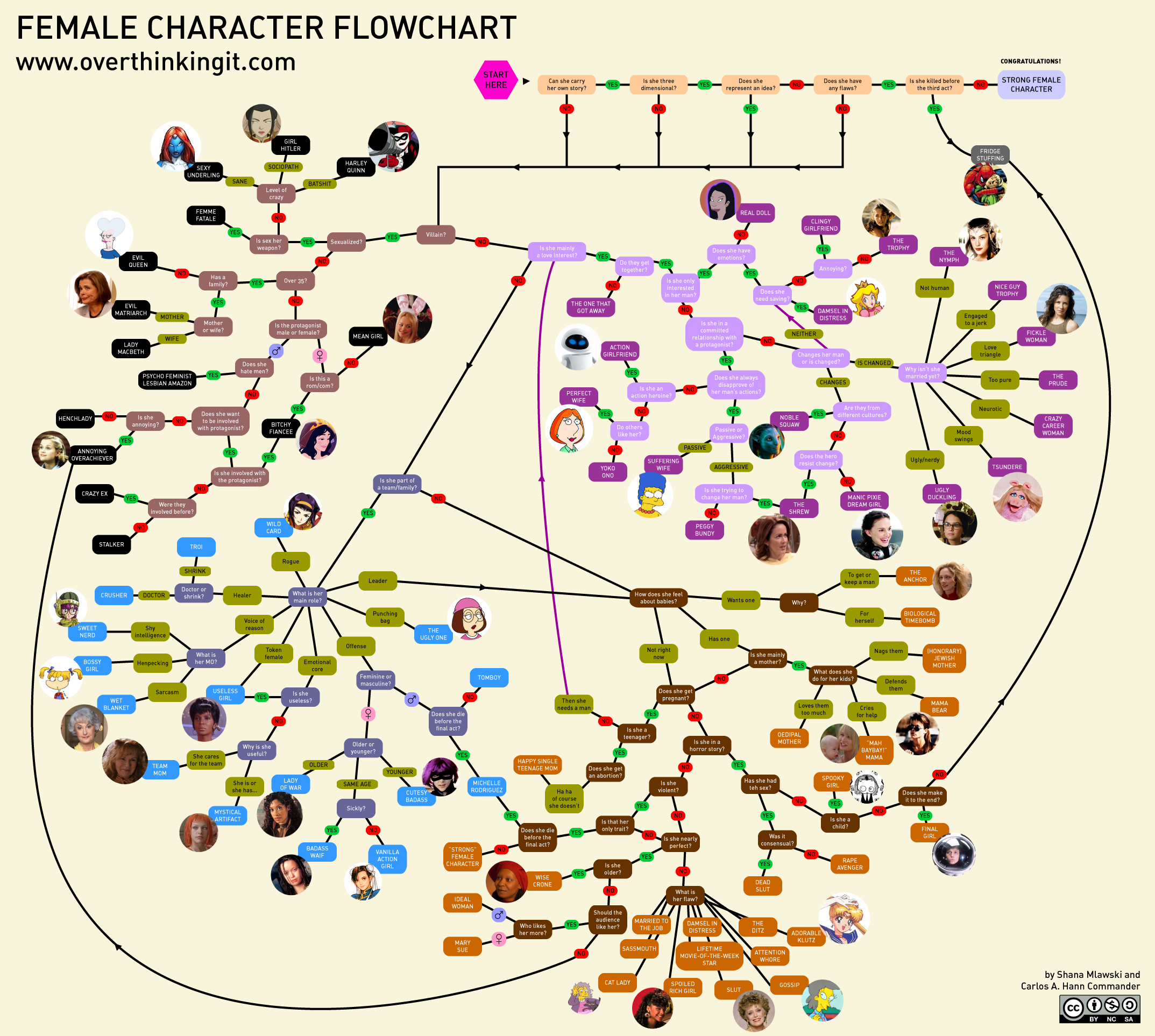
Click image to see full size flowchart
H/T to Royce McDaniels for the link.
Mitch Miller, drawing upon years of “men are simple/women are complicated” media memes, responded:
Wow! That’s a lot of female characters, considering that there’s only five male characters:
The Good Guy
The Bad Guy
The Good Bad Guy
The Bad Good Guy
and
The Sidekick
October 1, 2010
Freakonomics trailer
Since reading the book(s), I often find myself in discussions using the term “incentives” (especially in the sense of perverse incentives: those which produce the opposite of the desired effect). I think there’s much value in this approach to problem solving, and I’m looking forward to seeing the movie.
Update: I guess I’ve gotten out of the habit of seeing movies at all. Freakonomics is in the theatres now, but I seem to have uninstalled the movie theatre information app on my iPhone . . . it figures: it doesn’t appear to be playing anywhere near here.
Comments Off on Freakonomics trailer
August 24, 2010
July 26, 2010
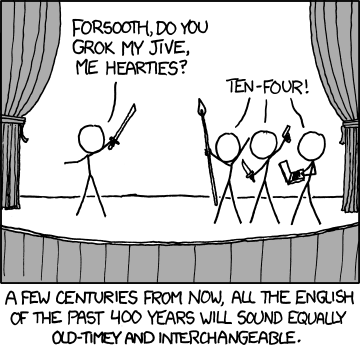
You’d have to say that they’re still following his guidelines
In an issue of Granta several years back, Binyavanga Wainaina provided some highly detailed guidelines for western writers to use in their work about Africa. Based on the results, you’d have to say that his guidance has been taken to heart by most novelists, journalists, and television personalities:
Always use the word ‘Africa’ or ‘Darkness’ or ‘Safari’ in your title. Subtitles may include the words ‘Zanzibar’, ‘Masai’, ‘Zulu’, ‘Zambezi’, ‘Congo’, ‘Nile’, ‘Big’, ‘Sky’, ‘Shadow’, ‘Drum’, ‘Sun’ or ‘Bygone’. Also useful are words such as ‘Guerrillas’, ‘Timeless’, ‘Primordial’ and ‘Tribal’. Note that ‘People’ means Africans who are not black, while ‘The People’ means black Africans.
Never have a picture of a well-adjusted African on the cover of your book, or in it, unless that African has won the Nobel Prize. An AK-47, prominent ribs, naked breasts: use these. If you must include an African, make sure you get one in Masai or Zulu or Dogon dress.
In your text, treat Africa as if it were one country. It is hot and dusty with rolling grasslands and huge herds of animals and tall, thin people who are starving. Or it is hot and steamy with very short people who eat primates. Don’t get bogged down with precise descriptions. Africa is big: fifty-four countries, 900 million people who are too busy starving and dying and warring and emigrating to read your book. The continent is full of deserts, jungles, highlands, savannahs and many other things, but your reader doesn’t care about all that, so keep your descriptions romantic and evocative and unparticular.
Make sure you show how Africans have music and rhythm deep in their souls, and eat things no other humans eat. Do not mention rice and beef and wheat; monkey-brain is an African’s cuisine of choice, along with goat, snake, worms and grubs and all manner of game meat. Make sure you show that you are able to eat such food without flinching, and describe how you learn to enjoy it — because you care.
H/T to Gerard Vanderleun for the link.
Comments Off on You’d have to say that they’re still following his guidelines
July 9, 2010
Matt Ridley on the onrush of DOOM!
Matt Ridley is about the same age as I am, and he clearly heard all the same warnings, predictions, and prophecies of doom that I heard when I was a teen:
When I was a student, in the 1970s, the world was coming to an end. The adults told me so. They said the population explosion was unstoppable, mass famine was imminent, a cancer epidemic caused by chemicals in the environment was beginning, the Sahara desert was advancing by a mile a year, the ice age was retuning, oil was running out, air pollution was choking us and nuclear winter would finish us off. There did not seem to be much point in planning for the future. I remember a fantasy I had — that I would make my way to the Hebrides, off the west coast of Scotland, and live off the land so I could survive these holocausts at least till the cancer got me.
I am not making this up. By the time I was 21 years old I realized that nobody had ever said anything optimistic to me — in a lecture, a television program or even a conversation in a bar — about the future of the planet and its people, at least not that I could recall. Doom was certain.
The next two decades were just as bad: acid rain was going to devastate forests, the loss of the ozone layer was going to fry us, gender-bending chemicals were going to decimate sperm counts, swine flu, bird flu and Ebola virus were going to wipe us all out. In 1992, the United Nations Earth Summit in Rio de Janeiro opened its agenda for the twenty-first century with the words `Humanity stands at a defining moment in history. We are confronted with a perpetuation of disparities between and within nations, a worsening of poverty, hunger, ill health and illiteracy, and the continuing deterioration of the ecosystems on which we depend for our well-being.’
And as we all know, it all came true . . .
Ridley’s latest book is The Rational Optimist, which I thoroughly enjoyed reading. I didn’t always agree with it, but it was refreshing reading material. Recommended.


