
The Great War
Published 9 Sept 2023As 1917 began, the Russian army was larger and better-equipped than ever before. Within weeks, the Tsar and his dynasty were gone, and by the summer, the Russian army was disintegrating before the eyes of its generals — but how exactly did one of the most powerful armies in the world collapse?
(more…)
September 11, 2023
How the Russian Army Collapsed
Comments Off on How the Russian Army Collapsed
September 3, 2023
“This is the world of the Spring and Autumn Annals, and the Zuozhuan“
Another anonymous book review at Scott Alexander’s Astral Codex Ten considers the Zuozhuan, a commentary and elaboration of the more bare-bones historical record of the Spring and Autumn Annals:
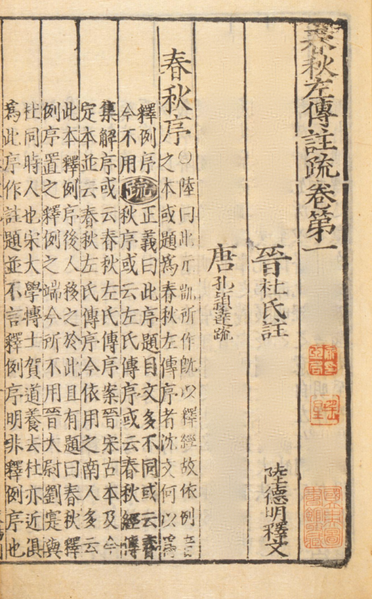
The first page of the Li Yuanyang edition of Zuo zhuan (16th century).
Wikimedia Commons.
To tell the story of the fall of a realm, it’s best to start with its rise.
More than three thousand years ago, the Shang dynasty ruled the Chinese heartland. They raised a sprawling capital out of the yellow plains, and cast magnificent ritual vessels from bronze. One of the criteria of civilization is writing, and they had the first Chinese writing, incising questions on turtle shells and ox scapulae, applying a heated rod, and reading the response of the spirits in the pattern of cracks. “This year will Shang receive good harvest?” “Is the sick stomach due to ancestral harm?” “Offer three hundred Qiang prisoners to [the deceased] Father Ding?” The kings of Shang maintained a hegemony over their neighbors through military prowess, and sacrificed war captives from their campaigns totaling in the tens of thousands for the favor of their ancestors.
But the Shang faced growing threat from the Zhou, a once-subordinate people from west beyond the mountains. Inspired by a rare conjunction of the planets in 1059 BC, the Zhou declared that there was such a thing as the Mandate of Heaven, a divine right to rule—and while the Shang had once held it, their misrule and immorality had forced the Mandate to pass to the Zhou. Thirteen years later, the Zhou and their allies defeated the Shang in battle, seized their capital, drove their king to suicide, and supplanted them as overlords of the Central Plains.
If the Shang were goth jocks, the Zhou were prep nerds. In grave goods, food-serving vessels replaced wine vessels. Mass human sacrifice disappeared, while bureaucracy expanded. The Shang lacked the state power to administer their surrounding subject peoples so much as intimidate them into line; the Zhou, galvanized by a rebellion not long after the conquest, put serious thought into consolidating their control. While the king remained in the west to rule over the original Zhou lands, he sent relatives and allies east into the conquered territories to establish colonies at strategically important locations, anchoring Zhou rule in a sprawling network of hereditary regional lords bound together by blood, marriage, custom, and ancestor worship of the Heaven-blessed founding Zhou kings.
For generations, the system worked, ensuring military successes at the borders and stability in the interior. The first reigns of the dynasty became a golden age in the cultural imagination for thousands of years. But by the dynasty’s second century, barbarian incursions were putting the state on the defensive, and surviving records hint at waning control over the regional lords and power struggles at court. 771 BC marked a breaking point, when barbarians allied with disgruntled nobles to overrun the royal domain and kill King You of Zhou.
Legend has it that the king was bewitched by his new consort, a melancholy beauty born from a virgin impregnated by the touch of a black salamander. Desperate to make her laugh, the king pranked his lords by lighting the beacon fires intended to summon them in case of invasion. When she delighted at the sight, he kept playing the same trick until the lords got sick of him and stopped coming, which doomed him when the barbarians actually invaded.
But the historical reality seems to be the usual sordid political struggle around a new consort — and heir — threatening the power of the old one. The original queen’s powerful father allied with barbarians to root out the upstart, only to get maybe more than he bargained for. Sure, he put his grandkid on the throne in the end, but the royal house had been devastated. It would never regain the ancestral lands it had lost to the barbarians, the direct holdings that filled its treasury and provided for its armies. The king retreated east into the Central Plains, playing ground of lords that were now more powerful than him. While the royal line remained symbolically important, as holder of the Mandate of Heaven from which all the states derived their legitimacy, the loss of central authority in every other sense would unleash centuries of intensifying interstate warfare and upheaval.
This is the world of the Spring and Autumn Annals, and the Zuozhuan.
The Spring
“Spring and Autumn Annals” is a bit of a redundant translation, since “spring and autumn” was just an old way of saying “year”, and thus, “annals”. And technically, there were multiple Spring and Autumn Annals — every state kept, in addition to court and administrative documents, its own laconic record of each year’s wars, diplomacy, natural phenomena, major rites, and notable deaths. But the state of Lu’s is special, because Confucius was from Lu. He’s said to have personally edited and compiled the extant version of its 242-year-long Spring and Autumn, loading each character with weighty yet subtle moral deliberation. This ensured it a place in the Confucian canon, and its survival where every other state’s annals have been lost to time. The era that it covers is named the Spring and Autumn period after the text, not the other way around.
Taken on its own, though, the Annals is little more than a list of dry facts. For example, the first year reads:
The first year, spring, the royal first month.
In the third month, our lord and Zhu Yifu swore a covenant at Mie.
In summer, in the fifth month, the Liege of Zheng overcame Duan at Yan.
In autumn, in the seventh month, the Heaven-appointed king sent his steward Xuan to us to present the funeral equipment for Lord Hui and Zhong Zi.
In the ninth month, we swore a covenant with a Song leader at Su.
In winter, in the twelfth month, the Zhai Liege came.
Gongzi Yishi died.
Who is Zhu Yifu? Who’s Duan? What’s all this about “overcoming”? Where does the moral deliberation come in? This canon badly needs meta, and the most notable of the ancient commentaries written for the Spring and Autumn Annals is the Zuozhuan. Ten times as long as the text it’s for, the Zuozhuan is the flesh on the Annals‘ bare bones, one of the foundational works of ancient Chinese literature and history-writing in its own right.
While tradition attributes the text’s authorship to Zuo Qiuming, a contemporary of Confucius, most modern historians date its compilation to the century after. In its extant form, it’s presented interleaved with the Annals, so that after the Annals’ account of each year, with entries such as …
In summer, in the sixth month, on the yiyou day (26), Gongzi Guisheng of Zheng assassinated his ruler, Yi.
… you have the Zuozhuan’s account of the year, mostly composed of elaborations upon the above entries, such as:
The leaders of Chu presented a large turtle to Lord Ling of Zheng. Gongzi Song and Gongzi Guisheng were about to have an audience with the lord. Gongzi Song’s index finger moved involuntarily. He showed it to Gongzi Guisheng and said, “On other days when my finger did this, I always without fail got to taste something extraordinary.” As they entered, the cook was about to take the turtle apart. They looked at each other and smiled. The lord asked why, and Gongzi Guisheng told him. When the lord had the high officers partake of the turtle, he called Gongzi Song forward but did not give him any. Furious, Gongzi Song dipped his finger into the cauldron, tasted the turtle, and left. The lord was so enraged that he wanted to kill Gongzi Song. Gongzi Song plotted with Gongzi Guisheng to act first. Gongzi Guisheng said, “Even with an aging domestic animal, one is reluctant to kill it. How much more so then with the ruler?” Gongzi Song turned things around and slandered Gongzi Guisheng. Gongzi Guisheng became fearful and complied with him. In the summer, they assassinated Lord Ling.
The text says, “Gongzi Guisheng of Zheng assassinated his ruler, Yi”: this is because he fell short in weighing the odds. The noble man said, “To be benevolent without martial valor is to achieve nothing.” In all cases when a ruler is assassinated, naming the ruler [with his personal name rather than his title] means that he violated the way of rulership; naming the subject means that the blame lies with him.
There’s a few too many mythological creatures and just-so stories for the Zuozhuan to be taken entirely at face value, but it’s clear that its creator(s) had access to diverse now-lost records for the era portrayed. For example, some of the events show a two-month dating discrepancy — one of the states used a different calendar, and most likely the creator(s) overlooked the difference when borrowing from sources from that state. While the overall level of historical rigor versus 4th century BC authorial invention remains under heated debate, the Zuozhuan is undeniably the most comprehensive written source on its era that we have.
And importantly, it’s enjoyable.
You can think of the Zuozhuan as the Gene Wolfe of ancient historical works. It’s not an easy read, especially in translation, where names that are visibly distinct in the original (e.g. 季, 急, 姬, etc.) all get unhelpfully collapsed into one transliteration (Ji). The work drops you into a whirl of nouns and events, some of them one-off asides, others part of long-running narrative threads that might only surface again decades of entries later. While a casual readthrough still offers plenty of rewards, putting together all the subtext, references, and connections between entries is an endeavor that’s occupied readers for millennia. Your unreliable narrator remains enigmatic on most of the events he presents, leaving interpretation as an exercise for the reader; when he does speak, either directly or in the voice of the “noble man”, he can raise more questions than he answers. For one, the rule about the naming of an assassinated ruler largely holds in the Annals, but seems to have some notable exceptions.
But if you’re willing to plunge in, the work offers an experience unlike anything else.
Comments Off on “This is the world of the Spring and Autumn Annals, and the Zuozhuan“
August 30, 2023
QotD: Hairstyles of the late Ancien Régime
… you get things like the massive and bizarre hairstyles of the nobility (and to be fair the rich bourgeois, but that’s because they aped the nobility) in France just before the French revolution.
As the industrial revolution and various other shifts (including truly disastrous harvests) robbed those whose income came from hereditary landholding of their ancient riches and prominence, even while the court demanded a complex set of “dancing attendance” for royal favor (A policy started and encouraged by Louis XIV in part to rob the nobility of wealth and prominence, not to mention keeping their minds off rebellion) the nobility felt insecure. The fact that its ranks were being penetrated by people from the bourgeoisie, who married their children or “simply” franked the nobility’s lavish lifestyles, made the nobles feel they were losing control. Even though rank remained a thing of birth, they were in fact, in the real world, losing rank.
The response were fashions so extravagant that they make us go “Wait, what?” and must have given people headaches.
You can see where wigs came from and were fashionable, in a society without running water and/or decent shampoos. It was easier to keep your hair ridiculously short and wear wigs, which is why they’ve been part of human fashion since ever.
But it took the French revolution to come up with wigs on armatures (or hair extensions, ditto) and hairstyles that incorporated ships and, at one point, bird cages with live, singing birds.
To look at drawings or read descriptions is to go “uh, what? who ever thought that was attractive?” and also “Boy their heads must have hurt”.
Yet the competition for the most elaborate and showy hairstyle, no matter how insane, did not stop until those heads fell to Madame Guillotine thereby stilling forever their status anxiety.
Sarah Hoyt, “Is That A Ship On Your Head?”, Libertarian Enterprise, 2019-09-01.
Comments Off on QotD: Hairstyles of the late Ancien Régime
August 22, 2023
History Summarized: Sparta’s Finest Hour
Overly Sarcastic Productions
Published 12 May 2023It’s not Thermopylai.
SOURCES & Further Reading:
Constantine Cavafy, The Collected Poems. Translated by Evangelos Sachperoglou, Oxford University Press, 2008. – George Economou, On Translating C.P. Cavafy’s “Come, O King of the Lacedaimonians”. https://newohioreview.org/2013/09/02/… – Plutarch, Lives of Agis and Cleomenes. Translated by Bernadotte Perrin, W. Heinemann, 1968. – Polybius, Histories. Edited by F. W. Walbank and Christian Habicht. Translated by W. R. Paton, VI, Harvard University Press, 2012.
– For way the heck more about Kleomenes and Kratisikleia, you can also read my undergraduate Honors Thesis, Greekness in Peril: Cavafy and the Essence of Hellenism. 2018. https://www.academia.edu/44709355/Gre…
(more…)
Comments Off on History Summarized: Sparta’s Finest Hour
July 24, 2023
QotD: The Duke and Duchess of Windsor after the abdication
We are reminded that the king’s much-rehearsed coronation speech was a success. “Millions of his subjects sat at home listening to the broadcast, willing him to succeed whilst knowing of his stammer and the difficulties that even speaking a few short sentences publicly had caused him … Yet fortunately for the coronation ceremony, the king’s nerves seemed to vanish on the day, aided by his sincere religious faith: another characteristic absent from his brother’s life.”
[…]
One trait that runs through this important book is the personal weakness of the Duke and the compelling strength of his bride. Larman makes it plain that both Baldwin and Chamberlain were aware that it was Wallis who was passing state secrets to German intelligence, although her husband also expressed sympathies for Hitler’s regime. Cecil Beaton, photographer of the David-Wallis wedding in France, noted in his diary that the Duchess “not only has individuality and personality, but [she] is a strong force”. Even as he praised her intelligence and admiration for the Duke, Beaton offered the judgement that she “is determined to love him, though I feel she is not in love with him” — an interesting reflection on the woman for whom her husband had abandoned his throne. In 2015, Andrew Morton dwelt in great detail on Wallis’s treachery in 17 Carnations: The Windsors, The Nazis and The Cover-Up.
Throughout Larman’s compelling read, we are offered evidence of how tone-deaf the Duke was to international protocol, the interests of Britain and the sufferings of others. Anthony Eden, as Foreign Secretary, observed how the pair felt they should be “treated abroad by ambassadors and dignitaries, rather as they would a member of the royal family on a holiday”. This came to a head when friends of the Duke organised a visit to Germany over 11–23 October 1937. They met several leading Nazis, including Hess, Goebbels (who called the Duke “a tender seedling of reason”) and Göring, as well as renewing their acquaintance with Ribbentrop, still then ambassador to Britain. It was Ribbentrop, according to Morton’s book, who had sent Wallis 17 carnations daily “each one representing a night they had spent together”.
On the penultimate day, the Windsors met Hitler at Berchtesgaden. Larman reasons that the visit was as much to show that the Duke and his bride were still relevant in the wider world, as to form a bond with the Führer to avoid future war. As with many public figures of the era, David feared communism far more than fascism, for which he saw the best antidote in an alliance with Germany. We are left wondering whether the Duke observed in Hitler’s authoritarian state all that he admired and wished for Britain, but was now denied.
A subtext to The Windsors at War is just how much anxiety David caused the King, his younger brother, during the run up to war and during it. For most of the period, the Duke badgered for money, confirmation of his status and a royal title for Wallis. Whilst the first was forthcoming, amounting to a financial settlement of £25,000 a year (generous by any standards, considering the Windsors spent their days sofa-surfing and sponging off their rich friends), neither of the latter were. Chamberlain was forced to write that “in addition to letters of protest he had as Prime Minister … all classes stood against him. In addition to the British not wanting him to return, residents of Canada, New Zealand and America wished him to remain in exile”.
Yet, writes Larman, the Duke would not simply “languish in exile and be denied the opportunity to contribute his thoughts on the international situation. This arrogance made him both unpredictable and, with the outbreak of war drawing closer, dangerous. At a time when it was crucial that the loyalties of prominent public figures were transparent, his inclinations remained opaque”.
Peter Caddick-Adams, “The other one”, The Critic, 2023-04-18.
Comments Off on QotD: The Duke and Duchess of Windsor after the abdication
July 23, 2023
QotD: Losing the Mandate of Heaven is fatal for a ruler
… so long as the rulers keep the Mandate of Heaven.
That no doubt seems like a stolen base, as something as amorphous as the “Mandate of Heaven” can be stretched to cover just about anything, but it’s the best I can do to convey what I mean. And I think you’ll see the utility of it when we look at a few examples. The negative first: Since Usurpers are much in the news these days, look at any successful one. England’s Henry IV, for example, or Henry VII. They had endless troubles during their personal rule, as all the people who mattered knew them when they were just one noble among many. Their sons, on the other hand, sat about as easily on the throne as any medieval monarch could, and while some of that was no doubt due to their sterling personal qualities,1 a lot of it was simply, for lack of a better term, “the Mandate of Heaven” — the Usurper who delivered stability and competence in his lifetime passed on the purple to a stable, competent son, which proves the regime’s essential rightness.
In other words, inertia kicks in — just an object in motion tends to stay in motion, a competent regime continues competent, in public perception at least. Those who are old enough to remember the Wars of the Roses (etc.) are just grateful that they don’t have to go through it again, while the younger generations simply don’t know any different. So long as the usurper’s son isn’t both personally loathsome and egregiously incompetent, things will go on much as before. (And please note what an extremely high bar that is — we’re talking Nero- or Commodus-level loathsome incompetence. France spent a lot of the Hundred Years’ War under the “leadership” of a filthy lunatic who thought he was made of glass, and they came out ok … largely because soon after he kicked, it was England’s turn to suffer the long reign of a filthy lunatic, but still. It’s got to be spectacular on both counts to kick off a revolution).
Severian, “Witch Trial Syndrome”, Rotten Chestnuts, 2021-01-27.
1. Opinions are bitterly divided on Henry VIII even among the laity, and professionals carry on blood feuds about it, but everyone agrees that for all his faults, the young Henry VIII was a seriously impressive guy. Contemporaries certainly thought so — Erasmus was a professional ass-kisser, but Thomas More was dazzled by Henry, too, and More was a tough guy to fool.
Comments Off on QotD: Losing the Mandate of Heaven is fatal for a ruler
July 13, 2023
QotD: The Annales school of history
The big shift in focus for the Annales school was an interest in charting the experience of society below the level of elites (though the elites are not abandoned either), what is sometimes termed “history from below”, as distinct from traditional elite-centered “great man” history or the more deterministic Marxist models of history at the time. You can see the political implications, of course, in the very early 1900s, of declaring the common man worthy of study; this is generally a history from the left but not the extreme left. That focus in turn demanded new approaches because it turned the focus of social history towards people who by and large do not write to us.
In reaching for that experience, Annales scholars tended to frame their thinking in terms of la longue durée (“the long run”); history was composed of three parts: événements (“events”), conjonctures (“circumstances”) and finally la longue durée itself. Often in English this gets rendered as a distinction between “events” (kings, wars, politics, crises) and “structures” (economics, social thought and at a deeper level climate, ecology, and geography). What Annales scholars tended to argue was that those structures were often more important than the events that traditional historians studied: the farmer’s life was far more shaped by very long-term factors like the local ecology, the organization of his farming village, the economic structure of the region and so on. And then the idea goes, that by charting those structures, you can figure things out about the lives of those farmers even if you don’t have many – or any – of those farmers writing to you.
Important to this was the idea of enduring patterns of thought within a society, what Bloch termed mentalités (“mentalities”, like longue durée, this is a technical term usually used in French to make that fact clear). Mentalités – Bloch’s original example was the idea that kings had a holy healing touch, but this could be almost any kind of social construct or pattern of ideas (indeed, one critique of it is that the notion of mentalités is broad and ill-defined) – can last a long time and can inform or constrain the actions of many actors within a society; think of how successive generations of kings can have their decisions shaped or constrained by their societies view – their own view – of kingship. That view of kingship might be more impactful than any one king and so pervasive that even a king would struggle to change it.
So how does this influence my work? I tend to be very much a “history from below” kind of historian, interested in charting the experience of regular farmers, soldiers, weavers and so on. The distinction between the long-term structures that shape life and the short-term events that populate our history is very valuable to think with, especially for identifying when an event alters a structure, because those tend to be very important events indeed. And I think a keen attention to the way people thought about things in the past and how those mentalités can be different than ours is very important.
That said, the Annales stress on mentalités has in some ways been overtaken by more data-driven historical methods on the one hand or a strong emphasis on local or individual experience (“microhistory”) on the other. Mentalités tend to be very big picture, asking how, say, “the French” thought about something over a period of decades or centuries and seeking to know how that shaped their experience. But archaeology, demographics or economic data can reveal patterns of behavior which might not correspond to the mentalités that show up in written texts; this is fundamentally the interaction that informs the “revenge of the archaeologists” in the study of the ancient economy, for instance. On the other hand, not everyone in that big group thinks the same and a microhistory of an individual or a single village might reveal telling local variations not captured in massive-scale structures.
Fortunately, historians do not need to be doctrinaire in our use of theory, we don’t have to pick one and stick to it. Different projects also lend themselves to different approaches. I think the Annales school offers a lot of really useful tools to have my historian’s toolbox, but they sit alongside military theory, archaeological material culture studies methods, philological approaches, a smattering of economic and demographic tools, etc.
Bret Devereaux, “Referenda ad Senatum: January 13, 2023: Roman Traditionalism, Ancient Dates and Imperial Spies”, A Collection of Unmitigated Pedantry, 2023-01-13.
July 9, 2023
Imperial Rome
In UnHerd, Freddie Sayers talks to historian and podcaster Tom Holland about his latest book, Pax:
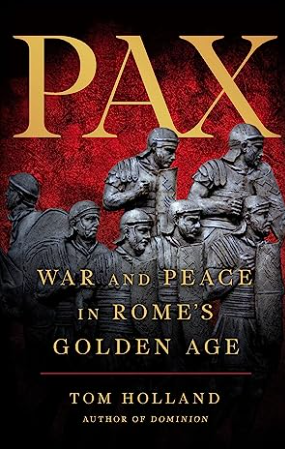
To his army of ardent followers, Tom Holland has a unique ability to bring antiquity alive. An award-winning British historian, biographer and broadcaster, his thrilling accounts offer more than a mere snapshot of life in Ancient Greece and Rome. In Pax — the third in his encyclopaedic trilogy of best-sellers narrating the rise of the Roman Empire — Holland establishes how peace was finally achieved during the Golden Age, with a forensic recreation of key lives within the civilisation, from emperors to slaves.
This week, Holland came to the UnHerd club to talk about Roman sex lives, Christian morality, and the rise and fall of empires. Below is an edited transcript of the conversation.
Freddie Sayers: Let’s kick off with the very first year in your book.
Tom Holland: It opens in AD 68, which is the year that Nero committed suicide: a key moment in Roman history, and a very, very obvious crisis point. Nero is the last living descendant of Augustus, and Augustus is a god. To be descended from Augustus is to have his divine blood in your veins. And there is a feeling among the Roman people that this is what qualifies you to rule as a Caesar, to rule as an emperor. And so the question that then hangs over Rome in the wake of Nero’s death is: what do we do now? We no longer have a descendant of the divine Augustus treading this mortal earth of ours. How is Rome, how is its empire, going to cohere?
FS: It seemed to me, when I was reading Pax, that there was a recurring theme: a movement between what’s considered decadence, and then a reassertion of either a more manly, martial atmosphere, or a return to how things used to be — to the good old days. With each new emperor in this amazing narrative, it often feels like there’s that same kind of mood, which is: things have gotten a bit soft. We’re going to return to proper Rome.
TH: It’s absolutely a dynamic that runs throughout this period. And it reflects a moral anxiety on the part of the Romans that has been characteristic of them, really, from the time that they start conquering massively wealthy cities in the East — the cities in Asia Minor or Syria or, most of all, Egypt. There’s this anxiety that this wealth is feminising them, that it’s making them weak, it’s making them soft — even as it is felt that the spectacular array of seafood, the gold, the splendid marble with which Rome can be beautified, is what Romans should have, because they are the rulers of the world.
That incredible tension is heightened by class anxieties. There’s no snob like a senatorial snob. They want to distinguish themselves from the masses. But at the same time, there’s the anxiety that if they do this in too Greek a way, in too effeminate a way, then are they really Romans? And so the whole way through this period, the issue of how you can enjoy your wealth, if you are a wealthy Roman, without seeming “unRoman”, is an endearing tension. And of course, there is no figure in the empire who has to wrestle with that tension more significantly than Caesar himself.
FS: The 100-odd years that you’re covering in this volume is a period of great peace and prosperity and power, and yet at each juncture, it feels like there’s this anxiety. That’s what surprised me as a reader. There’s this sense of the precariousness of the empire — maybe it’s become softer, maybe it’s decadent, or maybe it needs to rediscover how it used to be.
TH: And, you see, this is the significance of AD 69, “the Year of the Four Emperors”, because the question is, are the cycles of civil war expressive of faults? Of a kind of dry rot in the fabric of the Empire that is terminal? Of the anger of the gods? And whether, therefore, the Romans need to find a way to appease the gods so that the whole Empire doesn’t collapse. This is an anxiety that lingers for several decades. It looks to us like this is the heyday of the Empire. They’re building the Colosseum, they’re building great temples everywhere. But they’re worrying: “Have the gods turned against us?”
And of course, there is a very famous incident, 10 years after the Year of the Four Emperors, which is the explosion of Vesuvius. And this is definitely seen as another warning from the gods, because it coincides with a terrible plague in Rome, and it coincides with the incineration (for the second time in a decade) of the most significant temple in Rome — the great temple to Jupiter on the Capitol, the most sacred of the seven hills of Rome.
Romans offer sacrifice to the gods or you pay dues to the gods rather in the way that we take out an insurance policy. And if the gods are busy burying famous towns on the Bay of Naples beneath pyroclastic flows, or sending plagues, or burning down temples, then this, to most, is evidence that the Roman people have not been paying their dues. So a lot of what is going on — certainly in the imperial centre — in this period, is an attempt to try and get the Roman Empire back on a stable moral footing.
Comments Off on Imperial Rome
July 3, 2023
QotD: The key weakness of the royal cause in the English Civil War
[T]he power of the mighty hath no foundation, but in the opinion and belief of the people.
A king whose knights won’t ride out to battle on his behalf is just a weirdo in funny clothes. Charles I lost for a lot of reasons, but far from the least of them was that his “foundation” was badly cracked. However attached one might be to the notion of monarchy in the abstract, it – monarchy – is always intimately connected to the personality of the monarch … and Charles I was a real piece of work, even by the world-class standards of Renaissance princes. Parliament was outgunned, often outmanned, and suffered from what should’ve been a critical shortage of experienced leadership. But all those massive advantages were offset by the fact that the Royalist forces were fighting for Charles I, personally.
(This is not the place for a long discussion of the course of the English Civil Wars – and I’m not qualified to give you one in any case – but a quick look at the top commanders of the opposing sides will illustrate the point. Prince Rupert was arguably the equal, mano-a-mano, of any Parliamentary general, up to and including Cromwell. But he was still a Prince, and carried on like one (like a young one, to boot) … and even if he weren’t, he was still running the show on behalf of his uncle. Cromwell, on the other hand, inspired fanatic loyalty, not least because he embodied a cause that was much higher than himself).
Severian, “Hobbes (III)”, Founding Questions, 2020-12-12.
Comments Off on QotD: The key weakness of the royal cause in the English Civil War
June 22, 2023
Britain’s 17th century repeats: first time as tragedy, the second time as farce?
Dominic Sandbrook on the parallels between Britain in the 1600s and today:
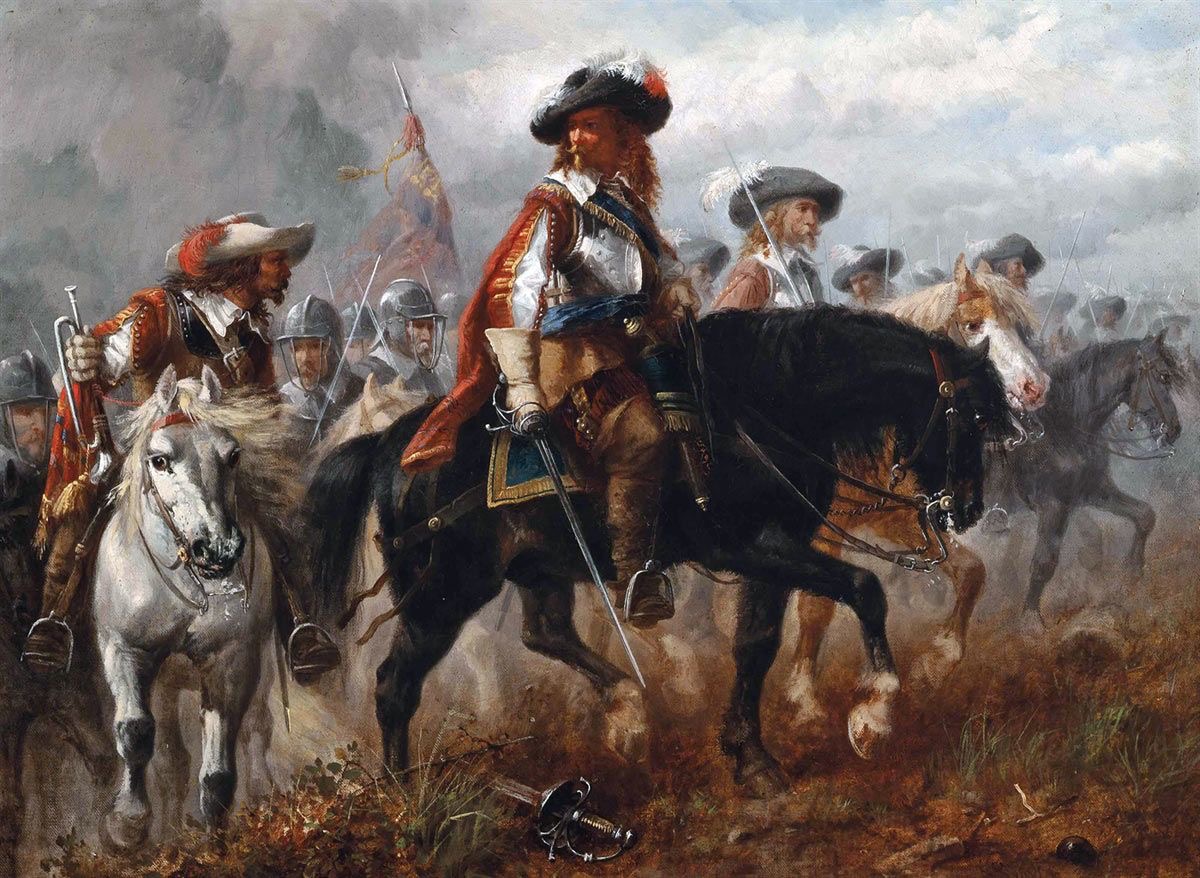
King Charles I and Prince Rupert before the Battle of Naseby 14th June 1645 during the English Civil War.
19th century artist unknown, from Wikimedia Commons.
A sunny Wednesday in early June 1665, and Samuel Pepys was suffering in the heat. It was “the hottest day that ever I felt in my life”, he confided to his diary, “and it is confessed so by all other people the hottest they ever knew in England”.
Pepys spent some of the day strolling with friends in the New Exchange, a shopping arcade on the south side of the Strand, before repairing to Vauxhall’s Spring Gardens, where he “walked an hour or two with great pleasure”. There was something on his mind, though. For as long as he could remember, relations with England’s neighbours had been distinctly fraught, and Lord Sandwich’s fleet was currently engaged in a struggle with the Dutch. London simmered with rumours about the outcome of the battle, but there was no certainty: as Pepys put it, “ill reports run up and down of his being killed, but without ground”.
By evening, “weary with walking and with the mighty heat of the weather”, the diarist had returned to his house in the City. The day had been pleasant enough, but now something else was troubling him. In Drury Lane, he had seen “two or three houses marked with a red cross upon the doors, and “‘Lord have mercy upon us’ writ there”. Pepys knew immediately what that meant. Plague — the first sign of the epidemic that would kill an estimated 100,000 people, a quarter of the capital’s population, in the next 18 months. To calm his nerves, he noted: “I was forced to buy some roll-tobacco to smell to and [chew], which took away the apprehension.”
Reading Pepys’s diary, you sometimes forget that he was born almost four centuries ago. In many respects he was utterly different from us, with assumptions and anxieties we can scarcely understand; and yet often he feels almost thrillingly contemporary, as if you might bump into him in the street tomorrow afternoon. Indeed, you merely have to re-read that diary entry, and you might be looking in a mirror: the stifling heat, the fears of disease, the foreign wars, the fake news.
The past is never just a mirror, of course, and it’s the height of narcissism to cast our predecessors as mere foreshadowings of ourselves. But there are times when, for obvious reasons, a particular historical moment catches the imagination — as is the case today with Pepys’s moment, the mid-17th century.
Just look, for example, at the titles in Britain’s bookshops. For a long time, commercial publishers were terrified of the 17th century. The Stuarts weren’t as sexy as the Tudors, and the age of Oliver Cromwell seemed too dark, too violent, too religious, too complicated for ordinary readers. Why read about perhaps the most significant moment in all our history — the titanic revolutionary conflict of the 1640s and 1650s, when armies surged across the map of our islands, a king was tried and executed, and a farmer from East Anglia tried to turn Britain into a religious commonwealth — when you could read yet another book about Catherine Howard?
And then, as if responding to some subterranean shift in the cultural landscape, something changed. The last few years alone have given us excellent books on Cromwell by Paul Lay and Ronald Hutton, as well as Anna Keay’s dazzling social history of Britain in the 1650s, and Malcolm Gaskill’s haunting account of witchcraft among the settlers who tried to build a new England on the other side of the Atlantic. Meanwhile, Robert Harris’s most recent blockbuster, Act of Oblivion, follows the hunt for Charles I’s Parliamentarian killers from England to America.
Even politicians are at it. In the Conservative MP Jesse Norman’s new novel The Winding Stair, which charts the bitter feud between Sir Francis Bacon, father of the Scientific Revolution, and Sir Edward Coke, the most influential jurist of the early modern era, we appear to be plunged back into the world of early 17th-century Jacobean England. But right from the first few pages, the parallels are obvious. Among his characters, for example, is James I, a man with “bulging, expressive eyes” and an “awkward gait”, who “dresses finely, yet somehow manages to look ill-kempt”, and always “loves to display his learning with a classical or biblical line”. Even if you didn’t know that Norman had been at Eton with Boris Johnson, worked for him as a junior minister and eventually released a blistering public letter calling for his removal, you’d probably spot the parallel.
Comments Off on Britain’s 17th century repeats: first time as tragedy, the second time as farce?
June 20, 2023
QotD: When kings and emperors become gods
Divine rulership was not universal however – it was subject to cultural context. In Egypt, the Pharaoh was the Living Horus, a physical incarnation of the divine; when he died he became Osiris, the ruler over the underworld. The mystery of the duality whereby a Pharaoh was both a specific person (and might be a different person in the future) but also the same god each time seems to owe something to the multipart Egyptian conception of the soul. Naram-Sin, an Akkadian King (2254-2218 B.C.) represents himself as divine (shown by his having horns) on his victory stele; future kings of Akkad followed suit in claiming a form of divinity, albeit a lesser one than the big-time great gods.
But in Mesopotamia, the rulers of Akkad were the exception; other Mesopotamian kings (Sumerian, Babylonian, etc) did not claim to be gods – even very great kings (at least while alive – declaring a legendary ruler a god is rather more like a divine founder figure). Hammurabi (king of Babylon, c.1810-c.1750 B.C.) is shown in his royal artwork very much a man – albeit one who receives his mandate to rule from the gods Shamash and Marduk. Crucially, and I want to stress this, the Achaemenid kings of Persia were not considered gods (except inasmuch as some of them also occupied the position of Pharaoh of Egypt; it’s not clear how seriously they took this – less seriously than Alexander and Ptolemy, quite clearly). The assumption that the Persians practiced a divine kingship is mostly a product of Greek misunderstandings of Persian court ritual, magnified in the popular culture by centuries of using the Persian “other” as a mirror and (usually false) contrast for European cultures.
But the practice that my students often find most confusing is that of the Roman emperors. To be clear, Roman emperors were not divinized while they were alive. Augustus had his adoptive father, Julius Caesar divinized (this practice would repeat for future emperors divinizing their predecessors), but not himself; the emperor Vespasian, on his deathbed, famously made fun of this by declaring as a joke, “Alas! I think I’m becoming a god” (Suet. Vesp. 23.4). And yet, at the same time, outside of Rome, even Augustus – the first emperor – received cult and divine honors, either to his person or to his genius (remember, that’s not how smart he is, but the divine spirit that protects him and his family).
I think it is common for us, sitting outside of these systems, to view this sort of two-step dance, “I’m not a god, but you can give me divine honors in the provinces and call me a god, just don’t do it too loudly” as fundamentally cynical – and to some degree it might have been; Augustus was capable of immense cynicism. But I think it is possible to view this relationship outside of that cynicism through the lens of the ideas and rules we’ve laid out.
Bret Devereaux, “Collections: Practical Polytheism, Part IV: Little Gods and Big People”, A Collection of Unmitigated Pedantry, 2019-11-15.
Comments Off on QotD: When kings and emperors become gods
June 16, 2023
Blackadder at 40
Ed West remembers his first encounter with the brilliant, devious, and hilarious Edmund Blackadder:
What do these famous figures from British history all have in common? Elizabeth I, George III, George IV, Victoria and Albert, the Duke of Wellington, Dr Samuel Johnson, Sir Walter Raleigh, Sir Douglas Haig, Richard III, er Richard IV, William Pitt the Younger, William Pitt the Even Younger …
They’re all, of course, characters in the greatest tale of our island story, a giant rollercoaster of a comedy in four sizzling chapters, one that was first shown 40 years ago today.
New British stamps issued on the 40th anniversary of the BBC comedy series Blackadder
I was probably always going to love history — my dad was obsessed with it — but Blackadder helped imprint the idea that the past can be one great black comedy. History is funny because people’s behaviour is often quite irrational, or spiteful, or motivated by petty reasons that contrast with their high-minded principles — and no doubt we will seem the same to future generations, too.
That was the whole idea behind Blackadder because, as creator Richard Curtis points out in a documentary screened tonight on Gold, he’s “a modern person in the stupidity of ancient times”.
Yet when the idea was first proposed by Curtis and Rowan Atkinson, they were advised that there are two sitcom premises that can never work — shows set in heaven and hell, or those in historical settings. And Blackadder was lucky to survive its first season.
Atkinson and Curtis had met at Oxford, going on to work together on Not the Nine O’Clock News, where they’d met producer John Lloyd. The two men were inspired by Fawlty Towers, but were also determined to avoid any comparison with John Cleese and Connie Booth’s great creation, so decided on a setting as far removed from a south coast hotel as possible.
Aired on 15 June, 1983, The Black Adder was quite lavish. There were location shots in places like Alnwick Castle and huge amounts spent on costumes and horses. Curtis says that one of the hats Atkinson wore was worth more than he was paid for writing the episode. It featured such big names as Brian Blessed and Peter Cook, the godfather of alternative comedy whose presence granted the show its place in the apostolic succession. But, while the first series has its moments, it was flawed; the original Blackadder was a weasel-like and pathetic figure, and less clever than his sidekick Baldrick. The comedy didn’t exactly work.
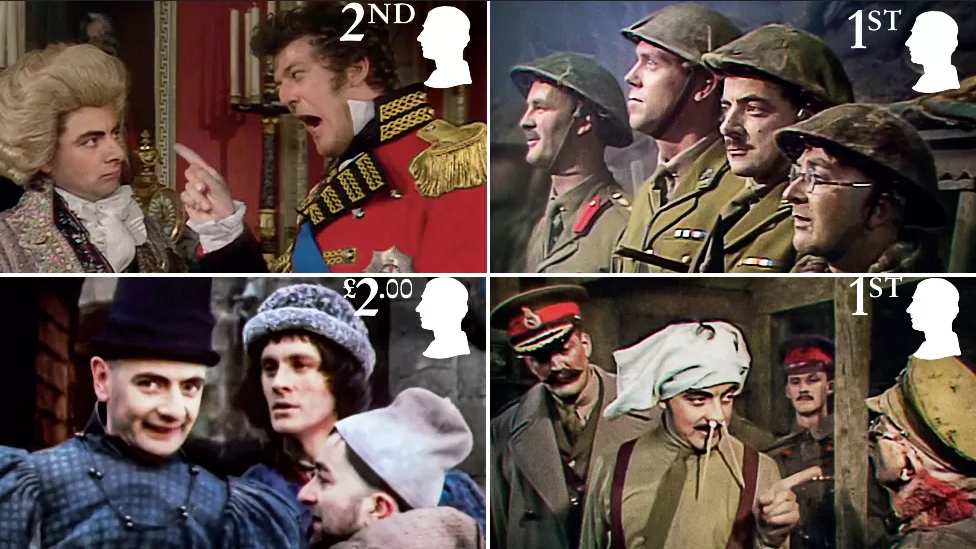
I was fortunate enough to encounter the second series, set in Elizabethan England, before I saw any of the first series. The original has its funny moments, but Ed is quite correct that it’s less than the sum of its parts. Brian Blessed steals every scene he’s in (as always), and Peter Cook’s portrayal of Richard III is great. The rest … is kinda funny if you know a bit of the history. Thankfully, there was more to come.
Blackadder II aired at the start of January 1986, and had a much smaller budget and a simpler set up — and it was far, far funnier, the protagonist no longer a conniving weasel but a court sycophant with Baldrick and Percy as comedy punchbags.
“Well, it is said, Percy, that civilised man seeks out good and intelligent company, so that through learned discourse he may rise above the savage and closer to God. Personally, however, I like to start the day with a total dickhead to remind me I’m best.”
(Fans of comedy shows who quote the lines endlessly can become quite tedious but, well, tough.)
Or: “The eyes are open, the mouth moves, but Mr. Brain has long since departed, hasn’t he, Percy?”
Towards Baldrick he is somewhat more indulgent, telling him that “Thinking is so important“.
“I’ve been in your service since I was two and a half my Lord,” his dogsbody protests upon being thrown out: “Well that is why I am so utterly sick of the sight of you.”
Elton also thought the medieval era to be too squalid and wanted Season 2 set in the “sexier” Elizabethan era (and indeed Edmund’s outfit is rather sexy, as Percy might put it).
Comments Off on Blackadder at 40
May 27, 2023
Communism, Democracy, Monarchy? Any form of government is inherently tyrannical once it gets big enough
As I’ve mentioned now and again, although I’m philosophically libertarian, I also describe myself as a “weak monarchist” … it’s not that I want a return to spurred-and-booted aristos literally lording it over everyone else, but that the central institution of the monarchy tends to tamp down some of the worst excesses of various flavours of democracy. Presidential systems put a temporary monarch on top, but a temporary monarch with real, day-to-day powers that can be — and often are — exercised to the detriment of some or all of the population. Constitutional monarchy reserves a few rarely used (and rarely needed) powers to the monarch, but delegates the vast majority of the grubby day-to-day governing stuff to grubby elected politicians. This neat division of powers progressively fails as governments attempt to take on more power to interfere in the lives of ordinary people … and that process went into overdrive with the pandemic lockdowns and so much arbitrary power put not into the hands of elected officials (who at least theoretically have to answer to the voters every now and again) but to the already bloated civil service and their extended families of government-funded but “independent” organizations delegated powers to do all sorts of mischief.
All that said, I don’t think I quite fit into Theophilus Chilton‘s group of former-libertarians-turned-monarchists, if only because I’ve always preferred keeping the monarchy in place:

One of the greatest ironies of modern non-mainstream politics in the West is the tendency on the part of libertarians (whose whole ideology supposedly centers upon the maximization of personal freedom) to eventually find their way into supporting much more authoritarian ideologies on the dissident and reactionary Right. Indeed, this is the general route that my own political convictions have taken – from libertarianism to monarchism. Many libertarians would recoil in horror at the thought, yet given the number of former libertarians in neoreaction and in the dissident Right in general, it obviously happens quite often. One of the reasons I would suggest for this is that the foibles and failures of democracy – the governing system most often associated with the libertarian view of freedom – are becoming increasingly apparent to thoughtful observers. The old propaganda used to prop up the democratic dogma in Western nations is becoming increasingly stale and unconvincing. It becomes more and more apparent that democracy does not equal freedom, just as it is becoming apparent that “freedom” is not always and in every sense something that is conducive to good government and stable society.
My purpose with this essay is not to seek to convince my libertarian or classically liberal readers to become monarchists. This may well end up being where they land, politically and ideologically speaking, but their experiences and growth may move them in other directions. What I do want to do is to try to get them started on that path by pointing out that democracy is not any better than other forms of government and may indeed be worse in some areas that we can see empirically. I want to plant a seed of doubt and encourage it to grow. If the thoughtful libertarian is to be convinced, it must be by convincing himself or herself.
Please note that throughout this article, I will refer to “democracy” in a general sense to refer to any modern popular form of government. This includes the sort of representative republican system (formerly) typified by the American government which, while not directly democratic, was still essentially democratic in its overall form and complexion.
Personal Freedom
One of the obvious objections which libertarians and other classical liberals have against monarchy (and other authoritarian governing systems in general) is that the unification of power into the hands of a single executive makes it prone to abuse and to the removal or suppression of the freedoms of the citizenry. Typically, they will envision a monarchy as some kind of police state where citizens who step out of line are severely punished and every aspect of life is closely watched and regulated by the government. This, in turn, leads to a somewhat jaundiced view of history, especially that of the much-excoriated “Dark Ages”, believed to have been a dystopia of violence and tyranny.
This view of the relevant history is, however, untrue and generally relies upon a false epistemic dichotomy that is sadly very common within libertarianism. This is the failure to distinguish between “strong government” and “big government”, the two of which are usually confounded in the classical liberal’s mind. The former term refers to the capacity of the executive to exercise power within his sphere of activity, while the latter describes the extent of the sphere of activity itself. A ruler may be strong in the sense of being decisive and effective in what he does, yet find the area in which he can legitimately act to be circumscribed by law or custom. Among most historical Western monarchies, while kings often ruled “strongly”, they were not able to rule intrusively. Their subjects were often left with a relatively wide degree of latitude in their personal and economic affairs, and the restraints of custom and social structure tended to be more constraining than the actual deeds of their king himself.
Let us contrast this with the various democracies we see in the West, both the United States and others. How much do they really respect personal freedoms? In other words, how much do they really embody the “small government” ideal desired by libertarians and other classical liberals? The answer is: not much at all. Western man lives in democracies in which he can be arrested for tweeting “hate speech” on social media. His everyday life is overseen, administered, and commandeered by a body of regulations enforced by entirely unaccountable bureaucrats who have the capacity to trap him into Kafkaesque nightmares of life-altering tribulation. Every aspect of his food, his clothing, his home, his transportation, his workplace – all controlled by the government he (wrongly) believes he elected freely. If he has any kind of well-paying job or business enterprise, he will be paying a tax rate that ancient absolute monarchs would have blushed to even suggest exacting from their subjects. Democratic governments – supposedly by and for the people – intrude into every area of his life (big government) and do so through robust and often corrupt police state apparatuses which are literally willing to break down his door and possibly shoot him and his family for even minor infractions.
So please, let us dispense with the notion that democracy protects personal freedom.
Comments Off on Communism, Democracy, Monarchy? Any form of government is inherently tyrannical once it gets big enough
May 11, 2023
London’s return to normality after Coronation Day
In The Line, Matt Gurney recounts his third and final day in London covering the Coronation, the rather impressive clean-up efforts afterwards and the damp squib of the third day, “The Big Help Out”:

Monday was a holiday in the U.K., too, it’s important to note. A “bank holiday”, in the local jargon, which had been declared as part of the official period of celebration. There were still lots of people working, of course. Restaurant staff and taxi drivers and all the rest. But there were a lot of people who could have been volunteering. And I didn’t see any. Not a one.
I’d gone looking, too. There was a website for the so-called Big Help Out, where you could put in your address and what kind of volunteering you were interested in, and find local opportunities. I used my hotel address and selected every possible category of volunteerism, and was offered … not much. I broadened the search area and … still not much. I could download a few kits to collect some signatures for petitions. I was invited to pick up some trash in my local park, whichever park that was, and just as a solo effort. I was asked to fill out some surveys about nature and wildlife for some local conservation groups. And that all sounds … uhh … worthwhile. But this wasn’t what I had in mind, I admit. No group activities? No community activism?
It seemed odd especially because the entire point of Sunday’s events, the Big Lunches, had been bringing people together. To celebrate. It seemed fitting and appropriate for those same people to then get together the next day and contribute something. But no. No one seemed interested. I didn’t have as much time to wander the city on Monday as I’d had on Sunday, but I still had a few hours, and I didn’t see anything. It was quiet.
This had been foreseen as being a problem. Even before I’d flown over, as part of my research, I’d come across this article in The Guardian, warning three weeks ago that volunteerism was at a crisis point in the U.K., was trending further down, and had been for years. It’s not that anyone seemed to think that the idea of the Big Help Out was bad. It’s just that no one seemed to think many people would actually show up.
Some events certainly seemed to go off as planned. Mainly the ones where royals or other VIPs attended. The BBC reported that the Prince and Princess of Wales, and their children, helped improve a Scouts facility. The prime minister and his wife prepared and served food to the elderly. The BBC also reported that 55,000 events were planned across the U.K. I truly and sincerely hope they did well, and that good things were accomplished in communities and for people that needed the help. But I can only tell you what I saw, as I’ve done in my other dispatches, and I didn’t see anything in London on Monday. I asked around a bit, and people either just shrugged it off and went about their day or hadn’t heard of The Big Help Out at all. They’d sure as hell heard of The Big Lunches, though.
Again, probably not a shock that an invitation to party got a better response than an invite to help out. But still.
He also considers the monarchy as an institution from a Canadian constitutional perspective and I find I largely agree with his conclusions:
If I was starting a country from scratch, I would never decide that the logical thing to do would be to invest our notion of sovereignty and much of our government’s powers in an old man who lives in a castle on an island across the ocean. No one would. It’s absurd. But … it works? And, more to the point, I have zero faith — absolutely zero — that we’d ever be able to replace what we currently have with something that functioned at least as well. That has to be the minimum bar. And look around, at the state of things in Canada right now, and for the foreseeable future. Does anyone think we’re going to be in a place to design a new Canadian republic from scratch without just epically screwing it up? Julie Payette, President of Canada, anyone? David Johnston, Eminent President?
We all know that’s exactly who we’d end up with, right? Would we just skip a lot of fuss and bother and just make the president whomever happens to be the youngest (or oldest, or median) member of the Trudeau Foundation board of directors at any given moment? Alternate between astronauts and retired Supreme Court justices? Tack it on as a side gig for whomever happens to be hosting The National that week?
If you think I’m being unduly flippant or sarcastic, I beg you: imagine the president we’d end up with if we locked Justin Trudeau, Pierre Poilievre and Jagmeet Singh in a room together until they could sort it out. If ever. And then tell me you don’t find yourself reconsidering whatever thoughts you may have re: Charles over in Blighty.
I’m a pretty luke-warm monarchist, to be honest, but the thought of the great and the good of Canada running a republic has me singing “God Save the King” at a high volume. His Majesty King Charles III will almost certainly never achieve the personal popularity of her late Majesty Queen Elizabeth II, and that’s okay. As long as he manages to follow the model of his mother and keep his trap shut about political matters in any of his various realms, the better we’ll all feel about keeping the monarchy going a bit longer.
Comments Off on London’s return to normality after Coronation Day
May 9, 2023
The Republicans’ moment in the sun rain
I joked on Coronation Day that the only people not trying to have a good experience there were the British republicans, but they did get a bit more attention due to their proximity to the Royal Procession than they normally manage:
I mentioned before that it was a happy crowd, with high spirits. The crowd didn’t strike me as remarkable, which is to say, there wasn’t anything particularly notable about it. It was mixed. You’d find every age group and colour there, as well as a smattering of obvious tourists. Lots of people had little Union Jacks they would wave or tuck into the brims of hats or under backpack straps. Some wore full-sized flags as capes. A few young men, who’d obviously been drinking either since early that morning or perhaps the night before, were there in cheap royalty costumes — robes and plastic crowns. The way they were going, I had doubts they’d last much longer. One in particular seemed a bit wobbly on his feet.
One young woman with them had somehow attached a frisbee to her head, in delightfully mockery of the absurd hats women seem to love wearing to royal events. It made me laugh. So begins and ends The Line‘s coronation-related hat commentary.
One of a collection of photos from Kim du Toit’s post-coronation post showing many (perhaps most) of the Republican protestors along the parade route.
https://www.kimdutoit.com/2023/05/08/monday-funnies-post-coronation-edition/Quite near to the front of the viewing area, just off to the left of Nelson’s Column, was a group of a few dozen republican protesters. I have to remind my North American readers — I don’t mean U.S. Republicans, the of-late MAGA-infused husk of the once Grand Old Party. These are British republicans, an arguably even more baffling breed: these are the people that want Britain to be a republic. They too were a mixed group, but as I wandered over to join them, I did note something interesting. I had expected them to be younger and more ethnically diverse than the rest of the crowd. They weren’t. I don’t know if I’d go as far as saying that they were less diverse, but my sense was that, at least in terms of the age of the crowd of protesters, maybe they were a touch older than the rest? In any case, it would have been a near-run thing, but that was one of the only things that really jumped out at me about the protest. My assumption that they’d be younger, more diverse, more obviously progressive was wrong. If they’d dropped their yellow flags and banners and quit their chanting of “NOT MY KING!”, they’d have blended in with the rest.
It started to rain around this time. It’s England, of course it was raining. I’d come prepared with a rain jacket so wasn’t deterred, but the rain did have one admittedly lousy impact. Umbrellas. I’d been gradually able to work my way up quite close to the front of the crowd — I’d stuck close to the republicans and it seems that many people tried to give them a wide berth, and I’d been able to shuffle my way gradually forward. Nelson’s Column was to the right, behind me. To my right and front was Admiralty Arch. And off in the distance, but not too far, was Westminster Abbey itself. It was a pretty perfect place to view the procession.
But for the umbrellas. Once they opened up, all one could see was umbrellas.
And that’s how it stayed, to be honest. Troops began to march past in perfect ranks. Bands struck up patriotic songs. The crowd cheered and more than a few sang. One loud female voice — a surprisingly lovely one — struck up The Star Spangled Banner — which was either some kind of deliberate prank or just a very historically confused soul getting caught up in the moment. I heard the clopping of hooves and the crowd went absolutely wild, and suddenly, thousands of arms shot up into the air holding smartphones, every person present seeking a better angle for their videos. The arms and the umbrellas made it virtually impossible to see a damn thing. (See this video by a New York Times team: they must have been standing within 50 feet of where I was, a bit off to my left. You’ll see what I mean.)
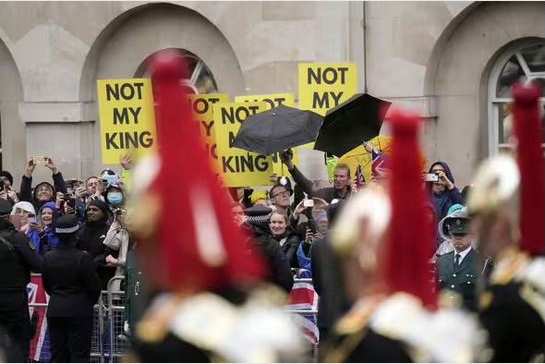
That was from Matt Gurney’s sleep-deprived view of the procession from The Line (that’s not editorializing on my part — he hadn’t slept on the plane from Toronto and got to London at 7am on Coronation Day). In what seemed like a useful break in the public celebrations, he snuck away to get some sustenance and be out of the rain for a bit. When he returned it was lowlight time for the Republicans:
After I’d polished off the pint, I headed back out, back to the square, and that’s where things got interesting. I figured I’d get back to my former spot near the chanting republicans, and did so, no problem. But I noticed there suddenly seemed to be an awful lot of cops around … all heading that way. As in: right toward me, and the chanting people I was standing near. Oops. I left, working my way around the crowd, heading back the way I came from my hotel, and found myself actually facing a rank of advancing cops. Oops again. One had a badge that said inspector, and I walked right up and told him I was a Canadian journalist just watching things. He grinned at me and said, “Alright, mate, come this way,” and had a security guard walk me through the police. I thus ended up missing what has proven to be a controversial event and perhaps the only unhappy moment I know of during the coronation, at least in my area: a bunch of the chanting republicans were arrested just moments after I got out of dodge, and then large metal screen barriers were thrown up, closing off the square due to, apparently, overcrowding. People could leave but no one new could enter.
My sense, as I walked away, was that there was no reason to arrest anyone. (And as I said, this is proving controversial.) I hadn’t seen anything getting out of hand. There had been some chanting and counter-chanting and even some heckling back and forth, but it had all seemed in good enough spirits. Even some of the boos sent at the republicans — two young men with flags had been hamming it up in the main crowd, apart from the main blob of republicans — had seemed in good humour. I don’t know what the police saw or knew. But I couldn’t tell you why they’d moved then and not before, or later. As for overcrowding, I don’t think so. The square really wasn’t all that full. It seemed less full at that moment than it had been when the procession had passed on the way to the abbey. But the barriers seemed to go up quickly, everywhere. Literally everywhere.
And though I was glad to have avoided getting caught up in the Cops vs. Chanting Republicans, I was now on the wrong side of the barriers.
In The Critic, Kittie Helmick recounts finding herself in the vicinity of the “NOT MY KING!” group:
“You seem to find this whole thing rather amusing,” snapped a short angry man with a Not My King sign, about half an hour into the Republic protest against the coronation of King Charles III. I must admit I did. Kettled into a small enclave just off Trafalgar Square, an angry swell of old school socialists, Twitter anarchists, Lib Dem mums, eccentric vicars, boomer hippies, blue haired students and Covid conspiracists had somehow found themselves part of the coronation spectacle. Before the bells of St Martin in the Fields, the full shouty brunt of British republicanism was aimed at a bewildered stream of Chinese tourists and young families out for a day in London.
The survival of the British monarchy is one of the great wonders of modern history. Spending the morning of the coronation with Republic, it began to seem less mysterious. Despite everything in recent years, the Monarchy is still liked more than most of our institutions and probably every one of our elected politicians. No one gathered there could really explain why. The arguments were articulated in between the shouty chanting: things about “modern Democracy” and a “family of Lizards”, none of which quite landed the blow as the day unfolded around us.
Somewhere beyond the crowds, towards Westminster Abbey, an ageing, eccentric dandyish farmer, who secretly wants to be King of Transylvania, was being anointed in holy oil and crowned by an Archbishop wearing hearing aids in a seven hundred year old chair vandalised by 18th century schoolboys. All the while this ceremony was being fawned over across the world by everyone from Kay Burley to one of the world’s most remote tribes. None of it made sense, and that is precisely the point.
Earlier that morning, the CEO of Republic Graham Smith, a man not even the protestors could name, achieved the greatest success of his kind since Cromwell, by being arrested at the hands of the jobsworth Met. For a brief moment, a shiver of excitement spread through the protest. Whilst the country was entranced by a fugue of sombre ritual and Zadok the Priest, Republic were experiencing their own desired reality unfold on the streets of London. Here was a police state enforcing the will of a “politically illiterate” nation brainwashed by bunting and tabloid journalism. The mask was finally off. The incoherent gaggle of shouty slogans and reddit thread arguments made sense. The fight was here and now.
Except that was all a fantasy too. As stupid as the arrests were, nothing could disguise the fact this was a fringe event for a movement that just can’t seem to take off — a Coronation curio to gawp at. “They’re a bunch of wronguns, aren’t they?” said one bored steward to me as we watched a man larping Les Miserables as he chanted Not My King at a trio of giggling Chinese students. The deeper I dug into the many arguments and protestations offered as an alternative to the “fairytale” of monarchy, the more the core transgressive energy of British republicanism revealed itself. It is itself strangely twee and fantastical. Rid us of the Royals, and everything will become better. Gone will be the “psychological baggage” of Britain’s past holding us back. Democracy will triumph. The crown jewels will be sold off and spent on food banks. The plebs will not worship hereditary blood, but NHS rainbows. Britain will become less racist, elitist and classist. The left might even win an election. We could have a poet president like Ireland, a Lineker or a Stormzy shaking hands with the American president.
Comments Off on The Republicans’ moment in the sun rain


