Quotulatiousness

July 24, 2020

QotD: A death in the Roman Empire

Filed under: Europe, History, Middle East, Quotations, Religion — Tags: , , , , — Nicholas @ 01:00

The women who came to tend the tomb in the garden had no doubt that their Lord was dead. They had personally arrayed his body in shining white vestments, and then, when all was ready, laid his physical remains to rest. Rejected as he had been by his own people, legally condemned as an enemy of Rome, brought to a squalid and ignominious end, his defeat had seemed total. What victory could there possibly be in the wake of such a death?

Yet then something miraculous happened. Spreading from east to west across the Mediterranean, travelling along the great network of roads and shipping lanes that constituted the arteries of the Roman Empire, news began to spread that this man whose mortal remains supposedly lay entombed in the grave had been seen alive. Most people, of course, scoffed at such reports — but there were some, small communities of believers, who did not. These, even as the decades passed, kept the faith: the conviction that their saviour would come again, that he would reign, in the words of a widely circulated prophecy, as “the king of Jerusalem”, that he would bring to groaning humanity a universal peace.

In the event, Nero did not come again. Despite the various imposters who appeared in the wake of his death in AD 68, and the fact that, centuries later, there were cities in the eastern reaches of the Roman Empire that still honoured his memory, his fate was to be commemorated, not as a saviour, but as a monster. And so, in numerous ways, he was. His readiness to have members of his own family — mother, brother, wife — put to death ensured that when he himself died the dynasty of the Caesars perished with him.

His sex games were notorious. He was darkly rumoured to have set fire to Rome. By the time that Suetonius, half a century after his death, came to write his biography, the details of his life could be structured almost entirely as a catalogue of deviancies and crimes. “Insolence, an uninhibited sexual appetite, dissipation, greed, cruelty: these were the vices which, to begin with — because he gave expression to them only secretly and incrementally — might well have been chalked up as the excesses of youth, had it not been manifest to everyone even at the time that they were failings, not of age, but of character.”

Nero’s rule had become one protracted blasphemy against the customs of the Roman state. These, hallowed by the centuries, enabled the people of a city that had conquered most of the known world to feel a sense of communion still with the mos maiorum: the customs of their distant ancestors. To no class of society was this more important than the Senate, which still, despite the collapse of Rome’s venerable republican order and its replacement by the autocracy of the Caesars, cherished its time-honoured role as the guardians of tradition.

Tom Holland, “When Christ conquered Caesar”, UnHerd, 2020-04-10.

July 22, 2020

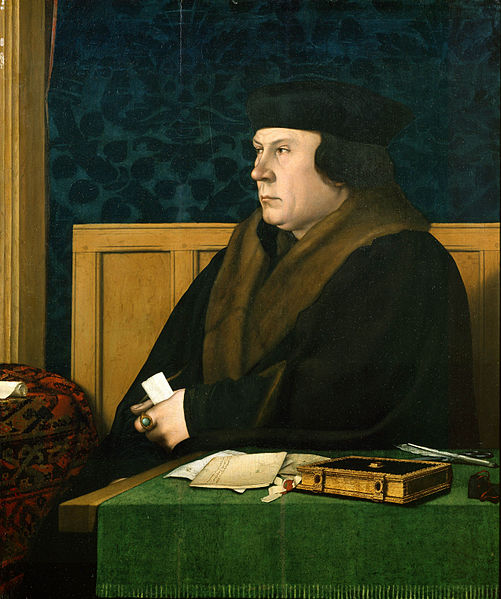
A brief look at the life of Thomas Cromwell, Henry VIII’s “main fixer”

Filed under: Books, Britain, Government, History — Tags: , , , , , — Nicholas @ 05:00

Michael Coren discusses the career and reputation of Henry VIII’s powerful and capable Lord Chamberlain until he fell from favour and was executed in 1540:

Portrait of Thomas Cromwell, First Earl of Essex painted by Hans Holbein 1532-33.
From the Frick Collection via Wikimedia Commons.

The panoply of British history doesn’t include too many monsters. The nation was founded more on meetings than massacres, and other than the usual round of chronic blood-letting in the Middle Ages, and a civil war in the seventeenth-century, the English have left it to the French, the Russians, and the Germans to provide the mass murderers and the genuine villains. But if anyone was generally regarded as being unscrupulous, with a touch of the devil always around his character, it was Thomas Cromwell, the main fixer for Henry VIII in the 1530s, and according to the Oscar-winning movie A Man for all Seasons, the dark politician who had hagiographical Thomas More executed. For decades both on British television and in Hollywood epics it was this self-made man who was willing to smash the monasteries, torture innocent witnesses into giving false evidence, and assemble lies to have that nice Anne Boleyn beheaded.

This was the dictatorship of reputation. Historians provided the framework, and popular entertainment dressed it all up in countless Tudor biopics. But then it all began to change.

The first person to seriously challenge the caricature was himself a victim of lies and hatred. The revered Cambridge historian GR Elton was born Gottfried Rudolf Otto Ehrenberg, son of a German Jewish family of noted scholars, who fled to Britain shortly before the Holocaust. He’s also, by the way, the uncle of the comedian and writer Ben Elton. GR, Geoffrey Rudolph, was one of the dominant post-war historians, and insisted that modern Britain, with its secular democracy and parliamentary system, was very much the child of Thomas Cromwell the gifted administrator and political visionary.

So we had the Cromwell wars. On the one side were the traditionalist, often Roman Catholic, writers who insisted that Cromwell was a corrupt brute and a cruel tyrant; and the rival school that regarded him as the first modern leader of the country, setting it on a road that would distinguish it from the ancient regimes of the European continent. But there was more. While previous political leaders – the term “Prime Minister” didn’t develop until the early eighteenth-century – had sometimes been of relatively humble origins, and Cromwell’s mentor and predecessor Thomas Wolsey was the son of a butcher, they were invariably clerics. Cromwell wasn’t only from rough Putney on the edge of London, and the son of a blacksmith, but he was a layman, and someone who had lived abroad, even fought for foreign armies.

Here was have the embodiment of the great change: the autodidact who was multi-lingual, well travelled, reformed in his religion and politics, and prepared to rip the country out of its medieval roots. Yet no matter how many historians might believe and write this, the culture is notoriously difficult to change, and understandably indifferent to academics. Not, however, to novelists. And in 2009 the award-winning author Hilary Mantel published Wolf Hall, a fictional account of Cromwell’s life from 1500 to 1535. Three years later came the sequel, Bring Up the Bodies. Both books won the Man Booker Prize, an extraordinary achievement for two separate works. The trilogy was completed recently with The Mirror and the Light. The first two volumes were turned into an enormously successful stage play and a six-part television show. Forget noble academics working away in relative obscurity, this was sophisticated work watched and read by tens of millions of people. Cromwell was back.

“It is as a murderer that Cromwell has come down to posterity: who turned monks out on to the roads, infiltrated spies into every corner of the land, and unleashed terror in the service of the state”, wrote Mantel in the Daily Telegraph back in 2012. “If these attributions contain a grain of truth, they also embody a set of lazy assumptions, bundles of prejudice passed from one generation to the next. Novelists and dramatists, who on the whole would rather sensationalise than investigate, have seized on these assumptions to create a reach-me-down villain.”


Glorious Revolution | 3 Minute History

Filed under: Britain, France, History, Military, Religion — Tags: , , , , , — Nicholas @ 02:00

Jabzy
Published 21 Jul 2015

Sorry about the delay I’ve been without internet while I’ve moved apartment. And thanks for the 9,000 subs

Thanks to Xios, Alan Haskayne, Lachlan Lindenmayer, William Crabb, Derpvic, Seth Reeves and all my other Patrons. If you want to help out – https://www.patreon.com/Jabzy?ty=h

Please let me know if I’ve forgot to mention you, I’m a little disorganized without internet.

July 13, 2020

“The Richard of Richard III is often regarded as a caricature, a cardboard-cutout villain rather like the Sweeney Todd of Victorian melodrama”

Filed under: Britain, History — Tags: , , , , — Nicholas @ 05:00

Theodore Dalrymple discusses two Shakespeare characters, the protagonists of Richard II and Richard III:

This was long thought to be the only portrait of William Shakespeare that had any claim to have been painted from life, until another possible life portrait, the Cobbe portrait, was revealed in 2009. The portrait is known as the “Chandos portrait” after a previous owner, James Brydges, 1st Duke of Chandos. It was the first portrait to be acquired by the National Portrait Gallery in 1856. The artist may be by a painter called John Taylor who was an important member of the Painter-Stainers’ Company.
National Portrait Gallery image via Wikimedia Commons.

… if we cannot know Shakespeare’s positive thoughts about any major question, as Nutall puts it, we can at least surmise some of the things that he did not believe. No one, I think, could imagine that Shakespeare romanticized the common man or was impressed by a crowd’s capacity for deep reflection. If there is one thing that he was not, it is a utopian.

Apart from the absence of direct evidence, one reason that it is so difficult to know what Shakespeare thought is that he seemed uniquely able to imagine himself into the minds of an almost infinite number of characters, so that he actually became them. He was, in a sense, like an actor who has played so many parts that he no longer has a personality of his own. A chameleon has many colors, but no color. What is perhaps even more remarkable is that, by some verbal alchemy, Shakespeare turns us into a pale version of himself. Through the great speeches or dialogues, we, too, enter a character’s world, or even become that character in our minds. I know of no other writer able to do this so often and across so wide a spectrum of humanity.

Included in this spectrum are the two King Richards, the Second and the Third. Shakespeare wrote the two plays in reverse historical order, about four years apart. The usurpation of Richard II’s throne in 1399 by Henry Bolingbroke, Henry IV, led to political instability and civil war in England that lasted until the death of Richard III in battle in 1485. Because everyone loves an unmitigated villain, Richard III is said to be the most frequently performed of all Shakespeare’s plays, but its historical verisimilitude is much disputed. It is clearly an apologia for the Tudor dynasty, for if Richard III were not the absolute villain he is portrayed as having been (and such is the power of Shakespeare’s play that everyone’s image of the king, except for those specially interested, derives from it), then Henry VII, whose dynastic claims to the throne were meager, to say the least, was not legitimately king — in which case neither was Henry VIII, Queen Elizabeth’s father, nor, therefore, was Queen Elizabeth legitimately queen: a dangerous proposition at the time Shakespeare wrote. So reminiscent of sycophantic Soviet historical apologetics does a Soviet emigré friend of mine find the play that he detests it. In 1924, a surgeon in Liverpool, Samuel Saxon Barton, founded what became the Richard III Society, which now has several thousand members globally, to rescue the reputation of the king from the Bard’s calumnies.

If Richard III were merely a propaganda play on behalf of the Tudors, however, it would hardly have held its place in the repertoire. It does so because it tackles the perennially fascinating, and vitally important, question of evil in the most dramatic manner imaginable; its historical inaccuracy does not matter. Richard III may not have been the dark figure Shakespeare portrays, but who would dare to say that no such figure could ever have existed?

The two plays offer a contrast between different political pathologies: that of ambitious malignity and that of arrogant entitlement, both with disastrous results, and neither completely unknown in our time. They share one rather surprising thing in common, however: before reaching the throne, both usurpers — Richard III, when still Duke of Gloucester; and Henry IV, when still Duke of Hereford — felt obliged to solicit the good opinion of the common people. This is perhaps surprising, in view of the extremely hierarchical nature of society in both the age depicted in the plays and the age in which they were written, and suggests a nascent populism, if not real democracy. However powerful the king or nobility, the Peasants’ Revolt of 1381, early in the reign of Richard II (as much a revolt of merchants as of peasants), must have alerted them to the need to keep the populace at least minimally satisfied.

Update: Fixed broken link and mis-placed image.

July 11, 2020

The “Puritan Moment” of The Current Year

Filed under: Britain, History, Liberty, Politics, Religion — Tags: , , , , — Nicholas @ 05:00

Nigel Jones on the long history of struggle between British puritans and libertarians:

Portrayal of the burning of copies of William Pynchon’s book The Meritous Price of Our Redemption by early colonists of the Massachusetts Bay Colony, who saw his book as heresy; it was the first-ever banned book in the New World and only 4 original copies are known to survive today.
Engraving by F.T. Merrill in The History of Springfield for the Young by Charles Barrows, 1921.

Behind the wave of Wokeism that has swept and is now swamping Anglo-American Culture, is a pattern that has recurred throughout British History since the early 17th century. This is the pendulum that regularly swings between periods of joyful Libertarianism and purse lipped Puritanism.

Puritanism takes its name from the Calvinist religious movement that arose during the Protestant Reformation, partly in reaction to the explosive cultural Renaissance of the Elizabethan era – the age of Shakespeare, Marlowe, Ralegh and John Donne.

The Puritans exported their austere doctrines to America aboard the Mayflower, where they eventually became one of the building blocks of the USA, and briefly achieved political power in England after the Civil War in the forbidding guise of Oliver Cromwell’s Commonwealth.

We all have a mental picture of the Puritans in action. Sombrely dressed in black and grey, smashing the statues of saints, preaching their varied versions of the scriptures, and policing and banning anything when they suspected people of enjoying themselves, from Christmas festivities, to theatres, to fornicating for pleasure rather than reproduction. The Puritans endeavoured to dictate what people could think, speak and write. If this rings any bells with Wokeism, that is surely not coincidental.

There was an inevitable vengeful reaction to this po-faced culture of control and repression, and it soon came with the Restoration of the monarchy in 1660. King Charles II exemplified in his own libidinous person, with his myriad mistresses and tribe of illegitimate children, the loose culture of license that spread out from his court like a stain. This was the easy going Age of Lord Rochester and Nell Gwynn, so disapprovingly, if hypocritically, frowned on in the diaries of Samuel Pepys and John Evelyn. More darkly, the Puritan Regicides who had beheaded Charles’s father were hung, drawn and quartered along with Cromwell’s exhumed corpse.

The Libertarianism ushered in by the Restoration had a much longer run than the initial rule of Puritanism had enjoyed. It lasted through the Georgian Age of the 18th century, culminating in the decadence of the Regency bucks and Queen Victoria’s “wicked uncles”. Puritanism made its comeback with the accession of Victoria herself, with her eponymous reign infamous for its crinolines, covered piano legs, cruel persecution of that supreme Libertarian Oscar Wilde, and its massive hypocrisy – a constant adjunct of Puritanism when it comes up against the incontrovertible facts of life and human nature.

Neatly coinciding with the reign of Victoria’s despised eldest son, Libertarianism returned in the portly shape of Edward VII in the opening decade of the 20th century to which he gave his name. As during the Restoration, the ruling elite again set the tone of the Edwardian era with their shooting and hunting, their discreet adultery at country house weekends, and their lavish clubs and parties.

July 10, 2020

English Civil War | 3 Minute History

Filed under: Britain, History, Military — Tags: , , , , , — Nicholas @ 02:00

Jabzy
Published 9 Mar 2015

I cut quite a bit out to save time. I’ll try and do a video on the Protectorate or the Restoration soon.

July 9, 2020

Ethiopian Emperor Haile Selassie died in 1974, but was toppled in 2020

Filed under: Africa, Britain, History, Italy, Religion — Tags: , , , , — Nicholas @ 05:00

In The Critic, James Jeffrey explains the late emperor and how he fell off his plinth in June of this year:

The Ethiopian emperor has fallen in leafy Wimbledon, but there’s more to his demise than meets the eye

In 1936, Emperor Haile Selassie gave a rousing speech to the League of Nations reminding it of its moral duty to defend Ethiopia which was being invaded and ransacked by Italy.

Despite the League entirely ignoring him — thereby dooming its proclaimed doctrine of collective security, which in turn hastened World War II — Selassie’s impressive performance recounting “the tortures inflicted upon the Ethiopian people,” while imploring the League to save Ethiopia from the “bonds of vassalship,” cemented his iconic international reputation. Time magazine named him “Man of the Year.”

All the while, and for the span of his reign from 1930 to 1974, the vast majority of Ethiopians lived in feudal conditions, knowing only vassalship. An authoritarian ruler, Selassie’s full title was “By the Conquering Lion of the Tribe of Judah, His Imperial Majesty Haile Selassie I, King of Kings, Lord of Lords, Elect of God.”

Among his retinue of lackies there was a man whose sole job was to wipe away the urine of the imperial dog Lulu after it relieved itself on the shoes of visiting dignitaries, according to Ryszard Kapuscinski’s The Emperor: Downfall of an Autocrat (a hotly contested point and accused of being invented by Kapuscinski; it sounds entirely plausible to me having seen how much Ethiopians, especially those with wealth and power, go in for being kowtowed to and waited on).

Civil rights and political rights were little known during Selassie’s reign — cementing an oppressive trend that continues to this day in Ethiopia — while he failed to adequately respond to famines in 1958 and 1973, dooming tens of thousands, possibly hundreds of thousands, of Ethiopians to their deaths.

Yet for all his faults — based on what I know and saw in Ethiopia, and on my gut instinct, I’ve never been a fan — Selassie opened up Ethiopia to the world and pushed to develop it. He introduced the country’s first written constitution in 1931, which while heavily in favour of the nobility, envisaged a transition to democracy. In Ethiopia today, he remains an inspiring figure for many, his image appearing all over the place. Among the Rastafari movement, Selassie is revered by many as the returned messiah and God incarnate.

Last week a group of Ethiopian diaspora in London got to give their judgement on the so-called Negusa Nagast, King of Kings, whose dynastic lineage reportedly stretched back to Emperor Menelik I, the offspring of King Solomon and the Queen of Sheba. In a Wimbledon park on June 30, a bust of Selassie was destroyed by a group of around 100 people, leaving a shattered plinth surrounded by rubble.

June 27, 2020

Maximilien Robespierre: The Reign of Terror

Filed under: France, Government, History — Tags: , , , , , — Nicholas @ 06:00

Biographics
Published 5 Jul 2018

Maximilien Robespierre promised to usher a fairer, more representative form of government to the French people. What they got was a reign of terror that saw thousands facing the horror of the guillotine.

Visit our companion website for more: http://biographics.org

Credits:
Host – Simon Whistler
Author – Steve Theunissen
Producer – Jack Cole
Executive Producer – Shell Harris

Business inquiries to biographics.email@gmail.com

June 24, 2020

Napoleon’s Great Blunder: Spain 1808

Filed under: Britain, Europe, France, History, Military — Tags: , , , — Nicholas @ 04:00

Epic History TV
Published 16 Jan 2019

In 1808, Napoleon’s rivalry with Britain led to an ill-fated intervention in Portugal and Spain, that sparked a nationalist revolt against the French. At Bailén Napoleon’s Empire suffered its first major defeat, and though Napoleon himself then arrived in Spain to reassert French military dominance, he could not prevent the escape of Sir John Moore’s small British army, after its defensive victory at Corunna on 16 January 1809. The British army would return, under new leadership, to play a major part in his downfall.

Get early access and a vote on future topics by supporting us on Patreon: https://www.patreon.com/epichistorytv

With thanks to HistoryMarche, check out his channel here: https://www.youtube.com/channel/UC8MX…

Find Osprey books on the Napoleonic Wars here:
https://ospreypublishing.com/

Great books about the Napoleonic Wars (as an Amazon Associate I earn from qualifying purchases):
The Napoleonic Wars http://geni.us/R5ZI9c
Corunna 1809 http://geni.us/IHLD
Peninsular War Atlas http://geni.us/S6Na84z
Napoleon the Great http://geni.us/NqMW

#EpicHistoryTV #NapoleonicWars #Napoleon

All music from Filmstro https://www.filmstro.com/
Get 20% off an annual license with this exclusive code: EPICHISTORYTV_ANN

Thanks to The 95th Rifles Battle Re-enactment and Living History Society: https://www.95thrifles.com/

June 20, 2020

History-Makers: Confucius

Overly Sarcastic Productions
Published 19 Jun 2020

Welcome to the challenge run of History-Makers, where I attempt to give insightful historical context to someone whose backstory is almost entirely blank.

SOURCES & Further Reading: Confucius: A Very Short Introduction by Gardner, China: A History by Keay, The Analects of Confucius, The Mencius.

This video was edited by Sophia Ricciardi AKA “Indigo”. https://www.sophiakricci.com/
Our content is intended for teenage audiences and up.

PATREON: https://www.Patreon.com/OSP

MERCH LINKS: https://www.redbubble.com/people/OSPY…

OUR WEBSITE: https://www.OverlySarcasticProductions.com
Find us on Twitter https://www.Twitter.com/OSPYouTube
Find us on Reddit https://www.Reddit.com/r/OSP/

June 19, 2020

Anglo-Dutch Wars | 3 Minute History

Filed under: Britain, Europe, History, Military — Tags: , , , , , , — Nicholas @ 02:00

Jabzy
Published 25 Apr 2015

First, Second and Third Anglo-Dutch Wars. I left out the Fourth War because it really wasn’t connected to the previous 3.

Also – I hope you don’t mind I used ‘Netherlands’ throughout the video despite the fact the term didn’t come until much later.

June 13, 2020

The CHAZ is a little bit 1968, a little bit 1789, but perhaps more 1871

Filed under: France, Germany — Tags: , , , , , , — Nicholas @ 03:00

Lawrence W. Reed finds the developments in the Capitol Hill Autonomous Zone of Seattle remind him of the Paris Commune:

Otto von Bismarck talks with the captive Napoleon III after the Battle of Sedan in 1870.

“‘Autonomous zone’ has armed guards, local businesses being threatened with extortion.”

That was quite a striking headline to behold. My immediate reaction was, “Oh my gosh, the Paris Commune is back!”

Except that it wasn’t Paris, and it wasn’t 1871. It was Seattle, Washington, USA — today. According to multiple reports, radical protesters seized a six-block area of the city. They declared it a police-free fiefdom, posted armed guards at its perimeter, began extorting money from local businesses (normally called “taxation”) and were even requiring residents to provide ID to enter their own homes.

The Paris Commune that lasted just 70 days in the spring of 1871 was born amid the ruins of France’s wartime loss at the hands of Prussia in the fall of the previous year. When the Prussians captured France’s Emperor Napoleon III, the monarchy collapsed, and the French Third Republic was born. In Versailles, just a few miles from Paris, its leaders sat on their hands as Parisians stewed in the toxic juices of defeat, resentment, and a rising tide of Marxist-inspired class warfare. The voices of the big mouths increasingly drowned out those of the more moderate citizens who preferred to get the city back to normal and work for a living.

On March 18, 1871, the socialist radicals seized the upper hand in the City of Lights. They occupied government buildings and ousted or jailed their opposition. It was a “People’s Revolution” (unless you were one of the people who didn’t support it). Karl Marx’s communist scribblings provided the radicals — called “Communards” — with their primary inspiration, but Marx himself later criticized their failure to immediately seize the Bank of France and march on the government in Versailles. In the early days of the Paris Commune, however, he hoped he was witnessing a fulfillment of his own delusions:

    The struggle of the working class against the capitalist class and its state has entered upon a new phase with the struggle in Paris. Whatever the immediate results may be, a new point of departure of world-historic importance has been gained.

Barricades of the Paris Commune, April 1871. Corner of the Place de l’Hôtel-de-Ville and the Rue de Rivoli.
Photo by Pierre-Ambroise Richebourg (1818-1875) from the collection of the Metropolitan Museum of Art.

June 12, 2020

History of Prussia | Animated History

Filed under: Europe, Germany, History, Military — Tags: , , , , , , , — Nicholas @ 02:00

The Armchair Historian
Published 14 Sep 2018

Sign up for The Armchair Historian website today:
https://www.thearmchairhistorian.com/

Our Twitter: https://twitter.com/ArmchairHist

Sources:
The Rise and Fall of Prussia, Sebastian Haffner
Germans and Slavs, Arno Lubos
Frederick the Great, Tim Blanning

Music:
“Hungarian Rhapsody” by Franz Liszt

“Twenty six variations on La Folia de Spagna”, London Mozart Players
Matthias Bamert, conductor

*Correction 1: In 1648, Brandenburg-Prussia also acquired parts of Pomerania, which isn’t shown in the video. Pomerania is a state directly above Brandenburg.

June 5, 2020

Australia’s 1975 constitutional crisis back in the news

Filed under: Australia, Government, History, Law — Tags: , , — Nicholas @ 03:00

Colby Cosh outlines the events of 1975, where the Governer-General of Australia, Sir John Kerr, used his reserve powers to dismiss the government of Gough Whitlam and call for a fresh federal election in which Whitlam’s party was soundly defeated. In taking this action, Sir John corresponded with Queen Elizabeth and after his retirement deposited those documents with the National Archives. The bulk of his papers were made available to researchers after the statutary 30 year delay, but the letters involving Her Majesty were withheld for 60 years. An Australian historian has now successfully challenged the National Archives in Federal Court:

National Archives of Australia in Parkes, Australian Capital Territory.
Photo by Bidgee via Wikimedia Commons.

The confrontation at Yarralumla, and the various narrative twists and turns leading up to it, are a major event in Australian constitutional history. Which brings us to Jenny Hocking, a left-leaning historian who is a top specialist on the 1975 crisis.

Hocking knew that Kerr, after his retirement, had deposited copies of his correspondence with the Queen in Australia’s National Archives. Hocking made good professional use of Kerr’s formal papers, made available to the public in 2005 under the 30-year rule that covers Australian state papers. But Kerr had, with the agreement of the Archives, made separate arrangements for his letters to and from the Queen — the so-called “(Buckingham) Palace letters”.

[…]

The National Archives, trying to stand by its bargain with Kerr as a donor, successfully argued that while papers generated or received by “the official establishment of the Governor-General” would clearly be ordinary public records under Australian law, the letters that Hocking wanted to see didn’t involve “the official establishment,” but merely Kerr himself as … well, just a guy. The Federal Court found that the Palace letters therefore had the legal status of one of Sir John’s grocery bills, or sex diaries, or anything else that he would be perfectly entitled to stick in a locked box for 50 years.

(Or to burn in private. Which was an option he had, but rejected, explaining explicitly that he wanted future historians to have access to the material. But not for them to have it so soon that it might surprise or embarrass the Queen during her own lifetime.)

What happened last week was that the case reached Australia’s top court and Hocking won a smashing victory. Kerr’s correspondence with the Queen is known to have contained discussions of the Australian constitutional situation, and in view of that, the High Court said, the Federal Court’s distinction between Commonwealth records and personal correspondence must be regarded as a bogus artifice. The concepts aren’t mutually exclusive.

The Archives also asserted that queen-viceroy letters attract a higher level of secrecy “by convention” in all the Queen’s realms, but they couldn’t produce evidence that such a convention exists. Hocking’s costs must be covered by the Archives, and as far as the letters go, the ball is in their court legally. They could still use a “national security” exemption to withhold some of the material, and the freedom with which this magic formula is used by archival gatekeepers is notorious. But it may soon be possible for Australians to read the final chapter of the cataclysmic Kerr-Whitlam story.

Hundred Years War | 3 Minute History

Filed under: Britain, France, History, Military — Tags: , , , — Nicholas @ 02:00

Jabzy
Published 18 Oct 2015

Thanks to Xios, Alan Haskayne, Lachlan Lindenmayer, William Crabb, Derpvic, Seth Reeves and all my other Patrons. If you want to help out – https://www.patreon.com/Jabzy?ty=h

Apologies, especially to the Patreon supporters for not uploading recently, I’ve changed jobs/moved house etc. I should be back on the usual schedule now.

Plus, thanks for the 12,000 subs.

« Newer PostsOlder Posts »

Powered by WordPress