Epimetheus
Published 19 Jan 2019The history of Canada explained in 10 minutes
Support new videos on this channel on Patreon! đ
https://www.patreon.com/Epimetheus1776Canadian history from the discovery of the Vikings to the French and English colonization until modern times.
Tags:
Canadian history documentary, Canadian history crash course, Canada history, history of Canada documentary, history Canada summarized, Canada, history, Canadian history, Canadian American history, animated history of Canada, canadian history in a nutshell, canadian history for kids, educational, Canada Indians, Canada great Britain, English Canada, Quebec, French Canada, French English Canada,
November 12, 2020
The history of Canada explained in 10 minutes
November 6, 2020
A Swedish Trilogy Pt. 1 – A New Hope – Sabaton History 092 [Official]
Sabaton History
Published 5 Nov 2020The Swedish nation was in turmoil, as news spoke of King Gustavus Adolphus’ death on the battlefield of LĂŒtzen in 1632. The Lion from the North was slain — but who would reign in his stead? Gustavus had fathered a young daughter, the 6-year old Christina. Torn between a grief-stricken Queen Mother and the overbearing duties to monarchy and country, Christina grew into an unhappy and troubled woman. Much was expected of her, as she was still the daughter of the legendary warrior-king. But was she able and willing to continue his legacy? Or would she rather forsake her throne in order to find her own future far away from Sweden?
Support Sabaton History on Patreon: https://www.patreon.com/sabatonhistory
Listen to Sabaton on Spotify: http://smarturl.it/SabatonSpotify
Official Sabaton Merchandise Shop: http://bit.ly/SabatonOfficialShopHosted by: Indy Neidell
Written by: Markus Linke and Indy Neidell
Directed by: Astrid Deinhard and Wieke Kapteijns
Produced by: PÀr Sundström, Astrid Deinhard and Spartacus Olsson
Creative Producer: Maria Kyhle
Executive Producers: PÀr Sundström, Joakim Brodén, Tomas Sunmo, Indy Neidell, Astrid Deinhard, and Spartacus Olsson
Community Manager: Maria Kyhle
Post-Production Director: Wieke Kapteijns
Editor: Karolina DoĆÄga
Sound Editor: Marek Kaminski
Archive: Reuters/Screenocean – https://www.screenocean.comSources:
– Nationalmuseum
– Statens Museum for Kunst
– Livrustkammaren
– Herzog Anton Ulrich Museum
– Swedish capture of Kauzenburg 1631 colorized by DextwinAll music by: Sabaton
An OnLion Entertainment GmbH and Raging Beaver Publishing AB co-Production.
© Raging Beaver Publishing AB, 2019 – all rights reserved.
October 23, 2020
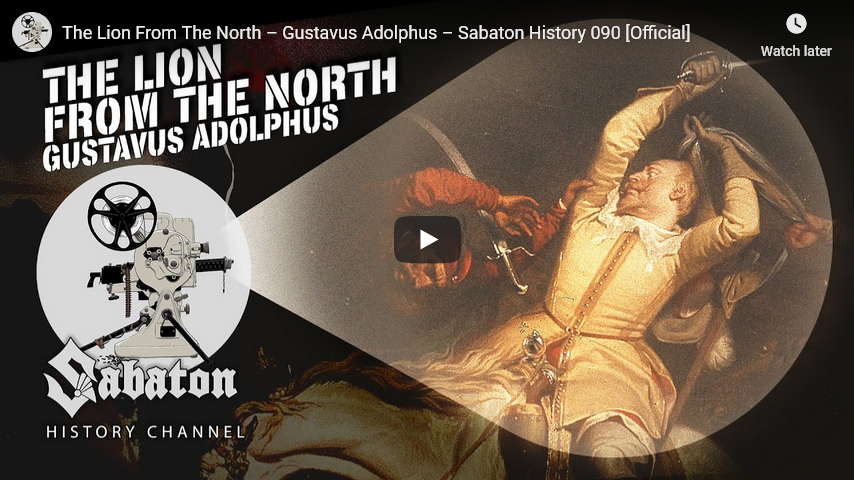
“The Lion From The North” â Gustavus Adolphus â Sabaton History 090 [Official]
Sabaton History
Published 22 Oct 2020It was a time of religion and war. Legends tell the tale of a mighty Swedish King, a Lion from the North, who arrived in the German Empire with a mighty host to save Protestantism. Beyond the legends, Gustavus Adolphus was a warrior king who sought to create a Swedish empire through hegemony on the Baltic Sea. Once, Sweden’s involvement in the 30 Years War had begun out of sheer necessity, but soon send her armies on a path of glory and fame. But would this path lead the Swedish King to victory or his inevitable demise?
Support Sabaton History on Patreon: https://www.patreon.com/sabatonhistory
Listen to “The Lion From The North” on the album Carolus Rex: https://music.sabaton.net/CarolusRexEN
Watch the Official Music Video of “The Lion From The North” here:
https://www.youtube.com/watch?v=T1gvN…Listen to Sabaton on Spotify: http://smarturl.it/SabatonSpotify
Official Sabaton Merchandise Shop: http://bit.ly/SabatonOfficialShopHosted by: Indy Neidell
Written by: Markus Linke and Indy Neidell
Directed by: Astrid Deinhard and Wieke Kapteijns
Produced by: PÀr Sundström, Astrid Deinhard and Spartacus Olsson
Creative Producer: Maria Kyhle
Executive Producers: PÀr Sundström, Joakim Brodén, Tomas Sunmo, Indy Neidell, Astrid Deinhard, and Spartacus Olsson
Community Manager: Maria Kyhle
Post-Production Director: Wieke Kapteijns
Editor: Karolina DoĆÄga
Sound Editor: Marek Kaminski
Maps by: Eastory – https://www.youtube.com/c/eastory
Archive: Reuters/Screenocean – https://www.screenocean.comVisual Sources:
– Nationalmuseum
– Arms of Vasa courtesy of Sodacan from Wikimedia
– Nils Forsberg Gustav II Adolf courtesy of Nils Forsberg, Swedish painter from Wikimedia
– Death of King Gustav II Adolf of Sweden by Carl Wahlbom courtesy of Osama Shukir Muhammed Amin FRCP (Glasg) from Wikimedia
– Icons from The Noun Project: Cannon by Graphic Nehar, Man by Milinda CoureyAll music by: Sabaton
An OnLion Entertainment GmbH and Raging Beaver Publishing AB co-Production.
© Raging Beaver Publishing AB, 2019 – all rights reserved.
October 21, 2020
The First Liberation From Nazism – The Republic of UĆŸice – WW2 Special
World War Two
Published 20 Oct 2020When the Yugoslav Partisans and Chetniks liberate a large part of modern-day Serbia, the Partisans found the Republic of UĆŸice, complete with its own governmental structure, education and cultural policy and weapons factory.
Join us on Patreon: https://www.patreon.com/TimeGhostHistory
Or join The TimeGhost Army directly at: https://timeghost.tvFollow WW2 day by day on Instagram @ww2_day_by_day – https://www.instagram.com/ww2_day_by_day
Between 2 Wars: https://www.youtube.com/playlist?list…
Source list: http://bit.ly/WW2sourcesHosted by: Indy Neidell
Written by: Joram Appel
Director: Astrid Deinhard
Producers: Astrid Deinhard and Spartacus Olsson
Executive Producers: Astrid Deinhard, Indy Neidell, Spartacus Olsson, Bodo Rittenauer
Creative Producer: Maria Kyhle
Post-Production Director: Wieke Kapteijns
Research by: Joram Appel
Edited by: Miki Cackowski
Sound design: Marek KamiĆski
Map animations: Eastory (https://www.youtube.com/c/eastory)Colorizations by:
Mikolaj Uchman
Carlos Ortega Pereira, BlauColorizations – https://www.instagram.com/blaucolorizations
Dememorabilia – https://www.instagram.com/dememorabilia/Sources:
Narodowe Archiwum Cyfrowe
FOTO-FORTEPAN – MZSL-Ofner KĂĄroly
Yad Vashem 3731/1
Bundesarchiv
IWM H 11368
Museum of Yugoslavia
ETH-Bibliothek
map of Belgium, courtesy of Marcuscalabresus https://commons.wikimedia.org/wiki/Fi…
from the Noun Project: Injury by Adriano Emerick, Dead Soldier by Gan Khoon Lay, Helmet by Daniel Turnel, person by Adrien Coquet, Skull by Muhamad UlumSoundtracks from the Epidemic Sound:
Johannes Bornlof – “The Inspector 4”
Hakan Eriksson – “Epic Adventure Theme”
Reynard Seidel – “Deflection”
Rannar Sillard – “March Of The Brave 4”
Philip Ayers – “Trapped in a Maze”
Johan Hynynen – “Dark Beginning”Archive by Screenocean/Reuters https://www.screenocean.com.
A TimeGhost chronological documentary produced by OnLion Entertainment GmbH.
October 9, 2020
“Ruina Imperii” â End of an Empire â Sabaton History 088 [Official]
Sabaton History
Published 8 Oct 2020The death of Charles XII was followed by the rapid decline of the Swedish Empire. The Swedish nation had suffered much in the last ten years of his reign. The constant state of war had brought famine and poverty and ruined the state in many ways. Charles XII fought Sweden’s numerous enemies in the vain hope of restoring the empire to its old glory. He was the King who most strongly believed that Sweden was destined for imperial greatness, no matter the cost. What can be said about his reign? How would history judge his character or his decisions as a King?
Support Sabaton History on Patreon: https://www.patreon.com/sabatonhistory
Listen to “Ruina Imperii” on the album Carolus Rex:
Carolus Rex (English Version) – https://music.sabaton.net/CarolusRexEN
Carolus Rex (Swedish Version) – https://music.sabaton.net/CarolusRexSEListen to Sabaton on Spotify: http://smarturl.it/SabatonSpotify
Official Sabaton Merchandise Shop: http://bit.ly/SabatonOfficialShopHosted by: Indy Neidell
Written by: Markus Linke and Indy Neidell
Directed by: Astrid Deinhard and Wieke Kapteijns
Produced by: PÀr Sundström, Astrid Deinhard and Spartacus Olsson
Creative Producer: Maria Kyhle
Executive Producers: PÀr Sundström, Joakim Brodén, Tomas Sunmo, Indy Neidell, Astrid Deinhard, and Spartacus Olsson
Community Manager: Maria Kyhle
Post-Production Director: Wieke Kapteijns
Editor: Karolina DoĆÄga
Sound Editor: Marek Kaminski
Archive: Reuters/Screenocean – https://www.screenocean.comVisual Sources:
– Nationalmuseum
– Carl Andreas Dahlström – httpruneberg.org dcateckn0126
– Icons form The Noun Project: Farm by Laymik, Fruit by Eucalyp, Vegetable by Eucalyp, treasure by dDara, treasure by Eucalyp, Wheat Grain Bag by Symbolon & Wine by Vladimir Belochkin.All music by: Sabaton
An OnLion Entertainment GmbH and Raging Beaver Publishing AB co-Production.
© Raging Beaver Publishing AB, 2019 – all rights reserved.
October 7, 2020
Ten Minute History – The French Revolution and Napoleon
History Matters
Published 12 Sep 2016Twitter: https://twitter.com/Tenminhistory
Patreon: https://www.patreon.com/user?u=4973164This episode of Ten Minute History (like a documentary, only shorter) covers the French Revolution and the Napoleonic Wars from the beginning of King Louis XVI’s reign all the way to the death of Napoleon Bonaparte in 1821. The first half covers the life and death of Louis XVI during the events of the revolution, including the rise and fall of Robespierre and the Reign of Terror. The second half covers the rise of Napoleon, the Napoleonic Wars and the eventual allied victory over France.
Ten Minute History is a series of short, ten minute animated narrative documentaries that are designed as revision refreshers or simple introductions to a topic. Please note that these are not meant to be comprehensive and there’s a lot of stuff I couldn’t fit into the episodes that I would have liked to. Thank you for watching, though, it’s always appreciated.
October 3, 2020
History Summarized: Hawai’i
Overly Sarcastic Productions
Published 2 Oct 2020To learn more about the Native Hawaiian community and their culture, visit: https://www.hawaiiancouncil.org/about
This year, to celebrate Indigenous People’s Day, we’re taking a look at the history of Hawai’i, from its early history in the Polynesian maritime culture to its forming a Kingdom to its annexation by the United States. Beyond simply a special case in the story of American expansion, Hawai’i has a deep history that deserves to be better known.
SOURCES & Further Reading: Great Courses Lecture “Lifeways of Australia and the Pacific” by Craig Benjamin, Britannica Hawai’i, “The Navigators: Pathfinders of the Pacific” By Low & Estus, Lonely Planet Hawai’i History, and lots of discussion with a native Islander (see discord section below).
This video was edited by Sophia Ricciardi AKA “Indigo”. https://www.sophiakricci.com/
Our content is intended for teenage audiences and up.
DISCORD: https://discord.gg/kguuvvq â Come to the #New-Video-Discussion channel to chat about this video, and ask questions about Hawai’i to my friend Lady Eris#9175, a native Islander!
PATREON: https://www.Patreon.com/OSP
MERCH LINKS: http://rdbl.co/osp
OUR WEBSITE: https://www.OverlySarcasticProductions.com
Find us on Twitter https://www.Twitter.com/OSPYouTube
Find us on Reddit https://www.Reddit.com/r/OSP/
September 29, 2020
Frederick the Great – A First Glance
Military History not Visualized
Published 22 May 2018» patreon – https://www.patreon.com/mhv
Frederick the Great â Friedrich der GroĂe â is a very controversial figure. Regarded by many as one of the great field commanders of his time, enlightened, strict, aggressive and militaristic. For a long time he was the example and icon of the Prussian general staff. What were his characteristics, traits, his background and his views on various military issues? After all, he wrote about the principles of war and other aspects.
»» SUPPORT MHV ««
» patreon – https://www.patreon.com/mhv
» paypal donation – https://www.paypal.com/cgi-bin/webscr…
» Book Wishlist https://www.amazon.de/gp/registry/wis…»» MERCHANDISE – SPOILS OF WAR ««
» shop – https://www.redbubble.com/people/mhvi…»» SOCIAL MEDIA ««
» minds.com – https://www.minds.com/militaryhistory…
» twitter – https://twitter.com/MilHiVisualized
» twitch – https://www.twitch.tv/militaryhistory…
» RallyPoint – https://www.rallypoint.com/organizati…Military History for Adults is a support channel to Military History Visualized with a focus personal accounts, answering questions that arose on the main channel and showcasing events like visiting museums, using equipment or military hardware.
» SOURCES «
Showalter, Dennis: Frederick the Great. A Military History. Frontline Books: London, 2016.
MilitĂ€rgeschichtliches Forschungsamt (Hrsg.): Friedrich der GroĂe und das MilitĂ€rwesen seiner Zeit. VortrĂ€ge zur MilitĂ€rgeschichte â Band 8. E. S. Mittler & Sohn: Herford â Bonn, 1987.
Clark, Christopher: The Iron Kingdom. The Rise and Downfall of Prussia 1600-1947. Penguin Books: London, 2007.
Citino, Robert M.: The German Way of War. From the Thirty Years’ War to the Third Reich. University Press of Kansas: USA, 2005.
MilitĂ€rgeschichtliches Forschungsamt (Hrsg.): Deutsche MilitĂ€rgeschichte 1648-1939 in sechs BĂ€nden – Band 6. Bernard & Graefe Verlag; MĂŒnchen, 1983.
Browing, Peter: The Changing Nature of Warfare. The Development of Land Warfare from 1792 to 1945. Cambridge University Press: Cambridge, UK, 2002.
Margiotta, Franklin D.: (Executive Editor): Brassey’s Encyclopedia of Military History and Biography. Brassey’s, Inc.: USA, 1994.
» CREDITS & SPECIAL THX «
Song: Ethan Meixsell – “Demilitarized Zone”
September 25, 2020
QotD: “Qu’ils mangent de la brioche!” [“Let them eat cake!”]
It’s one of the most famous remarks in history â an instantly recognizable catchphrase to convey haughty indifference to the misfortune of others. And we all know who said it and why: It was Marie Antoinette (1755â1793), the queen whose life was claimed by the French Revolution, dismissing news that the peasants were starving due to the high price of bread.
In the original French, the Queen allegedly said, Qu’ils mangent de la brioche!, which doesn’t quite translate to “let them eat cake.” Brioche is sweet, eggy bread that tastes only vaguely like cake. The translated English word “cake” made Marie Antoinette seem even haughtier than in French. But it’s beside the point, since Marie Antoinette never uttered “let them eat cake” in any language. There is no historical evidence that she ever uttered that phrase. The story is pure invention. It’s a historical legend that rivals the myth of Nero “fiddling” while Rome burned. And yet this outlandish fabrication has shaped our image of Marie Antoinette for more than two centuries.
Compared to other historical falsehoods, this legend is easy to trace to its source. It was the French philosopher Jean-Jacques Rousseau. In book six of his Confessions, written in 1767, Rousseau wrote of a “great princess” who had, when told that the peasants had no bread, replied with those words cited above, Qu’ils mangent de la brioche! Was Rousseau referring to Marie Antoinette? This is impossible. When he wrote that passage, Marie Antoinette was still a girl living at the Habsburg court in Vienna (under her original name, Maria Antonia Josepha Johanna). Rousseau’s story was entirely made up, probably borrowed from another source. And while his book wasn’t published till 1782, this was still seven years before the French Revolution began. In fact, the first time someone (spuriously) put the words “let them eat cake” in Marie Antoinette’s mouth was a half-century later, in a book published by Jean-Baptiste Alphonse Karr, Les GuĂȘpes.
Matthew Fraser, “Marie Antoinette: Figure of Myth, Magnet for Lies”, Quillette, 2020-06-24.
September 18, 2020
From innovation to absolutism — English inventors and the Divine Right of Kings
In the latest Age of Invention newsletter, Anton Howes looks at how innovations during the late Tudor and Stuart eras sometimes bolstered the monarchy in its financial battles with Parliament (which, in turn, eventually led to actual battles during the English Civil War):

King Charles I and Prince Rupert before the Battle of Naseby 14th June 1645 during the English Civil War.
19th century artist unknown, from Wikimedia Commons.
The various schemes that innovators proposed â from finding a northeast passage to China, to starting a brass industry, to colonising Virginia, or boosting the fish industry by importing Dutch salt-making methods â all promised to benefit the public. They were to support the “common weal”, or commonwealth. And to a certain extent, many projects did. The historian Joan Thirsk did much pioneering work in the 1970s to trace the impact of various technological or commercial projects, revealing that even something as mundane as growing woad, for its blue dye, could have a dramatic impact on local economies. With woad, the income of an ordinary farm labouring household might be almost doubled, for four months in the year, by employing women and children. In the late 1580s, the 5,000 or so acres converted to woad-growing in the south of England likely employed about 20,000 people. That may seem small today, but at a time when the population of a typical market town was a paltry 800 people, even a few hundred acres of woad being cultivated here or there might draw in workers from across the whole region. In the mid-sixteenth century, even the entire population of London had only been about 50-70,000. As Thirsk discovered, innovative projectors also sometimes fulfilled their other public-spirited promises, for example by creating domestic substitutes for costly imported goods, or securing the supplies of strategic resources.
But the ideal of benefiting the commonwealth could also, all too frequently, be elided with serving the interests of the Crown. Projectors might promise the monarch a direct share of an invention’s profits, or that a stimulated industry would result in higher income from tariffs or excise taxes. Increasingly, they proposed schemes that were almost entirely focused on maximising state revenue, with little evidence of new technology. They identified “abuses” in certain industries â at this remove, it’s difficult to tell if these justifications were real â and asked for monopolies over them in order to “regulate” them, then making money by selling licences. Last week I mentioned patents over alehouses, and on playing cards. They also offered to increase the income from the Crown’s property, for example by finding so-called “concealed lands” â lands that had been seized during the Reformation, but which through local resistance or corruption had ostensibly not been paying their proper rents. The projectors would take their share of the money they identified as “missing”. And they proposed enforcing laws, especially if the punishments involved levying fines or confiscating property. The projectors offered to find the lawbreakers and prosecute them, after which they’d take their share of the financial punishments.
Projectors thus came to present themselves as state revenue-raisers and enforcers, circumventing all of the traditional constraints on the monarch’s money and power. They provided an alternative to Parliaments, as well as to city corporations and guilds, in raising money and propagating their rule. Taking it a step further, projectors offered the tantalising possibility that kings like James I and Charles I might rule through proclamation and patents alone, without having to answer to anybody. They thus experimented with absolutism for much of 1610-40, only occasionally being forced to call Parliament for as briefly as possible when the pressing financial demands of war intervened.
In the process, with the growing multitude of projects â a few bringing technological advancement, but many merely lining the pockets of courtier and king â the designation “projector” became mud. It was as if, today, the Queen were to use her prerogative to grant a few of her courtiers monopolies on collecting all traffic fines, or litter penalties, to be rewarded solely on commission. Or if she were to award an unscrupulous private company the right to award all alcohol-selling licences (perhaps on the basis that underage drinking was becoming common). The country would soon be awash with hidden speed cameras and incognito litter wardens, and the price of alcohol would go through the roof. The people responsible would not be popular. A recent book by economic historian Koji Yamamoto meticulously charts the changing public perceptions of projects, describing the ways in which innovators then struggled, for decades, to regain the public’s trust.
September 11, 2020
“Carolus Rex” – Charles XII of Sweden – Sabaton History 084 [Official]
Sabaton History
Published 10 Sep 2020In 1697, just 15 years old, Charles XII ascended to the Swedish throne. By the grace of God, he was anointed King — Carolus Rex. Charles would not ask for obedience, nor would he make any concessions to his rule. His authority was divine and his judgment law. Determined to rule the Swedish Empire with absolute power, Charles set out to restore the might and glory of the kingdom.
Support Sabaton History on Patreon: https://www.patreon.com/sabatonhistory
Listen to “Carolus Rex” on the album Carolus Rex:
Carolus Rex (English Version) – https://music.sabaton.net/CarolusRexEN
Carolus Rex (Swedish Version) – https://music.sabaton.net/CarolusRexSEWatch the Official Live Video of Carolus Rex here:
https://www.youtube.com/watch?v=WhA9B…Listen to Sabaton on Spotify: http://smarturl.it/SabatonSpotify
Official Sabaton Merchandise Shop: http://bit.ly/SabatonOfficialShopHosted by: Indy Neidell
Written by: Markus Linke and Indy Neidell
Directed by: Astrid Deinhard and Wieke Kapteijns
Produced by: PÀr Sundström, Astrid Deinhard and Spartacus Olsson
Creative Producer: Maria Kyhle
Executive Producers: PÀr Sundström, Joakim Brodén, Tomas Sunmo, Indy Neidell, Astrid Deinhard, and Spartacus Olsson
Community Manager: Maria Kyhle
Post-Production Director: Wieke Kapteijns
Editor: Karolina DoĆÄga
Sound Editor: Marek Kaminski
Maps by: Eastory – https://www.youtube.com/c/eastory
Archive: Reuters/Screenocean – https://www.screenocean.com
Sources:
Osipov Georgiy and Nokka Tarajan from Wikimedia
Nationalmuseum
All music by: SabatonAn OnLion Entertainment GmbH and Raging Beaver Publishing AB co-Production.
© Raging Beaver Publishing AB, 2019 – all rights reserved.
September 5, 2020
Beginning the transition from personal rule to the modern bureaucratic state
Anton Howes discusses some of the issues late Medieval rulers had which in some ways began the ascendency of our modern nation state with omnipresent bureaucratic oversight of everyone and everything:
… the bureaucratic state of today, with its officials involving themselves with every aspect of modern life, is a relatively recent invention. In a world without bureaucracy, when state capacity was relatively lacking, it’s difficult to see what other options monarchs would have had. Suppose yourself transported to the throne of England in 1500, and crowned monarch. Once you bored of the novelty and luxuries of being head of state, you might become concerned about the lot of the common man and woman. Yet even if you wanted to create a healthcare system, or make education free and universal to all children, or even create a police force (London didn’t get one until 1829, and the rest of the country not til much later), there is absolutely no way you could succeed.
King James I (of England) and VI (of Scotland)
Portrait by Daniel Myrtens, 1621 from the National Portrait Gallery via Wikimedia Commons.For a start, you would struggle to maintain your hold on power. Fund schools you say? Somebody will have to pay. The nobles? Well, try to tax them â in many European states they were exempt from taxation â and you might quickly lose both your throne and your head. And supposing you do manage to tax them, after miraculously stamping out an insurrection without their support, how would you even begin to go about collecting it? There was simply no central government agency capable of raising it. Working out how much people should pay, chasing up non-payers, and even the physical act of collection, not to mention protecting that treasure once collected, all takes substantial manpower. Not to mention the fact that the collecting agents will likely siphon most of it off to line their own pockets.
[…]
It was not until 1689, when there was a coup, that an incoming ruler allowed the English parliament to sit whenever it pleased. Before that, it was convened only at the whim of the ruler, and dispersed even at the slightest provocation. In 1621, for example, when James I was planning to marry his heir to a Spanish princess, Parliament sent him a petition asserting their right to debate the matter. Upon hearing of it, he called for the official record of parliamentary proceedings, personally ripped out the page with the offending vote, and promptly dissolved the Parliament. The downside, of course, was that James could not then acquire any parliamentary subsidies.
Ruling was thus an intensely personal affair, of making deals and finding ways to circumvent deals you had inherited. Increasing your capabilities as a ruler â state capacity â was thus no easy task, as the typical ruler was stuck in an essentially medieval equilibrium. Imposing a policy costs money, but raising money involves imposing policy. Breaking out of this chicken-and-egg problem took centuries of canny leadership. The rulers who achieved it most would today seem hopelessly corrupt.
To gain extra cash without interference from Parliament, successive monarchs first asserted and then abused their ancient prerogative rights to grant monopolies over trades and industries. They eventually granted them to whomever was willing to pay, establishing monopolies over industries like gambling cards or alehouses under the guise of regulating unsavoury activities. They also sold off knighthoods and titles, and in 1670 Charles II even made a secret deal with the French that he would convert to Catholicism and attack the Protestant Dutch, all in exchange for cash. Anything to not have to call a potentially pesky Parliament. At times, the most effective rulers even resembled mob bosses. Take Elizabeth Iâs anger when a cloth-laden merchant fleet bound for an Antwerp fair in 1559 was allowed to depart. Her order to stop them had not arrived in time, thus preventing her from extracting âloansâ from the merchants while she still had their goods within her power.
August 25, 2020
The Russian Revolution 1917
Epic History TV
Published 4 Aug 2016Everything you need to know about the Russian Revolution in a 13 min video. Produced in partnership with Bridgeman Images http://www.bridgemanimages.com/en-GB/
We explain all the major events of Russia’s TWO revolutions of 1917 â the February Revolution that ended Tsarist rule in Russia, and the October Revolution, that brought the Bolsheviks to power. We explain the causes of Tsar Nicholas II’s growing unpopularity – the role of the mysterious Siberian mystic Rasputin, Russia’s disastrous involvement in World War One, and the events on the streets of Petrograd that led to the Tsar’s abdication. That summer Russia lurched from crisis to crisis, with a Provisional Government that faced riots (the July Days), military revolt (the Kornilov Affair), economic chaos, and constantly dwindling support. Socialist Prime Minister Alexander Kerensky, once hailed as Russia’s great hope, was unable to restore order, or, in October, prevent the Bolsheviks from launching a coup, organised by Leon Trotsky and led by Vladimir Lenin, that overthrow the Provisional Government and brought the Bolsheviks to power. A brutal civil war followed, leading to the death of more than 10 million Russians â amongst them Tsar Nicholas II and his family, executed by Bolsheviks at Yekaterinburg in July 1918. From the wreckage emerged the Soviet Union, formed in 1922, and destined to be one of the 20th century’s two superpowers.
Please help me make more history videos by supporting me at Patreon: https://www.patreon.com/epichistorytv
#EpicHistoryTV #HistoryofRussia #RussianRevolution
Recommended books on the Russian Revolution (as an Amazon Associate I earn from qualifying purchases):
S. A. Smith, The Russian Revolution: A Very Short Introduction http://geni.us/RzOAk2U
Orlando Figes, A People’s Tragedy: The Russian Revolution http://geni.us/UIxyirj
Robert Service, The Last of the Tsars: Nicholas II and the Russian Revolution http://geni.us/A89T
Neil Faulkner, A People’s History of the Russian Revolution http://geni.us/bME0unl
August 20, 2020
Thomas Becket, Archbishop of Canterbury 1162-1170
Reverend Steve Morris tries to show why St. Thomas of Canterbury needs a “reboot” for modern eyes:

Stained glass showing the murder of St. Thomas at Canterbury on 29 December, 1170.
Wikimedia Commons.
It’s 850 years since that night when four knights murdered the Archbishop of Canterbury. It’s been a rocky old road for Thomas Becket despite hundreds of years as the poster-boy of the cult of saints which swept medieval England. His reputation, his legacy and his conduct have been filleted over the last few centuries and we are left with just a ghost of the man who, once upon a time, stood for all that was good.
It is a cautionary tale of historical revisionism, measuring yesterdays’ saints by today’s “standards” and assembling a set of half-truths to trash the reputation of England’s great, perhaps greatest, saint. It is high time he made a comeback â especially in these political times. After all, Becket was perhaps the greatest political martyr we have. Of course, there is always truth in just about any criticism. And Becket lays himself open. He was, to say the least, stubborn. He was a contrarian and he was reckless with his own safety. In an age of kingly power, it doesn’t do to embarrass the monarch.
The charge sheet does quickly stack up. Becket was a canny careerist (although you’d be hard pushed to find anyone of influence at the time who wasn’t). He seemed to have a death wish, or at least refused to listen to perfectly sensible advice on taking a more circumspect path. And his cause, seen through a certain lens, seems off-beam for modern times. He has been painted as standing for the ancient legal power of the church against a reforming king who began to kick-start Common Law. But of course, it’s never as simple as this.
But none of this was the real problem and none of it was what caused our great saint to be consigned to the historical dustbin. As is often the way, the problem comes down to background and class. Becket was born to only modestly well-off parents in London (he has always been London’s saint). His father was middle-class, and a merchant. Becket was “trade” by background and it was something he couldn’t shake off. But his rise was an astounding feat of defying gravity.
In an era of complex geopolitics and conflicts between pope and state Thomas rose through the ranks and became Archbishop of Canterbury. At first, he seemed like the king’s man, but relations soured. Becket and the king were entangled in a fight to the death, with the archbishop excommunicating various opponents and generally throwing his weight around.
His death was gruesome. Four knights ambushed him. He could have run or barricaded himself in the cathedral, but he told his followers that God’s house should not be made a fortress. He pushed one of his attackers. What followed was a flurry of sword-strokes to the head â one of which took his tonsured skull right off. The contemporaneous reports paint a ghastly picture of brain fluid and blood mixing freely on the cathedral floor. But it didn’t end there.
August 4, 2020
Nationalism DOESNâT explain WHY Austria-Hungary collapsed
TIK
Published 3 Aug 2020The go-to answer is that national or ethnic divisions caused the collapse of the Austro-Hungarian Empire. But is this really the case? Using multiple sources, it’s time to provide YouTube with a narrative which doesn’t confirm nationalist beliefs. The Habsburgs survived the collapse, with Emperor Karl / Charles trying to reclaim his throne later on before being exiled. However, by about mid-November 1918, he had lost all power. The fact that there is no specific date when Austria-Hungary collapsed, and the fact that the “national revolutions” were met with relatively little opposition, speaks volumes. As does the fact that the new states were all multinational, which undermines the narrative that nationalism was the reason why Austria-Hungary collapsed. Leave your thoughts in the comments below.
âČïž Videos EVERY Monday at 5pm GMT (depending on season, check for British Summer Time).
– – – – –
đ BIBLIOGRAPHY / SOURCES đ
Judson, P. The Habsburg Empire: A New History. Belknap Press, Kindle 2016.
Kiste, J. The End of the Habsburgs: The Decline and Fall of the Austrian Monarchy. Kindle 2019.
Macgregor, J. & Docherty, G. Prolonging the Agony: How the Anglo-American Establishment Deliberately Extended WW1 by Three-and-a-Half Years. Trine Day LLC, 2018.
Marx, K. Capital: A Critique of Political Economy: Volume III. PDF, English edition, 2010. (Originally written 1894)
Mises, L. Socialism: An Economic and Sociological Analysis. Liberty Fund, 1981. 1969 edition (roots back to 1922).
Oxford Dictionary of English, Oxford University Press, Third Edition 2010.
Rady, M. The Habsburgs: The Rise and Fall of a World Power. Perseus Books, Kindle 2020.
Watson, A. Ring of Steel: Germany and Austria-Hungary at War, 1914-1918. Penguin Books, 2015.Cornwall, M. “Propaganda at Home (Austria-Hungary).” 1919. https://encyclopedia.1914-1918-online….
Online Latin-Dictionary http://www.latin-dictionary.net/defin…
Online Etymology Dictionary https://www.etymonline.com/word/publicFull list of all my sources – https://docs.google.com/spreadsheets/…
– – – – –
â SUPPORT TIK â
Want to ask a question? Please consider supporting me on either Patreon or SubscribeStar and help make more videos like this possible. For $5 or more you can ask questions which I will answer in future Q&A videos. Thank you to my current Patrons! You’re AWESOME! https://www.patreon.com/TIKhistory or https://www.subscribestar.com/tikhistory
– – – – –
ABOUT TIK đ
History isn’t as boring as some people think, and my goal is to get people talking about it. I also want to dispel the myths and distortions that ruin our perception of the past by asking a simple question – “But is this really the case?” I have a 2:1 Degree in History and a passion for early 20th Century conflicts (mainly WW2). I’m therefore approaching this like I would an academic essay. Lots of sources, quotes, references and so on. Only the truth will do.
This video is discussing events or concepts that are academic, educational and historical in nature. This video is for informational purposes and was created so we may better understand the past and learn from the mistakes others have made.