Quotulatiousness

May 19, 2014

Exercising your ears – accents in Sherlock

Filed under: Britain, Media — Tags: , , — Nicholas @ 09:16

I’m a fan of the ongoing BBC series Sherlock starring Martin Freeman and Benedict Cumberbatch (or “Cummerband Bandersnatch” as his name seems to cause the yips in some people). At Firestorm over London there’s a brief discussion of British accents in general, and the specific variants in use among the actors in the show:

An introduction to the rich variety of British accents and an analysis of accents used in Sherlock. I explore the distinctive regional accents and of course the ubiquitous BBC pronunciation, what the accents can tell us about the characters. A short, not too serious guide by someone who has no linguistics expertise.

Islands of Contrast

An accent for the purposes of this essay is a manner of pronunciation that is particular to an individual, community or location.

The British Isles are geographically small but the accents that have evolved are incredibly diverse. I grew up in the North West of England where, even though the motorway links are brilliant, travelling a mere 60 miles or so will completely change the accents that you hear.

The most ubiquitous accent in the UK is BBC pronunciation. It used to be called “Received Pronunciation” but that term has fallen out of favour. If you’ve ever watched BBC News or listened to the English programs on the BBC World Service that is the accent I am referring to. This is not a regional accent — although it is more common in South of England. When people in the UK say that someone doesn’t have an accent, they really mean the person uses BBC pronunciation.

I haven’t been back to visit England in several years, but on my last few visits the number of times I heard RP seemed fewer than any regional accent everywhere we went. Even the BBC News presenters all seemed to have regional accents rather than speaking in RP. I’m originally from Middlesbrough, which boasts one of the least attractive regional accents you’ll ever hear (the closest you’d find would be a Newcastle “Geordie” accent … but less comprehensible). It’s been so long since I lived there that I now have trouble understanding it myself…

Many fans have identified Mycroft Holmes’ accent as “posh”. There is not an official “posh accent” — and even if there was Mycroft Holmes does not have it.

Posh is a very subjective description. Where I grew up anyone who didn’t have a regional accent was “posh”. After coming to University in the South, I have realised that BBC pronunciation is not considered “posh” but “standard”. Posh was defined as the rather over-exaggerated accent people often use to pantomime the rich. There are a small minority of people who have that stereotypical accent but “posh” on its own is not a very good way of describing anyone’s accent.

If we are going to talk about poshness — I believe it’s better to view it as a “gradation of poshness” which is superimposed on BBC pronunciation, rather than a distinct “posh accent”.

BBC pronunciation and the “gradation of poshness” are not good reflectors of social status in today’s society.

Traditionally BBC pronunciation was considered the preserve of the middle classes. It was something that set you apart from the common masses with their regional accents. I wouldn’t say that class has no role in today’s society, but BBC pronunciation itself has become less of a hallmark of class. Many people who would identify themselves as working class do not have a regional accent, whilst the middle-classes are more accepting of regional accents. The BBC has worked hard to introduce presenters with regional accents onto prime time television. Therefore it is hard to judge the social status of a person purely based on how “posh” they sound. Their accent will not always match your expectations of their material circumstances.

[…]

John Watson

John had me rather puzzled but my conclusion is that his accent qualifies as BBC pronunciation but unlike Mycroft or Sherlock, he has not superimposed any of those “upper class” vowels on his pronunciation. For example his “a” vowel sounds are much shorter as evidenced in words such as “pass”. John is a much better presentation of what a great number of people in the UK actually sound like.

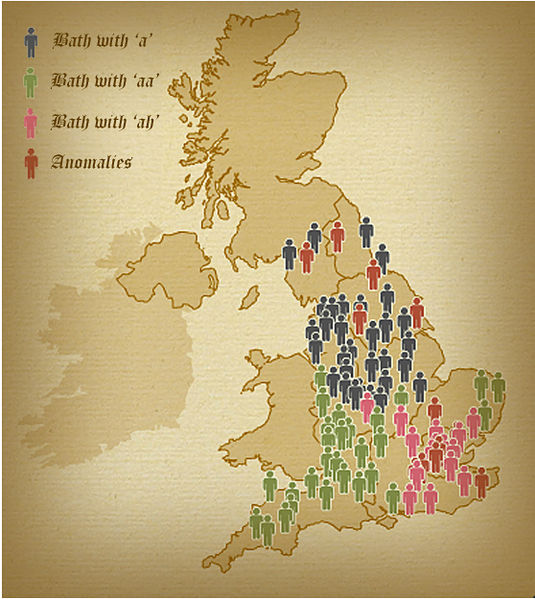
Here is an amusing map of how the “a” vowel varies in pronunciation between different geographic areas:

British pronunciation of the letter a

John fits in very much with the blue group. His rendition of the “a” vowel is still correct and technically BBC pronunciation. However it is considered less “posh” than pronouncing the “a” vowel as “ah”.

His rhythm of speech and accentuations within words may contribute to the overall impression that his accent is different to Sherlock’s. This is true because Sherlock doesn’t have exact BBC pronunciation and neither does John. Though they deviate in different ways I would say their accents overall qualify as BBC pronunciation. It is certainly hard to pinpoint a location for the original of John’s accent.

H/T to ESR, who asked about the Sherlock accents on Google+ (the link to Firestorm was provided in the comments to his post).

QotD: Communism and language

Filed under: Media, Politics, Quotations — Tags: , , , — Nicholas @ 00:01

It is not a new thought that Communism debased language and, with language, thought. There is a Communist jargon recognizable after a single sentence. Few people in Europe have not joked in their time about “concrete steps,” “contradictions,” “the interpenetration of opposites,” and the rest.

The first time I saw that mind-deadening slogans had the power to take wing and fly far from their origins was in the 1950s when I read an article in The Times of London and saw them in use. “The demo last Saturday was irrefutable proof that the concrete situation…” Words confined to the left as corralled animals had passed into general use and, with them, ideas. One might read whole articles in the conservative and liberal press that were Marxist, but the writers did not know it. But there is an aspect of this heritage that is much harder to see.

Even five, six years ago, Izvestia, Pravda and a thousand other Communist papers were written in a language that seemed designed to fill up as much space as possible without actually saying anything. Because, of course, it was dangerous to take up positions that might have to be defended. Now all these newspapers have rediscovered the use of language. But the heritage of dead and empty language these days is to be found in academia, and particularly in some areas of sociology and psychology.

Doris Lessing, “Questions You Should Never Ask a Writer”, New York Times, 1992-06-26 (reprinted 2007-10-13)

May 9, 2014

Shakespeare: Original pronunciation

Filed under: Britain, History, Media — Tags: , , , — Nicholas @ 13:04

Jon, my former virtual landlord sent along an interesting link:

An introduction by David and Ben Crystal to the ‘Original Pronunciation’ production of Shakespeare and what they reveal about the history of the English language.

April 21, 2014

English borrowings from Chinese

Filed under: China — Tags: , — Nicholas @ 08:20

The Wall Street Journal‘s China Real Time section wonders why we haven’t seen much linguistic small change from China filtering into everyday English:

As languages go, English is a notoriously promiscuous one, borrowing caricatures from Italian, chutzpah from Yiddish and faux pas from French.

And yet despite the English-speaking world’s deep and wide confluences with Chinese culture, for some reason, few Chinese words have lately entered the English-speaking world’s vocabulary.

China’s state media is hoping that could change: Last week, it cited several Chinese entries that have recently appeared [at] UrbanDictionary.com. “English speakers may soon be saying ‘you can you up, no can no bb’ in response to criticism,” the official Xinhua news agency said, referring to a Chinese phrase that means if you can do it, do it, and if you can’t, don’t criticize others. (The original Chinese is你行你上,不行别BB. In Beijing dialect, “BB” means to nag or complain.)

[…]

On the English side, resistance to Chinese words doesn’t seem to be a simple difficulty of pronunciation: though Mandarin’s different tones may be daunting, the basic syllables are easy enough, and the trickiness of French or Japanese pronunciation (coup d’etat, karaoke) hasn’t stopped English from embracing words from either language.

And there are plenty of words that would seem ripe to jump the Pacific: Here at China Real Time, one particularly accessible term, mafan — meaning a hassle, or difficulty — could be easily adopted by English speakers (and in fact already has been by many on staff). And who could resist the roll-off-the-tongue ease of mamahuhu, a term that means “so-so”? (The literal translation is “horse horse tiger tiger.”) Maybe, as some theorize, it’s just a matter of time, as China’s reach grows, and exchanges continue to deepen.

Oddly, some of the most colourful terms listed here haven’t yet become common:

15) Stupid Inbred Stack of Meat
笨天生的一堆肉。・ BUN tyen-shung duh ee-DWAY-RO
On a visit to one of Mal’s old Army buddies, Monty, on an uninhabited moon, Mal and crew encounter “Saffron”, the beautiful con-artist who once tricked Mal into marriage, and nearly stole his ship (played by the absolutely magnificent Christina Hendricks); this time, she’s taken the name “Bridget” and married Monty. A short tussle ensues between her and Mal (lucky bastard) which Monty breaks up as Mal explains the details of their shared history. When Saffron, who had been denying everything, lets it slip that she knows Mal’s name, Monty abandons her on the barren lunar surface. She screams this bit of Mandarin to the heavens as his ship departs. This phrase is also noteworthy for its use on the back cover of Serenity: The Official Visual Companion, where Chinese characters inform prospective buyers: “If you don’t buy this book, your friends will think you’re a stupid inbred stack of meat.”

[…]

6) Filthy Fornicators of Livestock
喝畜生雜交的髒貨 ・ Huh choo-shung tza-jiao duh tzang-huo
As a clergyman, Shepherd Book is usually denied the use of the kind of innovative vulgarity the rest of the crew enjoys. Sometimes, however, a particular sight inspires even a man of the cloth to throw down with the best obscenity slingers. Book offers this exclamation in response to crime boss Adelai Niska’s reprehensible act of sending the Serenity‘s crew their kidnapped Captain’s severed ear. Fun fact: the Firefly-Serenity Pinyinary offers translations of not only the entire phrase, but of the component words. We mention this in case anyone might be wondering if this translation is simply a more polite way of saying “Dirty Cow Fuckers”. It isn’t. Foreign languages are fun, huh?

5) Motherless Goats of All Motherless Goats
羔羊中的孤羊 ・ Gao yang jong duh goo yang
Another slice of pure Mandarin what-the-fuckery, this time from Wash, who has the honor of delivering some of the most outrageous Chinese dialogue this side of a Beijing mental hospital. Wash mutters this under his breath when he learns that Magistrate Higgins has put a landlock on the ship — his consternation doesn’t last long, for only a moment after noticing the lock, it was removed. Only Inara knows why (she was hired to deflower the Magistrate’s son, and accomplished making a man of him a bit too well for the senior Higgins’ liking).

4) Holy Mother of God and All Her Wacky Nephews
我的媽和她的瘋狂的外甥都 ・ Wuh duh ma huh tah duh fong kwong duh wai shung
This may be the most awesome phrase we’ve ever heard in any language; only its lack of vulgarity kept it from breaking the Top Three. Once again, it issues forth from the mouth of Wash. In “Our Mrs. Reynolds,” we first encounter the deliciously devious ginger con-babe, Saffron. After leading Mal to the “Special Hell”, she proceeds to the cockpit where she puts the moves on poor Wash. Only his devotion to Zoe keeps him from succumbing to Saffron’s charms — devotion that earns him a roundhouse kick to the head. This marvelous line is his singular response to Saffron’s advances.

April 10, 2014

Policing the language, German style

Filed under: Europe, Germany, Law — Tags: , , , , — Nicholas @ 09:24

Matthias Heitmann on the odd things that happen to avoid any hint of Nazi contamination in allowable letter combinations on license plates and to mandate equal gender presence in job titles and place names:

In Germany today, you see, there is a palpable desire to cleanse society of views officially deemed unacceptable or politically incorrect. This is most obvious when it comes to words or views associated with fascism or the far right. It’s likely that even the most liberal of Germans would oppose the right of members of the right-wing National Democratic Party to voice their strange views in public. Indeed, having embarrassingly failed to ban the party in 2003, the federal government is currently trying to outlaw the party once again. Anyone attempting to defend free speech or freedom of association in this context will find themselves accused of being a fascist sympathiser, an apologist or, even worse, disrespecting victims of the Holocaust and their descendants.

The popular fear of being accused of being a Nazi sympathiser has resulted in some strange regulations. Since the 1980s, for instance, the letter combinations ‘NS’, ‘KZ’, ‘SS’, ‘SA’ or ‘HJ’, which all potentially allude to fascist symbols or institutions, have been banned from use on car licence plates. In the past few months, there has been a heated debate about whether letter or number combinations like ‘HH’ or ‘88’ (which both allude to ‘Heil Hitler’), ‘18’ (meaning ‘Adolf Hitler’), 204 (meaning Hitler’s birthday) or even ‘GV’ (which is short for sexual intercourse) should be banned from licence plates, too. This poses something of a problem for Hamburg car owners, whose licence plates all start with ‘HH’.

[…]

It’s not only on the traditional minefield of racism and fascism that free speech has suffered in Germany. Free speech has also been knocked about by feminists, too, with their determination to impose new language and behaviour regulations. Last summer, for instance, the University of Leipzig announced plans to address its staff using only the feminine forms of words. ‘Professorin’ is due to replace older formulations like ‘Professorinnen und Professoren’ or ‘Professor/innen’. Schröder, meanwhile, admitted during a recent interview that not even the Bible is immune from linguistic tinkering. When talking to girls, for instance, the masculine ‘der Gott’ could simply become the neutral ‘das Gott’.

Interestingly, when feminist language control clashes with anti-fascist dogma, feminism seems to prevail. In the German capital, Berlin, a local parliament, heavily dominated by green and left-wing politicians, voted against naming a square in front of the Jewish Museum after the Enlightenment philosopher Moses Mendelssohn. This decision was made on the grounds that as Mendelssohn was a man, he would break the rule established in 2005 to only name streets and squares after women. This was deemed necessary in order to achieve sexual equality on the city map. As a compromise, the local parliament used Mendelssohn wife’s name alongside his own, creating ‘Moses-und-Fromet-Mendelssohn-Platz’. Although Fromet wasn’t a historic figure, she at least was a woman.

March 22, 2014

The “narrative”

Filed under: Media, Politics, USA — Tags: , , , , — Nicholas @ 11:10

Wilfred McClay noticed the increasing use of the term “narrative” over the last few years:

We have this term now in circulation: “the narrative.” It is one of those somewhat pretentious academic terms that has wormed its way into common speech, like “gender” or “significant other,” bringing hidden freight along with it. Everywhere you look, you find it being used, and by all kinds of people. Elite journalists, who are likely to be products of university life rather than years of shoe-leather reporting, are perhaps the most likely to employ it, as a way of indicating their intellectual sophistication. But conservative populists like Rush Limbaugh and Sean Hannity are just as likely to use it too. Why is that so? What does this development mean?

I think the answer is clear. The ever more common use of “narrative” signifies the widespread and growing skepticism about any and all of the general accounts of events that have been, and are being, provided to us. We are living in an era of pervasive genteel disbelief — nothing so robust as relativism, but instead something more like a sustained “whatever” — and the word “narrative” provides a way of talking neutrally about such accounts while distancing ourselves from a consideration of their truth. Narratives are understood to be “constructed,” and it is assumed that their construction involves conscious or unconscious elements of selectivity — acts of suppression, inflation, and substitution, all meant to fashion the sequencing and coloration of events into an instrument that conveys what the narrator wants us to see and believe.

These days, even your garage mechanic is likely to speak of the White House narrative, the mainstream-media narrative, and indicate an awareness that political leaders try to influence the interpretation of events at a given time, or seek to “change the narrative” when things are not turning out so well for them and there is a strongly felt need to change the subject. The language of “narrative” has become a common way of talking about such things.

One can regret the corrosive side effects of such skepticism, but there are good reasons for it. Halfway through the first quarter of the 21st century, we find ourselves saddled with accounts of our nation’s past, and of the trajectory of American history, that are demonstrably suspect, and disabling in their effects. There is a view of America as an exceptionally guilty nation, the product of a poisonous mixture of territorial rapacity emboldened by racism, violence, and chauvinistic religious conviction, an exploiter of natural resources and despoiler of natural beauty and order such as the planet has never seen. Coexisting with that dire view is a similarly exaggerated Whiggish progressivism, in which all of history is seen as a struggle toward the greater and greater liberation of the individual, and the greater and greater integration of all governance in larger and larger units, administered by cadres of experts actuated by the public interest and by a highly developed sense of justice. The arc of history bends toward the latter view, although its progress is impeded by the malign effects of the former one.

March 20, 2014

My mondegreens make more sense than your lyrics

Filed under: Media — Tags: , — Nicholas @ 07:59

Kevin Dettmar discusses the best form of mondegreen: the kind that makes more sense (to the listener anyway) than the actual lyrics being slurred or mumbled or bellowed by the lead singer:

I’ve been thinking a great deal lately about the important role that misunderstood lyrics play in the way rock music works. The problem is especially pointed in the case of the post-punk Gang of Four because they saw much of their music as a political intervention in the events of their day (the late 70s through the early 80s). But how can rock really “rage against the machine” if no one’s quite sure what it’s saying? What can it mean that a band that put a great deal of emphasis on its songwriting — pop songs as political theory — actively resisted making that theory more intelligible? Resisted to the degree that even smart and sympathetic critics have sometimes badly misread the work?

One answer involves taking the “mondegreen” seriously.

For better or worse, we seem to be stuck with the term that was coined in 1954 by the writer Sylvia Wright, in a piece in Harper’s Magazine. That the word is about the same age as rock and roll itself is a fitting coincidence. In her mother’s recitation of the ballad “The Bonnie Earl of Murray,” Wright as a child misheard the phrase “laid him on the green” as “Lady Mondegreen” and wove a coherent narrative around the mistake, or “mondegreen.”

[…]

My mistake, trivial in itself, does suggest something important about the capacity of rock music (in which marginal intelligibility is not just an accident but rather a constitutive element) to do significant political work. For my misreading, I’d suggest, wasn’t random free association. In important, if largely subconscious and unconscious ways, what I understood of the lyrics, and the politics of the sound of the song itself, conditioned me to fill in the blanks in my understanding from among a fairly limited range of possibilities.

In music as powerful as this — and for a listener as powerfully in its thrall as I was, as I am — the mumbly bits actually provide moments where I can become co-creator of this aggressive, political music along with the band. And that, I would submit, is powerful political pedagogy. The songs on Entertainment! don’t teach me what to think: They teach me how to think. The proof is in my mondegreens.

My mishearing the line wasn’t simply an error, then — or if an error, it was a productive one. Sylvia Wright insisted that “the point about what I shall hereafter call mondegreens … is that they are better than the original.” Dave Marsh maintains that his lyrics to “Smells Like Teen Spirit” are better than Cobain’s. What I heard at the end of “Ether” may not have been what King and Gill meant; but having my interpretation revealed through my misreadings tells me something about where my mind prefers to go. And that is precisely the work of ideological critique. “Ether” taught me not, or not only, about Gang of Four’s politics: More powerfully, it also taught me about my own.

H/T to Kathy Shaidle for the link. She also included a brilliant little music video to illustrate the point:

March 18, 2014

QotD: OED updated again

Filed under: Books, Britain, Humour, Quotations — Tags: — Nicholas @ 00:01

This month’s update to the Oxford Dictionary includes the words ‘c**ted’, ‘c**ting’, ‘c**tish’ and ‘c**ty’. The expletives now join the list of 750,000 English words defined by the dictionary. ‘Twerk’ and ‘Selfie’ were added at the last update.

Along with the ‘c**ty’, the words ‘Old Etonian’, ‘Rt. Hon.’ and ‘Right Honourable’ have also been included for the first time, although the choices are believed to be unrelated.

Andre Walker, “Official: Oxford Dictionary Says You Can Get ‘C**ted’ and ‘Twerk'”, Breitbart.com, 2014-03-17

March 14, 2014

Accented gibberish

Filed under: Humour, Media — Tags: — Nicholas @ 12:56

H/T to Richard Gray who says “Unless you have a good grasp of languages, it can be hard to grasp the words when listening to someone from another country speak. But have you ever thought about how you might sound to them?”

February 27, 2014

OQLF now monitoring social media for language

Filed under: Cancon, Law, Media — Tags: , , , — Nicholas @ 10:32

No, not coarse language … the English language:

The agency in charge of enforcing the primacy of the French language in Quebec apparently has a new target — social media.

Eva Cooper, the owner of a small retail boutique in Chelsea, Que., has been notified by the language agency that if she doesn’t translate the shop’s Facebook page into French, she will face an injunction that will carry consequences such as a fine.

“Ultimately, to me, Facebook has nothing to do with Quebec,” said Cooper, who uses the social media site to inform customers of new products in her boutique north of Ottawa. The shop — Delilah in the Parc — has an all-bilingual staff of fewer than 10 people.

“I’m happy to mix it up, but I’m not going to do every post half in French, half in English. I think that that defeats the whole purpose of Facebook,” said Cooper, who has requested the agency send her their demands in English.

Cooper’s case represents a new frontier for the language agency, the Office québécois de la langue française (OQLF). The agency says probes of social media complaints, which started only recently, are “not frequent.”

February 26, 2014

Sometimes a direct translation fails to convey the exact meaning

Filed under: Britain, Business, Europe — Tags: , — Nicholas @ 17:42

Especially if the speaker is British and the listener is Dutch:

Anglo-Dutch Translation Guide

Facebook‘s 58th gender and the (in)flexibility of language

Filed under: Media, Politics — Tags: , , , , — Nicholas @ 14:04

Chrissie Daz discusses the rise of the “third gender” (should that be 58th?) and earlier attempts to make language conform to an idealized view of how life should be, as opposed to how it is:

The legal recognition [in passports and other legal documents] of intersex people and others who cannot properly be said to be either male or female is probably a good idea, but this should not impact upon the vast majority of people who have no problem living in a binary-gendered world or using binary-gendered language.

History is replete with failed attempts to re-invent or modify language, from Esperanto to the feminist PC language of the Eighties. But this campaign to institute a third sex in language and law may well prove to be the most unstable project yet. The ever-changing and ever-expanding taxonomy of words and identities aimed at respecting difference among transsexuals, always seems to cause undue offence among transsexuals themselves. To use the word transsexual, for instance, as a noun (rather than as an adjective) is said, by some, to diminish a person’s identity down to a single trait. The very term transsexual has been replaced, first by transgendered (to assert that fact that it is about gender not sexuality) and now by Trans*. The capital ‘T’ is obligatory and the asterisk is meant to represent inclusivity. Apparently, to simply call someone ‘Trans’ implicitly denigrates the experiences of cross-dressers and gender-queer folk who are not intent upon making a full transition from one gender to the other.

Amid all the offence being taken over these linguistic acrobatics, the one thing trans campaigners, and now Facebook, fail to realise is that language does not respond well to being artificially manipulated. As Wittgenstein once remarked, language is like a toolbox, you use the best tool available for the job in hand. With general use, over time, words and their meanings change to reflect changing forms of social consciousness. It is not the other way around. Any attempt to force language to respond to the presumed delicate sensitivities of marginal groups not only underlines and reifies these presumed vulnerabilities, it also undermines the responsiveness of language to real experience.

February 25, 2014

QotD: The power of the right accent

Filed under: Humour, Media, Quotations, USA — Tags: , , — Nicholas @ 09:57

We assign 20 extra IQ points to anyone who speaks with a British accent, redistributing them from the people who speak with Southern accents.

Dave Weigel, “Shut Up, Piers: Thank goodness Piers Morgan Live is dead. Finally.”, Slate, 2014-02-24

Next on Quebec’s language hit-list – getting rid of “Bonjour-Hi”

Filed under: Cancon, Law — Tags: , , , — Nicholas @ 09:48

The Anglos in Quebec will be facing tougher language laws if (when) the Parti Québécois wins a majority in the next provincial election:

Speaking to business leaders, Diane De Courcy vowed to halt Quebec’s “unacceptable slide” into institutional bilingualism — in Montreal and across the province.

A PQ majority government would make it a priority to bring back Bill 14 and to stamp out examples of creeping bilingualism like sales staff who greet customers with “Bonjour-Hi,” she said at a day-long conference on francization programs held by the Conseil du patronat.

“Montreal is not a bilingual city. Quebec is not a bilingual Quebec,” De Courcy said to reporters after her speech.

Last year, the government decided not to push for adoption of Bill 14, strengthening Quebec’s French Language Charter, because of a lack of support from opposition parties. The wide-ranging bill would extend Bill 101 rules for large businesses to smaller companies with between 25 and 50 employees, and toughen up aspects of the language law on access to English education and bilingual municipalities.

[…]

Employees who deal with the public must be able to address customers correctly in French, “not like what we have right now in downtown Montreal, and not only in Montreal, which is ‘Bonjour-Hi,’” De Courcy said.

De Courcy said she thinks it’s great if individuals want to learn different languages like English, Spanish, Mandarin or Arabic in their private lives, but institutions and businesses must function strictly in French.

“There is a difference with what is institutional and it must be without mercy,” she said.

December 17, 2013

The purity of Quebec’s linguistic environment must be protected at all costs!

Filed under: Cancon, Law — Tags: , , — Nicholas @ 09:29

How dare these linguistic wreckers think they can subvert the official language laws by speaking another language to each other?

Two Montreal hospital workers of Haitian origin who sometimes speak to each other in Creole — and not exclusively in French — have raised the ire of the Office québécois de la langue française.

On Dec. 3, the OQLF warned the Hôpital Rivière-des-Prairies, an 88-bed psychiatric facility, to take action after an employee of the hospital complained to the French-language watchdog about the two workers.

The hospital was given until Dec. 20 to respond or face an investigation by an OQLF inspector and a fine of as much as $20,000. The two employees in question do speak French, and there appears to be no evidence that they refused to speak to patients or co-workers in French. But on occasion, they engaged in private conversations in Creole while on lunch or during some shifts in the presence of colleagues and patients.

On Dec. 10, the east-end hospital held a meeting of all the employees in the department where the two Creole-speaking workers are assigned, and reminded everyone that French is the official language of the workplace in Quebec, not Creole.

[…]

The Charter of the French Language, adopted in 1977, states that French is the sole official language of Quebec. What’s more, the charter enshrines the right of every Quebecer to be served in French, and that “workers have a right to carry on their activities in French.”

However, the law does not prohibit workers in the public sector from engaging in a private conversation other than French while on the job.

Even if a conversation between two public-sector employees “is related to work,” they can still speak in another language as long as their exchange does not involve colleagues who don’t understand what they’re saying, Le Blanc explained.

Gagnon, who is also the hospital’s liaison with the OQLF, said the government agency did not provide her with the precise circumstances of the complaint.

“We’re in a very difficult position,” she added. “It’s a very particular situation, because we don’t know the name of the person who made the complaint, we don’t know the circumstances, we don’t know the moment that the employees spoke to each other in Creole, but we have an obligation to act because we received a (letter) from the Office.

« Newer PostsOlder Posts »

Powered by WordPress