Quotulatiousness

December 7, 2022

Facebook’s strategy for collapse

Filed under: Business, Media, Technology — Tags: , , , , — Nicholas @ 05:00

Ted Gioia clearly isn’t a Facebook fan — and I sympathize, having lost access to my Facebook account a few years ago — but it’s not just people like us that have contributed to Facebook’s epic decline:

Most companies fail because of competition. They simply aren’t fast enough or smart enough to keep up with the marketplace.

But the big web platforms aren’t like that.

In many instances, they are quasi-monopolies. They are so big and powerful that they hardly need to worry about competition.

After all, who can match Google for search? Who can beat Amazon for online shopping? Who does more to keep you connected with family and friends than Facebook? Who helps you clean out the junk in your garage better than eBay?

But even the most dominant players can falter. There was a point in living memory when Sears controlled 30% of all retail spending in the US. I’m not exaggerating: three out of every ten dollars were spent at Sears.

Sears once operated 3,500 stores. Today only 22 are left. Many of my readers have never seen the inside of a Sears store.

This happened because Sears was so big that it didn’t need to worry about competitors.

That sounds impossible. How can you fail by being too powerful? But this has happened in many instances, even on the web. There was a day when Yahoo was the leader in search. There was a day when MySpace was the dominant social network. There was a day when Tumblr was the place to share photos.

There was even a day when the two companies in total control of your access to the Internet were called Netscape and America Online.

Not anymore.

This has happened before and will happen again. The bigger they are, the harder they fall.

[…]

The situation at Facebook is now uglier than MC Hammer’s wardrobe closet. Meta is the worst performing stock in the S&P 500 this year. In other words, there were 499 other companies in the composite that did better — and this was a tough year all around in financial markets.

Mark Zuckerberg has personally lost more than $100 billion. In fact, he lost $11 billion in a single day. Has that ever happened before in human history? Almost exactly 12 months earlier, I’d written an article entitled “Meta Is for Losers” — but even I never envisioned losses on this scale,

Of course, there are many losers in this story — including the 11,000 workers who got fired a few days ago.

What’s going on?

You probably think that this is the result of Zuckerberg’s fool’s bet on the Metaverse. That’s what everybody is saying. But as we shall see, the Metaverse is just a symptom not a cause.

I can actually explain the problem in one sentence:

Instead of serving users, the dominant company decides it’s better to control them.

This would never occur to a small business. The owner of your neighborhood deli or gas station has no grand plans to control people — for the simple reason that this is an impossible dream.

That’s the reason why they say: “The customer is always right.” It’s not because the customer isn’t often wrong. Customers are frequently wrong — go listen to them sometimes and cringe at the stuff they demand. But if you’re in business, you must act as if they’re right even when they aren’t. And you do learn things by listening, even (or especially) when their demands are excessive.

By the way, you succeed by listening in every sphere of your life — starting at home.

There’s a good reason why students at hospitality school are told never to use the word never — or “no” or “can’t” or “impossible” — when talking to clientele. Instead of saying: “No way, dude, we’re not putting mayonnaise on your pizza, that’s disgusting”, you offer something positive:

I wish we could do that, dude, because it does sound super tasty — but I will put extra mozzarella on your slice, and our high temperature oven will give it a kind of mayo texture.

That’s how you roll in retail.

But at Facebook, the customer is always wrong.

November 8, 2022

The inevitable next act of the media subsidy game – “Before long we will be back for more”

Filed under: Business, Cancon, Government, Media, Technology — Tags: , , , , , , — Nicholas @ 05:00

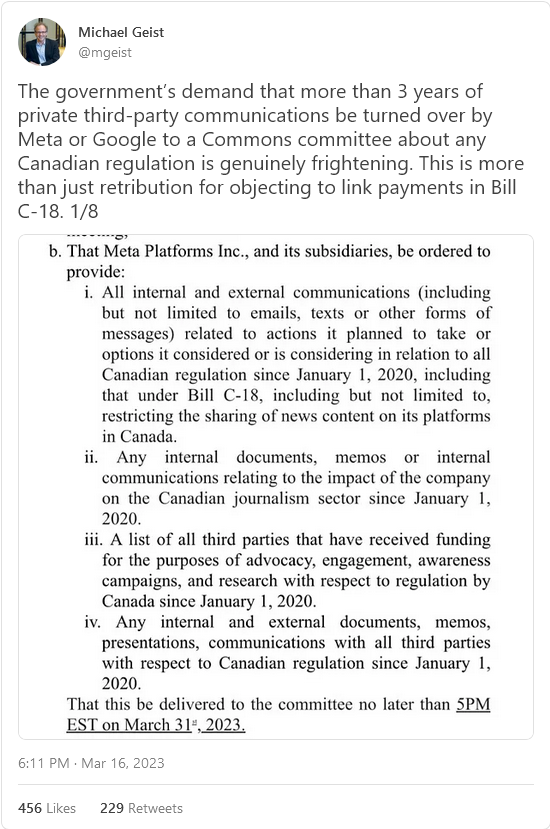
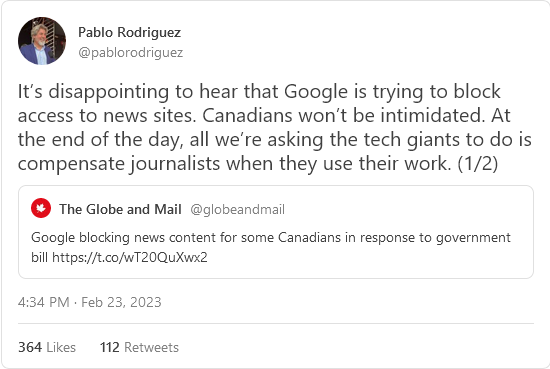
In The Line, Peter Menzies outlines the state of play in the continued efforts of the federal government to pass C-18, a bill that will massively benefit certain media outlets … or convince the “tech giants” to pull out of the Canadian market altogether rather than pay the blackmail:

News Media Canada’s persistent campaigning finally produced its Holy Grail — Bill C-18. All might have been well for Torstar, Postmedia and Le Devoir except that once the flesh was thrown on the bones of the Act, broadcasters that aren’t facing economic peril heard the dinner bell and came running.

The result, according to the Parliamentary Budget Officer, is that Bill C-18 is expected to produce $329 million in annual revenue for Canadian media (for context, that’s less than the Calgary Herald, Edmonton Journal, Edmonton Sun and Calgary Sun were bringing in between them 20 years ago). Of that, $249 million will go to broadcasters, few of whom are on a fiscal ledge and a good many of whom have contributed to the demise of local newspapers. Remarkably, the CBC, already receiving $1 billion in taxpayer funding, will get the most of that cash, followed by CTV (Bell), Rogers, Videotron and others. The newspapers and start ups will have $80 million (a little more than what the Edmonton Journal and Edmonton Sun used to make in combined annual profit) to fight over.

And very few of those previously mentioned startups — run by mostly young and often female innovators — trying to find a sustainable business model for good journalism can expect anything more than a token pay off. No. They will have to go to the little kids table and see what they can find on the children’s menu of subsidies.

It is distressingly obvious that while so many were tricked into believing this was the most progressive Canadian government ever, it is in fact, a slave to the status quo; as staunch a defender of the corporate establishment as the Toronto Club could wish for. With the 21st century and all its opportunities staring it in the face, Justin Trudeau’s government has not only turned its back on innovation, it has put its thumb on the scale in favour of failed business models that long ago ran out of ideas.

Yet there may be a final twist in this tale.

Bill C-18’s particulars are, as Meta/Facebook’s Kevin Chan put it to a Parliamentary committee last week “globally unprecedented”. For all its sins — and for all we know there are a few more skeletons rattling around in its closet — Meta is unlikely to pay up. Sure, it can cover the Canadian shakedown; what it can’t afford though is to pay every other country in the world that makes the same demand. So Meta says it may simply stop serving up news links which, when you think about it, is a better idea in the long run than permanently entrenching its dominant market position

So while the publishers of those blank pages appear to have bullied even the Conservatives into supporting this travesty, they are still left to ponder:

“Imagine if Facebook wasn’t there.”

November 2, 2022

Bill C-18’s scheme to force payment for online links threatens freedom of expression

Filed under: Cancon, Government, Media — Tags: , , , , , , — Nicholas @ 03:00

Michael Geist considers the ways that the federal government’s Bill C-18 will suppress online freedom of expression in Canada:

“Automotive Social Media Marketing” by socialautomotive is licensed under CC BY 2.0

The study into the Online News Act continues this week as the government and Bill C-18 supporters continue to insist that the bill does not involve payment for links. These claims are deceptive and plainly wrong from even a cursory reading of the bill. Simply put, there is no bigger concern with this bill. This post explains why link payments are in, why the government knows they are in, and why the approach creates serious risks to the free flow of information online and freedom of expression in Canada.

[…]

Why is the government suspending the fair dealing rights of Internet platforms in the bill? Because it knows that the platforms don’t typically use the news in a manner that would be compensable. For example, the platforms may link to the news, feature a headline with the link or sometimes offer a one-or-two sentence summary or quote from the article. These uses are generally permitted under Canada’s fair dealing copyright law rules and do not require a licence or compensation. In other words, claiming that links might qualify for compensation requires setting aside the platforms’ copyright rights which places Canada in breach of its obligations under the Berne Convention, the international treaty that governs copyright law.

The government’s intervention into the final arbitration process is further evidence that it recognizes the weakness of the argument for payments for links. Bill C-18 mandates final offer arbitration, which encourages the parties to provide their very best final offer as part of the process since the arbitrator must select one or the other. Yet Section 39 gives the arbitration panel the right to reject an offer on several policy grounds. Why would such a provision be necessary in a final arbitration system that encourages submitting your best offer? It is only necessary if you fear one side will examine the evidence and proffer a low offer on the grounds that it does not believe that there has been a demonstration of compensable value. That is a real possibility in this case given that there should be no need to compensate for links and there is little else of value. In light of that risk, the government gives the arbitration panel the power to reject offers that do not meet the government’s policy objectives.

[…]

Aside from the obvious unfairness, the broader implications of this policy are even more troubling. Once government decides that some platforms must pay to permit their users to engage in certain expression, the same principle can be applied to other policy objectives. For example, the Canadian organization Journalists for Human Rights has argued that misinformation is akin to information pollution and that platforms should pay a fee for hosting such expression much like the Bill C-18 model. The same policies can also be expanded to other areas deemed worthy of government support. Think health information or educational materials are important and that those sectors could use some additional support? Why not require payments for those links from platforms. Indeed, once the principle is established that links may require payment, the entire foundation for sharing information online is placed at risk and the essential equality of freedom of expression compromised.

To be clear, supporting journalism is important. But Bill C-18’s dangerous approach ascribes value to links where there isn’t any, regulates which platforms must pay in order to permit expression from their users, and dictates which sources are entitled to compensation. This is an unprecedented government intervention into the media and freedom of expression. If the government believes that Facebook and Google should be paying more into Canada, tax them and use the funds for journalism support. If that isn’t enough, create a fund for participation in the news system with mandated contributions similar to the Cancon broadcast world. That may not be ideal, but it would at least keep the system arms length, remove the qualification issues, and reduce the market intervention.

I suspect the government fears that Canadians would easily recognize the risks associated with mandated payments for links and fundamental unfairness with the system envisioned by Bill C-18. It is why it has misled on the inclusion of link payments, rejected the Parliamentary Budget Officer’s estimates on who benefits, and sought to frame Facebook’s concerns as a threat, when the real threat lies in the bill itself. But despite those efforts, make no mistake: Bill C-18 is a law about forcing some platforms to pay for links. It gives the government the power to regulate who pays and which expression is worthy of payment. In doing so, it creates a threat to freedom of expression for all Canadians.

September 30, 2022

“To maintain the illusion of free, all our online activities are sinking into spam, scam, and sham”

Filed under: Business, Media, Technology, USA — Tags: , , , , , — Nicholas @ 05:00

Ted Gioia on the insatiable growth of predatory behaviour from providers of “free” content online:

The biggest trick the Devil ever played was convincing people that online stuff is free. But the Devil always collects, sooner or later — and we are starting to learn the actual terms of this cursed deal.

Consider some recent news stories:

  • YouTube has been testing users’ willingness to watch 10 unskippable ads on a video. And the ads aren’t spaced out. They come at you, one right after the other, at the outset — because Google wants to be paid first, even if the video sucks.
  • Nobody wants ads on iPhone, but they’re coming. Executives at Apple are allegedly planning to triple the ad revenue from phones.
  • “For some Google searches literally the whole screen on Google is ads.”
  • TikTok can track a user’s every keystroke, and Beijing has “access to everything”.
  • “Scams are showing up at the top of online searches.”
  • Snapchat has been forced to pay $35 million for storing and selling users’ biometric information without permission.
  • Even if you pay for ad-free streaming, Spotify inserts ads in podcasts.
  • Ads are coming to Netflix too.
  • Etc. etc. etc.

This is what happens when “free” really isn’t free — but consumers prefer to stay in denial. Go ahead and rob me, just make sure I’m not looking when it happens.

It’s even worse than that. Web users are now hooked on free — and like all addictions, this one is far costlier than you realize at the outset.

You have more leverage when you negotiate an actual price. When I cancel a paid subscription, the corporate provider always comes back with a special offer to get me to reconsider. But how much bargaining power do I have if I refuse to click on those “terms and conditions” that always come with the free stuff?

I’ll answer that for you — none at all.

How bad will it get? YouTube described its ten unskippable ads as a “test” — but this wasn’t done in a laboratory or with volunteers. They just forced it on users, and watched them squirm. And squirm they did.

In fact, one person reported a 12-ad blitz.

This wouldn’t be so bad if it was just one business or sector of the economy that played these games. But this is the de facto business model for the entire digital economy. To maintain the illusion of free, all our online activities are sinking into spam, scam, and sham. Everything from sending an email to sharing a photo gets monitored and monetized by big tech companies — and often you’re the last person to find out what the real price is.

Witness about to testify on Bill C-11? Time to break out good old Parliamentary bullying and intimidation tactics!

Filed under: Cancon, Government, Politics, Technology — Tags: , , , , — Nicholas @ 03:00

It’s had to believe, but the Liberal government continues to defy expectations in their continued mission to prevent public participation in political processes, as Michael Geist documents here:

“In the east wing of the Centre Block is the Senate chamber, in which are the thrones for the Canadian monarch and consort, or for the federal viceroy and his or her consort, and from which either the sovereign or the governor general gives the Speech from the Throne and grants Royal Assent to bills passed by parliament.”
Photo and description by Saffron Blaze via Wikimedia Commons.

The Senate Bill C-11 hearings have provided a model for the much-needed, engaged, non-partisan inquiry that was largely missing from the House committee’s theatrics in which the government cut off debate on over 150 amendments. But this week those hearings attracted attention for another reason: serious charges of witness intimidation and bullying by government MPs, most notably Canadian Heritage Parliamentary Secretary Chris Bittle (yes, the same Bittle who last month suggested I was a racist and a bully for raising concerns about Minister Pablo Rodriguez silence over Canadian Heritage funding of an anti-semite as part of its anti-hate program).

The Globe and Mail reported late on Tuesday night that Bittle – together with his colleague, Liberal MP Lisa Hepfner – had sent a letter to the Lobbying Commissioner to seek an investigation into the funding of Digital First Canada, a group representing digital first creators. The letter may have been shopped around to other MPs as Liberal MP Anthony Housefather has told the Globe he did not sign it. DFC’s Executive Director, Scott Benzie, had appeared before the Heritage committee months ago and Bittle used his time to focus on the organization’s funding. Leaving aside the fact that government MPs reserve these kinds of questions only for critics of Bill C-11 (there were no similar questions this week from Ms. Hepfner to the Director of Digital Content Next, whose organization supports Bill C-18 and counts Fox News among its members), the timing of Globe story was incredibly troubling. The Lobbyist Commissioner letter was apparently filed nearly two months ago and Benzie had been assured that he was compliant with the law. Yet the story was presumably leaked to coincide with Benzie’s appearance before the Senate committee last night.

The letter and leak smacked of witness intimidation and bullying with the government seeking to undermine critics of the legislation hours before a Senate appearance. Indeed, the entire tactic felt like the policy equivalent of a SLAPP suit, which are used to intimidate and silence critics through litigation. By the end of the day, the tactic had clearly backfired on Bittle and the government. Conservative MP John Nater filed a point of privilege in the House of Commons, arguing that Bittle had attempted to intimidate a Senate witness.

    I rise on a question of privilege, for which I gave notice earlier this same day, regarding the conduct of the member for St. Catharines, who attempted to intimidate Scott Benzie, a witness appearing before a committee of the Senate studying Bill C-11, an act to amend the Broadcasting Act and to make related and consequential amendments to other acts, as reported yesterday by the Globe and Mail.

    While I appreciate that this attempt to intimidate relates to proceedings of a Senate committee currently studying Bill C-11, the culprit in this case is a member of the House, and that same witness appeared before the House of Commons Standing Committee on Canadian Heritage during its deliberations on Bill C-11, an appearance where Mr. Benzie, no doubt, first established himself as an undesirable witness for the government on the merits of Bill C-11.

The government response was surprisingly muted with MP Mark Gerretsen simply asking for a couple of days to formulate a response, perhaps recognizing that defending Bittle would mean defending the indefensible.

September 28, 2022

There are two kinds of people online talking about mental illness: those suffering with mental illness and those glorying in the attention they get for faking it

Filed under: Health, Media, Technology, USA — Tags: , , , — Nicholas @ 03:00

Freddie deBoer on the phenomenon of mental health culture online and the two primary kinds of participants (my headline over-dramatizes the case he’s actually making):

I was not, at first glance, inspired with confidence by this Washington Post piece on online mental illness culture. The piece has a header image of a “mental illness influencer” lounging in bed, taking a selfie. I’m someone who’s committed to de-glamorizing mental illness, and I’ve been begging people to stop romanticizing pathology for a long time. I suppose there’s an implied critique in that photograph, but it’s not ideal.

On substance, Tatum Hunter’s piece fails the way so many others have failed in this milieu: it studiously avoids the possibility that some people who talk about their mental illnesses online don’t really have them. I’m not specifically talking about simple fraud and lies, which I suspect are rare, but rather the weird combination of hypochondria, Munchausen’s syndrome, and social contagion that we see all around us in these spaces. Spend any time at all in these communities on Tumblr or Tik Tok and you will find many people, most of them young, who are using mental illness as a means to self-define, to differentiate themselves from the hordes of other people they see online who are just like them. I’ve written again and again about why it’s a bad idea to want to be your mental illness, and it’s even worse to want to be mentally ill, period – not just bad for other people, but bad for you. But there are people who have become influencers and garnered hundreds of thousands of followers on their apps of choice by performing mental illness. People use their disorders to chase clout. That’s just reality.

Hunter considers the problems of misdiagnosis, of self-diagnosis, of people undertaking mental health care on the advice of internet randoms rather than under the care of a doctor, but nowhere does she seriously consider the possibility that the basic problem for many people is that they believe they have mental disorders they don’t in fact have. I think doing so is seen, at this point, as a kind of identity crime, and thus unlikely to be found in the Washington Post.

But hypochondria exists. Munchausen’s syndrome exists. Psychosomatic illness exists. I can get people to admit to those realities in the abstract, now, but they stay entirely in the abstract – to suggest that any group of people is suffering under those conditions, rather than under authentic mental illness, is treated as a sin. This was my biggest disappointment with Ross Douthat’s book on his chronic illness, which I quite liked overall; Douthat never stops his narrative to ask whether any of the people who believe themselves to be sick from chronic illness actually aren’t. (Surely he himself suffered, but because of the woo and mysticism found in that space, an accounting was necessary.) And I don’t know how we confront the spiraling number of people claiming to have illnesses for which there are no objective tests without being frank about the existence of hypochondria, Munchausen’s, and psychosomatic illness – particularly when people insist on deepening the social incentives by giving the sick more and more attention.

Even for the authentically ill, online culture is fraught. The meta-problem with pieces like that in WaPo, obviously, is that by giving certain members of this community the glamour shot treatment (literally in this case), they’re creating direct incentive for people to make illness their identity -and to not get better. Young people understand the allure of being seen; they don’t yet understand the horror of being frozen in other people’s gazes. They don’t understand the costs of being defined. There have been many opportunities for me to make myself the mental illness guy, certainly including financial opportunities. Perhaps I’ve already fallen into that trap, despite my efforts to remain a generalist. But I’ve fought to avoid that because I know just how painful and limiting self-definition can become. I’m sorry to pull wizened old guy here, but young people don’t understand. They don’t understand that pinning yourself down that way can produce a kind of horror.

September 22, 2022

Why Electronic Voting Is Still A Bad Idea

Filed under: Government, Politics, Technology — Tags: , , , — Nicholas @ 04:00

Tom Scott
Published 9 Dec 2019

We still shouldn’t be using electronic voting. Here’s why.
(more…)

September 18, 2022

Forget #GamerGate already, here’s #NAFO!

Filed under: Media, Politics, Russia, Technology — Tags: , , — Nicholas @ 05:00

At Samizdata, Perry de Havilland briefly recaps the story of #gamergate and the incomprehension of the “official” gaming press and PR departments of gaming companies that their actions to ridicule and shutdown the “racist/sexist/homophobe” #gamergate activists not only failed but drew more attention to the #gamergate issue, and compares it to a new instance of the same phenomenon:

Fast forward to 2022 and behold #NAFO: the North Atlantic Fellas Organisation.

And who are “the fellas”? A large and growing online pack of attack dogs countering, dare I say smothering, official Russian troll factory output, as well as other pro-Kremlin talking heads online. And their mascots are daft cartoon dogs (variations of a Shiba Inu to be precise). If journalistic collusion was a constant target of #GamerGate, the Russian troll farms are the modern analogy to that, constantly targeted and smothered by NAFO posting either pro-Ukrainian counter-narratives or just ridiculing or flagging up pro-Russian ones.

Many people, particularly those operating within institutions, don’t understand #NAFO for same reason PR departments of various video games companies & press outlets didn’t (and still don’t) understand #GamerGate.

Is #NAFO engaged in “information warfare”? Absolutely. They even get a shout out from the Ukrainian Ministry of Defence. But they are not managed out of an office in Langley, Virginia nor by some adjunct of the Ukrainian intelligence services. #NAFO is a hashtag, a phenomena, it isn’t “run” by anyone, because it doesn’t need to be. Like GamerGate, NAFO is a confluence of the motivated willing in every timezone on the planet.

And just as GamerGate had a single original trigger, which was then largely forgotten as the “movement” grew and started attacking larger more juicy prey, NAFO started as a fund raising effort for the Georgian Legion (a now battalion sized unit of about 600 within the Ukrainian army made up mostly of Georgian volunteers). At blinding speed, NAFO rapidly morphed into a wider distributed online effort supporting Ukraine in the “information space”.

August 8, 2022

The British left briefly rediscovers an interest in free speech … no, wait, they’re back to loving Big Brother again

In Spiked, Tom Slater recounts the brief moment last week that the great and good of British left wingers found nice things to say about freedom of speech. A very brief moment:

The British left – or what passes for it today – briefly pretended to care about free speech this week. Which was kind of cute. It was all sparked by Tory leadership no-hoper Rishi Sunak’s bonkers suggestion that people who “vilify” Britain should be put on the Prevent anti-radicalisation programme, alongside all the Islamists and fascists. “Who are the real snowflakes?”, thundered one left-wing commentator. “Fascism creeps ever closer”, warned Richard Murphy, a one-time adviser to Jeremy Corbyn, as he wondered out loud if he might soon end up in “some camp of Sunak’s choosing for ‘re-education'”.

This is probably the meme that Darren Brady posted which drew the attention of Hampshire Police’s crack “hurty words and pictures” squad last week.

Such principled expressions of horror, over an insanely authoritarian policy that almost certainly will never be implemented, might have had a bit more weight had the exact same people not studiously ignored a very real incident of state censorship – and attempted re-education – that went viral last week. I’m referring, of course, to Hampshire Police’s arrest of 51-year-old army veteran Darren Brady, all because he posted an offensive meme, which arranged four “Progress Pride” flags to resemble a swastika – a clumsy commentary on the authoritarianism of the contemporary LGBT movement.

The details chillingly echo Richard Murphy’s tweeted fever dream. Reportedly, the police had visited Brady 10 days before they tried to arrest him, informing him that he had committed an offence by posting the flag meme. They offered him a deal: pay for a £60 “community-resolution course” and they’d downgrade his offence to a “non-crime hate incident”, which would still appear on an advanced background check. Brady refused and contacted Harry Miller, leading campaigner against thoughtpolicing, who was present at the arrest and spent a night in the cells himself for trying to obstruct the cops. Going by the footage, now seen around the world, the (several) officers who attended Brady’s home had no idea what offence he was supposed to have committed, saying only that he had “caused anxiety”.

So, state censorship? Yep. Threats of re-education? Yep. The police showing up at someone’s door for no other crime than expressing an opinion? Big yep. Just because it was done in a Keystone Cops sort of fashion doesn’t make the treatment of Brady any less sinister. And yet there hasn’t been a peep of protest from the left-leaning intelligentsia. The armed wing of the state is going about harassing and arresting people purely for upsetting someone on the internet. And yet the people who pass themselves off as liberal, progressive, radical even, are clearly not the tiniest bit bothered about it.

Brady isn’t an isolated case, either. Britain is fast becoming a warning to the Western world about “caring” censorship, about trying to quite literally police “hurtful” speech. According to one investigation, nine people a day are arrested in the UK over offensive things they post on the internet. On top of that, more than 120,000 people have had so-called non-crime hate incidents recorded against their name. These alleged incidents needn’t be investigated or even be credible to be recorded. So much so that an Oxford professor once managed to get a hate incident recorded against then home secretary Amber Rudd, for a speech she gave about immigration that he later admitted he hadn’t even listened to, let alone witnessed in person.

July 19, 2022

Drawing the proper lessons from the massive Rogers outage earlier this month

Filed under: Business, Cancon, Government, Media, Technology — Tags: , , , , — Nicholas @ 05:00

In The Line, Matt Gurney explains the really important lesson that seems to have escaped a lot of the critics who covered the Rogers internet/cell/TV outage that took a third of the country offline for 24 hours or more:

Most of the conclusions reached after the Rogers telecommunication outage two weeks ago are wrong. Millions of people lost home internet, television and cellphone service for the better part of a day (some for much longer). For those who had all their services bundled with Rogers, this meant being entirely cut off, including from access to emergency services. It was a big deal, both in terms of lost economic productivity and for those Canadians who needed help and could not access it.

The problem isn’t with Rogers, though. The problem is with everyone else.

I don’t want to be misunderstood. Rogers is bad. It did have a big problem. I am not a fan. Their customer service is generally awful. Their reliability and performance is decidedly meh and the meh costs a fortune. So don’t take this column as some sort of apologia for Rogers. I am one of their customers, but I’m only one of their customers because none of the other options are much better.

But still. The lesson of two Fridays ago shouldn’t be that Rogers is bad. It also shouldn’t be that the CRTC is bad or that our politicians are spineless and that our regulators are thoroughly captured. All of those things are true, but they’re not the lesson. That wasn’t the failure of two Fridays ago. The failure of two Fridays ago was that when one of our telecom companies went down, a pretty horrifying cross-section of Canadian society had no back-up plan.

Let’s imagine an alternate universe where things in Canada simply functioned better. Close your eyes and just dream it up. You’re in a different Canada now. The CRTC is awesome. Our politicians are terrific. Rogers is an incredibly good company that is masterful at delivering services that are overwhelmingly reliable and affordably priced. Even in this increasingly far-fetched parallel timeline, no telecom company is going to bat a thousand. You will never have 100 per cent service reliability. This alternate Canada still has outages — maybe they’re rare and brief, but they’re not unheard of or impossible.

And that’s why we can’t look at what happened two weeks ago as a failure at Rogers. Obviously Rogers failed. But the real failure was a failure of imagination and planning on the behalf of millions of individuals, and a worryingly diverse set of institutions, that did not have a back-up plan.

July 11, 2022

Canadians deserve better than “core network maintenance problems” for critical cell phone and internet services

Filed under: Business, Cancon, Government, Technology — Tags: , , , , — Nicholas @ 05:00

Our internet service provider, Rogers, suffered a major network failure early on Friday morning, taking down not just wired internet services, but also cable TV, and cell phone services and causing knock-on issues that utterly disrupted many emergency 911 services, government websites, banks (including ATM and point-of-sale terminals) and many more. I subscribe to both Rogers internet and Rogers cell phone services, but fortunately my wife has a different wireless phone provider so we weren’t completely offline all of Friday and most of Saturday. Michael Geist and his family weren’t as lucky:

Like many Canadians, I spent most of the massive Rogers outage completely offline. With the benefit of hindsight, my family made a big mistake by relying on a single provider for everything: broadband, home phone, cable, and wireless services on a family plan. When everything went down, everything really went down. No dial tone, no channels, no connectivity. Work was challenging and contact with the kids shut off. It was disorienting and a reminder of our reliance on communications networks for virtually every aspect of our daily lives.

So what comes next? We cannot let this become nothing more than a “what did you do” memory alongside some nominal credit from Rogers for the inconvenience. Canada obviously has a competition problem when it comes to communications services resulting in some of the highest wireless and broadband pricing in the developed world. Purchasing more of those services as a backup – whether an extra broadband or cellphone connection – will be unaffordable to most and only exacerbate the problem. Even distributing the services among providers likely means that consumers take a financial hit as they walk away from the benefits from a market that has incentivized bundling discounts. Consumers always pay the price in these circumstances, but there are policy solutions that could reduce the risk of catastrophic outages and our reliance on a single provider for so many essential services.

First, there is a need to better understand what happened and why. Rogers CEO says the problem lies with maintenance to the core network, which caused some routers to malfunction. But that’s just tech talk. Canadians deserve answers that explain not only how this happened, but how we find ourselves in a position where malfunctioning routers at one company cause a nationwide payment system to go down, government services to be taken offline, and emergency services to be rendered inaccessible. It is one thing for my household to make a mistake, but another for Interac to do so. That means conducting an open CRTC process into this outage alongside a Parliamentary hearing on the broader issues since this is a matter that requires both regulatory and political response. There is no need to wait: these hearings must happen this month with the goal of identifying the scope and source of the problem along with potential policies that might mitigate future harms.

Neither the CRTC nor the current government has shown much inclination to challenge the big telcos. CRTC Chair Ian Scott has reversed years of a consumer-focused Commission into one more comfortable supporting the big providers, while the government has been far more interested in sabre rattling or shaking down Internet companies than taking on big telecom. Yet as we were reminded on Friday, the linkage to the availability of essential services – payments, health care, government services – runs through the telcos, not the Internet companies.

This is the second object lesson in concentrated power in a small number of government-approved hands this year. Our first wake-up call was when the government prompted chartered Canadian banks to cut off some of their customers from all financial services even though no crimes had been committed and no charges were laid. It’s not clear how many people were affected, but arbitrarily denying people access to their bank accounts and credit cards should have rung alarm bells for many people. Now, we’ve been shown how dangerous it can be to allow a very small number of companies to divide the mobile phone and internet service market between them and use the power of government to keep out potential competitors. Will enough Canadians notice?

June 23, 2022

The government believes that anyone opposed to Bill C-11 is “spreading misinformation”

Filed under: Cancon, Government, Liberty, Media, Politics, Technology — Tags: , , , , — Nicholas @ 03:00

Happily for the Canadian government (if not for Canadian internet users), if Bill C-11 gets passed, they can sic the CRTC on those critics … isn’t that convenient?

Last week, shortly after midnight in Ottawa, the House of Commons Heritage Committee concluded its deliberations on the Online Streaming Act, which will grant a federal regulator authority over the global Internet.

You may think putting the Canadian Radio-television and Telecommunications Commission (CRTC) and its nine government-appointed commissioners in charge of the entire online world is a good thing. Or you may think it’s a bad thing. But I’m guessing we can all agree that Bill C-11, the world’s most extensive internet regulation legislation so far, is a Thing.

And you’d think a thing that big would be deserving of respectful, honest debate and thoughtful review. If there’s something in the legislation that is bad in a way that isn’t intended, you’d want it caught and fixed, right? We are, after all, about to grant authority over 21st-century communications to people in charge of something called The Broadcasting Act. An act that was passed in 1993 to make sure nothing terrible — like people preferring NFL over CFL football or the Oscars over the Genies — results from watching too much American TV. Given that thousands of successful Canadian free enterprise Tik-Tokers and YouTubers fear new rules will disadvantage them in favour of the CRTC’s certified cultural broccoli, you’d think that’d be worth a think.

But you’d be wrong.

[…]

But then Liberal MP Tim Louis of Kitchener took this government’s truth-torquing communications strategy to a breathtaking level of self-righteous fantasy — one that dripped with contempt for all but he and his clan.

He calmly rose in the House of Commons and quietly accused C-11’s critics of deliberately spreading “misinformation” — a chilling threat given the government’s plans to deal with he same in “Online Harms” legislation later this year.

Louis did not even try to say, as did Mendicino’s deputy minister, that there was a misunderstanding of some kind. He did not attempt to make it clear that there are people who — as reasonable people often will — disagree. He did not dismiss the bill’s critics as being overwrought, incorrect and yet honourable. He stood up in the House of Commons and, barefaced, declared that views, lived experiences and legal analyses — including the testimony of CRTC Chair Ian Scott — are “simply untrue”. In other words, it’s all #fakenews.

And we are all liars.

June 17, 2022

The dark side of Tim Berners-Lee’s statement “When something is such a creative medium as the web, the limits to it are our imagination”

Filed under: Health, Media, Technology — Tags: , , , , — Nicholas @ 03:00

In The Critic, Tom Farr wonders about the wider meaning of the Eugenia Cooney story:

Eugenia Cooney in 2016.
Photo by Lilg54g – CC-BY-SA 4.0 via Wikimedia Commons.

Journalist and author Mandy Stadtmiller shared a new article last week on her excellent Substack series Rabbitholed entitled: “Why is Jeff Bezos Allowing Millions of Teenage Girls to Watch the Severely Anorexic Influencer Eugenia Cooney Slowly Kill Herself On Stream?”

The article itself received widespread attention for its harrowing coverage of the story of Eugenia Cooney, a 20-something Twitch streamer and YouTuber, who has built a global fanbase off vlogs featuring her cosplaying, and giving makeup and beauty tips amongst other things, as well as her distinctive early 2000s emo aesthetic.

Cooney is also severely anorexic. As Stadtmiller’s article succinctly explains:

    Cooney’s horrific skeletal appearance is documented lavishly by her sick and enabling mother, Debra Cooney, who is seemingly keeping her daughter trapped and isolated at home with almost no contact with the outside world outside of the online predatory men who pay her daughter tips to spin around, crawl around on the floor, act like a cat and show how weak she is when trying to lift things.

Whilst Cooney’s story warrants attention, that isn’t the purpose of this article. In order to understand fully the social apparatus that allows and encourages Cooney’s mother to disturbingly parade her young daughter around for tens of thousands of digital voyeurs, no better explanation can be found than the one that actually answers Stadtmiller’s original question: Just why is Jeff Bezos allowing millions of teenage girls to watch Eugenia Cooney slowly kill herself on stream?

Whilst Jeff Bezos could and should be skewered for his role in amassing grotesque, Scrooge McDuck levels of wealth at the expense of anyone with the temerity to want to use the toilet during their working hours, in this instance he is merely a symptom of a deeper rot that has taken hold of our society, aided in part by the explosion of the internet in the late 90s.

Sir Tim Berners-Lee, the founder of the World Wide Web, once said: “When something is such a creative medium as the web, the limits to it are our imagination.” Berners-Lee was not wrong, but it would be unfair to stick him with the responsibility for what the depraved depths of some individuals’ “imagination” have conjured up in the subsequent decades since the web’s mass adoption.

Those of us who grew up in the 90s and early 2000s — ostensibly the first generation to be exposed from an early age to the internet in its more rudimentary form – will surely remember the sporadic emergence of individual “shock videos”: from the fairly benign (“Meatspin”, anyone?) to videos of murder (“Three Guys One Hammer”), the internet was a developing digital territory that its early adopters were still testing the limits of. These videos were occasionally linked to entire websites that would host videos depicting varying degrees of degeneracy, but they operated mainly in the darker corners of the web, reliant on people sending links to each other on MSN with a description that would lull the recipient into a false sense of security in order to get them to click on it.

Such content ran, if not explicitly then certainly conceptually, parallel to another early-2000s meme: Rule 34. In short, Rule 34 stated: “Rule #34 There is porn of it. No exceptions.” It doesn’t really require Einstein’s intellect to parse what was meant by this aphorism: as the porn industry was finding its footing in the new digital age, the type of pornographic content that was readily available was also breaking new ground. Initially, those shock videos existed in a slightly separate orbit to that of more mainstream pornography, but their intersection was by no means a rarity, even in those early days. This somewhat grimly operates as the perfect example of Berners-Lee’s observation that the creativity fostered by the internet is only constrained by our collective imaginations.

June 4, 2022

Bill C-18 might as well be called the “Keep legacy media alive at all costs, even if nobody wants it anymore” act

The Line‘s Jen Gerson lays out the case against the federal government’s plans for permanent corporate welfare for the big Canadian legacy media organizations:

How Jen Gerson might visualize Torstar and Postmedia during the lobbying effort for Bill C-18.
“Zombie nuns” by Michael Cavén is licensed under CC BY-NC-SA 2.0

This week, The Line signed on to a campaign put together by a coalition of independent media publishers calling for amendments to the panda trash fodder piece of legislation known as C-18. To be fair, I mostly signed on; my co-founder Matt Gurney had some reservations, and I figured it would be best to hash them out in full here.

The bill is a hot mess created by a clearly well-intentioned government that appears to have been bamboozled by a group of media industry lobbyists helmed by organizations like Postmedia and Torstar — companies that despite extraordinary history and resources have largely failed to sustainably transition to a digital media environment. These large outlets are now using the last of their dying power and influence to champion legislation that will force big technology companies like Facebook and Google to compensate them for linking to their content.

This is a straightforward case of regulatory capture, the very thing we would condemn in any other industry; big media companies are using their credibility and political power to pressure the government into forcing “Big Tech” to sustain their dying business models — the very “Big Tech” that they’ve spent years deriding and defaming in their very own newspapers and outlets.

This whole process is corrupt. I don’t say that lightly. Perhaps inevitably, I’ve grown totally disillusioned with the industry to which I have devoted all of my adult life. We used to consider journalism a calling or a vocation — manipulative terms that justified the low pay, harassment, and sometimes abusive management. How can the church of journalism and its holy mandate to preserve democracy continue to take itself seriously when the very catechism of the craft are nowhere present in its own self-created lobbying arm, New Media Canada?

I think the leaders of this initiative have convinced themselves that the business model they enjoyed in the ’80s and ’90s is so totally central to the survival of democracy and liberal values that they’ve committed to keeping it afloat by any means necessary regardless of the ethical and philosophical cost. In doing so, I believe that they’re only ensuring their own failure.

By driving legislation in this way, they are not proving their worth to the broader public. Rather, they are conceding that what they produce has so little value that they need to evolve into parasites of the state. It demonstrates that commitment to democracy and accountability is secondary to their primary functions; running a business. They have stockholders to please and interest on loans to pay. Big loans.

Meanwhile, the legacy media they have managed is little more than a zombie in nun’s drag. It is in a state of terminal decline, and keeping it alive poisons the earth for the generations to come after.

May 28, 2022

“… the only thing that is history are any immediate hopes for a more competitive communications marketplace in Canada”

Filed under: Business, Cancon, Government, Media, Technology — Tags: , , , , — Nicholas @ 03:00

Michael Geist pans the latest official misinformation from the federal government on telecommunications legislation:

Innovation, Science and Industry François-Philippe Champagne unveiled the government’s proposed new telecom policy directive yesterday, hailing it as a “historic step”. However, a closer look at the policy suggests that the only thing that is history are any immediate hopes for a more competitive communications marketplace in Canada. Once again, the government has shown itself unwilling to take a strong stand in favour of consumers and competition, instead releasing a directive that largely retains the status quo and sends the message to CRTC Chair Ian Scott to stay the course. Indeed, the primary purpose behind the announcement would appear to be an attempt to shield the government from criticism over its decision to leave the controversial CRTC decision on wholesale Internet access intact, thereby denying consumers the prospect of lower costs for Internet services.

While the new proposed policy directive features much needed details and helpfully replaces the 2006 and 2019 directives that often conflicted and enabled the CRTC to pay little more than lip service to the issue, it sends a strong signal that it is happy with the Commission’s current approach. For example, the directive’s summary on measures to address wholesale Internet access are all about the status quo: “requiring large companies to continue to give access to competitors” or “directing the CRTC not to phase out the existing model for wholesale access.” These are not instructions to change.

The same is true for mobile wireless competition. Rather that using the opportunity to accelerate competition through mobile virtual network operators, the CRTC is instead to directed to improve its hybrid MVNO model “as necessary”. A full MVNO model? The government says it is prepared to support it “if needed”. Based on the current market, it apparently believes it isn’t needed.

« Newer PostsOlder Posts »

Powered by WordPress