Forgotten Weapons
Published 12 Nov 2016Cool Forgotten Weapons Merch! http://shop.bbtv.com/collections/forg…
Russell Turner was a Pennsylvania gunsmith and inventor who developed this semiautomatic conversion of an SMLE bolt action rifle circa 1940. It was intended for trial and potential sale to the Canadian military, as it would allow them to retrofit existing rifles into semiautomatic configuration and still use existing supplies of .303 British ammunition. Rather than try to devise a reliable system to rotate the original Enfield bolt, Turner replaced the bolt entirely, using instead a side-tilting design much like what he used in his M1 Carbine trials rifle for the US military. This was coupled with a long stroke gas piston and a hammer firing trigger mechanism.
Reportedly the rifle was tested by Canadian authorities, and performed quite well, with the adjustable gas system allowing it to function reliably even in temperatures of 25 below zero (where the Garand, tested alongside, experienced problems). However, Turner’s rifle was deemed too complex for military adoption.
That decision against the rifle was probably the right one for Canada, although Turner’s conversion is one of the better semi auto bolt acton conversions I have handled. It was remarkably non-awkward — that may not sound like much to crow about, but it sets a pretty high standard for this type of rifle.
June 21, 2021
Turner Semiauto SMLE Conversion
June 19, 2021
Proposed new firearms rules “… are ultimately unenforceable, and […] they are dangerous end-runs around due process that threaten fundamental rights”
J.D. Tuccille reports on the latest US federal government proposals on changes to firearm regulations:
As expected, the Biden administration released proposed new rules for pistol braces and model legislation for “red flag” laws that make it easier to confiscate privately owned firearms. Also as expected, the proposals are ludicrous. On the one hand, they are pointless and nitpicky rules that are ultimately unenforceable, and on the other hand they are dangerous end-runs around due process that threaten fundamental rights. Taken together, they illustrate the unserious nature of gun regulations which are crafted more to appeal to political audiences than to achieve positive results.
The silliness inherent in this sort of rulemaking is apparent from the Department of Justice’s announcement of “a notice of proposed rulemaking that makes clear that when individuals use accessories to convert pistols into short-barreled rifles, they must comply with the heightened regulations on those dangerous and easily concealable weapons.”
For those new to this controversy, stabilizing braces were developed to help disabled veterans more accurately shoot pistols (usually those built around AR-15 receivers) one-handed. The “problem” is that many resemble shoulder stocks and can be used in that role. By no means does an attachment that lets a pistol be fired from the shoulder make it especially “dangerous and easily concealable.” Instead, it makes it less concealable since it has a brace sticking off the back. Braces do render pistols more accurate, which could be interpreted as dangerous if you’re upset by shooters hitting where they aim.
But a pistol that can be fired from the shoulder is arguably a short-barreled rifle under the National Firearms Act (NFA), and subject to special restrictions, taxes, and registration requirements that don’t apply to regular pistols or regular rifles, but do apply to (among other weapons) rifles with barrels shorter than 16 inches. These regulations are not evidence that short-barreled rifles are particularly dangerous, but that, like many laws, the NFA is thoroughly idiotic.
Braces have been treated as legal devices for years but have recently been targeted by the sort of people who see advantage in pretending that a firearm with a buttstock and a short barrel is more “dangerous and easily concealable” than stock-less pistols and long-barreled rifles. In compliance with White House direction, proposed rules from the Bureau of Alcohol, Tobacco, Firearms, and Explosives (ATF) would impose new requirements to determine if braced pistols achieve Great Pumpkin-level sincerity, or are super-dangerous and concealable short-barreled rifles in disguise.
Among other tests, the rule would set the maximum length of a pistol at 26 inches (because 27 inches is super-dangerous and concealable). These tests add up to a four-point assessment, ranging from “1 point: Minor Indicator (the weapon could be fired from the shoulder)” to “4 points: Decisive Indicator (the weapon is designed and intended to be fired from the shoulder)” with four points the ultimate sign that a firearm crosses the line into very naughty territory indeed.
[…]
But foolish stabilizer brace rules affect mostly disabled shooters and fanciers of a particular type of firearm. Red flag laws affect potentially any gun owner by allowing for property seizures and confrontations with law enforcement without due process.
Red flag laws “make it easier for states to craft ‘extreme risk protection orders’ authorizing courts to temporarily bar people in crisis from accessing firearms,” insists the Department of Justice. “By allowing family members or law enforcement to intervene and to petition for these orders before warning signs turn into tragedy, ‘extreme risk protection orders’ can save lives.”
Maybe such orders “can save lives”—all sorts of restrictions on personal liberty theoretically “can save lives” if that’s your only criteria. But the model legislation proposed by the Biden administration requires same-day issuance of orders that “prohibit the respondent from possessing, using, purchasing, manufacturing, or otherwise receiving a firearm” with a hearing to be held only after the fact. That certainly deprives those affected of their rights without due process of any sort before cops show up on their doorsteps to search the premises and confiscate property.
June 17, 2021
MG-34: The Universal Machine Gun Concept
Forgotten Weapons
Published 7 Oct 2017The MG34 was the first German implementation of the universal machine gun concept — and really the first such fielded by any army. The idea was to have a single weapon which could be used as a light machine gun, heavy machine gun, vehicle gun, fortification gun, and antiaircraft gun. The MG34 was designed to be light enough for use as an LMG, to have a high enough rate of fire to serve as an antiaircraft gun, to be compact and flexible enough for use in vehicles and fortifications, and to be mounted on a complex and advanced tripod for use as a heavy machine gun.
Mechanically, the MG34 is a recoil operated gun using a rotating bolt for locking. It is chambered for 8mm Mauser, and feeds from 50-round belt segments with a clever and unique quick-change barrel mechanism. The early versions were fitted with adjustable rate reducers in the grips allowing firing from 400 to 900 rounds per minute, and also had an option for a top cover which would fit a 75-round double drum magazine. Both of these features were rather quickly discarded, however, in the interest of more efficient production. However, the gun fulfilled its universal role remarkably well.
The MG34 was considered a state secret when first developed, and despite entering production in 1936 it would not be formally adopted until 1939 — by which time 50,000 or so had already been manufactured. It would comprise about 47% of the machine guns in German service when the Wehrmacht invaded Poland, but would be fully standardized by March of 1941. It was replaced by the MG42 later in the war, as that weapon was both faster and cheaper to produce and also required substantially less of the high-grade steel alloys that Germany had limited supplies of. However, it would continue to be produced through the war, particularly for vehicle mounts.
http://www.patreon.com/ForgottenWeapons
Cool Forgotten Weapons merch! http://shop.bbtv.com/collections/forg…
If you enjoy Forgotten Weapons, check out its sister channel, InRangeTV! http://www.youtube.com/InRangeTVShow
June 13, 2021
Wartime Changes: The Bren MkI Modified and Bren MkII
Forgotten Weapons
Published 3 Mar 2021http://www.patreon.com/ForgottenWeapons
https://www.floatplane.com/channel/Fo…
Cool Forgotten Weapons merch! http://shop.bbtv.com/collections/forg…
The British lost some 90% of their stock of Bren light machine guns in the disastrous Dunkirk evacuation, and in the following months rushed to rearm. Part of this program was a two-tiered simplification of the Bren design. First was a MkI Modified Bren (which was not marked any differently than the original MkI), and this was followed by a MkII design. These patterns simplified many of the machining operation required to produce the Bren, significantly reducing the number of required machining operations. The most visually distinctive elements of the MkII pattern were the omission of the stainless steel flash hider assembly and the replacement of the original dial rear sight with a simple ladder sight. In addition, changes were made to the buttstock, buttplate, receiver profile, gas block, and bipod. Both Enfield and Inglis would produce the simpler MkII Brens by the middle of the war. Despite the many changes made, the core operating components (bolt, bolt carrier, etc) were left unchanged, so they could still interchange between all patterns of the gun in service.
Contact:
Forgotten Weapons
6281 N. Oracle #36270
Tucson, AZ 85740
June 9, 2021
Very Rare and Mostly Pointless: the Bren Fixed Line Sight
Forgotten Weapons
Published 25 Feb 2021http://www.patreon.com/ForgottenWeapons
https://www.floatplane.com/channel/Fo…
Cool Forgotten Weapons merch! http://shop.bbtv.com/collections/forg…
The very early production MkI Bren light machine guns were made with two dovetail brackets on the left side of the receiver. The rear one was for the standard rear sight, and the front one was to accommodate two types of optical sights. A mounting for the No.32 telescopic sight (the same one used on the No4(T) sniper rifle) was planned, but never produced. What was made in small numbers by the Plessey company was a “fixed line sight”. This was really more like a surveyor’s tool than a traditional sight, and it used the same optical element as the Vickers dial sight that was introduced alongside it in 1939. The purpose was to allow a tripod-mounted Bren to be set up with specific limits to its field of fire, and then for the gun to be removed, used on the bipod elsewhere, and returned to the tripod and confirm the field of fire, especially in the dark. This is a somewhat technically complex task, but not one that was actually needed very much for the Bren. As a result, production and use of the fixed line sights was very limited, and the sights are extremely rare today. The mounting bracket on the Bren receiver was rather quickly dropped from production as an unnecessary waste of machining time.
Contact:
Forgotten Weapons
6281 N. Oracle #36270
Tucson, AZ 85740
June 5, 2021
Bren MkI: The Best Light Machine Gun of World War Two
Forgotten Weapons
Published 24 Feb 2021http://www.patreon.com/ForgottenWeapons
https://www.floatplane.com/channel/Fo…
Cool Forgotten Weapons merch! http://shop.bbtv.com/collections/forg…
In the years after World War One, the British military wanted a new machine gun, and they wanted it to replace both the Lewis and the Vickers. Through the 1920s the British would tinker with most of the light machine guns that became available, but it was not until the early 1930s that a serious formal trial was conducted. The initial trials found three particularly encouraging guns; the ZB-26, Madsen, and Vickers-Berthier. Over a series of followup testing, the Madsen and Vickers-Berthier were both eliminated, leaving the Czechoslovakian ZB as the final choice.
The British were extremely enthusiastic about the qualities of the ZB, and it is understandable why. The final .303 British version, the Bren, is widely regarded as the best magazine-fed light machine gun ever made. In its final preproduction trial, one of the prototype guns endured a 150,000-round trial without any real problems.
The design was licensed for British production as well as in the Dominions, and would be put into production at both Enfield in England and the John Inglis company in Canada. About 30,000 were produced before the Dunkirk disaster, which would lead to simplification of the design. But those changes are a subject for another video later…
Contact:
Forgotten Weapons
6281 N. Oracle #36270
Tucson, AZ 85740
From the comments:
Jeffrey Holdeman
5 hours ago
Ian- “this video is getting a little long already”Everyone else- “so what!”
Notable Discomfort
2 hours ago
Ian: “This video is a little long already.”
Everyone: “Baby doll, you take all the time you need, I’m in love with every second you take. Every minute you take to explain this rifle is a minute I get to spend with you and your comforting voice. Don’t never apologize. There’s nothing to be sorry about.FLIBFLAGGAFLUP
2 hours ago
The sheer amount of Victoria Cross citations that start with “he picked up a Bren gun” is stupendous, like a WW2 cheat code.
June 2, 2021
Prototype Ross “H5” from 1909
Forgotten Weapons
Published 22 Feb 2021http://www.patreon.com/ForgottenWeapons
https://www.floatplane.com/channel/Fo…
Cool Forgotten Weapons merch! http://shop.bbtv.com/collections/forg…
The Ross MkII (aka Ross 1905) was a reasonably successful rifle design, but it lacked a few elements that the Canadian military would have preferred. Most significantly, it was not compatible with the charger clip that was introduced for the Lee Enfield rifles in 1907. The rifle we have today is a toolroom prototype Ross from about 1909 that was an experiment in adding clip compatibility. The receiver is a 1905/MkII type, but with a combination stripper clip guide and rear sight screwed onto the rear of the action. It has a 5-round staggered Mauser-type magazine box, a Lee Enfield style buttstock, a 1903 Springfield type bolt stop, and a thinner profile barrel than either the MkII or eventual MkII Ross patterns. The only marking on the rifle is the designation “H5” on the receiver and bolt. Ultimately, virtually none of this rifle’s unique features were included in the finalized MkIII Ross.
Contact:
Forgotten Weapons
6281 N. Oracle #36270
Tucson, AZ 85740
May 29, 2021
Prototype Jungle Carbine: A No1 MkV Becomes a No5 MkI
Forgotten Weapons
Published 17 Feb 2021http://www.patreon.com/ForgottenWeapons
https://www.floatplane.com/channel/Fo…
Cool Forgotten Weapons merch! http://shop.bbtv.com/collections/forg…
When the British began developing a shortened version of the No4 Lee Enfield in 1943 (which would become the No5 MkI “Jungle Carbine”), the development process included work with some rather older rifles. What we have here is a 1922 production No1 MkV rifle cut down as a trials prototype for the carbine development program. The No1 MkV was a trials gun itself from the early 1920s which basically gave a rear aperture sight to the classic MkIII SMLE. Unfortunately, I don’t have any specific details on the testing or use of this particular example, but I think it is a fascinating example!
Contact:
Forgotten Weapons
6281 N. Oracle #36270
Tucson, AZ 85740
May 25, 2021
Wait, Go Back! The SMLE MkIII* Wartime Simplification
Forgotten Weapons
Published 10 Feb 2021http://www.patreon.com/ForgottenWeapons
https://www.floatplane.com/channel/Fo…
Cool Forgotten Weapons merch! http://shop.bbtv.com/collections/forg…
The British entered World War One with a technically excellent rifle, with lots of bells and whistles. By 1916, the war was taking a previously unimaginable toll on the industrial capacity of the Empire and rifle production had to be economized. This led to the adoption of the MkIII* pattern of the Lee Enfield, to reduce cost and speed up production. The MkIII* omitted the windage adjustments on the rear sight, the front and rear volley sight elements, and the magazine cutoff. Around the same time, stock discs stopped being stamped with unit information (to avoid giving military intelligence of troop distribution when rifles were captured) and eventually deleted entirely.
The Pattern 1907 bayonet was also changed, although this does not coincide with the MkIII* rifle. In 1913, the British decided to delete the quillon from the standard bayonet. A great many bayonet with quillons were already in service, and those would be used in World War One, although many were modified in the field to cut off the quillons to avoid them hanging up on barbed wire or other obstacles.
Contact:
Forgotten Weapons
6281 N. Oracle #36270
Tucson, AZ 85740
May 22, 2021
Guns in the Movies – like this S&W Model 29
Forgotten Weapons
Published 10 Feb 2017Today we have not so much an examination of a specific firearms, but rather a look at how Clint Eastwood’s film portrayal of Dirty Harry Callahan drove a huge wave of popularity of the Smith & Wesson Model 29 — “the most powerful handgun in the world.”
http://www.patreon.com/ForgottenWeapons
Cool Forgotten Weapons merch! http://shop.bbtv.com/collections/forg…
If you enjoy Forgotten Weapons, check out its sister channel, InRangeTV! http://www.youtube.com/InRangeTVShow
May 18, 2021
SMLE MkI***: The Updated Early Lee Enfields (and Irish Examples!)
Forgotten Weapons
Published 3 Feb 2021http://www.patreon.com/ForgottenWeapons
https://www.floatplane.com/channel/Fo…
Cool Forgotten Weapons merch! http://shop.bbtv.com/collections/forg…
When the British adopted a new high-velocity spitzer bullet for the .303 cartridge, they had to update their rifles to use it. Specifically, the sights had to be recalibrated for the flatter trajectory of the new MkVII ammunition. In addition, the sight picture was changed from a barleycorn front and V-notch rear to the more precise square front post and rear U-notch.
These rifles are quite scarce, but several thousand were brought into the US in the early 1960s as surplus from Ireland. These Irish examples all had new serial numbers applied when the were sent to Ireland by the British in the 1920s, and they are in two different batches (one in MkI*** configuration, and one with the MkIII rear sight). We will take a look at both patterns today as well, so you can see the difference between the much more available Irish type and the pure British version.
Contact:
Forgotten Weapons
6281 N. Oracle #36270
Tucson, AZ 85740
May 16, 2021
Bayonets
Lindybeige
Published 26 Feb 2011A weapon can be very effective even if it never actually kills anyone.
Support me on Patreon: https://www.patreon.com/Lindybeige
Lindybeige: a channel of archaeology, ancient and medieval warfare, rants, swing dance, travelogues, evolution, and whatever else occurs to me to make.
▼ Follow me…
Twitter: https://twitter.com/Lindybeige I may have some drivel to contribute to the Twittersphere, plus you get notice of uploads.
website: www.LloydianAspects.co.uk
May 15, 2021
Adventures in military procurement
Back in September, Matt Gurney wrote about the generations-long travesty that is the Canadian government’s procurement system for the Canadian Armed Forces. I missed it at the time, but — this is a shock, I know — it’s still fully accurate and up-to-date, because the government hasn’t done anything to address the blatant failings of the “system”:
Some history first: during the Second World War, Canada manufactured hundreds of thousands of Browning “Hi-Power” 9mm pistols. The pistols were originally made by Belgian manufacturer FN, but Belgium, of course, was overrun by the Nazis early in the war. The schematics and part diagrams were evacuated before the Germans arrived and the pistol saw service in numerous allied militaries. The Canadian army ended up acquiring 60,000 of them, all built in 1944 and 1945. And here’s where things get bonkers: we’ve never replaced them. Some Canadian military units have used more modern pistols, acquired in smaller batches, but the standard sidearm of the Canadian Armed Forces, today, isn’t just the same kind of pistol we used in the Second World War. It’s literally the same pistols.
Reliability issues with the pistols are a chronic problem. I mean, they’re 75 years old, and they’ve been in use continuously. Our military weapons technicians do what they can, and they’ve been stripping some pistols for spare parts to put into other pistols for decades. But the Hi-Powers are in desperate need of a replacement. They’re a generation overdue for replacement. But in keeping with the finest traditions of Canadian military procurement, we can’t get it done. It’s beyond our ability.
We’ve tried, sort of. At the start of 2017, the military began work on a replacement program that would have procured up to 25,000 new 9mm semi-automatic pistols for the Canadian Armed Forces. The military gave itself 10 years to get this accomplished and budgeted $50 million. It’s hard to overstate how crazy that is. Pistols aren’t complicated. If you have a credit card and a firearms licence, you can walk into a store and buy one. A lot of what the military needs is super complex and custom-made. Pistols are easy. There are factories all over the world that are already producing proven, reliable, affordable designs. Buying new pistols has got to be about the simplest procurement any military is ever going to face. And we still thought we’d need 10 years to do it. A decade.
The amazing thing is, by total fluke, in 2016, the British also decided they needed new pistols. And they also decided they needed 25,000 of them. This is entirely coincidental, but it’s a fantastically convenient coincidence: it’s a rare apples-to-apples comparison of two national procurement systems. And how’d it go?
Well, the Brits selected a type of pistol, purchased 25,000 of them and issued them to their military units by 2018. They wrapped the whole thing up in two years. The total cost was $15,000,000.
In Canada, we set a 10-year goal for the same thing, budgeted more than three times as much … but never got it off the ground. No progress was made.
So now, the military is trying again.
When I was in the militia in the late 1970s, we trained with the Browning, although even then we were told it was slated to be replaced within a few years. After thirty-some years of heavy use, the guns were still going strong, but definitely showing significant signs of wear and were probably already at the point they should have been retired even then.
Machine Gun Terminology Part 2: SMG, PDW, & Machine Pistol
Forgotten Weapons
Published 12 Jan 2018http://www.patreon.com/ForgottenWeapons
Cool Forgotten Weapons merch! http://shop.bbtv.com/collections/forg…
Today we have Part 2 of machine gun terminology — the small caliber guns. Specifically, submachine guns, personal defense weapons, and machine pistols. [Part 1 is here]
Submachine Gun: Pistol caliber, fully automatic, and fitted with a shoulder stock. For example, Thompson, MP40, MAS-38.
Machine pistol: Handgun form factor and fully automatic. For example, Glock 18, Mauser Schnellfeuer, Stechkin.
Automatic Rifle: Shoulder or hip fired, limited magazine capacity, minimal sustained fire capacity. Examples: M1918 BAR, Chauchat.
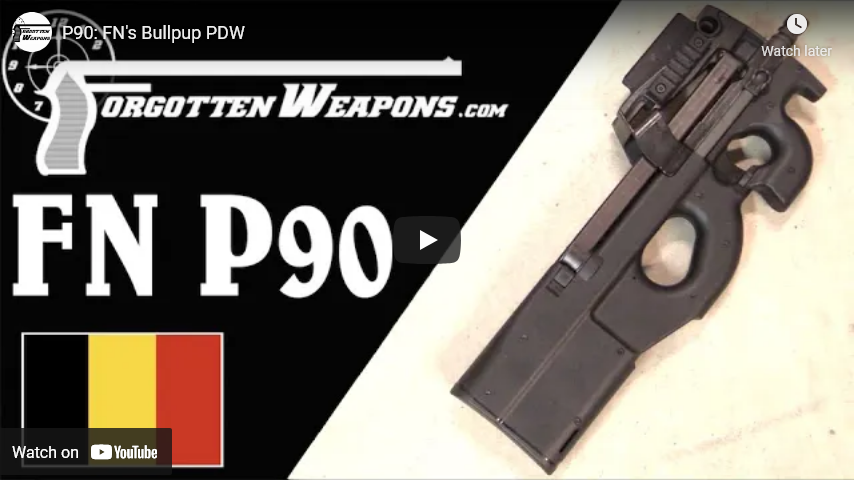
Personal Defense Weapon: (1) Armor-piercing or (2) holsterable submachine gun, not intended for front line combat. For example, FN P90, H&K MP7, Czech vz.61 Skorpion, Polish PM63 Rak.
If you enjoy Forgotten Weapons, check out its sister channel, InRangeTV! http://www.youtube.com/InRangeTVShow
May 14, 2021
QotD: Gun safety
The really hard part about firearm safety is that they’re Schrodinger devices. Every firearm is both loaded and unloaded at the same time.
When you need them to be unloaded, they have a bullet in the chamber, ready to fire.
When you really need one to be loaded, they make that really sad “click” which tells you you need more ammo.
Chad Irby, posted to the comments at Wizbang, 2005-03-10. (original link had gone stale … updated with current archive link).