Quotulatiousness

August 17, 2021

Opening Battles of the Franco-Prussian War: Saarbrücken, Wissembourg, Wörth I GLORY & DEFEAT Week 4

Filed under: France, Germany, History, Military — Tags: , , , , , — Nicholas @ 04:00

realtimehistory
Published 5 Aug 2021

Support Glory & Defeat: https://realtimehistory.net/gloryandd…

Early August 1870 saw the first series of opening battles of the Franco-Prussian War. The Battle of Saarbrücken was the only battle of the entire war fought on German soil, the following Battle of Wissembourg, the Battle of Wörth and the Battle of Spicheren happened right after and gave a glimpse of the carnage to come.

» THANK YOU TO OUR CO-PRODUCERS
John Ozment
James Darcangelo
Jacob Carter Landt
Thomas Brendan

» OUR PODCAST
https://realtimehistory.net/podcast – interviews with historians and background info for the show.

» LITERATURE
Arand, Tobias: 1870/71. Die Geschichte des Deutsch-Französischen Krieges erzählt in Einzelschicksalen. Hamburg 2018

Bourguinat, Nicolas/Vogt, Gilles: La guerre franco-allemande de 1870. Une histoire globale. Paris 2020

Gall, Lothar (Hrsg.): Deutschland Archiv. Deutsche Geschichte in Dokumenten. O.O., o. J. (2007)

Mährle, Wolfgang: “Das württembergische Heer im Deutsch-Französischen Krieg 1870/71“, in: Nation im Siegesrausch. Württemberg und die Gründung des Deutschen Reichs 1870/71, hrsg.v. Wolfang Mährle. Stuttgart 2020. S. 45-64.

Milza, Pierre: L’année terrible. La guerre franco-prussienne septembre 1870 – mars 1871. Paris 2009

Roux, Georges: La Guerre de 1870. Paris 1966

» SOURCES
Bazaine, François-Achille: Episoden aus dem Krieg von 1870 und der Belagerung von Paris. Berlin 1884

Chuquet, Arthur: La guerre 1870/71. Paris 1895

Engel, o.V.: Die Verluste der deutschen Armeen an Offizieren und Mannschaften im Kriege gegen Frankreich 1870 und 71. Berlin 1872

Engels, Friedrich: Der Deutsch-Französische Krieg. Sechzig Artikel aus der ‘Pall Mall Gazette’. Berlin (Ost) 1957

Goncourt, Edmond de: Journal. Bd. 5. 1869-1872. Leipzig 2013

Henderson, George: The battle of Spicheren, August 6th 1870, and the events that preceded it – a study in practical tactics. London 1891

Klein, Karl: Fröschweiler Chronik. Kriegs- und Friedensbilder aus dem Jahre 1870/71. Illustrierte Jubelausgabe. München 1897

Kriegsgeschichtliche Abtheilung des Großen Generalstabs (Hg.): Der deutsch-französische Krieg 1870/71. Erster Theil. Erster Band. Berlin 1874

Kühnhauser, Florian: Erinnerungen eines Soldaten des königlich bayerischen-Infanterie-Leib-Regiments. Partenkirchen 1898

Le Faure, Amédée: Atlas de la guerre 1870/71. Paris 1875

Meisner, Heinrich Otto (Hrsg.): Kaiser Friedrich III. Das Kriegstagebuch von 1870/71. Berlin, Leipzig 1926

Pietsch, Ludwig: Von Berlin bis Paris. Kriegsbilder 1870-1871. Berlin 1871

» OUR STORE
Website: https://realtimehistory.net

»CREDITS
Presented by: Jesse Alexander
Written by: Cathérine Pfauth, Prof. Dr. Tobias Arand, Jesse Alexander
Director: Toni Steller & Florian Wittig
Director of Photography: Toni Steller
Sound: Above Zero
Editing: Toni Steller
Motion Design: Philipp Appelt
Mixing, Mastering & Sound Design: http://above-zero.com
Maps: Battlefield Design
Research by: Cathérine Pfauth, Prof. Dr. Tobias Arand
Fact checking: Cathérine Pfauth, Prof. Dr. Tobias Arand

Channel Design: Battlefield Design

Contains licensed material by getty images
All rights reserved – Real Time History GmbH 2021

August 16, 2021

French and German Armies in 1870 – Dreyse and Chassepot Rifle Overview I GLORY & DEFEAT Week 3

Filed under: France, Germany, History, Military, Weapons — Tags: , , , , — Nicholas @ 04:00

realtimehistory
Published 29 Jul 2021

Sign up for Curiosity Stream and get Nebula bundled in and SAVE 26%: https://curiositystream.com/realtimeh…

While the French and different German Armies are gathering we are taking the time this week to take a look at military organization and warfare in 1870. As a special guest we also have Cap And Ball on the show who introduces the famous Chassepot and Dreyse rifles which will be important in this conflict.

» THANK YOU TO OUR CO-PRODUCERS
John Ozment
James Darcangelo
Jacob Carter Landt
Thomas Brendan

» OUR PODCAST
https://realtimehistory.net/podcast – interviews with historians and background info for the show.

» LITERATURE
Arand, Tobias: 1870/71. Die Geschichte des Deutsch-Französischen Krieges erzählt in Einzelschicksalen. Hamburg 2018
Delpérier, Louis; Mirouze, Laurent: Der Deutsch-Französische Krieg 1870/71. Bd. 2. Uniformierung und Ausrüstung der französischen Armeen. Wien 2020
Herre, Franz: Kaiser Wilhelm I. Der letzte Preuße. Köln 1980
Milza, Pierre: L’année terrible. La guerre franco-prussienne. Septembre 1870 – mars 1871. Paris 2009
Stein, Markus; Bauer, Gerhard: Der Deutsch-Französische Krieg 1870/71. Bd. 1. Uniformierung und Ausrüstung der deutschen Armeen. Wien 2020

» SOURCES
Fontane, Theodor: Der Krieg gegen Frankreich. Bd. 1. Berlin 1873
Kriegsgeschichtliche Abtheilung des Großen Generalstabs (Hg.): Der deutsch-französische Krieg 1870/71. Erster Theil. Erster Band. Berlin 1874
Pflugk-Harttung, Julius: Krieg und Sieg 1870-1871. Bd. 2 Berlin 1896

» OUR STORE
Website: https://realtimehistory.net

»CREDITS
Presented by: Jesse Alexander
Written by: Cathérine Pfauth, Prof. Dr. Tobias Arand, Jesse Alexander
Director: Toni Steller & Florian Wittig
Director of Photography: Toni Steller
Sound: Above Zero
Editing: Toni Steller
Motion Design: Philipp Appelt
Mixing, Mastering & Sound Design: http://above-zero.com
Maps: Battlefield Design
Research by: Cathérine Pfauth, Prof. Dr. Tobias Arand
Fact checking: Cathérine Pfauth, Prof. Dr. Tobias Arand

Channel Design: Battlefield Design

Contains licensed material by getty images
All rights reserved – Real Time History GmbH 2021

August 15, 2021

Denel NTW 20: A Multi-Caliber Anti-Materiel Rifle

Filed under: Africa, Military, Weapons — Tags: , , , , — Nicholas @ 02:00

Forgotten Weapons
Published 7 Sep 2018

http://www.patreon.com/ForgottenWeapons​

Cool Forgotten Weapons merch! http://shop.bbtv.com/collections/forg…​

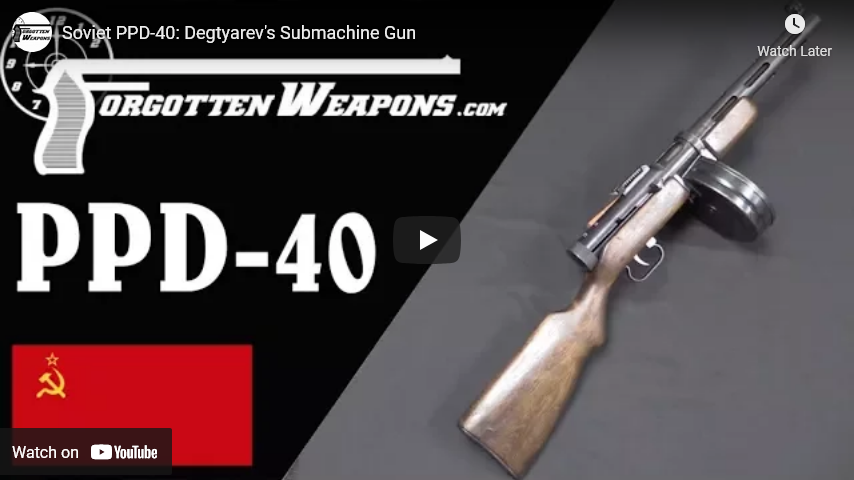
Created by noted South African gun designer Tony Neophytou, the NTW-20 is a bolt action anti-materiel rifle made in 20x82mm, 20x110mm, and 14.5x115mm. The weapon began as idea to use the large quantities of surplus 14.5mm ammunition available at the time, and a recognition that the 14.5mm Soviet cartridge was an excellent anti-armor round, with a really remarkably high muzzle velocity. To widen the rifle’s capabilities, it was decided to incorporate an easily interchangeable barrel, and also chamber it for the 20x82mm round used in the Inkunzi PAW individual weapon and Inkunzi Strike machine gun. The 20x82mm is low velocity compared to traditional 20mm cartridges, carrying the same explosive or incendiary payload but without the punishing recoil of what was originally an aircraft cannon cartridge.

Both of these cartridges are fed from a 3-round box magazine on the left side of the action. A single-shot version in the longer 20x110mm cartridge was also developed by request of a military client, but this cartridge is too long to fit the magazine. A version in .50 BMG was considered, but decided against on the basis of the 14.5mm being just as available and substantially more effective.

The gun is liberally sprinkled with clever engineering and design features — things like using the recoil-absorbing travel of the action to recock the hammer, and the use of both 20mm and 14.5mm cartridge cases as levers for unlocking the barrel. The optic was custom made for the rifle, an 8x56mm long eye relief scope to prevent any chance of the scope bell injuring the shooter during recoil. The trigger mechanism uses only a single spring, and is easily removed from the action. The bolt handle itself is on a pivot pin, and provides the primary extraction leverage to ensure easy cycling with the high-pressure 14.5mm cartridge.

From a military perspective, the NTW-20 is easily broken apart into barrel and action loads, and can be transported more easily than any comparable weapon by a two-man team. The use of a recoil buffer in the action and an effective muzzle brake makes it a remarkably pleasant 20mm rifle to fire. Of all the anti-material rifles I have fired (Lahti L39, Solothurn S18-1000, Mauser T-Gewehr), the NTW-20 was by far the most comfortable to shoot. It was also the only one in which I jumped at the chance to fire more rounds once the filming needs were met. It certainly has a kick, but not at all a painful one.

Many thanks to Denel Land Systems for allowing me to try out this very cool rifle!

If you enjoy Forgotten Weapons, check out its sister channel, InRangeTV! http://www.youtube.com/InRangeTVShow
August 14, 2021

Infantry Weapons at Guadalcanal – WW2 Special

Filed under: History, Japan, Military, Pacific, USA, Weapons, WW2 — Tags: , , , , , , , — Nicholas @ 04:00

Update: The folks at the World War Two channel have taken down this video due to technical errors in the script. Here’s their explanation.

World War Two
21 hours ago
Video on Infantry Arms at Guadalcanal retracted. Indy explains why:

Hi everyone. Indy here. As most of you know, I do the research and writing for all of the regular weekly episodes here. I host many of the specials as well, though I do not do the research for most of them- occasionally so, if it’s something that’s really in my field of expertise, like geopolitics, strategy, personal stories, communications, and international relations. The research for the other specials is done by a variety of specialists in their fields or historians, so we can maintain the quality you’ve come to expect from us. I understand, though, that many of you have serious issues with the research for the Guadalcanal infantry special. Our apologies for that- the research was done by an historian, a PhD [student], actually, and we also ensured it was double fact-checked, but obviously some serious mistakes slipped through. Live and learn. I will say that I think it is important that you continue to tell us when you take issue with something we present, since we strive to make the most complete and accurate documentary series possible, so although some of them are hard to read we appreciate such feedback from our community.

And this is from the researcher who worked on the script:

Marlon Londoño
18 hours ago
Hey guys! This is Marlon, the PhD student in question who helped with the researching and writing of the episode. Just to give a little background, I’m a volunteer researcher who helps with the channel over the summer while I’m not teaching/researching/taking coursework. I’m a military historian and my main academic focus is on social and cultural military history (i.e. what people’s wartime experiences were like and why. I’m especially interested in how people justify wartime violence and oftentimes the types of weapons they use play a role in that mental process, so that’s the context in which I usually think about weapons on the battlefield).

I’m sorry that I let a lot of you down with the mistakes about the Garand and Arisaka, among others. To be honest, I was surprised to learn they were myths. But I certainly know now, and I don’t think I’ll be forgetting any time soon 😅 One thing that I firmly believe as a researcher and educator is that nobody has a monopoly on the truth, least of all me. I tell that to my students on the first day of class each semester. I certainly don’t presume that the degree I’m pursuing makes me infallible or instantly qualified for anything. And this was a classic example of just how wrong I can be sometimes!

For what it’s worth, I love war history just as much as anyone else in the community, and I’m sorry that my research wasn’t as rigorous as it might otherwise have been. I hope you all might be willing to give any future episodes of mine a second chance, and of course I’m all ears for any mistakes that you want to point out!

August 12, 2021

FN CAL: Short-Lived Predecessor to the FNC

Filed under: Europe, History, Military, Weapons — Tags: , , , , — Nicholas @ 02:00

Forgotten Weapons
Published 4 Jan 2019

http://www.patreon.com/ForgottenWeapons​

Cool Forgotten Weapons merch! http://shop.bbtv.com/collections/forg…​

The CAL (Carabine Automatique Leger; Light Automatic Carbine) was FN’s first attempt to produce a 5.56mm rifle as a counterpart to the 7.62mm FAL. While light and handy, the CAL was a relatively complex and expensive design, and failed to garner many sales. About 12,000 were made in total before FN pulled the gun in favor of the FN FNC, which would prove to be much more successful.

Contact:
Forgotten Weapons
PO Box 87647
Tucson, AZ 85754

August 8, 2021

Australia’s FAL-Based L2A1 Heavy Automatic Rifle

Filed under: Australia, Britain, Cancon, History, Military, Weapons — Tags: , , , , , — Nicholas @ 02:00

Forgotten Weapons
Published 21 Apr 2021

http://www.patreon.com/ForgottenWeapons​

https://www.floatplane.com/channel/Fo…​

Cool Forgotten Weapons merch! http://shop.forgottenweapons.com

Many the nations that adopted the FAL (or L1A1, in Commonwealth terminology) opted to also use a heavy-barreled variant of the same rifle as a light support weapon. In the Commonwealth, this was designated L2A1 and it was used by Canada, Australia, and New Zealand. The Australian model was build at Lithgow and supplied to the Australian and New Zealand forces, as well as being exported to a variety of other nations including Ghana, India, Singapore, Malaysia, Papua New Guinea, and others (total Lithgow production was 9,557). It has a 21″ heavy barrel and a distinct folding bipod with wooden panels that act as handguard when the bipod is folded up. Doctrinally, the L2A1 was intended to be used in semiauto most of the time, with the bipod and heavy barrel allowing greater sustained semiauto fire than a standard rifle.

A 30-round magazine was developed and issued, but abandoned before long. It was found to be insufficiently reliable, interfered with prone shooting, and contributed to overheating of the guns. Interestingly, Australia also opted to not have an automatic bolt hold open functionality in their FAL type rifles. The control can be used manually, but the rifle does not lock open when empty. This was presumably done in favor of keeping the action closed and clean at the expense of slower reloading (the same compromise was made on the G3 family of rifles).

This particular example is a registered transferrable machine gun made on a Lithgow receiver imported by Onyx in 1985 with other Lithgow-produced parts, including a 1960 bolt, 1961 carrier, and 1961 lower receiver from an L1A1 originally exported to Malaysia.

Contact:
Forgotten Weapons
6281 N. Oracle 36270
Tucson, AZ 85740

August 5, 2021

Gordon Ingram’s Westarm .308 Battle Rifle

Forgotten Weapons
Published 2 Apr 2021

http://www.patreon.com/ForgottenWeapons​

https://www.floatplane.com/channel/Fo…​

Cool Forgotten Weapons merch! http://shop.bbtv.com/collections/forg…​

In the late 1970s and early 80s, Gordon Ingram came close to producing a military rifle in one of the most convoluted international arrangements I’ve yet heard of. Prototypes were made in Italy using British raw castings, to be tested in Somalia as part of a project to build a rifle factory there with Dominican Republic expertise from the San Cristobal armory. Somalia actually ordered a large quantity of rifles in 7.62x39mm, but Ingram prototyped the design in .223 and .308 as well.

Mechanically, the rifle was essentially a scaled-up M1 Carbine with a long stroke gas piston instead of a gas tappet. The production guns were select-fire, but the handful or prototypes brought into the US were semi-automatic only, to meet import requirements. In .308, the rifle used FAL magazines, while the .223 ones used AR magazines and the 7.62x39mm ones AK magazines.

Unfortunately for Ingram (but predictably), the project fell apart as the result of financial corruption among the many interested parties. The Somali government ended up paying out something like $5 million US and all they got for it were 10 unreliable prototype rifles.

Contact:
Forgotten Weapons
6281 N. Oracle 36270
Tucson, AZ 85740

August 2, 2021

Who is Colt? A History of the Colt Patent Firearms Manufacturing Company

Filed under: Business, History, USA, Weapons — Tags: , , , , , , — Nicholas @ 02:00

Forgotten Weapons
Published 23 Feb 2017

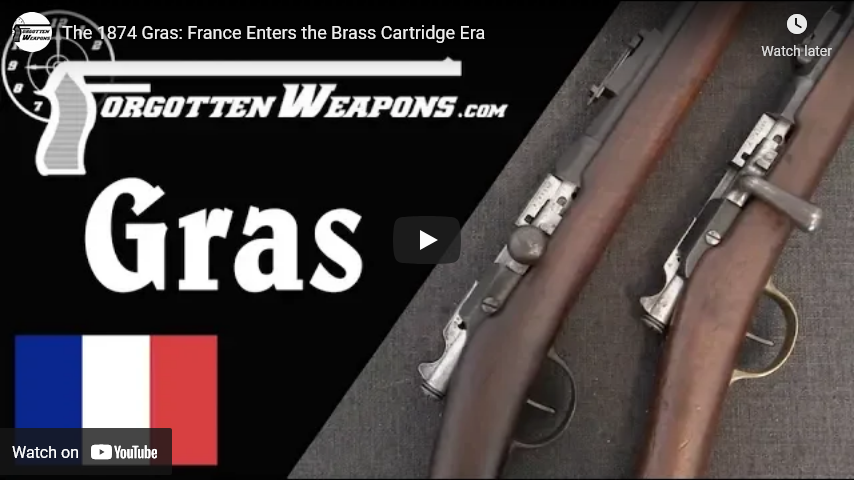
Today we will take a look at the history of the Colt company, from Sam Colt’s first efforts in Paterson (and before) to the West Hartford remnants that survive today. If you enjoy this type of history, please let me know in the comments!

http://www.patreon.com/ForgottenWeapons

Cool Forgotten Weapons merch! http://shop.bbtv.com/collections/forg…​

If you enjoy Forgotten Weapons, check out its sister channel, InRangeTV! http://www.youtube.com/InRangeTVShow
Gun display racking provided by Matrix Armory: http://www.matrixarmory.com

July 29, 2021

MAT 49: Iconic SMG of Algeria and Indochina

Filed under: France, History, Military, Weapons — Tags: , , , , — Nicholas @ 02:00

Forgotten Weapons
Published 16 Jan 2018

http://www.patreon.com/ForgottenWeapons​

Cool Forgotten Weapons merchandise! http://shop.bbtv.com/collections/forg…​

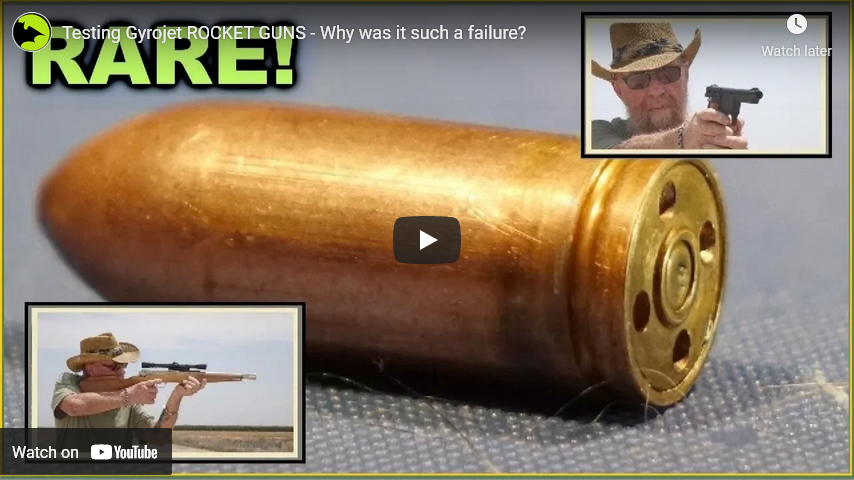
The MAT-49 was developed by France after World War Two to satisfy the need for a more modern submachine gun to replace the MAS-38. The military had come around to standardizing on the 9x19mm cartridge for its pistols and subguns, and the 7.65mm MAS-38 was not feasible to convert. All three state arsenals and the Hotchkiss company submitted designs, and the Tulle arsenal won out with a gun that borrows substantially from the American M3 “Grease Gun”.

About 700,000 MAT-49s were produced between 1949 and 1979, when it (along with the MAS 49/56 rifle) was replaced by the FAMAS bullpup rifle. During that time it saw substantial combat in France’s colonial wars, notable Algeria and Indochina. Despite being a relatively heavy weapon, it came to be well liked by all who used it for its durability and reliability.

Many thanks to the anonymous collector who let me take a look at this piece and bring you a video on it!

If you enjoy Forgotten Weapons, check out its sister channel, InRangeTV! http://www.youtube.com/InRangeTVShow
July 25, 2021

Russian Type 2 AK: Introducing the Milled Receiver

Filed under: History, Military, Russia, Weapons — Tags: , , , — Nicholas @ 02:00

Forgotten Weapons
Published 8 Jul 2018

http://www.patreon.com/ForgottenWeapons​

Cool Forgotten Weapons merch! http://shop.bbtv.com/collections/forg…​

Updated to fix errors in nomenclature and production dates.

With recognition of the production problems of the original Type 1 AK, an alternative was needed. Russian engineer Valeriy Kharkov led a team of engineers who designed a replacement drop-forged and machined receiver for the AK. This new receiver was not a technical challenge for Izhevsk to produce, and it added durability and potentially accuracy to the weapon, at the cost of an additional pound (half kilo) of weight and more manufacturing time/expense.

The Type 2 AK is distinctive for its rear socket used to attach the buttstock, which was done to simplify the receiver profile and to allow the same receiver to be used for both fixed and underfolding stocks. The Type 2 receiver also has a weight reduction scalloped cut on the right side which is parallel to the top surface of the receiver (on the later Type 3, this cut would be made parallel to the bottom of the receiver instead) as well as a few other smaller features.

While the Type 2 receiver solved the immediate problem for Kalashnikov’s team, it would only be in production for a short time. Introduced in 1951, production ceased in 1957, being replaced by an improved iteration of milled receiver, the Type 3, in 1955. The Type 3 would remain in production until the stamped receiver was finally perfected as the AKM in 1959, and the Type 3 would be produced by a significant number of nations outside the Soviet Union.

Today, the second pattern AK is an very rare weapon, and I am grateful to the private collector who allowed me to video this one for you!

If you enjoy Forgotten Weapons, check out its sister channel, InRangeTV! http://www.youtube.com/InRangeTVShow
Contact:
Forgotten Weapons
6281 N Oracle #36270​
Tucson, AZ 85704

July 22, 2021

Type 1 Russian AK: The First Production Stamped AK (Updated)

Filed under: History, Military, Russia, Weapons — Tags: , , , , — Nicholas @ 02:00

Forgotten Weapons
Published 8 Jul 2018

http://www.patreon.com/ForgottenWeapons​

Cool Forgotten Weapons merch! http://shop.bbtv.com/collections/forg…​

Updated to fix errors of nomenclature and production dates.

The AK was formally adopted in 1947, and went into production in 1948. In this very first form, it used a stamped receiver with front and rear trunnions riveted in place. Unfortunately, while the hand-fitted preproduction guns were quite excellent, the manufacturing processes and quality control left a lot to be desired. The stamped receiver was relatively thin (especially compared to previous stamped Russian small arms like the PPS-43), and was very susceptible to warping during heat treating and other parts of the manufacturing process. The guns that met QC requirements were every bit as good as expected, but the high number of rejects nullified much of the point of having those stamped parts in the first place.

For this reason, Type 1 AK production ended in 1951, and a milled receiver was developed to allow rifles to continue being made while the engineering and production team worked to improve the receiver design and the manufacturing processes around it.

It should be noted that the “AK-47” was the final prototype version of the gun, and the Type 1 was designated simply “AK” in official Soviet documentation.

Today, the first pattern AK47 is an extremely rare weapon, and I am grateful to the private collector who allowed me to video this one for you!

If you enjoy Forgotten Weapons, check out its sister channel, InRangeTV! http://www.youtube.com/InRangeTVShow​

Contact:
Forgotten Weapons
6281 N Oracle #36270​
Tucson, AZ 85704

July 19, 2021

Luxembourg FN49 Semiauto Sniper Rifle

Filed under: Europe, History, Military, USA, Weapons — Tags: , , , , — Nicholas @ 02:00

Forgotten Weapons
Published 30 Jan 2019

http://www.patreon.com/ForgottenWeapons​

Cool Forgotten Weapons merch! http://shop.bbtv.com/collections/forg…​

After World War Two, Luxembourg was one of the nations which opted to purchase new FN-49 rifles. It bought a total of 6,203 of them for the military — an initial purchase of 4,000 semiauto SAFN rifles and a followup purchase of 2,000 AFN select-fire rifles and 203 semiauto rifles fitted with Belgian OIP telescopic sights. The scope mounts were commercial Echo mounts, designed and manufactured by an American engineer named Herkner, in Boise Idaho.

When Luxembourg replaced its FN49 rifles with the newer FN FAL type, the snipers were either scrapped or sold as surplus, but the scopes were kept and reused on FALs. However, the Luxembourg rifles used the same pattern OIP scopes as the Belgian military, and these are often found mounted to surviving Luxembourg rifles.

Contact:
Forgotten Weapons
PO Box 87647
Tucson, AZ 85754

July 17, 2021

QotD: “Magic” bullets

Filed under: Business, Humour, Quotations, Technology, USA, Weapons — Tags: , , , — Nicholas @ 01:00

As I write this, another wave of ballistic hyperbole is sweeping across the Internet. There’s a new bullet out! It sets the paradigm on its ear! Gun owners are drooling for this, the last bullet you’ll ever need! Blah, blah, blah, yakkity-shmakkity.

Stick around long enough and you’ll notice this phenomenon happen every few years. You’re sitting there, minding your own business, and the next thing you know, friends from work or church or the book club who know you as “The Gun Expert” are coming up to you and asking about this bullet that’s being hyped in the mainstream media as either the surest felon-stopper since Wyatt Earp or the biggest menace to society since John Dillinger.

It’s rare for something as esoteric as a projectile design to come to the attention of the non-gun press. Generally, for that to happen, it takes one of two things: either a mainstream manufacturer made an unusually poor PR choice in the bullet naming *cough*BlackTalon*cough*, or someone has launched a buzzword-laden press release with all the discrimination of a desert island dweller putting notes in bottles.

[…]

When a new Magic Bullet is launched and makes media waves, I always apply two filters as to whether it’s worth chasing down. The first filter is “Are the police using this?” This is not necessarily because I think that the police are all-that-and-a bag-of-chips in the gear-selection department, but they’ve generally been okay with bullets for the last 15 or 20 years and, should I ever have to justify my choice of rounds in a courtroom, it would be nice to be able to say “You, alright! I learned it by watching you!” like the kid in the commercial.

The second filter? The second filter is “Is this cartridge sold in six-round blister packs with pictures of explosions and rappelling ninjas on them?” Because if it is, well, I’m just not Operator enough.

Tamara Keel, “No Magic Bullet”, GunsAmerica Digest, 2018-11-27.

July 16, 2021

Rhodesian FAL – with Larry Vickers

Filed under: Africa, History, Military, Weapons — Tags: , , , , , , — Nicholas @ 02:00

Forgotten Weapons
Published 1 Jul 2018

http://www.patreon.com/ForgottenWeapons​

Cool Forgotten Weapons merch! http://shop.bbtv.com/collections/forg…​

The iconic weapon of the Rhodesian Bush War is the FN-FAL, painted in a distinctive “baby poop” yellow and green pattern. Because Rhodesia was under international embargo, its options for obtaining weapons were limited. Some domestic production was undertaken, but one large source was neighboring South Africa. Both South African production FALs and also Belgian-made South African contract FALs were provided. This rifle is one of the latter, with the South African crest and proof marks defaced for some theoretical deniability should it be scrutinized.

Larry Vickers will talk us through this FAL, pointing out the different elements that are distinctly Rhodesian, as well as the unique Halbeck Device — and detachable muzzle brake.

Thanks to Larry for sharing this rifle with us!

If you enjoy Forgotten Weapons, check out its sister channel, InRangeTV! http://www.youtube.com/InRangeTVShow​
Contact:
Forgotten Weapons
6281 N Oracle #36270​
Tucson, AZ 85704

July 12, 2021

Shooting the Ishapore MkIII Vickers-Berthier LMG

Filed under: History, India, Military, Weapons, WW2 — Tags: , , — Nicholas @ 02:00

Forgotten Weapons
Published 20 Sep 2017

http://www.patreon.com/ForgottenWeapons

Cool Forgotten Weapons merch! http://shop.bbtv.com/collections/forg…​

The Vickers-Berthier MkIII was adopted by the Indian army in 1933, and served through World War Two and into the 1970s (at least). It is chambered for the standard .303 British cartridge, fires from an open bolt, and uses top-mounted 30-round magazines. I didn’t know exactly what to expect when I had the chance to fire this one — and it turned out the be an excellent experience.

The rate of fire on the Vickers-Berthier is relatively low, and I found it to be an exceptionally stable and controllable gun to fire from its bipod. I don’t know if it’s the unusual muzzle brake design or other factors as well, but the sight picture remains stable and clear in a way that few other LMGs have matched in my experience.

Thanks to Marstar for letting me examine and shoot their Vickers-Berthier!

If you enjoy Forgotten Weapons, check out its sister channel, InRangeTV! http://www.youtube.com/InRangeTVShow
« Newer PostsOlder Posts »

Powered by WordPress