To very loosely paraphrase a big city major crimes detective of my acquaintance who has investigated more than a few of these sorts of incidents, most of the time someone is in your house, it’s because they think you aren’t. (I mean, unless you live the sort of life where you have targeted assassination squads after you, and I’m afraid that that sort of thing is way, way outside of my lane.)
Lying silently in wait in the dark for someone to shoot is practically a recipe for starring in a Claude Werner blog post. Your house is not a free-fire zone, and you are not laying ambushes for Charlie on the Ho Chi Minh trail.
Even if it is a bad guy and not a family member, pet, or drunk neighbor, ensconcing oneself in a safe position, dialing 911, and loudly announcing that you have a gun and have called the cops is likely to save money for carpet cleaning bills and legal fees.
A friend quipped “What, and no advice to drag the body inside?”, which was funny, but … y’know what? I got to thinking about that, and this is even worse advice than that.
“Jes’ drag ’em inna house” is something that most non-dumb people who have watched some TV police procedurals can suss out for themselves as bad advice. It trips the BS detectors of all but the most inept.
But this? This sounds like plausible advice because it sounds like how “bad guy in the house” scenarios play out in Hollywood. The bad guy is never a tweaker who’s after a watch and some jewelry and who bolts when they realize the homeowner is there and armed. (It’s also never the homeowner’s husband home a day early from a business trip.) It’s always some elite killer team or serial murderer who’s there specifically to get the homeowner. And why wouldn’t you want to hide and ambush those guys?
Tamara Keel, “Rules of Engagement”, View From The Porch, 2019-03-27.
May 19, 2022
QotD: “Rules of engagement” for home intruder drills
May 18, 2022
L119A2: The New British SOF Rifle
Forgotten Weapons
Published 24 Jan 2022http://www.patreon.com/ForgottenWeapons
https://www.floatplane.com/channel/Fo…
Cool Forgotten Weapons merch! http://shop.forgottenweapons.com
Around 2013, the UK MoD began looking for a new rifle to replace the Special Forces’ L119A1. Those A1 rifles were getting old, and something new was needed — and there was some thought that a new rifle could improve on some shortcomings of the A1 model. The new rifle was produced by Colt Canada (formerly Diemaco), and it was procured in both 10″ and 15.7″ barrel lengths (note that the rifle in this video has a 16″ barrel to avoid being an SBR).
The most distinctive feature of the new L119A2 was the licensed LMT monolithic upper receiver. This was used because it allowed solid mounting of devices like lasers on the side rails. However, it had major shortcomings in terms of heat retention and cleanability. The A2 also now used a MagPul CTR stock, and Geissele triggers (an excellent improvement from the A1’s MILSPEC trigger). The same Surefire suppressors were used, as were the optics from the A1s — the new A2 tender did not include new optics (nor funding for them).
Very few photos are known showing the L119A2. It came into service around 2016 or 2017, and entered public awareness after Christian Craighead was photographed using one in the Nairobi Westlands mall siege in 2019.
Contact:
Forgotten Weapons
6281 N. Oracle 36270
Tucson, AZ 85740

May 14, 2022
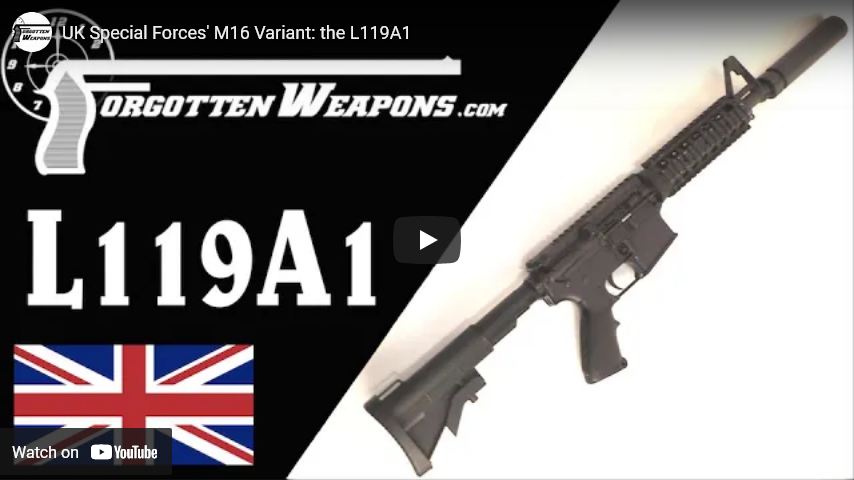
UK Special Forces’ M16 Variant: the L119A1
Forgotten Weapons
Published 21 Jan 2022http://www.patreon.com/ForgottenWeapons
https://www.floatplane.com/channel/Fo…
Cool Forgotten Weapons merch! http://shop.forgottenweapons.com
—
UPDATE: One correction to make; this rifle has the A2 charging handle. The original A1 version was essentially identical to the standard conventional charging handle. Sorry!
—In 1999, the UK Ministry of Defense put out a tender for a new rifle for UK Special Forces (UKSOF). The elite units of the British military were definitely not going to be using the L85! There was some competition (including the SIG 550 series), but it was pretty much known going in that the contract would be going to Diemaco (later Colt Canada) for a version of their C8 SFW (“Special Forces Weapon”). That was the case, but only after very extensive trials, which actually cost more than the procurement contract itself. The rifles were tested in all environmental extremes, including Alaska, Kuwait, and Brunei.
The rifle ultimately adopted had a number of unique features. It was at heart a Diemaco C8, with Diemaco’s early flat top upper (which predates Picatinny adoption, and is actually a bit closer to Weaver — but still compatible with modern accessories). Two barrel lengths were purchased, 10.0 inch and 15.7 inch. Other details include:
Stepped buffer tube
Textured telescoping stock
Permanently attached rubber buttplate
Lone Star grip
Knight’s RAS with locking clamps on both top and bottom rails
Strengthened gas block (usually but not always)
SureFire 216-A flash hider
Unique castle nut details
Ambidextrous charging handleThe barrel profile chosen for the L119A1 is quite heavy, and the 10 inch barreled version is substantially overgassed. The guns were heavy, but very reliable, and have since been adopted as the standard service rifle of the Royal Marines. The SOF opted to seek out a replacement around 2013-2016, and that would result in the L119A2 (a significantly different rifle).
Contact:
Forgotten Weapons
6281 N. Oracle 36270
Tucson, AZ 85740
May 11, 2022
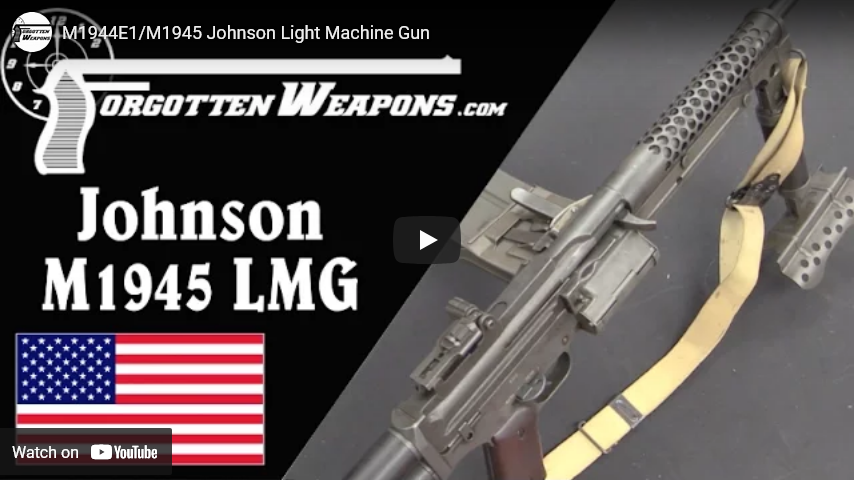
M1944E1/M1945 Johnson Light Machine Gun
Forgotten Weapons
Published 27 Aug 2016http://www.patreon.com/ForgottenWeapons
After getting his Model 1941 machine gun purchased in small numbers by the US military, Melvin Johnson continued to press for more sales and a general adoption. Following testing results and recommendations from soldiers in the field, he made a number of modifications to the gun and developed the M1944, which was quickly tweaked to become the M1944E1, also called the M1945. This new version included several improvements including:
* Replacing the bipod with a monopod less prone to interfering with barrel removal
* Improved stronger bolt anti-bounce latch
* Metal dual-tube buttstock in place of wood
* and most significantly, a gas-boosted hybrid recoil operating systemThis new model of the Johnson was in testing at the end of WWII, and weapons development budget cuts at the conclusion of the war prevented it from replacing the BAR as Johnson and many in the Marine Corps had hoped.
This particular M1945 Johnson is fully transferrable, as came out of the Winchester Museum Collection (now the Cody Firearms Museum) back many years ago when curators would occasionally sell items from the collection to raise money.
May 7, 2022
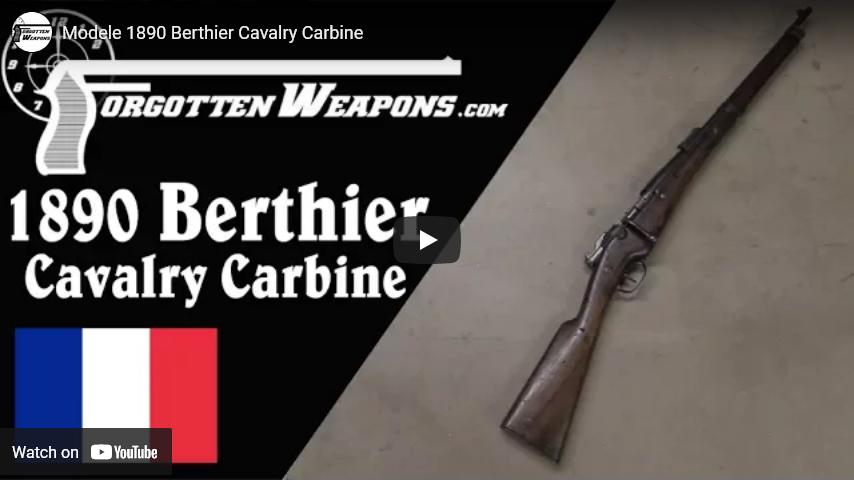
Modele 1890 Berthier Cavalry Carbine
Forgotten Weapons
Published 14 Jul 2017Get the shirt here: https://shop.bbtv.com/collections/for…
http://www.patreon.com/ForgottenWeapons
The Berthier was adopted in 1890 as a new repeating rifle for the French cavalry, who were at that time still using single shot Gras carbines. The Lebel rifle had been adopted in 1886 for the infantry, but because of its tube magazine it was not conducive to being shortened into carbine form. Andre Berthier devised a way to combine the basic action of the Lebel with the Mannlicher clip system, resulting in a light and handy repeating carbine.
The majority of these carbines were made in 1890 and 1891, and have full length stocks without any provision for bayonets (since the cavalry already had their sabers). A few more were made between 1900 and 1904, and a final order for 40,000 was placed in 1905, but it is unknown if they were actually built. Total production was either 160,000 or 200,000, depending on that last order.
It was not long into World War One when it became clear that cavalry were not suited to trench warfare, and the French cavalry units were repurposed as infantry. As a result, these cavalry carbines were rebuilt in the 1892 infantry pattern when damaged, and after the war all the surviving examples in original configuration were rebuilt as well. This makes them quite rare today in original form.
If you enjoy Forgotten Weapons, check out its sister channel, InRangeTV! http://www.youtube.com/InRangeTVShow
May 4, 2022
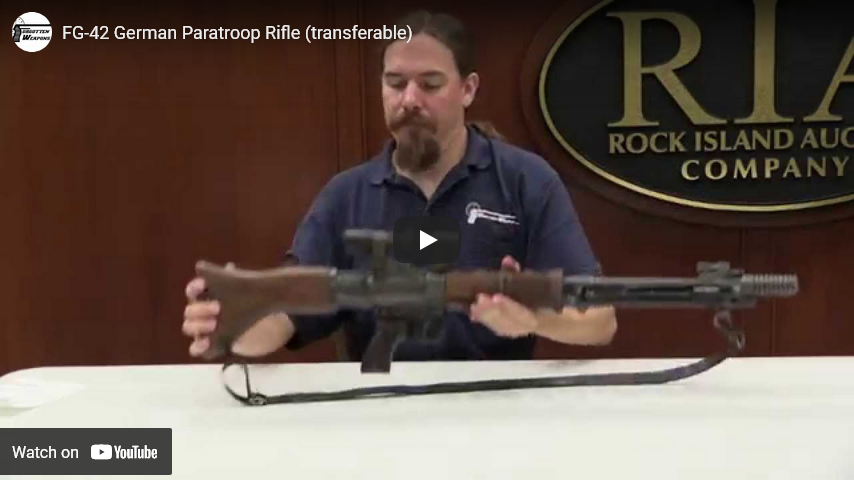
FG-42 German Paratroop Rifle
Forgotten Weapons
Published 24 Aug 2014Cool Forgotten Weapons Merch! http://shop.bbtv.com/collections/forg…
Only a few dozen of these are in private hands in the US, and they are an extremely advanced design for WWII.
Theme music by Dylan Benson – http://dbproductioncompany.webs.com
May 1, 2022
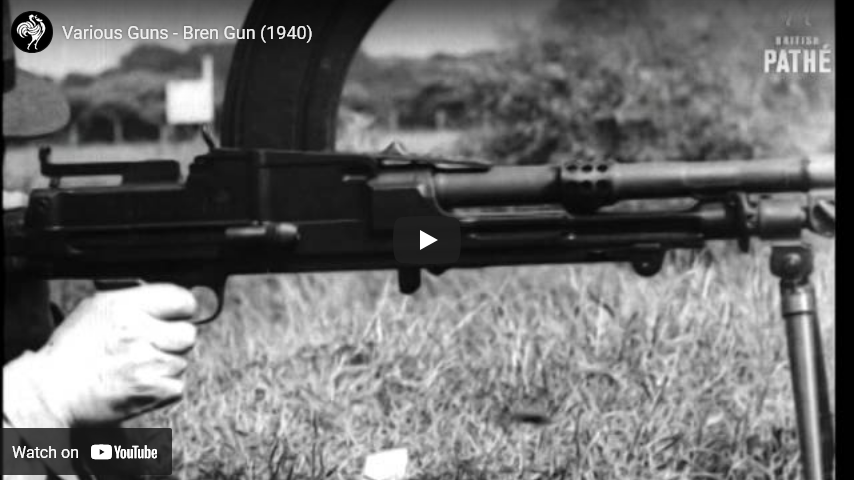
Various Guns – Bren Gun (1940)
British Pathé
Published 13 Apr 2014Various guns – Bren gun.
Item on the Bren Gun. L/S parachutists falling to earth. After seeing various machine guns of the recent past, including the Browning BAR and French Chauchat machine gun, we see the manufacture and firing of the Bren gun. There is also a diagrammatic sequence showing the workings of the gas operated machine gun.
FILM ID:1292.13A VIDEO FROM BRITISH PATHÉ. EXPLORE OUR ONLINE CHANNEL, BRITISH PATHÉ TV. IT’S FULL OF GREAT DOCUMENTARIES, FASCINATING INTERVIEWS, AND CLASSIC MOVIES. http://www.britishpathe.tv/
FOR LICENSING ENQUIRIES VISIT http://www.britishpathe.com/
British Pathé also represents the Reuters historical collection, which includes more than 136,000 items from the news agencies Gaumont Graphic (1910-1932), Empire News Bulletin (1926-1930), British Paramount (1931-1957), and Gaumont British (1934-1959), as well as Visnews content from 1957 to the end of 1984. All footage can be viewed on the British Pathé website. https://www.britishpathe.com/
April 29, 2022
QotD: The Rooftop Koreans
The year was 1992, 27 years ago right about now, and the city was Los Angeles. Several police officers who got into a videotaped brawl with a petty criminal named Rodney King were acquitted of beating him up. The city exploded. It was chaos.
I was a first-year law student, back a year from the Gulf War, and I had just joined the California Army National Guard. My unit was the 3rd Battalion, 160th Infantry, and we got called up early the first night and were on the streets for three long weeks. Making it even more delightful was the fact that the unit was in Inglewood, which was pretty much on fire. They burned most everything around, except our armory – that would have gone badly for them – and the Astro Burger.
My battalion commander grabbed then-First Lieutenant Schlichter, and we went all over the city in his humvee as he led his deployed and dispersed troops. Our soldiers came, in large part, from the areas most effected by the riots, and they were notably unpleasant to the thugs and criminals who quickly discovered our guys had no patience for nonsense. One dummy discovered that the hard way when he tried to run over some Guard soldiers from another battalion; he had a closed casket funeral.
The city went insane. Order simply ceased to exist. It was Lord of the Flies. I remember a cop totally breaking down because everything was completely out of control.
But I had a M16A1 – a real assault rifle – and I had a bunch of buddies with M16A1s. The regular folks … not so much. The decent people of LA were terrified, and with good reason. See, the dirty little secret of civilization is that it’s designed to maintain order when 99.9% of folks are orderly. But, say, if just 2% of folks stop playing by the rules … uh oh. Say LA’s population was 15 million in 1992 … that’s 300,000 bad guys. There were maybe 20,000 cops in all the area agencies then, plus 20,000 National Guard soldiers and airman, plus another 10,000 active soldiers and Marines the feds brought in. Law enforcement is based on the concept that most people will behave and that the crooks will be overwhelmed by sheer numbers of officers. But in the LA riots, law enforcement was massively outnumbered. Imposing order took time.
And until then, our citizens were on their own, at the mercy of the mob. Betting that the cavalry was going to come save you was a losing bet.
LA’s Korean shopkeepers knew that. They operated many small businesses in some of the least fashionable areas of Los Angeles, and they were already widely hated by activists, being scapegoated for problems and pathologies that long pre-dated their immigration to Southern California. So, they became targets for the mobs.
Bad decision by the mobs.
See, most of these Koreans had done their mandatory service in the Republic of Korea’s Army. Those ROK soldiers are the real deal – the Norks are not a theoretical threat and the South Korean army does not spend a lot of time talking about feelings. They were some solid dudes. So, when the local dirtbags showed up for some casual looting, they noticed the rooftops were lined with hardcore guys packing some serious heat, including the kind of scary rifles that the Democrats want to ban.
The Rooftop Koreans.
It did not take long for the bad guys to realize that the Rooftop Koreans were not playing games – they were playing for keeps. The mob went away in search of softer targets.
There’s a lesson there.
Kurt Schlichter, “Be A Rooftop Korean”, Townhall.com, 2019-05-02.
April 27, 2022
Airtronics PSRL: An American RPG (with demo shot…for real!)
Forgotten Weapons
Published 27 Dec 2021https://utreon.com/c/forgottenweapons/
http://www.patreon.com/ForgottenWeapons
Cool Forgotten Weapons merch! http://shop.forgottenweapons.com
Thanks to Jeff Folloder and Airtronics USA, I have a chance today to look at and test-fire a PSRL (Precision Shoulder-fired Rocket Launcher) — in essence, an American-made RPG-7. The rocket we are using here is a Bulgarian-made training round with an inert warhead and live booster and rocket.
Contact:
Forgotten Weapons
6281 N. Oracle 36270
Tucson, AZ 85740

April 24, 2022
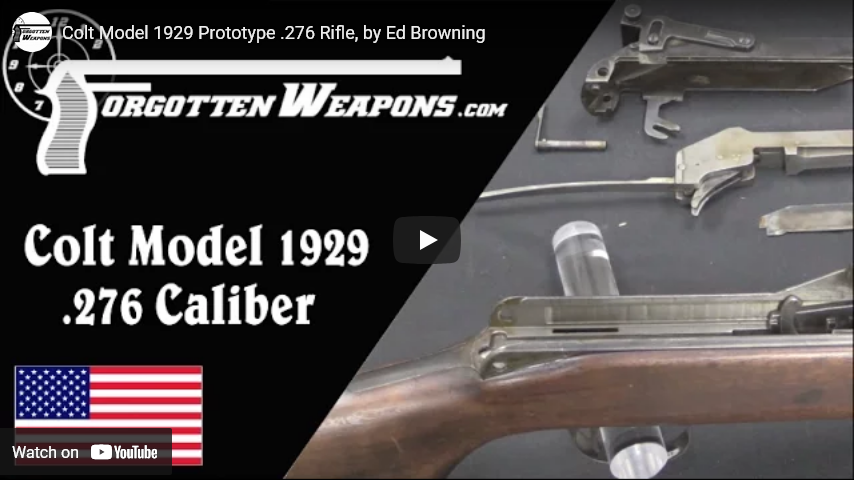
Colt Model 1929 Prototype .276 Rifle, by Ed Browning
Forgotten Weapons
Published 22 Jul 2016http://www.patreon.com/ForgottenWeapons
https://centerofthewest.org/explore/f…On October 1, 1928, the US War Department published a request for semiautomatic rifle designs. The Colt company submitted this .276 caliber rifle to the ensuing trials in 1929. It was designed by Jonathan Edward “Ed” Browning (half brother of John Moses Browning) and was a recoil-operated, tilting bolt design weighing 9lb 9oz and using 108 parts. The tilting bolt system was derived from the 1911 pistol system as designed by John Moses Browning, and the operating system also used an accelerator reminiscent of JMB’s Model 1917 and 1919 machine guns.
After the trials, the Colt 1929 rifle was deemed unfit for further testing by the Ordnance Department because of poor feeding, poor cooling ability, an overly long receiver and short barrel, too many parts, and being too heavy overall. Ed Browning would take the design back to his workshop and continue working on it, eventually replacing the short recoil operating system with an annular gas piston, and bringing it to the Winchester company in the late 1930s.
April 21, 2022
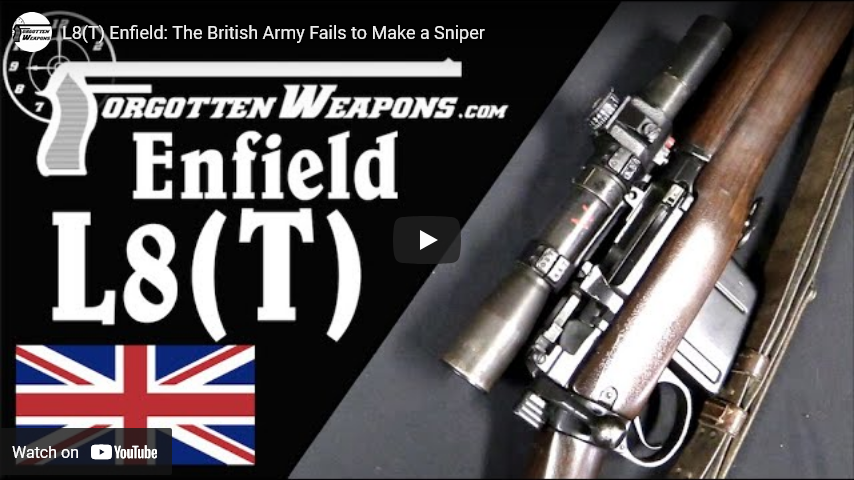
L8(T) Enfield: The British Army Fails to Make a Sniper
Forgotten Weapons
Published 14 Dec 2021http://www.patreon.com/ForgottenWeapons
https://www.floatplane.com/channel/Fo…
Cool Forgotten Weapons merch! http://shop.forgottenweapons.com
We looked at the 7.62mm conversion of the No4 Enfield into Rifle L8 yesterday. Part of that program was an attempt to develop a new sniper rifle on the L8 platform. To this end, six good-quality No4(T) Lee Enfield sniper rifles were tested for accuracy, then made into L8 rifles and fitted with No.32 telescopic sights (the standard scope from the .303 days) and tested for accuracy again. Much to the chagrin of the Army, the new L8(T) rifles were barely able to match the performance of the .303 rifles they began as. The goal was to significantly improve on the No4(T) accuracy, and that was clearly not happening.
However, at this same time, British civilian competition shooters were having excellent success making 7.62mm versions of the No4. It was only when Enfield was willing to collaborate with the British NRA and others that they were able to successfully create the L42A1 rifle, which at last met the accuracy goals of the program.
The rifle we are looking at today is one of those original six trials L8(T) rifles. Many thanks to the generous collector who allowed me to film it for you!
Contact:
Forgotten Weapons
6281 N. Oracle 36270
Tucson, AZ 85740
April 18, 2022
7.62mm Rifle L8: The Last Gasp of the Service Lee Enfield
Forgotten Weapons
Published 13 Dec 2021http://www.patreon.com/ForgottenWeapons
https://www.floatplane.com/channel/Fo…
Cool Forgotten Weapons merch! http://shop.forgottenweapons.com
After the British adopted the FAL as the L1A1 rifle, there was still an interest in converting stocks of existing No4 Enfield rifles to the new 7.62x51mm cartridge for reserve and training use. A conversion system was developed using a new barrel, bolt, and magazine — although the Sterling company was doing much the same thing at the same time and intellectual property lawsuits would close the project for nearly 10 years. By the time the lawsuits cleared up, it had become clear that the rifles were neither particularly successful nor particularly necessary anymore. The problem the British has was one of accuracy — the 7.62mm version just wasn’t sufficiently accurate. A thousand were sold to Sierra Leone, and a few more used in New Zealand and by cadet organizations in the UK, but the project was basically a failure.
Contact:
Forgotten Weapons
6281 N. Oracle 36270
Tucson, AZ 85740
April 14, 2022
Winchester M2 Rifle
Forgotten Weapons
Published 29 Jul 2016http://www.patreon.com/ForgottenWeapons
In the previous video, we looked at the Winchester G30M rifle as it was submitted to Marine Corps trials in 1940. When the trial result came back with the G30M in last place, Winchester immediately assigned David Williams to work on adapting it to resolve the problems found in testing. What Williams did was to replace the tilting bolt with a virtual duplicate of the Garand’s two-lug rotating bolt. Williams also worked to reduce the weight of the gun, and was able to bring it down to a remarkable 7.5 pounds (3.4kg).
This prototype of the rifle (which Winchester optimistically designated the M2, implying that it would supercede the M1 Garand) was actually made largely from M1 Garand forgings, as Winchester was by this time building M1 rifles on contract. The receiver, bolt, and operating rod in this rifle was converted from Garand parts. Clearly it is not a finished product, and shows many signs of being a shop prototype — but it was in this state when it was shown to Rene Studler of the Ordnance Department in early 1941. Studler was impressed by the design, but knew that it would not replace the M1 at that point. However, he urged Winchester to scale the gun down to the .30 Carbine cartridge (which Winchester had themselves developed) and submit it in the second round of the Light Rifle testing which was to happen soon.
Does a two-lug rotating bolt, short stroke gas tappet, and Garand-style operating rod sound like a familiar set of features? Well, there is good reason … Winchester took Studler’s advice, and the scaled-down version was developed in just a few weeks and proved to be the best gun in the trials. It would be developed quickly into the M1 Carbine, and become the most-manufactured semiauto rifle of WWII.
At that point Winchester would set aside the .30-06 side of this rifle design for a little while, as they had plenty of work now with M1 Garand and M1 Carbine production. But we will see the M2/G30M/G30 come back in new form in the next episode …
April 11, 2022
Book Review: Sturmgewehr! From Firepower to Striking Power (New Expanded Edition)
Forgotten Weapons
Published 17 Sep 2017Get your copy from Collector Grade Publications: http://www.collectorgrade.com/bookshe…
Collector Grade is known for being a premiere publisher of technical firearms reference books, and I would be willing to argue that Sturmgewehr! by Hans-Dieter Handrich is the best book they have yet printed. The book was originally printed in 2004, and by the time I started looking for a copy myself, it was out of print and the price had jumped to at least $250, when I could even find a copy. I could never quite bring myself to pay that much, and so I was very excited when I learned that an expanded second edition was in the works. Well, that second edition is available now, and it’s even better than I had anticipated.
What makes Sturmgewehr! such an excellent book in my opinion is how it tackles the story of the MP43/MP44/StG44 from several different angles in depth. It has the mechanical development of the gun from prewar experiments to the open-bolt MKb-42 trials guns to the production versions. But it also puts those guns in historical context, how they related to the other weapons being used by both Germany and other nations. It discusses how the design criteria of the Sturmgewehr were arrived at, in terms of logistics and manufacturing methodologies. It explains in detail the political disagreements and convoluted process of weapon design and adoption in Germany, including the three direct rejections of the concept by Hitler.
In short, it gives you the fully-rounded story of how the German military conceived and implemented a whole new class of small arms. In this way, it is really much more than just a book about a single gun’s history — what you learn reading Handrich’s work will give you insight into virtually all arms design programs of the 20th century, from the Chauchat to the 7.62mm NATO rifle trials to the SA80.
If you already have a copy of the original work, you will probably want this one as well, to get the additional 120 pages of information that have been added. And it should go without saying that if you don’t have the original, you should absolutely get a copy of this new edition before it also falls out of print!
http://www.patreon.com/ForgottenWeapons
Cool Forgotten Weapons merchandise! http://shop.bbtv.com/collections/forg…
If you enjoy Forgotten Weapons, check out its sister channel, InRangeTV! http://www.youtube.com/InRangeTVShow
April 8, 2022
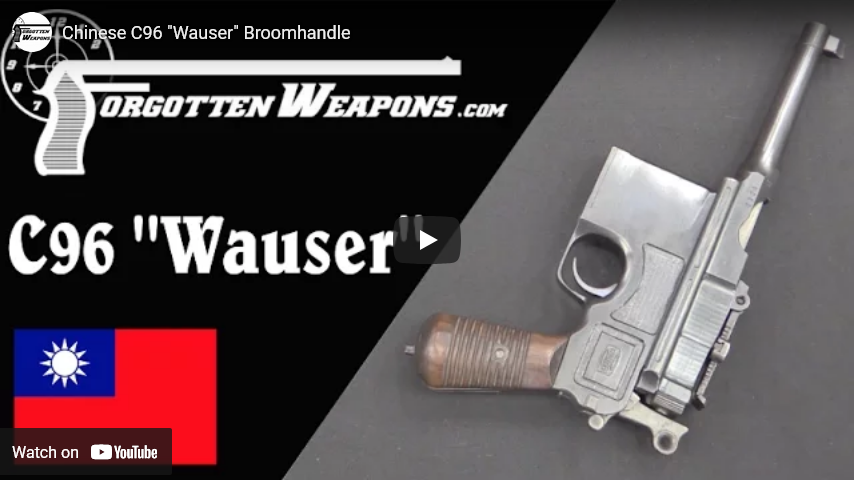
Chinese C96 “Wauser” Broomhandle
Forgotten Weapons
Published 10 Nov 2016Cool Forgotten Weapons Merch! http://shop.bbtv.com/collections/forg…
The C96 Mauser was a very popular handgun in China in the 1920s and 30s, which naturally led to a substantial number of domestically-produced copies of it. These ran the full range of quality, from dangerous to excellent. This particular example falls into the middle, appearing to be a pretty fair mechanical copy of the C96 action. However, it does exhibit classic Chinese misspelled markings — the workers who made these guns often did not actually read English (or German), and made best-guess attempts at copying the markings on authentic firearms. The result was sometimes something like the Wauser.