Quotulatiousness

January 20, 2020

Gaming India’s colonial and post-colonial history

Filed under: Britain, Gaming, History, India — Tags: , , , , , — Nicholas @ 05:00

In Quillette, Jonathan Kay looks at two wargames that deal with different aspects of Indian history:

… the peoples whom Europeans encountered in the Americas were skilled and inventive combatants who often put white men to flight (or worse) despite their enormous disadvantage in technology and (ultimately) manpower. In many cases, First Nations (as we now call them in Canada) fought fiercely with one another, too, and had well-developed military traditions that Europeans variously feared, admired and adopted. And they would make fitting protagonists for any modern boardgame designer willing to reject the current fashion of presenting indigenous peoples as holy elves of the forest.
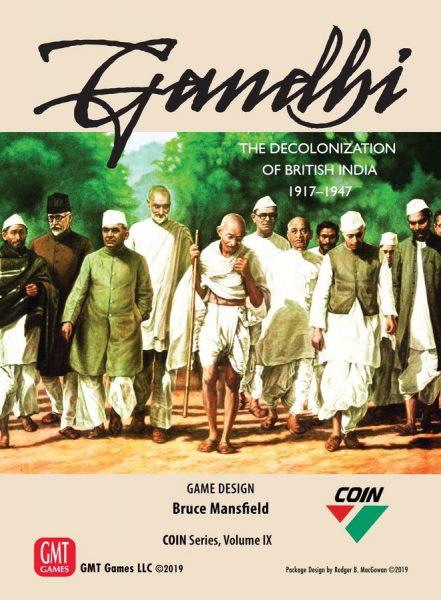
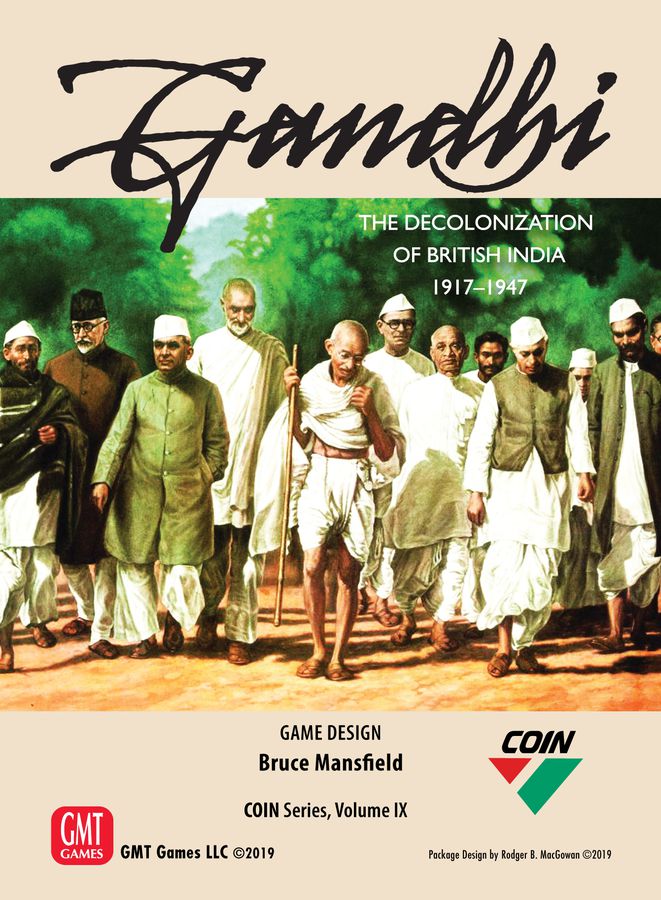
What would such a game look like? A good example comes to us in the form of GMT Games’ 2019 release, Gandhi: The Decolonization of British India. This is the latest entry in GMT’s COIN series, which is designed to model guerrilla wars and other unconventional conflicts through the use of cards that represent historical events. As in other games of the genre, such as Fire in the Lake (Vietnam), People Power (Insurgency in the Philippines, 1983-1986) and Colonial Twilight (The French-Algerian War, 1954-62), the game doesn’t present a simple narrative of good versus evil, but a more complex narrative in which all sides have at least some ulterior motives that are at odds with their official propaganda. In Gandhi, there are four players, one each controlling the Raj, the Indian National Congress, the Muslim League and the “Revolutionaries.” The latter three all share the goal of some kind of national independence, but each pursues its own (often mutually antagonistic) methods, with the Revolutionaries using violence to undercut the more pacifistic Congress, and the Muslim League playing off Congress, the Revolutionaries and the Raj in order to protect the interests of the country’s Islamic minority. (Historians of Canada would note that diplomacy and warfare with and among First Nations often was similarly complex.)

The game is unpredictable and complex, since each player will pursue different strategies in the country’s many different zones, making and breaking de facto partnerships depending on the circumstances. Amid all of this gaming chaos, the moral logic of decolonization remains a central theme of the game. But by the end of things, you realize that the ejection of the British from India was a big and messy project, as history typically is. While Spirit Island was created with the goal of mainlining anti-colonialism directly into the boardgame experience, Gandhi gets to the same theme obliquely by way of amoral realism, doing a better job pedagogically in the process.

A key aspect of Gandhi is that the Raj has agency: It is not reduced to the status of automaton-villain, as in Spirit Island. But there are limitations to the imaginative ecosystem that players inhabit: Every one of the four players has to take on their assigned role without questioning their underlying, game-dictated objective — including the Raj player, who must, start to finish, exert himself in defence of a colonial project that now is widely viewed as being on the wrong side of history. The other three factions likewise remain prisoners of their parochial regional, religious and doctrinal differences, which, historically, would contribute to millions of deaths in the chaos that accompanied the British exit.
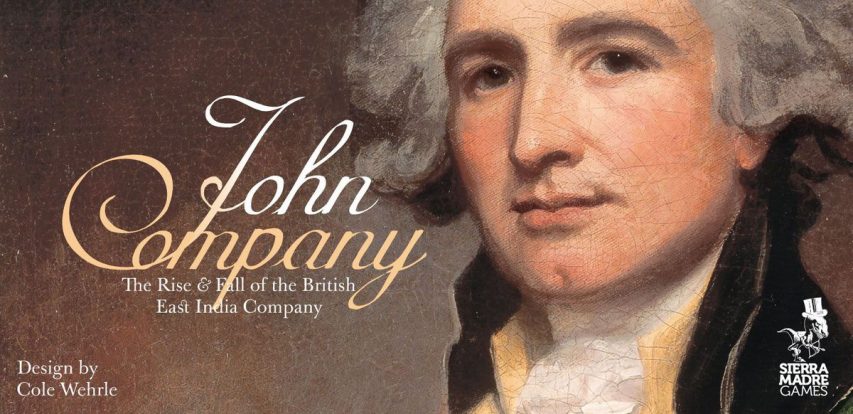
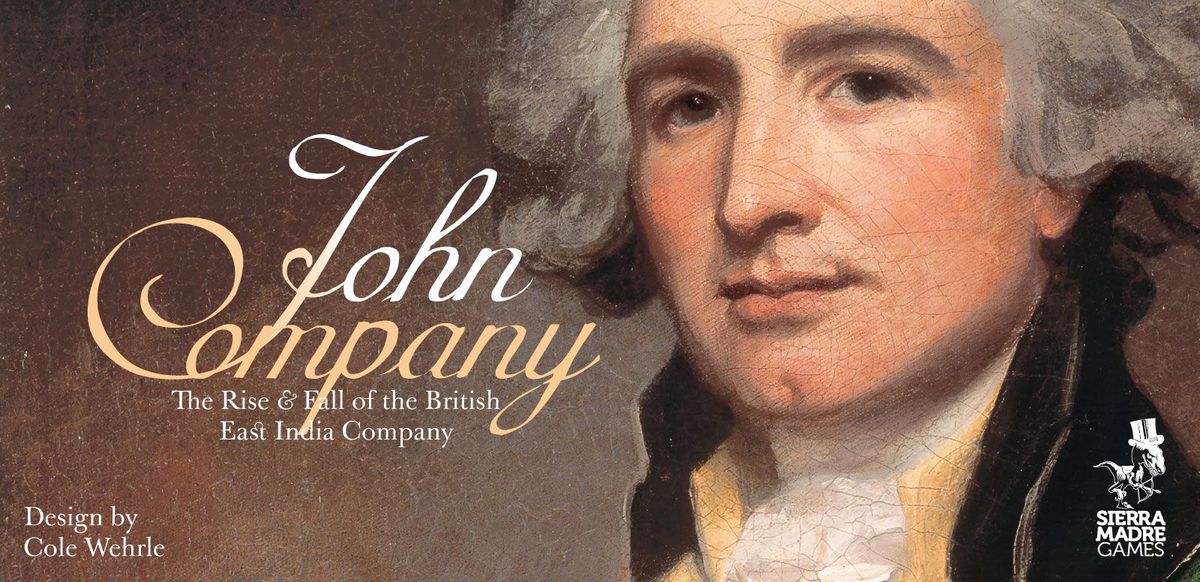
Which brings me to the fourth and final colonialism-themed game I will discuss: the acclaimed 2017 release John Company, by Indiana-based designer Cole Wehrle. In theory, John Company is also a game about British colonialism in India. But here’s the rub: The players all act as competing factions within the commercial innards of John Company (a nickname for the British East India Company). On one hand, the players have a co-operative goal — to keep the company afloat as it manages the enormous expense of creating and operating a colonial apparatus on the subcontinent. But I can attest that far more of players’ mental energy goes into fighting each other for the spoils of war and trade. Indeed, much of the game consists of exchanging favours and bribes among players, as each attempts to leverage positions of power within the company to extract revenues, plunder and positions of influence.

As the game progresses, you notice, almost as an afterthought, that great things are afoot within India: New trade routes are created, military battles are fought, whole regions go into revolt and are pacified, with many (fictional) lives hanging in the balance. But as a player, you barely notice any of this — except to the narrow extent these events can be exploited as a source of wealth, since the way you win the game is by accumulating enough cash and baubles to retire your functionaries into gilded clubs and country houses back in England.

And what of the actual Indians who lived and died under the Raj? They don’t appear at all in the game, for John Company‘s real play arc exists within the corrupt solipsism of intra-corporate deal-making. Which sounds horrifyingly amoral. But when the game’s over, you realize: That’s the whole point. The colonialists who ran India — like those who came to North America and every other place on the map, from South America to the Belgian Congo to China — typically weren’t motivated by a desire to destroy and subjugate. They were out to make a buck, either as lone freelancers in a canoe, or bureaucrats pulling levers within some gigantic corporate behemoth. The horrifying, often genocidal murder and mayhem was a by-product of greed. Which doesn’t make it better. But it does make the narrative more comprehensible in regard to governing our future behaviour as human societies — since we all are vulnerable to spasms of greed, while true evil for its own sake is a rare thing.

Games teach you about the forces of history not by listing a set of facts for you to memorize, but by creating a rules system that effectively pushes you to act in a certain way — whether as a colonialist, revolutionary or deity. If the game is well-designed, then those actions make a certain kind of internal sense. That dark logic is what stays with you — as an explanation of why people acted a certain way at a certain time. It’s always easy to judge historical figures. It’s harder, but ultimately more interesting and valuable, to understand them.


December 20, 2019

“Seven Pillars of Wisdom” – T. E. Lawrence of Arabia – Sabaton History 046 [Official]

Filed under: Britain, History, Media, Middle East, WW1 — Tags: , , , , — Nicholas @ 06:00

Sabaton History
Published 19 Dec 2019

The British T.E. Lawrence played a major role in bringing together a coalition of Arab factions to rise up against the Ottoman Empire. Their efforts helped the British war effort in the Middle East, but the British-Arab coalition was not as stable as it might have seemed.

Support Sabaton History on Patreon: https://www.patreon.com/sabatonhistory

Listen to The Great War (Where “Seven Pillars of Wisdom” is featured):
CD: http://nblast.de/SabatonTheGreatWar
Spotify: https://sabat.one/TheGreatWarSpotify
Apple Music: https://sabat.one/TheGreatWarAppleMusic
iTunes: https://sabat.one/TheGreatWarItunes
Amazon: https://sabat.one/TheGreatWarAmazon
Google Play: https://sabat.one/TheGreatWarGooglePlay

Listen to Sabaton on Spotify: http://smarturl.it/SabatonSpotify
Official Sabaton Merchandise Shop: http://bit.ly/SabatonOfficialShop

Hosted by: Indy Neidell
Written by: Markus Linke and Indy Neidell
Directed by: Astrid Deinhard and Wieke Kapteijns
Produced by: Pär Sundström, Astrid Deinhard and Spartacus Olsson
Creative Producer: Joram Appel
Executive Producers: Pär Sundström, Joakim Broden, Tomas Sunmo, Indy Neidell, Astrid Deinhard, and Spartacus Olsson
Post-Production Director: Wieke Kapteijns
Production Intern: Rune Væver Hartvig
Edited by: Iryna Dulka
Sound Editing by: Marek Kaminski
Maps by: Eastory – https://www.youtube.com/c/eastory

Archive by: Reuters/Screenocean https://www.screenocean.com
Music by Sabaton.

Sources:
– National Portrait Gallery
– Boston Public Library
– IWM: Q 59294, Q 73536, Q 115096, Q 73535, Q 60212, Q 103747, Q 67234, Q 59703A, Q 59576, Q 58858A, Q 58861, Q 58863, Q 59193, Q 58823, Q 58938, Q 59078, Q 59190, Q 58841, Q 58704, Q 59422, Q 58891, Q 60035, Q 59073, Q 60102, Q 60096, HU 123936, Q 12629, Q 58752, Q 59314, Q 59314A, Q 58830, Q 58845, Q 12364, ART 3198, ART 2510, Q 105583, Q 103750, Q 59324, Q 59312, Q 12363, Q 103770, Q 86295, Q 59061, Q 72565, Q 12332

An OnLion Entertainment GmbH and Raging Beaver Publishing AB co-Production.

© Raging Beaver Publishing AB, 2019 – all rights reserved.

From the comments:

Sabaton History
2 days ago (edited)
Thats right, it’s Indy of Arabia! Even though “Seven Pillars of Wisdom” is a crew-favourite, we have waited with this episode until we could show off some exclusive material from the “Seven Pillars of Wisdom” music video. With none other than Indy Neidell in the role of Lawrence (or Peter O’Toole?). This episode sure is among our favourite episodes to this date — we hope you enjoy it as well. If you do (and you weren’t already convinced by Joakim’s awesome Call To Action (17:20), please consider supporting this project on Patreon. It is thanks to those who are already there that we’re able to keep making these episodes! -> https://www.patreon.com/sabatonhistory

Cheers,
The Sabaton History Team

December 13, 2019

Communist Boots Are Made For Walking – Mao‘s Long March | BETWEEN 2 WARS I 1935 Part 3 of 4

Filed under: China, History, Military — Tags: , , , , , — Nicholas @ 06:00

TimeGhost History
Published 12 Dec 2019

From 1927 to 1934, the Chinese Communists lived in a state within the National Chinese State led by Chiang Kai-Shek. In 1935, the Nationalists strike and the Communists follow their leader Mao Zedong on a Long March Northwards.

Join us on Patreon: https://www.patreon.com/TimeGhostHistory

Hosted by: Indy Neidell
Written by: Joram Appel
Directed by: Spartacus Olsson and Astrid Deinhard
Executive Producers: Bodo Rittenauer, Astrid Deinhard, Indy Neidell, Spartacus Olsson
Creative Producer: Joram Appel
Post-Production Director: Wieke Kapteijns
Research by: Joram Appel
Edited by: Daniel Weiss
Sound design: Marek Kaminski

Colorizations:
– Klimbim – https://klimbim2014.wordpress.com

A TimeGhost chronological documentary produced by OnLion Entertainment GmbH.

November 1, 2019

“Unbreakable” – Guerrilla Warfare – Sabaton History 039 [Official]

Filed under: China, History, Media, Military, Russia, WW2 — Tags: , , , , , , — Nicholas @ 06:00

Sabaton History
Published 31 Oct 2019

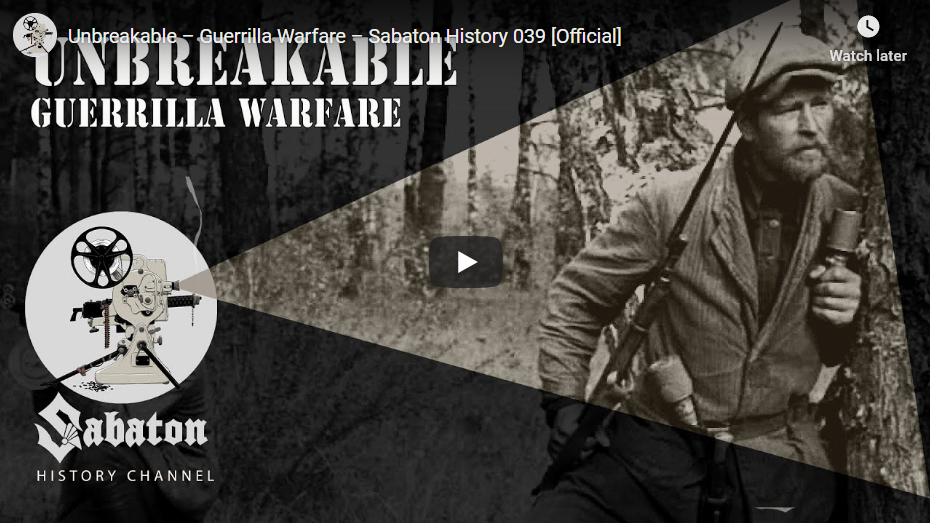
The exact topic of Sabaton’s song “Unbreakable” will forever be a mystery. But we do know that it has to do with guerrilla warfare, which is what Indy will dive into in this episode.

Support Sabaton History on Patreon: https://www.patreon.com/sabatonhistory

Listen to The Art of War (where “Unbreakable” is featured):
CD: http://bit.ly/TheArtOfWarStore
Spotify: http://bit.ly/TheArtOfWarSpotify
Apple Music: http://bit.ly/TheArtOfWarAppleMusic
iTunes: http://bit.ly/TheArtOfWariTunes
Amazon: http://bit.ly/TheArtOfWarAmz
Google Play: http://bit.ly/TheArtOfWarGooglePlay

Listen to Sabaton on Spotify: http://smarturl.it/SabatonSpotify
Official Sabaton Merchandise Shop: http://bit.ly/SabatonOfficialShop

Hosted by: Indy Neidell
Written by: Indy Neidell, Spartacus Olsson and Markus Linke
Directed by: Astrid Deinhard and Wieke Kapteijns
Produced by: Pär Sundström, Astrid Deinhard and Spartacus Olsson
Creative Producer: Joram Appel
Executive Producers: Pär Sundström, Joakim Broden, Tomas Sunmo, Indy Neidell, Astrid Deinhard, and Spartacus Olsson
Post-Production Director: Wieke Kapteijns
Maps by: Eastory
Edited by: Iryna Dulka
Sound Editing by: Marek Kaminski

Eastory YouTube Channel: https://www.youtube.com/channel/UCEly…
Archive by: Reuters/Screenocean https://www.screenocean.com
Music by Sabaton.

Sources:
– RIA Novosti archive
– Colorization of Mao Zedong by Olga Shirnina a.k.a. Klimbim
– IWM: NA 15129
– Water splash sound effect – littlerobotsoundfactory

An OnLion Entertainment GmbH and Raging Beaver Publishing AB co-Production.

© Raging Beaver Publishing AB, 2019 – all rights reserved.

From the comments:

Sabaton History
2 days ago
There are many examples where guerrilla warfare was used in an attempt to force out or at least harass a foreign invader or domestic military power. Partisan movements are almost always connected to a certain ideology or party — after all, they rebel against a power they disagree with. We haven’t mentioned a lot of different movements and causes in this episode, not because we don’t value or support them or their cause, but because we have a limited amount of time to cover a general topic in. As Indy also states in the video, we have picked several examples to describe what guerrilla warfare was. Please share any additional groups or events that are relevant for this episode, but keep it civil and keep your political thoughts to yourself.
Cheers, The Sabaton History team

October 21, 2019

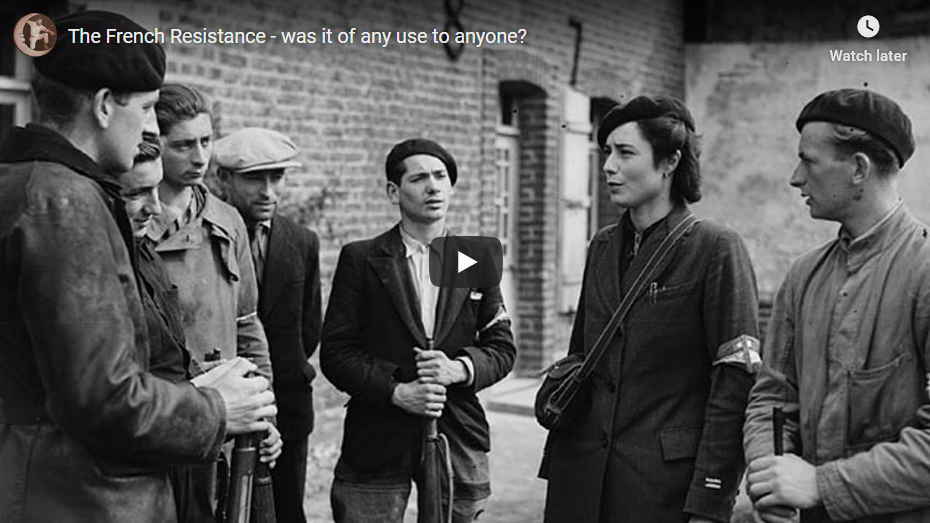
The French Resistance – was it of any use to anyone?

Filed under: France, Germany, History, Military, WW2 — Tags: , , , — Nicholas @ 02:00

Lindybeige
Published on 19 October 2016

Who organised the French Resistance? Did it ever do much?
Support me on Patreon: https://www.patreon.com/Lindybeige

I had planned to say a lot more, but this should be long enough. In take one, which I had to ditch because my sound recorder packed in half-way through it (but I didn’t notice, so carried on), I talked quite a bit about Wing Commander F.F.E. Yeo-Thomas AKA “The White Rabbit” who did a lot of organising the French Resistance, and I was also planning to talk about “R.A.F. blackmail sabotage” but perhaps that will come out in another video another day. Probably not, though. Never mind – sixteen minutes should be long enough for anyone.

Many of the figures I quote were fresh in my mind because I had just read them in Dadland by Keggie Carew. Another influential book on this video was The White Rabbit about Wing Commander FFE Yeo-Thomas.

Lindybeige: a channel of archaeology, ancient and medieval warfare, rants, swing dance, travelogues, evolution, and whatever else occurs to me to make.

▼ Follow me…

Twitter: https://twitter.com/Lindybeige I may have some drivel to contribute to the Twittersphere, plus you get notice of uploads.

website: http://www.LloydianAspects.co.uk

June 23, 2019

QotD: The American way of war

Filed under: Books, Bureaucracy, History, Military, Quotations, USA — Tags: , — Nicholas @ 01:00

Back in 2015 and again in April 2016, I commented on what I consider to be a fairly consistent litany of failures in American strategic leadership since, about 1960. Just this month I saw a new article (almost a synopsis of his recent book) in Foreign Affairs by George Packer about noted (notorious to some) American diplomat “Richard Holbrooke and the Decline of American Power.”

One paragraph caught my eye:

    We prefer our wars quick and decisive, concluding with a surrender ceremony, and we like firepower more than we want to admit, while counterinsurgency requires supreme restraint. Its apostles in Vietnam used to say, “The best weapon for killing is a knife. If you can’t use a knife, then a gun. The worst weapon is airpower.” Counterinsurgency is, according to the experts, 80 percent political. We spend our time on American charts and plans and tasks, as if the solution to another country’s internal conflict is to get our own bureaucracy right. And maybe we don’t take the politics of other people seriously. It comes down to the power of our belief in ourselves. If we are good — and are we not good? — then we won’t need to force other people to do what we want. They will know us by our deeds, and they will want for themselves what we want for them.

There is, I fear, a lot of truth in that little paragraph and I am also worried that the American fascination (mainly the Pentagon’s fascination) with process and organization has spread to Canberra, London, Ottawa, Wellington and even Berlin. The notion is that if we can just get our organizations and procedures right then everything will fall into line. We have forgotten that while good, sound organizations and sensible, simple, robust procedure do matter, they need to be in service to a sound strategic aim (a vision, if you like) and, sometimes, ad hoc organizations and “off-the-wall” procedures work best in new situations, whether counter-insurgency or all-out war against a peer.

Ted Campbell, “Following the blind leader (3)”, Ted Campbell’s Point of View, 2019-05-21.

August 27, 2018

Feature History – Peninsular War

Filed under: Britain, Europe, France, History, Military — Tags: , , , , — Nicholas @ 02:00

Feature History
Published on 20 Aug 2017

Hello and welcome to Feature History, featuring the Peninsular War and not much else. It’s not called Peninsular War and other stuff, just Peninsular War so really you can’t complain.

Help me defeat Napoleon (or not)
https://www.paypal.me/FeatureHistory
Patreon
https://www.patreon.com/FeatureHistory
Twitter
https://twitter.com/Feature_History
Discord
https://discord.gg/Zbk4CvR
———————————————————————————————————–
I do the research, writing, narration, art, and animation. Yes, it is very lonely

August 4, 2018

Forgotten History: Vercors – the Climactic Battle of the French Resistance

Filed under: France, Germany, History, Military, WW2 — Tags: , — Nicholas @ 04:00

Forgotten Weapons
Published on 31 Jul 2018

http://www.patreon.com/ForgottenWeapons

The imposing heights of the Vercors Massif form a very impressive natural defensive position in the southeastern corner of France. It was here that the French Resistance had its largest set piece battle against German occupation forces, in the summer of 1944.

Plan Montagnards originally called for several thousand Allied paratroops to be dropped into Vercors when the landings in Normandy and Provence took place. The Provence landings were pushed back many weeks, however, and the Resistance forces streaming onto the plateau were left almost entirely on their own. One large airdrop of supplies and a single American OSS combat team were all the reinforcement they received.

French Maquisards repelled German probing attacks for about 6 weeks until in late July the final German offensive against the plateau came. It would see nearly 20,000 troops, units of tanks, glider-borne paratroops, and reserve mountain troops in a well coordinated assault that soundly defeated the lightly-armed resistance fighters.

Today we are on the plateau itself, and we will follow the battle across several specific sites, including the glider landings at Vassieux, the last stand of Section Chavant, the destroyed village of Valchevrière, and the hospital at Le Grotte de la Luire.

Want to see some original footage of these fighters taken in the weeks before the battle? It actually exists, and you can see it here: https://youtu.be/zoq7QREIgB8

If you enjoy Forgotten Weapons, check out its sister channel, InRangeTV! http://www.youtube.com/InRangeTVShow

March 15, 2016

German East Africa – World War 1 Colonial Warfare I THE GREAT WAR Special

Filed under: Africa, Europe, Germany, History, Military, WW1 — Tags: , , — Nicholas @ 03:00

Published on 14 Mar 2016

The military campaign in German East Africa during World War 1 went on longer than the whole war and thanks to Paul von Lettow-Vorbeck and his guerilla warfare is now infamous among the theatres of the great war. But what was the history behind German East Africa and was it really a gentleman’s war and what role did the Askari play in it?

October 16, 2015

The rules of war, US edition

Filed under: Law, Media, Military, USA — Tags: , , , — Nicholas @ 03:00

Tom Kratman read through the latest edition of the US government’s Law of War Manual, so you (probably) won’t have to:

I thought I was free of one thousand plus page books of the driest prose imaginable when I finished law school. Sadly, no such luck; the Department of Defense released, back in mid-June, its Law of War Manual, which is eleven hundred and seventy-six pages of painfully sere verbiage. Go ahead and divide the number of pages by the number of days since about 15 June, 2015. Yeah, that dry.

But, dry or not, it’s not that bad. Nothing that induces the legal LibLePRs (Liberals, Leftists, Progressives, and Reds) of ICOTESCAS (the International Community Of The Ever So Caring And Sensitive) to denounce it as something that “reads like it was written by Hitler’s Ministry of War,” could be all that bad.

[…]

The left’s grasp of law of war is tenuous at best, often mistaken and frequently fraudulent. For example, one of their usual charges, also much heard during the campaign in Iraq and especially at Fallujah, was that incendiary weapons are banned, per the Protocol on Prohibitions or Restrictions on the Use of Incendiary Weapons (Protocol III). The fraud there is that incendiary weapons are not banned there or anywhere. Their use under some circumstances is restricted or banned, but the weapons themselves, and their use for other purposes or other circumstances is perfectly legal.

That’s just one example of the fraud the left has perpetrated with regard to the manual. There are numerous others, too numerous to list here. I will limit my comment, therefore, to the observation that attacking a legitimate military target in proximity to a civilian or civilians is not quite the same thing as carte blanche to attacks civilians, qua civilians, generally. ICOTESCAS seems to harbor some confusion about this or to pretend to confusion to cover their fraud.

One aspect, in particular, that has the left up in arms about the manual is in its treatment of journalists. I suppose in their ideal world, camera teams from Al Jazeera should be able to do reconnaissance for groups of guerillas and terrorists, scot free. Too, one suspects, in the ideal lefty world, the presence of a journalist, even if he happens to be carrying ammunition for the other side, should protect all combatants around the “journalist,” lest the journalist’s expensive coif be mussed.

Sadly, for that set of values and outlooks, in the real world, once the soldiers realize that some “journalists” are helping the enemy, those journalists are going to be killed as quickly and conveniently as possible, as they should be. Aim true, boys, aim true.

The rules, as outlined in the manual, for journalists are actually pretty reasonable. To paraphrase:

  1. If you are a journalist and among the enemy, your presence will not protect them. Their presence will endanger you and the closer you are to them the more you will be in danger. We will neither aim expressly for you if we know where and who you are, nor avoid targeting places you might be, if we don’t know who and where you are, nor avoid targeting places where you are, if we know or suspect the enemy is there, too. You knew it was a risk when you undertook the profession.
  2. If you take part in hostilities, to include by providing reconnaissance or by spying, you will have lost your immunities as a civilian, but not gained the privilege of a combatant. We can kill you.
  3. If you act as a spy and we catch you, we can try you as a spy, give you a judge and jury who may not much care for you or your profession, then stand you against a wall and shoot you.

January 28, 2015

Paul von Lettow-Vorbeck I WHO DID WHAT IN WW1?

Filed under: Africa, Germany, History, Military, WW1 — Tags: , — Nicholas @ 05:00

Published on 26 Jan 2015

Paul von Lettow-Vorbeck, also known as the Lion of Africa, was commander of the German colonial troops in German East Africa during World War 1. His guerilla tactics used againd several world powers of the time are considered to be one of the most successful military missions of the whole war. In Germany, he was celebrated as a hero until recently. But recent historical research show a picture much more controversial than the one of a glorious hero.

January 23, 2015

Zeppelins Over England – New Inventions For The Modern War I THE GREAT WAR Week 26

Filed under: Europe, France, Germany, History, Military, WW1 — Tags: , , , — Nicholas @ 03:00

Published on 22 Jan 2015

For a decisive advantage on the Western Front, the military commanders of both sides are trying to use technological advances. And so this week, German Zeppelins are flying their first air raids on English towns. Winston Churchill is outlining his ideas for what would later become the tank. Meanwhile at the Western Front, the soldier Adolf Hitler is thinking about how this war is going to continue.

July 7, 2014

QotD: The mother of mediocrity is the university

Filed under: Americas, Bureaucracy, Education, History, Quotations — Tags: , , — Nicholas @ 00:01

Why, almost everywhere you look, should such mediocrity triumph?

Of course, if mediocrity has not triumphed throughout the Western world, there is nothing to explain. There is, after all, no need to search for the origins of the nonexistent. But let us suppose that there is such a trend to mediocrity, a manifestation of which is bureaucratization: What can explain it? (Here I should mention that we should not get too exercised about definitional matters: Words should be used as precisely as possible, but not more precisely than possible. We know what a cloud is without being able to define its limits.)

The explanation lies in the expansion of tertiary education. Earlier in my life I used to think that this was unequivocally a good thing: The more educated a population, the better. But length of education, or attendance at supposedly educational establishments, is not the same thing as education itself. But in the modern world, where governments have to demonstrate tangible progress to their electorates, length of education and education are confounded.

Guerrilla movements in the last half-century or so in Latin American countries, seeking to establish totalitarian utopias, were caused by the expansion of tertiary education, not by peasant discontent. The graduates of that education — many of them, at any rate — found after obtaining their diplomas that the only work available to them, if any at all, was beneath their new status as educated person, a status that formerly would have entitled them to both respect and an important position in society. If they found work, it was work that they could have done without having gone to university. Bitter disappointment and resentment was the natural consequence.

We in the developed Western world do not have guerrilla movements, at any rate to a significant extent. Our equivalent is the bureaucracy that administers increasingly politically correct regulations. In this way people who have gone to the considerable trouble of obtaining a tertiary education that is of value to them neither vocationally nor intellectually may avenge themselves upon an unjust world, though their anger can’t be assuaged, being the only thing that gives meaning to their lives.

Thus, the mother of mediocrity is the university.

Theodore Dalrymple, “Triumph of the Mediocre”, Taki’s Magazine, 2014-01-19.

January 8, 2014

Tactical “lessons learned” from combat in Iraq and Afghanistan

Filed under: Middle East, Military, Weapons — Tags: , , , , — Nicholas @ 09:04

A couple of weeks back, Strategy Page posted some of the things that US and allied troops have had to learn from their experiences in combat since deploying to Iraq and Afghanistan. These tactical tips and tricks include:

The list is long and often embarrassing. For example, in peacetime troops are taught to drive carefully, in order to avoid accidents. But in combat the safest form of driving is fast and, to peacetime sensibilities, reckless. Even if commanders seek to practice “combat driving” in peacetime they do so in the knowledge that after a few bad accidents orders will come down to not drive like that because it causes bad publicity.

It’s a somewhat similar situation with battlefield first aid. It’s difficult to provide many troops with realistic training, especially since it’s harder to train on pigs or goats with the animal welfare zealots constantly trying to sue you into training methods that will get more troops killed in combat.

Another bad habit armies tend to drift into during peacetime is using weapons for training less and less. These things are, after all dangerous and with all the safety precautions and restrictions it is understandable why firing practice is cut and cut until it’s a rare event. But once war breaks out you quickly appreciate why sending troops to the weapons range several times a week is one of those lifesaving things you need to do.

[…]

Along with learning how to drive like a madman, you have to practice hard so you can change tires like one as well. In combat you will often have to do this under fire, so you must learn to do it quickly. This does two things. First, you learn how long it takes, even when you are in a hurry. This can be a useful bit of information if you are under fire while changing the flat. Second, practicing it forces you to make sure the spare tire is in good shape, and can quickly be reached (along with any tools needed.)

Then you must learn how Mister Grenade can be your friend, even on the crowded streets of a city like Baghdad or Kandahar. If your vehicle has a glove compartment, re-label it as the “grenade compartment.” Carry one smoke, one fragmentation and one tear gas grenade. If you’re stuck in traffic and the situation outside it starting to look dicey, then drop a smoke grenade out the window and try to get moving. You MUST be moving if you drop the tear gas grenade, because you cannot drive through the tears. Most other drivers will give you a wide berth when they see the smoke or tear gas grenade go off. For those who keep coming, with evil intent, the fragmentation grenade may come in handy (it is good for getting at bad people hiding behind something.) Remember, when using grenades, do not touch the pin until the grenade is outside the window. Accidents happen, and having a smoke grenade go off in your vehicle will ruin your day, at the very least.

November 4, 2013

Law, the military, and the media

Filed under: Britain, Law, Military — Tags: , , , , — Nicholas @ 11:23

Sir Humphrey debunks a recent story in the Telegraph which makes a big deal about the British military hiring more lawyers at the same time as they are disbanding front-line units:

The Forces have always needed effective legal support, and arguably the tiny number of military lawyers provides an utterly vital capability. Its not just about the provision of support to people who understand the arcane intricacies of a military law system which is very complex, and very different to our normal law — though this is extremely important. It’s about the provision of people who bring a vital advisory role to Commanders on the ground, and the wider MOD.

[…]

Similarly, once the direct fighting is over, UK troops often find themselves operating in a very strange environment — one only has to look at Iraq in the aftermath of the initial war fighting phase to realise that its not a clear cut place to operate. The advice offered by in theatre legal personnel can often make a huge difference in helping commanders understand their freedom to operate, and what genuine constraints may affect them. For instance, on a single tour in Iraq, units may have found themselves conducting everything from searches, checking for IEDS, detaining known individuals through deliberate operations, and then engaging in combat — quite possibly in the same day. The requirement for modern troops to adapt very quickly to all manner of situations places a huge burden on them — it is important that they get the best possible guidance to know they are acting correctly. Certainly in this authors experience on both TELIC and HERRICK, the LEGAD advice was often one of the most critical parts of any potential operation.

The same lawyers provide vital services back home — in the Royal Navy for instance, there are a range of in house experts on the Law of the Sea, international maritime disputes and territorial waters and the like. This may sound questionable, but when the RN is daily conducting counter piracy and counter narcotics operations across the globe, or sailing in possible maritime flashpoints where different nations have very different interpretations of maritime boundaries, having a good legal understanding on hand of the art of the possible is absolutely vital.

« Newer Posts — Older Posts »

Powered by WordPress