Quotulatiousness

October 11, 2021

QotD: Columbus Day

Filed under: Americas, Europe, History, Quotations, USA — Tags: , , , , , — Nicholas @ 01:00

It was Columbus Day yesterday, where historically, Americans have celebrated the discovery of the “New world” by Christopher Columbus’ little fleet in 1492. Now, historically there were previous discoveries of parts of the Americas by Europeans. Vikings encountered Newfoundland in roughly 1000 and even had a small settlement there. Some writings indicate that an explorer named Brendan encountered the Americas in the sixth century AD. Chinese apparently had landed on the Pacific coast as early as 3300 years ago.

But when Columbus landed on the Caribbean Island of San Salvador in the Bahamas, he set off a wave of exploration and colonization which the previous discoveries had not. The Viking and Chinese settlements did not last, but the post-Columbian ones did. And that is an incredibly significant historical event, no matter how you view history.

In the 1970s it became popular on the left to consider Columbus a monster, a villain who gave the innocent and peaceful natives diseases, enslaved them, wiped out their culture, and destroyed all that was good. This theory teaches that the American natives were all good and peaceful and wonderful and just and true and righteous. They all ate free trade non-GMO gluten free food and were perfectly multicultural and non-judgmental, free of war and with perfect gender equality. Columbus, an evil white European showed up and ruined it all. In short, Columbus he infected the Eden-like paradise of the Americas with his Euro-masculinity.

And the origin of this theory is that of the Noble Savage. There were people living outside the evil corrupting influence of White European Males, and Columbus found them and ruined everything. That’s why when you hear someone talking about this, they never mention the nearly-constant wars, cannibalism, human sacrifice, rape, pillaging, genocide, disease, poverty, and incredible lack of technical and scientific, artistic, and literary knowledge of the native peoples of America.

Columbus was a man of his time, and a particularly greedy one at that. He ripped off his own people, acting as the King’s supreme representative and authority in the Americas (which at the time was not known to be as vast as it is). He took credit for what others did, he took over what they developed, he took the riches they found, and so on. And yes, he and his men enslaved the local natives, and because of their culture of “free love” spread European venereal diseases among the natives they were not exposed to before. Entire tribes were wiped out by the infections they had no resistances to.

Of course, the natives spread disease among the Europeans they hadn’t been exposed to, either, such as Typhus and Syphilis, and the natives were murderous and killed Europeans but those are details that modern revisionist historians either ignore, gloss over, or present as a rough sort of justice: they had it coming for daring to set foot in the Eden of the Americas.

Objectively, neither side was particularly admirable, as one would expect if you understand innate and original sin. If what’s bad comes from within us rather than outside influences, then its spread evenly throughout all humanity without regard to creed, culture, race, or location. The natives were bad because people are bad. The Spaniards and Columbus (who was Italian) was bad, because people are bad.

Christopher Taylor, “Eden Ruined By Italian”, Word Around the Net, 2018-10-09.

October 10, 2021

Three Years in Vinland: The Norse Attempt to Colonize America

Atun-Shei Films
Published 9 Oct 2021

Happy Leif Erikson Day! Some time after Thorvald Erikson’s disastrous voyage to the mysterious lands west of Greenland, a wealthy Icelander named Thorfinn Karlsefni financed and led an expedition of his own, with the goal of establishing a permanent Norse settlement in Vinland. Karlsefni and his crew would spend three summers in the New World, where they would have to deal with internal division, hostile Native Americans, and (according to some) the wrath of demonic mythological creatures.

Support Atun-Shei Films on Patreon ► https://www.patreon.com/atunsheifilms

Leave a Tip via Paypal ► https://www.paypal.me/atunsheifilms

Buy Merch ► https://teespring.com/stores/atun-she…

#LeifErikson #Vinland #History

Original Music by Dillon DeRosa ► http://dillonderosa.com/
Reddit ► https://www.reddit.com/r/atunsheifilms
Twitter ► https://twitter.com/atun_shei

~REFERENCES~

[1] Magnus Magnusson & Hermann Pálsson. The Vinland Sagas: The Norse Discovery of America (1965). Penguin Books, Page 7-43

[2] Birgitta Wallace. “Karlsefni” (2006). The Canadian Encyclopedia [https://www.thecanadianencyclopedia.c..].

[3] Lorraine Boissonault. “L’Anse Aux Meadows and the Viking Discovery of North America” (2005). JSTOR Daily https://daily.jstor.org/anse-aux-mead…

October 6, 2021

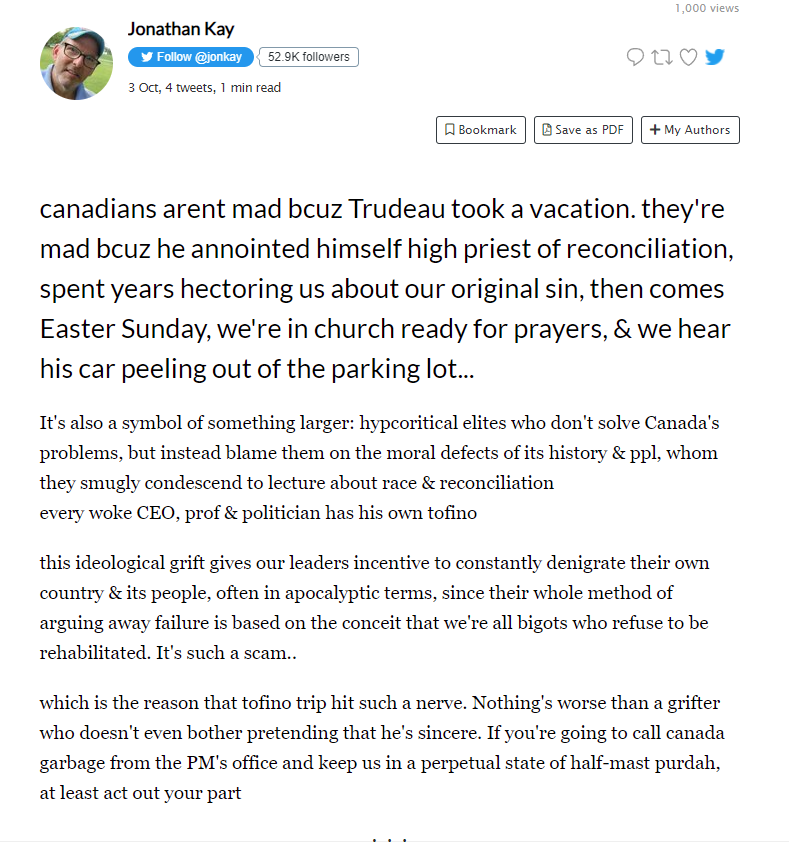
Jonathan Kay explains why Justin Trudeau’s no-show got a lot of Canadians mad

Filed under: Cancon, Media, Politics — Tags: , , , — Nicholas @ 03:00

Linked from Small Dead Animals, Jonathan Kay took to the twits to summarize why this particular Justin Trudeau flake-out seems to have impacted his reputation so much more than all the other flake-outs he’s pulled over the years (screencapped for those who find Threadreader links objectionable):

October 3, 2021

Trudeau’s no-show on the very first “National Day for Truth and Reconciliation” wasn’t accidental

Filed under: Cancon, Media, Politics — Tags: , , , — Nicholas @ 03:00

In The Line, an explanation of sorts for the Prime Minister effectively boycotting his own National Day for Truth and Reconciliation to go on a family vacation in British Columbia:

Thursday was Canada’s first National Day for Truth and Reconciliation. According to Heritage Canada, it is a day that “honours the lost children and Survivors of residential schools, their families and communities. Public commemoration of the tragic and painful history and ongoing impacts of residential schools is a vital component of the reconciliation process.”

To mark the occasion, ceremonies were held in Indigenous communities across the country. Politicians from every level of government took part. In those provinces where it was not a holiday, schoolchildren wore orange shirts and learned about a shameful part of their country’s past, and came home telling their parents that “every child matters”.

And Justin Trudeau, the prime minister of Canada, who lowered the flag on federal buildings and has kept it down ever since, who has made reconciliation the centrepiece of his leadership, went surfing in Tofino. But not before lying about it — his official itinerary had him in private meetings in Ottawa, and it was only after Toronto Sun reporter Bryan Passifiume noticed that a federal jet had taken off from Ottawa and made its way to one of the most gorgeously isolated parts of the country that the PMO admitted that Trudeau wasn’t in Ottawa working the phones, he was in Tofino playing in the waves. When he was tracked down by a team from Global news, he turned his back to the camera and walked sullenly away along the beach.

What are we to make of this behaviour? Social media was full of people calling it an “own goal” or an “unforced error” or a “self-inflicted wound”, and that Trudeau’s officials should have known that this trip was a bad idea, and urged him to put it off by a day or two.

We think these people are getting it wrong. To call this an error in judgment fundamentally misunderstands Justin Trudeau’s psychology and what motivates him. As far as we at The Line can tell, the timing of this trip, the location, and the predictable negative reaction, was very deliberate, and is entirely in keeping with the prime minister’s previous behaviour. To put it bluntly, the prime minister is taking a suck attack.

When the Liberals came to power in 2015, winning a very surprising majority government, it was almost completely due to the perceived magnetism of Justin Trudeau. He charmed Canadians, he charmed the press, and he charmed foreigners; his “because it’s 2015” line made international headlines and made him the figurehead of youthful, global progressive politics. He was the handsome noble young prince here to save us all.

The problem is, when you’re at the top there is only one way to go in politics and that’s down. And so inevitably came the 2019 federal election, in which Liberal fortunes were undermined by two main things: the fallout from the SNC-Lavalin scandal that saw two ministers and his senior adviser resign, and the emergence of a number of photos showing a very grownup, but very immature, Justin Trudeau cavorting around in blackface. After the Liberals were reduced to a minority, with his own reputation heavily, er, stained, Trudeau disappeared in what was clearly an epic sulk. When he re-emerged in the public eye, he’d grown a beard that was clearly designed to Add Gravitas to his public image.

He did it because he could do it, and he’d do it again just to show Canadians just how disappointed he is in them and how much harder they will need to work to regain the privilege of his leadership. We could use a man like Bertolt Brecht again…

September 12, 2021

Ocean travel without losing half the crew to scurvy

In the most recent Age of Invention newsletter, Anton Howes discusses the scurvy dogs of the Spanish Main, or any other ocean before Europeans discovered how to fight off scurvy:

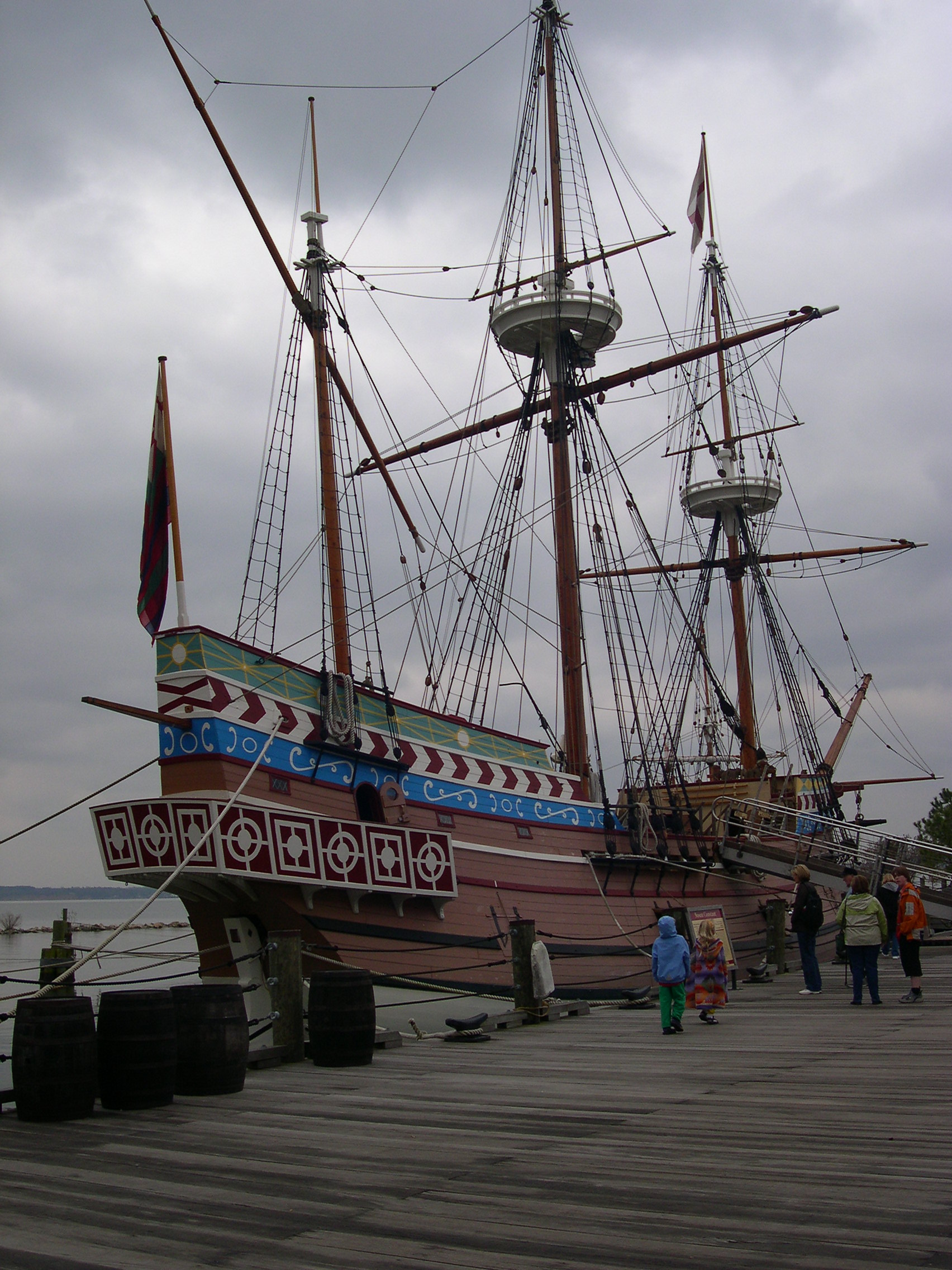
An English ship of the late 16th/early 17th century: this is a replica of the Susan Constant at the Jamestown Settlement in Virginia. The original ship was built sometime before 1607 and rented by the Virginia Company of London to transport the original settlers to Jamestown.
Photo by Nicholas Russon, March 2004.

For as long as humans have suffered severe food shortages, scurvy has been known. The first record of it appears to date to ancient Egypt, in 1550BC, and it was especially familiar to the inhabitants of northern climates, with fresh vegetation every winter becoming scarce. Our word for scurvy almost certainly comes from the old Norse skyrbjugr — the skyr being a sort of soured cow’s milk that was thought to have caused the disease by going bad. In mid-sixteenth-century sources, scurvy was often referred to as though it was endemic to the Netherlands — a flat land assailed by the North Sea each winter, that had suffered long sieges and devastation thanks to the Dutch Revolt, and where fishing and merchant shipping employed an especially large proportion of the workforce. The Dutch thus had a perfect storm of factors to make vitamin C deficiencies more common, even though they abounded in fresh-caught fish and imported Baltic grain.

And so, over the centuries, the people of the northern climes had discovered the cure. Or rather, cures. The Iroquois ate the bark, needles or sap of evergreen trees — most likely white cedar, or some other kind of spruce, fir, juniper or pine, all rich in vitamin C. Their remedy saved the lives of Jacques Cartier’s colonists based near modern-day Quebec City in the winter of 1536. It’s the reason white cedar is known as arborvitae, the tree of life. And the Saami of northern Scandinavia prized cabbages and other leafy greens, in the summertime filling up casks of reindeer milk with crowberries and cloudberries, to be ready for winter.

[…]

Still more remedies were discovered by accident, as European ships began to range farther and farther abroad. The very first Portuguese voyagers around the Cape of Good Hope almost immediately discovered the value of orange and lemons — especially effective sources of vitamin C, as their acidity helps to preserve it. The voyage of Vasco da Gama, having been the first to round the Cape and reach the eastern coast of Africa, was then stricken with scurvy. They were only inadvertently saved when they traded with some Arabian ships laden with oranges, before landing at Mombasa. There, the ruler sent them a sheep and some sugar-cane, the gift also happening to include some oranges and lemons. Although the Portuguese couldn’t stay there long — they learned of a conspiracy to capture their ship — one of the voyagers later reported in wonder how the climate there must have been especially healthful to have cured them all.

Fortunately, at least some of the crew suspected the citrus instead. On the return journey from India, after a fatally slow three-month crossing of the Indian Ocean, some of the newly scurvy-ridden sailors asked their captain to procure them some oranges at Malindi. At least a few of the crew must certainly have been saved by this request, though perhaps the excitement of their imminent deliverance induced a few fatal aneurysms: “our sick did not profit”, was the report, “for the climate affected them in such a way that many of them died here.” By the time the fleet limped home back to Lisbon in 1499, scurvy had still managed to claim the lives of over two thirds of the original crew.

Nonetheless, the status of oranges as a scurvy wonder-cure had entered sailors’ lore. When Pedro Alvares Cabral repeated da Gama’s feat of rounding the Cape of Good Hope in 1500, his crew purposefully treated their scurvy using oranges. And by the 1560s, if not earlier, the news of the cure had spread beyond the Portuguese. Sailors from the Low Countries, on the eve of the Dutch Revolt from Spain, were said to be staving off scurvy by eating oranges in large quantities, skins and all. (Orange peel is in fact especially rich in vitamin C, so they were onto something.) Their value was certainly appreciated by the Dutch explorer Jacob Corneliszoon van Neck by the time of his second expedition to the Indian Ocean in 1598. Not long after setting out, he purchased 10,000 oranges from a passing ship off the coast of Spain, rationing them out to all his crew. And on the return journey via St Helena they were dismayed when initially “we found no oranges, whereof we had most need, for those that were troubled with the scurvy disease.”

The account of van Neck’s journey was translated into English for the first voyage of the East India Company in 1601, which may be why its commander, James Lancaster, directed his crew to drink three spoonfuls of lemon juice every morning. Lancaster doesn’t appear to have paid any special attention to oranges and lemons ten years earlier, when he first attempted the voyage, although other English mariners like the privateer Sir Richard Hawkins had in the 1590s already been extolling their virtues. We don’t know many of the details of Lancaster’s lemon juice trial, but his flagship’s crew was not entirely saved. Contrary to common report, at least a third of them had died by the time they left their first landing at Table Bay, South Africa — a proportion similar those on the other ships of his fleet, though we don’t know how many actually died of scurvy or of other causes. But upon the expedition’s return, the experience placed lemon juice firmly on the list of known scurvy cures — “the most precious help that ever was discovered against the scurvy” as the East India Company’s surgeon-general put it.

August 30, 2021

A History of American Barbecue

Filed under: Americas, Food, History, USA — Tags: , , , — Nicholas @ 02:00

The History Guy: History Deserves to Be Remembered
Published 29 Jun 2020

Different cultures have been roasting meat over a fire since prehistory, but the practice took on special meaning in the United States. The History Guy remembers a brief history of American barbecue.

This is original content based on research by The History Guy. Images in the Public Domain are carefully selected and provide illustration. As very few images of the actual event are available in the Public Domain, images of similar objects and events are used for illustration.

You can purchase the bow tie worn in this episode at The Tie Bar:
https://www.thetiebar.com/?utm_campai…

All events are portrayed in historical context and for educational purposes. No images or content are primarily intended to shock and disgust. Those who do not learn from history are doomed to repeat it. Non censuram.

Find The History Guy at:

Patreon: https://www.patreon.com/TheHistoryGuy
Join the History Guy for history trivia at https://www.quizando.com/TheHistoryGuy

The History Guy: History Deserves to Be Remembered is the place to find short snippets of forgotten history from five to fifteen minutes long. If you like history too, this is the channel for you.

Awesome The History Guy merchandise is available at:
teespring.com/stores/the-history-guy

Script by THG

#ushistory #thehistoryguy #foodhistory

August 26, 2021

A New World Order? – The World Power Conference | B2W: ZEITGEIST! I E.24 Summer 1924

TimeGhost History
Published 25 Aug 2021

The League of Nations is just one manifestation of a broader ideal in the interwar years. Within a palace in the heart of the British Empire, a new conference is underway. It is attended by everyone from H.G. Wells to the Prince of Wales.
(more…)

August 12, 2021

The Canadian Historical Association’s “consensus” on genocide in Canada

Filed under: Cancon, Education, Government, Health, History — Tags: , , , , — Nicholas @ 03:00

In Quillette, Christopher Dummitt reports on last month’s declaration by the Canadian Historical Association that not only were past Canadian governments complicit in deliberate genocide against First Nations, but that such mass extermination efforts are current and ongoing:

Kamloops Indian Residential School, 1930.
Photo from Archives Deschâtelets-NDC, Richelieu via Wikimedia Commons.

Last month, the Canadian Historical Association (CHA) issued a public “Canada Day Statement” — described as having been “unanimously approved” by the group’s governing council — declaring that “existing historical scholarship” makes it “abundantly clear” that Canada’s treatment of Indigenous peoples amounts to “genocide”. The authors also claimed that there is a “broad consensus” among historians on the existence of Canadian “genocidal intent” (also described elsewhere in the statement as “genocidal policies” and “genocidal systems”) — an alleged consensus that is “evidenced by the unanimous vote of our governing Council to make this Canada Day Statement”.

The authors went further by arguing that both federal and provincial governments in Canada “have worked, and arguably still work, towards the elimination of Indigenous peoples as both a distinct culture and physical group” (my emphasis); thereby suggesting that there is “arguably” an ongoing genocide going on, to this day, on Canadian soil.

The idea that Canada is currently waging a campaign of mass extermination against Indigenous people may sound like something emitted by Russian social-media bots or Chinese state media. But no, this is an official statement from the CHA, a body that describes itself as “the only organization representing the interests of all historians in Canada” — presumably including me.

In fact, there is no “broad consensus” for the proposition that Canadian authorities committed genocide, let alone for the completely bizarre idea that a genocide is unfolding on Canadian soil even as you read these words. And while many of us have become used to such plainly dilatory claims being circulated by individual Canadian academics in recent years, the CHA’s use of its institutional stature in this way was so shocking that it caused dozens of historians to affix their names to a letter of protest.

Notwithstanding what this (or any other) official body claims, the question of whether Canada committed genocide is not a settled issue among scholars. Canada is a relatively small country, home to only a small number of professional historians. And so even this modest-seeming collection of names suffices to disprove the CHA’s claim that it speaks for the entire profession. Moreover, many of those who have signed the letter are senior scholars giving voice to younger colleagues who (rightly) fear that speaking out publicly will hurt their careers.

I am not writing here to defend the actions of Canadian governments toward Indigenous populations. As most Canadians have known for decades, the policy of forcing Indigenous children to attend residential schools led to horrendous cases of sexual and physical abuse. There was also a long history in many schools of refusing to let children speak their native languages or continue their cultural traditions. These were assimilatory, underfunded institutions created and run by people who typically believed that they were doing Indigenous people a favour by “civilizing” them.

What I am addressing, rather, is (a) the question of whether these actions are correctly described with the word “genocide”, and (b) the CHA’s false claim that there is “broad consensus” on the answer to that question. As the letter of protest states:

    The recent discovery of graves near former Indigenous residential schools is tragic evidence of what the Truth and Reconciliation Commission (TRC) documented in Volume 4 of its final report — a report that we encourage all Canadians to read. We also encourage further research into gravesites across Canada and support the completion of a register of children who died at these schools. Our commitment to interrogate the historical and ongoing legacies of residential schools and other forms of attempted assimilation is unshaken. However, the CHA exists to represent professional historians and, as such, has a duty to represent the ethics and values of historical scholarship. In making an announcement in support of a particular interpretation of history, and in insisting that there is only one valid interpretation, the CHA’s current leadership has fundamentally broken the norms and expectations of professional scholarship. With this coercive tactic, the CHA Council is acting as an activist organization and not as a professional body of scholars. This turn is unacceptable to us.

Historians are taught to approach their study of the past with humility, on the understanding that the emergence of new documents and perspectives may require us to revise our assessments. Moreover, even if an individual scholar might have strong opinions about a particular historical subject — having become certain that his or her interpretation represents the truth — the community of historians exists in a state of debate and disagreement. We are always aware that two historians sifting through the same archival box of documents can develop very different theories about what those documents mean.

It is true that there are some areas of history that might be fairly labelled as definitively “settled”. But these are few. And even in these cases, consensus typically arises organically, through the accumulated weight of scholarship — not, as in the case of the CHA’s Canada Day stunt, through ideologically charged public statements that seek to intimidate dissenting academics into silence.

July 7, 2021

The “Squirrel!” distractions will end when it’s convenient for certain people and groups

Jay Currie considers the constant barrage of distractions that appear to be preventing most people from noticing what is actually going on in Canada:

Kamloops Indian Residential School, 1930.
Photo from Archives Deschâtelets-NDC, Richelieu via Wikimedia Commons.

The remarkable thing about all of these little snippets of news is that they seem to be regarded as business as usual. Being taxed by an inflation rate which is well into the double digits does not cut through the COVID hype. Vandalism and arson purportedly in rage over residential school deaths which we have known about for decades attracts very little comment – though many First Nations people are not very happy that reservation churches which have served their communities for years are being burnt. People seem to shrug off the heat wave deaths and ambulance delays.

I expect very little from government at any level. A reasonably sound currency, a degree of public order and emergency services which can deal with the inevitable surges in demand.

The emergency services issue is probably the most easily fixed. Yes, having more para-medics is part of the solution but planning a reponse to these sorts of surge emergencies which tries to avoid the need for an ambulance in the first place is important too. Most of the dead were old, in many cases, very old. It should not be impossible to identify those older people and have a plan for these sorts of emergencies. Something as simple as a “Helpful Neighbour” program on a voluntary basis would be a good first step.

Restoring public order is more complicated. First, you have to have the political will to actually take on the problem. As we saw a couple of years ago, when it comes to people purporting to act on behalf of First Nations/environmental causes that will is absent. But even if the politicians decided that enough was enough there needs to be an investigation and an understanding of how the “spontaneous” vandalism and arson and blockades are driven. That is going to require rooting around in the activist community which will be, to say the least, difficult. The people who are actually creating the public disorder pay close attention to operational and communications security. Suffice to say this stuff is not being organized on a Facebook page.

Restoring order is also going to require a look at who benefits from disorder. To take an example: was it co-incidence that the sad fact of the Kamloops residential school graveyard came up just as the inquiry into Canada’s Winnipeg Lab’s connection to the Wuhan virology lab was heating up? The fact of there being a graveyard had been know for decades. The ground radar was being used to determine the boundaries so a new fence could be built. Yet, somehow, the number of bodies became headline news. I suspect, but cannot prove, that this was no accident. Public order will be restored when disorder is no longer in anyone’s interest.

July 6, 2021

History Summarized: The Wild West

Filed under: Americas, History, Humour, Media, USA — Tags: , , , , , — Nicholas @ 02:00

Overly Sarcastic Productions
Published 7 Sep 2018

This video was commissioned by Patron Matthew Ritter. Thanks Matthew! If you would like to support the channel and earn special rewards, check out our Patreon page: www.patreon.com/OSP

Articles referenced — Because Gun Control and Black Cowboys sound incredulous on paper so I can see why you wouldn’t believe me but it’s real and there’s tons of proof:
Gun Control in the West: https://www.smithsonianmag.com/histor…
Black Cowboys: https://www.smithsonianmag.com/histor…​

MERCH LINKS:
Shirts – https://overlysarcasticproducts.threa…​
All the other stuff – http://www.cafepress.com/OverlySarcas…​

Find us on Twitter @OSPYouTube!

Another article covering gun control in the “Wild West” says:

… enforcement of the anti carry ordinances in Tombstone and Dodge City and other frontier towns like Deadwood, South Dakota that had them were highly selective. In Tombstone, those friendly with the Earps and their buddies got a pass. In Dodge City those friendly with the powers that be and or the Dodge City Gang — which included Wyatt when there — got a pass too on the side of Dodge with the carry ban. That “side” is a rarely mentioned fact. […] The famous sign reading “The Carrying of Firearms Strictly Prohibited” so often used to promote similar laws today was at the entrance to the North incorporated portion where the “decent” Dodge permanent residents sought to exclude riffraff like the drovers and maintain a somewhat puritan lifestyle. Women were not allowed in saloons and singing or dancing was against the law.

The cowboys and other undesirables were supposed to stay below the Deadline according to Wyatt Earp in the book The Old West in Fact and Film: History Versus Hollywood: “Below the deadline, as far as the marshals force was concerned, almost anything went, and a man could get away with gunplay if he wasn’t too careless about lead. North of the railroad, gun toting was justification for shooting on site, if an officer was so inclined, and meant certain arrest.”

Sounds like cut no slack enforcement, but there are simply too many accounts of gun carry on the North side to believe Earp’s account was anything other than his famed self promoting hyperbole. One example is the 1879 gunfight in the Long Branch Saloon between gamblers Frank Loving and Levi Richardson. Loving killed Richardson and a magistrate ruled the killing justifiable self defense. Even so, why was he not charged with illegal gun carry? Possibly because Dodge’s no carry laws and others like it else- where were not put on the books purely for public safety reasons as anti-Second Amendment activists claim …

June 17, 2021

Canada’s most recent bout of mourning sickness

Filed under: Cancon, History, Religion — Tags: , , — Nicholas @ 03:00

In Wednesday’s NP Platformed, Colby Cosh reports on a shocking incident in Dunnville, Ontario where a Catholic priest discovered and threw away some shoes that had been deposited on a bench in front of his church. This ***obviously*** was some sort of hate crime by the priest personally and the entire hierarchy of the Catholic church collectively all the way up to the Pope which must now be tearfully acknowledged and repented of in multiple media appearances, because the items were part of an informal, unofficial memorial to the long-deceased children whose unmarked graves were discovered at a former residential school in British Columbia.

Kamloops Indian Residential School, 1930.
Photo from Archives Deschâtelets-NDC, Richelieu via Wikimedia Commons.

Ne Hiyawak seemingly didn’t ask permission to leave the shoes at the church, or give the pastor any notice; the next day, when others seeking to do the same thing explained what they were up to, the priest allowed an enormous pile of stuffed animals and handmade signs to be created on the front steps of the building.

A natural next question may be whether these mementoes will be allowed to obstruct the church door forever. Can it be that these items, too, are certain to end up in the garbage after sitting around amid the elements for a few days? (If you want to recycle an old stuffed animal and thereby guarantee that it finds its way into the hands of a child, actually finding such a child yourself is the only appropriate procedure.)

NP Platformed would like to suggest very gently that temporary “memorials” constructed by leaving stuff on common property, or on someone else’s property, should be discouraged by the press rather than encouraged. We have all driven past a mildewed or long-rotted bundle of plastic-wrapped flowers lying in a ditch or on a corner where someone died: this has somehow become the last acceptable form of littering, a vice our civilization once embraced, and had to work hard to mitigate.

Eventually, someone or other, probably a custodial professional paid peanuts, has to pick all that stuff up. We’re not sure how this isn’t obvious, or why it ought to be controversial. If you want to festoon a church with protest materials, and you do this precisely because you have a well-founded disrespect for the church, we are not sure anyone can justly complain when the materials are removed.

The Catholic Church may be monstrous, but the creation of memorials consisting of piles of items like shoes puts its stewards in an impossible position. If you remove the items too soon, you’re being disrespectful. If you leave them lying around long enough to become an eyesore, that’s surely no less disrespectful. There is a stubborn segment of the public that cannot resist this sociopathic behaviour, but it should be observed that in publicizing these stunning and brave makeshift memorials, the news media always photograph them at their very nicest (which is never all that nice) and walk away. Those who have to collect the detritus are never asked their opinion, nor are those unfortunates who merely live nearby.

June 7, 2021

Why is the belated discovery of (potentially hundreds of) unmarked graves at a former residential school surprising?

Filed under: Cancon, Education, Government, History, India — Tags: , , , , — Nicholas @ 03:00

The weekly wrap-up post at The Line considers the recent revelation of possibly hundreds of unmarked graves of First Nations children at the site of a former Catholic-run residential school in BC. Despite being Canadian, my interest in Canadian history centres mostly on economic, naval, and military aspects, but I was certainly aware that the residential school system was a black mark on Canada’s historical dealings with First Nations and that the general outline of events — if not the gruesome details — had been known for many years. The first time I found out about it was in middle school, through what we’d now call a “Young Adult” novel about a young First Nations boy escaping from the residential school he’d been sent to and his attempts to travel hundreds of miles to get home. I read it in the early 70s and it may have been published up to a decade before then (I no longer remember the author’s name or the title of the book, unfortunately).

If I, as a schoolchild, knew something of this fifty years ago, why have people younger than me been shocked and appalled to be hearing about this widespread tragedy for the first time now?

Kamloops Indian Residential School, 1930.
Photo from Archives Deschâtelets-NDC, Richelieu via Wikimedia Commons.

We like to start our dispatches with something pithy or casual, but it’s been a heavy week. The discovery of what appears to be a burial site containing the bodies of more than 200 children at the site of a former residential school in B.C. has shaken Canadians. Of course it has. There are two outrages here — the outrageous reality of the generations of combined abuses inflicted on Indigenous Canadians, of which the residential school system was but a part. Also, the outrage that most Canadians are only learning about this now.

Your Line editors are not experts on Indigenous affairs or history, but we dare say we’re better read than most on Canadian history in a general sense. We do not say this in any way with snark or derision, but to our fellow Canadians — this should not be surprising to you. The Catholics who ran most of these schools under the sanction of the state had a long history of trying to save souls at the expense of the bodies in which they inhabited. Religious institutions were slow to recognize and stop the spread of disease in their own institutions. Most disturbingly, their ideology glorified, even sanctified, physical suffering. It still does.

Mass graves have been uncovered in Ireland, at the site of Catholic-run homes once devoted to the care of unwed mothers and children. “Saint” Mother Teresa’s hospitals in India were altars to the needless suffering of impoverished people who could not afford to die in peace and dignity. Her hospitals were dirty, poorly run facilities where children were reportedly tied to beds, and terminal patients were given little more than aspirin.

One of the great lessons of history that we consistently fail to accept is that many of our most evil actions are rooted not in self-evidently evil impulses, but rather in our desire to “save” others. Hubris and paternalism, these are the sins we cannot seem to shake. Residential schools, Catholic or otherwise, were the disastrous result of marrying a poisonous and righteous ideology with the authority and resources of a centralized state.

The Truth and Reconciliation report laid out much of this in detail in its final report in 2015, which also spelled out that graves like the ones we’re now mourning in Kamloops are likely to be far more prevalent and common than we now understand. Everyone here deserves the truth.

Update: I’m delighted to see that David Warren continues to improve from his recent health issues and he has rather a different view on Canada’s residential school system and its place in the lives of the First Nations children who attended the schools:

Ryerson was also a figure in the development of Canada’s “residential schools”, which took Indians from (mostly) dysfunctional homes and gave them an education with priests, nuns, and respectable Protestants. Not all denizens of an orphanage are happy, and by attaching the word “colonialism”, and giving simplified accounts, full of libels, “progressive” Canadian politicians have made this period of Canadian history into a scandal. Those who know better have been silenced.

Some years ago I tried to defend the “residential schools”, more or less alone in the Canadian “meejah”. I received many, many letters from former students of them, who said their memories were happy. They had been inspired by teachers of real Christian faith and conviction, and had been equipped with the rudiments of sound learning. “They saved my life,” was a frequent comment.

I could understand the residential schools because I am familiar with Canadian education before it was taken over by barbaric hordes; and also because I am myself partly a product of “British colonial” private schools in Asia, decades ago. They were brutal towards their boys, sometimes. I was myself beaten, and their teachers were sometimes tyrannical.

As a young man I thought this was the way of the world. Now that I am old, I look back on the teaching I received with great pride. It was vastly better than what I would receive in a Canadian high school; and that was much better than what we get today.

April 12, 2021

Tom Longboat: The “Bronze Streak to a Wildfire”

Filed under: Cancon, History, Military, Sports, WW1 — Tags: , , , — Nicholas @ 02:00

The History Guy: History Deserves to Be Remembered
Published 6 May 2019

Tom Longboat has been called Canada’s first professional athlete. But amid his setting records and gaining accolades, he served his country in the Great War and fought discrimination. His life is history that deserves to be remembered.

This is original content based on research by The History Guy. Images in the Public Domain are carefully selected and provide illustration. As images of actual events are sometimes not available, images of similar objects and events are used for illustration.

All events are portrayed in historical context and for educational purposes. No images or content are primarily intended to shock and disgust. Those who do not learn from history are doomed to repeat it. Non censuram.

Patreon: https://www.patreon.com/TheHistoryGuy

The History Guy: History Deserves to Be Remembered is the place to find short snippets of forgotten history from five to fifteen minutes long. If you like history too, this is the channel for you.

Awesome The History Guy merchandise is available at:
teespring.com/stores/the-history-guy

Script by HCW

#wwi #thehistoryguy #canada

March 27, 2021

“Unfortunately for the RCMP, obstruction of justice and tampering with evidence is very much a criminal offence and it looks like the boys in red should lawyer up”

Filed under: Cancon, Law — Tags: , , , , — Nicholas @ 03:00

An investigation into the conduct of the Royal Canadian Mounted Police (RCMP) shows an organization that firmly believes — and acts — as though it is above the law:

To its credit, RCMP leadership accepted the findings of the CRCC [Civilian Review and Complaints Commission]. But the rank and file membership, the actual police officers who interact with the public, and their union, have rejected the report, calling it biased.

All of this is a stain on Canada’s top law enforcement agency, and part of a deeper failure by the RCMP to meaningfully address its own reluctantly acknowledged systemic racism toward Indigenous peoples, but it is far from criminal misconduct.

Unfortunately for the RCMP, obstruction of justice and tampering with evidence is very much a criminal offence and it looks like the boys in red should lawyer up.

In the course of the CRCC investigation, the commission requested all recordings, transcripts, and radio communications from the day of the shooting. These communications would have undoubtedly been important to the investigation and could have provided a window into why the RCMP engaged in illegal and discriminatory conduct.

But the RCMP destroyed those records. They claimed that it was part of a routine procedure and that records with no evidentiary value have a shelf life of two years. Except the RCMP knew that there was an ongoing CRCC investigation and a civil lawsuit by the Boushie family when they destroyed the records.

If you or I destroyed relevant records, while staring down a barrel of a civil lawsuit or investigation, we would end up before a judge on charges.

Every time I ask the RCMP to destroy records relating to my clients who have been acquitted at trial, even after years have passed, I am met with a wall of resistance. So it seems a bit convenient when relevant documents are so easily destroyed when it is the RCMP who are being investigated.

The CRCC report also discloses that the RCMP conducted a parallel investigation into the Boushie incident — with officers questioned and evidence gathered. This RCMP investigation not only potentially contaminated the CRCC inquiry, but the RCMP kept their investigation a secret and failed to disclose the fruits of their internal investigation to the CRCC.

This all reeks of a cover up and an attempt to obstruct justice.

March 9, 2021

QotD: Canadian culture

Everywhere one turns one sees a tendency toward mimesis — we tend to copy rather than invent — qualified by intellectual emptiness. In other words, it may be that the vacancy of the Canadian mind reflects the vacancy of the Canadian landscape. Of course, much of the land is variegated — lakes, rivers, forests, the impressive mountain ranges running down the length of “beautiful British Columbia” — in the same way, metaphorically speaking, that we can boast a number of resonating exceptions to the staple of tepid cultural and intellectual sameness.

One thinks of novelist Mordecai Richler, poet Irving Layton, critical minds Harold Innis, Marshall McLuhan and Northrop Frye, musicians Leonard Cohen and Gordon Lightfoot. Our founding father, Sir John A. Macdonald, was the ne plus ultra of our political class; there has been none like him since, which may explain why he is now on posthumous trial for war crimes and a hue and cry has gone up to remove his statues and rename eponymous schools.

The constitutive factor, however, exceptions aside, is the “howling emptiness” of a vast landmass that may partially account for the emptiness of our intellectual topography — if, as Jared Diamond had argued in Guns, Germs and Steel, geography governs the development of culture and spirit.

Any nation the preponderance of whose citizens regularly elects left-wing political parties; accepts single-payer healthcare; believes in the efficacy of the welfare state; endorses the hoax of global warming; accommodates swarms of third-world immigrants and refugees who have no love for or understanding of a country becoming an open-to-all multicultural tombola with the highest proportionate rate of immigrants in the Western world; has allowed its educational industry, from pre-school to graduate school, to be corrupted possibly beyond retrieval by lockstep Leftism, “diversity and inclusion,” and “social justice” claptrap; has caved to the feminist and campus-rape fable; dutifully takes CBC Leftist propaganda as gospel; has fallen for the 16th Century meme of the “Noble Savage” in its dealings with the aboriginal peoples; extravagantly celebrates a second-rate rock band like The Tragically Hip and names a street after it; reads (when it does read) tedious scribblers like the acclaimed Joseph Boyden and Ann-Marie MacDonald; and gives a complete ignoramus like Justin Trudeau a majority government on the strength of name and coiffure, cannot be regarded as informed, well-educated or in any way distinguished. Unlike the U.S., there are no cracks, to quote Leonard Cohen, where the light gets in. The Canadian political, cultural and academic spectrum has gone dark from end to end.

David Solway, “The Canadian Mind: A Culture So Open, Its ‘Brains Fall Out'”, PJ Media, 2018-10-10.

« Newer PostsOlder Posts »

Powered by WordPress