
… the moment we get into how courage (and showing courage) was understood in these cultures, both the idea of a universal battle experience and also a universal notion of “warrior courage” break down. To take just a few examples …
Among Great Plains Native Americans, the sign of great courage was the individual act (on this, see A.R. McGinnis, Counting Coup and Cutting Horses (2010), which is replete with examples), particularly touching an enemy combatant (“counting coup“) or stealing enemy horses from their camp, typically by night and by stealth. It is sometimes asserted that counting coup means touching an enemy without killing them, but McGinnis fairly handily debunks this – not only could the enemy be killed, he could be already dead, killed by someone else and in some cases up to four warriors might count coup on the same fallen foe, none of whom need be the person who did the killing (McGinnis, 44, 63). These acts were fundamentally individual and the honor that resulted from them was entirely from the daring, rather than, necessarily, their direct efficacy. As McGinnis notes at multiple points, it was not the killing of an enemy, but the actual act of rushing forward to touch the body that was rewarded with honor.
Of course in many cases, counting coup in this way was followed by swift retreat, since the body in question was likely to be amongst the still living and dangerous enemy, which was the point since the purpose of the act was to show supreme daring and skill to rush forward among the enemy and get back out after touching one. The same of course was true of “cutting horses”, a task which could generally only be done by sneaking into an enemy camp, literally surrounded by (hopefully unaware) enemy warriors, before grabbing their horses and riding off (there is a first person account of such a raid in Black Elk Speaks (1932) which has always stuck with me, but McGinnis provides several other examples).
(I should note that the last Great Plains Native American to achieve the complete set of military honors and be made a war chief was Joe Medicine Crow who quite famously managed to lead a war party, take an enemy’s weapon, count coup (on a live opponent!) and steal some fifty horses from the Nazi SS during the Second World War)
Bret Devereaux, “Collections: The Universal Warrior, Part IIa: The Many Faces of Battle”, A Collection of Unmitigated Pedantry, 2021-02-05.
September 16, 2022
QotD: Counting coup
September 2, 2022
QotD: Historical parallels between the British and American empires
England was colonised by the Norman Empire (a tribe that spread across France, Britain, Italy, and the Middle East can be referred to as an empire I believe), in 1066. After some initial fierce resistance, they settled well, integrated with the local economy, and started developing a more advanced economic society.
North America was colonised by the British Empire (and Spanish and French of course), in the sixteenth century. After some initial fierce resistance, they settled well, integrated with the local economy, and started developing a more advanced economic society.
Norman England spent the next few centuries gradually taking out its neighbours. Wales, Ireland, and eventually Scotland (though the fact that the Scottish King James I & VI actually inherited England confuses this concept a bit). The process was fairly violent.
The North American “English” colonies spent the next few centuries taking out their neighbours. Indian tribes, Dutch, Spanish and French colonists, etc. The process was fairly violent.
England fought a number of wars over peripheral areas, particularly the Hundred Years war over claims to lands in France.
The North American colonies enthusiastically joined (if not blatantly incited) the early world wars, with the desire of taking over nearby French and Spanish colonies
The English fought a civil war in the 1640s to 50s over the issue of how to share power between the executive government, the oligarchs, and the commons. It appears that the oligarchs incited the commons (which was not very common in those days anyway). It was extremely bloody, and those on the periphery — particularly the Scots and Irish — came out badly (and with a long term bad taste for their over-mighty neighbour).
The Colonies fought their first civil war over the issue of how to share power between the executive, the oligarchs and the commons in the 1770s to 80s. It is clear that the oligarchs incited the commons (who in the US were still not very common — every male except those Yellow, Red or Black. An improvement? Certainly not considering the theoretical philosophical base of the so-called Revolution!). It was not really so bloody, but those on the periphery — particularly the Indians and slaves (both of which were pro-British), and the Loyalists and Canadians — came out badly. (60-100,000 “citizens” were expelled or forced to flee for being “loyalists”, let alone Indians and ex-slaves). Naturally the Canadians and their new refugee citizens developed a long term bad taste for their over-mighty neighbour — who attempted to attack them at the drop of a hat thereafter.
The British spent the next century and a half accumulating bits of empire — the Dominions, the Crown Colonies, and the Protectorates — in a haphazard fashion. Usually, but not always, troops followed traders and settlers.
The United States spent the next century and a half accumulating bits of empire — conquests from the Indians, purchases from France and Russia, conquests from Mexico and Spain, annexations of places like Hawaii, etc. — in a haphazard fashion. Usually, but not always, troops followed traders and settlers.
Nigel Davies, “The Empires of Britain and the United States – Toying with Historical Analogy”, rethinking history, 2009-01-10.
July 30, 2022
QotD: The advent of horses and firearms on the North American plains
Horses arrived in the Great Plains from the south via the Spanish and moving through Native American peoples west of the Rocky Mountains by both trade and eventually raiding in the early 1700s. Notably firearms also began moving into the region in the same period, but from the opposite direction, coming from British and French traders to the North and West (the Spanish had regulations against trading firearms to Native Americans, making them unavailable as a source). Both were thus initially expensive trade goods which could only be obtained from outside and then percolated unevenly through the territory; unlike firearms, which remained wholly external in their supply, horses were bred on the plains, but raiding and trade were still essential sources of supply for most peoples on the plains. We’ll get to this more when we talk about warfare (where we’ll get into the four different military systems created by this diffusion), but being in a position where one’s neighbors had either the horse or the gun and your tribe did not was an extreme military disadvantage and it’s clear that the “falling out” period whereby these two military innovations distributed over the area was very disruptive.
But unlike guns, which seem to have had massive military impacts but only minimal subsistence impacts (a bow being just as good for hunting bison as a musket, generally), the arrival of the horse had massive subsistence impacts because it made hunting wildly more effective. But the key thing to remember here is: the horse was introduced to the Great Plains no earlier than 1700, horse availability expanded only slowly over the area, but by 1877 (with the end of the Black Hills War), true Native American independence on the Great Plains was functionally over. Consequently, unlike the Steppe, where we have a fairly “set” system that had already been refined for centuries, all we see of the Plains Native American horse-based subsistence system is rapid change. There was no finally reached stable end state, as far as I can tell.
Though there is considerable variation and also severe limits to the evidence, it seems that prior to the arrival of the horse, most Native peoples around the Great Plains practiced two major subsistence systems: nomadic hunter-gathering on foot (distinct from what will follow in that it places much more emphasis on the gathering part) on the one hand and a mixed subsistence system of small-scale farming mixed seasonally with plains hunting seems to have been the main options pre-horse, based on the degree to which the local area permitted farming in this way (for more on those, note Isenberg, op. cit., 31-40). Secoy (op. cit.) notes that while there is some evidence that the Plains Apache may have shifted through both systems, being hunter-gatherers prior to the arrival of horses, by the time the evidence lets us see clearly (which is shortly post-horse) they are subsisting by shifting annually between sedentary agricultural racheirias (from the Spring to about August) and hunting bison on the plains during the fall. Isenberg notes the Native Americans of the Missouri river combining corn agriculture with cooperative bison hunting in the off-season (in that case, in the summer). Meanwhile, the Comanches and Kiowas seem to have mostly subsisted on pedestrian bison hunting along with gathering fruit and nuts, with relatively little agriculture, prior to going fully nomadic once they acquired horses. Bison hunting on foot required a lot of cooperation (so a group) and it seems clear that it was not enough to support a group on its own and had to be supplemented somehow, at least before the arrival of the horse. Some mix of either bison+gathering or bison+horticulture was required.
Isenberg argues (op. cit.), that at this point the clear advantage was to what he terms the “villagers” – that is the farmer-hunters who lived in villages, rather than the nomadic hunter-gathers. These horticulturists were more numerous and seem quite clearly to have had the better land and living conditions. Essentially the hunter-gatherers stuck on marginal land were mostly hunter-gatherers because they were stuck on marginal land, which created a reinforcing cycle of being stuck on marginal land (the group is weak due to small group size because the land is marginal and because the group is weak, it is only able to hold on to marginal lands). That system was stable without outside disruption. The horse changed everything.
A skilled Native American hunter on a horse, armed with a bow, could hunt bison wildly more effectively than on foot. They could be found more rapidly, followed at speed and shot in relative safety. It is striking that while pedestrian bison hunting was clearly a team effort, a hunter on a horse could potentially hunt effectively alone or in much smaller groups. In turn, that massively increased effectiveness in hunting allowed the Native Americans of the region, once they got enough horses, to go “full nomad” and build a subsistence system focused entirely on hunting bison, supplemented by trading the hides and other products of the bison with the (increasingly sedentary and agrarian) peoples around the edges of the Plains. Many of the common visual markers of Plains Native Americans – the tipi, the travois, the short bow for use from horseback – had existed before among the hunter-gathering peoples, but now spread wore widely as tribes took to horse nomadism and hunting bison full time. At the same time, Isenberg (op. cit. 50-52) has some fascinating paragraphs on all sorts of little material culture changes in terms of clothing, home-wares, tools and so on that changed to accommodate this new lifestyle. The speed of the shift is quite frankly stunning.
We’ll come back to this later, but I also want to note here that this also radically changed the military balance between the nomads and the sedentary peoples. The greater effectiveness of bison hunting meant that the horse nomads could maintain larger group sizes (than as hunter-gatherers, although eventually they also came to outnumber their sedentary neighbors, though smallpox – which struck the latter harder than the former – had something to do with that too), while possession of the horse itself was a huge military advantage. Thus by 1830 or so, the Ute and Comanche pushed the Apache off of much of their northern territory, while the Shoshone, some of the earliest adopters of the horse, expanded rapidly north and east over the Northern Plains, driving all before them (Secoy, op. cit., 30-31, 33). Other tribes were compelled to buy, raise or steal horses and adopt the same lifestyle to compete effectively. It was a big deal, we’ll talk about specifics later.
Bret Devereaux, “That Dothraki Horde, Part II: Subsistence on the Hoof”, A Collection of Unmitigated Pedantry, 2020-12-11.
July 24, 2022
Still no actual evidence of unmarked graves for Residential School children
In Quillette, Jonathan Kay updates the year-old sensational stories about First Nations children being buried in unmarked (in more unhinged reporting it might have been “mass”) graves on the grounds of former Residential Schools in Canada:
Canada’s unmarked-graves story broke on May 27th, 2021, when the Tk’emlúps te Secwépemc First Nation reported the existence of ground-penetrating radar (GPR) data that indicated regularly spaced subterranean soil disturbances on the grounds of a former Indigenous Residential School that had operated in Kamloops, BC between 1893 and 1978. In addition, the First Nation’s leaders asserted their belief that these soil disturbances corresponded to unmarked graves of Indigenous children who’d died while attending the school.
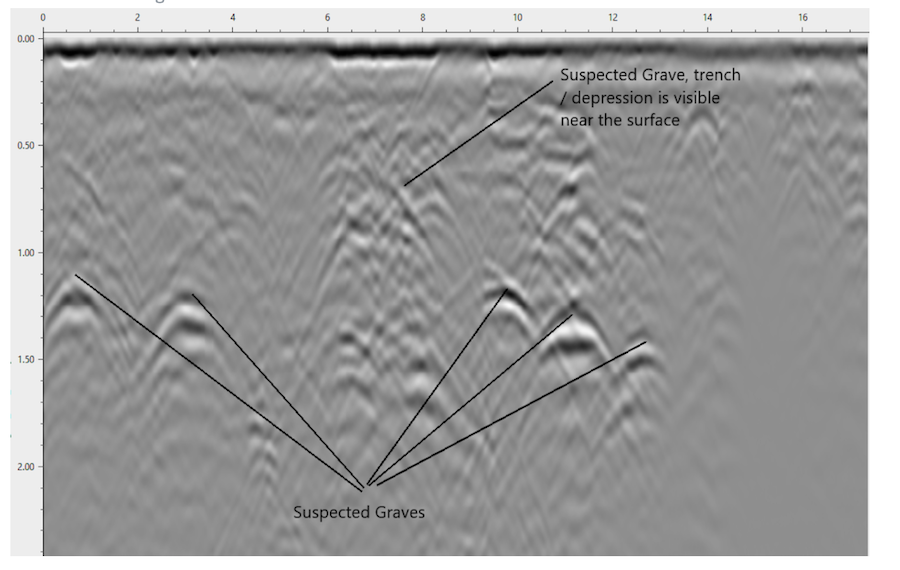
The story became an immediate sensation in the Canadian media; and remained so for months, even after the GPR expert on whom the First Nation relied, Sarah Beaulieu, carefully noted that the radar survey results didn’t necessarily indicate the presence of graves — let alone graves that had been unmarked, graves of Indigenous people, or graves of children. Contrary to what many Canadians came to believe during that heady period, GPR survey data doesn’t yield X-ray-style images that show bodies or coffins. What it typically shows are disruptions in soil and sediment. Investigators then need to dig up the ground to determine what actually lies underneath.
An explanatory image posted by GeoScan, a Canadian Ground-Penetrating-Radar service provider, showing how mapped GPR data can indicate the possible presence of graves.
Image via Quillette.But those details were swept aside during what, in retrospect, appears to have been a true nation-wide social panic. As other Indigenous groups announced that they’d be conducting their own GPR surveys, media figures confidently asserted that the original Canadian Residential-School student death-toll estimate of 3,201 would soon double or even triple. One op-ed writer went so far as to declare that “the discovery of the graves of the children in Kamloops may be Canada’s Holocaust moment.” Dramatic, tear-drenched acts of public atonement unfolded everywhere, with many July 1st Canada Day celebrations being either cancelled or transformed into opportunities for morose self-laceration.
I was one of many Canadians who initially got swept up with all of this — in large part because it seemed as if everyone in the media was speaking with one voice, including journalists I’d known and respected for many years. Looking back on the coverage, I note that headline writers mostly skipped over the technical bits about soil dislocations and such, and went straight to “bodies” and “graves”. And the stories often were interspersed with credulous recitations of dubious tales featuring live babies being thrown into furnaces or buried alive.
The whole mission of Canada’s church-run Residential School system was to assimilate Indigenous people into white Canadian society, usually against their will, while forcing children to leave their families and communities for months or even years at a time. No one disputes that many students were subject to cruel (and sometimes even predatory) treatment and substandard medical care. Certainly, the death rate for Indigenous children attending these schools was much higher than that for children in the general population. No, I never bought into the idea that there was any kind of mass-murder plot going on at these schools. But it hardly seemed far-fetched that some victims of mistreatment and neglect had been buried in unmarked graves — “off the books”, so to speak—by malevolent white teachers, school administrators, and priests seeking to evade responsibility for their actions.
The other important aspect to mention is that — like most other Canadians, I’m guessing — I believed we were only a few days or weeks from seeing real physical evidence plucked from the earth. So it didn’t much matter to me that early commentators were temporarily playing fast and loose with the distinction between GPR data and actual corpses.
Canadians were being told that the old orchard in Kamloops where the GPR data had been collected was a crime scene — a site of mass murder, and the final resting place of 215 child homicide victims. As I’ve reasoned elsewhere: If you told Canadians that, say, 215 murdered white children were buried somewhere in Toronto, or Ottawa, or Vancouver, there’d be investigators and police crawling all over the place, looking for remains that could be tested and identified. And so I naturally assumed the same thing soon would be happening in Kamloops.
But … no. Not at all, in fact.
As I wrote over a year ago, the way the story swept the media was as if the whole Residential School history was somehow new and previously unknown:
Despite being Canadian, my interest in Canadian history centres mostly on economic, naval, and military aspects, but I was certainly aware that the residential school system was a black mark on Canada’s historical dealings with First Nations and that the general outline of events — if not the gruesome details — had been known for many years. The first time I found out about it was in middle school, through what we’d now call a “Young Adult” novel about a young First Nations boy escaping from the residential school he’d been sent to and his attempts to travel hundreds of miles to get home. I read it in the early 70s and it may have been published up to a decade before then (I no longer remember the author’s name or the title of the book, unfortunately).
If I, as a schoolchild, knew something of this fifty years ago, why have people younger than me been shocked and appalled to be hearing about this widespread tragedy for the first time now?
July 3, 2022
David Warren waves the flag
As noted the other day, the official period of mourning sickness that enveloped Canada last year after the blockbuster revelations about residential schools has not been followed-up by any substantive proof of any of the sensational claims that Prime Minister Trudeau seized upon to lecture Canadians about our historical guilt (the “genocideal nation” that he claimed we were) and to haul the national flag down to half-staff for half a year. David Warren chooses to wave the flag instead:
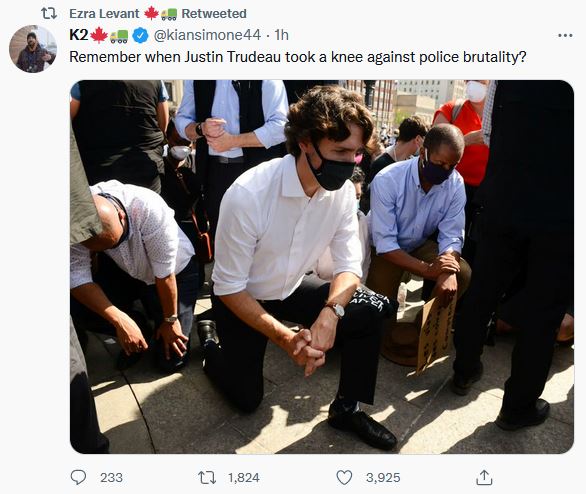
Justin Trudeau has always had a strong affinity for the symbolic gesture, especially when the media are around to record it.
The latest trick in what we might call “eco-commie-perv agitprop”, emerged while shaming Canadian history and traditions. I’ll touch on it in a moment. It is a product chiefly of the Indian Wars of the last few years. The White Man, and more specifically when Catholic, has been accused of massacring the Native People in 20th-century residential schools, just as he did upon coming to the continent. He then ploughs the anonymous victims into mass graves, showing his affinity to, exempli gratia, the Nazis.
This propaganda campaign, which quickly reached the tedious stage, was founded on a series of oft-repeated unambiguous lies, driven into our susceptible children in our compulsory public schools, and throughout life by such agencies as the CBC. (All our significant media are now under government control, subsidy, and watch.) White men, especially the Catholics, contaminate Canadian history by their Satanic essence, according to this malicious fantasy. Goodness and innocence can be found only in their victims, the “visible minorities” (or majorities, as the case may be). Shame is inculcated among persons exhibiting the wrong race.
I write of Canada, but something similar is happening in the United States, and has been carried to Europe on the sails of Hollywood and popular “music”. Canada is, however, an extreme example — of brazen idiocy — and even to underprivileged (all-white) rural places the message is piped in. Disharmonious voices must expect state interference, and eventual arrest.
For Canada now has political prisoners, including many who participated in the Freedom Convoy of truck drivers. Tamara Lich, a prominent organizer of this demonstration, has been gratuitously jailed, though she didn’t even try to commit a plausible crime. This week she was gaoled again, apparently for receiving a freedom medal. (Persons it was in her bail conditions not to meet may have been in the audience.) She was put out of sight for “Canada Day” (the former Dominion celebration, yesterday). This manipulation of Canadian law is, sadly, no longer unprecedented. It seems to be ordered directly from the Prime Minister’s Office.
July 1, 2022
Trying to reconcile the highly mediagenic “Residential School mass graves” stories with facts-on-the-ground
Prime Minister Justin Trudeau — never one to miss opportunities to preen before the camera and shed a performative tear or two — quickly ordered Canadian flags to half-staff when the stories about unmarked graves on the grounds of former residential schools spread across the world. Claims and accusations flew, based on ground-penetrating radar scans that didn’t actually prove that the surveyed land contained lost graves. Once the narrative was established, it provided many opportunities for First Nations organizations, activists, and Canadian and foreign politicians to moralize, condemn, and demand investigations, restitution, and apologies from the Catholic church (which ran over 40% of the residential schools), and the provincial and federal governments.
So, more than a year later … what has been investigated? Not much, it turns out:
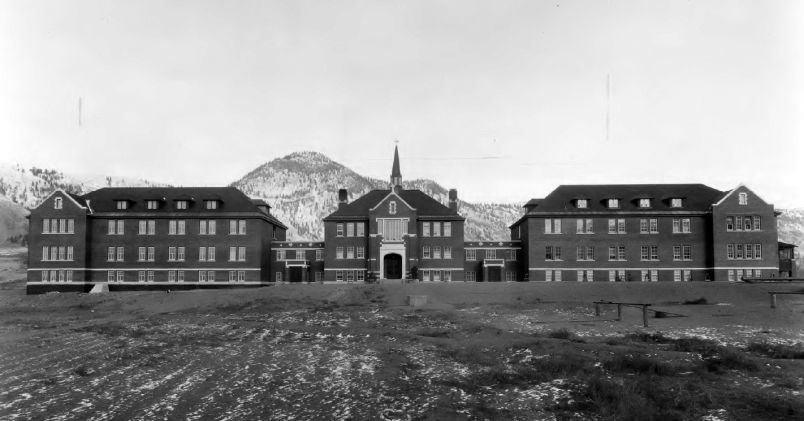
Kamloops Indian Residential School, 1930.
Photo from Archives Deschâtelets-NDC, Richelieu via Wikimedia Commons.
Sixty-eight Christian churches, mostly Roman Catholic, were vandalised or even burned to the ground. Many of these were historical church buildings still used and revered by native people. The pretext for arson and vandalism was that the Kamloops Indian Residential School had been run by a Catholic religious order, as had 43% of all residential schools. Imagine the outrage if 68 synagogues or mosques had been vandalised and burned. Yet the attacks on 68 Catholic churches passed with only mild criticism.
An article in the New York Times was typical of media commentary about the unmarked graves. It was first published under the headline “Horrible History: Mass Grave of Indigenous Children Reported in Canada” on 28 May and updated on 5 October under the same title. It asserted that: “For decades, most Indigenous children in Canada were taken from their families and forced into boarding schools. A large number never returned home, their families given only vague explanations, or none at all.”
Because the corporate press take their cue from the New York Times, its perspective echoed widely. The discovery of the so-called unmarked graves was chosen by Canadian newspaper editors as the “news story of the year”. And the World Press Photo of the Year award went to “a haunting image of red dresses hung on crosses along a roadside, with a rainbow in the background, commemorating children who died at a residential school created to assimilate Indigenous children in Canada”.
But the award this news report should have won is for fake news of the year. All the major elements of the story are either false or highly exaggerated.
First, no unmarked graves have been discovered at Kamloops or elsewhere. GPR has located hundreds of soil disturbances, but none of these has been excavated, so it is not known whether they are burial sites, let alone children’s graves. At her original press conference, the Chief of the Kamloops Indian Band called these findings unmarked graves, and the media, politicians, and even Pope Francis ran with the story without waiting for proof.
Similar claims from the chiefs of other Indian reserves ran into grave difficulty (no pun intended) because the GPR research was conducted in whole or in part on community cemeteries located near the sites of residential schools. It would hardly be surprising to find burial sites in a cemetery! But again, since no excavations have been conducted, it is not known whether these unmarked graves contain the bodies of children.
North American Indians did not conduct burials; they usually exposed the bodies of the dead to be worn away by predators and the elements. Christian missionaries introduced the practice of burial. But Indian graves were usually marked by simple wooden crosses that could not long withstand the rigours of Canadian weather. Thus Indian reserves today contain probably tens of thousands of forgotten unmarked graves of both adults and children. To “discover” these with ground-penetrating radar proves nothing without excavation.
Second, there are no “missing children”. This concept was invented by the Truth and Reconciliation Commission (TRC), whose members spoke at various times of 2,800 or 4,200 Indian children who were sent to residential schools but never returned to their parents. Indeed, some children died at residential schools of diseases such as tuberculosis, just as they did in their home communities. But the legend of missing students arose from a failure of TRC researchers to cross-reference the vast number of historical documents about residential schools and the children who attended them.
June 11, 2022
Spanish Canada: The Nootka Crisis
The History Guy: History Deserves to Be Remembered
Published 10 Jun 2022In 1789, the Spanish empire prepared to enforce their territorial claims far to the North of what they nominally controlled, and instigated a crisis that threatened to bring the great European powers to war.
Check out our new community for fans and supporters! https://thehistoryguyguild.locals.com/
This is original content based on research by The History Guy. Images in the Public Domain are carefully selected and provide illustration. As very few images of the actual event are available in the Public Domain, images of similar objects and events are used for illustration.
You can purchase the bow tie worn in this episode at The Tie Bar:
https://www.thetiebar.com/?utm_campai…All events are portrayed in historical context and for educational purposes. No images or content are primarily intended to shock and disgust. Those who do not learn from history are doomed to repeat it. Non censuram.
Find The History Guy at:
New community: https://thehistoryguyguild.locals.com/
Please send suggestions for future episodes: Suggestions@TheHistoryGuy.netThe History Guy: History Deserves to Be Remembered is the place to find short snippets of forgotten history from five to fifteen minutes long. If you like history too, this is the channel for you.
Awesome The History Guy merchandise is available at:
teespring.com/stores/the-history-guyScript by JCG
#history #thehistoryguy #Canada
June 3, 2022
Why the people who don’t freak out politically are the ones politicians pay the least attention to
In the free-to-cheapskates portion of this Paul Wells essay, he shows why it’s the weirdos, the whackos, and the cheerleaders who get political parties to pander to them and the hair-not-on-fire, steady-as-they-go, non-freaking-out normies who get ignored:
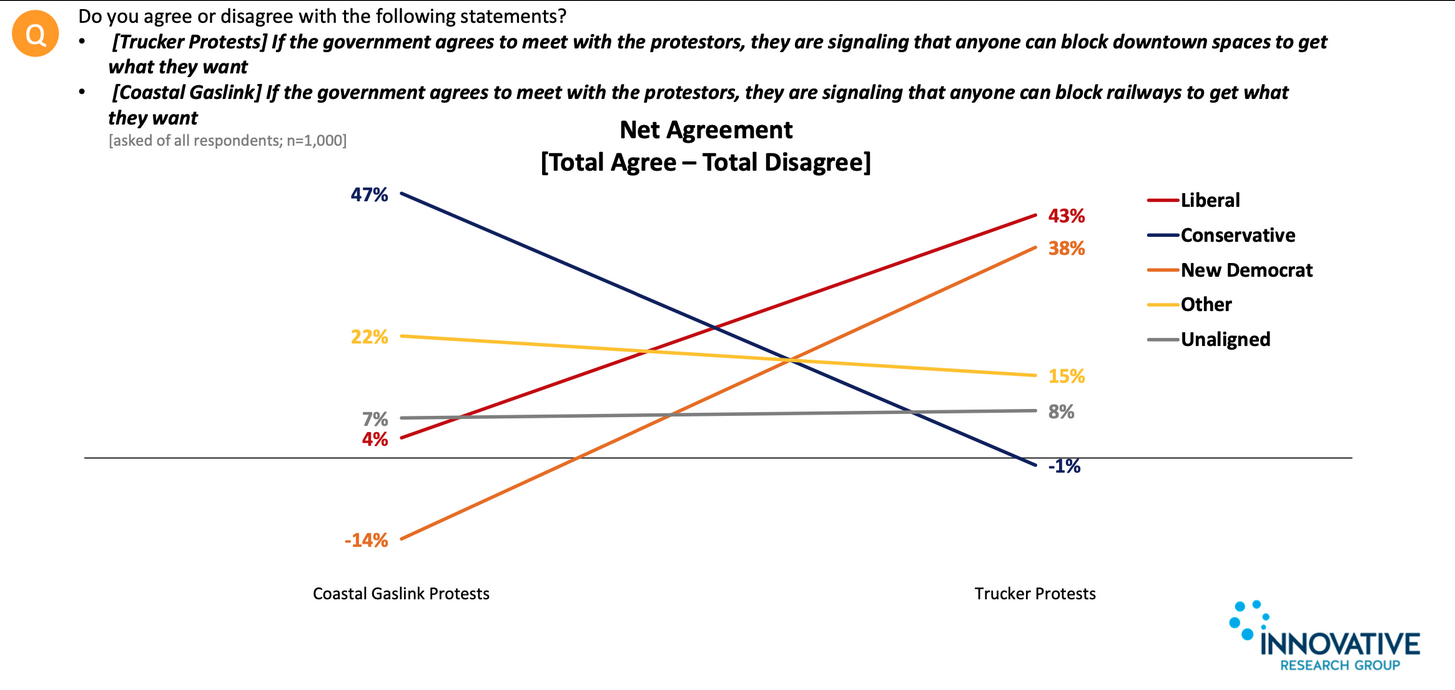
This graph is the best illustration of Canadian politics I’ve seen this year. It comes from Greg Lyle, the pollster who runs Innovative Research Group. He published it in February when downtown Ottawa was full of trucks. It takes some explaining, but we have time today.
On the left are results from a poll Lyle did in 2020. Rail blockades and protests had flared up across Canada, in support of Wet’suwet’en hereditary chiefs who opposed the Coastal GasLink pipeline project. One of the questions Lyle asked in 2020 was, Do you agree or disagree that “If the government agrees to meet with the protestors, they are signaling that anyone can block railways to get what they want”?
On the right are results from a poll Lyle did two years later, in March of this year. Agree/disagree, “If the government agrees to meet with the protestors, they are signaling that anyone can block downtown spaces to get what they want”?
[…]
In addition to NDP, Liberal and Conservative supporters, Lyle tracked opinions of people who support other parties. That’s the yellow line above. It’s nearly useless, a jumble of Green, People’s Party, Bloc Québécois and who knows what else.
But he also tracked responses of people who didn’t express support for any political party. That group’s responses didn’t swing at all between 2020 and 2022. That’s the black line above. Does meeting protesters encourage protests? Sure, on balance, a bit, these non-aligned voters said in 2020 (net +7%). People like them said the same thing in 2022 (net +8). Call this group the people who don’t freak out.
Now. Who gets heard in our politics? It goes without saying that the people in political parties, including the people in governments formed by political parties, are partisan. Liberals will tend to be on that upward-sloping red line in our graph. But what’s more important is that these days, only the people on the steeply-sloping partisan lines pay for our politics.
Since 2011, individual donors are the only source of funds for Canadian federal political parties. Corporate and union donations were eliminated in 2006. Public per-vote subsidies were eliminated in 2011. Today the only way I can pay my political party’s bills is if I can persuade lots of people like you to give me many small sums of money. And the people on that nice, even-keel, non-sloping black line in our graph? The people who don’t view every sparrow that falls as a little morality play about their heroes and the villains they face? Those people will never give anyone a dime. It’s the people who mood-swing wildly — who think our gang is great and their gang is the demon — who can be provoked into donating, again and again, until they max out for the year, and then again starting in January.
Irving Gerstein, the Conservative Party’s chief fundraiser under Stephen Harper, explained all of this in a 2013 column by Ken Whyte that stands as one of the most important documents for understanding our times: “Message creates momentum creates money.” Parties that reside permanently on the sloping lines of a Greg Lyle poll — that think, talk and act like their most fervent supporters — are able to separate those people from their money. Parties that exit the slope for the level meadows of moderation go nowhere.
May 16, 2022
The Hudson’s Bay Company in Canadian history
As a kid growing up in the late 60s and early 70s, “The Bay” was just a department store. It wasn’t as upscale as Eaton’s, but had different stock than Eaton’s or Simpson’s so occasionally you’d find something there that wasn’t available in the other major central Canadian department stores. It took me an embarrassingly long time to make the connection between the big retail store in the mall and the company that owned vast swathes of what eventually became Canada in the seventeenth and eighteenth centuries. At Terra Nullius, Ned Donovan tries to put that massive geo-political organization into context:
At the turn of the 17th Century, felt hats were all the rage and felt hats are made of beaver skin. At the time, this relied on Russia’s long-established fur trade. But as demand grew, quality dropped significantly as the native European beaver population began to be hunted out of existence. Within decades, it was very difficult for merchants to find high quality felt from Russia, and customers in England were complaining that they were having to wear felt made from rabbit instead.
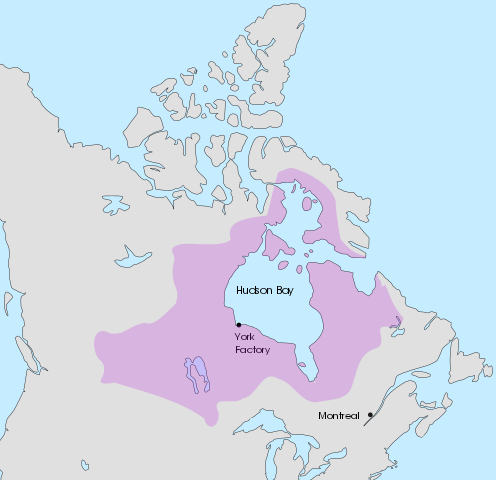
Approximate extent of Prince Rupert’s Land in the late 17th to early 18th century – note that this is the range of the company’s trappers and traders, not military or political control.
Image from Wikimedia Commons.But around the same time, irregular and rare shipments began to arrive from the European colonies in North America where beaver – mostly trapped by French settlers and Indigenous Americans – was still plentiful and of very good quality. In 1669, the ship Nonsuch dropped anchor in the Thames with a large shipment of some of the highest quality furs London had ever seen, selling them immediately for £1,233 (equivalent to around £1 million in 2022). The Nonsuch had led an expedition invested in by some of London’s richest merchants and sponsored by Prince Rupert, a first cousin of King Charles II. It had done its trapping in Hudson’s Bay in the north of what is now Canada. The purpose of the expedition was to demonstrate that the issues with fur supply could be solved if its trapping in North America could be optimised, leaving behind the slow and traditional approach of the French and First Nation trappers.
This was not the first time Prince Rupert had seen to make money from exploiting colonised lands, having poured large amounts of his wealth into the slave trade from West Africa and sitting on the board of the Royal African Company. With this financial success made from trading in human lives, he turned his interest to North America and helped put together the syndicate that sent the Nonsuch to Hudson’s Bay. In 1670, his cousin King Charles II granted the syndicate a royal charter to form the Hudson’s Bay Company, giving the company a monopoly over “Prince Rupert’s Land” made up of the land drained by rivers and streams flowing into Hudson’s Bay – or 3,861,400 square kilometres.
In short order, the company had established trading posts throughout its monopoly, known as factories (as each was controlled by a company official known as a factor). The only thing that mattered to these factories and its parent company was beaver. Nothing could stand in the way of ensuring the safe passage of furs and pelts to Europe. By 1690, the demand in England for hats and caps was five million per year – or one per person. Hundreds of thousands more would be exported onwards from England to Europe such was the demand for the well-known quality of the Hudson Bay beaver. For example in 1756, Portuguese customers spent more than £20 million in today’s money on English beaver felt hats.
As Prince Rupert’s Land was largely still wilderness, besides company staff it was inhabited only by European and First Nations trappers and as a result there was only a barter economy, to both subjugate indigenous residents and prevent private wealth. There were standardised prices throughout Prince Rupert’s Land and instead of a normal currency, the company instead pegged everything against the unit of 1MB (1 Made Beaver). For three made beaver pelts, you could be given one clay pot in exchange at a company store, or for 10 you could get a gun. Private trading was outlawed and all beaver pelts that left Prince Rupert’s Land traveled through the warehouses and accounts of the Hudson’s Bay Company.
May 8, 2022
“It’s like these guys watched Anne Hathaway on WeCrashed and convinced themselves they can ‘elevate the world’s consciousness’ through arts grants. “
In the latest SHuSH newsletter, Kenneth Whyte brings us up to date on the latest adventures of the Canada Council for the Arts:

The Canada Council for the Arts held its annual public meeting March 30 and a video of it is now up on YouTube where, as of Thursday night, 321 people had tuned in to see CEO Simon Brault’s new shoelaces.
It’s not time for another deep dive into the ameliorative ambitions of Canada’s leading arts funding agency. We’ll just note that everything I observed in SHuSH 139 is on abundant display in this video, from the exhaustive land grant acknowledgment to non-stop discussion of equity, climate change, and Ukraine to a (mercifully short) speech by council chairman Jesse Wente, most of it dedicated to his usual one-note Indigenous activism (you’re supposed to rep all artists, Jesse).
Cheque-mailer-in-chief Brault, who obviously finds the real work of his position boring as fuck, says his immediate and long-term priorities (at a time when most of the nation’s artists and arts organizations have been economically devastated by the pandemic) are “elimination of racism and discrimination … and focusing on decolonization in people’s minds, in systems, and in institutions.”
Every square on the bureaucratic buzzword bingo card is covered: “intentionality”, “innovation”, “risk-taking”, “sustainability”, “inclusivity”, etc.
It’s like these guys watched Anne Hathaway on WeCrashed and convinced themselves they can “elevate the world’s consciousness” through arts grants.
Will they succeed? Given that they can’t match the production values of local cable despite a half-billion budget, odds are long.
Anyway, their not-quite-viral symphony of sanctimony is an experience. Give it a watch.
April 16, 2022
Remember all the angst about untold numbers of unmarked graves at former residential schools?
Oh, c’mon man! You must remember the performative grief and anger as even the Prime Minister got into the act by declaring Canada a nation that had committed genocide against as-yet-uncounted First Nations children (oh, and upping the ante, he also implied that this genocide was still ongoing). Do you remember the number of times these graves — often described as “mass graves” rather than merely “unmarked graves” — were investigated in the wake of all this media attention and the fate of at least some of the victims confirmed? No? Well, there’s a good reason for that:
Kamloops Indian Residential School, 1930.
Photo from Archives Deschâtelets-NDC, Richelieu via Wikimedia Commons.
Rosanne Casimir, the chief of the local Tk’emlúps te Secwépemc First Nation, said that “knowledge keepers” within the community had guided investigators to the area to be searched — which had once been an apple orchard on the residential school’s premises. The chief also said that knowledge keepers had already told her that what lay below the surface were graves of children whose deaths had previously been undocumented.
Following that announcement, several other First Nations announced their own discoveries. And in December, the Canadian Press called the discovery of unmarked graves, the “news story of the year”.
If you aren’t from Canada, it’s hard to understand the scale of the national reaction to this story. It’s been known for decades that thousands of Indigenous children died during their time in the residential-school system, many of them from tuberculosis. But this new discovery set the country off emotionally. Justin Trudeau, the prime minister, lowered the Canadian flag on public buildings, and didn’t raise it for another five months. And journalists became unrestrained in the language they used. In one Canadian newspaper, a headline ran, “Is this Canada’s Holocaust moment?”
Canadians were assured that these weren’t just graves, they were the graves of children; and furthermore, it was suggested, these children hadn’t just died from malnutrition or untreated disease — which is obviously bad enough. Some suggested these children were flat out murdered and dumped in shallow graves in the middle of the night. These claims were even aired by the national broadcaster, CBC, on an investigative show called Fifth Estate.
In the Kamloops press, meanwhile, Dr. Sarah Beaulieu, the ground-penetrating-radar expert who’d helped with the discovery, described — as a newspaper put it — “recollections of children as young as six years old being woken up in the middle of the night to dig holes for burials in the apple orchard.”
But there was one odd aspect to the story — and it got odder as the weeks and months marched on: No one seemed to be in any kind of hurry to see what was actually beneath the surface. All we had were ground-penetrating-radar images. And those images don’t show bodies, or caskets, or anything like that. What this technology shows are soil dislocations, which, depending on their depth and spacing, can sometimes indicate the possible presence of grave sites. Why weren’t police, or indigenous authorities, or forensic teams searching for the remains of these poor children?
It’s important to remember that Canadians were being told that this was a crime scene — indeed, not just any crime, but mass murder. If you told Canadians that, say, 215 murdered white children were buried in a field in Toronto, or Ottawa, or Vancouver, there’d be investigators and police all over the place — to see if they could find remains that could be tested and identified. Maybe evidence could be collected showing the manner of death.
And remember that many of the abuses identified at the Kamloops residential school and others like it date to the middle of the 20th century. This means that some of the perpetrators of these claimed child homicides — that is, the teachers, administrators, priests, and ministers who worked at these schools — some of them could still be alive. Shouldn’t we be getting evidence and building a case against them?
March 13, 2022
The Canada Council for the (woke) Arts
In the latest SHuSH newsletter, Kenneth Whyte looks at the origins of the Canada Council for the Arts and compares its original mission to the new direction the crown corporation plans to take:

The Massey Commission (1951), from which all public funding of arts, culture, and scholarly research in Canada derives, and out of which our flagship granting body, the Canada Council for the Arts, was born, knew that it was pushing the nation into perilous terrain. “The dangers inherent” in any system of grants from the central government to arts, letters, and culture was that “the government or its agents would attempt not merely to encourage but to direct” artistic and cultural expression.
The Massey Commission was not the first entity to confront this issue. Much like the Great Canadian Baking Show is a re-staging of the Great British Baking Show, the Massey Commission itself was a knockoff of a UK original (a sad commentary on an initiative intended to define and promote Canada’s unique national identity). The UK effort resulted in the establishment of the British Arts Council, initially chaired by Lord Keynes. Massey quoted him at length on the potential pitfalls of arts funding:
At last the public exchequer has recognized the support and encouragement of the civilizing arts of life as part of their duty. But we do not intend to socialize this side of social endeavour. Whatever views may be held by the lately warring parties, whom you have been hearing every evening at this hour, about socializing industry, everyone, I fancy, recognizes that the work of the artist in all its aspects is, of its nature, individual and free, undisciplined, unregimented, uncontrolled. The artist walks where the breath of the spirit blows him. He cannot be told his direction; he does not know it himself. But he leads the rest of us into fresh pastures and teaches us to love and to enjoy what we often begin by rejecting, enlarging our sensibility and purifying our instincts. The task of an official body is not to teach or to censor, but to give courage, confidence and opportunity.
The founders of the Canada Council felt so strongly about the dangers of political interests imposing themselves on the arts, using federal money to force artistic and cultural activities in one direction or another, that they built checks and balances into its founding legislation. The Canada Council was made a crown corporation, at arm’s length from political types, and its board members were required to “avoid the promotion of any personal interests” or any other specific interests, whether on behalf of regions or “stakeholder groups”.
I can’t speak to the whole of the Canada Council’s activities, but from what I’ve seen of its annual reports, public statements, and funding practices, the Canada Council has jumped the tracks and is now fully dedicated to teaching, censoring, and directing artistic endeavour.
Here’s Simon Brault, chief executive of the Canada Council, giving an enthusiastic endorsement of the core Trudeau government priorities of Indigenous rights and environmental activism:
We need to reimagine an arts sector determined to eliminate racism and discrimination in every form, and the legacy of colonialism. We need to reimagine the arts’ rightful place in the conversations that shape our future. And we need to reimagine, through the arts, a greener and more just and equitable world.
Even if you agree with Brault’s priorities, you have to admit that he is not straightforwardly supporting artistic endeavor but pushing the arts-and-culture sector toward the achievement of a socio-political program.
This mission is also explicit in the Canada Council’s new five-year plan, which has surprisingly little to say about lifting artists and arts organizations out of penury, which some might consider a laudable goal after years of financial crisis and pandemic:
Those are the council’s highlights, not mine.
This past week, the politicization of the Canada Council reached new heights when Brault announced that in solidarity with the Ukrainian people he would cease to fund any “activity involving the participation of Russian or Belarusian artists or arts organizations … This includes partnerships, direct and indirect financing of tours, co-productions, participation in festivals or other events held in Russia.”

March 8, 2022
HMCS Harry DeWolf goes INTO THE NORTH
Royal Canadian Navy / Marine Royale Canadienne
Published 7 Mar 2022Akuni aullarsimaniq (ᐊᑯᓂ ᐊᐅᓪᓚᕐᓯᒪᓂᖅ) Inuktitut for “A long journey”.
Imagine the adventure! For the crew of our first Arctic and Offshore Patrol Vessel, HMCS Harry DeWolf, their inaugural deployment circumnavigating North America from August to December 2021 presented many unique and life-changing experiences.

January 26, 2022
Three generations of the OG Puritans
At Founding Questions, Severian considers the New England Puritans and the world they inhabited:
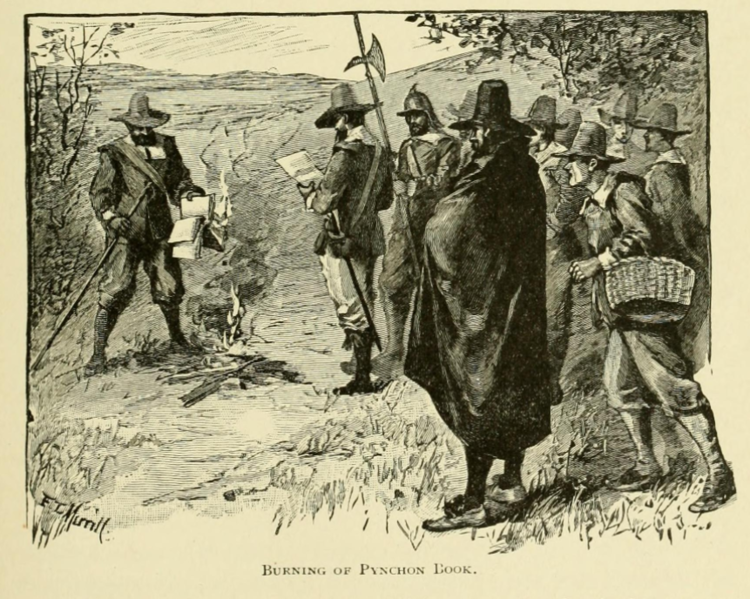
Portrayal of the burning of copies of William Pynchon’s book The Meritous Price of Our Redemption by early colonists of the Massachusetts Bay Colony, who saw his book as heresy; it was the first-ever banned book in the New World and only 4 original copies are known to survive today.
Engraving by F.T. Merrill in The History of Springfield for the Young by Charles Barrows, 1921.
Total cultural and intellectual uniformity, constantly reinforced. If those Puritans were going to go crazy, in other words, they’d do it within very carefully circumscribed boundaries. The only thing close to that level of mental control is Twitter … and I suppose I must put the disclaimer out front, so that you can factor it in if you disagree with me: I hate the Puritans. They’re just SJWs with balls and a slightly less tedious prose style. When they’re not obsessing over the tiniest motions of their pwecious widdle selves, they’re screwing you over for the hellbound heathen you are.
Credit where it’s due, though: If you need to go sodbusting in an unexplored continent, the Puritans are your guys. The original Plymouth Bay colony was thoroughly militarized, and they didn’t fuck around — when the local Indian tribes were beginning to wonder if they shouldn’t do something about these White devils they’d let loose, the Puritans attacked the fiercest tribe and wiped them out, as a show of force. Life was hard in the OG Plymouth Colony, but it was about as good as you were going to get in that era.
But the typical inheritance pattern soon took over. “Regression to the mean” is a behavioral phenomenon, too, not just an IQ one. Puritanism is an obsessive, paranoid creed; it can only flourish in times of high stress and dire insecurity. But by the 1690s, Plymouth Colony was arguably the healthiest, wealthiest, safest place per capita in Christendom (not a high bar, obviously, but still). The OG settlers were all gone by that time, of course — the original settlement, you’ll recall, was 1620 — and so were most of their almost as hardcore kids. The third generation was coming up fast …
… but finding their way blocked by the old men of the previous generation, who were as tediously, dogmatically Puritan as the OGs, but without the stones. This made them — the 2nd generation — enormous hypocrites, but even without the hypocrisy, imagine living in a world where the ultra-wealthy who control everything in society tell you that they deserve it all, because they’re God’s Elect, while you, sinner, deserve to live in a rented box and eat bugs and own nothing, because God hates you.
History’s full of weird stuff like that, and that was the situation circa 1690. One example will have to do: Since we probably all got to experience Nathaniel Hawthorne’s existential angst back in high school, consider that the ancestor who caused him so much grief, Judge John Hathorne, was born in 1641. He would’ve been 51, then, during his trial service – a ripe old age by 17th century standards.
Not only that, but the 2nd generation — the one that stubbornly refused to move on and let the kids take their place in the sun — had spent the previous twenty years grievously fucking things up. King Philip’s War nearly ruined the colony, there’d been widespread plague, and oh yeah, that whole Restoration thing back in England — the hardest of hardcore Puritan thinkers in the run-up to the Civil War had been colonials; guys like Col. Rainsborough were closely associated with Massachusetts, etc. Lots of bad blood on the other side of the water, and while the third generation was willing to let bygones by bygones, the 2nd generation wasn’t.
So: Hypocritical old throwbacks and cavemen, with a decades-long track record of dumbfuckery, who just wouldn’t get out of the way. As they got older, they got more insular and inward-looking, as old people tend to do … and “more inward looking” for a Puritan is a near-BCG level of narcissism. Meanwhile, the new generation is eager to take their place in the burgeoning Atlantic world, especially after the Glorious Revolution (1688) … but can’t.
January 16, 2022
QotD: Once “discovered”, colonization of the Americas was inevitable
This is not a joke. Political reality has a way of crashing in on the pipe dreams of liberal academics. The reality is, if the English had not colonised, then the French or the Dutch would have. If the Spanish had not colonised, the Portuguese would have. This would have shifted the balance of power at home, and any European country which had not colonised, would have been relegated to secondary status. And it is easy to overestimate the amount of control that European governments actually had. As soon as the New World was discovered, many fisherman and traders sailed across the Atlantic on their own, in hopes of circumventing tax authorities and scoring a fortune. Long before colonies were established in most regions, the New World was crawling with Europeans whose superior technology gave them an edge in combat. Nonetheless, it was extremely dangerous for Europeans to provoke fights with Native Americans, and most of them tried to avoid this when possible. In retrospect, one could in theory be impressed that so many European governments showed a genuine concern to rein in the worst excesses of their subjects, with an express eye to protecting the Indians from depredation. The logic was simple: they attempted to protect their subjects at home, in order to secure good order and a better tax base. So they would do the same to their subjects in the New World. For a long time, few Europeans harboured any master plan of pushing the Native Americans out of their own lands. In more densely populated regions such as Mexico, such an idea must have seemed an absurdity. Reality tends to occur ad hoc. Boundaries often took generations to move, and would have seemed fixed at the time. For several centuries, many Europeans assumed that they would long be a minority on the North American continent. In Mexico and Peru, they always have been.
Population density mattered, a lot, when it came to pre-modern global migrations. China and India were “safe” from excessive European colonisation because they had the densest populations in the world, and they were likewise largely immune to any diseases brought by Europeans. SubSaharan Africa had a lower population density depleted by slave raiding, but they still outnumbered European colonists by a large margin throughout the colonial era — again because European contact did not decimate their numbers through disease the way it did in the Americas. It is worth noting that no one claims that Europeans committed genocide in India, Asia or even Africa, although their technological advantages gave them every opportunity had they actually been of a genocidal mindset (as were for example the Mongols). In fact, the European track record shows them to be almost shockingly un-genocidal, given their clear technological advantages over the rest of the world for a period of several centuries. Few other civilisations, given similar power over so much of the world’s people, would have behaved in a less reprehensible manner. This is not to give Europeans a pat on the back. Rather it is to point out that Europeans are regularly painted as the very worst society on Earth, when in fact they had the power to do far, far more evil than they actually did. Let us at least acknowledge this fact.
Jeff Fynn-Paul, “The myth of the ‘stolen century'”, Spectator Magazine, 2020-09-26.


