
World War Two
Published 24 Apr 2024It’s time for another thrilling installment of Out of the Foxholes, but what sort of questions does Indy answer today? Well, it’s good stuff — about Allied security and logistics at the major conferences, about what the British navy was doing once the Atlantic and Mediterranean were secure, and about the skills (or lack thereof) of the soldiers of the Waffen SS. How can you live without knowing about such things? I suppose it’s possible, but it would be a sad life indeed, so check it out!
(more…)
April 25, 2024
Were the Waffen-SS Really Germany’s Elite Fighters? – WW2 – OOTF 35
Comments Off on Were the Waffen-SS Really Germany’s Elite Fighters? – WW2 – OOTF 35
April 20, 2024
How much of your language do you have to destroy to avoid the taint of historical fascist usage?
For understandable reasons, German governments since the end of World War 2 have been twitchy about any symbols, songs, words and phrases that were used by Hitler’s various fascist organizations … to the point of making many things illegal. eugyppius outlines one particular case where the use of a simple German phrase by an AfD politician has landed him in court, facing a possible three-year prison sentence even though he denies that he knew the phrase had such connotations:
Today, the leader of the Alternative für Deutschland faction in the Thuringian state parliament, Björn Höcke, appeared before the district court in Halle for the first day of his long-awaited speech trial. He stands accused of having used a forbidden Nazi slogan favoured by the Sturmabteilung at a political rally in Merseburg on 29 May 2021. Höcke pleads that he used the three-word phrase in a moment of spontaneous elaboration at the end of his speech, without knowing its National Socialist associations. Out of an abundance of caution, I won’t quote the phrase here, even in translation, but I’ll provide it in context below; it begins with the words “Everything for” (“Alles für“) and concludes with the name of the Federal Republic. As slogans go, it is so seemingly banal that before the trial many Germans would have been surprised to know it had any Nazi associations at all.
For the moment, not much has happened. Höcke’s lawyers filed a variety of requests, among them that the Federal Constitutional Court answer a question surrounding the court’s jurisdiction. In consequence, it’s unclear whether the trial will continue as scheduled next week or whether it will have to be substantially delayed. The state prosecutor’s position is that Höcke’s background as a history teacher makes his claims of ignorance implausible. The prosecutors’ office have also added an additional charge for Höcke’s defiance at a rally in Gera last December, where he shouted the first two words of the slogan at the crowd, and invited them to supply the last one. I fear that this was a grave mistake, because as we will see, the original case against Höcke is laughably weak.
If found guilty, Höcke could be fined or sentenced to prison for up to three years. It is also conceivable that his right to vote and run for office could be suspended. Whatever you think of Höcke or his politics, the political dimensions of this trial are undeniable, as it is occurring mere months ahead of the Thuringian state elections, and as Alternative für Deutschland commands a solid plurality of polling numbers in that state.
[…]
That Höcke deliberately used the SA slogan as a subtle enticement to the extreme right is more than doubtful; that he also did so in hopes that he would be prosecuted and profit politically from his victimisation is so ridiculous, I can’t imagine that even Hillje really believes this. This obnoxious thesis nevertheless recurs whenever the German press report on the harassment of AfD politicians; it is somehow their fault, because they are held to benefit from it.
Der Spiegel, always a source of unintentional amusement, ran a headline today mocking Höcke as a “history teacher with no knowledge of history“. “He claims not to know it was an SA slogan”, they report, “but there are doubts about this”. Alas, the very same news magazine last September accidentally used the forbidden phrase to headline an approving article on Olaf Scholz’s proposed “Germany Pact”. They rapidly changed the headline, appending this brief and embarrassing correction to the bottom:
An earlier version of the article was headed with a line that was used by the SA as a slogan. This was not intended by the author and editors and has now been changed.
Comments Off on How much of your language do you have to destroy to avoid the taint of historical fascist usage?
Russian and French Nazis Defend the Reich – ϟϟ Foreign Fighters Part 3
World War Two
Published 19 Apr 2024As the war turns ever more against Germany, Reichsführer-SS Heinrich Himmler keeps loosening the racial standards of his Waffen SS. More and more non-Germans fill the ranks of his forces. Some of these non-German fighters will be among the last defenders of the Third Reich.
Click here for parts one and two:
Comments Off on Russian and French Nazis Defend the Reich – ϟϟ Foreign Fighters Part 3
March 27, 2024
The Volkssturm – a Million men to save the Reich?
World War Two
Published 26 Mar 2024The Volkssturm is the last-ditch people’s army of the Third Reich. Sure, on paper, there are millions of old men and boys ready to defend Germany. But how will they be armed? Are they truly willing to die for Hitler? Will they make any difference at all?
(more…)
Comments Off on The Volkssturm – a Million men to save the Reich?
March 23, 2024
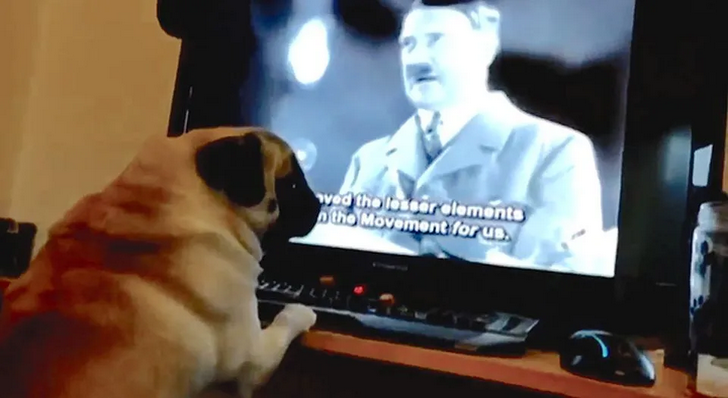
“At least they didn’t arrest the dog”
Andrew Doyle revisits the Nazi pug story as new Scottish blasphemy hate speech laws are about to come into force at the beginning of April:
If you’re deluded enough to suppose that human history works in a progressive linear fashion, the example of Scotland should swiftly change your mind. Once the home of the Enlightenment, the country has now veered into authoritarianism under the control of the SNP. The party’s new hate crime law will come into force on April Fools’ Day, and no-one in government is seemingly able to give examples of “crimes” that would be covered by this legislation that aren’t already criminal. When specifically asked on the BBC’s Newsnight whether “misgendering” would result in prosecution, SNP backbench Fulton MacGregor could only mutter: “Well, it depends on the circumstances”. How reassuring.
For all MacGregor’s “faith” that the law would be “properly” implemented, nonbelievers are right to be cautious. Vaguely worded legislation is bound to be exploited, and has been many times in the past. This is particularly the case when it comes to “hate speech”, a concept for which no adequate definition has ever been achieved. The best the Irish government could muster for their forthcoming hate crime bill is that hatred “means hatred”. In these times of slippery authoritarian wordplay, that’s about as specific as we can expect.
The Scottish police have claimed that they will not “target” comedians and actors under the new legislation, and yet at the same time have sworn to investigate every complaint. Thankfully, activists never make spurious complaints against their ideological opponents in the hope of seeing them silenced. Oh wait. They do. All the time.
[…]
So for all of the claims that our concerns about the new hate crime law are unfounded, and that the police would never prosecute anyone for a gag, we should remember that they already have. This legislation will simply make it easier for activists within and without the police force to weaponise the law against those deemed to be subversive. On the day of Meechan’s arrest, one police officer affirmed that he must be “an actual Nazi trying to inspire people to become Nazis”. The judge eventually agreed, in spite of the fact that after two years of investigation the police had uncovered no evidence of far-right sympathies.
Of course those who wish to criminalise dissent will not stop at comedians. They’ll also be keen to crack down on anyone who knows the difference between men and women and is willing to declare this esoteric knowledge out loud. Although it has become a cliché to cite George Orwell’s Nineteen Eighty-Four in such circumstances, that is only because it is so apposite: “The Party told you to reject the evidence of your eyes and ears. It was their final, most essential command”.
I do not sincerely believe that the police will turn up at our Comedy Unleashed show next Monday. It seems unfathomable that we might see a kind of re-enactment of the closing scenes of The Blues Brothers, with police officers standing in the shadows of the club to monitor the show for heterodox content. But then, I would never have anticipated that in a free country someone who made a video mocking Nazis would end up with a criminal record. Of course our show will be offensive to those who choose to be offended. Such is the nature of comedy. The only way to avoid such a situation would be for the acts to stand on stage in total silence. And even then, someone might find this offensive to mutes.
Comments Off on “At least they didn’t arrest the dog”
March 17, 2024
QotD: Imperial Japan and Nazi Germany never had a “long game” … but Stalin did
Though both the Germans and the Japanese had every intention of starting major wars, as everyone knows they seemingly put zero thought into what they’d do once they won. I know, I know, [Himmler] had his sweaty wet dreams about Wehrbauern on the vast Russian steppes, but all but the most rudimentary post-victory planning seems to have been beyond the Third Reich’s capacity — the Reich Resettlement Office, for instance, was tiny even when the war looked like it would be over by Christmas. The Japanese were, if anything, even dumber — they honestly seemed to believe they could run China, all of it, and even India Manchukuo-style.
The Russians, meanwhile, never stopped playing the long game. While Goebbels made a few token gestures at rapprochement with “the West” (yeah, they called it that), and to sell Nazism to ditto, his heart wasn’t in it, any more than the Japanese’s heart was in their “Greater East Asia Co-Prosperity Sphere” hooey. Stalin, by contrast, was always pimping Communism to the West — even in the deepest, darkest days of the war, when it looked like the Wehrmacht was about to march into Moscow, the propaganda directed at the West continued full blast.
Like the German and Japanese aircraft industries, the German propaganda industry was ideologically locked into its core mission: To sell Nazism to Germans. And they were aces at it, no doubt … but then the mission changed. The smart thing for the Germans (and Japanese) to have done with their conquered territories was, in the context of the war, to ease up on the Nazi shit for the duration. The Nazis could’ve had zillions of Ukrainians fighting for them in 1941 just as the Japanese probably could’ve waltzed into India in 1941 had they not been so … well, so Japanese, in the rest of the Pacific rim. Stalin would’ve done it in a heartbeat, had the situation been reversed, and to hell with “authentic” Marxism-Leninism. Win the war first; square the ideology later.
As this is running way long, one example should suffice. Goebbels approached the task of selling Nazism to Germans in the most German way possible: He created the Reich Culture Chamber, which controlled all newspapers, radio broadcasts, film distribution, etc. And it worked, as far as it went — Goebbels deserves his “evil genius” rep — but as we’ve seen, that locked the leadership into an ideological straightjacket. Telling the Wehrmacht to ignore the Commissar Order and buddy up with the Ukrainians would’ve been the smart thing to do, militarily, but it was culturally impossible. Goebbels did his job too well … and then the mission changed.
The Soviets had a similar problem inside the USSR, but — here’s Stalin’s evil genius — they had free reign in propagandizing the West. Goebbels hardly bothered, but the Soviets poured massive resources into it. Forget, as far as you can, everything you think you know about “Nazism” […]. Even if you look at it as objectively as possible, it still seems ridiculous, and there’s a simple explanation for that — it’s not for you. Unless you were a pure blooded Aryan, actually living in Germany (or within Germany’s potential military reach), [they] couldn’t care less about you. Which made being a “Nazi” in, say, America uniquely pointless — you just look like a bigot at best, a traitorous bigot at worst.
Being a “Communist”, though? That was universal. Indeed, that made you a Smart person, a very very smart person, and morally superior to boot. Why? Because you care so much that you’ve mastered this large body of deliberately esoteric doctrine, comrade … all straight out of the NKVD playbook. And if actual life as it was lived in the Soviet Union didn’t quite measure up to the promises, well, that’s because they didn’t have the right people — people like YOU — running things. It’s fucking brilliant — a totally ideologically closed, indeed brutal, system at home, presented as the most open-minded, enlightened, tolerant one possible abroad.
Which is why Joey G. needed a huge Reich Culture Chamber that never came close to justifying its budget, and Stalin needed, effectively, nothing. Being so very, very Smart, wannabe “elites” in the West were happy to spread Commie propaganda for free. The NKVD, let alone the Gestapo, ain’t got shit on the Junior Volunteer Thought Police of Twitter and Facebook …
… which forces us to confront the question: Which model of propaganda are our rulers using? Has the one morphed into the other? Is it real, or is it just “German efficiency”?
Severian, “The Myth of German Efficiency”, Rotten Chestnuts, 2021-05-26.
Comments Off on QotD: Imperial Japan and Nazi Germany never had a “long game” … but Stalin did
March 2, 2024
The Hindenburg Disaster – Dining on the Zeppelin
Tasting History with Max Miller
Published Nov 28, 2023Decadent vanilla rice pudding with poached pears, chocolate sauce, and candied fruit
City/Region: France
Time Period: 1903Everything about this dish exudes fanciness, and it comes as no surprise. A ride across the Atlantic on the Hindenburg cost around $9,000 in today’s money, and the whole experience was meant to be luxurious. The head chef on the Hindenburg, Xaver Maier, had worked at the Ritz Hotel in Paris, which was still cooking from the recipes of Auguste Escoffier.
The Escoffier recipe for pears condé seems simple enough, until you realize he references about 5 other recipes in total in order to make the dish. It’s a lot of work, but it’s so good. The rice pudding has such an intense vanilla flavor that really elevates it and is the perfect base for the poached pears. Don’t get too much of the rich chocolate sauce or it will overwhelm the other flavors.
Really you could make just the rice pudding and have that be a fancy dessert all on its own if you don’t want to go to all the fuss.
Poires Condé:
Very small pears which are carefully peeled and shaped are most suitable for this preparation. Those of medium size should be cut in half. Cook them in vanilla-flavored syrup then proceed as for Abricots Condé, recipe 4510.
Abricots Condé:
On a round dish prepare a border of vanilla-flavored Prepared Rice for sweet dishes (recipe 4470)— Auguste Escoffier, 1903
Comments Off on The Hindenburg Disaster – Dining on the Zeppelin
February 17, 2024
Hitler speaking – not the raging, raving maniac we all think he was
Colby Cosh on a major German academic effort to provide an authoritative digital record of Adolf Hitler’s actual speeches, rather than the highly selective snippets we in the English speaking world have seen or the “official” transcripts that were published in Nazi propaganda organs:
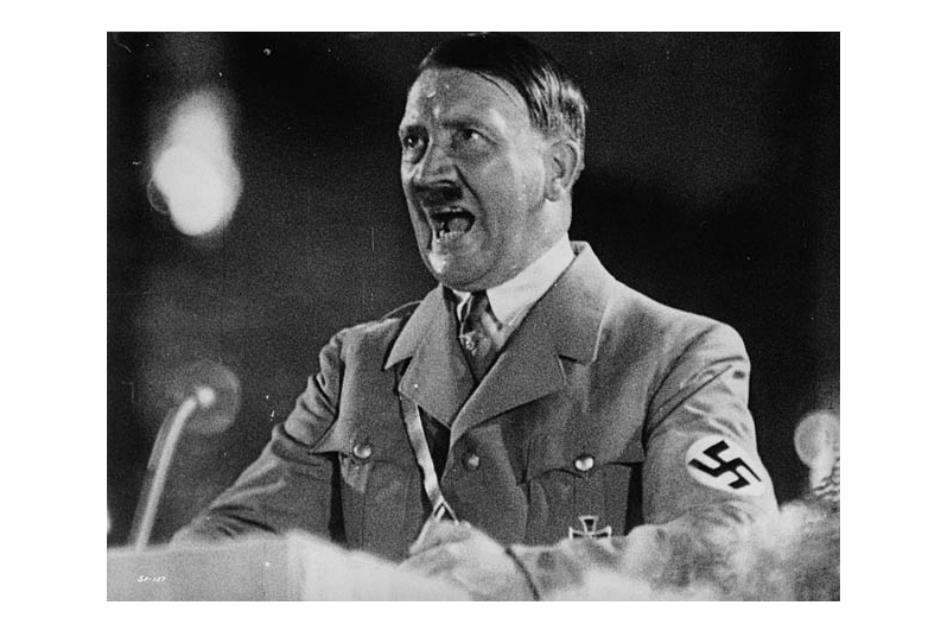
Adolf Hitler making a speech sometime between 1933 and 1940.
Library and Archives Canada item number 3191955.
You may have seen reports that a consortium of German research institutions has set out on a seven-year project to compile, annotate and digitize every speech Adolf Hitler gave as chancellor of Germany. The effort is being led by the Institute of Contemporary History (Institut fuer Zeitgeschichte, or IfZ), a Munich-based German government research consortium founded in 1947 to preserve the various records of Germany’s experience under National Socialism. Since that time, there has been a whole lot more zeitgeschichte in Germany, of course, so the IfZ also does a lot of work on communism, the Cold War and German reunification. It helps run important museums and historical sites, such as Hitler’s mountain retreat on the slopes of the Obersalzberg.
[…]
The co-head of the new project is Magnus Brechtken, deputy director of the IfZ and author of a landmark 2017 biography of Hitler’s pet architect and economic manager, Albert Speer. In January, Brechtken gave an absorbing German-language interview explaining the need for a contemporary, digital Hitler edition. Run that puppy through Google Translate and you’ll see that it commences amusingly with the question, “So do you have Adolf Hitler’s voice running through your head all the time?”
(This probably wouldn’t be as hellish as it sounds. Hitler didn’t really bellow like a rabid animal at his audiences for hours on end, contrary to the image of him that you and I have in our heads, and he spoke with a low, musical Austrian accent that German speakers like Brechtken seem to appreciate.)
Brechtken observes that in writing his Speer book, he spurned Domarus and went to the Sisyphean trouble of running down primary versions of relevant Hitler speeches himself. Hundreds of audio recordings of Hitler have survived in the German Broadcasting Archive in Frankfurt, and the project team has computer scientists and even linguists on board to help integrate text, sound and historians’ notes on persons, events and the context of the speeches.
No doubt the finished product will be consumed by the uglier parts of today’s German political right, and its reaction is fully predictable. Some will say, “At last, the real Hitler!”; and an equal number will say, “This whole project is a parcel of falsehoods — it’s fake Hitler!”
Comments Off on Hitler speaking – not the raging, raving maniac we all think he was
January 18, 2024
Understanding the Spanish Civil War
Niccolo Soldo offers an introduction to the context in which the Spanish Civil War took place, with emphasis on one side’s uneasy coalition of interests:
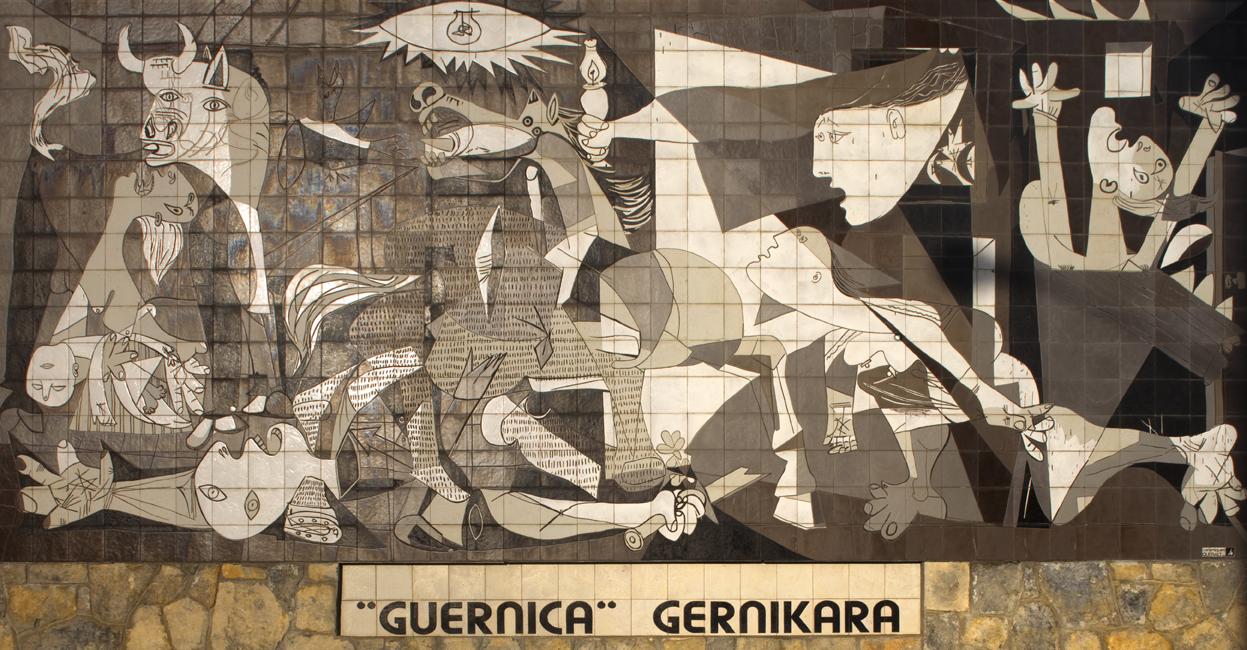
Picasso’s “Guernica” in mural form in the town of Guernica.
Photo by Papamanila via Wikimedia Commons.
At a crossroads in his life, [Ernest Hemingway] decided to go to Spain to cover the conflict for a newspaper chain. Out of his experiences in that war came For Whom the Bell Tolls (1940), one of his most celebrated novels. In this excerpt, he uses the female character “Pilar” to relate the story of how Republican forces massacred a group of people in a small town who were opposed to the government and supported the Spanish Generals seeking to overthrow it. Derided as “fascists”, each of the men were forced to pass a line of pro-government peasants who would beat them with flails before throwing them off of a cliff. Civil wars are indeed the most vicious, even in fictional depictions like this one.
The Spanish Civil War is odd for two reasons, the first one being that more than any other war that I can think of, historians have placed a much stronger focus on the politics of the conflict to the detriment of its military aspects. The second reason is much more important overall, and particularly germane to the subject of this essay: it is the only war that I can think of where the histories have been overwhelmingly written by the losers.1
If you ask a random, somewhat educated person in the West about the Spanish Civil War, they will generally say that “Franco was a fascist who allied himself to Hitler and Mussolini and won the civil war in the most brutal fashion possible. He was a dictator who hated democracy and killed thousands upon thousands of innocent people.” Beyond that, they might make mention of Hemingway and his novel, or even Pablo Picasso’s painting entitled “Guernica”2, that depicts the victims of the German Luftwaffe bombardment of that small Basque town in the north of Spain. Others still will relay the fact that the term “Fifth Column” came out of the Spanish Civil War.3 Added up all together, the most simplified take becomes “Franco bad, Republicans good”.
Of course this take is wrong, as this conflict was too complex to arrive at such a ridiculous reductionist conclusion no matter which side you sympathize(d) with. To give you a quick illustration of just how complex this conflict was, here is a list of the major domestic factions that took part in it:
Spanish Republican Side:
- People’s Army (the armed forces of the Spanish Republic)
- Popular Front (left-wing electoral alliance of communists, socialists, liberals, anarchists)
- UGT (very large trade union affiliated with the Spanish Socialists)
- CNT-FAI (massive trade union of anarchist militants)
- POUM (anti-Stalinist communists, including some Trotskyites)4
- Generalitat de Catalunya (Catalonian Autonomists)
- Euzko Gudarostea (Army of the Basque Nationalists)
Spanish Nationalist Side:
- Spanish Renovation (monarchists supporting the Bourbon claimant to the throne, Alfonso XIII, who abdicated in 1931)
- CEDA (the main conservative party, Catholic conservatives)
- Requetés (traditionalist Catholic monarchist militants who supported the Carlist Dynasty, mainly from the region of Navarre)
- Falange Española de las JONS (Spanish Fascists)
- The Army of Africa, including the Spanish Legion (Spanish Army in Spain’s then-colony of Morocco, with many Moroccans serving in it)
Add to this mix the International Brigades5 that fought on the side of the government, and the German and Italian forces who backed the rebels. To list off all the political groupings that participated in the war is a mouthful, but necessary to hammer home the point of the complexity of this conflict. So here goes: nationalists, monarchists (from two competing royal houses), fascists, conservatives, liberals, social democrats, socialists, communists (from two competing camps), anarchists, and regional autonomists. In short, this war had something for everyone, which is why it caught the attention of so many foreigners (especially famous ones) at the time. But before we dive into the run up to the civil war, we need to understand some of the history of Spain that lead up to this “world war in miniature”.
1. “History will be kind to me, for I intend to write it” – falsely attributed to Winston Churchill, but it makes for a good quote to illustrate the point. From the International Churchill Society: “‘Alas poor Baldwin. History will be unkind to him. For I will write that history.’ And another version often repeated is ‘History will be kind to me. For I intend to write it.’
What Churchill actually said, in the House of Commons in January 1948, was in response to a speech by Herbert Morrison, the Labour Lord Privy Seal, which attacked the Conservatives’ foreign policy before the war:
“For my part, I consider that it will be found much better by all parties to leave the past to history, especially as I propose to write that history myself.”
2. In January of 1937, Picasso was commissioned by the Spanish Republican government to create a work of art to display at the upcoming World’s Fair in Paris in order to draw international attention to their cause. At the time, Picasso was living in the French capital. It wasn’t until he read reports of the bombing of Guernica on April 26 of that same year that he felt inspired enough to create something that he felt was worthwhile for audiences to see.
3. In September 1936, General Francisco Franco supposedly claimed that there were “four nationalist columns approaching Madrid, and a fifth column inside of it ready to attack”.
4. Leon Trotsky did not support POUM and went on to disassociate himself from them and their actions. George Orwell joined POUM when he went to Spain to volunteer to fight against the Spanish nationalists.
5. Formed by volunteers from outside of Spain and almost entirely Stalinist in leadership and political orientation.
Comments Off on Understanding the Spanish Civil War
December 27, 2023
The never-settled “Pétain question”
Theodore Dalrymple reviews a new book on the trial of Marshal Pétain after the liberation of France in WW2:
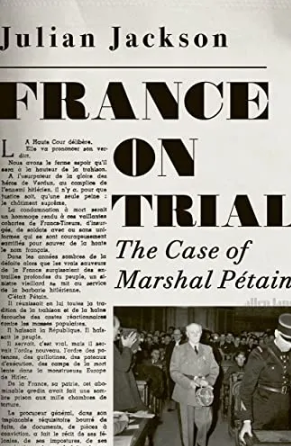
François Mauriac, the left-leaning, Nobel Prize–winning, Catholic novelist, said of the trial of Marshal Pétain that it would never be over: a sentiment more or less echoed by General de Gaulle. And certainly, the figure of Pétain continues to divide opinion in France, at least among those with opinions on such matters. Was he a traitor to France, or its savior, or perhaps something in between the two?
Professor Julian Jackson has written a superb book about Pétain’s trial, its circumstances, and its aftermath. I would like to say that I read it in one sitting, but it was too long for that; but I looked forward impatiently to picking it up again, all else being but a regrettable interruption.
The continued salience of what might be called the “Pétain question” is illustrated by the fact that one of the candidates in the last French presidential election, Éric Zemmour, claimed that Pétain was the savior of the French Jews. This was all the more startling because Zemmour himself is Jewish (his parents emigrated from Algeria to France not long before independence), and because, if Pétain is exonerated in the matter of the deportation of seventy-five thousand Jews during the war to Germany, there to be murdered, his reputation is all but saved: for it is in this matter that his record is most excoriated.
As Jackson reminds us, this was not always so. In the immediate post-war period, and during his trial for treason, the fate of the Jews of France was not much emphasized. According to Éric Conan and Henry Rousso, in their book Vichy, un passé qui ne passe pas (Vichy, a past that does not pass), the Jews of France themselves were not anxious that their treatment by Vichy should be emphasized, for they had had more than enough of being treated as a population apart. They wanted their suffering to be subsumed under that of the nation as a whole, and it was only later, by the subsequent generation, that the deportation assumed its great historiographical importance. It is not that nothing about the deportation was known before, it was merely that less emphasis was placed on it. There is an analogy with the historiography of the Soviet Union. Solzhenitsyn revealed nothing that was not, or could not have been, known before, with all its human and moral significance; the difference was that the world was now ready or willing to believe it.
But what of Zemmour’s claim, which is precisely that which Pétain’s defenders, when they are not outright anti-Semites, make on the Marshal’s behalf? It is certainly true that a far higher percentage of French Jews survived than, say, of Belgian or Dutch Jews (the figures are seventy-five, fifty, and twenty-five percent, respectively). But how much of the difference was attributable to the alleged relative decency, and cunning, of Vichy and its marshal?
Allow me a personal anecdote. Above my mother-in-law’s flat in Paris lived an old Jewish lady whose brother had been deported on the last convoy of Jews from Paris before the end of the occupation. She, however, had been saved by having been sent out of Paris to the care of nuns, who disguised her identity. Hence, she survived.
One day my mother-in-law was traveling on a bus and started to talk to an old lady next to her, who asked her where she lived. She gave the street, then the number, then the number of the flat, whereupon the lady next to her, who was Jewish, burst into tears. This was the very flat in which she had been hidden by family friends during the four years of the occupation, being careful never to appear at the window because opposite was the German Kommandantur, formerly and afterwards a police station. Four years of claustrophobic terror during adolescence: it was like something from a novel by Patrick Modiano.
The survival of these two old ladies owed nothing to Vichy or Marshal Pétain, but this does not settle the historical question. What percentage of the survivors owed their survival to the bravery of individuals, and what to policy decisions? We shall probably never know with any certainty. If one compares the survival rates of France and the Netherlands, what part did the relative geographies of the two countries play? France is much larger and less densely populated, and has many landscapes more conducive to concealment than the Netherlands.
Again, what of the pétainiste claim, repeated by Zemmour, that Vichy sacrificed Jews of non-French origin in order to save those of French origin? The former, however, were more conspicuous, with much smaller networks of potential defenders, than the latter. This might explain the large difference in the survival rates between the French-born and foreign-born Jews, an explanation which would hardly redound to the regime’s credit.
Comments Off on The never-settled “Pétain question”
December 12, 2023
La trahison des intellectuels modernes
Niall Ferguson explains why the situation in Europe in the late 1920s persuaded Julien Benda to publish the famous La trahison des clercs … and how similar the situation in western academia is to a century ago:
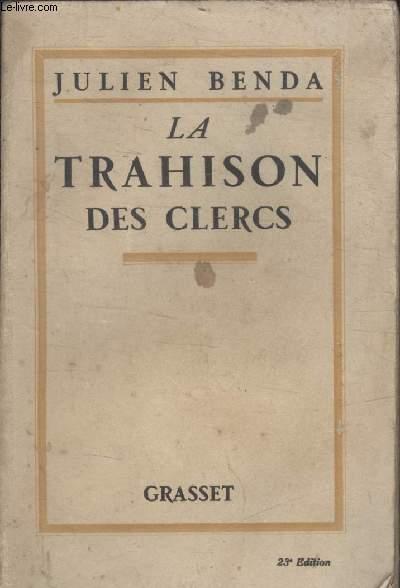
In 1927 the French philosopher Julien Benda published La trahison des clercs — “The Treason of the Intellectuals” — which condemned the descent of European intellectuals into extreme nationalism and racism. By that point, although Benito Mussolini had been in power in Italy for five years, Adolf Hitler was still six years away from power in Germany and 13 years away from victory over France. But already Benda could see the pernicious role that many European academics were playing in politics.
Those who were meant to pursue the life of the mind, he wrote, had ushered in “the age of the intellectual organization of political hatreds”. And those hatreds were already moving from the realm of the ideas into the realm of violence — with results that would be catastrophic for all of Europe.
A century later, American academia has gone in the opposite political direction — leftward instead of rightward — but has ended up in much the same place. The question is whether we — unlike the Germans — can do something about it.
For nearly ten years, rather like Benda, I have marveled at the treason of my fellow intellectuals. I have also witnessed the willingness of trustees, donors, and alumni to tolerate the politicization of American universities by an illiberal coalition of “woke” progressives, adherents of “critical race theory”, and apologists for Islamist extremism.
Throughout that period, friends assured me that I was exaggerating. Who could possibly object to more diversity, equity, and inclusion on campus? In any case, weren’t American universities always left-leaning? Were my concerns perhaps just another sign that I was the kind of conservative who had no real future in the academy?
Such arguments fell apart after October 7, as the response of “radical” students and professors to the Hamas atrocities against Israel revealed the realities of contemporary campus life. That hostility to Israeli policy in Gaza regularly slides into antisemitism is now impossible to deny.
I cannot stop thinking of the son of a Jewish friend of mine, who is a graduate student at one of the Ivy League colleges. Just this week, he went to the desk assigned to him to find, carefully placed under his computer keyboard, a note with the words “ZIONIST KIKE!!!” in red and green letters.
Just as disturbing as such incidents — and there are too many to recount — has been the dismally confused responses of university leaders.
Comments Off on La trahison des intellectuels modernes
QotD: “Natural hierarchies” don’t work in distributed systems
Politics, being a distributed system, doesn’t work like that. Neither does the corporate world, which is why both invariably end up dominated by sociopathic, sexually deviant shitweasels. Whereas the social interaction in a bar, in a pickup basketball game, in a church group, whatever, naturally bends towards a baboon troop, “social” interaction in a distributed power structure bends towards whoever has the time, energy, and sheer Wille zur Macht, as our friend above would put it, to dominate it.
Example: Even at the height of his power, when he really could have liquidated everyone in the room with a wave of his hand, Joe Stalin didn’t win arguments with his nomenklatura by threatening to have them all shot. Rather, he outworked them. Even when he exercised the most raw power any one human being is capable of wielding, Stalin’s work ethic was legendary – he spent a minimum of fifteen hours a day at his desk, every day, 365 days a year. He simply ground down all lesser men with the sheer force of his leather ass and cast-iron bladder … and compared to Stalin, when it came to paperwork, all men were lesser men.
That’s a cast of mind, reinforced by the habits of a lifetime. Stalin was also a dominant personality by the end, of course, but he certainly didn’t start that way – he was cringingly servile to Lenin, for instance, and even once to Trotsky, which is probably the main reason Trotsky had to die when you come right down to it.
Hitler was the same way, in his own special, bizarre way. While no one would ever accuse Hitler of an overactive work ethic when it comes to government – those who study these things still can’t get their heads around it, the fact that for long, critical periods the Third Reich basically didn’t have a government – but he could wear you down with the best of them when it came to party speeches, organizing, propaganda. No one worked harder at that stuff than Corporal Hitler … and no one knuckled under to authority faster, which is why he remained Corporal Hitler despite four years on the Western Front.
Combine them, and you get the Big Man On Campus thoroughly dominated by the deviant sociopathic shitweasels. The BMOC dominates every personal interaction; therefore, he thinks it’s the rules which get him where he is. Society is set up, he thinks, to produce people such as himself. And since that society is also set up such that the deviant sociopathic shitweasels (we should probably acronymize that; hereafter, DSS) do the boring shit like student government, when the DSS pass some bizarre law the BMOC just rolls with it …
Severian, “Bio-Marxism Grab Bag”, Founding Questions, 2021-01-21.
Comments Off on QotD: “Natural hierarchies” don’t work in distributed systems
November 5, 2023
QotD: The Auftragstaktik principle of the Third Reich
Obviously civilian life isn’t as goal-directed as the military in wartime, but a similar principle applied — given a vague set of generalized objectives from the top (Kershaw’s famous “working towards the Führer” thesis), everyone at every level was encouraged to move the ball downfield as he saw fit … with the added twist that, in the absence of a clearly defined, military-style chain of command, the various “subordinates” would ruthlessly battle it out with each other, Darwin-style, for bureaucratic supremacy.
Thus the Nazis’ infamous plate-of-spaghetti org charts. I’m not an expert, but I’m pretty sure there were more than a few guys who held wildly different ranks in various different organizations simultaneously. He might be a mere patrolman in the Order Police, but an officer in the SS, a noncom in the SA (you could be in both, at least in the early days), and so forth. I wouldn’t be surprised if there was more than one guy who technically reported to himself, somewhere deep in the bowels of the RHSA [Reich Security Main Office]. You could spend a lifetime trying to sort this stuff out …
Severian, “The Crisis of the Third Decade”, Rotten Chestnuts, 2021-03-18.
Comments Off on QotD: The Auftragstaktik principle of the Third Reich
October 29, 2023
QotD: Leni Riefenstahl’s Triumph of the Will
Ah, if only it weren’t for that awkward patch …
In the 1930s, Fräulein Riefenstahl put her formidable film-making talents to the cause of the Third Reich, and, after attending the Reichsparteitag des Willens in 1934, produced one of the most remarkable films ever made: Triumph Of The Will.
Go back to that scuba-diving disembarkation scene in Ray Müller’s The Wonderful Horrible Life Of Leni Riefenstahl. In theory, it could all be a setup, and the participants chewed over how best to do it beforehand and did fifteen takes: anyone who’s worked in documentaries knows how phony the whole business is. But the point is it seems careless — as if it happened, and the camera happened to be there to record it.
There’s no sense of that in any frame of Triumph Of The Will. Granted that audiences were a lot less media savvy in 1934, and granted that a people dumb enough to fall for National Socialism will fall for anything, it’s still hard to believe that even in its day anyone accepted what remained Fräulein Riefenstahl’s official explanation to the end — that this was just a “documentary record” of the 1934 annual party convention. Early on, we see the Führer‘s motorcade driving through Nuremberg, with what seems like the entire citizenry jammed on to the streets to greet him. Riefenstahl’s camera shoots Hitler (if you’ll forgive the expression) from directly behind him, a sequence which for some reason always reminds me of Gore Vidal’s boast that only very famous people such as himself know what the back of their heads look like. There’s a fabulous moment when the great man — Adolf, not Gore — is responding to the Hitler salutes offered up by the crowds with his campy little elbow-bend and wrist-flip and, as his Mercedes moves forward, the sun catches his fingers and fills the palm, first bathing it in glory and then making it appear as if the Führer‘s hand is the very source of the sunlight itself. Did the director just get lucky? Did the sun just happen to hit? Seconds later, we cut to a long shot of Hitler in the Mercedes continuing down the street. There’s no camera in the car, although the scene we’ve just witnessed could only have been filmed by someone in the back seat. Another minute goes by, and we’re back to the close-up of the Führer‘s neck.
Did she stop the car, get out and film the long shot, and then get back in? Did Leni get Adolf to do re-takes? Or maybe she made the entire population of Nuremberg re-take the scene; maybe they staged the procession twice. If Hitler was unusually agreeable about taking direction, it was because this was never a filmed record of an event so much as an event created for the film. Whatever Triumph Of The Will is, it’s not a documentary. Its language is that of feature films — not Warner Brothers gangster movies or John Ford westerns, but rather the supersized genres, the epics and musicals where huge columns of the great unwieldy messy mass of humanity get tidied and organized — and, if that isn’t the essence of totalitarianism, what is? Riefenstahl has the same superb command of the crowd as Busby Berkeley, the same flair for human geometry (though Berkeley would have drawn the line at giving the gentlemen of the chorus as swishy a parade step as Hitler’s personal SS bodyguard do).
Mark Steyn, “Triumph of the Will”, SteynOnline, 2019-09-07.
Comments Off on QotD: Leni Riefenstahl’s Triumph of the Will
October 4, 2023
Douglas Murray – “Canada today looks like a nation of ignoramuses”
Writing in the National Post, Douglas Murray flays the Canadian Parliament for their shameful ignorance put on display by publicly honouring a former Waffen SS officer:
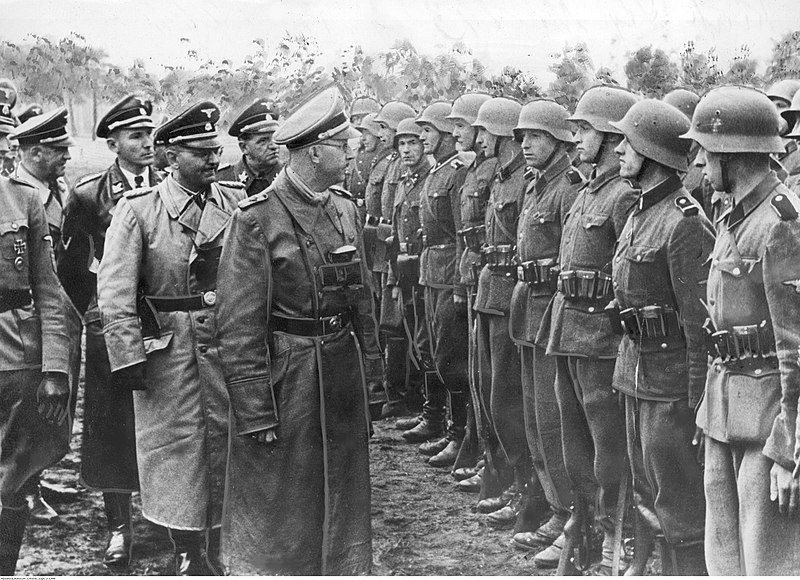
Reichsführer Heinrich Himmler (in the foreground) visiting the 14th Grenadier Division of the Waffen SS “Galizien” in May 1943.
Narodowe Archiwum Cyfrowe photo via Wikimedia Commons.
Perhaps I should say straight away that I love Canada. Some of my best friends are Canadian. That minimal throat-clearing aside, let me say — as a friendly outsider — that Canada today looks like a nation of ignoramuses.
The incident in Parliament the other week is just one case in point. Standing ovations are very rare things. They should be very special things. When a whole House stands to applaud someone they had better be very sure who they are applauding.
I know that Speaker Anthony Rota has now resigned. But here is the thing. Anybody who knows anything about the Second World War knows that if you were fighting the Soviets in Ukraine in the 1940s you were most likely fighting with the Nazis. It does not require a fine-tuned expert in the era to know this. Almost anybody could have guessed this. If almost anyone knew anything.
It seemed to be the assumption not just of Speaker Rota but of the whole Canadian Parliament that there existed in the 1940s some proto-anti-Putin fighting force and that the great cause of this moment has some direct lineage back to the fight of the 1940s. Ukrainian President Volodymyr Zelenskyy almost certainly guessed this. But it was the Canadian Parliament who was hosting him, the Canadian Parliament who embarrassed him and the Canadian Parliament who have handed the most magnificent propaganda victory to the Kremlin. In a war which Putin pretended to start in order to “de-Nazify” Ukraine, how much help has Canada given by your entire Parliament standing to applaud an actual Nazi?
What makes this worse is that this all comes after a period in which Prime Minister Justin Trudeau has been perfectly happy to call decent, ordinary Canadians Nazis. To use measures like the de-banking of his critics in moves that have horrified most of the other democracies in the West. When a bank in my country of birth — Britain — was recently found to have de-banked a politician (Nigel Farage) for what turned out to be political reasons not only did the head of the bank resign, but politicians in Britain from across the political system condemned the bank. Such moves are unlikely to be taken by another bank in Britain again. But in Canada it seems to be perfectly acceptable, because at any time the Canadian prime minister and deputy prime minister can claim that their critics are homophobes, xenophobes, racists, Nazis, misogynists and all of the rest.
The world — especially America — has looked on in horror as the Canadian government has tried to curtail speech in the country, and looked on with ever-more horror as Canadians seem willing to go along with this. It seems to be the view of the Canadian authorities that they are capable of deciding at the merest glance who is and is not allowed to speak, what is and is not acceptable speech, what any Canadians can and cannot read and who is and who is not a “Nazi”. These being the same authorities who apparently cannot even perform the most basic Google searches on their guests.
I know that Canadians often like to look down on Americans. But as someone who spends most of his time in America I can tell you that it is the American public who now wonder at what on earth is happening with our neighbour in the north.
Comments Off on Douglas Murray – “Canada today looks like a nation of ignoramuses”


