All 1,472 employees of Facebook, Inc. reportedly burst out in uncontrollable laughter Wednesday following Albuquerque resident Jason Herrick’s attempts to protect his personal information from exploitation on the social-networking site. “Look, he’s clicking ‘Friends Only’ for his e-mail address. Like that’s going to make a difference!” howled infrastructure manager Evan Hollingsworth, tears streaming down his face, to several of his doubled-over coworkers. “Oh, sure, by all means, Jason, ‘delete’ that photo. Man, this is so rich.”
“Entire Facebook Staff Laughs As Man Tightens Privacy Settings”, The Onion, 2010-05-26
May 26, 2010
QotD: Facebook privacy follies
May 18, 2010
Posts of interest
A few links you may find worth your attention:
- Publius explains that it’s no surprise that the Conservatives don’t want to support Toronto’s Pride Parade. I’m not at all against the parade, I just don’t think it’s a valid use of federal tax money.
- The creative staffers at Reason offer some help to the Environmental Protection Agency — three propaganda contest entries.
- Test your Facebook privacy settings. (Disclaimer: I haven’t tried this myself, so I can’t speak for how well it works).
- And on the topic of privacy, the EFF warns that the next big thing in privacy breaches: your web browser leaves identifiable “fingerprints” when you surf.
- Do you have a digital executor? If you’re reading this, you probably should.
- Everyone Draw Mohammed Day
May 10, 2010
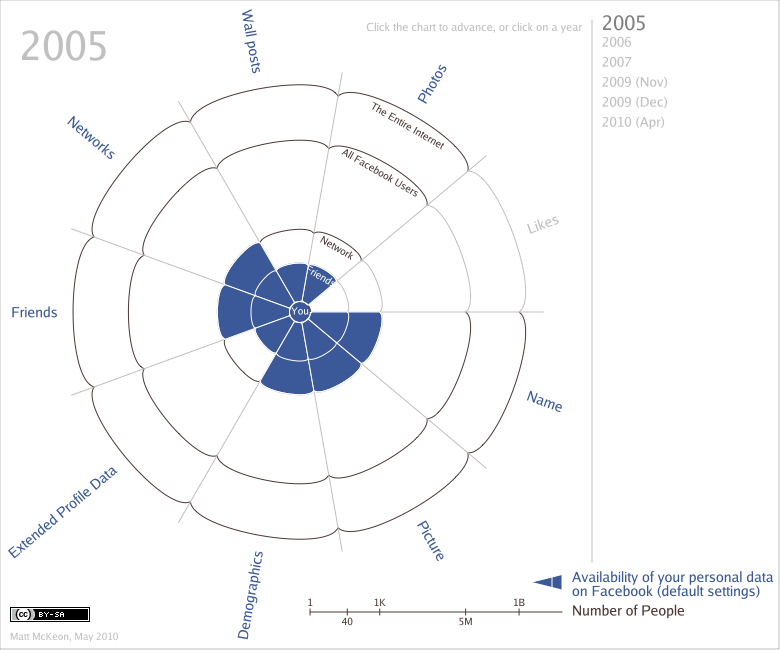
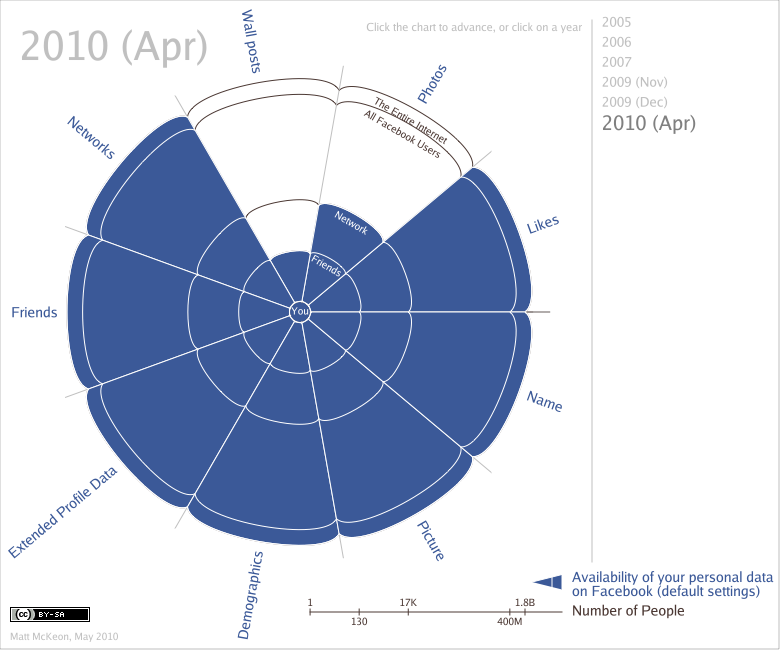
Graphical illustration of the death of privacy on Facebook
Matt McKeon has a very persuasive set of images, showing the extent of changes to your private information on Facebook between 2005 and last month:
2005
Compare that to the latest set of changes to the default Facebook privacy settings:
April 2010
Facebook is a great service. I have a profile, and so does nearly everyone I know under the age of 60.
However, Facebook hasn’t always managed its users’ data well. In the beginning, it restricted the visibility of a user’s personal information to just their friends and their “network” (college or school). Over the past couple of years, the default privacy settings for a Facebook user’s personal information have become more and more permissive. They’ve also changed how your personal information is classified several times, sometimes in a manner that has been confusing for their users. This has largely been part of Facebook’s effort to correlate, publish, and monetize their social graph: a massive database of entities and links that covers everything from where you live to the movies you like and the people you trust.
May 8, 2010
Facebook’s business model
Ryan Singel looks at where Facebook started and why it’s changed its privacy protections:
Facebook used to be a place to share photos and thoughts with friends and family and maybe play a few stupid games that let you pretend you were a mafia don or a homesteader. It became a very useful way to connect with your friends, long-lost friends and family members. Even if you didn’t really want to keep up with them.
Soon everybody — including your uncle Louie and that guy you hated from your last job — had a profile.
And Facebook realized it owned the network.
Then Facebook decided to turn “your” profile page into your identity online — figuring, rightly, that there’s money and power in being the place where people define themselves. But to do that, the folks at Facebook had to make sure that the information you give it was public.
So in December, with the help of newly hired Beltway privacy experts, it reneged on its privacy promises and made much of your profile information public by default. That includes the city that you live in, your name, your photo, the names of your friends and the causes you’ve signed onto.
This spring Facebook took that even further. All the items you list as things you like must become public and linked to public profile pages. If you don’t want them linked and made public, then you don’t get them — though Facebook nicely hangs onto them in its database in order to let advertisers target you.
Every time Facebook changes their privacy policies, well-meaning folks try to explain how to retain as much of your previous settings as possible . . . and every time, Facebook’s defaults have changed further towards exposing everything. There’s money in that information, money that Facebook is determined to obtain. Privacy? The inevitability of zero-privacy is Facebook’s unspoken motto.
May 5, 2010
Facebook obliterates the entire notion of “privacy settings”
As someone noted the other day, when it comes to Facebook and their constant twiddling with privacy settings, you can just copy-and-paste the last outraged story you did and change the date. That being said, the latest Facebook changes are pretty bad:
“Connections.” It’s an innocent-sounding word. But it’s at the heart of some of the worst of Facebook’s recent changes.
Facebook first announced Connections a few weeks ago, and EFF quickly wrote at length about the problems they created. Basically, Facebook has transformed substantial personal information — including your hometown, education, work history, interests, and activities — into “Connections.” This allows far more people than ever before to see this information, regardless of whether you want them to.
Since then, our email inbox has been flooded with confused questions and reports about these changes. We’ve learned lots more about everyone’s concerns and experiences. Drawing from this, here are six things you need to know about Connections:
- Facebook will not let you share any of this information without using Connections. [. . .]
- Facebook will not respect your old privacy settings in this transition. [. . .]
- Facebook has removed your ability to restrict its use of this information. [. . .]
- Facebook will continue to store and use your Connections even after you delete them. [. . .]
- Facebook sometimes creates a Connection when you “Like” something. [. . .]
- Facebook sometimes creates a Connection when you post to your wall. [. . .]
Overall, you’d have to assume that nobody in the Facebook architecture group has ever needed or even wanted to keep certain information private. Every change they make seems to make it harder and harder to restrict where your personal information will be accessible, and it’s not as though there haven’t been complaints: Facebook just carries on as if nobody cared.
I’ve still got a Facebook account, although I find I’m using it less and less (ironically, many of you reading this will have come here because of a link from Facebook . . .). Lack of ability to fine-tune the privacy settings is certainly one of the reasons I don’t use Facebook as much as I once did.
January 23, 2010
January 6, 2010
Behold the awesome power of Facebook groups
The editors at the National Post poke some fun at their opposite numbers over at the Toronto Star:
We know about the Star editors’ foray onto the big exciting Interweb because of the newspaper’s front-page headline on Monday: “Grassroots fury greets shuttered Parliament.” The breathless story suggests Canada is on the verge of some kind of violent 1917-style revolution — a “growing public uprising” no less, complete with “protest rallies” from coast to coast, and young activists full of unhinged, wild-eyed rage. The evidence for all this: 20,000 people joined a Facebook page called “Canadians Against Proroguing Parliament,” which urges Parliament to “Get back to work.”
[. . .]
For all we know, that 20,000 figure is up to 50,000 now, thanks to the Star publicity. Or maybe even 100,000. Who knows? But for the sake of context, let’s look at some other causes that also got a six-digit response: Almost 300,000 people have joined a group encouraging rocker John Mellencamp to quit smoking. Another hundred thousand people have joined a group encouraging random people to move to Finland. A whopping half-million people have used the power of Facebook to declare that they enjoy the television program 90210.
And then there’s our personal favourite: A group called “If 100,000 people join this group, Laura will name her son Megatron” recently met its goal. Congratulations, Laura, on the birth of your Transformer. We bet you didn’t know that he’d become the subject of — what does the Star call it? — oh yes, a “growing public uprising”!
November 20, 2009
Those inevitable “new word” lists
David Harsanyi falls into the trap cunningly laid for him by the devious wordmongers at Merriam-Webster:
Like other books Americans have a duty to own — the Bible or “Atlas Shrugged,” for instance — the dictionary does not require an absurd marketing ploy to sell itself.
Yet, every year a barrage of cockamamie “word lists” are unveiled by publishers seeking to bring attention to the evolving English language.
In the end, these lists establish two facts: 1) We are unable to invent any new words of value. 2) If you put a list together, a columnist will probably write about it.
One needn’t be William Safire, though, to be unsettled that the word “philanderer” is a major mystery to so many people. According to a new list by Merriam-Webster, “philanderer” (a national pastime, meaning to be sexually unfaithful to one’s wife) was one of the most searched words of the past year because of the crush of politicians and celebrities busy hiking the Appalachian trial.
The word receiving the highest intensity of searches over the shortest period of time was “admonish” (to express warning or disapproval). It was triggered by a crude outburst of a South Carolina congressman and the subsequent moralistic “admonishment” of him by Congress.
It’s not the lists themselves that bother me . . . it’s the blatantly contrived nature of the words appearing in most of the lists. “Unfriend”? Bleargh.
There is, admittedly, one trend that could prove to be a bright spot. The newly minted “teabagger” gives us hope that crude sexual terms will now regularly be applied to politics, where they can do the most good.
Perhaps “felching” will come to describe how the media gathers material for their coverage of the White House. Oh, wait . . .
November 12, 2009
“Mafia Wars” developer got too much into the spirit of the game
I hate to say it, but I’ve worked for folks with nearly this little class, so I readily believe him:
From the beginning, the profitability and viability of popular Facebook social networking games Mafia Wars and Farmville were predicated on the backs of scams, boasts Zynga CEO Mark Pincus in this video. “I did every horrible thing in the book just to get revenues,” he crows in the clip to a gathered bunch of fellow scumbag app developers.
In games like Mafia Wars, Farmville, YoVille and Vampires Live, you know, some of the major sources of all those garbage announcements cluttering up your Facebook, players compete to complete missions and level up. By leveling up, you can complete more difficult missions and fight off weaker opponents. You can wait for your various energies to regenerate naturally over time, or you can purchase with real money in-game boosts. Or, you can complete various lead generation offers, many of which are of the “answer page after page of questions and opt in and out of receiving various kinds of spam” variety. Some of them install malware and adware that is impossible to remove. And some of them secretly subscribe you to monthly recurring $9.99 credit card charges.
Couple this reckless profiteering with in-game incentives for recruiting more players into your network and a constant blast (if you let it) of promotional messages to your friends, and it’s like Amway discovered Facebook and threw a gangster-themed house party.