Today begins the 72-hour observance of the Climate Reality Project’s “24 hours of reality” info-event on the so-called “climate crisis” on Facebook and Twitter. I know, I know. Why call it “24 hours of reality” when you’re going to spend 72 hours doing it? Because SHUT UP YOU DENIALIST NAZI SYMPATHIZER!
I’m not on Twitter, but let me share what I’ve communicated to my friends on Facebook:
If ANYONE allows that fat bastard access to their Facebook account in order to spam me with their “THE SKY IS FALLING AND IT’S ALL YOUR FAULT, WINGNUTZ” crap; not only will I de-friend you and refuse to speak to your dumb ass strictly out of principle, I solemnly vow that I will mail a LIVE OPOSSUM to your house in a big box full of styrofoam peanuts.
LIVE. OPOSSUM.
Please don’t test me. I’m serious here. Much like me, live opossums don’t care about fake science. They’re more interested in breaking stuff and having panicked bowel movements on the top shelf of your china hutch.
“Russ from Winterset”, “My Response to ‘The Climate Reality Project'”, Ace of Spades H.Q., 2011-09-13
September 13, 2011
August 18, 2011
August 15, 2011
August 11, 2011
July 14, 2011
Yet another twist in the twisty-turny mess that is Ontario liquor law
Michael Pinkus responds to an unfair accusation against Diamond Estates over their ability to open a retail store in Scarborough (most wineries are not legally able to do this):
Upon reading the Fashionable Press’ article I shot back the following (on everybody’s favourite medium these days) the Facebook comment section: “Have you really not been paying attention??? Diamond has a store because they bought a winery that had 1) a pre-1993 license and 2) had a pre-existing store. No mystery here, no cronyism, just smart business sense. In Ontario’s archaic system there are two things that reign supreme: a pre-1993 license (which allows you to blend foreign and domestic wines) and a winery with an outside store attached. Diamond got them both when they acquired DeSousa.”
The reply from Fashionable was quick: “Yes we understand that point the issue remains why no other winery can do the same thing?”
To which I answered, “This comes back to the archaic laws … not cronyism or the fact that Murray Marshall is chairman and CEO of VQA Canada. As many know I am not a huge supporter of the big wineries that can blend (and do) but Murray is working well within the crappy, backward, stink-ass system we call the alcohol laws in Ontario. If another winery wanted to do it they can pony up the 3+ million Cilento will sell their license for (of course I may be off by a few million on the price because that pre-93 piece of paper is a license to print money).”
To understand all this, and all it’s intricacies and complexities is to understand why Ontario’s small wineries are so pissed off (and yes that is the right wording here) when the subject of VQA stores is brought up. But back to Diamond … The moment DeSousa went up for sale Murray saw it as an opportunity to get a store that wasn’t tied to Niagara and a way to get his products into the hands of consumers in the much more lucrative market of Toronto (in this case Scarborough).
Now the astute amongst you (or the Ontario wine history buff) will note that Lakeview also has a pre-1993 license (est. 1991) – but that’s where it gets even wonkier. While Lakeview would be allowed to blend foreign with domestic wines, the original owners never branched out to buy another retail store, so their operation was stuck in Niagara post-1993 when the moratorium on wine store licenses was imposed. DeSousa (est. 1990) on the other hand, did acquire one additional retail licence prior to the cut-off.
The hard part about owning these stores is they are rarely permanent, and here’s why. The rationale behind placing one of these additional retail outlets somewhere is that it is an “under-serviced neighbourhood” … Fashionable asks the following: “Why didn’t the LCBO find this under-serviced gem and plunk one of its outlets there? … Why did they choose in a gentlemanly way to cede over to Diamond?”
To that I say ‘Have No Fear’, if that Diamond store does well then you can bet the farm that the liquor monopoly will parade in like a white knight and announce a store nearby … which will force Diamond to relocate the store to another “under-serviced area” … and how, you may ask, will the LC know that Diamond is doing so well? That my friends is what smells bad in this entire deal: Who do you think gets to look at the sales numbers from these off site stores? Hmm? They’re not called the KGBO by some for nothing.
So the brief and fleeting moment that Diamond has taken advantage of will disappear as soon as the LCBO decides that they need to move into that disadvantaged area and open an LCBO store, which will force the private seller to close their store in the area. Nice.

July 6, 2011
July 4, 2011
June 23, 2011
June 18, 2011
June 7, 2011
QotD: The Bill of Rights on federal government property
Friends,
There’s been a hassle on FaceBook about what civilians and cops can or can’t do on “government property”, with some saying the Bill of Rights doesn’t apply there. I wrote this in response:
A little civics lesson, gentlemen, if you will allow me. The Bill of Rights is misnamed. It is not a list of things we are “allowed” to do, it is a list of things that government is not allowed to do, principally to trespass against certain natural liberties that are ours simply by virtue of our having been born.
The Bill of rights, therefore, is actively in force any time, any place that there are human beings. If it were metaphysically possible (it is not) it would apply even more on so-called government property than anyplace else, since it is specifically government that is constrained by it.
Moreover, since it is not just Americans who are human beings (contrary to what many seem to believe) it puts a whole new face on the legality — or illegality — of war, and in particular the treatment being accorded to the political prisoners at Guantanamo and similar places.
L. Neil Smith, “Letters to the Editor”, Libertarian Enterprise, 2011-06-05.
May 29, 2011
May 28, 2011
Feeling optimistic about peoples’ common sense?
A few visits to this site will quickly disabuse you of that feeling.


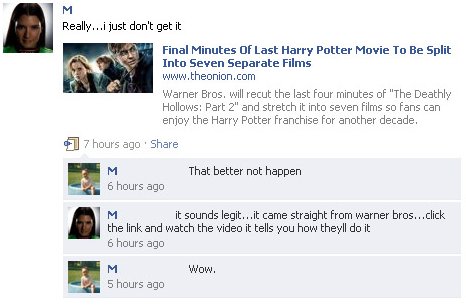
It’s how some folks on Facebook react to stories from The Onion as if it was real news.
May 18, 2011
Reminder: check state law before videotaping the police
Clive sent me this Wendy McElroy post from last year, but it’s still (mostly) valid today:
In response to a flood of Facebook and YouTube videos that depict police abuse, a new trend in law enforcement is gaining popularity. In at least three states, it is now illegal to record any on-duty police officer.
Even if the encounter involves you and may be necessary to your defense, and even if the recording is on a public street where no expectation of privacy exists.
The legal justification for arresting the “shooter” rests on existing wiretapping or eavesdropping laws, with statutes against obstructing law enforcement sometimes cited. Illinois, Massachusetts, and Maryland are among the 12 states in which all parties must consent for a recording to be legal unless, as with TV news crews, it is obvious to all that recording is underway. Since the police do not consent, the camera-wielder can be arrested. Most all-party-consent states also include an exception for recording in public places where “no expectation of privacy exists” (Illinois does not) but in practice this exception is not being recognized.
It shouldn’t need to be said that the police and the courts who’ve backed the police on this issue are wrong. But they appear to be running scared, at least in a few states:
Carlos Miller at the Photography Is Not A Crime website offers an explanation: “For the second time in less than a month, a police officer was convicted from evidence obtained from a videotape. The first officer to be convicted was New York City Police Officer Patrick Pogan, who would never have stood trial had it not been for a video posted on Youtube showing him body slamming a bicyclist before charging him with assault on an officer. The second officer to be convicted was Ottawa Hills (Ohio) Police Officer Thomas White, who shot a motorcyclist in the back after a traffic stop, permanently paralyzing the 24-year-old man.”
When the police act as though cameras were the equivalent of guns pointed at them, there is a sense in which they are correct. Cameras have become the most effective weapon that ordinary people have to protect against and to expose police abuse. And the police want it to stop.