Quotulatiousness

September 14, 2018

A sensible post-Brexit farming policy

Filed under: Britain, Bureaucracy, Business, Economics, Europe, Government — Tags: , , , — Nicholas @ 05:00

Tim Worstall linked to his 2016 post at the Adam Smith Institute that nicely summarizes the best post-Brexit farm policy for Britain:

We have an alternative policy framework to suggest. Let’s just not have a policy. No subsidies, no payments, no department, no Minister, nothing, nowt, zippedy dooh dah. The New Zealand option. You’ve had it good for a century or more now there’s yer bike and have a nice ride.

We would not swear that this is true but we have heard that it is so — British farming has long passed Parkinson’s Event Horizon. There are now more bureaucrats “managing” farming than there are farmers farming. Let’s not pay the farmers anything and thus we don’t need the bureaucrats paying it — a double saving. Instead of £2 to £3 billion a year in taxes going to the farmers, plus whatever the amount again to pay it to them, we could just keep that what, £5 billion? And go and buy food from whomever.

Sounds like a plan really and we recommend it to all. Let’s use Brexit to right some of the wrongs of our current system. One of those wrongs being the incessant whining and demands for bribery from the farming sector.

The correct design of the new domestic agriculture policy is that there isn’t one. And nor is there any funding for either it or its absence. In short Meurig, go away.

August 11, 2018

Post-coup Turkey – every move has served to increase Erdoğan’s hold on power

Filed under: Europe, Middle East — Tags: , , , , — Nicholas @ 05:00

Austin Bay‘s recent essay for Strategika on the post-coup Turkish political situation and its NATO membership:

Ataturk bequeathed Turkey what his greatest biographer, Andrew Mango, called “the structure of a democracy, not of a dictatorship.” He authored an orientation, not an ideology, creating a political, social, and cultural process that he believed would eventually make Turkey capable of perpetual self‐modernization. Ataturk was a political giant and a superb military commander. Eighty years after his death he remains a cult historical and political figure.

President Erdogan is a canny politician and, to be fair, Turkey’s most significant political figure since Ataturk. The green-eyed monster feeds his inner fire; Recep knows he disappears in Kemal’s giant shadow. Not capable of displacing Ataturk the man, he has chosen to replace Ataturk’s state, first under the guise of extending democracy, now behind the façade of maintaining stability. Erdogan also intends to remain in office over twice as long as Ataturk. Turkey 2034 will be an Erdoganist political construct, not Kemalist.

That last paragraph sketches a novelistic interpretation of Erdoğan’s motives. It expands on the answer I gave at Hoover’s October 2017 Military History and Contemporary Conflict symposium after Barry Strauss asked me what I thought drove Erdoğan — the deep drive that might shed light on his long-term vision for Turkey and help us craft policy responses to his challenge.

Novelistic speculations have numerous weaknesses. However, over the decades Erdoğan has supplied plot points and psychologically-indicative dialog. We are able to assess action through time. Early in his career Erdoğan routinely employed Islamist poetry: “Democracy is merely a train that we ride until we reach our destination. Mosques are our military barracks. Minarets are our spears.” That poetry led to his arrest for sedition. After his release he renounced his piously seditious poetry, claiming his fundamentalist views had fundamentally altered. His sudden commitment to Turkish democracy energized his “moderate Islamist” Justice and Development Party’s (AKP) 2002 victory over a tired and corrupted Republican Peoples Party (CHP). In 2003 the AKP became Turkey’s governing party with Erdoğan serving as prime minister.

First he tested Kemal’s structure, then he began to dismantle it. Erdoğan purged the military of suspected political opponents. A cunning narrative camouflaged his operation. He claimed European Union accession rules demanded he strip the military of its political powers and make certain Kemalist military coups entered history’s dustbin. Sometime in 2008, as Erdoğan began pursuing the Ergenekon conspiracy of “secular fundamentalists” and other secret nationalist vigilante organizations, I finally realized whatever explanation du jour Erdoğan offered for his actions, the dismantling scheme always expanded his personal power and influence.

The bizarre July 2016 coup follows the same pattern. The Turkish people defeated the coup. Ironically, Erdoğan remains in office today because Turkish citizens (across Turkey’s complex political and ethnic spectrum) courageously defended their hard-won democracy — a democracy nine challenging decades in the making. In its aftermath, however, Erdogan used emergency powers to purge Gulenist Islamists and his political opponents. He dismantled elements of the democratic system that saved him and his government.

August 1, 2018

British Labour Party continues to sideline pro-Brexit MPs

Filed under: Britain, Europe, Politics — Tags: , , , , , , — Nicholas @ 05:00

Fraser Myers on the most recent pro-Brexit Labour MP deselected by local party activists:

Labour Party activists have passed votes of no confidence in two of Labour’s Brexit-backing MPs, and called for their deselection. Frank Field and Kate Hoey were censured by their local parties for voting with the government against an amendment that would have kept the UK in a customs union with the EU after Brexit. If passed, it would have killed off any prospect of Britain having an independent trade policy after Brexit, and would have kept us under the jurisdiction of the European Court of Justice. Recognising this as a betrayal of the Leave vote, Labour Brexiteers had no other choice but to vote with the government to defeat the amendment. Now, for defending the democratic choice of 17.4million voters, Field and Hoey stand accused of ‘betraying’ the Labour movement and ‘siding with the reactionary Tory establishment’.

This sends a disastrous message to voters and pits Labour against the Leave vote, the largest democratic mandate in British history. Labour’s better-than-expected result at the 2017 General Election depended on retaining Brexit-voting seats. Two thirds of Labour MPs represent Leave-backing constituencies, with some of the largest Leave votes in Labour-held seats. Labour needs to win 64 seats at the next election to form a majority government, 42 of which are dotted around blue-collar, Leave-voting England. To attack the few Labour MPs who are on the side of the Leave majority is an astonishing act of self-harm for a party that claims to represent ordinary people.

While some Blairite MPs have long feared the prospect of deselection campaigns launched by the Corbyn-backing Momentum, the no-confidence motion against Kate Hoey was initiated by members of the Blairite pressure group, Progress. And rather than stand up for Hoey, a defender of Corbyn’s leadership, Momentum sided with its erstwhile rivals against the Brexiteer MP. As Owen Jones revealingly writes in the Guardian: ‘Self-professed Blairites, soft lefties and Corbynites were united in this vote.’ While the Blairite and Corbynite wings of the party claim to agree on very little, they appear to be united in their contempt for the electorate and for democracy.

These activists seem to forget that Labour has a long history of Euroscepticism. Labour’s much-celebrated postwar prime minister, Clement Attlee, and the architect of the NHS, Nye Bevan, were against Britain joining the EU’s predecessor, the European Economic Community (EEC). When the left-winger Michael Foot led Labour into the 1983 General Election, the party’s manifesto pledged to withdraw Britain from the EEC. Tony Benn – Corbyn’s hero – opposed the anti-democratic tendencies of the EU all his life. Would Benn, Foot and Bevan face a similar fate to Hoey and Field in Labour today?

July 31, 2018

The anti-Brexit propaganda machine of “Project Fear”

Filed under: Britain, Media, Politics — Tags: , , , — Nicholas @ 05:00

Brendan O’Neill on the never-ending whinge by the Remoaners emphasizing the potential negatives of Brexit:

I can’t remember a time when the elitist politics of fear has been as cynically wielded as it has been over the past week. It wasn’t even this bad when schoolkids of my generation were made to watch The Day After, a nuclear-disaster movie in which a wholesome American family slowly die from radiation after the Soviets go mental and bomb the US. Also, at least that dread-laden propaganda was only designed to make us fear the Ruskies – the even more unhinged Project Fear of elitist Remoaners is an attempt to make us fear ourselves and our friends and family and our collective electoral stupidity that has allegedly propelled Britain to the brink of ‘self-immolation’, in the words of the increasingly bizarre figure of David Lammy, the Member of Parliament for Brussels.

Every day the fearful propaganda intensifies. One wakes wondering what unearthly horror our vote against the EU 25 months ago might now have unleashed. Gonorrhoea is the latest. If we leave the EU with No Deal, Britain will apparently become a 15th-century-style hotbed of such sexual malaise. ‘Brexit could lead to spread of infectious diseases such as super-gonorrhoea’, says a headline in the London Evening Standard, which was once a newspaper but is now a score-settling sheet for its current editor: arch Remainer and former chancellor George Osborne, who we turfed out of office with our vote for Brexit. Medical officials fear that a shortage of medicine in the event of No Deal will mean we won’t be able to treat knob rot. It’s almost Biblical. ‘Defy me and your genitals shall wither.’ Up next: plagues of locusts? Floods?

Yes, floods. Brexit could ‘water down [the UK’s] environment laws’, says a piece in the Guardian, complete with a photo of a flooded English village. We could see more ‘severe flash floods’ if we leave the EU without boosting eco-laws. Perhaps we should build arks, get some animals on board? If you don’t drown, you might be poisoned. If there’s No Deal, Britain will become a ‘dumping ground for chemicals’, claim green groups. There won’t be much food, either. Remoaners are stoking up fears of food shortages if we change our trade arrangements with the EU. Because we will struggle to import ingredients and therefore won’t be able to make bread and other essentials. Why won’t be able to do this? They never say. They just know starvation is on the cards.

In the words of chief Remoaner Alastair Campbell, ‘No deal Brexit means no food Brexit and no medicines Brexit…’. Imagine being Alastair Campbell. Imagine giving the green light to the destruction of a foreign country and the deaths of tens of thousands of people in the name of delivering democracy, only to decide 15 years later that you don’t believe in democracy after all and so you devote your entire life to overthrowing the largest democratic vote in British history. Scientists should study Mr Campbell to discover how such a human being manages to sleep at night. Also, no one is saying there will be ‘no food’ after Brexit. Campbell is lying now as surely as he was when he said Saddam could bomb Britain in 45 minutes.

June 28, 2018

Shifting attitudes toward mass immigration in Europe

Filed under: Africa, Europe, Middle East, Politics — Tags: , , , — Nicholas @ 03:00

At Gates of Vienna, Baron Bodissey maps the way public sympathies are changing in the wake of the immigration/refugee waves of the last few years:

From Szczecin in the Baltic to Trieste in the Adriatic, a Razor-Wire Curtain Has Descended…

Immigration-related events are moving rapidly this in Europe summer. The situation is in such flux that now would be a good time to step back and try to get an overview of the process.

Three years ago the dead baby hysteria, followed by Chancellor Merkel’s invitation to the world (“Y’all come in and set a spell, bitte!“), launched the Great European Migration Crisis. Since then I’ve read hundreds of news articles and analyses about the flow of “refugees” and the reactions to their violent and fragrant arrival in Western Europe.

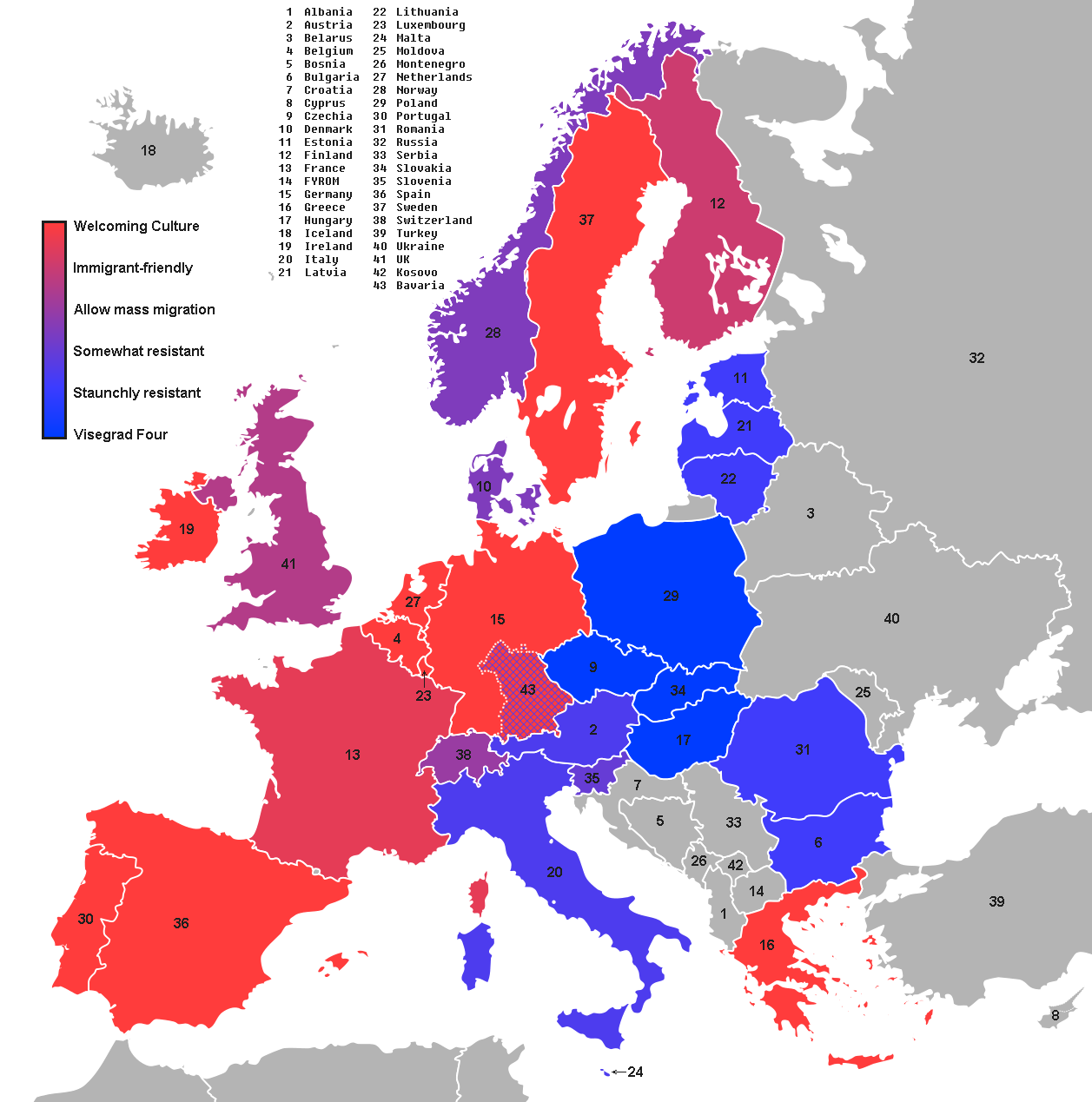
After digesting all that information I created the following map, which presents my subjective evaluation of the different approaches to migration by various European countries. I’ve rated the policies of 28 different countries (the EU 27 minus Croatia, plus Switzerland) on a scale from 0 to 100, from zero (red) for the open-borders attitude of the “Welcoming Culture” to 100 (blue) for the absolute refusal of mass migration by the Visegrád Four (Hungary, Poland, Slovakia, and the Czech Republic). Data from the last six months weighs more heavily in the score assigned to each country — for example, Spain and Italy recently changed governments, which has strongly affected each country’s migration policy.

[Click to see full-sized image]

The grouping of countries based on their stance on migration bears a striking resemblance to the division of Europe into East and West by the Iron Curtain. This is especially true if we roll the clock back three months — back then Italy and Bavaria would have been quite red. And the analogy becomes even more apt if we remember that Austria was occupied by Soviet troops until 1955, which gives it one foot in the Eastern camp.

The biggest change in the past three months has been the formation of a new anti-immigration government in Italy. The “xenophobia” of the East Bloc has now broken through the razor-wire curtain and gained a foothold in Western Europe. No wonder EU politics is in such turmoil! After failing to contain the “anti-European” attitudes of Poland and Hungary, Brussels now has to contend with Matteo Salvini. Italy is one of the “big four” pillars of the European Union, so its defection to the anti-migration side carries enormous significance for continental politics.

The situation is metamorphosing rapidly, but before we analyze the process of change — the “delta”, as they say in the military-industrial complex — let’s go over the snapshot of current European migration policies.

June 25, 2018

Differences between the United States and the “idealized” United States of Europe

Filed under: Bureaucracy, Europe, Law, Liberty, USA — Tags: , , , — Nicholas @ 03:00

Tim Worstall, in the Continental Telegraph:

There are those who think – urge, wish for perhaps – the European Union is or should become the United States of Europe. Lots of central bureaucratic control, the nation states left as just the remnants of once independent countries like the US states are these days. In some ways the two systems are very much the same already. No US state has any control at all over trade across its own border. Nor does any EU one. Trade is an issue solely the competence of the central organisations, respectively Washington DC and Brussels. Equally, both systems use this central control of trade and trade only to expand that central control.

In the US there was a case that Federal control of trade meant that the Feds got to decide who could grow wheat where and when. The usual sort of planning idiocy led to the Feds telling farmers who could grow how much and when. One farmer claimed he was only growing for his own consumption and this shouldn’t be limited. The centre (the Supreme Court) disagreed, the crux being that if he didn’t grow for his own consumption he would buy, this affected inter-state commerce, he had to obey the Feds. The EU takes this a step further. The Single Market rules are nominally about trade. Anything legal to be buying and selling in one place is such in all is a reasonable explanation of the nub of the matter. Sure, exceptions and all that. But this then smuggles into all law that continental (Roman Law really) idea that what is legal to do is something that the legislation defines. Instead of that Common Law idea that legislation, the law even, defines what it is illegal to do all other things being legal.

Once this is accepted then of course the next step is that there must be regulation of all things so as to tell people what it is legal to do. In this manner all sorts of things get smuggled in. Vacuum cleaner motors must be limited to a certain size or power. Because those whose lives are unfortunate enough that they’ve time to spare to be concerned about legislation on such matters note that they can be and thus incorporate their trivialities into legislation. The extent of this reach is larger than you think. The underlying legal, not political, justification for recycling targets is that some countries – Holland, where digging a hole gains nothing but wet boots – don’t have space for landfill. This would put them at a disadvantage if other countries do have the space, therefore all must recycle.

Giving the centre power always, but always, means an extension of the centre’s power. The two systems aren’t so different then.

June 24, 2018

Europe and the refugees

Filed under: Africa, Europe, Government, Italy, Law, Middle East, Politics — Tags: , , , , — Nicholas @ 05:00

Theodore Dalrymple on the various European governments’ attitudes and actions on the refugee problem:

Europe, despite its Union, is as divided as ever. Recently, when Italy’s new right-wing government — anxious to prove its credentials — refused to allow a boat carrying 629 African migrants to dock in Italy, Spain’s new left-wing government — equally anxious to do the same — accepted the boat. When the French president, Emmanuel Macron, criticized the Italians for their decision, the Italian government accused the French of hypocrisy, inasmuch as they had refused to take more than 9,000 migrants from Italy that they had previously agreed to accept.

This story is revealing in several aspects. The first is that, whatever attitude governments take to the migrants, no one truly believes that they are more of an asset than a liability. Madrid’s action, for example, was taken on “humanitarian” grounds, rather than because it believed that Spain would benefit from the migrants’ presence. When European leaders discuss the migrant question, it is always in terms of sharing the burden, not the assets, equitably. No one speaks of foreign investment in this way, which suggests that European politicians believe, whether rightly or wrongly, that the free movement of people and capital are different in an important way.

The leaders speak of sharing the burden, then, and are incensed when countries such as Hungary and Poland refuse point-blank to take any migrants from Africa or the Middle East. But I have never seen mentioned in this context the question of where the migrants themselves want to go. They might as well be inanimate toxic waste as far as the discussion is concerned, rather than human beings with wishes, desires, ambitions, and so forth. They are but pawns in a political game. Hungary, for example, is deemed duty-bound to take x number of migrants: no one asks whether x number of migrants can be found who want to go to Hungary. Nor is the question ever discussed in public whether Hungary, having open borders, would be held responsible for making the migrants stay there once they had arrived. Short of penning them in, how exactly would you keep them in Hungary, or in Poland?

Berlin protest planned against EU’s proposed copyright changes

Filed under: Europe, Law, Liberty, Media, Technology — Tags: , , , , — Nicholas @ 03:00

If you’re a regular internet user and you’re anywhere near Berlin, you might want to consider supporting this protest:

On Wednesday, the Legislative Committee of the European Union narrowly voted to keep the two most controversial internet censorship and surveillance proposals in European history in the upcoming revision to the Copyright Directive — as soon as July Fourth, the whole European Parliament could vote to make this the law of 28 EU member-states.

The two proposals were Article 11 (the link tax), which bans linking to news articles without paying for a license from each news-site you want to link to; and Article 13 (the copyright filters), requiring that everything that Europeans post be checked first for potential copyright infringements and censored if an algorithm decides that your expression might breach someone’s copyright.

These proposals were voted through even though experts agree that they will be catastrophic for free speech and competition, raising the table-stakes for new internet companies by hundreds of millions of euros, meaning that the US-based Big Tech giants will enjoy permanent rule over the European internet. Not only did the UN’s special rapporteur on freedom of expression publicly condemn the proposal; so did more than 70 of the internet’s leading luminaries, including the co-creators of the World Wide Web, Wikipedia, and TCP.

We have mere days to head this off: the German Pirate Party has called for protests in Berlin this Sunday, June 24 at 11:45h outside European House Unter den Linden 78, 10117 Berlin. They’ll march on the headquarters of Axel-Springer, a publisher that lobbied relentlessly for these proposals.

If you use the Internet to communicate, organize, and educate it’s time to speak out. Show up, stand up, because the Internet needs you!

Original post, with embedded links, at BoingBoing.

June 19, 2018

Time to throw Mutti Merkel under the bus?

Filed under: Europe, Germany, Politics — Tags: , , , — Nicholas @ 03:00

Sabine Beppler-Spahl thinks Angela Merkel’s time is running out:

Angela Merkel’s days may be numbered. ‘She will never recover from this crisis’, said an article in a German newspaper last week, about the rift within her government over immigration.

This latest crisis began after the interior minister, Horst Seehofer, announced that he wanted to introduce tougher rules for asylum seekers, including turning away those who have already been registered in another EU country. Merkel responded by saying that Europe needed a common solution to the refugee crisis, and that she would discuss it with French president Emmanuel Macron during his upcoming visit, and at the EU summit later this month. She blocked Seehofer from unveiling his immigration ‘master plan’, and he has insisted that a solution should be found by today. He has also threatened to sidestep Merkel and impose his plan regardless, leading to speculation about a government breakdown, and a confidence vote, little more than 100 days since the new ruling coalition, led by Merkel’s Christian Democratic Union (CDU), was formed.

[…]

Merkel’s decision to put the brakes on Seehofer’s ‘master plan’ reflects her evasive and anti-democratic style. No voter has yet been able to read this plan, let alone discuss it. Her concern about publishing it reflects the contempt in which she holds democratic debate. Meanwhile, her carefully prepared statements on the issue (mostly in the form of TV interviews with choice journalists or her own weekly podcast) rarely tell us very much at all. Despite opening Germany’s doors to refugees in 2015, she has never made a proper public case for the benefits of immigration. Her inability, or unwillingness, to explain her politics to the electorate has contributed to the narrow and technical way in which immigration is being discussed in Germany these days, with a focus on numbers and deportation practices.

Taking an issue to the ‘European level’ has become Merkel’s default solution to everything. ‘This is a European challenge that also needs a European solution’, she said in her latest podcast. Of course, a joint European solution would be preferable, but not if this means bypassing national electorates. Her original plan of imposing migrant quotas on other EU member states has failed completely. Excluding the public from the debate, and discussing politics behind closed doors, is simply not cutting it with voters. Whatever one thinks of Seehofer’s ‘master plan’, he is right that immigration needs to be discussed and decided upon at the democratic, national level.

June 8, 2018

The British political scene has all the horrific fascination of a slow-motion car crash

Filed under: Britain, Europe, Politics — Tags: , , , , , — Nicholas @ 05:00

Colby Cosh says that anyone who claims to be shocked and appalled at the Ontario political mess need only glance across the pond to put things into proper perspective:

The one thing everyone seems to agree upon about Ontario’s provincial election is that it has been all kind of horrid, strange and exhausting; if there is another thing they agree upon, it is that Ontario politics will probably continue to be horrid, strange and exhausting for a while even when it’s over. I have one word for these people: Brexit. Try following U.K. politics for a while in the era of British secession from the European Union. You will scurry, shrieking, back to Queen’s Park soon enough.

The Brexit drama is a mesmerizing blend of jargon and impotence, frustration and confusion; it is a vivisection of democracy from which Britain cannot avert its gaze. In Ontario you still have distinguishable political parties: in Britain now, familiar entities have been altogether dissolved into underlying tendencies, shades and conspiracies. So-and-so is a “soft Brexiter.” How soft? Oh, not as soft as Mr. Whatnot, but distinctly softer than Miss How-Do-You-Do. Mysterious verbal puzzles — do you favour the “single market” or the “internal market”? — become theatres of struggle.

A bonus of Brexit-watching for us is that, over the past six months or so, you have often been able to get the brief neurochemical pop that Canadians all receive when Canada is mentioned abroad. The Canada-EU free-trade deal CETA, which you may remember being signed in October 2016 after some obscure trouble with Walloons, has turned out to be an important anchoring concept in the Brexit debate. CETA is the European Union’s most liberal and comprehensive trade deal with an offshore non-member — and that is just what Britain voted to become.

Advocates of a “hard” Brexit, with no judicial, bureaucratic or fiscal ties to the continent, began pointing to CETA as a readymade model for Britain-EU relations almost before the ink was dry. Problem: CETA broadly allows free movement of goods between Canada and Europe, but services are not included. Britain doesn’t make much physical stuff anymore, and it quit digging coal; it depends especially heavily on providing financial services to the world.

May 30, 2018

Eurocrats send Italy back to the polls, to get it right this time

Filed under: Europe, Government, Italy, Politics — Tags: , , — Nicholas @ 05:00

What were the Italians thinking? Didn’t they realize that the election of Euroskeptics would just result in the powers-that-be sending them back to vote (and possibly to vote again) until they get the right answer? Brendan O’Neill calls it a putsch:

There has been a putsch in Italy. A bloodless putsch, with no guns or jackboots, but a putsch nonetheless. The president’s vetoing of the finance minister put forward by the populist parties that won a huge number of votes in the General Election in March represents a grave assault on the democratic will. It is a technocratic coup, an EU-influenced, big-business-pleasing attempt to isolate and weaken the popular anti-Brussels sentiment that has swept Italy. Indeed, it has brought about the collapse of the talks to form a new populist government and made it necessary to hold fresh elections. Let’s be honest about what has happened here: March’s democratic election has essentially been voided by technocrats who care more about Euro financiers than they do about the ordinary people of Italy.

Italy has been plunged into political crisis by establishment figures who are repulsed by the Euroscepticism spreading through the nation. In the election in March, the mainstream parties – the Democratic Party and Forza Italia – were decimated by voters. They suffered an historic blow at the ballot box, the Democratic Party getting 18.7 per cent of the vote, and Forza Italia an even sadder 14 per cent. Meanwhile, populist parties, in particular the Five Star Movement (M5S) and the League (formerly the Northern League), soared to the forefront of political life. M5S won 32.7 per cent of the vote, and the League won 17.4 per cent – a huge rise on the four per cent it got in the election in 2013.

[…]

The usurping of the popular will is best summed up in who has been promoted by Mattarella to replace Conte as the interim prime minister: Carlo Cottarelli, a former senior official in the International Monetary Fund who is referred to as ‘Mr Scissors’ for his insistence on cuts to public spending. So even though millions of Italians voted for populist parties that said they would reverse spending cuts and challenge Eurozone stability rules, now they find themselves ruled, for the time being, by a technocrat who takes an entirely different view. They have ended up with the opposite to what they voted for. This is the putsch; this is the technocratic coup; this is the thwarting of the democratic outlook by an establishment that thinks it knows better than ordinary people how their lives should be run.

This is how life in the Eurozone, and in the EU more broadly, works now. The people and the parties they vote for are written off by the expert class and technocrats and the forces of big business as irrational or prejudiced or dangerous, and the popular will is overriden in the name of maintaining the status quo. We saw this in the EU fury that greeted the French, Dutch and Irish revolts against the EU Constitution a decade ago; in the enforcement of spending cuts in Greece and Ireland that the people in those countries did not want; and we see it in the ongoing efforts by Brussels and its useful idiots in Britain to weaken or even kill off our mass vote for Brexit. Remainers, behold the truth of the institution you are fighting to defend: not the happy-clappy union of European peoples of your deluded dreams, but rather a vast oligarchical machine that laughs in the face of national sovereignty, views the democratic will as a pesky fly to be swatted away, and looks upon ordinary people as too pig-ignorant to make big political decisions. We need more rebellions against this elitist Euro-hatred for the views of ordinary people, and an all-out defence of the hard-won European principle of democracy.

May 23, 2018

Farage and Zuckerberg

Filed under: Business, Europe, Liberty, Media, Technology — Tags: , , , , — Nicholas @ 04:00

May 4, 2018

QotD: The EU and democracy

Filed under: Bureaucracy, Europe, Government, Quotations — Tags: , — Nicholas @ 01:00

The EU is quite clear however that it stands as the champion of democracy, just not the kind of democracy that involves people voting. No, for the EU democracy means compliance with the EU’s standards and rules – any departure indicates a drift towards un-democracy that must be checked by sanctions and punishments, even if people voted for it. The EU’s democratic principles, you understand, trump stuff like elections and voting; they are a purer form of democracy, crafted by unelected officials and demagogues free from popular approval. And yes, there are many in Brussels who actually believe all that.

Raedwald, “Sorry Herr Juncker your woes are just starting”, Raedwald, 2018-04-09.

April 8, 2018

Brexit: Why Britain Left the European Union

Filed under: Britain, Bureaucracy, Europe, Government — Tags: , — Nicholas @ 02:00

PragerU
Published on 12 Mar 2018

Is the European Union good for Europe? Or would Europeans be better off without it? Nigel Farage, a leader of the United Kingdom’s Brexit movement, shares his view.

Script:

If one big government is bad, imagine how much worse two big governments would be. But that’s what people living in Europe have had to deal with: their own nation’s bloated government and the super-national government of Europe, now known as the European Union. Bureaucracy times two! How’s that for a horror show?

Well, actually, you’ve no idea. It’s worse than you think. Believe me — I know, because for seventeen years, I’ve represented South East England as a member of the European Parliament, the EU’s legislative body. I was also leader of the UK Independence Party, or UKIP, where I lead Britain’s efforts to leave the European Union. To their everlasting credit, that’s just what happened on June the 23rd, 2016: The United Kingdom left the European Union. The world knows it as “Brexit.”

Brexit is a statement of national sovereignty. Don’t misunderstand me: I like nations. I like borders. I like the people that live within those borders making their own laws. But I don’t like it when faceless bureaucrats make laws for nations they don’t even live in.

But that’s what they do in the European Union.

Imagine a Belgian telling a Brit how much he can charge his customers — or the reverse. The EU bureaucrats do this in a myriad of different ways, all day, every day. It is a conspiracy of the elites.

Who are those elites? Well, they’re a bunch of self-important, overpaid, social engineers with useless college degrees who have never done a proper day’s work in their lives and have no connection with ordinary, decent people. I’ll take the good sense of an Italian farmer or a French baker over the arid intellectualism of an EU bureaucrat any day.

And I say these things not as an anti-European; I love Europe! It’s a fantastic, exciting, great continent: different peoples, languages, and cultures. But these peoples, with their languages and cultures, have effectively been hijacked by a giant, ever-expanding bureaucracy: the European Union.

People will say, “but isn’t there a parliament, a European parliament, that represents the people of Europe?” Well, yes, but this body has got no real power; it can’t make its own laws. Rather, the power resides with the European Commission. They’re unelected and they can’t be removed, and that’s how absurd the whole thing is.

The European Parliament meets in Brussels. At least, that’s what I thought when I was elected there. But once a month, do you know what happens? They load the contents of our offices and papers into big, plastic trunks, and they put those trunks on lorries, and they drive them nearly 400 miles down Europe’s motorways to a French city called Strasbourg where, for four days, the contents of our offices, and our papers, are put into a new office, and the parliament then sits there. Twelve times a year this back-and-forth happens, and this from an organization who say they want to reduce their level of carbon footprint! This, from an organization whose accounts have not been given a clean bill of health by the auditors for the last twenty years!

This…a parliament? It’s more like a traveling circus.

For the complete script, visit https://www.prageru.com/videos/brexit-why-britain-left-european-union

March 3, 2018

QotD: Elite incompetence

Filed under: Britain, Europe, Government, Quotations — Tags: , , — Nicholas @ 01:00

Most people, most of the time, are perfectly happy to let elites run the country. After all, it seems to make the elites happy to run run things, and as long as they’re reasonably competent at it, and do it reasonably unobtrusively, no one much seems to care. But when elite competence is compromised by faulty ideology and cronyism, people become unhappy. And when the elite response to complaints is dismissal or insult, political problems begin to bloom. People begin to think about politics. They begin to do things. It is no coincidence, as our Soviet friends used to say, that the last decade has seen the rise of the TEA Party, the Occupy Movement, and the Trump phenomenon. People of all political stripes are becoming unhappy.

I think we’re about to watch the elites start paying a price for their incompetence, inattention and contempt. Euroskepticism is on the rise elsewhere in Europe. If EU membership were put to a popular vote in the Netherlands, Spain, or Sweden, there is a good chance that Leave would win there, too. Indeed, it’s possible that a vote to leave the EU might even win in France, the nation for whom creating and strengthening the EU has been the primary policy goal for 60 years.

Perhaps the “Vote Remain, you virulent racist!” PR campaign for staying in the EU needs a bit more thought.

Dale Franks, “Vote Properly, You Virulent Racist!”, Questions and Observations, 2016-06-28.

« Newer PostsOlder Posts »

Powered by WordPress