
Engine Porn
Published 19 Jan 2015Light, agile and very fast on all types of terrain, the fabulous Scimitar FV107 armoured reconnaissance vehicle was developed by car manufacturer Alvis, who were asked to build a fast military vehicle that was light enough to be airdropped — simply not an option for full sized battle tanks at the time, which averaged around 13 tonnes. [NR: I think they mean “light tanks” here, as MBTs of the era would have been more like 50+ tons.]
Alvis got the weight down to under 8 tonnes by using a new type of aluminium alloy and minimising armour rating in favour of speed. They built the Scimitar around a 220 horsepower, six cylinder, 4.2 litre Jaguar sports car engine with ground-breaking transmission that allowed differential power to each set of tracks. The result was a sports car of the the military world that might not be the toughest in the field, but could race its way out of trouble at speeds of up to 70 miles an hour.
What makes it great: A revolutionary armoured vehicle that brought the very best of British sports car performance to the battlefield.
Time Warp: The Scimitar was the only armoured vehicle to be used by the British Army in the Falklands War.
This short film features Chris Barrie taking the Scimitar for a spin.
(more…)
February 1, 2023
What’s the Greatest Machine of the 1980s … the FV107 Scimitar?
January 29, 2023
France’s Ultimate WW1 Selfloading Rifle: The RSC-1918
Forgotten Weapons
Published 14 Sept 2017The French RSC-1917 semiauto rifle was a major step forward in arms technology during World War One, offering a reliable and effective self-loading rifle for issue to squad leaders, expert marksmen, and other particularly experienced and effective troops. No other military was able to field a semiauto combat shoulder rifle during this was in anything but very limited numbers. However, the RSC-1917 definitely had some shortcomings:
– It was just too long, at the same size as the Lebel
– The specialized clip was a logistical problem
– The gas system was fragile and difficult to clean or disassemble
– The magazine cover was easily damagedThese issues were all addressed in the Model 1918 upgrade of the rifle, although it was too late to see active service in the Great War. The new pattern was substantially shorter (both the stock and barrel), it used the standard Berthier 5-round clip, it had a substantially strengthened magazine cover, and a much improved gas system.
Today, we will compare the various features of the 1917 and 1918 rifles, and disassemble the 1918 gas system to show how it worked.
(more…)
January 24, 2023
What Would Browning Do: FN’s New High Power
Forgotten Weapons
Published 30 Sept 2022It seems like everyone is making a copy of the Browning High Power these days, and FN themselves have jumped into the arena as well. What FN is making isn’t just a clone of the original pistol, though — they have built something largely new, taking inspiration and design cues from the original BHP to create a gun more suited to 2022 than 1935.
While the original High Power (or Hi Power, depending on what era you are looking at) is lovingly romanticized by many — and I totally understand why — it has a number of significant shortcomings by today’s standards. It doesn’t feed hollow points well. The triggers are often bad, in part because of the magazine safety. The sights are tiny. The capacity is underwhelming. And most significantly to me, they tend to have bloody hammer bite, forcing you to take a low grip or just suffer through.
The new FN High Power looks to have fixed all of that. It’s a bigger pistol, but it offers a much more comfortable grip, modern style sights, a very nice single action trigger, and 17 round capacity (it does not interchange magazines with the original BHP). Let’s take a closer look at what FN did, and why …
(more…)
January 18, 2023
Ask Ian: Why No German WW2 50-Cal Machine Guns? (feat. Nick Moran)
Forgotten Weapons
Published 20 Sep 2022From Nathaniel on Patreon:
“Why didn’t Germany or Axis powers have a machine gun similar to the American M2?”Basically, because everyone faced the choice of a .50 caliber machine gun or 20mm (or larger) cannons for anti-aircraft use, and most people chose the cannons — including Germany. There were some .50 caliber machine guns adopted by Axis powers, most notably the Hotchkiss 1930, a magazine-fed 13.2mm gun that was used by both Italy and Japan (among others). However, the use of the .50 caliber M2 by the US was really a logistical holdover form the interwar period. The M2 remained in production because it was adopted by US Coastal Artillery as a water-cooled anti-aircraft gun, and commercial sales by Colt were slim but sufficient to keep the gun in development through the 20s and 30s. It was used as a main armament in early American armor, but obsolete in this role when the war broke out.
However, with the gun in production and no obvious domestic 20mm design, the US chose to simply make an astounding number of M2s and just dump them everywhere, from Jeeps to trucks to halftracks to tanks to self-propelled guns. And that’s not considering the 75% of production that went to coaxial and aircraft versions …
Anyway, back to the question. The German choice for antiaircraft use was the 20mm and 37mm Flak systems, and not a .50 MG on every tank turret. And so, there was really no motive to develop such a gun. The Soviets did choose to go the US route, though, and developed the DShK-38 for the same role as the US M2 — although it was made in only a tiny fraction of the quantity of the M2.
(more…)
January 14, 2023
Star Megastar: Spain’s Massive 10mm Autopistol
Forgotten Weapons
Published 19 Sep 2022In the late 1980s, the Spanish gun maker Star decided to join the new hot trend of 10mm semiauto pistols. The cartridge was getting a lot of press, and Star saw this as an opportunity to ride the wave and also the get a pistol on the market that would attract IPSC competitors. Unlike some companies adapting existing .45ACP designs to 10mm, Star decided to start from scratch to build a pistol that was massive and durable; able to handle the power of the cartridge without any worries.
Star engineer Eduardo Zamacola (who had previously designed the M38/30/31 series for Star) had the first prototypes ready in 1990, in both 10mm Auto and .45 ACP. The design took cues from the Petter designs of France and SIG, with full-length internal slide rails and a removable modular fire control system. It offered 12 round capacity in .45 and 14 rounds in 10mm.
The pistol was quite massive and heavy (1.4kg / 3.1 lb), and failed to sell well from the start. The 10mm craze flared out rather quickly — it remains a niche cartridge to this day, despite periodic releases of new 10mm pistols (the SIG 320 in 10mm being the most recent). What really killed the Megastar, though, was the 1994 Assault Weapons Ban in the US. This prohibited new magazines holding more than 10 rounds, and the whole point of the bulk of the Megastar was to allow larger double-stack magazines. With those no longer available, there was really not much reason to get a Megastar instead of something like a 1911. In total, just 978 were made in 10mm and 5,424 in .45ACP, with production ending in 1995.
(more…)
January 12, 2023
Tank Chats #163 | Scorpion & Sabre | The Tank Museum
The Tank Museum
Published 9 Sep 2022In this episode of Tank Chats, David Fletcher details Scorpion and Sabre from the CVRT collection.
(more…)
January 5, 2023
Tank Chats #162 | Springer | The Tank Museum
The Tank Museum
Published 2 Sep 2022Join Curator David Willey in his latest Tank Chat as he delves into the Springer, a German demolition vehicle.
(more…)
January 4, 2023
The First Modern Military Rifle: The Modele 1886 Lebel
Forgotten Weapons
Published 5 Dec 2017The Lebel was a truly groundbreaking development in military small arms, being the first rifle to use smokeless powder. This gave it — and in turn the French infantry — a massive advantage in range over everyone else in the world at the time. This advantage was short-lived, but the French did their best to exploit it.
French chemist Paul Vielle successfully developed his smokeless powder (“poudre B“) formula in 1884, and French ordnance spent 1885 experimenting with different calibers of small bore bullet to see what would work best. They also began looking at rifle actions to use, including specifically the Remington-Lee and the Mannlicher. However, a new Minister of War was appointed in January of 1886 and he demanded a completed prototype rifle and ammunition be completed by May 1886. This was a nearly impossibly short deadline to meet, and it meant that the Ordnance officers could not possibly develop a wholly new rifle, and instead would have to modify something already in the inventory.
The only suitable option was the Model 1884/5, a combination of the Gras bolt and Kropatschek tube magazine. The new smokeless cartridge was made by simply necking down the 11mm Gras round, and the 1884 rifle was given a new barrel in 8mm and a new dual-locking-lug bolt head to accommodate the high chamber pressure of the new powder. The result was the Lebel, and it was formally accepted in April 1887 after a relatively short period of testing. The weapon may not have been used the most advanced elements, but it was without any doubt the foremost military rifle in the world at the time, by a substantial margin.
The three main French state arsenals of St Etienne, Chatellerault, and Tulle would all tool up to produce the Lebel, and by the end of 1892 approximately 2.8 million had been produced, enough to equip the entire Army. The rifle would remain in service as France’s primary infantry rifle until World War One, would be declared obsolete in 1920, and remain in inventory and in use until the end of World War Two.
(more…)
January 2, 2023
An in-depth look at the Type 26 frigate design
Navy Lookout
Published 31 Dec 2022The Type 26 frigates being built for the Royal Navy [and Royal Canadian and Royal Australian navies] are specialist submarine hunters but with a range of other capabilities. This video provides a primer on the overall warship design, its weapons, sensors and decoys.
(more…)
December 29, 2022
Anti-Tank Chats #5 | PIAT | The Tank Museum
The Tank Museum
Published 26 Aug 2022Bring up the PIAT! Join Stuart Wheeler as he takes a look at the iconic WW2 British anti-tank weapon — the PIAT. With thanks to @The Armourer’s Bench and @History in Firearms
(more…)
December 18, 2022
QotD: Citation systems and why they were developed
For this week’s musing I wanted to talk a bit about citation systems. In particular, you all have no doubt noticed that I generally cite modern works by the author’s name, their title and date of publication (e.g. G. Parker, The Army of Flanders and the Spanish Road (1972)), but ancient works get these strange almost code-like citations (Xen. Lac. 5.3; Hdt. 7.234.2; Thuc. 5.68; etc.). And you may ask, “What gives? Why two systems?” So let’s talk about that.
The first thing that needs to be noted here is that systems of citation are for the most part a modern invention. Pre-modern authors will, of course, allude to or reference other works (although ancient Greek and Roman writers have a tendency to flex on the reader by omitting the name of the author, often just alluding to a quote of “the poet” where “the poet” is usually, but not always, Homer), but they did not generally have systems of citation as we do.
Instead most modern citation systems in use for modern books go back at most to the 1800s, though these are often standardizations of systems which might go back a bit further still. Still, the Chicago Manual of Style – the standard style guide and citation system for historians working in the United States – was first published only in 1906. Consequently its citation system is built for the facts of how modern publishing works. In particular, we publish books in codices (that is, books with pages) with numbered pages which are typically kept constant in multiple printings (including being kept constant between soft-cover and hardback versions). Consequently if you can give the book, the edition (where necessary), the publisher and a page number, any reader seeing your citation can notionally go get that edition of the book and open to the very page you were looking at and see exactly what you saw.
Of course this breaks down a little with mass-market fiction books that are often printed in multiple editions with inconsistent pagination (thus the endless frustration with trying to cite anything in A Song of Ice and Fire; the fan-made chapter-based citation system for a work without numbered or uniquely named chapters is, I must say, painfully inadequate.) but in a scholarly rather than wiki-context, one can just pick a specific edition, specify it with the facts of publication and use those page numbers.
However the systems for citing ancient works or medieval manuscripts are actually older than consistent page numbers, though they do not reach back into antiquity or even really much into the Middle Ages. As originally published, ancient works couldn’t have static page numbers – had they existed yet, which they didn’t – for a multitude of reasons: for one, being copied by hand, the pagination was likely to always be inconsistent. But for ancient works the broader problem was that while they were written in books (libri) they were not written in books (codices). The book as a physical object – pages, bound together at a spine – is more technically called a codex. After all, that’s not the only way to organize a book. Think of a modern ebook for instance: it is a book, but it isn’t a codex! Well, prior to codex becoming truly common in third and fourth centuries AD, books were typically written on scrolls (the literal meaning of libri, which later came to mean any sort of book), which notably lack pages – it is one continuous scroll of text.
Of course those scrolls do not survive. Rather, ancient works were copied onto codices during Late Antiquity or the Middle Ages and those survive. When we are lucky, several different “families” of manuscripts for a given work survive (this is useful because it means we can compare those manuscripts to detect transcription errors; alas in many cases we have only one manuscript or one clearly related family of manuscripts which all share the same errors, though such errors are generally rare and small).
With the emergence of the printing press, it became possible to print lots of copies of these works, but that combined with the manuscript tradition created its own problems: which manuscript should be the authoritative text and how ought it be divided? On the first point, the response was the slow and painstaking work of creating critical editions that incorporate the different manuscript traditions: a main text on the page meant to represent the scholar’s best guess at the correct original text with notes (called an apparatus criticus) marking where other manuscripts differ. On the second point it became necessary to impose some kind of organizing structure on these works.
The good news is that most longer classical works already had a system of larger divisions: books (libri). A long work would be too long for a single scroll and so would need to be broken into several; its quite clear from an early point that authors were aware of this and took advantage of that system of divisions to divide their works into “books” that had thematic or chronological significance. Where such a standard division didn’t exist, ancient libraries, particularly in Alexandria, had imposed them and the influence of those libraries as the standard sources for originals from which to make subsequent copies made those divisions “canon”. Because those book divisions were thus structurally important, they were preserved through the transition from scrolls to codices (as generally clearly marked chapter breaks), so that the various “books” served as “super-chapters”.
But sub-divisions were clearly necessary – a single librum is pretty long! The earliest system I am aware of for this was the addition of chapter divisions into the Vulgate – the Latin-language version of the Bible – in the 13th century. Versification – breaking the chapters down into verses – in the New Testament followed in the early 16th century (though it seems necessary to note that there were much older systems of text divisions for the Tanakh though these were not always standardized).
The same work of dividing up ancient texts began around the same time as versification for the Bible. One started by preserving the divisions already present – book divisions, but also for poetry line divisions (which could be detected metrically even if they were not actually written out in individual lines). For most poetic works, that was actually sufficient, though for collections of shorter poems it became necessary to put them in a standard order and then number them. For prose works, chapter and section divisions were imposed by modern editors. Because these divisions needed to be understandable to everyone, over time each work developed its standard set of divisions that everyone uses, codified by critical texts like the Oxford Classical Texts or the Bibliotheca Teubneriana (or “Teubners”).
Thus one cited these works not by the page numbers in modern editions, but rather by these early-modern systems of divisions. In particular a citation moves from the larger divisions to the smaller ones, separating each with a period. Thus Hdt. 7.234.2 is Herodotus, Book 7, chapter 234, section 2. In an odd quirk, it is worth noting classical citations are separated by periods, but Biblical citations are separated by colons. Thus John 3:16 but Liv. 3.16. I will note that for readers who cannot access these texts in the original language, these divisions can be a bit frustrating because they are often not reproduced in modern translations for the public (and sometimes don’t translate well, where they may split the meaning of a sentence), but I’d argue that this is just a reason for publishers to be sure to include the citation divisions in their translations.
That leaves the names of authors and their works. The classical corpus is a “closed” corpus – there is a limited number of works and new ones don’t enter very often (occasionally we find something on a papyrus or lost manuscript, but by “occasionally” I mean “about once in a lifetime”) so the full details of an author’s name are rarely necessary. I don’t need to say “Titus Livius of Patavium” because if I say Livy you know I mean Livy. And in citation as in all publishing, there is a desire for maximum brevity, so given a relatively small number of known authors it was perhaps inevitable that we’d end up abbreviating all of their names. Standard abbreviations are helpful here too, because the languages we use today grew up with these author’s names and so many of them have different forms in different languages. For instance, in English we call Titus Livius “Livy” but in French they say Tite-Live, Spanish says Tito Livio (as does Italian) and the Germans say Livius. These days the most common standard abbreviation set used in English are those settled on by the Oxford Classical Dictionary; I am dreadfully inconsistent on here but I try to stick to those. The OCD says “Livy”, by the by, but “Liv.” is also a very common short-form of his name you’ll see in citations, particularly because it abbreviates all of the linguistic variations on his name.
And then there is one final complication: titles. Ancient written works rarely include big obvious titles on the front of them and often were known by informal rather than formal titles. Consequently when standardized titles for these works formed (often being systematized during the printing-press era just like the section divisions) they tended to be in Latin, even when the works were in Greek. Thus most works have common abbreviations for titles too (again the OCD is the standard list) which typically abbreviate their Latin titles, even for works not originally in Latin.
And now you know! And you can use the link above to the OCD to decode classical citations you see.
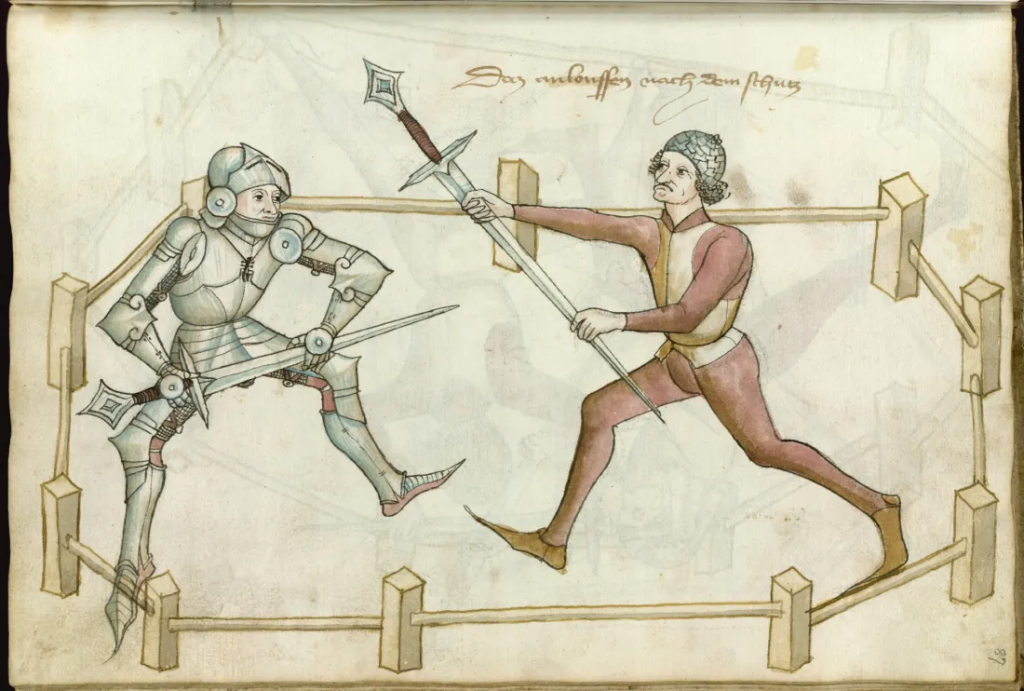
One final note here: manuscripts. Manuscripts themselves are cited by an entirely different system because providence made every part of paleography to punish paleographers for their sins. A manuscript codex consists of folia – individual leaves of parchment (so two “pages” in modern numbering on either side of the same physical page) – which are numbered. Then each folium is divided into recto and verso – front and back. Thus a manuscript is going to be cited by its catalog entry wherever it is kept (each one will have its own system, they are not standardized) followed by the folium (‘f.’) and either recto (r) or verso (v). Typically the abbreviation “MS” leads the catalog entry to indicate a manuscript. Thus this picture of two men fighting is MS Thott.290.2º f.87r (it’s in Det Kongelige Bibliotek in Copenhagen):
MS Thott.290.2º f.87r which can also be found on the inexplicably well maintained Wiktenauer; seriously every type of history should have as dedicated an enthusiast community as arms and armor history.
And there you go.
Bret Devereaux, “Fireside Friday, June 10, 2022”, A Collection of Unmitigated Pedantry, 2022-06-10.
December 15, 2022
Kraut Space Magic: the H&K G11
Forgotten Weapons
Published 25 Dec 2018I have been waiting for a long time to have a chance to make this video — the Heckler & Koch G11! Specifically, a G11K2, the final version approved for use by the West German Bundeswehr, before being cancelled for political and economic reasons.
The G11 was a combined effort by H&K and Dynamit Nobel to produce a new rifle for the German military with truly new technology. The core of the system was the use of a caseless cartridge developed in the late 60s and early 70s by Dynamit Nobel, which then allowed H&K to design a magnificently complex action which could fire three rounds in a hyper-fast (~2000 rpm) burst and have all three bullets leave the barrel before the weapon moved in recoil.
Remarkably, the idea went through enough development to pass German trials and actually be accepted for service in the late 1980s (after a funding shutdown when it proved incapable of winning NATO cartridge selection trials a decade earlier). However, the reunification with East Germany presented a reduced strategic threat, a new surplus of East German combat rifles (AK74s), and a huge new economic burden to the combined nations and this led to the cancellation of the program. The US Advanced Combat Rifle program gave the G11 one last grasp at a future, but it was not deemed a sufficient improvement in practical use over the M16 platform to justify a replacement of all US weapons in service.
The G11 lives on, however, as an icon of German engineering prowess often referred to as “Kraut Space Magic” (in an entirely complimentary take on the old pejorative). That it could be so complex and yet still run reliably in legitimate military trials is a tremendous feat by H&K’s design engineers, and yet one must consider that the Bundeswehr may just have dodged a bullet when it ended up not actually adopting the rifle.
Many thanks to H&K USA for giving me access to the G11 rifles in their Grey Room for this video!
(more…)
December 9, 2022
Rod Bayonet Springfield 1903 (w/ Royalties and Heat Treat)
Forgotten Weapons
Published 20 Nov 2016(Note: I misspoke regarding Roosevelt’s letter; he was President at the time and writing to the Secretary of War)
The US military adopted the Model 1903 Springfield rifle in 1903, replacing the short-lived Krag-Jorgenson rifle. However, the 1903 would undergo some pretty substantial changes in 1905 and 1906 before becoming the rifle we recognize today. The piece in today’s video is an original Springfield produced in 1904, before any of these changes took place.
The most notable difference is the use of the rod bayonet. When the 1903 was in development, the Ordnance Department opined that the bayonet was largely obsolete, and that it was unnecessary to encumber soldiers with a long blade hanging from the belt. Instead, the new rifle would have a retractable spike bayonet that could double as cleaning rod and would be stored in the rifle stock, unobtrusive to the soldier. This ended in 1905 with a critical letter from Theodore Roosevelt (who was Secretary of War at the time). As the rod bayonet was replaced with a traditional blade bayonet, the cartridge would also be improved to a new style spitzer projectile at higher velocity, and the rifles’ stocks, hand guards, and sights were redesigned.
In this video I also discuss two often misunderstood elements of the Springfield’s history: heat treating and patent royalties. Are low serial number 1903 Springfields safe to shoot, and why or why not? And did the US government actually pay royalties to Germany for copying Mauser elements in the 1903?
(more…)
December 6, 2022
Tank Chat #160 | M18 Hellcat | The Tank Museum
The Tank Museum
Published 5 Aug 2022Hello Tank Nuts! M18 Hellcat perfectly fit the American Army’s Tank Destroyer doctrine during WW2. This particular M18 saw service during WW2 and conflict in former Yugoslavia. It is part of the Phelps private collection and recently took part in the celebrations for the 75th Anniversary of the liberation of the city of Mons, Belgium. Discover more on Hellcat and watch the latest Tank Chat with David Willey.
(more…)
December 5, 2022
QotD: Open concept house designs
A single room could serve as a study in the morning, a dining room at noon, a living room in the evening, and a bedroom at night. Beds were couches, and couches were beds. Your house was your workspace, and your minimal furniture typically had no fixed arrangement, as it was constantly moved about to accommodate different uses of the only room available. (The French and Italian words for “furniture” still hint at this history: You can see the similarity to “mobile” in meubles and mobilia.)
These open concepts of old were not only motivated by different conceptions of privacy and the expense of building additional walls. They were also required for the lower classes by premodern heating technologies. A single open hearth, or, later, fireplace or stove, could warm one large room but could not do much for other, closed-off spaces. A lord or king could build a heating element into every room, but for the average family, winter warmth required most of life to happen in a single space.
As technology advanced, ideas about privacy changed, and standards of living improved over the last 500 years, ordinary people were increasingly able to move away from an open concept home, and they eagerly did so. “Rooms began to proliferate as wealthy householders discovered the satisfactions of having space to themselves,” notes Bill Bryson in At Home: A Short History of Private Life. Though the transition was slow — toilets long had “multiple seats, for ease of conversation” — rooms were increasingly devoted to particular uses, and those uses were separated from one another as much as resources permitted.
Bonnie Kristian, “Open concept homes are for peasants”, The Week, 2019-05-12.


