Kings and Generals
Published 2 Mar 2021Video is Sponsored by Ridge Wallet: https://www.ridge.com/KINGSANDGENERALS Use Code “
KINGSANDGENERALS” for 10% off your order!The Kings and Generals animated historical documentary series on the evolution of the Roman Army continues with the first episode of the series on the Army of the Eastern Roman Empire — the Byzantine Empire. In this episode, we’ll mainly focus on how the Roman army was transformed into the Byzantine army and talk about the armies of Justinian and Belisarius described by Procopius.
Support us on Patreon: http://www.patreon.com/KingsandGenerals or Paypal: http://paypal.me/kingsandgenerals. We are grateful to our patrons and sponsors, who made this video possible: https://docs.google.com/document/d/1o…
The video was made by our Arb Paninken http://bit.ly/2Ow3oC8, while the script was developed by Leo Stone. This video was narrated by Officially Devin (https://www.youtube.com/user/OfficiallyDevin)
✔ Merch store ► teespring.com/stores/kingsandgenerals
✔ Podcast ► Google Play: http://bit.ly/2QDF7y0 iTunes: https://apple.co/2QTuMNG
✔ Twitter ► https://twitter.com/KingsGenerals
✔ Instagram ► http://www.instagram.com/Kings_GeneralsProduction Music courtesy of Epidemic Sound: http://www.epidemicsound.com
#Documentary #Byzantines #Romans
March 4, 2021
How the Roman Army Became the Byzantine Army
March 2, 2021
The Evolution of Shock Cavalry – From Antiquity to the Middle Ages
Invicta
Published 1 Mar 2021Learn about the evolution of shock cavalry from antiquity before the use of saddles and stirrups! Check out The Great Courses Plus to learn about shock cavalry in the campaigns of Alexander the Great: http://ow.ly/osex30rvhjf
In this history documentary we explore the topic of ancient cavalry. The basic idea is that these units often get depicted in media as performing glorious massed charges headlong into the enemy ranks as seen in such scenes as the Charge of the Rohirrim from the Battle of Pelenor Fields. In reality this would have been a very dangerous situation for cavalrymen even under the best circumstances. But to make matters worse, riders from antiquity fought without the use of either saddles or stirrups. So how on earth did they manage to dominate the battlefield with these handicaps. Let’s find out.
We begin by covering the history of cavalry with the first domestication of the horse and its introduction to warfare first as member of the baggage train and soon after as a part of chariot crews rather than as actual mounted forces. This was in large part due to the lack of riding experience and technology on behalf of the rider. Soon after the Bronze Age Collapse however cavalry began to rise to prominence across the armies of the Mediterranean. We speak about the various forms of equine practices which ranged from riding bareback into combat as with the Numidian Cavalry to the use of simple bridles and cloth seats as with Greek Cavalry and Persian Cavalry.
We then cover the techniques used by these cavalrymen to mount, ride, and fight. As a part of this discussion, we rely heavily on Xenophon’s Manual on Horsemanship which provides excellent first hand details from the period. We also show how these techniques were successfully used by shock cavalry of antiquity such as the Macedonian Companion Cavalry, the Saka Steppe Lancers, and the Persian Cataphracts to great effect even without the use of saddles and stirrups.
Finally we do pose the question of why they didn’t use the saddle and stirrup given its seemingly obvious advantages. To answer this question we look at the history of its development from late antiquity to the early Middle Ages.
Bibliography and Suggested Reading
On Horsemanship, by Xenophon
Adrian Goldsworthy, The Complete Roman Army
Adrian Goldsworthy, Roman Warfare
J.C. Coulston, Cavalry Equipment of the Roman Army in the First Century A.D.
George T. Dennis, Maurice’s Strategikon, p. 38.
Julius Caesar, Commentarii de Bello Civili
Russel H. Beaty, Saddles#History
#Documentary
#ShockCavalry
From the comments:
Invicta
13 hours ago
I was inspired by comments on our latest Units of History episode covering the Companion Cavalry which asked about how shock tactics worked in an age before the stirrup and saddle. I went down the rabbit hole finding answers and present to you my findings in this video! One awesome source we used was the Manual on Horsemanship by Xenophon which you can read for yourself here: http://www.gutenberg.org/files/1176/1176-h/1176-h.htm
January 3, 2021
QotD: Literary stasis in the Byzantine empire
Undoubtedly, the Mediaeval Romans – now exclusively Greek in their language – made little effort to be original in their literature. They had virtually the whole body of Classical Greek literature in their libraries and in their heads. For them, this was both a wonderful possession and a fetter on the imagination. It was in their language, and not in their language. Any educated person could understand it. But the language had moved on – changes of pronunciation and dynamics and vocabulary. The classics were the accepted model for composition. But to write like the ancients was furiously hard. Imagine a world in which we spoke Standard English, but felt compelled, for everything above a short e-mail, to write in the language of Shakespeare and the Authorised Version of the Bible. Some of us might manage a good pastiche. Most of us would simply memorise the whole of the Bible, and, overlooking its actual content, write by adapting and rearranging remembered clauses. It would encourage an original literature. Because Latin soon became a completely foreign language in the West – and because we in England were so barbarous, we had to write in our own language – Western Mediaeval literature is often a fine thing. The Mediaeval Romans never had a dark age in our sense. Their historians in the fifteenth century wrote up the fall of Constantinople to the Turks in the same language as Thucydides. Poor Greeks.
Sean Gabb, “The Mediaeval Roman Empire: An Unlikely Emergence and Survival”, SeanGabb.co.uk, 2018-09-14.
December 25, 2020
“Swedish Pagans” – Vikings & The Russ – Sabaton History 099 [Official]
Sabaton History
Published 24 Dec 2020It was a sword-age, a spear-age — an age when fearsome Northmen, savage Vikings, and mysterious pagans from across the sea haunted the shores of northern Europe. The Swedish pagans, believing in the fate of the old Norse gods, traveled south across the Baltic Sea and deep into modern-day Russia. With their sleek longships, they sailed along the big rivers, ever southwards to reach Miklagard. Miklagard — the Great City — that was Constantinople, where the Swedish Pagans sold slaves and goods from the north for silver and coin. Those who made the long hazardous journey and survived the treacherous country were to be rich men.
Support Sabaton History on Patreon: https://www.patreon.com/sabatonhistory
Listen to “Swedish Pagans” on the album The Art of War: https://music.sabaton.net/TheArtOfWar
Listen to Sabaton on Spotify: http://smarturl.it/SabatonSpotify
Official Sabaton Merchandise Shop: http://bit.ly/SabatonOfficialShopHosted by: Indy Neidell
Written by: Markus Linke and Indy Neidell
Directed by: Astrid Deinhard and Wieke Kapteijns
Produced by: Pär Sundström, Astrid Deinhard and Spartacus Olsson
Creative Producer: Maria Kyhle
Executive Producers: Pär Sundström, Joakim Brodén, Tomas Sunmo, Indy Neidell, Astrid Deinhard, and Spartacus Olsson
Community Manager: Maria Kyhle
Post-Production Director: Wieke Kapteijns
Editor: Karolina Dołęga
Sound Editor: Marek Kamiński
Maps by: Eastory – https://www.youtube.com/c/eastory
Archive: Reuters/Screenocean – https://www.screenocean.comSources:
Swedish National Heritage Board
Kulturhistorisk museum
Museum of Cultural History, part of the University of Oslo, Norway
Pictures of Runestone courtesy of: Berig, RJürgen Howald & Bjoertvedt from Wikimedia
AU Library, Campus Emdrup, http://galleri.au.dk/aul/#14891850309…
Longship sketch with a keel courtesy of Cornelis from Wikimedia
Map from 878 courtesy of Hel-hama – from WikimediaAll music by: Sabaton
An OnLion Entertainment GmbH and Raging Beaver Publishing AB co-Production.
© Raging Beaver Publishing AB, 2019 – all rights reserved.
December 15, 2020
History Summarized: Spread of Christianity
Overly Sarcastic Productions
Published 10 Jan 2017Things I learned when making this video: 1) when your script goes beyond 4 single-spaced pages, you’re heading into the danger zone 2) Gregorian Chants are awesome and you should totally listen to them, 3) editing always takes longer than you’d hope 4) self care is huffing frankincense for breakfast lunch and dinner and single-handedly sacking a levantine city!
Have a question about something I mentioned, or maybe something I might have left out? Leave it down below and I’ll do my best to respond!
PATREON: https://www.patreon.com/OSP
MERCH LINKS:
Shirts – https://overlysarcasticproducts.threa…
All the other stuff – http://www.cafepress.com/OverlySarcas…Find us on Twitter @OSPYouTube!
twitter.com/OSPyoutube
December 13, 2020
How the Romans Stole Silk Production Secrets from China
Kings and Generals
Published 31 Jan 2019Go to https://www.wix.com/KingsAndGenerals to get started on your website today!
Check out our new website at http://kingsandgenerals.orgSilk production was one of the biggest secrets of China and one of the most lucrative industries of the age. So it is not a surprise that the Roman emperor Justinian was eager to learn this secret. In this video we will discuss the start of the silk production, its importance and the story of how Justinian managed one of the first industrial thefts in history
Support us on Patreon: http://www.patreon.com/KingsandGenerals or Paypal: http://paypal.me/kingsandgenerals
Check out our Merch Store: teespring.com/stores/kingsandgenerals
We are grateful to our patrons and youtube members, who made this video possible: https://drive.google.com/open?id=1Xa-…
The video was made by our friend Cogito
This video was narrated by Officially Devin (https://www.youtube.com/user/Official…)
✔ Merch store ► teespring.com/stores/kingsandgenerals
✔ Podcast ► Google Play: http://bit.ly/2QDF7y0 iTunes: https://apple.co/2QTuMNG
✔ Twitter ► https://twitter.com/KingsGenerals
✔ Instagram ► http://www.instagram.com/Kings_GeneralsProduction Music courtesy of Epidemic Sound: http://www.epidemicsound.com
#Documentary #Justinian #Silk
December 5, 2020
The Fall of the Byzantine Empire — History Summarized
Overly Sarcastic Productions
Published 4 Dec 2020At long last, the concluding chapter of Roman history! Let’s tie the bow on Byzantine Constantinople as the empire comes to an end, slightly earlier than we might think, but far later than anybody ever could have expected.
SOURCES & Further Reading: Byzantium: The Decline and Fall & A Short History of Byzantium by John Julius Norwich, Osman’s Dream by Finkel, https://www.ancient.eu/Despotate_of_t…
This video was edited by Sophia Ricciardi AKA “Indigo”. https://www.sophiakricci.com/
Our content is intended for teenage audiences and up.
PATREON: https://www.Patreon.com/OSP
PODCAST: https://overlysarcasticpodcast.transi…
DISCORD: https://discord.gg/osp
MERCH LINKS: http://rdbl.co/osp
OUR WEBSITE: https://www.OverlySarcasticProductions.com
Find us on Twitter https://www.Twitter.com/OSPYouTube
Find us on Reddit https://www.Reddit.com/r/OSP/
July 26, 2020
Hagia Sophia
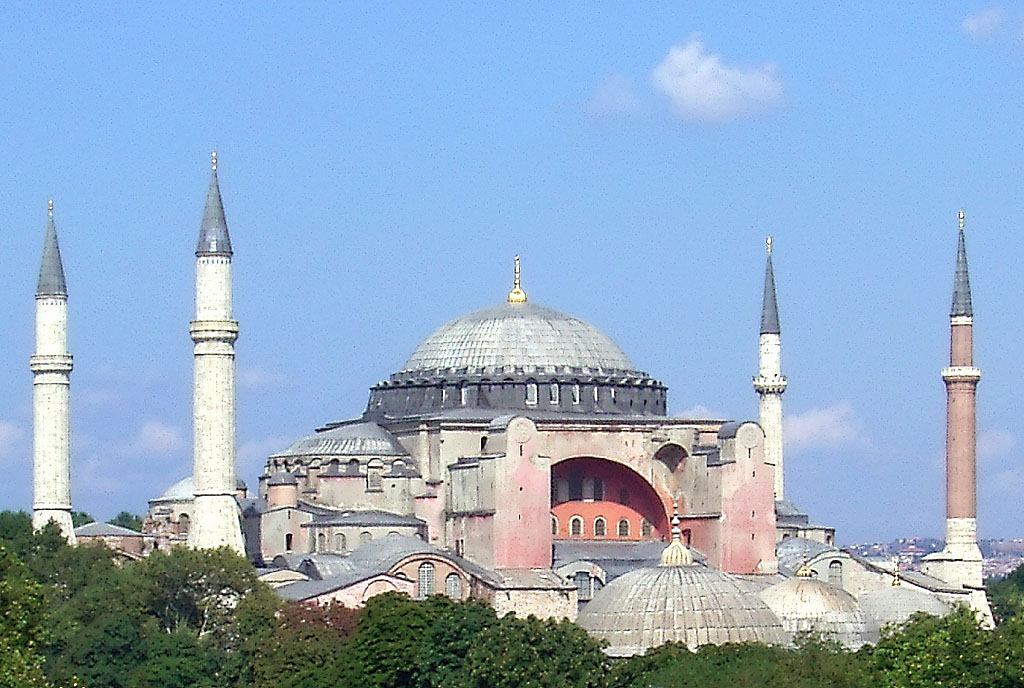
Lars Brownworth (author of the excellent Lost to the West: The Forgotten Byzantine Empire That Rescued Western Civilization) on the building of the Hagia Sophia by Eastern Roman Emperor Justinian in Constantinople:

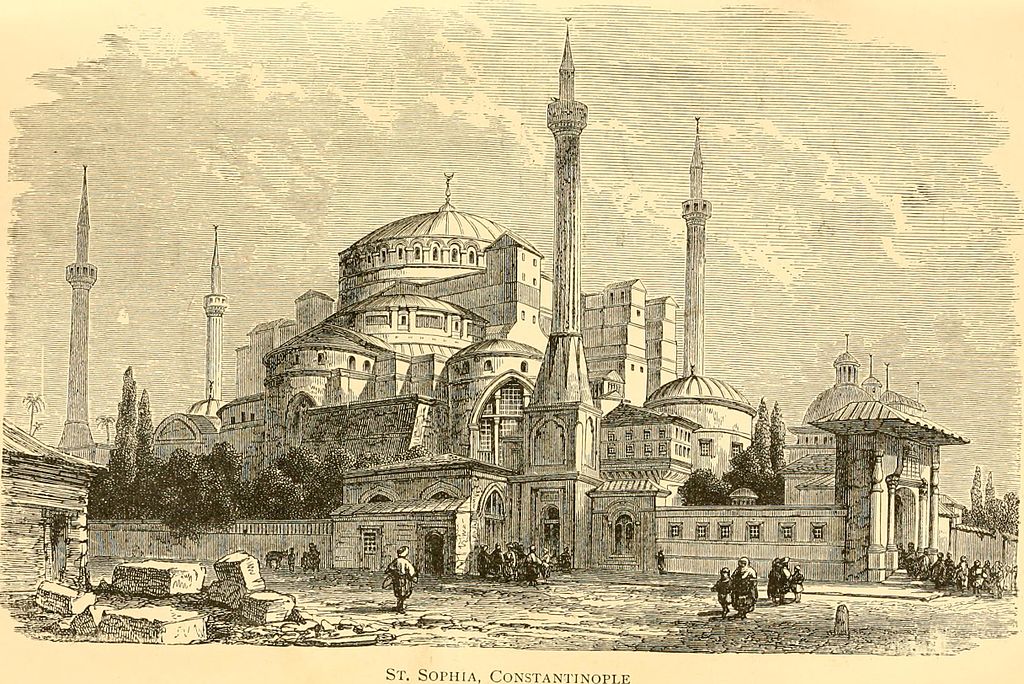
Illustration of the Hagia Sophia from European History: An outline of its development by George Burton Adams, 1899.
Wikimedia Commons
The Hagia Sophia was the brainchild of a unique figure in history. At birth, Justinian was a nobody among nobodies in a grindingly poor part of what is today North Macedonia. By his mid-40s, he was a Byzantine emperor. His appetites were large, his dreams larger. The man who knew what it was like to have nothing gave new meaning to the idea of luxury. For one memorable celebration, he spent almost two tons of gold on decorations.
Justinian had no time for small things. By the second year of his reign, he had decided to codify all of Roman law, founded several new cities, and had started construction on at least eight new churches.
The money for all these projects inevitably came from the public. And by the fifth year of his reign, his subjects had had enough. Already upset by rampant corruption, an inefficient bureaucracy, and crushing taxes, they hit the boiling point when Justinian severely restricted public games. A mob tore through the streets, overwhelming the unprepared police forces. Several stores were set on fire, and the wind quickly spread the flames to a nearby hospital, which burned down with its patients inside. An inferno raged. For five long days, Constantinople burned.
By the time Justinian reasserted control, more than 30,000 citizens were dead, and perhaps a third of the city was a blackened shell. It looked as if some barbarian horde had sacked the capital. The fact that its own people had inflicted such a wound hovered like a black cloud over the streets.
Characteristically, Justinian saw a perfect opportunity within the ashes. This was a blank canvas on which to create a new city in his image. The transformation would begin with the cathedral. The original building, known simply as the Magna Ecclesia — the Great Church — had been built by a son of Constantine the Great in the fourth century, but had burned down a few decades later. Since it was a standard Roman basilica — a large hall with square walls and angled wooden roof — it had been fairly easy to rebuild along the same lines.
But of course, Justinian had no intention of following the tired plans of an earlier age. This was a chance to remake the cathedral on a new scale, something worthy of the ages. It was to be nothing short of a revolution, equal parts art and architecture, the enduring grandeur of the emperor himself frozen in physical form.
Everything about this project was audacious, including his selection of architects. Instead of choosing a traditional builder, he picked two teachers who — like himself — had more vision than practical experience. This was a lifelong pattern with Justinian. He had a habit of plucking genius out of the common crush; his wife was a reformed prostitute, and his greatest generals were an elderly eunuch and a former bodyguard.
The emperor’s instructions to Isidore of Miletus, a physics teacher, and Anthemius of Tralles, a mathematician, should have terrified them. They merely had to design and successfully build a church unlike anything else the world had seen. Sheer scale wasn’t enough — the empire was full of grand monuments and immense sculpture. This had to be something different, something fitting for the new golden age that was dawning. Expense wasn’t an issue, but speed was. Justinian was already in his 50s, and he didn’t intend to have some successor apply the final coat of paint and claim the project as his own.

June 2, 2020
The Fall Of The Roman Empire With Tom Holland | History Hit LIVE on Timeline
Timeline – World History Documentaries
Published 29 May 2020The Roman Empire remains one of the most enduring and prolific civilisations of written history. Yet it, like all great civilisations, would eventually come to an end. Join Dan Snow as he speaks to historian Tom Holland about the many contributing factors that would bring this seismic and seemingly invincible empire to its knees.
#StayHome #WithMe #FallOfRome
May 4, 2020
Fourth Crusade | 3 Minute History
Jabzy
Published 24 Sep 2016https://www.patreon.com/Jabzy
Thanks to Xios, Alan Haskayne, Lachlan Lindenmayer, Victor Yau, William Crabb, Derpvic, Seth Reeves and all my other Patrons.
April 11, 2020
Pandemics Economically Worse than War – The First Pandemic – Pandemic History 01
TimeGhost History
Published 10 Apr 2020There is much we can learn from past pandemics, like how Emperor Justinian ruined the Eastern Roman Empire’s economy and made the first plague pandemic even worse.
Join us on Patreon: https://www.patreon.com/TimeGhostHistory
Hosted by: Indy Neidell and Spartacus Olsson
Written by: Spartacus Olsson
Directed by: Astrid Deinhard
Executive Producers: Bodo Rittenauer, Astrid Deinhard, Indy Neidell, Spartacus Olsson
Creative Producer: Joram Appel
Post-Production Director: Wieke KapteijnsResearch by: Spartacus Olsson
Edited by: Spartacus OlssonArchive by Reuters/Screenocean http://screenocean.com
A TimeGhost chronological documentary produced by OnLion Entertainment GmbH.
From the comments:
TimeGhost History
3 minutes ago
As announced, here is the first instalment of our impromptu series on the history of pandemics. Now, as you will see in the video this is not just a reaction to the current COVID-19 pandemic, but very much back to the roots for us. Indy studied the pandemics extensively back in university times, and to study history in general requires a somewhat morbid fascination with human disaster in general. So we have spent many, many years looking intently at the worst disasters that have befallen humanity — and there is nothing worse than disease, especially on a pandemic scale. Hopefully this is the time when we can share a bit of that amassed knowledge to add a little timely understanding of the greater effects of pandemics, beyond the immediate tragic medical ones, like how they have impacted society, the economy, and human life in general throughout history. While we cannot give you fixed schedule for this series (we have the regular programming to take care of) we will try to come out with the next one very soon.A note on a statement I make in the video: when I say COVID-19 might be the first time we successfully fight back a pandemic, I am saying that fully aware of the eradication of small pox and the near eradication of polio, the flu vaccine successes and so on — but that is avoidance of recurring pandemics of a specific kind and we have made more progress there than actually handling pandemics of a new disease when they break out for the first time. On that note, take care, stay safe, and may you be healthy despite these trying times.
Spartacus
March 19, 2020
Second Crusade | 3 Minute History
March 5, 2020
First Crusade | 3 Minute History
March 2, 2020
History-Makers: Anna Komnena
Overly Sarcastic Productions
Published 28 Feb 2020She’s a Princess! She’s a Poet! She’s a Historian! She’s Anna Komnena — the COOLEST writer in the Byzantine Empire! On this episode of History-Makers, jump into the reign of Alexios Komnenos from the perspective of his daughter Anna, and learn about the emperor who saved the Byzantines from certain doom, as well as the traits that make Anna’s Alexiad a masterpiece.
This video was edited by Sophia Ricciardi, AKA “Indigo”.
Our content is intended for teenage audiences and up.Sources & Further Reading: The Alexiad — obviously, what are you waiting for? (Also Norwich’s Byzantium)
PATREON: https://www.Patreon.com/OSP
DISCORD: https://discord.gg/h3AqJPe
MERCH LINKS: https://www.redbubble.com/people/OSPY…
OUR WEBSITE: https://www.OverlySarcasticProductions.com
Find us on Twitter https://www.Twitter.com/OSPYouTube
Find us on Reddit https://www.Reddit.com/r/OSP/
March 1, 2020
The Black Death of the 14th Century
Ed West looks at what we know of the spread of the worst plague to hit western Europe in the 1300s:

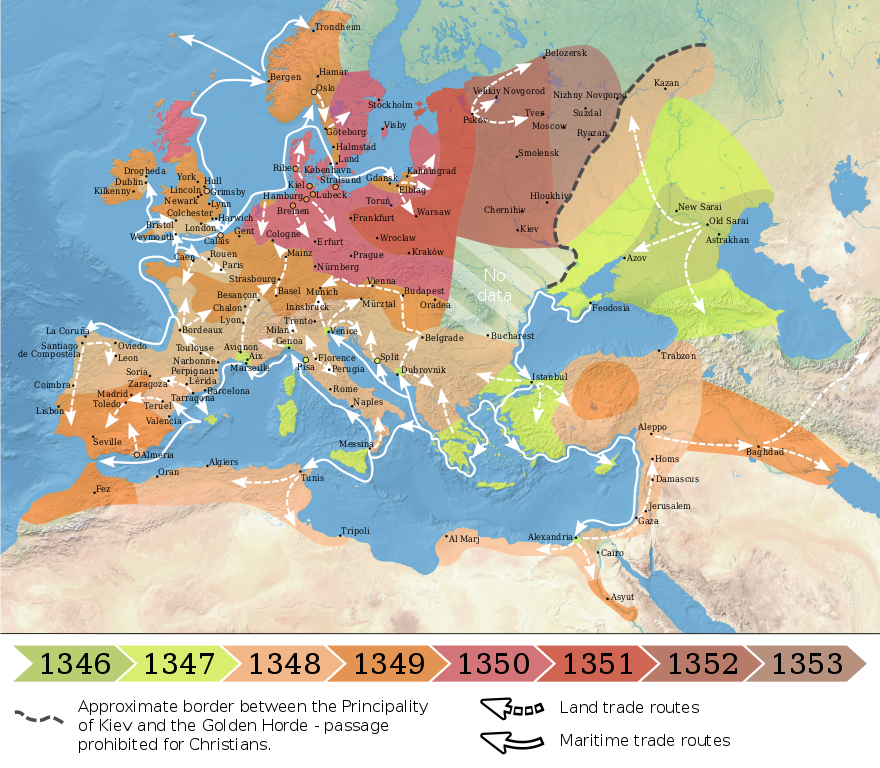
Map showing the spread of the Black Death in Europe between 1346 and 1353.
Map by Flappiefh via Wikimedia Commons.
There had never been a terror like it, and the “Great Mortality” as it was known — and much later, the “Black Death” — has seared itself in the European imagination. It changed the culture and tested the institutions of the time, and as we anxiously await the arrival of another — thankfully far less deadly — contagion from Italy its legacy and impact are worth remembering.
Epidemics have been around as long as civilization. Plaga — from the Greek for “strike” or “hit” — devastated classical Athens in the 5th century BC, when the historian Thucydides nursed sufferers; the Antonine Plague — probably smallpox or measles — killed as many as five million Romans at the empire’s peak. Far more deadly was the Plague of Justinian in the sixth century, which had a toll of 25 million and emptied whole regions of the eastern (Byzantine) Empire. Only in the 21st century did researchers confirm that this was the same illness that would appear eight centuries later — the Bubonic Plague.
Empires were particularly affected by these horrific epidemics, because empires are a form of globalisation — bringing different people into contact with each other and, more dangerously, into contact with other mammals, who act as disease vectors.
Another danger is climate change, which might turn a mild virus into a deadly one, or cause disease-carrying animals to migrate. This is what happened during the 14th century when the northern hemisphere became considerably cooler, soon after the Mongols had created the largest contiguous empire in history.
Genghis Khan’s people have generally received a historical bad press — people are more likely to recall the pyramid of skulls and the Tigris flowing black and red — yet their rule had opened up trade routes, allowing goods and people to cross Asia. Whether brought at the point of a sword or a trade deal, globalisation always brings the new: new cultures, new ideas, new languages and new pathogens.
Yersinia pestis had been living on gerbils and other rodents in central Asia, but unstable climate conditions in 1330s caused the disease to jump onto the rat flea. It was killing people by 1339, and in the mid-1340s Christians first heard of a disease raging in the Islamic world, which some at least took as divine punishment for the crusades.
After two centuries of Holy War this was understandable, yet hatred was not universal and during these conflicts Italian merchants had continually done business with Muslims, much to the Church’s fury. Now this trade, once the source of prosperity and peace, proved deadly: plague reached Europe via the Genovese colony of Caffa on the Black Sea (now Feodosiya, in the Ukraine). In October 1347, four ships escaping the diseased city had turned up in Sicily, condemning Italy to its fate.