TED-Ed
Published 9 Apr 2018Check out our Patreon page: https://www.patreon.com/teded
View full lesson: https://ed.ted.com/lessons/the-rise-a…
Most history books will tell you that the Roman Empire fell in the fifth century CE, but this would’ve come as a surprise to the millions who lived in the Roman Empire through the Middle Ages. This Medieval Roman Empire, today called the Byzantine Empire, began when Constantine, the first Christian emperor, moved Rome’s capital. Leonora Neville details the rise and fall of the Byzantine Empire.
Lesson by Leonora Neville, animation by Remus & Kiki.
Thank you so much to our patrons for your support! Without you this video would not be possible! Abhijit Kiran Valluri, Mandeep Singh, Sama aafghani, Vinicius Lhullier, Connor Wytko, Marylise CHAUFFETON, Marvin Vizuett, Jayant Sahewal, Quinn Shen, Caleb ross, Elnathan Joshua Bangayan, Gaurav Rana, Mullaiarasu Sundaramurthy, Jose Henrique Leopoldo e Silva, Dan Paterniti, Jose Schroeder, Jerome Froelich, Tyler Yoshizumi, Martin Stephen, Justin Carpani, Faiza Imtiaz, Khalifa Alhulail, Tejas Dc, Govind Shukla, Srikote Naewchampa, Ex Foedus, Sage Curie, Exal Enrique Cisneros Tuch, Vignan Velivela, Ahmad Hyari, A Hundred Years, eden sher, Travis Wehrman, Minh Tran, Louisa Lee, Kiara Taylor, Hoang Viet, Nathan A. Wright, Jast3 , Аркадий Скайуокер, Milad Mostafavi, Singh Devesh Sourabh, Ashley Maldonado, Clarence E. Harper Jr., Bojana Golubovic, Mihail Radu Pantilimon, Sarah Yaghi, Benedict Chuah, Karthik Cherala, haventfiguredout, Violeta Cervantes, Elaine Fitzpatrick, Lyn-z Schulte, cnorahs, Henrique ‘Sorín’ Cassús, Tim Robinson, Jun Cai, Paul Schneider, Amber Wood, Ophelia Gibson Best, and Cas Jamieson.
March 1, 2020
The rise and fall of the Byzantine Empire – Leonora Neville
February 15, 2020
The Best Couples in History — Valentine’s Day Special
Overly Sarcastic Productions
Published 14 Feb 2020Happy Valentine’s Day! Celebrate the history of Love with a rundown of these outstanding couples — for better and for worse.
Our content is intended for teenage audiences and up.
This video was edited by Sophia Ricciardi, AKA “Indigo”.
PATREON: https://www.Patreon.com/OSP
DISCORD: https://discord.gg/h3AqJPe
MERCH LINKS: https://www.redbubble.com/people/OSPY…OUR WEBSITE: https://www.OverlySarcasticProductions.com
Find us on Twitter https://www.Twitter.com/OSPYouTube
Find us on Reddit https://www.Reddit.com/r/OSP/
February 12, 2020
The Animated History of Italy | Part 1
Suibhne
Published 19 Mar 2018Signup for your FREE trial to The Great Courses Plus here: http://ow.ly/tsMf30iqEeT
The exciting first video in the History of Italy series. Find out how the Italian peninsula was perfectly positioned at the heart of the Mediterranean to both dominate trade, and then rise to defeat its rivals, becoming the most powerful empire Europe, and perhaps the world has ever known
February 1, 2020
History Summarized: Byzantine Empire — The Golden Age
Overly Sarcastic Productions
Published 31 Jan 2020What do you do when life takes away half of your empire? Well, if you’re the Medieval Byzantines, you make comprehensive structural reforms to better manage a changing geopolitical landscape — And then you make an absolute crapload of mosaics.
Our content is intended for teenage audiences and up.
This video was edited in part by Sophia Ricciardi, AKA “Indigo”.
FURTHER SOURCES: A Short History of Byzantium by John Julius Norwich.
PATREON: https://www.Patreon.com/OSP
DISCORD: https://discord.gg/h3AqJPe
MERCH LINKS: https://www.redbubble.com/people/OSPY…
OUR WEBSITE: https://www.OverlySarcasticProductions.com
Find us on Twitter https://www.Twitter.com/OSPYouTube
Find us on Reddit https://www.Reddit.com/r/OSP/
January 13, 2020
The Nika riots in Constantinople (with bonus NASCAR analogies)
Not only does Tamara Keel provide interesting and informative gun information, she also has at least a vague interest in late Classical/early Medieval history:

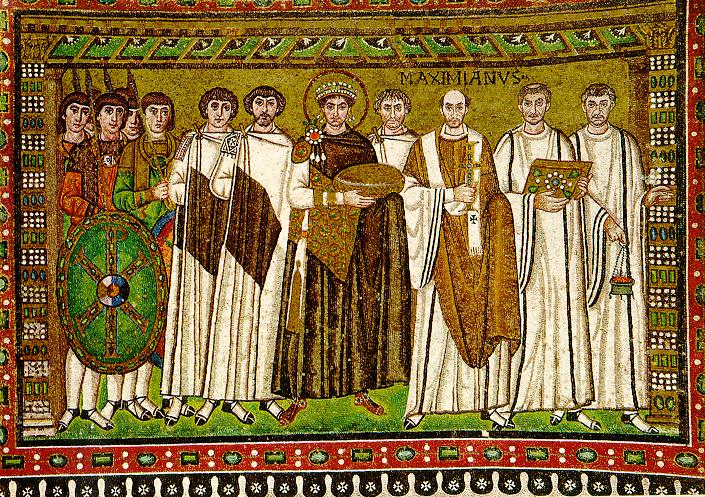
Court of Emperor Justinian with (right) archbishop Maximian and (left) court officials and Praetorian Guards; Basilica of San Vitale in Ravenna, Italy. The bearded man to Justinian’s right is believed to be Belisarius. (via Wikimedia)
The center of social life in Constantinople was the Hippodrome, a massive stadium where chariot races were held. Chariot racing was wildly popular with all strata of society, and everybody was a fan of one team or another; the Blues, the Greens, the Whites, and the Reds. Although as time went on, hardly anybody paid attention to anybody other than the Blues and the Greens. Kinda like Dale Jr. fans and Jeff Gordon fans and who cares about Kurt Busch anymore ’cause he’s a tool.
So, everybody who was anybody was a fan of the Blues or the Greens. You only hung out with fellow Dale fans, all the Jeff Gordon fans voted the same way, you beat the crap out of rival fans in bar fights when you could. Trouble really erupted, however, when some popular ringleaders from each faction were imprisoned on murder raps after a bit of friendly head-busting got out of hand after a contested race.
Dale fans and Jeff Gordon fans united and went wild in the streets, burning and looting and actually laying siege to the palace in a mob scene. The emperor Justinian (via someone expendable, no doubt) announced his willingness to accede to their demands, even to the point of agreeing to abdicate in favor of their choice for a new ruler. Fortunately for Justinian, his wife Theodora and a senior eunuch in the palace bureaucracy named Narses had the stones the emperor lacked. They put their heads together with Belisarius and Mundus, two great Byzantine generals, and hatched a plan.
As the tens of thousands of rioters thronged in the vast Hippodrome, waiting for the new emperor’s coronation, Belisarius and his bodyguard of no more than a couple hundred steppe archers took the passageway under the street from the palace to the imperial box in the stadium. With the crowd focused on the impending ceremony, nobody noticed the archers fanning out in the skybox until they started volleying into the crowd. Panic ensued and, leaving a litter of 24 flags and 88 mesh-back ball caps and shot-up, trampled bodies, the crowd stampeded for the big main gates off the racetrack.
Unfortunately, Mundus and his bodyguard were drawn up in ranks blocking the exit, and they opened fire into the front rows of the fleeing mob. Needless to say, when all was said and done, the backbone of the rioters was broken. Thousands had been shot, and many thousands more were crushed in the press. Justinian held onto his crown, no thanks to his own dithering.
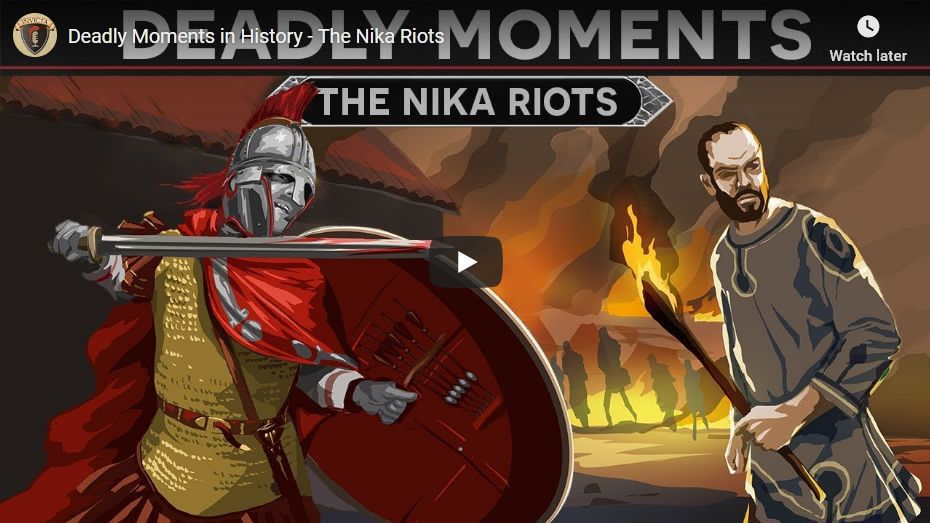
Deadly Moments in History – The Nika Riots
Invicta
Published 27 Feb 2018We relive the deadly Nika Riots which brought the Emperor Justinian to his knees and resulted in the death of 30,000 civilians. In our journey we will explore the history of chariot racing, the undercurrents of dissent, and the blow by blow unfolding of the riot.
Support future documentaries: https://www.patreon.com/InvictaHistory
Twitter: https://twitter.com/InvictaHistoryDocumentary Credits:
Research: Invicta and Luas McCahill
Script: Invicta
Artwork: Robbie McSweeney
Editing: Invicta
Music: Total War Soundtrack, Dreamnote, RecognitionLiterary Sources
–History of the Wars, I by Procopius
–Empress Theodora by J. A. S. Evans
–Justinian: The Last Roman Emperor by G. P. Baker
October 26, 2019
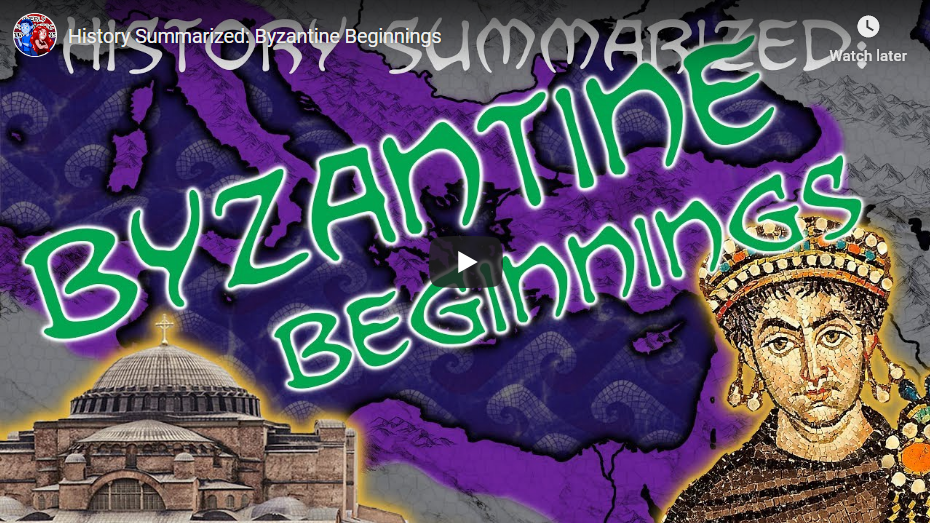
History Summarized: Byzantine Beginnings
Overly Sarcastic Productions
Published 25 Oct 2019It’s Rome! It’s Greece! It’s… The Byzantine Empire! Check out how late Imperial Rome transformed in the centuries from Constantine to Justinian, as it evolved into a new and unique iteration of Roman civilization. Watch as Byzantine craftsmen revolutionize artwork by throwing a megaton of gold onto every last mosaic in the Mediterranean, and radically reimagine architecture by asking “But what if *dome*?”
PATREON: https://www.Patreon.com/OSP
DISCORD: https://discord.gg/sS5K4R3
MERCH LINKS: https://www.redbubble.com/people/OSPY…
OUR WEBSITE: https://www.OverlySarcasticProductions.com
Find us on Twitter https://www.Twitter.com/OSPYouTube
Find us on Reddit https://www.Reddit.com/r/OSP/
June 22, 2019
History Summarized: The Fall of Rome
Overly Sarcastic Productions
Published on 21 Jun 2019Go to http://www.audible.com/overlysarcastic or text
OVERLYSARCASTICto 500500 to get a free audiobook, 2 free Audible Originals, and 30-day free trial.Rome, in one form or another, has been around for a *while*. Kinda seemed like it was going to last forever, like it was basically immortal. Well bad news for everyone involved: Rome goes bye-bye just like all the other empires in world history. So let’s talk about when, how, and why Rome fell!
SEASONS OF ROME T-Shirt: https://www.threadless.com/discover/s…
SOURCES & FURTHER READING:
Gibbon’s Decline and Fall: https://amzn.to/2FwBRvO
Mary Beard’s SPQR: https://amzn.to/2Wwu2x3
The History of Rome Podcast: https://apple.co/2U7Q4tq
Lectures from TheGreatCourses: “The Decline and Fall of the Roman Empire?” (Gregory Aldrete), “Late Antiquity — Crisis and Response” & “Barbarians & Emperors” (Thomas Noble)
If I see anyone complaining that I didn’t sufficiently cite this video I’m going to sack your ancient capital and pillage your temples.PATREON: https://www.Patreon.com/OSP
OUR WEBSITE: https://www.OverlySarcasticProductions.com
Find us on Twitter https://www.Twitter.com/OSPYouTube
Find us on Reddit https://www.Reddit.com/r/OSP/
June 5, 2019
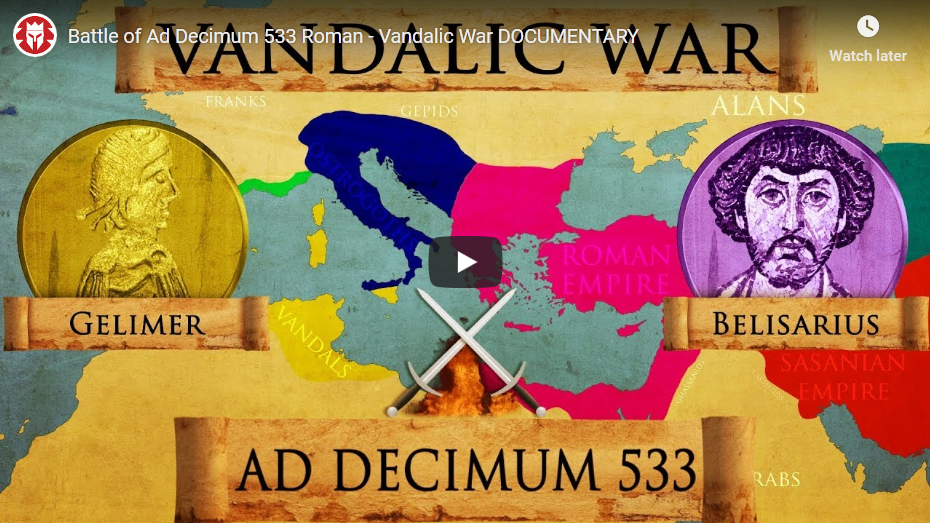
Battle of Ad Decimum 533 Roman – Vandalic War Documentary
Kings and Generals
Published on 12 Nov 2017Although Belisarius, the best general of the Roman Emperor Justinian, had earned a significant victory over the Sassanids at the battle of Dara in 530, the restoration of the empire was just starting. The empire’s western lands were under Vandalic control and Justinian was eager to get them back. He sent Belisarius to Africa to deal with the Vandals. Two battles – Ad Decimum and Tricamarum – were central in this campaign.
Previous video within this series – Battle of Dara 530: https://www.youtube.com/watch?v=9GR_V…
Support us on Patreon: http://www.patreon.com/KingsandGenerals or Paypal: http://paypal.me/kingsandgenerals
We are grateful to our patrons, who made this video possible: Koopinator, Daisho, Łukasz Maliszewski, Nicolas Quinones, William Fluit, Juan Camilo Rodriguez, Murray Dubs, Dimitris Valurdos, Félix Gagné-Dion, Fahri Dashwali, Kyle Hooton, Dan Mullen, Mohamed Thair, Pablo Aparicio Martínez, Iulian Margeloiu, Chet, Nick Nasad, Jeyares, Amir Eppel, Thomas Bloch, Uri Sternfeld, Juha Mäkelä, Georgi Kirilov, Moe Mia, Daniel Yifrach, Brian Crane, Muramasa, Gerald Tnay, Hassan Ali, Richie Thierry, David O’Hare, Christopher Commins, Chris Glantzis and Mike.
The script was developed by our friend DismountedCentaur. His help with the research was essential for this documentary.
This video was narrated by good friend Officially Devin. Check out his channel for some kick-ass Let’s Plays. https://www.youtube.com/user/Official…
The Machinimas for this video are created by one more friend – Malay Archer. Check out his channel, he has some of the best Total War machinimas ever created: https://www.youtube.com/user/Mathemed…
February 28, 2019
First Crusade Part 2 of 2
Epic History TV
Published on 31 Mar 2017Part 2 of Epic History TV’s story of the First Crusade continues with the Siege of Antioch. The Crusaders endure immense hardships outside the city walls, but finally take Antioch thanks to a ruse by Bohemond of Taranto. Against the odds, and inspired by their recent discovery of a relic believed to be the ‘Holy Lance’, the Crusaders then defeat the Seljuk army of Kur Burgha. After disagreements within the Crusader camp, the army finally moves on to Jerusalem in the spring of 1099. During a full-scale assault of the city walls, Godfrey of Bouillon’s troops gain a foothold in the defences, and Crusader troops pour into the city. A bloodbath follows. Victory results in the creation of four Crusader states, but their existence is precarious, surrounded by hostile Muslim powers, who will one day return with a vengeance.
Produced in partnership with Osprey Publishing
https://ospreypublishing.com/Campaign: The First Crusade 1096–99
https://ospreypublishing.com/the-firs…Essential Histories: The Crusades
https://ospreypublishing.com/the-crus…The Armies of Islam 7th–11th Centuries
https://ospreypublishing.com/the-armi…Armies of the Crusades
https://ospreypublishing.com/armies-o…Music with thanks to Filmstro: https://www.filmstro.com/
Get 20% off an annual license! Use our exclusive coupon code: EPICHISTORYTV_ANNImage credits – via Flickr under Creative Commons CC-BY-SA 2.0
Sky – Anyul Rivas
Wooded Hills – Alexander Annenkov
Dramatic Fields – Antonio Caiazzo
Twin peaks of Mount Ararat – Adam JonesPlease help me make more videos at Patreon: https://www.patreon.com/EpicHistoryTV
February 27, 2019
First Crusade Part 1 of 2
Epic History TV
Published on 13 Jan 2017The First Crusade was one of the most extraordinary, bloody and significant episodes in medieval history. It began with an appeal for aid from the Christian Byzantine Empire, threatened by the rising power of the Muslim Seljuk Turks. But when Pope Urban II preached a sermon at Clermont in 1095, the result was unlike anything ever seen before. The Pope offered spiritual salvation to those willing to go east to aid their fellow Christians in a holy war, and help liberate Jerusalem from Muslim rule. Knights and peasants alike signed up in their thousands, leading to the disastrous People’s, or Peasants’, Crusade, then to a much more organised and powerful Princes’ Crusade. Their forces gathered at Constantinople, where they made an uneasy alliance with Byzantine Emperor Alexius I Comnenus. Entering Anatolia, they helped to win back the city of Nicaea, then won a decisive but hard-fought victory at Dorlyaeum, before marching on the great city of Antioch…
Produced in partnership with Osprey Publishing
https://ospreypublishing.com/Campaign: The First Crusade 1096–99
https://ospreypublishing.com/the-firs…Essential Histories: The Crusades
https://ospreypublishing.com/the-crus…The Armies of Islam 7th–11th Centuries
https://ospreypublishing.com/the-armi…Armies of the Crusades
https://ospreypublishing.com/armies-o…Music with thanks to Filmstro: https://www.filmstro.com/
Get 20% off an annual license! Use our exclusive coupon code: EPICHISTORYTV_ANNImage credits – via Flickr under Creative Commons CC-BY-SA 2.0
Sky – Anyul Rivas
Wooded Hills – Alexander Annenkov
Dramatic Fields – Antonio Caiazzo
Twin peaks of Mount Ararat – Adam JonesPlease help me make more videos at Patreon: https://www.patreon.com/EpicHistoryTV
December 11, 2018
Why the Byzantine Empire Never Existed
KhAnubis
Published on 12 Aug 2018We frequently talk about the Eastern Roman Empire as if it were some separate empire from the Roman Empire, when in fact, in a lot of ways, the Roman and Byzantine Empires were really the same empire.
November 19, 2018
Viking Expansion – The Lands of the Rus – Extra History – #4
Extra Credits
Published on 17 Nov 2018The Rus Vikings headed further inland into eastern Europe, raiding Constantinople (unsuccessfully) at first, and then eventually falling into negotiations with the Byzantines and changing their own culture over time. One of their most famous descending rulers was Olga of Kiev, who was also the grandmother of Vladimir.
Join us on Patreon! http://bit.ly/EHPatreon
November 18, 2018
New research shows 536AD to have been the true annus horribilis
There have been bad years in human history. There have been worse days in human history. But according to a recent study summarized in Science magazine, the worst year in recorded history was 536AD:
Ask medieval historian Michael McCormick what year was the worst to be alive, and he’s got an answer: “536.” Not 1349, when the Black Death wiped out half of Europe. Not 1918, when the flu killed 50 million to 100 million people, mostly young adults. But 536. In Europe, “It was the beginning of one of the worst periods to be alive, if not the worst year,” says McCormick, a historian and archaeologist who chairs the Harvard University Initiative for the Science of the Human Past.
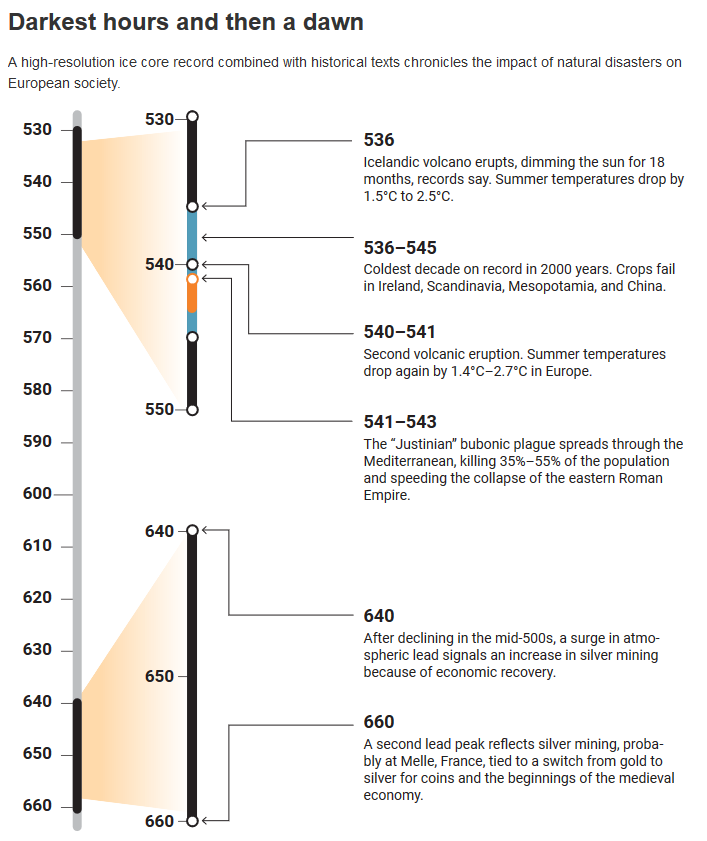
A mysterious fog plunged Europe, the Middle East, and parts of Asia into darkness, day and night — for 18 months. “For the sun gave forth its light without brightness, like the moon, during the whole year,” wrote Byzantine historian Procopius. Temperatures in the summer of 536 fell 1.5°C to 2.5°C, initiating the coldest decade in the past 2300 years. Snow fell that summer in China; crops failed; people starved. The Irish chronicles record “a failure of bread from the years 536–539.” Then, in 541, bubonic plague struck the Roman port of Pelusium, in Egypt. What came to be called the Plague of Justinian spread rapidly, wiping out one-third to one-half of the population of the eastern Roman Empire and hastening its collapse, McCormick says.
Historians have long known that the middle of the sixth century was a dark hour in what used to be called the Dark Ages, but the source of the mysterious clouds has long been a puzzle. Now, an ultraprecise analysis of ice from a Swiss glacier by a team led by McCormick and glaciologist Paul Mayewski at the Climate Change Institute of The University of Maine (UM) in Orono has fingered a culprit. At a workshop at Harvard this week, the team reported that a cataclysmic volcanic eruption in Iceland spewed ash across the Northern Hemisphere early in 536. Two other massive eruptions followed, in 540 and 547. The repeated blows, followed by plague, plunged Europe into economic stagnation that lasted until 640, when another signal in the ice — a spike in airborne lead — marks a resurgence of silver mining, as the team reports in Antiquity this week.
H/T to Blazing Cat Fur for the link.
September 19, 2018
The Byzantine Empire should really be called the “Medieval Roman Empire”
Sean Gabb makes the case for the least well-known part of the Roman world that outlasted the western empire by a thousand years:
Properly considered, the history of what I will from now call not the Byzantine Empire, but the Mediaeval Roman Empire, is perhaps the most astonishing instance of how courage and determination can keep civilisation alive in the face of the most forbidding and apparently overpowering challenges. In setting out my argument, I hope you will forgive me if I begin with an introduction covering much that many of your will know at least as well as I do, but that may not be so familiar to those reading the text or watching the speech on YouTube.
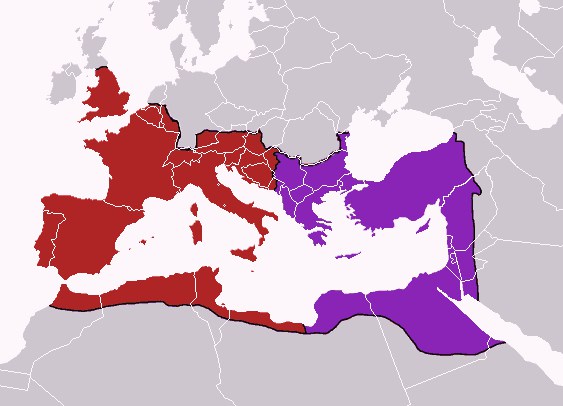
If you look at the first of the maps that I have put on your tables, you will see the Roman Empire as it was in the year 395 AD. This shows the Empire at something close it its greatest extent. The conquests that Trajan made to the north of the Danube and east of the Euphrates have been given up. But it includes the whole of the Mediterranean World and its various hinterlands – an area stretching from the North of England to Upper Egypt, from Casablanca to Trebizond. In that year, however, nearly a century of political experiments is formally ended with the division of the Empire into two administrative zones. There is the Western or the red Empire, ruled by an Emperor in Rome or Milan or Ravenna. There is the Eastern or the purple Empire, ruled by an Emperor in Constantinople.
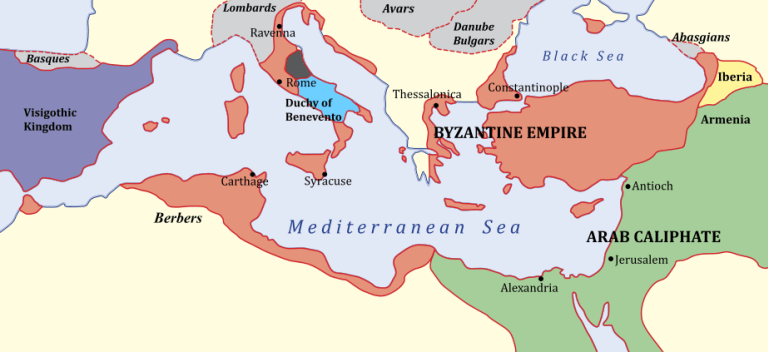
If you look at the second map, dated roughly 650 AD, you will see that the Western Empire has disappeared. Excepting North Africa and parts of Italy, now ruled from Constantinople, the whole of the Western Empire has disappeared – replaced by a set of barbarian kingdoms from which modern Europe takes its origin. The Eastern Empire itself has lost both Syria and Egypt to the Arabs.
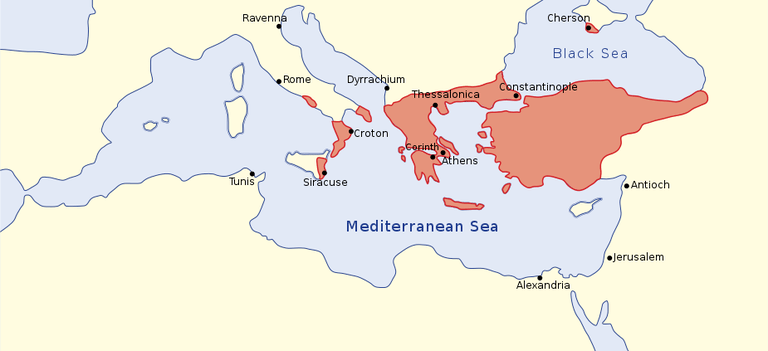
If you look at the third map, dated roughly 867 AD, you will see that the Empire has suffered the further loss of Cyprus and North Africa and most of Sicily. Nevertheless, what we have in that year should undeniably be called the Mediaeval Roman Empire. It has weathered the storm of the Early Middle Ages. It is the richest and most powerful state in the Mediterranean World. Indeed, during the next few centuries, it will expand. It has already reconquered Greece. It will conquer the Bulgarian Kingdom and re-establish its ancient frontier on the Danube. It will even retake Antioch and make Egypt for a while its economic and diplomatic client.
After 1071, the Empire falls on evil days. In that year, the Turks deprive it of its Anatolian heartland. But this loss is stabilised and in part reversed by a skilful handling of the Crusades. There is another disaster in 1204, when the Venetians take and plunder Constantinople. But this is not the end. The Empire is restored in large parts in 1261; and, even if as little more than a city-state based around Constantinople, it continues to the final Turkish conquest of 1453. Indeed, the formal extinction of the Empire comes nearly a decade after 1453, with the annexation of its last territories in Southern Greece.
There was a time when school textbooks in England dated the fall of the Roman Empire to 476 AD. Its continued survival for a thousand years after then had to be explained, where admitted, by taking a contemptuous view of what was called the Byzantine Empire. See, for example, W.E.H. Lecky:
Of that Byzantine empire, the universal verdict of history is that it constitutes, without a single exception, the most thoroughly base and despicable form that civilization has yet assumed. There has been no other enduring civilization so absolutely destitute of all forms and elements of greatness, and none to which the epithet “mean” may be so emphatically applied… The history of the empire is a monotonous story of the intrigues of priests, eunuchs, and women, of poisonings, of conspiracies, of uniform ingratitude.
Lecky is one of my favourite historians. But, if you look even at the mediaeval Greek and Italian historians of the Empire, you will see that this is a bizarre judgement. Undoubtedly, these historians tended to focus on intrigues in and about the Imperial Palace. But they also record much else. They record the story of a rich and powerful empire, directed with high military and diplomatic ability – an empire in which slavery and the death penalty have been almost abolished, where people lived, and knew that they lived, under a set of divinely-ordained laws that protected life, liberty and property to a degree unknown in any other mediaeval state.