
Jabzy
Published on 13 Dec 2015Covering the conquests during the Rashidun Caliphate. I will probably do a separate video on the First Fitna.
Thanks for the 15,000 subs. And thanks to Xios, Alan Haskayne, Lachlan Lindenmayer, Derpvic, Seth Reeves and all my other Patrons. If you want to help out – https://www.patreon.com/Jabzy?ty=h
September 16, 2018
Early Arab Conquests | 3 Minute History
Comments Off on Early Arab Conquests | 3 Minute History
August 7, 2018
QotD: Sailing past Byzantium
To those who know nothing about the mediaeval, “byzantine” East of Christendom (and what do I know about anything?) a book by the respectable Oxford scholar, Averil Cameron, is worth mentioning. It is a short survey of developments in her academic field, entitled, Byzantine Matters (2014). It poses five basic questions on which our common assumptions are mostly wrong, and provides succinct directions for thinking again.
Mediaeval Greece, the Byzantine dynasties, and Orthodox Christianity: these are far from interchangeable concepts. Moreover, “Byzantine art” — the focus of enthusiasm in the anglosphere through the last century or so — is misunderstood. The term “Byzantine” itself — conceived from late antiquity as a deprecation — persists in the academy as an intelligence neutralizer. The vanity of “the West” gets in the way of appreciating a parallel Christian realm, which flourished for more than a thousand years, and never succumbed to the Arabs. (It finally succumbed to the Turks.) We disdain what amounts to an alternative universe of Christian witness and high culture, of great variety and depth, even more obtusely than we disdain our own Middle Ages.
We are narrowed and prejudiced by the attitudinizing of Edward Gibbon, and the inheritance (or disinheritance) of our Western “Enlightenment,” to view as backward a civilization in most ways superior to our “modern” own, from pride in the tinsel of technology. From AD 330 (the founding of Constantine’s capital) to 1453 (when it fell into Ottoman hands), we see only a continuous story of “decline.” But there were many declines over this vast period, and in the intervals between them, many recoveries.
David Warren, “Sailing past Byzantium”, Essays in Idleness, 2016-11-07.
Comments Off on QotD: Sailing past Byzantium
August 3, 2018
QotD: The lost kingdom of Pontus
Pontus is that country, within modern Turkey, that follows the south-east Black Sea shore, and inland is enclosed as by an amphitheatre of mountains. It is the more interesting, archaeologically, for having been often by-passed, in the movements of conquering nomads and armies, from Hittites and Hurrians to Arabs and Turks. The Greeks took it, because they came by sea. They kept it, till late in the day; so that even after Constantinople fell to our short-sighted Franks (in 1204), the Empire of Trebizond immediately formed, and Byzantium persisted in Pontus, as in Crimea and elsewhere, until it could be restored at its centre.
David Warren, “A wonderworker”, Essays in Idleness, 2016-11-17.
Comments Off on QotD: The lost kingdom of Pontus
June 4, 2018
The History of Non-Euclidian Geometry – The Great Quest – Extra History – #2
Extra Credits
Published on 2 Jun 2018For hundreds of years, Euclid’s geometry disappeared with the fall of the Roman Empire. But in Constantinople, Islamic mathematicians, including Al-Khwarizmi (who gave us the word “algebra”) worked long and hard on proving the Fifth Postulate.
Comments Off on The History of Non-Euclidian Geometry – The Great Quest – Extra History – #2
May 3, 2018
Total War History: The Theodosian Walls
Invicta
Published on 9 Jan 2015Amongst the most formidable structures ever built by the Romans would be the massive triple layered walls of Constantinople. Today we dive into the details of this super structure!
Comments Off on Total War History: The Theodosian Walls
March 29, 2018
QotD: The decline of Epicureanism
The philosophy seems to have continued strong into about the 3rd century AD. Thereafter, it went into decline. By the middle of the 6th century, when the Emperor Justinian closed all the philosophical schools in Athens and dispersed the teachers, Epicureanism appears to have been already dead.
The main traditions of thought during the last few centuries of the ancient world were turned away from the everyday world. There were the neoplationists, with their settled belief in a higher reality that could be approached through a combination of mathematics and magic. There were, of course, the Christians, for whom the world is simply a preparation for the better life that is to come.
As said, relating what people think to what is happening around them is not easy. But the last few centuries of the ancient world were ages of great uncertainty. There were epidemic diseases that swept away multitudes without warning and without apparent cause. There were barbarian raids and civil wars. There was catastrophically overextended government to grind the survivors into helplessness and poverty. In this sort of world, teachings of Epicurus about seeking happiness in this life may have lost their attraction.
In one of his more sensible comments on Epicurus, Plutarch writes:
As to the vulgar sort… when they lose their children, wives, or friends, they would rather have them be somewhere and still remain, though in misery, than that they should be quite destroyed, dissolved, and reduced to nothing. And they are pleased when they hear it said of a dying person, that he goes away or departs, and such other words as intimate death to be the soul’s remove and not destruction. …. …. And they are discomposed when they hear it said of any one, he is perished, or he is gone or he is no more…. And therefore it is very plain that with the belief of immortality they [the Epicureans] take away the sweetest and greatest hopes the vulgar sort have.
In a world where life is uncertain and often unpleasant, there will tend to be an emphasis on some happier supernatural future.
There may be nothing sinister in the loss of virtually the whole body of Epicurean writings. Perhaps they were destroyed by a triumphant Church that had room for Plato and Aristotle but none for a naturalist enemy of all that Christianity proclaimed. But there is no reason to suppose any deliberate act of destruction. Papyrus rolls were by their nature delicate things. They were also far more expensive and therefore scarce in number than modern books. In any European climate, a papyrus roll would last for about a century, and then the glue that held it together would perish. Without careful recopying, a work might easily be lost.
The last centuries of the ancient world were mostly ages of depression. There was a shortage of all the means that had so far kept libraries together. Such means as remained were naturally given to recopying works for which there was an active demand. That means Christian theology, those parts of the pagan philosophies that could be reconciled to Christianity, and the greatest products of the pagan high culture. Since, with the exception of Lucretius — whose work largely survived — the works of Epicurus and his followers were in a style remarkable only for its plainness, it is unreasonable to suppose that librarians, forced to choose what to copy and what to leave to die, would take up the 37 volumes of On Nature and not the Ecclesiastical History of Eusebius.
So far as I can tell, whatever works of Epicurus survived were not studied in the Byzantine Empire. In the West, all but his name and whatever is said about him in Cicero vanished for a thousand years.
Sean Gabb, “Epicurus: Father of the Enlightenment”, speaking to the 6/20 Club in London, 2007-09-06.
Comments Off on QotD: The decline of Epicureanism
March 8, 2018
History of the Vikings (in One Take)
History Bombs
Published on 15 Feb 2018History of the Vikings (in One Take) by History Bombs
THIS IS THE AGE OF THE VIKING…
From the first raid on Lindisfarne in 793 to the fall of Harald Hardrada in 1066, we take an exciting tour through the Viking Age.
The Vikings had a remarkable global impact. Their long boats gave them a technological advantage that enabled them to dominate the sea and establish settlements across Northern Europe.
Ivar the Boneless established Danelaw and controlled central England for many years. Only Alfred the Great of Wessex was able to halt the Vikings advance across England by defeating Guthrum.
To the east, the Vikings were employed in modern-day Turkey as guards to Byzantine Emperors for four hundred years. The guard was called the ‘Varangian Guard’.
The video also includes the intrepid explorer, Leif Erikson, who is believed to have discovered North America some 500 years before Christopher Colombus!
This video was filmed in Northern Ireland and we would like to thank Magnus Vikings for use of their fantastic longboat!
Thank you for watching 🙂
Cast (in order of appearance): Guy Kelly, Robert Brown, Chris Hobbs, Suzie Preece, Tom Tokley, Richard Sherwood, John Henry Falle, Corinna Jane, Adrian Stevenson, Martin Savage, Richard Soames
Script & Music: Chris Hobbs
Director: Ellie Rogers
Producer: Claire O’Brien
Camera: Ryan Kernaghan
Focus Puller: Matt Farrant
Costumes: Alex Walker
Grade: Jack Kibbey NewmanScript Contributions: Ellie Rogers, John Henry Falle, Guy Kelly, Tom Tokley
Longship supplied by Magnus Vikings: http://www.magnusvikings.com/
Costumes supplied by Hampshire Wardrobe: https://www.hampshireculturaltrust.or…
Comments Off on History of the Vikings (in One Take)
February 4, 2018
Khosrau Anushirawan – Lies – Extra History
Extra Credits
Published on 3 Feb 2018Why did we refer to Khosrau’s empire as Iran, not Persia? Did Mazdak really exist, or was his proto-communist movement pure propaganda? Dan (narrator) and Soraya (writer) tackle these questions and address the large issue of how perspective can shape one’s idea of the truth.
Comments Off on Khosrau Anushirawan – Lies – Extra History
January 22, 2018
Khosrau Anushirawan: On Top of the World – Extra History – #5
Extra Credits
Published on 20 Jan 2018Plague had brought an end to Khosrau’s war against Justinian, but Justinian’s nephew soon reignited the rivalry. Khosrau was at the peak of his political power and eager to crush this young upstart personally… but old age had also crept up on him.
Comments Off on Khosrau Anushirawan: On Top of the World – Extra History – #5
January 15, 2018
Khosrau Anushirawan: Trolling Justinian – Extra History – #4
Extra Credits
Published on 13 Jan 2018Iran and Rome had agreed to an Eternal Peace, but tensions between them proved too great and Khosrau decided to invade while Justinian’s guard was down. His army swept into Rome practically unopposed, and he made a mockery of Justinian at every opportunity while treating himself to a grand old time pillaging and parading across the Roman border.
Comments Off on Khosrau Anushirawan: Trolling Justinian – Extra History – #4
December 18, 2017
Khosrau Anushirawan: Prince of Persia – Extra History – #2
Extra Credits
Published on 16 Dec 2017Kavadh asked his allies in Eastern Rome for help getting Iran back on its feet. The Romans’ replies were not only unhelpful – they were insulting. By the time Khosrau inherited the throne, resentment and war had turned the delicate alliance with Rome into an open rivalry.
Comments Off on Khosrau Anushirawan: Prince of Persia – Extra History – #2
November 26, 2017
The “fall” of the Roman Empire
If you haven’t read much history, you may be aware that the Roman Empire fell in 476 AD. If you have read a bit more history, you’ll be fully aware that the Western Roman Empire fell then … the rest of it lasted nearly another thousand years. Richard Blake, who has a very readable series of novels set in the “blind spot” of history between the collapse of the West and the revival of the Eastern Empire, offers a quick thumbnail sketch of the historical background to his fiction:
In 395 AD, following a century of experiment, the Roman Empire was divided into Eastern and Western administrative zones, with joint Emperors in Rome and in Constantinople. The purpose was to let each Emperor deal with the pressure on his own critical frontiers – the barbarians along the Rhine and Danube frontiers in the West, and the Persians along the Euphrates and desert frontiers in the East.
In theory, each Emperor was equal. In practice, the Eastern Emperor, ruling from Constantinople, was soon the senior partner. During the next two hundred years, becoming increasingly Greek in language in culture, the Eastern Empire flourished, and Constantinople became one of the largest and most opulent cities in the world.
The Western Empire went into immediate and rapid decline. In 406 AD, barbarians crossed the Rhine in large numbers, and broke into Italy. In 410 AD, they sacked Rome. By then, the Western Capital had been moved to Ravenna, a city in North Eastern Italy, impregnable behind marshes, and within easier reach of the frontiers – and within easier reach of Constantinople.
During the next seventy years, the Barbarians took France and Spain and North Africa from the Empire. Britain remained in the Empire, but its people were told to look to their own defence. In 476 AD, the last Western Emperor was deposed. By 500 AD, the whole of the Western Empire had been replaced by a patchwork of barbarian kingdoms.
After 527 AD, the Emperor Justinian began to reach out from Constantinople to reconquer the lost Western provinces. He recovered North Africa and Italy and part of Spain. However, the effort was exhausting. After his death in 568, the Empire lost much of Italy to the Lombard barbarians, and Rome itself fell under papal domination. Slavic and Avar barbarians crossed the Danube and conquered and burned all the way to Athens and the walls of Constantinople. After 602, the Persians began a war of destruction against the Empire. Though they ultimately lost, they did briefly take Egypt and Syria.
Comments Off on The “fall” of the Roman Empire
October 5, 2017
The greatest general you’ve probably never heard of
I missed this article when it was posted in September: Iskander Rehman discusses the life and times of Byzantium’s greatest general, Belisarius:
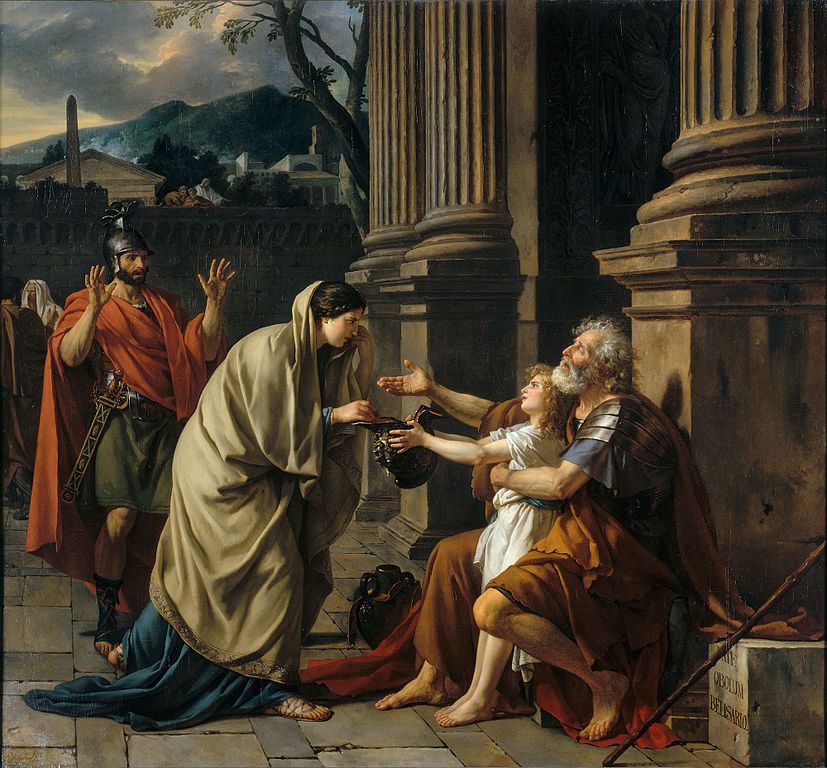
Belisarius begging for alms. Painting by Jacques-Louis David, 1781.
(Via Wikimedia)
In 1780, the great neoclassical painter Jacques-Louis David completed one of his finest works. Entitled “Belisarius Begging for Alms,” the oil painting depicts an aging warrior, blinded with a hand outstretched, seated at the base of a colossal Roman monument. His feet are bare, his beard unkempt, and his armor draped in coarse rags, dull in sheen. A slender walking cane rests to his side, propped against a stone slab bearing the name of a famous former general — Belisario, or Belisarius. A beautiful woman, her face etched in concern, drops a few coins into an upturned helmet, and whispers words of consolation. Her husband, a man in the vigor of youth and full military regalia, is in shock, his arms raised and his mouth open. He has just realized that the stricken veteran is his former commander, the legendary Belisarius himself.
Although his name is not as well known as it once was, Belisarius has long been considered one of history’s finest tacticians. Under the orders of the Byzantine emperor Justinian I, the sixth century general reclaimed vast tracts of Western Roman territory, from northern Africa to the Italian peninsula. Frequently outnumbered and leading an eclectic grouping of warriors composed of romaioi (Eastern Romans), foederati (Barbarian allies), and ethnikoi (specialist ethnic troops), the Thracian commander greatly expanded the footprint of the Byzantine empire at a time when many thought that Rome’s ancestral lands had been irredeemably lost. The fact that many of these conquests, as we shall see, only proved fleeting, has, if anything, only burnished his myth, transmogrifying the soldier into something of a crepuscular icon — Western Europe’s last great Roman protector before the advent of the so-called Dark Ages.
For Liddell Hart, Belisarius was also the consummate practitioner of the so-called “indirect approach” and the “master of the art of converting his weakness into strength; and the opponent’s strength into a weakness.” T.E. Lawrence, an avid reader of the ancient military classics, considered “the Thracian genius” to be one of “three really first-class Roman generals in history” (the other two being Scipio Africanus and Julius Caesar) and encouraged his friend, Robert Graves, to write the novel Count Belisarius. This piece of historically informed fiction retraces Belisarius’s military campaigns and was much admired by Winston Churchill, who is said to have often turned to it for guidance during the fraught early years of World War II.
Who was the man behind the myth? And why do the tales of Belisarius’s life and military exploits continue to resonate, firing the imaginations of great men from David to Churchill and Lawrence of Arabia? What insights can be gleaned, not only from his campaigns, but from the Eastern Roman Empire’s strategic literature more broadly?
Comments Off on The greatest general you’ve probably never heard of
July 31, 2017
Byzantine religion – not a joking matter
When Tamara Keel isn’t talking about guns, she apparently relaxes by talking about Byzantine history:
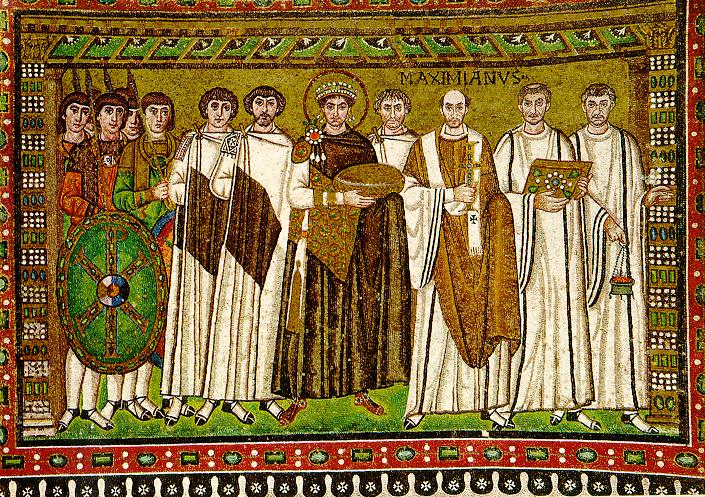
Court of Emperor Justinian with (right) archbishop Maximian and (left) court officials and Praetorian Guards; Basilica of San Vitale in Ravenna, Italy. The dark-haired bearded man to Justinian’s right is believed to be Belisarius. (via Wikimedia)
So, this Maximus dude was a bureaucrat in the Byzantine Empire who apparently had religion as a hobby, as did everybody in Constantinople back then. All the Byzantines did was watch chariot races, debate arcane theological matters, and riot and/or kill each other over differences of opinion on chariot races or arcane theological matters. (Oh, and they engaged in so much intra-governmental intrigue that they went in the dictionary for it.)
At some point, Maximus dropped out of government service and took up religion as a full-time occupation, leaving the city of Constantinople for a monastery in Anatolia. Skipping town ahead of the invading Persians, he landed in Carthage, in Eastern Roman hands for the nonce, thanks to Justinian and Belisarius’s ruinously expensive Mediterranean campaigns.
The big argument in the Church (there was just the one, back then) at the time was between guys who thought Jesus had two natures, human and divine, but only one divine will, and other guys who thought that Jesus had not only two natures, but also a human will and a divine will. Seriously. This was a very big deal and dudes were killing each other over it.
Well, the first view, Monothelitism, was the official view at the time, but Maximus was a believer in the second, or Dyothelitism. And he and the new Pope, Martin I, called a religious council in Rome to debate on the matter without bothering to ask the Emperor. When the council turned out a Dyotheletic verdict, Emperor Constans II (a Monotheletist) had both Pope Martin I and Maximus arrested.
The Pope got de-Poped and banished to the Crimea, where he died. Maximus was tried and sentenced to exile. However, he would not shut up about Dyothelitism and wound up having a great big show trial a few years later, following which he got his tongue cut out and his right hand cut off so he couldn’t tell people that Jesus had two wills anymore or even write it very legibly. Then he got banished to Georgia. (The one on the Black Sea, not the one you drive through on the way to Florida.)
He died in exile there in 662 AD. Nineteen years later, at the Third Council of Constantinople, the Church (still just the one) decided that maybe Jesus did have two wills after all. Maximus received a posthumous pardon, sort of a more official version of “Whoops! Hey, sorry about the tongue and the hand and the whole exile-and-dying-in-prison thing. No hard feelings, okay? Here, have a feast day.”
I told you they took their religion seriously in Constantinople, didn’t I?
Comments Off on Byzantine religion – not a joking matter
May 30, 2017
The Belisarius fixation in SF&F
Jo Walton wonders why an otherwise obscure general of an otherwise obscure empire appears so often in fantasy and science fiction:
I once wrote jokingly here that there are only three plots, and they are Hamlet, Pride and Prejudice, and Belisarius, because those are the ones everyone keeps on reusing.
There is a conference in Uppsala in Sweden the weekend before the Helsinki Worldcon called “Reception Histories of the Future” which is about the use of Byzantium in science fiction. The moment I heard of it, I immediately started thinking about our obsessive reuse of the story of Belisarius. (I’m going. Lots of other writers are going. If you’re heading to Helsinki, it’s on your way, and you should come too!)
It’s strange that science fiction and fantasy are obsessed with retelling the story of Belisarius, when the mainstream world isn’t particularly interested. Robert Graves wrote a historical novel about him in 1938, Count Belisarius, and there’s Gillian Bradshaw’s The Bearkeeper’s Daughter (1987), but not much else. Whereas in genre, we’ve had the story of Belisarius retold by Guy Gavriel Kay, David Drake (twice) and Chelsea Quinn Yarbro, and used by L. Sprague de Camp, John M. Ford, Jerry Pournelle, Robert Silverberg, and Isaac Asimov. So what is it about this bit of history that makes everyone from Asimov to Yarbro use it? And how is it that the only place you’re likely to have come across it is SF?
First, let’s briefly review the story. First Rome was a huge unstoppable powerful indivisible empire. Then Rome divided into East and West, with the Eastern capital at Constantinople. Then the Western half fell to barbarians, while the Eastern half limped on for another millennium before falling to the Ottoman conqueror Mehmed II in 1453. We call the eastern half Byzantium, but they went right on calling themselves the Roman Empire, right up to the last minute. But long before that, in the sixth century, at the exact same time as the historical Arthur (if there was an Arthur) was trying to save something from the shreds of Roman civilization in Britain, Justinian (482-565) became emperor in Constantinople and tried to reunite the Roman Empire. He put his uncle on the throne, then followed him. He married an actress, the daughter of an animal trainer, some say a prostitute, called Theodora. He has a loyal general called Belisarius. He built the great church of Hagia Sophia. He withstood a giant city riot in the hippodrome, the great chariot-racing stadium, by having Belisarius’s soldiers massacre a huge number of people. He wrote a law code that remained the standard law code everywhere in Europe until Napoleon. And Belisarius reconquered really quite large chunks of the Roman Empire for him, including Rome itself. At the height of his success he was recalled to Rome and fired because Justinian was jealous. Belisarius had a huge army and could have taken the throne for himself, which was typical of both the Roman and the Byzantine empires, but he was loyal and let Justinian fire him. This is all happening at a time of Christian schism and squabbling about heresy between different sects.
While I’d quibble about her thumbnail sketch a bit, there’s more than enough there to fuel dozens of alt-history, fantasy, or science fiction novels … the fiction couldn’t be much more difficult to swallow than the reality. My first contact with the story of Belisarius was indeed the Robert Graves novel (which I still heartily recommend). I imagine that was true for most of the authors listed above.


