
Adrian Goldsworthy. Historian and Novelist
Published 12 Mar 2025With the Ides of March a few days away, we take a look at the final months of Julius Caesar’s life and the conspiracy led by Brutus and Cassius. Both had fought against Caesar at the start of the Civil War, but later surrendered and were treated well by him. They were joined by men who had served Caesar in Gaul and during the Civil War, like Decimus Brutus and Trebonius and Sulpicius Galba. Why did they want to kill Caesar and how was the plot organised?
March 15, 2026
Killing CAESAR – the Ides of March and the conspiracy against Julius Caesar
Comments Off on Killing CAESAR – the Ides of March and the conspiracy against Julius Caesar
March 4, 2026
Larry Thorne Biography Part 2: Green Berets in Vietnam
Forgotten Weapons
Published 4 Oct 2025Welcome back to Part II of our biography on Lauri Törni / Larry Thorne with author and researcher Kari Kallonen. Today we are covering Thorne’s life and exploits after emigrating to the United States. He joined the US Army, then 10th Special Forces Group in Germany, and was one of the original Green Berets in Vietnam until his death in a helicopter crash in October 1965. His remains were only recovered in 1999, and Mr. Kallonen was part of the team that traveled to Vietnam for the recovery effort.
(more…)
Comments Off on Larry Thorne Biography Part 2: Green Berets in Vietnam
February 28, 2026
Lauri Torni Biography Part 1: Soldier of Three Armies
Forgotten Weapons
Published 3 Oct 2025Today is the first of a two-part biography on Finnish legend Lauri Törni, later known as Larry Thorne. He fought in the Winter War and Continuation War, and was awarded the Mannerheim Cross for his actions in the Continuation War. He also travelled to Germany between the two (and again after the Continuation War), spending some time with the German army. In the early 1950s he emigrated to the United States, joining the US Army and eventually serving several tours in Vietnam.
My guest today is Finnish writer and researcher Kari Kallonen, who has written several books on Törni and was kind enough to join me to share the man’s story …
(more…)
Comments Off on Lauri Torni Biography Part 1: Soldier of Three Armies
February 27, 2026
The British Are Coming! – British Fighter Aces – WW2 Gallery 09
World War Two
Published 26 Feb 2026In this gallery special, we examine five of Britain’s leading fighter aces: Archie McKellar, James MacLachlan, Robert Stanford Tuck, John Braham, and James Edgar Johnson. From the Battle of Britain to night fighting, Intruder missions, and offensive sweeps over occupied Europe, their careers reflect the RAF’s transformation from desperate air defense to sustained air superiority.
These pilots did more than accumulate victory claims. Their experiences illuminate the evolution of air combat, showing how individual skill, technology, and strategy intersected in the broader history of the Second World War.
Which of these careers best captures the changing nature of air power in World War Two?
(more…)
Comments Off on The British Are Coming! – British Fighter Aces – WW2 Gallery 09
February 16, 2026
Unsung Heroes of the Eastern Front – Soviet Fighter Aces – WW2 Gallery 08
World War Two
Published 15 Feb 2026We’re back with another helping of fighter ace tales, this time taking us to the USSR. From the personal brilliance of Ivan Kozhedub, to the cerebral genius of Alexander Pokryshkin, come with us as we explore five more individual stories of skill, determination, self-sacrifice, and tragedy, who defined a generation of Soviet aviation in a theatre of WW2 where the aerial campaign is so often overlooked in favor of the ground war.
Check out Sabaton History‘s episode about the Night Witches: • Night Witches – Female Soviet Pilots – Sab…
(more…)
Comments Off on Unsung Heroes of the Eastern Front – Soviet Fighter Aces – WW2 Gallery 08
February 12, 2026
QotD: Books for children written for “the narrative” instead of for children
Children can spot books written by adults for other adults a mile away — when I read bedtime stories to my son, I always notice when he loses interest. And almost all products of the modern children’s entertainment industry are so freighted with issues and role models, and ingratiating attempts to be cool, that escape velocity cannot be reached.
C.S. Lewis, the master of escapist fiction, was prophetic in warning against such noxious paternalism from authors. “Of all tyrannies, a tyranny sincerely exercised for the good of its victims may be the most oppressive”, he wrote. “It may be better to live under robber barons than under omnipotent moral busybodies. The robber baron’s cruelty may sometimes sleep, his cupidity may at some point be satiated; but those who torment us for our own good will torment us without end for they do so with the approval of their own conscience.” Let’s hope Barbie director Greta Gerwig, who has been tapped up to direct the next year’s Chronicles of Narnia series, is taking note.
In the meantime, we have the books, the first of which, The Lion, the Witch and the Wardrobe, was published 75 years ago today. When I read this to my son, it transfixed him in a way that all those morally improving Disney and Pixar movies could not — and in a way that I recognised too from my own childhood. The Narnia books are weird and archaic and they are far from comforting. But they leave unanswerable questions and imaginative territory to roam for a lifetime.
What would compel a child to climb into a claustrophobic wardrobe, full of moth-eaten coats and spiders, as apt a symbol as any for the human psyche? C.S. Lewis knew all too well. There are real and terrible things to escape from. And the land of magic, mystery and hope that Peter, Susan, Edmund and Lucy arrived in would soon reveal that it too was blighted. By facing up to this, conquering its climate of terror, the child would become an adult. If they didn’t pass into the dark and through it, they would remain infantilised.
This partly explains the backlash against Lewis. Two years ago, it was reported that the Government’s counter-terrorism unit, Prevent, had classified his works along with some by his friend J.R.R. Tolkien as potentially leading to “radicalisation”: the kind of wormtongue deception worthy of the villains of Narnia or Middle Earth. It demonstrates that, at its best, fantasy can be the mirror that shows us who we are and what we’ve become. But then, there is a long history of people taking leave of their senses when it comes to Narnia. The books have been banned in the US for being both too Christian and not Christian enough. One critic ranked the books (with delicious venom) as worse than 120 Days of Sodom or Mein Kampf. Being shot by all sides might indicate a writer is on the right track.
For his part, Lewis lambasted “those who do not wish children to be frightened […] Since it is so likely that they will meet cruel enemies, let them at least have heard of brave knights and heroic courage. Otherwise, you are making their destiny not brighter but darker.” He knew of the existence of shadows from early in life. There is a spine-chilling passage in his memoir, Surprised by Joy, in which he recalls waking up one night with toothache when he was 10. He called out his mother’s name and she did not come. She was dying in another room. His father was never the same and sent Lewis off to a boarding school run by a deranged sadist. “With my mother’s death, all settled happiness, all that was tranquil and reliable, disappeared from my life.”
As a result, Lewis developed a fear and mistrust of the adult world in those years — and it was well-placed. Scarcely more than a boy, Lewis was sent to the trenches. He was seriously injured in the Battle of Arras (he would have shrapnel, from a shell that obliterated a colleague, embedded permanently in his body) and, like Tolkien, he watched many of his friends die. “One cannot help wondering why,” he wrote to his father.
Darran Anderson, “Save Narnia from the woke witch”, UnHerd, 2025-10-15.
Update, 13 February: Welcome, Instapundit readers! Have a look around at some of my other posts you may find of interest. I send out a daily summary of posts here through my Substack – https://substack.com/@nicholasrusson that you can subscribe to if you’d like to be informed of new posts in the future.
January 17, 2026
Scott Adams, RIP
Another Scott, Scott Alexander, has a long essay about the career and life of the late comic strip artist, author, and internet personality. When I first encountered his Dilbert comic strip, I was living the cubicle life and far too many of the jokes and situations felt like Adams must be in the same company — possibly even the same department. I read a couple of his non-Dilbert books, but I didn’t follow his work very much after I escaped the cube farm, so reading this essay told me a number of things about Adams that I didn’t already know:

Thanks to everyone who sent in condolences on my recent death from prostate cancer at age 68, but that was Scott Adams. I (Scott Alexander) am still alive.1
Still, the condolences are appreciated. Scott Adams was a surprisingly big part of my life. I may be the only person to have read every Dilbert book before graduating elementary school. For some reason, 10-year-old-Scott found Adams’ stories of time-wasting meetings and pointy-haired bosses hilarious. No doubt some of the attraction came from a more-than-passing resemblance between Dilbert’s nameless corporation and the California public school system. We’re all inmates in prisons with different names.
But it would be insufficiently ambitious to stop there. Adams’ comics were about the nerd experience. About being cleverer than everyone else, not just in the sense of being high IQ, but in the sense of being the only sane man in a crazy world where everyone else spends their days listening to overpaid consultants drone on about mission statements instead of doing anything useful. There’s an arc in Dilbert where the boss disappears for a few weeks and the engineers get to manage their own time. Productivity shoots up. Morale soars. They invent warp drives and time machines. Then the boss returns, and they’re back to being chronically behind schedule and over budget. This is the nerd outlook in a nutshell: if I ran the circus, there’d be some changes around here.
Yet the other half of the nerd experience is: for some reason this never works. Dilbert and his brilliant co-workers are stuck watching from their cubicles while their idiot boss racks in bonuses and accolades. If humor, like religion, is an opiate of the masses, then Adams is masterfully unsubtle about what type of wound his art is trying to numb.
This is the basic engine of Dilbert: everyone is rewarded in exact inverse proportion to their virtue. Dilbert and Alice are brilliant and hard-working, so they get crumbs. Wally is brilliant but lazy, so he at least enjoys a fool’s paradise of endless coffee and donuts while his co-workers clean up his messes. The P.H.B. is neither smart nor industrious, so he is forever on top, reaping the rewards of everyone else’s toil. Dogbert, an inveterate scammer with a passing resemblance to various trickster deities, makes out best of all.
The repressed object at the bottom of the nerd subconscious, the thing too scary to view except through humor, is that you’re smarter than everyone else, but for some reason it isn’t working. Somehow all that stuff about small talk and sportsball and drinking makes them stronger than you. No equation can tell you why. Your best-laid plans turn to dust at a single glint of Chad’s perfectly-white teeth.
Lesser lights may distance themselves from their art, but Adams radiated contempt for such surrender. He lived his whole life as a series of Dilbert strips. Gather them into one of his signature compendia, and the title would be Dilbert Achieves Self Awareness And Realizes That If He’s So Smart Then He Ought To Be Able To Become The Pointy-Haired Boss, Devotes His Whole Life To This Effort, Achieves About 50% Success, Ends Up In An Uncanny Valley Where He Has Neither The Virtues Of The Honest Engineer Nor Truly Those Of The Slick Consultant, Then Dies Of Cancer Right When His Character Arc Starts To Get Interesting.
If your reaction is “I would absolutely buy that book”, then keep reading, but expect some detours.
- As is quantum complexity blogger Scott Aaronson.

At Ace of Spades H.Q., Buck Throckmorton remembers Scott Adams:
Scott Adams’ death is being eloquently covered by others, so there is not much I can add. But I do want to offer up a few quick thoughts. Aside from Dilbert being my favorite cartoon for decades, I was a loyal reader of Mr. Adams’ blog for many years before his greater celebrity during the Trump era. Mr. Adams often expanded my views, and occasionally frustrated me, but he helped me understand how rational people can understand things differently.
Back in 2016, when I doubted that Donald Trump was in any way conservative, and when I thought Trump had no chance to beat Hillary in the presidential election, Scott Adams was one of two writers who made an impact on my attitude toward that election. Mr. Adams famously wrote about the reasons why Trump was likely to win. He was right. (The other writer was John Hinderaker of Powerline, who was the first legacy conservative I read who stated that of course we traditional Republicans needed to vote for Trump.)
I was flattered once when Scott put out a call for Dilbert topics and he ended up using one of my submissions. As I recall, his invitation to the public was something to the effect of “You provide the workplace situation and I’ll provide the humor“. I wrote him and offered up what a special hell it was to be working for a company campaigning for recognition in a local “Best Places to Work” contest. Shortly thereafter he used that in a cartoon.
Finally, my favorite Dilbert character was one who got very little screen time. Scott Adams may be gone, but Mordac, The Preventer of Information Services lives on.
I think of Mordac every time I have a spontaneously obsolete password, or I’m blocked from being able to access a system necessary for my job, or I can’t access an SaaS app because there are too few licenses, or I’m logged out of a system because I got called away for a short meeting, etc. In all these circumstances, I give a tip of the hat to Mordac, and I applaud his success in protecting my employer by preventing me from doing my job.

Comments Off on Scott Adams, RIP
January 11, 2026
Nazis Are the Big Losers – Rise of Hitler 26, October-December 1932
World War Two
Published Jan 10, 2026Adolf Hitler and the Nazi Party are forced to hit the campaign trail yet again for yet another round of elections. All this campaigning has seriously drained their finances, so they expect it to do some real good. Unfortunately for them, the November elections are very disappointing for the Nazi Party, and they lose a lot of seats in the Reichstag. Adolf Hitler is still demanding that President Hindenburg make him Chancellor, but the President still refuses time and again, although Hindenburg does have his hands full with two other Chancellors — Franz von Papen and Kurt von Schleicher, and their endless political intriguing.
(more…)
Comments Off on Nazis Are the Big Losers – Rise of Hitler 26, October-December 1932
January 6, 2026
QotD: John Foster Dulles
Tevi Troy, Fight Club: Rivalries in the White House from Truman to Trump, 2020.
Comments Off on QotD: John Foster Dulles
January 1, 2026
QotD: Niccolao Manucci’s improbable early career
That sounded pretty good to the teenager, so he disembarked with Bellomont at Smyrna, made the hazardous journey across Ottoman Anatolia, thence through Armenia, and finally to the Safavid Empire, where Bellomont declared himself an ambassador from the rightful king of England and sought Persian intervention in the English Civil War (!). The Shah was horrified by the regicide and amazed that the other Christian kings of Europe had not come to the aid of Charles I,1 but gently rebuffed Bellomont’s request by pointing out that it would be quite impractical to send a large army from Persia to England.
Frustrated, Bellomont set off once again with his young charge, this time to the Mughal Empire. He got as far as the port of Surat, where he suddenly died, leaving the teenage Manucci completely on his own, thousands of miles from his home, in the middle of a civil war.
I sometimes wonder how often this sort of thing happens without us ever finding out. Perhaps history is full of ridiculous people having ridiculous adventures, it’s just that most of them aren’t Zhu Yuanzhang, or they don’t write detailed memoirs, or those memoirs are lost or destroyed before they reach us. Something like this very nearly happened to Manucci. The Venetian teenager left all alone in India not only survived, but flourished socially and financially, lived to a ripe old age, and wrote thousands of pages of penetrating social observations. His account is both the most entertaining and the most reliable history of the Mughal Empire at its zenith. Manucci had the singular talent of moving through every social circle, from the royal court to the lowest of peasants. He interacted with generals and statesmen, harem attendants, Islamic jurists, Hindu sages, elephant drivers,2 Portuguese mercenaries, eunuchs, merchants, prostitutes, common soldiers, missionaries, beggars, and even the emperor himself. There are very few cases where we get to see a premodern society laid out in all its intimate detail and from every angle, and we only missed losing this one by the barest of lucky strokes.
The story of Manucci’s manuscript is a twisting one. The original copies of his tale fell into the hands of a French Jesuit who mutilated the text — excising all the fun parts, all the personal observations, the adventure stories, and of course anything remotely critical of the Catholic Church. The resulting “edition” found its way back to India and into Manucci’s hands before his death. Naturally, he freaked out and tried to reproduce his original text from memory, sending it along with a letter of protest by sealed courier directly to the Venetian Senate. But this second copy is the work of a much older man, much farther from the stories and events described, and has numerous omissions and differences from the original.3 In 1763, the Jesuit order was expelled from France and their Paris library, including Manucci’s first manuscript, was seized by the state. It was then lost during the Revolution and believed destroyed, before turning up in damaged and partial form at an auction-house in Berlin a century later.
Countless European intellectuals have tried their hand at stitching the mishmash of fragments we have back into a cohesive whole, including a “J. Bernoulli” (yes, one of those Bernoullis, but I can’t figure out which brother it was). But everybody agrees the most successful of these efforts was that by William Irvine, a British colonial administrator and fellow of both the Royal Asiatic Society and the Asiatic Society of Bengal, who also helpfully translated the whole thing into English. Irvine’s edition has been republished many times, most recently by the wonderful people at Forgotten Books, which is how it found its way into my hands.4
Irvine is not the sort of editor who confines his remarks to a preface and some footnotes. Instead, he directly injects his own commentary inline, into the body of the text. These asides range from bracketed remarks like “[here I have deleted a coarse and obscene description]” all the way up to essays dozens of pages long containing his reflections and opinions on the text. And this is layered on top of the various modifications and emendations made by French Jesuits and Venetian scribes. All of this gives the book a meta-textual, almost postmodern feeling. It’s a bit like House of Leaves. Sometimes you’re reading Manucci, and sometimes you’re reading three nested layers of people commenting on people commenting on people commenting on Manucci. And the effect is heightened when you suddenly realize that Manucci, like the protagonist of a Gene Wolfe story, is not telling you all that he knows.
John Psmith, “REVIEW: Storia do Mogor, by Niccolao Manucci”, Mr. and Mrs. Psmith’s Bookshelf, 2025-09-08.
- Bellomont’s only real success in his mission was to completely poison the well for all future European travelers in Persia. Manucci reports that the next Englishman to visit the court of the Shah was thrown into a dungeon for disloyalty to his liege lord (a story independently corroborated by the French adventurer Jean-Baptiste Tavernier). “[The shah’s] object was to give a lesson to his own nobles as to the manner in which they should serve their king and the fidelity they ought to display, when the occasion arose, in defence of their monarch.”
- The book contains extensive discussion of how all elephants and horses that the Mughal princes might want to ride are pre-ridden by an attendant, to “loosen its stomach” and eliminate any flatulence.
- This is actually a huge simplification — there are four distinct Venetian codices, all with major differences from each other.
- I started with the Forgotten Books paperback, but halfway through the first volume I was hooked, and seeing that I had a thousand pages left to go, picked up a handsome leatherbound set from a used book seller for a song. I would normally never dream of buying a second copy of a book I already own just because it feels nicer in my hands, but you, dear subscribers, have spoiled me.
Comments Off on QotD: Niccolao Manucci’s improbable early career
December 29, 2025
What Do We ACTUALLY Know About Homer? (Author of Iliad & Odyssey)
MoAn Inc.
Published 23 Dec 2025
(more…)
Comments Off on What Do We ACTUALLY Know About Homer? (Author of Iliad & Odyssey)
December 1, 2025
QotD: Young Cyrus, before he became “the Great”
And then … the most important single moment in Cyrus’s education, the moment when it becomes clear that he has actually set his sights appropriately high. He gets bored of the hunts. Cyrus deduces, correctly, that the hunts he is sent on, and all the other little missions, are contrived. Each is a problem designed to impart a lesson, a little puzzle box constructed by a demiurge with a solution in mind. In this respect, they’re like the problems in your math textbook. And like the problems in your math textbook, getting good at them is very dangerous, because it can mislead and delude you into thinking that you’ve gotten good at math, when actually you’ve gotten good at the sorts of problems that people put in textbooks.
When you’re taught from textbooks, you quickly learn a set of false lessons that are very useful for completing homework assignments but very bad in the real world. For example: all problems in textbooks are solvable, all problems in textbooks are worth solving (if you care about your grade), all problems in textbooks are solvable by yourself, and all of the problems are solvable using the techniques in the chapter you just read. But in the real world, the most important skills are not solving a quadratic by completing the square or whatever, the most important skills are: recognizing whether it’s possible to solve a given problem, recognizing whether solving it is worthwhile, figuring out who can help you with the task, and figuring out which tools can be brought to bear on it. The all-important meta-skills are not only left undeveloped by textbook problems, they’re actively sabotaged and undermined. This is why so many people who got straight As in school never amount to anything.
The section covering his childhood and education concludes with a dialogue between Cyrus and his father Astyages as the two ride together towards the border of Persia. Astyages recapitulates and summarizes all of the lessons that Cyrus has been taught, and adds one extra super-secret leadership tip. Cyrus wants to know how to attract followers and keep their loyalty, and his father gives him a very good answer which is: just be great. Be the best at what you do. Be phenomenally effective at everything. People aren’t stupid, they want to follow a winner, so be the kind of guy who’s going to win over and over again, and if you aren’t that guy, then maybe choose a different career.
Cyrus asks and so Astyages clarifies: no, he doesn’t mean be great at making speeches, or at crafting an image, or at appearing to be very good at things. He doesn’t mean attending “leadership seminars”, or getting an MBA, or joining a networking organization for “young leaders”. He means getting extremely good at the actual, workaday, object-level tasks of your trade: “There is no shorter road, son … to seeming to be prudent about such things … than becoming prudent about them”. In Cyrus’s case, this means tactics, logistics, personnel selection, drill, all the unglamorous parts of running an ancient army. People aren’t stupid. If they see that he is great at these things, they will flock to his banner. And then, one more ingredient, the final step: make it clear that you care about their welfare. “The road to it is the same as that one should take if he desires to be loved by his friends, for I think one must be evident doing good for them.”
There you have it. Two simple #lifehacks to winning undying loyalty: be the best in the world at what you do, and actually give a damn about the people under you. Our rulers could learn a thing or two from this book. So ends the education.1 The rest of this book, and the bulk of it, is Cyrus putting these lessons into practice by very rapidly conquering all of the Ancient Near East. It’s telegraphed well in advance that the final boss of this conquest will be the mighty Neo-Babylonian empire founded by Nebuchadnezzar,2 but before he takes them on Cyrus first has to grind levels by putting down an incipient rebellion by his grandfather’s Armenian vassals,3 then whipping the neighboring Chaldeans into line, then peeling away the allegiance of various Assyrian nobles, then defeating the Babylonians’ Greek allies and Egyptian mercenaries, before finally taking on the Great King in his Great City.
John Psmith, “REVIEW: The Education of Cyrus, by Xenophon”, Mr. and Mrs. Psmith’s Bookshelf, 2024-01-08.
- There’s actually one other noteworthy bit of advice that Astyages gives:
“Above all else, remember for me never to delay providing provisions until need compels you; but when you are especially well off, then contrive before you are at a loss, for you will get more from whomever you ask if you do not seem to be in difficulty … be assured that you will be able to speak more persuasive words at just the moment when you are especially able to show that you are competent to do both good and harm.”
This is decent enough advice, but what makes it especially fun is that Astyages also applies it to the gods! Maybe it’s his own pagan spin on “God helps those who help themselves”, but Cyrus takes this advice and takes it a step further. He learns to interpret auguries himself so that he will never be at the mercy of priests. Then when he needs an omen, he performs the sacrifices, decides which of the entrails, the weather, the stars, and so on are pointing his way, loudly points them out, and ignores the rest.
Henrich notes in The Secret of our Success that divination can be an effective randomization strategy in certain sorts of game theoretic contests. But the true superpower is deciding on a case-by-case basis whether you’re going to act randomly, or just make everybody think you’re acting randomly.
- Yes, that Nebuchadnezzar.
- Somewhere in the middle of In Xanadu, Dalrymple recounts an old Arab proverb that goes: “Trust a snake before a Jew, and a Jew before a Greek. But never trust an Armenian.” The tricksy Armenian ruler more than lives up to this reputation. But when Cyrus outwits and captures him, his son shows up to beg for his life, and what follows is one of the more philosophically charged exchanges in the entire book. They go multiple rounds, but by the end of it the Armenian crown prince has put Cyrus in a logical box as deftly as Socrates ever did to one of his interlocutors, and Cyrus lets the king off with a warning. The prince goes on to combat anti-Armenian stereotypes by serving Cyrus faithfully to the end of his days.
Comments Off on QotD: Young Cyrus, before he became “the Great”
November 16, 2025
QotD: Elon the gambler
Each of these bets might have been a smart one in a statistical sense, but it still requires a special kind of person to take a $200 billion market cap and bet it all on black. So why has Elon done this? Does he just not believe in the St. Petersburg paradox, like Sam Bankman-Fried claimed to do? No! It’s actually very simple: remember all that stuff about how SpaceX is less of a company and more of a religious movement, with a goal of making life multi-planetary? Elon and SpaceX behave the way that they do because they believe that stuff very sincerely. A version of SpaceX that merely became worth trillions of dollars, but never enabled the colonization of Mars, would be a disastrous failure in Elon’s eyes.
Every bit of company strategy is evaluated on the basis of whether it makes Mars more or less likely. This fully explains all the choices that look crazy from the outside. SpaceX does things that look incredibly risky to conventional business analysts because they reduce the risk of never getting to Mars, and that’s the only risk that matters. This has the nice side-benefit for shareholders that it’s revolutionized space travel several times and built several durable monopolies, but if Elon decided that actually blowing up the business increased the odds of getting to Mars, he would do it in a heartbeat. He’s said as much. This all has very important implications that we will return to in a moment.
A necessary, and to me charming, component of this approach is an utter disregard for bad press. Most corporate communications departments live in flinching terror of the slightest whiff of negative PR. Meanwhile, SpaceX’s puts out official blooper reels of exploding rockets. More seriously, one of the company’s lowest points came in the aftermath of the CRS-7 mission, when a rocket exploded two and a half minutes after launch and totally destroyed its payload. Most companies would do everything possible to minimize the risk of the following “return-to-flight” mission. SpaceX instead used it to debut a completely untested overhaul of the rocket and to attempt the first ever solid ground landing of an orbital-class booster. (It succeeded.)
Hopefully by now it’s not a mystery why SpaceX is a far more effective organization than NASA, but I think this last point is underappreciated. NASA, unfortunately, has boxed itself into a corner where it cannot publicly fail at anything.2 But if you aren’t failing, you aren’t learning, and you certainly aren’t trying to do things that are very hard. SpaceX, conversely, rapidly iterates in public and blows up rockets to deafening cheers. Permission to fail in public is one of the most powerful assets an organization has, and it flows directly from the top. This, too, is something for which Musk deserves credit.
The last thing I’ll say about Elon is that he is notably, uhhh, unafraid to disagree with people. In fact, this book literally has a chapter subheading called “Musk versus the entire human spaceflight community”.3 This quality can be a bit of a two-edged sword, but it’s safe to say that without it the company would never have gotten anywhere. Practically from the moment SpaceX came into existence, its enemies were trying to destroy it. Anybody who followed space policy in the early-to-mid 2010s knows what I’m talking about — politicians like the imbecilic NASA administrator Charles Bolden and the flamboyantly corrupt US Senator Richard Shelby did everything in their power to make life difficult for SpaceX and to smother the newborn company in its crib.
It’s a sign of how total SpaceX’s victory has been that some of those old episodes feel surreal in hindsight. Not just the antics of clowns like Bolden and crooks like Shelby, but also the honest-to-goodness competition in the form of Boeing and Lockheed, who fought dirty from the very beginning. For instance, they lobbied hard to block SpaceX from having any place to launch rockets at all, and dispatched their employees to stand around SpaceX facilities mocking and jeering while taking photographs of operations. In those early, desperate days, it would only have taken one or two successes of Boeing’s massive lobbying team to lock SpaceX completely out of government contracts and starve them of business. It was only Elon’s reputation as “a lunatic who will sue everyone” that prevented NASA from awarding the entire Commercial Crew Program to Boeing despite SpaceX offering to do it for about half as much money.4 And of course Elon actually did sue the Air Force when under intense lobbying they froze SpaceX out of the EELV program.
All of this is ancient history now. SpaceX’s competitors are no longer trying to stop the company with lawfare, because SpaceX no longer has any meaningful competition. But there are still people trying to slow down and sabotage the company; they’re just doing it for ideological rather than economic reasons. In the early days of SpaceX, the “deep state” of unelected bureaucrats who direct and control the United States government were huge supporters of the company, because back then the reigning ideology of that set was a sort of good-government technocratic progressivism and the idea of a scrappy new launch provider disrupting the incumbents genuinely pleased and excited them. A few years later, the state religion changed, and a few years after that, Musk revealed himself to be a definite heretic. And so, in utterly predictable and mechanistic fashion, the agencies that once made exceptions for SpaceX now began demanding years of delays in the Starship program in order to study the effects of sonic booms on tadpoles and so on.
One might be tempted to rage about how detrimental this all is to the rule of law. Think of the norms. Berger is certainly upset by it, and he ends his book (published in September 2024) by urging Musk to self-censor and stop antagonizing powerful forces with his political activism. Implicit to this demand is the advice, “If you just act like a good boy and stop making trouble, they’ll go back to leaving you alone.” Obviously, Musk did not take this advice. He instead further kicked the hornet’s nest by redoubling his support for Donald Trump. By October, the social network formerly known as Twitter was teeming with employees of US spy agencies and their allies demanding that SpaceX be nationalized and that Musk be deported.5 Given that Trump’s election was no sure thing, why would he take this risk?
There was a famous uprising against the Qin dynasty that happened when two generals realized that (1) they were going to be late, and (2) that the punishment for being late was death, and (3) that the punishment for treason was … also death. Elon Musk thinks being late to Mars is just as bad as being deported and having his companies taken away from him. He has already gambled the entire future of SpaceX on a coin flip five or six times, because he considers partial success and total failure to be literally equivalent. When it became clear that an FAA empowered by a Harris administration would put one roadblock after another in front of him, his only choice was to rebel and to flip the coin one more time.
When I saw Musk charging into the lion’s den back in October, I immediately thought of the Haywood Algorithm and its dreadful, stark simplicity. “Make a list of everything you need to do in order to succeed, and then do each item on your list.” When you run a normal company, the algorithm sometimes demands that you stay late at work or come in on a weekend. When you run a rocket company, the algorithm sometimes demands that you buy Twitter6 and use it to take over the United States government. It’s far from the riskiest thing Musk has done on his path to Mars. At this point, it might be wise to stop betting against him.
John Psmith, “REVIEW: Reentry, by Eric Berger”, Mr. and Mrs. Psmith’s Bookshelf, 2024-12-09.
- “Propellant densification” may sound like a nerdy topic, but it’s actually one of the most interesting subplots in the entire book. In the interest of making the Falcon 9 the highest performing rocket ever, and especially in the interest of improving the economics of booster landing and reuse, SpaceX decided to try to just pack more fuel and oxidizer into the tanks. The way you fit more of a gas or liquid into a given volume is by making it colder. So they developed a way to chill liquid oxygen down to -340 degrees Fahrenheit, way colder than anybody had ever made it before. What they weren’t prepared for was that at these temperatures, liquid oxygen starts making all kinds of horrible, eerie noises that made the engineers not want to be around it.
- Remember propellant densification? NASA considered it in the 80s and 90s, but dismissed it. Not for technical reasons, but because the need to destructively test pressure vessels might result in negative news stories.
- The subject of this section is whether it’s acceptable to fuel a rocket when the astronauts are already inside. The position of “the entire human spaceflight community” was that fueling can be dangerous, so better to complete propellant loading first, wait for everything to settle, and only afterwards being the astronauts on board. Seems sensible enough, but remember propellant densification? SpaceX’s ultra-cold liquid oxygen immediately begins heating up after loading, so the only practical way to use it is to load at the last minute and then immediately launch the rocket. Densification was vital to eking out the last bit of performance margin that makes rocket reuse possible, so Musk stuck to his guns. So far zero astronauts have died as a result.
- NASA’s pretext for favoring Boeing over SpaceX was the former’s “reliability” and “experience” and “technical superiority”. In the decade since then, SpaceX has completely dozens of missions flawlessly, while Boeing has yet to actually make it to the International Space Station and back.
- It’s hard to tell when the radical centrists mean things “seriously but not literally”, but I sincerely think that had Trump lost the best case outcome for Musk would be something like Jack Ma: chastened, humiliated, wings clipped, freedom of action greatly reduced.
- It’s become fashionable to mock Musk for running Twitter into the ground, but control over the social network’s content policies probably had a major effect on the election outcome. Even if Twitter literally becomes worth zero dollars (which given Musk’s track record I doubt), surely you can imagine how when you have a tremendous amount of money, $44 billion might seem like a small price to pay to have the President of the United States owe you some major favors.
November 11, 2025
Four battles of the Canadian Corps
Following on from part one (excerpted here), The Black Horse outlines four major battles that the Canadians fought on the western front during the First World War:
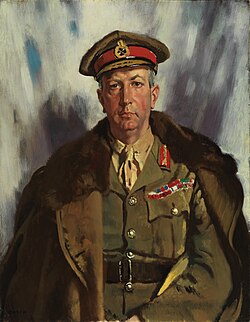
Sir Arthur Currie
Portrait by William Orpen, 1919.
The first part of the series was a political biography of Currie; the second part attempts to tell the story of the Canadian Corps at war through somewhat detailed account of four important battles. The piece is only partly biographical, it partly tells the story of Currie’s war, and partly tells the story the Canadian men who fought for the British Empire in the Great War. It’s a story of incredible martial prowess, but the careful reader will also observe a story of warring duties placed upon the leader of a colonial army; duty to his men, duty to the political leadership of his colonial people and the future of that nation, duty to the objectives of the imperial power on whose behalf he fought, and finally duty to glorious Victory. Currie ended his life understood by those with eyes to see as a great warrior and a military genius; but disliked by his men and hated by the leadership of his people because he prioritized the needs to the Empire and of Victory; but after the war the Empire was of limited service to Currie and to the Canadian people. I leave to the reader, to history, and to God, to decide the value of Victory.
[…]
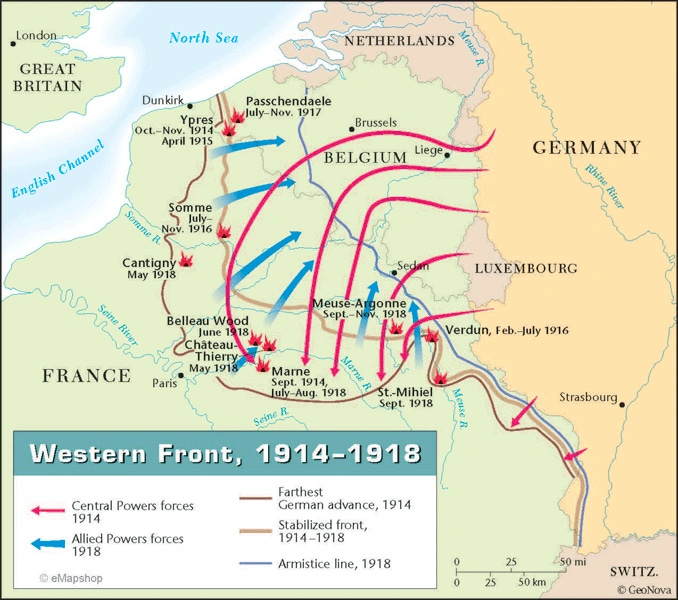
2nd Battle of Ypres
In the spring of 1915 the early dynamic advances of the German army were a distant memory faded behind the great defeat at the First Battle of the Marne. Through the winter both sides had dug in; and many German troops were redeployed to the Russian front. German chemists Walther Nernst and Fritz Haber brought forward the idea of using heavier-than-air Chlorine gas, carried on the wind, to overcome the mathematical impossibility of conventional attack. On April 22, 1915, Albrecht of Württemberg led 7 German divisions to attack 8 Allied divisions, including the 1st Canadian Division under the command of Sir Edwin Alfred Hervey Alderson. The attack began with the release of 168 tons of chlorine gas at about 1700h along a 4 mile stretch of the front around Langemark.
[…]
Vimy Ridge
For a year and a half after Ypres, Currie & the Canadian Corps continued to fight desperate engagements along the Western front with no clear strategic conclusion. After heavy losses and a lot of hard-learned lessons at the Somme from Sept 1915-Sept 1916, the Canadian Corps and Currie with them had become both hardened by bitter experience, and desperate to find better ways to prosecute the war. In September 1915 he was recorded to have said “I did not care what happened to me, but to my men, to their wives, their mothers, their children and to Canada I owed a duty which I wanted to fulfill to the very best of my ability”. Later that year as the division struggled with desertion, he ordered the execution of a deserter despite a three hour plea for clemency by the divisional cleric. The decision restored discipline, but haunted Currie’s dreams long afterwards.
In May 1916 Julian Byng took command of the Canadian Corps, replacing Sir Edwin Alderson. In the fall of that year, after heavy losses in a series of engagements at the Somme, Byng was given the opportunity to reorganize and refit the Canadian Corps; he looked to Currie as a key partner in the effort. They replaced the ineffective Ross Rifle with the Lee Enfield, reorganized the platoon structure to include heavy weapons within each platoon [machine guns, mortars, etc.], and implemented new training and tactics like rehearsals for advances, and the “creeping barrage”, carefully coordinated intended to keep artillery shells landing slightly ahead of advancing men.
[…]
Hill 70
After Vimy, Julian Byng was promoted. Currie was promoted in turn to lead the Canadian Corps. He would lead the Corps that he and Byng had made into one of the most effective fighting forces on any side of the conflict and lead it to bloody victory again and again. There is perhaps no better example of the mastery of the Canadian Corps, from top to bottom, than the battle of Hill 70. “Hill 70 was as close to a perfect battle as was ever fought on the Western Front” wrote historian Tim Cook.
[…]
The Hundred Days Offensive & the Pursuit to Mons
As the winter of 1917-18 passed, a new set of highly political decisions concerning whether and how to reorganize the Canadian Corps for the next round of fighting were taken. As noted in part one, Currie opted to split up the newly formed 5th division to reinforce the four divisions of the Canadian Corps and triple the size of the field engineering element. The decision optimized the Canadian Corps as an attacking force; and when they returned to the front that’s exactly how they would be used. Between August 8th and November 11th, 1918, the Canadian Corps fought nine major battles advancing 86 miles, and suffering 45,835 casualties [The force that began the offensive was ~100,000]. By comparison, the substantially larger American Expeditionary Force, over this same period, advanced only 34 miles while capturing only half the number of prisoners, suffering roughly twice the casualties per German division defeated.


Comments Off on Four battles of the Canadian Corps
QotD: Moltke the Younger and the Schlieffen Plan
Moltke therefore proved an ideal scapegoat for the “Schlieffen School”. For the Schlieffen School (mostly officers trained by Schlieffen), the Schlieffen Plan was a true recipe for victory bungled by incompetent execution. However, recent scholarship has shown a more nuanced picture. While Schlieffen did not fully approve of his successor, Moltke was a faithful student of Schlieffen’s concepts. The modifications he made to the plan were not because of a difference in opinion, but of circumstance. Following Schlieffen’s retirement, the French army became more aggressive, necessitating a stronger defense of the Rhine. Likewise, Russian strength and mobilization speed increased, necessitating a greater force allocated to the East. Moltke was also more realistic about the logistical limitations of the all-important right wing of the German offensive. While Schlieffen (allegedly with his dying breath) insisted “keep the right wing strong”, there were simply only so many divisions that could practically advance there. Moltke did his best to adapt the Schlieffen Plan to these changing circumstances, though with mounting fear that the strength of the Entente had placed victory beyond Germany’s strength.
Despite awareness of the long odds, officers continued to press for preventative war in succeeding European crises.3 The term “preventative war” did not mean “preempting the attack of hostile powers” but rather to initiate a war while the strategic balance was most favorable for Germany. While, as mentioned, they had their doubts about the surety of victory, they believed the odds would only get worse. The Schlieffen Plan had been designed for a one-front war against France (in 1905, the year of Schlieffen’s retirement, Russia was in the throes of revolution). Though adapted in later years, the plan remained tenable only so long as Germany had the chance to defeat France before Russian mobilization was completed. As the Russian army expanded and its rail system modernized, the General Staff saw the Schlieffen Plan nearing its expiration date.
The General Staff saw no alternative to Schlieffen’s concept because of its axiomatic focus on total victory. The kind of limited victory that the Elder Moltke had settled for in his later war plans had never entered the vocabulary of the General Staff. As such, the General Staff pressed strongly for war (which it believed was inevitable) to break out before the balance of power swung further against Germany.
The only alternative to this would have been to frankly state the perilous situation in which Germany stood militarily and admit that total military victory was out of reach and German diplomacy would need to be reoriented around this fact. Not only would this course of action been antithetical to the proud traditions of the officer corps, but it would also have been viewed as unacceptably political. What’s more, the Kaiser would have likely viewed such behavior as cowardly if not outright insubordinate. Once again, the Kaiser’s power over personnel decisions meant uncomfortable topics were not broached for fear of instant dismissal.
It is not entirely unjust to accuse German leaders of cowardice or careerism in avoiding these conversations. However, they — like so many who serve under capricious or incompetent heads of state — justified their silence and continued service under the logic of harm reduction. If they resigned (or clashed with the Kaiser leading to their dismissal) they knew they would be replaced by someone more compliant. The Kaiser’s power over personnel meant they understood clearly that they had no leverage.
The Chiefs of the General Staff, for all their influence, were incentivized to focus on the areas of their exclusive responsibility. Nevertheless, the younger Moltke was not passive in his efforts for war. He resumed contact with the Austro-Hungarian General Staff, assuring it of German support should Austria choose war in a crisis. As aforementioned, when crises came to Europe (some instigated by the German foreign ministry) he pressed the chancellor and Kaiser for a preventative war. Both, to their credit, while willing to risk war, would not choose it.
Perhaps most decisively, Moltke and his deputy, Erich von Ludendorff,4 made the decision to hinge the operational plan on an attack on the Belgian city of Liège (hosting a critical rail juncture) before the neutral country could mobilize.5 This modification was made because Moltke desired to avoid violating Dutch neutrality (as Schlieffen had called for). He wisely understood Germany could afford no more enemies and that invading the Netherlands would mean increasing the distance the German right wing would have to cover to gain the French flank, decreasing the odds of success. What’s more, Moltke hoped that Dutch neutrality would allow it to act as a “windpipe” in the event of a long war and a British blockade. However, avoiding Dutch territory complicated German logistics, necessitating the swift seizure of Liège to allow the offensive to meet its strict timetables.
This was a strictly operational decision, made on technical grounds. As such, neither the chancellor nor the Kaiser were informed of this detail of the plan (operational plans were kept strictly secret, with the prior year’s being systematically burned). However, as perceptive readers may have noticed, the need for a coup de main against a neutral country before it mobilized severely limited German strategic flexibility. There was only one deployment plan for war in the West (and only one at all after 1913). In a crisis, Germany was therefore bound to attack before the Belgians manned Liège’s fortifications. Yet this all-important point-of-no-return was unknown to the Kaiser, chancellor, and foreign minister. The General Staff had effectively stripped the Kaiser and civilian leaders of their “right to be wrong”.
Thus, the General Staff had drastically increased the likelihood of war in that the point-of-no-return was kept obscured from those who would be responsible for bring Germany to the brink. As would occur in 1914 during the July Crisis, the Kaiser and his minister could not understand why Moltke was pressing so strongly for war. As historian Annika Mombauer puts it, “Only Moltke knew that every hour counted”.6 The General Staff had — intentionally or not — engineered a situation in which political leadership would have to choose war or abandon its only operational plan. While political leadership was reticent to take this step (especially without the details of the plan) contributing to Moltke’s nervous breakdown, the General Staff ultimately got the war it so desired at the next crisis Germany found itself in. If the coup de main on Liège had been devised as a ploy to force political leadership to engage in a preventative war, it had succeeded.
Ultimately, the predominance of the military over German policy — both foreign and domestic — created an environment in which civilian leaders like Bethmann Hollweg were sidelined, and aggressive military strategies took precedence. This imbalance of prestige, coupled with the narrow, fatalistic worldview of military leaders, contributed to Germany’s march toward war, with little room to acknowledge alternative diplomatic or strategic approaches.
Kiran Pfitzner and Secretary of Defense Rock, “The Kaiser and His Men: Civil-Military Relations in Wilhelmine Germany”, Dead Carl and You, 2024-10-02.
- Helmuth von Moltke the Elder was his uncle.
- Mombauer, Moltke, 109.
- Better known for other work.
- Mombauer, 96.
- Mombauer, 219.
- Rosinski, “Scharnhorst to Schlieffen”, 99.
Comments Off on QotD: Moltke the Younger and the Schlieffen Plan


