Published on 6 Jul 2015
Louis Barthas was a French soldier who served on the Western Front for 54 months. He served in the Battle of Verdun and other major battles of World War 1. His War Diary gave a voice to the senselessness of war. As a socialist, Barthas was a supporter of the French mutinies of 1917 and a vocal enemy of the war. All about Louis Barthas in our biography.
July 8, 2015
Socialist and Front Soldier – Louis Barthas I WHO DID WHAT IN WW1?
June 23, 2015
A Genius and A Madman – Fritz Haber I WHO DID WHAT IN WW1?
Published on 22 Jun 2015
Fritz Haber is one of the most famous German scientists. His inventions made it possible to feed an ever growing human population and influence us till this day. But Fritz Haber had a dark side too: His research made the weaponization of gas and the increased production of explosives possible. Find out more about the life of Fritz Haber in our biography.
June 17, 2015
QotD: Heinlein’s alleged misogyny
My friend Cedar, today, posted about one of those lies that “everybody knows” and that are absolutely not true. Not only not true, but risible on their face. The lie is that Heinlein was a misogynist, which is not only a lie but a whole construct, an artifact of lies. And one that humans, nonetheless seem to buy wholesale.
I’m not going to repeat the argument. Cedar made it. But I’m going to quote what she said:
When the woman who had first made the titular accusation was questioned by multiple voices in startlement, she finally admitted that she knew it to be so, because she had read it in Asimov’s biography. Wait a minute, was my reply, you mean that man that Eric Leif Davin in his recent book Partners in Wonder wrote this about?” Isaac Asimov is on record for stating that male fans didn’t want females invading their space. According to the letter columns of the time, it seems that the only fan who held that opinion was… Isaac Asimov. A number of males fans welcomed their female counterparts. As did the editors, something Davin goes to great lengths to document.” (You can read more on the women that other women ignore here at Keith West’s blog) So this woman has taken a known misogynist’s claim that another man is a misogynist without questioning and swallowed it whole.
I run into this again and again. In a panel, once, questioning accusations of misogyny directed at Heinlein I got back “Well, obviously he was. His women wear aprons.” I then got really cold and explained that in Portugal, growing up, when clothes were expensive (how expensive. People stole the wash from the line. Imagine that happening here. People stealing clothes. Just clothes. Not designers, not leather, just clothes, including much-washed-and-mended pajamas.) we always wore aprons in the kitchen. And Heinlein was writing when clothes were way more expensive, relatively. (I buy my clothes at thrift stores. So unless it’s a favorite pair of jeans or something, I don’t wear aprons.) The difference is not “putting women in their place.” The difference is the cost of clothes.
And this is why I don’t get put on the “Heinlein, threat or menace” panels any more.
But 90% of the women who make the accusation that Heinlein hated women or couldn’t write women have never read him. They’ve just heard it repeated by people with “authority.” The cool kids. And so they can’t be reasoned out of this assumption, because it’s not an assumption. It’s glamor. (The other ten percent, usually, were primed to think he was a misogynist and read the beginning of a book and didn’t “get” some inside joke. Like, you know, the getting married after a tango. Which was pure fan fodder. They wouldn’t have thought anything of it if they hadn’t been primed. But they’d been primed. They were under a glamor to see what wasn’t there.)
Sarah Hoyt, “Glamor and Fairy Gold”, According to Hoyt, 2015-06-02.
June 12, 2015
The long-lasting impact of the “Little House” books
Jason Kuznicki on the deep emotional grasp Laura Ingalls Wilder’s “Little House” books are still having today:
“Not ‘Harry Potter’!” says Alice, age five. “I want ‘Little House’!”
It’s the age of negotiated bedtime reading. My husband and I oblige, and tonight we read from Little House in the Big Woods, the first installment of Laura Ingalls Wilder’s fictionalized autobiography. We take turns reading: Alice reads, then I do, then Scott does. Then Alice reads again. It’s never enough.
What draws her in? A lot of things. The characters are mostly female, young, and strong. Laura herself begins “Little House” at four, an age that wins our daughter’s ready empathy. Not unlike the first volume of “Harry Potter,” Little House in the Big Woods introduces an unknown world; done properly, that’s always exciting. As generations already know, the story is clean and earnest, without affectation or smarm. And it’s told in words that Alice can read all on her own — a great confidence builder.
It’s sometimes hard to fathom, though, just how different Laura’s life was from our own: churning butter, salting meat, boiling down maple syrup… Megan McArdle discussed all this in a recent piece for Bloomberg. The “Little House” books open up a lost world for today’s kids — and for today’s adults:
[A]s an adult… what really strikes you is how incredibly poor these people were. The Ingalls family were in many ways bourgeoisie: educated by the standards of the day, active in community leadership, landowners. And they had nothing.
We’re not just talking a different skill set, then. The skills came of necessity, and of hardships almost wholly unknown today: “Little House” contains the actual sentence, “They had never seen a machine before” — because, well, they hadn’t.
May 21, 2015
John Monash – Australia’s greatest general
Strategy Page reviews a new biography of Australia’s General John Monash:
The centennial of the First World War has brought forth renewed public interest and additional scholarly study of that still controversial conflict, variously the last 19th century imperial war and the first modern war. When its great generals are enumerated, one named by relatively few outside the Antipodes is Australian Army Corps commander John Monash (1865-1931), this despite Field Marshal Viscount Montgomery’s declaration half a century after the Armistice that Monash was “the best general on the Western Front in Europe,” and historian Sir Basil Liddell Hart’s even stronger accolade as “the greatest general of World War I by far.” Yet in the three-volume Cambridge History of the First World War, there is not one mention of him.
Monash, it must be said, has not been entirely overlooked. He was knighted in the field by George V (as a Knight Commander of the Order of the Bath) and subsequently given the title Knight Grand Cross of the Order of St. Michael and St. George, and in his homeland his name graces a university (indeed, the publisher of the book under review), a scholarship, a town and even a freeway. Nevertheless, in Maestro John Monash, former Australian Deputy Prime Minister Tim Fischer argues that Sir John has been wronged by history and not given his due. In a breezy hagiography (Fischer vehemently denies that characterization, protesting that his biography is “warts and all,” however, he downplays or dismisses most of the “warts” cited, e.g., other generals also had mistresses, and while he made mistakes at Gallipoli, he learned from them) and advocacy piece, he makes a justifiable case for Monash’s posthumous promotion to field marshal (backdated to 1930). Had he been promptly promoted postwar, rather than in 1929, to general (that is, full or four-star general), Fischer points out logically, he likely would have been promoted by the king one step up in rank to field marshal.
In his account of Monash’s life and military career, Fischer details the many obstacles faced and surmounted by “the most innovative general” of the war. His sobriquet for Monash, “maestro,” comes from Sir John’s comparison of a “perfected modern battle plan” to a “score for an orchestral composition.” Indeed, while some British and French generals were still thinking in terms of cavalry charges, sabers and bayonets, drawing on his engineering background, Monash made concerted use of infantry, artillery, tanks, aircraft and radio in (to quote him) “comprehensive holistic battle plan[s].” His strategy’s success became evident in thwarting Germany’s final westward push and smashing through the Hindenburg Line, in the 93-minute Battle of Hamel and the second Battle of Amiens, which German General Ludendorff later called “the black day of the German Army in the war,” victories achieved while Monash was still a lieutenant general (three stars). “Never has a general who did so much to help win a world war … been so unacknowledged,” affirms Fischer, returning to his theme.
May 20, 2015
Mustafa Kemal Atatürk I WHO DID WHAT IN WORLD WAR 1?
Published on 18 May 2015
Mustafa Kemal or simply Atatürk was the founder of the modern, secular Turkish Republic. He earned his stripes as an officer in World War 1 as the defender of Gallipoli against the ANZAC troops. You can find out all about Mustafa Kemal Atatürk during the last years of the Ottoman Empire in our biography.
May 5, 2015
Conrad von Hötzendorf I WHO DID WHAT IN WW1?
Published on 4 May 2015
Conrad von Hötzendorf was one of the main figures pushing for war and escalating the July crisis in 1914 leading to World War 1. His failure as commander in chief of Austria-Hungary were staggering but still today some consider him a military genius. Who was this man who polarizes military scholars till today and played such a huge role in the downfall of the Habsburg empire? Find out in our biography.
April 13, 2015
QotD: The real man behind Kipling’s Man Who Would Be King
It is quite possible that Kipling based Daniel Dravot, the hero of The Man Who Would Be King, on Dr Harlan. He would surely have heard of the American, and there is a strong echo, in Dravot’s fictional Kafiristan adventure (published in 1895), of Harlan’s aspirations first to the throne of Afghanistan, and later successfully to the kingship of Ghor. as described in Gardner’s Memoirs (published in 1890); whether Harlan’s story was true is beside the point. Like many passages in his astonishing career, it lacks corroboration; on the other hand it was accepted, along with the rest, by such authorities as Major Pearse, who was Gardner’s editor, and the celebrated Dr Wolff.
Josiah Harlan (1799-1871) was born in Newlin Township, Pennsylvania, the son of a merchant whose family came from County Durham. He studied medicine, sailed as a supercargo to China, and after being jilted by his American fiancée, returned to the East, serving as surgeon with the British Army in Burma. He then wandered to Afghanistan, where he embarked on that career as diplomat, spy, mercenary soldier, and double (sometimes treble) agent which so enraged Colonel Gardner. The details are confused, but it seems that Harlan, after trying to take Dost Mohammed’s throne, and capturing a fortress, fell into the hands of Runjeet Singh. The Sikh maharaja, recognising a rascal of genius when he saw one sent him as envoy to Dost Mohammed; Harlan, travelling disguised as a dervish was also working to subvert Dost’s throne on behalf of Shah Sujah, the exiled Afghan king; not content with this, he ingratiated himself with Dost and became his agent in the Punjab — in effect, serving three masters against each other. Although as one contemporary remarks with masterly understatement, Harlan’s life was now somewhat complicated, he satisfied at least two of his employers: Shah Sujah made him a Companion of the Imperial Stirrup, and Runjeet gave him the government of three provinces which he administered until, it is said, the maharaja discovered that he was running a coining plant on the pretence of studying chemistry. Even then, Runjeet continued to use him as an agent, and it was Harlan who successfully suborned the Governor of Peshawar to betray the province to the Sikhs. He then took service with Dost Mohammed (whom he had just betrayed), and was sent with an expedition against the Prince of Kunduz; it was in this campaign that the patriotic doctor “surmounted the Indian Caucasus, and unfurled my country’s banner to the breeze under a salute of 26 guns … the star-spangled banner waved gracefully among the icy peaks.” What this accomplished is unclear but soon afterwards Harlan managed to obtain the throne of Ghor from its hereditary prince. This was in 1838; a year later he was acting as Dost’s negotiator with the British invaders at Kabul; Dost subsequently fled, and Harlan was last seen having breakfast with “Sekundar Burnes”, the British political agent.
Thus far Harlan’s story rests largely on a biographical sketch by the missionary Dr Joseph Wolff; they met briefly during Harlan’s governorship of Gujerat, but Wolff (who of course never had the advantage of reading the present packet of the Flashman Papers confesses that he knows nothing of the American after 1839. In fact, Harlan returned to the U.S. in 1841, married in 1849, raised Harlan’s Light Horse for the Union in the Civil War, was invalided out, and ended his days practising medicine in San Francisco; obviously he must have revisited the Punjab in the 1840s, when Flashman knew him. Of his appearance and character other contemporaries tell us little; Dr Wolff describes “a fine tall gentleman” given to whistling Yankee Doodle”, and found him affable and engaging. Gardner mentions meeting him at Gujerat in the 1830s, but speaks no ill of him at that time.
His biographer, Dr Joseph Wolff, D.D., LL.D (1795-1862), was a scholar, traveller, and linguist whose adventures were even more eccentric than Harlan’s. Known as “the Christian Dervish”, and “the Protestant Xavier”, he was born in Germany, the son of a Jewish rabbi, and during his “extraordinary nomadic career” converted to Christianity, was expelled from Rome for questioning Papal infallibility, scoured the Middle and Far East in search of the Lost Tribes of Israel, preached Christianity in Jerusalem, was shipwrecked in Cephalonia, captured by Central Asian slave-traders (who priced him at only £2.50, much to his annoyance), and walked 600 miles through Afghanistan “in a state of nudity”, according to the Dictionary of National Biography. He made a daring return to Afghanistan in search of the missing British agents, Stoddart and Connolly, and narrowly escaped death at the hands of their executioner. At other times Dr Wolff preached to the U.S. Congress, was a deacon in New Jersey, an Anglican priest in Ireland, and finally became vicar of a parish in Somerset. As Flashman has remarked, there were some odd fellows about in the earlies. (See Gardner; The Travels and Adventures of Dr. Wolff (1860); Dictionary of American Biography; D.N.B.)
George MacDonald Fraser, Flashman and the Mountain of Light, 1990.
April 11, 2015
Robert E. Lee
In City Journal, Ryan L. Cole reviews a recent book on one of America’s most famous generals:
America’s Civil War presents a set of forever ponderable “what ifs.” What if a Union soldier hadn’t discovered plans for the Confederate invasion of Maryland in 1862? What if Stonewall Jackson hadn’t been hit by friendly fire after the Battle of Chancellorsville? What if George Meade had pursued the wounded Army of Northern Virginia in the wake of Gettysburg? The list goes on.
But perhaps the most vexing hypothetical has always been: What if Robert E. Lee had accepted Abraham Lincoln’s offer to command Union forces at the outset of the conflict? This would have likely robbed the Confederacy of its greatest military mind. It may have also robbed the South of its fleeting glories, dramatically shortened the war, and made Lee — not Ulysses S. Grant or even Abraham Lincoln — the savior of the Union. It could even have made Lee a second George Washington.
This decision and its ramifications are the basis of The Man Who Would Not Be Washington, Jonathan Horn’s thoughtful new life of the Confederate general. It would be wrong to call this a biography. Though Horn, a former speechwriter for President George W. Bush, assays Lee’s life from birth to death, the book is built around the premise that Lee was practically destined to become the second coming of Washington. Yet he declined, and the consequences of his refusal altered the course of the nation.
Lee had familial and professional connections to Washington. His father, Henry Lee III, better known as “Light-Horse” Harry Lee, was a dashing cavalry officer in the Continental Army. General Washington was impressed by Lee’s bravery and invited the young Virginian to join his personal staff. When Lee begged off, Washington asked Congress to give him an independent command. Like some other young officers, Lee found a mentor in Washington, who had no biological children of his own. He did, however, adopt and raise Martha Washington’s grandson, George Washington Parke Custis, as his own son. Custis’s daughter, Mary, wed Robert E. Lee. Their children, by birth and marriage, were direct descendants of America’s original first lady.
The Lees lived in Arlington House, a Potomac mansion overlooking Washington, built by Custis as a shrine to his adoptive father and a repository for his relics. Through marriage, Lee was heir to the tactile remains of Washington’s legacy; even the slaves he inherited from his father-in-law were descendants of those who had toiled at Mount Vernon. In his opening chapters, Horn carefully draws the connections between the two titular subjects and plots Lee’s rise to military distinction in the years leading up to the Civil War. The history is simply fascinating. Horn is a graceful writer, and when the occasion warrants, has a suitable flair for the dramatic. The pages blaze by.
February 10, 2015
Edmund Curll, “printer, pirate, and pornographer”
Sherwood Smith and Rachel Manija Brown, guest-posting at Charlie’s Diary, discuss a thoroughly awful man of letters:
Like now, there were ripoff booksellers masquerading among the legitimate ones, though today’s scammers (see Writer Beware) are rarely as colorful as the rascally Edmund Curll — printer, pirate, and pornographer. He stole material with flagrant disregard for copyright. As soon as some prominent person died, he collected gossip — it didn’t matter if it was true — for a biography, and if he didn’t have enough material, he made it up. Prominent people reportedly dreaded dying because of what Curll would do to them. A faint echo of the Curll treatment occurred a couple weeks ago, when Colleen McCullough’s obit started off by noting how fat and unlovely she’d been.
Curll churned out so much X-rated stuff under various guises that the word ‘Curlicism’ became synonymous with porn. Prison, a stint in the stocks, even being blanket-tossed and beaten by the boys at Westminster school not only didn’t stop him from theft and libel, he turned them all into marketing opportunities. Even when he was convicted of libel and forced to publish an apology and a promise to stop printing, his repentant words touted his latest books.
He’s best known for the twenty-year running duel with the poet Alexander Pope, from whom he not only stole, he lampooned under his own name and with sockpuppets. It began when he first pirated Pope, prompting the poet and his publisher to meet Curll at the Swan, where they slipped a mega dose of “physic” (think ExLax) into his drink. He turned that, too, into a marketing event, once he’d recovered from the extremes of ejecta; when Pope published a couple of triumphant pamphlets, claiming Curll was dead, Curl came right back with new material demonstrating that he was very much alive and up to his usual racket.
Their history — and there are other equally crazy-ass stories — remind me of the whoops and hollers of internet feuds and FAILS now, among writers, editors, publishers (some individuals wearing all three hats).
Aside from the Curlls, most booksellers, the publishers of the eighteenth century — like the editors working at traditional publishers now — were hardworking people who made careful decisions about what to publish because they were the ones fronting the costs of printing and of copyright.
The booksellers of Grub Street were all about copyright. For most of the eighteenth century, they met yearly, over sumptuous dinners, to hold a copyright auction that was exclusive to the booksellers. Interlopers were unceremonious chucked out.
February 3, 2015
A biography of Joss Whedon
In City Journal, Benjamin Plotinsky talks about a new biography of the creator of Buffy the Vampire Slayer, Firefly, Serenity, and Agents of S.H.I.E.L.D.:
Buffy the Vampire Slayer premiered in March 1997. The show’s name suggested either camp or children’s programming, which was probably why the network had wanted to call it simply Slayer. But Whedon insisted on the full name, Pascale writes. “As he explained, each word was crucial to understanding the show: ‘One of them is funny, one is scary, one of them is action.’” It wasn’t the last time that Whedon would make a questionable marketing decision. To this day, plenty of people who correctly point to The Sopranos and The Wire as high points of turn-of-the-century television don’t realize that Buffy, despite its name, was one of the most impressive products of that impressive period, which is to say, one of the best TV shows ever made.
The show wasn’t simply about a superpowered high schooler whose calling was to fight demons and periodically save the world. It was an allegory for American adolescence. The monsters and apocalypses represented — seldom so obviously as to induce cringes — many of the problems that teenagers routinely confront, and they forced the heroine to face problems that the rest of us must face sometimes, too: unpopularity, abandonment, fear, misery, loneliness, helplessness. Sometimes Buffy prevailed through simple self-reliance; more often, through the help of her friends, a group of smart misfits who distinguished themselves from others in their high school — and simultaneously endeared themselves to viewers everywhere — by speaking a clever, grammar-mangling patois that fans soon dubbed Buffyspeak. (“Punishing yourself like this is pointless,” Buffy’s mentor tells her early in the show’s second season. “It’s entirely pointy,” she retorts.) The wit of the dialogue balanced the pain of the plots, as Whedon put his characters through the emotional wringer with a perceptiveness seldom matched on the small screen — or the big.
Buffy ended in 2003, but Whedon was already running other projects and would continue to pilot more, most of them in science fiction or fantasy. They included a number of TV shows (Angel, Dollhouse, Agents of S.H.I.E.L.D.) and movies (Serenity, The Cabin in the Woods, Much Ado About Nothing), as well as an innovative, self-produced miniseries, Dr. Horrible’s Sing-Along Blog, distributed online. Deserving special mention is Firefly, a hugely promising TV series that mixed country-Western and sci-fi plots while showcasing Whedon’s trademarks: clever dialogue, perceptive psychology, and a motley crew of outsiders. The Fox network canceled Firefly after just 14 episodes, citing low viewership, which Pascale blames chiefly on Fox’s poor advertising for the show. Whedon may have deserved some of the blame, too. Firefly opened with a contemplative, almost dismal theme song, composed by Whedon himself, that captured the series’ spirit nicely but almost certainly put off many first-time viewers. Perhaps Whedon was once again insisting on artistic integrity at the price of practical success.
Until 2012, it seemed likely that Whedon’s name would be permanently associated with Buffy. That year, however, the best of the recent crop of comic-book flicks — The Avengers, written and directed by Whedon — became the third-highest-grossing movie of all time. Who better to helm a movie about a team of smart, squabbling mavericks who ultimately unite to save the world than the creator of Buffy and Firefly? The movie was classic Whedon: well paced, clever, and laced with dialogue at once witty and psychologically revealing. He’s currently working on a sequel, which will hit theaters this May.
Pascale’s book is carefully researched and documented, and it gives the reader a good idea of Whedon’s personality, thought process, and creative approach — no small feat for a narrative that, for the most part, must introduce its topics in chronological order. Pascale quotes Whedon often, and his insight about his own work makes the book a pleasure to read. After a conversation with composer Stephen Sondheim — who tells him, “I will always write about yearning” — Whedon starts wondering what his own chief motivation is. “Helplessness was what I realized was sort of the basic thing,” Whedon says. He varies the idea slightly in another context: “We, all of us, are alone in our own minds. … Loneliness and aloneness — which are different things — are very much, I would say, [among the] main things I focus on in my work.” Even The Avengers, Whedon says, is “a film about lonely people, because I’m making it, and my pony only does one trick.”
October 24, 2014
A new biography of Lincoln
Myron Magnet is quite enthusiastic about Founders’ Son: A Life of Abraham Lincoln by Richard Brookhiser:
Unlike those mega-biographies that bury their subject’s chief accomplishments under 900 pages of undigested detail, Richard Brookhiser’s compact, profound, and utterly absorbing new life of Abraham Lincoln, Founders’ Son, leaps straight to the heart of the matter. With searchlight intensity, it dazzlingly illuminates the great president’s evolving views of slavery and the extraordinary speeches in which he unfolded that vision, molding the American mind on the central conflict in American history and resolving, at heroic and tragic cost to the nation and himself, the contradiction that the Founding Fathers themselves could not resolve.
[…]
Lincoln did not start out an abolitionist. As early as 1837, he showed ambivalence on the subject. When the Illinois legislature voted to condemn abolition societies as unnecessarily provocative that year, legislator Lincoln and a colleague voted yes but entered a protest, declaring for the record “that the institution of slavery is founded on both injustice and bad policy.” Even so, as a campaigner for Whig candidate William Henry Harrison in the election of 1840, Lincoln, in a debate with Martin Van Buren supporter Stephen Douglas, “was not above slyly trafficking in prejudice,” Brookhiser notes, attacking Van Buren for supporting voting rights for New York State’s free blacks. But as his congressional term drew to an end in 1849, he proposed (unsuccessfully) a plan for ending slavery in the District of Columbia, and the next year, when the three-decade-long era of trying to find a compromise on the issue of slavery came to a climax with the Compromise of 1850, Lincoln knew that the choice between slavery and abolition was inevitable for the nation—and he knew that he would stand against slavery. “When the time comes my mind is made up,” he told a friend, “for I believe the slavery question can never be successfully compromised.”
The time came soon enough, with the infamous Kansas-Nebraska Act of 1854. In effect, the act repealed the 1820 Missouri Compromise, which, in admitting Missouri as a slave state, had barred slavery from the rest of the Louisiana Territory lying north of the 36° 30’ parallel. By the terms of the new act, however, settlers pouring into the vast, hitherto empty territories of Kansas and Nebraska, which mostly lay north of the 1820 line, could choose whether to admit or bar slavery by “popular sovereignty,” the term used by Democratic senate leader Stephen Douglas, who boasted of having “passed the Kansas-Nebraska Act myself. . . . I had the authority and power of a dictator throughout the whole controversy.”
Though what we call the Lincoln-Douglas debates occurred in their Illinois senatorial contest of 1858, the “six years from 1854 to 1860 were one long Lincoln-Douglas debate,” writes Brookhiser, as Douglas went around the state defending the act and an indignant Lincoln pursued him, rebutting his emollient arguments in a string of immortal speeches. In Peoria in October 1854, Lincoln condemned Douglas for reopening an already scabbed-over wound. “Every inch of territory we owned already had a definite settlement of the slavery question,” he observed; but thanks to Douglas, “here we are in the midst of a new slavery agitation.” Douglas wants the people of the territories to decide? Fine. But who the people are “depends on whether a Negro is not or is a man.” If he is, then isn’t it “a total destruction of self-government, to say that he too shall not govern himself?” When a white man “governs himself, and also governs another man, that is more than self-government — that is despotism.”
Lincoln appealed to the authority of his beloved Founding Fathers — a subject Brookhiser, biographer of several of them, knows better than most. These great men found slavery already existing in the colonies, and to forge a new nation that the slave states would agree to join, they had to accept the evil out of necessity, not principle. They clearly knew that it was wrong, as is evident in the 1787 Northwest Ordinance, by which the Continental Congress strove to prevent slavery’s spread to unsettled territories; in the Declaration of Independence—“the sheet anchor of American republicanism,” said Lincoln, “that teaches me that ‘all men are created equal,’” including blacks, who are emphatically men; and in the Constitution itself, which accepted slavery so reluctantly that it wouldn’t even name it, Lincoln noted, “just as an afflicted man hides away a wen or cancer, which he dares not cut out at once, lest he bleed to death.” So let’s not go beyond where the Founders felt themselves forced to go. Let’s not metastasize slavery further.
July 9, 2014
Justin Raimondo reviews new biography of the Koch family
The archvillains of capitalism, Charles and David Koch, are the subjects of a recent book by Mother Jones writer Daniel Schulman. Justin Raimondo reviews Sons of Wichita: How the Koch Brothers Became America’s Most Powerful and Private Dynasty.
According to Senate Majority Leader Harry Reid, the Koch brothers are responsible for global warming and much else that’s wrong with the world. This is part of a strategy to demonize Charles and David Koch — the principals behind the country’s largest privately-held company — and make them the issue come Election Day. There’s a big problem with this strategy, however: a recent poll shows that most of Reid’s own constituents haven’t the slightest idea who the Brothers Koch are.
Daniel Schulman’s much anticipated book, the first biography of the Koch family, may help voters bridge the knowledge gap — but Democrats are going to be disappointed if they think it will help their smear campaign. Indeed, it is likely to do the opposite. It’s hard to write a biography of someone you hate, and Schulman, a writer for Mother Jones, clearly came to admire his subjects.
The story starts with Fred Koch, a son of Dutch immigrants who settled in the “poor but plucky” town of Quanah, east of the Texas panhandle. Ambitious, single-minded, and tough as nails, Fred made his fortune helping Joe Stalin extract oil from the Russian steppes — learning in the process that the rosy picture of a “workers’ paradise” drawn by the likes of Walter Durante was the exact opposite of the truth.
Driven to seek overseas markets by an onslaught of patent-infringement lawsuits from a Rockefeller-connected oil consortium, Fred Koch arrived in Russia in 1930 and “found it a land of hunger, misery, and terror,” as he would later recall. When he left that autumn, his Soviet minder — who had spent the whole time capitalist-baiting him — bid adieu with this warning: “I’ll see you in the United States sooner than you think.” What Fred had seen in Stalin’s Russia set him on a course that landed him in the ranks of the John Birch Society.
Robert Welch, the society’s founder, recruited him early on: Fred was at the 1958 meeting where Welch first laid out his plan to fight the Communist menace and roll back the New Deal. The John Birch Society was a hybrid of Old Right libertarian economics and the McCarthyite paranoia of the 1950s, and Fred — by this time a tycoon — relentlessly lectured his four sons on the evils of collectivism and the value of hard work. He had no intention of raising a brood of “country-club bums” who would coast along on the family fortune. The 1950s were almost over before he bought the kids a television, and even then they had little time to watch it.
June 26, 2014
The second volume of Patterson’s biography of Robert Heinlein
In the Washington Post, Michael Dirda reviews the second (and final) volume of William Patterson’s Robert A. Heinlein: In Dialogue With His Century.
Robert Anson Heinlein (1907-1988) possessed an astonishing gift for fast-paced narrative, an exceptionally engaging voice and a willingness to boldly go where no writer had gone before. In “— All You Zombies—” a transgendered time traveler impregnates his younger self and thus becomes his own father and mother. The protagonist of Tunnel in the Sky is black, and the action contains hints of interracial sex, not the usual thing in a 1955 young adult book. While Starship Troopers (1959) championed the military virtues of service and sacrifice, Stranger in a Strange Land (1961) became a bible for the flower generation, blurring sex and religion and launching the vogue word “grok.”
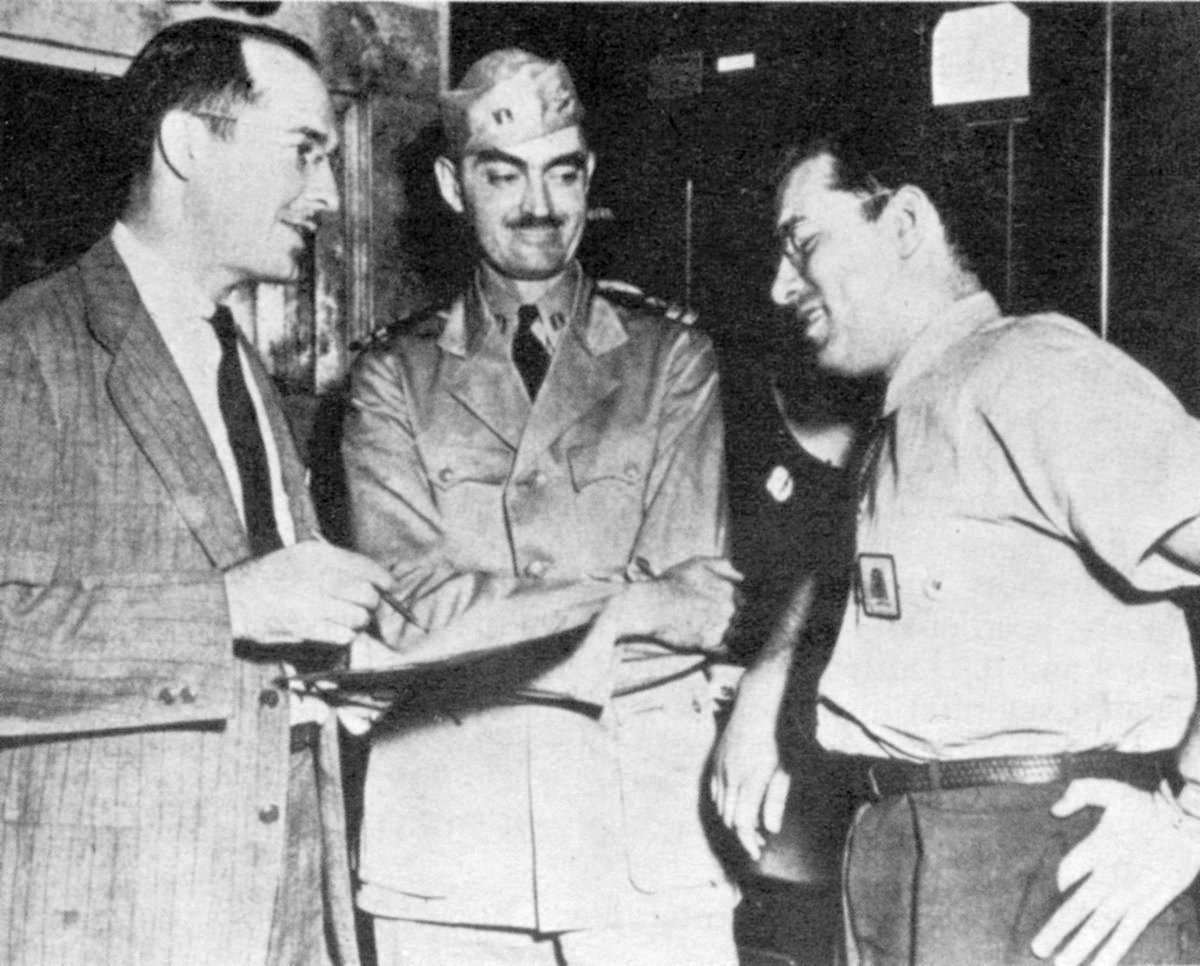
Heinlein’s finest work in the short story was produced in the late 1930s and early ’40s, mainly for the legendary editor of Astounding, John W. Campbell. But by 1948, when this volume opens, “The Roads Must Roll,” “By His Bootstraps, “Gulf” and “Requiem” are behind him. The onetime pulp writer has broken into the Saturday Evening Post and Boy’s Life, married his third (and last) wife, Virginia, and settled in Colorado Springs, where he designs and builds a state-of-the-art automated house. Apart from his occasional involvement with Hollywood, as in scripting Destination Moon, he will devote the rest of his career mainly to novels.
[…]
Like his fascinating but long-winded first volume, the second half of Patterson’s biography is difficult to judge fairly. Packed with facts both trivial and significant, relying heavily on the possibly skewed memories of the author’s widow, and utterly reverent throughout, volume two emphasizes Heinlein the husband, traveler, independent businessman and political activist. Above all, the book celebrates the intense civilization of two that Heinlein and his wife created. There is almost nothing in the way of literary comment or criticism.
Though Heinlein can do no wrong in his biographer’s eyes, if you use yours to look in Patterson’s voluminous endnotes, you will occasionally find confirmation that the writer could be casually cruel as well as admirably generous, at once true to his beliefs and unpleasantly narrow-minded and inflexible about them. Today we would call Heinlein’s convictions libertarian, his personal philosophy grounded in absolute freedom, individual responsibility and an almost religiously inflected patriotism. Heinlein could thus be a confirmed nudist and member of several Sunshine Clubs as well as a grass-roots Barry Goldwater Republican.
For the record, I loved this volume even more than I loved the first one. But Dirda’s comments are fair: Patterson worked hard to present Heinlein in as positive a light as possible, so it’s not unreasonable to suspect that the great man’s character quirks could make him difficult and awkward to deal with at times (to be kind). In the last post, I talked about the adolescent Heinlein as being “probably a pretty toxic individual” and that aspect of his character can still be discerned in the recounting of his later years.