
It is always tempting to look for our roots in ancient Athens … tempting, but wrong. The ancient Athenian “democracy” in the agora was, to be charitable, just mob rule, and the mob was incited, most often bought and paid for, by a series of loud mouthed bullies and celebrities ~ so, I can hear some of you saying, not much different from Canada and the USA in the 21st century, right? Now and again, Thucydides, for example, the loud mouth bully also had some brains and good ideas, but, more often than not they were just unqualified pretty boys and clowns.
The Romans gave us something a wee, tiny bit better: rule by law. But the Romans are, rightfully, often best remembered as engineers and they “engineered”, rigged, their political system to ensure that while there were, indeed, laws, to protect and serve the interests of the common people, the plebeians, the system ensured that no law could stand if it ever threatened the privileges of the patricians ~ Rome’s equivalent of our Laurentian elites.
The first time we find something that I think we can properly claim as a “root” of our, modern, liberal democracy is in Anglo Saxon England where, somewhat haphazardly to be sure, a council, called the Witan, advised and constrained and sometimes even elected the monarch for about 400 years, until the Norman conquest. The Witan (members of the Witenaġemot ~ the “meeting of wise men”) were the first privy council, the prototype of modern, Australian, British and Canadian cabinet government.
Next, in Norman times, came Magna Carta, echoes of which can still be heard in our great common law. Magna Carta itself was not as important as two men who, in their turn, gave it life. King John had no difficulty in persuading the Pope to disallow Magna Carta but the British barons actually went into open revolt and, first, William Marshal, acting as Earl Marshal of England and regent for the boy King Henry III, traded Magna Carta for an independent exchequer, and then Simon de Montfort, acting for the barons against the grown King Henry III, forced Magna Carta and parliamentary supremacy on to England.
Ted Campbell, “Our Conservative Roots”, Ted Campbell’s Point of View, 2017-03-05.
January 22, 2019
QotD: From Athenian democracy to the Magna Carta
December 12, 2018
Why Socrates Hated Democracy
The School of Life
Published on 28 Nov 2016We’re used to thinking hugely well of democracy. But interestingly, one of the wisest people who ever lived, Socrates, had deep suspicions of it.
October 27, 2018
Last Spartans: the survival of Laconic Greek
NativLang
Published on 27 Jan 2017The story of a Greek town that I’m told still preserves the Spartan tongue. I explore why they don’t speak like the rest of Greece and dig into their connection to ancient Sparta. Will their Tsakonian language survive?
Thanks to Vlogbrothers for their sponsorship of this video.
~ CORRECTIONS & ADDITIONS ~
The man from Leonidio is a “headmaster”, not “schoolmaster”. His story and links to the recordings are in my sources doc below.
“hoplos researched” should read “hoplon researched” / “aspis researched” – my thanks to @Roelkonijn
~ SUMMARY ~
Ancient Greece was home to a variety of dialects. Athens and Sparta both put up a major fight. Long story short, the dialect of one of those cities won out. Guess which? Athens, of course. Attic Greek combined with a hefty dose of Ionic to form the Koiné (Common) Greek, the ancestor of basically all modern Greek dialects.
All but perhaps one. Travel to a small town in the south of Greece, where a headmaster leads his students up the hillsides to record the words of their elders. These aging villagers speak Tsakonian (Τσακώνικα), a special remnant that may soon crumble into another Greek artifact.
I look at pieces of the grammar and pronunciation of the language, and show you what sets it apart from Modern Greek. Search for any ancient holdouts it preserves. Consider its connection to the Doric dialect of Ancient Sparta. Finally, ponder its place in modern Greece and how much longer it will be with us.
September 28, 2018
The Death of Socrates
Andrew Heaton
Published on 17 Feb 2017A 100% historically accurate, clinical portrayal of the Death of Socrates.
July 15, 2018
Alcibiades, the Athenian Byron
Not for poetry, but for the Byronian swathe he cut through a large portion of Classical Greece:
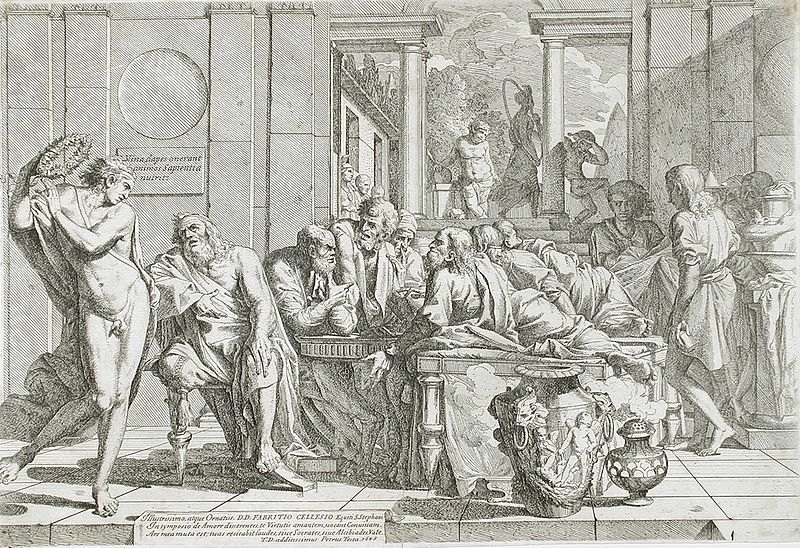
“Drunken Alcibiades interrupting the Symposium”, an engraving from 1648 by Pietro Testa (1611-1650)
Via Wikimedia Commons.
Of all personality traits, charisma is the hardest to appreciate at second hand. We read Cicero’s letters and can instantly tell that he was vain, insecure and ferociously clever; we read scraps of Samuel Johnson’s conversation in Boswell’s biography and know at once that he was magnificent, lovable and desperately unhappy. But as to what it was like to have Lord Byron turn the full force of his attention onto you – well, we have no conceivable way of knowing. We just have to trust his contemporaries that it felt like ‘the opening of the gate of heaven’.
This causes problems for a biographer of Alcibiades. On the face of it, the man was utterly insufferable. Born in around 450 BC into one of the oldest and richest families of ancient Athens, Alcibiades was the only Old Etonian (as it were) to play a leading role in the late-fifth-century radical democracy. The account of his childhood in Plutarch’s Life of Alcibiades suggests a bad case of antisocial personality disorder: biting during wrestling, mutilating dogs, punching his future father-in-law in the face for a dare. His later political career makes Boris Johnson seem like a man of firm and unbending principle. Exiled from Athens in 415 BC over some particularly odious Bullingdon Club antics, Alcibiades promptly sold his services to Sparta (where he seduced the king’s wife) before double-crossing both sides and wheedling his way into the court of a Persian satrap.
But Alcibiades, like Byron, clearly had that indefinable something. One catches a glimpse of it in the unforgettable last scene of Plato’s Symposium, when he crashes into the room, blind drunk, flirting with everything on legs, shouting about his love for Socrates. Thucydides captures it in his report of Alcibiades’s speech whipping up the Athenian assembly to vote for the disastrous Sicilian expedition of 415 BC – an extraordinary stew of egotistic bragging (about how successful his racehorses are), mendacious demagoguery and brilliantly acute strategic thinking. The unwashed Athenian masses, not usually prone to atavistic toff-grovelling, absolutely adored him: when Alcibiades finally returned to Athens in 407 BC after eight years of exile, sailing coolly into Piraeus on a ship with purple sails, they welcomed him back with paroxysms of joy.
Behind the Peloponnese-sized ego, Alcibiades was a general of spectacular genius – when he could be bothered. In 410 BC, shortly after his controversial reinstatement as admiral of the Athenian navy (on the back of a bogus promise of Persian support), he wiped out the entire Spartan fleet at the Battle of Cyzicus; two years later, through sheer chutzpah, he captured the city of Selymbria near Byzantium with only fifty soldiers, and without striking a blow. When things went wrong – as in 406 BC, after a disastrous campaigning season in the eastern Aegean – he showed an infuriating ability to wriggle out of trouble. His final years (406–404 BC) were spent once again in exile from Athens, holed up in a private castle on the Gallipoli peninsula. The circumstances of his death are still shrouded in mystery. One story tells that he died in the remote mountains of central Turkey at the hands of the brothers of a Phrygian noblewoman whom he had decided to seduce. This is, I fear, all too believable.
This is the introduction to a review by Peter Thonemann of a new biography of Alcibiades by David Stuttard in the Literary Review for July, 2018. H/T to Never Yet Melted for the link.
June 9, 2018
Thermopylae – The Hellenic Alliance – Extra History – #1
Extra Credits
Published on 7 Jun 2018A small handful of Grecian city-states have come together to stand off against the invading Persians at Thermopylae. At this fateful mountain pass, Greece will discover its identity as a nation.
The Battle of Thermopylae is one of the most significant events in the ancient world — and also one of the least understood.
Brought to you by Total War: Arena! Use the code HOPLITE for extra goodies:
https://totalwararena.net/join/4064_EN1…
March 25, 2018
The appearance of wealth
Victor Davis Hanson on how the wealthy once were eager to appear as distinct from the common herd as possible:
Even in the mostly egalitarian city-states of relatively poor classical Greece, the wealthy were readily identifiable. A man of privilege was easy to spot by his remarkable possession of a horse, the fine quality of his tunic, or by his mastery of Greek syntax and vocabulary.
An anonymous and irascible Athenian author — dubbed “The Old Oligarch” by the nineteenth-century British classicist Gilbert Murray — wrote a bitter diatribe known as “The Constitution of the Athenians.” The harangue, composed in the late fifth century B.C., blasted the liberal politics and culture of Athens. The grouchy elitist complained that poor people in Athens don’t get out of the way of rich people. He was angry that only in radically democratic imperial Athens was it hard to calibrate a man by his mere appearance: “You would often hit an Athenian citizen by mistake on the assumption that he was a slave. For the people there are no better dressed than the slaves and metics, nor are they any more handsome.”
The Old Oligarch’s essay reveals an ancient truth about privilege and status. Throughout history, the elite in most of the Western world were easy to distinguish. Visible class distinctions characterized ancient Rome, Renaissance Florence, the Paris of the nineteenth century, and the major cities of twentieth century America.
A variety of recent social trends and revolutionary economic breakthroughs have blurred the line separating the elite from the masses.
First, the cultural revolution of the 1960s made it cool for everyone to dress sloppily and to talk with slang and profanity. Levis, T-shirts, and sneakers became the hip American uniform, a way of superficially equalizing the unequal. Contrived informality radiated the veneer of class solidarity. Multimillionaires like Bruce Springsteen and Bono appear indistinguishable from welders on the street.
The locus classicus is perhaps Facebook owner Mark Zuckerberg, who wears T-shirts, jeans, and flip flops to work. His reported wealth of $71 billion makes him the world’s fifth-richest man. The median net worth of Americans is about $45,000. Zuckerberg is worth more than the collective wealth of about 1.5 million Americans — or about all the household wealth in Philadelphia put together. And yet, he looks perfectly ordinary. When I walk the Stanford campus — where many of the world’s wealthiest send their children — the son of a Silicon Valley billionaire looks no different from a machinist’s daughter on full support from Akron.
Second, technology has done its part to dilute superficial class distinctions. The nineteenth-century gap between a rich man in his fine carriage — with footman and driver — and someone walking three miles to work has disappeared. The driving experience between a $20,000 Kia bought on credit with $1,000 down and a $80,0000 Mercedes paid in cash is mostly reduced to the superficial logo on the hood and trunk. An alien from Mars could not easily distinguish, at least by sight, between the two cars. Even after a ten-minute ride, an alien might be puzzled: What exactly did that extra $60,000 buy?
August 24, 2017
The Story of Western Philosophy
Published on 26 May 2017
Relevant mystery link: https://youtu.be/myc7eHGg5y4
If you notice any factual errors in this week’s video, please just bear in mind that life is ultimately meaningless in the first place.
August 20, 2017
Thucydides again
David Warren found a dip into Thucydides was at least as informative on political issues today as any current “reporting”:
What a week it has been, at least in the yellow world of journalism and politics. I have had nothing new to say on anything — at least I hope to have said nothing new, for my intention in commenting on passing events is simply to repeat the old gnomes which they freshly illustrate. Thucydides, into whose works I privately dipped last Tuesday, was as up-to-date as anything I found “breaking” on the Internet.
Consider, for instance, the career of the Athenian general (then Spartan, then Persian, then Athenian again), Alcibiades — more sinned against than sinning, and more sinning than sinned against, by turns. A large man, persistently underridden by the mean and small; a hero and no saint. Loved to the point of worship by the crowds; hated by the umbrous, to the point of madness; and always “in the news.”
A polarizing figure, as we’d say today; who, for his impieties, was finally run down by a mob. They set fire to the cottage where he’d retired with his mistress. (The Spartans commissioned the mob by one account; the young lady’s parents by another.) Boldly emerging from the flames to confront the whole tribe of his adversaries, he died in a hail of arrows. The gods let only Stalin die in his sleep. (Or so we thought until we got more information.)
May 16, 2017
11 Things to see in Athens
Published on 5 Mar 2017
On February i got a few days away to relax from everything. I left you with some automatic videos, so you wouldn’t be without new documentaries and i went on holiday to Athens, Greece. I wanted to share a little bit about what i saw. This video is the first video made by me. (Be good, please!)
October 20, 2016
Sea power and land power
At Samizdata, Brian Micklethwait has an interesting essay, including this discussion of the historical differences between naval and land powers (Athens and Sparta, Greece and Persia, Britain and France, etc.) and an insight into the odd growth pattern of the British empire after the introduction of steam power:
This contrast, between seafaring and land-based powers, has dominated political and military history, both ancient and modern. Conflicts like that between Athens and Sparta, and then between all of Greece and Persia, and the later conflicts between the British – before, during and since the time of the British Empire – and the succession of land-based continental powers whom we British have quarrelled with over the centuries, have shaped the entire world. Such differences in political mentality continue to matter a lot.
Throughout most of modern human history, despots could completely command the land, including all inland waterways. but they could not command the oceans nearly so completely. Wherever the resources found in the oceans or out there beyond them loomed large in the life and the economy of a country or empire, there was likely to be a certain sort of political atmosphere. In places where the land and its productivity counted for pretty much everything, and where all communications were land-based, a very different political atmosphere prevailed.
You see this contrast in the difficulties that Napoleon had when squaring up to the British, and to the British Royal Navy. Napoleon planned his land campaigns in minute detail, like a chess grandmaster, and he played most of his military chess games on a board that could be depended on to behave itself. But you couldn’t plan a sea-based campaign in this way, because the sea had a mind of its own. You couldn’t march ships across the sea the way you can march men across a parade ground, or a continent. At sea, the man on the spot had to be allowed to improvise, to have a mind of his own. He had to be able to exercise initiative, in accordance with overall strategic guidance, yes, but based on his own understanding of the particular circumstances he faced. There was no tyranny like that of the captain of a ship, when it was at sea. But sea-based powers had many ships, so navies (particularly merchant navies), by their nature dispersed power. In a true political tyranny, there can be only one tyrant.
More fundamentally, the sea provided freedom, because it provided an abundance of places to escape to, should the tyranny of a would-be tyrant become too irksome and life-threatening. Coastal communities had other sources of wealth and power besides those derived from inland, and could hide in their boats from tyrants. Drive a sea captain and his crew mad with hatred for you and for your tyrannical commands and demands, and he and his ship might just disappear over the horizon and never be seen again. Good luck trying to capture him. If you did seriously attempt this, you would need other equally strong-minded and improvisationally adept sea captains whom you had managed to keep on your side, willing to do your bidding even when they were far beyond the reach of your direct power. One way or another, your tyranny ebbed away.
Other kinds of tyranny, or the more puritanical sort, were also typically made a nonsense of by seagoing folk, whenever they enjoyed a spot of shore leave.
[…]
The development of mechanically powered ships, since Napoleon’s time, served to make the deployment of ships at sea a lot more like marching them about on a parade ground. First, the significance of the wind and its often unpredictable direction is pretty much negated. And mechanically powered ships are also, especially in the days of coal power, much more dependent upon land-based installations, the arrangement of which demanded Napoleonic logistical virtuosity. Much of late British imperial politics only makes sense if you factor in the compelling need for coaling stations to feed ships. Sailing ships don’t run out of fuel. Modern ships do.
May 29, 2016
QotD: Re-evaluating Athenian democracy
Ancient critics of Athenian democracy, such as Plato and Thucydides, argued that the state was dysfunctional because the citizens who ruled it through direct democracy were often too ignorant and irrational to make good decisions. For example, Thucydides claimed that Athens launched the disastrous Sicilian expedition, which led to the fall of the Athenian Empire, because the ignorant citizens had no idea how large and populous the island of Sicily was, and thus were easily snookered by demagoguery in favor of the ill-advised high-risk venture.
For centuries, critics of democracy pointed to Athens as a prime example of why the ignorant masses should be barred from wielding political power, especially directly. These critiques of Athens had a major impact on the American Founding Fathers. They were a key factor leading them to include a number of anti-democratic features in our Constitution.
The good news is that modern scholarship suggests that Athenian voters were more knowledgeable and did a much better job of making decisions than the longstanding conventional wisdom supposes. The bad news is that ancient Athenian citizens could avoid some of the pitfalls of ignorance in part because they had important advantages that voters in modern democracies mostly lack. Relative to modern counterparts, ancient Athenian voters dealt with a government with a much narrower range of functions, had far stronger incentives to acquire relevant knowledge, and often had direct personal experience with the most important functions of the state, which made it easier for them to assess leaders’ performance. I summarized these points in greater detail in this review essay. While ancient Athenian democracy did a better job of surmounting political ignorance than it is often given credit for, some of the reasons for its relative success should lead us to be more rather than less concerned about the enormous extent of political ignorance today. Jonathan Gruber’s assessment of the American voter may be more accurate than Thucydides’ take on ancient Athens.
It’s also worth remembering that, by modern standards, Athens was closer to being a narrow oligarchy than a democracy. Because women, slaves, and the city’s large population of resident noncitizens were excluded from the franchise, only a small fraction of the adult population actually got to participate in politics (though still a much larger one than in most other ancient states). Athens’ enemies often saw it as a nightmare of democratic egalitarianism run amok. But that was because their own oligarchies were far narrower still.
Ilya Somin, “The modern case for studying ancient Athenian democracy”, The Volokh Conspiracy, 2015-01-30.
April 28, 2016
Wargaming at the Marine Corps War College
Professor James Lacey explains why he introduced commercial wargames into his curriculum for USMC officers at the war college:
As every team plotted their strategic “ends,” students soon realized that neither side had the resources — “means” — to do everything they wanted. Strategic decisions quickly became a matter of tradeoffs, as the competitors struggled to find the “ways” to secure sufficient “means” to achieve their objectives (“ends”). For the first time, students were able to examine the strategic options of the Peloponnesian War within the strictures that limited the actual participants in that struggle.
Remarkably, four of the five Athenian teams actually attacked Syracuse on Sicily’s east coast! As they were all aware that such a course had led to an Athenian disaster 2,500 years before, I queried them about their decision. Their replies were the same: Each had noted that the Persians were stirring, which meant there was a growing threat to Athens’ supply of wheat from the Black Sea. As there was an abundance of wheat near Syracuse, each Athenian team decided to secure it as a second food source (and simultaneously deny it to Sparta and its allies) in the event the wheat from the Black Sea was lost to them. Along the way, two of the teams secured Pylos so as to raise helot revolts that would damage the Spartan breadbasket. Two of the teams also ended revolts in Corcyra, which secured that island’s fleet for Athenian purposes, and had the practical effect of blockading Corinth. So, it turns out there were a number of good strategic reasons for Athens to attack Syracuse. Who knew? Certainly not any War College graduate over the past few decades.
All of these courses of action were thoroughly discussed by each team, as were Spartan counter moves. For the first time in my six years at the Marine Corps War College, I was convinced that the students actually understood the range of strategies and options Thucydides wrote about. In the following days, I was stopped dozens of times by students who wanted discuss other options they might have employed, and, even better, to compare their decisions to what actually happened. A number of students told me they were still thinking about various options and decisions weeks later. I assure you that no one even spent even a car ride home thinking about my Thucydides lectures.
[…]
At the end of each wargame, students walked away with a new appreciation of the historical circumstances of the period and the events they had read about and discussed in class. And even though all wargames are an abstract of actual events, I am sure that no student exposed to historical gaming will ever again read about the Peloponnesian War without thinking about Sicily’s wheat, the crucial importance of holding the Isthmus of Corinth, or what could have been done with a bit more Persian silver in the coffers of one side or the other’s treasury. Similarly, the next time one of this year’s students reads about Lee and Grant in 1864, they will also be thinking about how the truly decisive actions took place out west. For, as it was during the actual conflict, in every game the students played, Grant’s role was to pin down the Army of Northern Virginia, while the western armies ripped out the economic heart of the Confederacy.
In fact, I was astounded at the number of students who approached me after the Civil War exercise to mention that despite having studied the Civil War before, this was the first time they realized that the war was won in the west. I could go on for another few thousand words discussing other revelations students experienced through gaming and simulations, but the key point is that these experiential learning experiences linger in students’ minds for a very long time. I once asked my seminars how many of them had discussed the games and their results with their spouses. Every hand went up. I am quite sure that very few of them ever discussed one of my lectures with their spouses.
September 21, 2015
Greek businesses discover the receipt
Megan McArdle is in Athens, where she’s finding that Greek businesses have started handing out receipts for transactions that once would have been undocumented (the better to hide revenue from the taxman):
I was last in Greece in 2006, during the twilight years of the boom that peaked during the Athens Olympics. Back then, Greece was notable to Americans for its lack of receipts. This is convenient for the shoppers, who don’t have to hunt around for somewhere to toss yet another piece of unwanted paper. But it was also convenient for vendors who wanted to underpay the tax authorities.
The inability of the Greek government to collect the taxes it is owed is one of the recurring themes of coverage of the financial crisis. This problem is sometimes exaggerated, but everyone agrees that it’s very real. And since the burden of structural adjustment is falling on fiscal reforms — rather than, say, firing unproductive members of the vast government workforce — that’s a big problem.
Widespread evasion narrows the tax base, forcing the government to set higher rates. If the evasion were spread evenly across all sectors of the economy, then these two things would roughly cancel out. Unfortunately, it’s not. Some sorts of taxes are easier to evade than others. Employment taxes are hard to evade, while self-employed professionals like doctors and lawyers have found it relatively easy to shelter most of their incomes. As a result, the cost of employing a new staff worker is quite high (especially since those workers are incredibly difficult to fire). The value-added tax here is now 23 percent, close to the EU maximum rate. (Thank God for that maximum, joked one journalist I met; otherwise, who knows how high they’d have raised it.) That’s making up for taxes that aren’t collected elsewhere.
The good news is that Greece has at least made progress on collecting sales tax. They’re hardly at the level that our Internal Revenue Service would accept, but most of the places I’ve gone have automatically given me a receipt, printed out by a cash register. The taxi drivers mostly offer printed receipts. One did ask me how much he should make it out for. (Note to boss: I told him to make it out for the amount of the fare.) I’m told that on the islands, collection is less sure. But here in Athens, they are slowly but surely improving their collection apparatus.
Greece is attempting to do in the space of a few years what other economies did over the course of decades. Most people think of a cash register primarily as a way to add up the value of the sale, but in fact, that is the least of its functions. Its most attractive feature to the merchants who adopted them back in the late 19th century was that they made it harder for clerks to steal. (That’s why old registers made a noise every time the cash drawer opened; that prevented employees from stealthily recording sales and then pocketing the money, or alternatively, giving goods to their friends without being paid.) Over time, of course, revenue authorities realized that cash register tickers were also a good way to ensure that employers gave the state its due.
November 22, 2014
What Thucydides can teach us about fighting ebola
In The Diplomat, James R. Holmes says that we can learn a lot about fighting infectious diseases like ebola by reading what Thucidides wrote about the plague that struck Athens during the opening stages of the Peloponnesian War:
Two panelists from our new partner institution, a pair of Africa hands, offered some striking reflections on the fight against Ebola.
Their presentations put in me in the mind of … classical Greece. Why? Mainly because of Thucydides. Thucydides’ history of the Peloponnesian War isn’t just a (partly) eyewitness account of a bloodletting from antiquity; it’s the Good Book of politics and strategy. Undergraduates at Georgia used to look skeptical when I told them they could learn ninety percent of what they needed to know about bareknuckles competition from Thucydides. The remainder? Technology, tactics, and other ephemera. Thucydides remains a go-to source on the human factor in diplomacy and warfare.
But I digress. Ancient Greece suffered its own Ebola outbreak, a mysterious plague that struck Athens oversea during the early stages of the conflict. And the malady struck, perchance, at precisely the worst moment for Athens, after “first citizen” Pericles had arranged for the entire populace of Attica, the Athenian hinterland, to withdraw within the city walls. The idea was to hold the fearsome Spartan infantry at bay with fixed fortifications while the Athenian navy raided around the perimeter of the Spartan alliance.
[…]
That’s where the parallel between then and now becomes poignant. Thucydides notes, for example, that doctors died “most thickly” from the plague. The Brown presenters noted that, likewise, public-health workers in Africa — doctors, nurses, stretcher-bearers — are among the few to deliberately make close contact with the stricken. Relief teams, consequently, take extravagant precautions to quarantine the disease within makeshift facilities while shielding themselves from contagion. Sometimes these measures fail.
Now as in ancient Greece, furthermore, the prospect of disease and death deters some would-be healers altogether from succoring the afflicted. Selflessness has limits. Some understandably remain aloof — today as in Athens of yesteryear.
Teams assigned to bury the slain also find themselves in dire peril. Perversely, the dead from Ebola are more contagious than living hosts. That makes disposing of bodies in sanitary fashion a top priority. As the plague ravaged Athens, similarly, corpses piled up in the streets. No one would perform funeral rites — even in this deeply religious society. Classicist Victor Davis Hanson ascribes some of Athens’ barbarous practices late in the war — such as cutting off the hands of captured enemy seamen to keep them from returning to war — in part to the plague’s debasing impact on morals, ethics, and religion.


