
World War Two
Published 7 Jun 2022The thousand-bomber offensive was about to begin as Air-Marshall Harris was assembling his forces. Yet one man was to challenge his strategy. The aircraft designer Barnes Wallis thought: “What if there was a way to destroy Germany’s industrial might not by simply dropping thousands of bombs over its cities, but by a precision strike against its dams?” For this, a new kind of bouncing bomb was to be delivered.
(more…)
June 8, 2022
The Story Behind the Dambuster Raid – WW2 Special
Comments Off on The Story Behind the Dambuster Raid – WW2 Special
May 30, 2022
The Deadliest Job in World War Two – WAH 062 – May 29, 1943
World War Two
Published 29 May 2022Arthur Harris and the RAF set another record in bombing Germany, and the outnumbered Yugoslav Partisans show the Axis that numbers mean little when you’re clever.
(more…)
Comments Off on The Deadliest Job in World War Two – WAH 062 – May 29, 1943
May 16, 2022
Heaviest Air Raid in Human History – WAH 060 – May 15, 1943
World War Two
Published 15 May 2022As the Warsaw Ghetto Uprising is being quashed, there are renewed Japanese atrocities in China, and the RAF sets a world record by bombing German civilians.
(more…)
Comments Off on Heaviest Air Raid in Human History – WAH 060 – May 15, 1943
May 4, 2022
Allies on Amphetamines – WW2 Special
World War Two
Published 3 May 2022We’ve heard how German forces are fuelled by stimulants like Pervitin. But are the Allies doing the same thing? Of course! Their drug of choice is Benzedrine. It’s in use as the RAF bomb German cities, as Monty’s tanks push Rommel back, and as US Marines take the fight to the Japanese.
(more…)
Comments Off on Allies on Amphetamines – WW2 Special
April 24, 2022
Ladies and Gentlemen, We Got Him – Yamamoto – WW2 – 191 – April 23, 1943
World War Two
Published 23 Apr 2022The mastermind of Pearl Harbor meets his fate this week in the Solomons, as do a great many Italian airmen and sailors in the Mediterranean in the Palm Sunday Massacre trying to supply the desperate Axis forces in Tunisia.
(more…)
Comments Off on Ladies and Gentlemen, We Got Him – Yamamoto – WW2 – 191 – April 23, 1943
April 15, 2022
Look at Life – Thunder in Waiting (1960)
PauliosVids
Published 20 Nov 2018The deadly cargo of the Vulcan Bomber is a crucial part of Britain’s deterrent force.
Comments Off on Look at Life – Thunder in Waiting (1960)
April 5, 2022
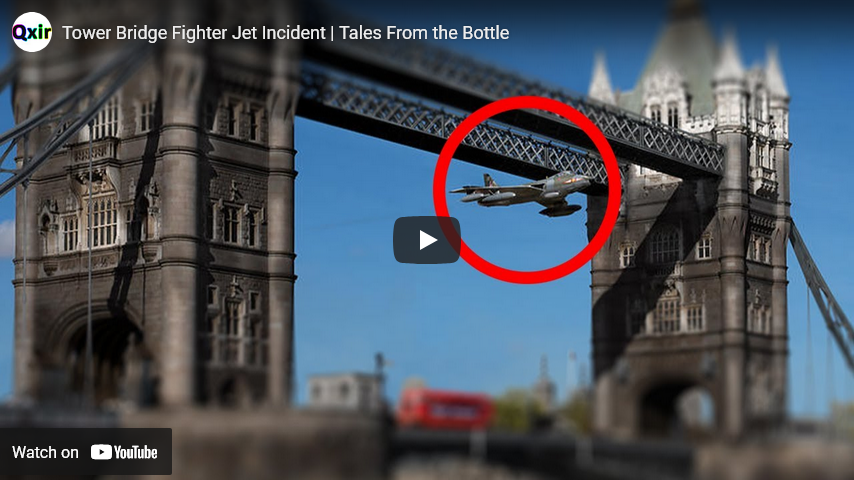
Tower Bridge Fighter Jet Incident | Tales From the Bottle
Qxir
Published 26 Nov 2021This jet pilot decided to stage a protest in the skies of London, but his actions became more well known for an incident that occurred on his journey home.
“The Hawker Hunter Tower Bridge incident occurred on 5 April 1968 when Royal Air Force (RAF) Hawker Hunter pilot Alan Pollock performed unauthorised low flying over several London landmarks and then flew through the span of Tower Bridge on the Thames. His actions were to mark the 50th anniversary of the founding of the RAF and as a demonstration against the Ministry of Defence for not recognising it.
Upon landing he was arrested and later invalided out of the RAF on medical grounds, which avoided a court martial.”
More on Wikipedia:
https://en.wikipedia.org/wiki/Hawker_…Merch: teespring.com/stores/qxir
Patreon: https://www.patreon.com/qxir
Twitter: https://twitter.com/QxirYT
Discord: https://discord.gg/jZzvvwJ
Twitch: https://www.twitch.tv/qxiryt/
Subreddit: https://www.reddit.com/r/Qxir/
From the comments:
Qxir
3 weeks ago (edited)
Yes, I know it’s pronounced “Tems” lol
Comments Off on Tower Bridge Fighter Jet Incident | Tales From the Bottle
February 24, 2022
Got Wood? – The de Havilland Mosquito
World War Two
Published 23 Feb 2022What if there was a plane that the enemy could neither catch nor reach? One that fully relied on speed instead of defensive armaments? The de Havilland DH.98 Mosquito was the first multi-role aircraft developed during World War Two. Made mostly out of wood, the “Wooden Wonder” could be easily converted into different roles — a fighter, a fighter-bomber, a bomber, and a reconnaissance aircraft.
(more…)
Comments Off on Got Wood? – The de Havilland Mosquito
February 15, 2022
Krieghoff: Lugers for the Luftwaffe
Forgotten Weapons
Published 20 Oct 2021http://www.patreon.com/ForgottenWeapons
https://www.floatplane.com/channel/Fo…
Cool Forgotten Weapons merch! http://shop.forgottenweapons.com
One of the scarce, small-production manufacturers of the Luger is Krieghoff — Heinrich Krieghoff to be exact. Kreighoff Waffenfabrik was a smallish arms company that wanted to get into major contracts with the rearming German military in the 1930s. They began by bidding on a contract for 10,000 Luger pistols for the Luftwaffe, and won. Krieghoff had previously worked as a subcontractor for the Simson company rebuilding Lugers under the Weimar government. Kreighoff got control of the Simson Luger tooling, and used it to manufacture a new set themselves.
Krieghoff built a total of 13,825 Luger pistols. The first 10,000 were delivered to the Luftwaffe between 1935 and 1937. A further 2,000 were delivered in small batches between 1940 and 1944, with a final 200 in 1945. In addition to these, 1,625 were sold commercially, including a few highly embellished examples. They are renowned for their excellent quality, and have always attracted particular collector interest.
Contact:
Forgotten Weapons
6281 N. Oracle 36270
Tucson, AZ 85740

Comments Off on Krieghoff: Lugers for the Luftwaffe
December 19, 2021
Canada’s almost functional flying saucer; the story of the Avro Canada VZ-9 Avrocar
Polyus Studios
Published 14 Jul 2018Support me on Patreon – https://www.patreon.com/polyusstudios
The Avro Canada VZ-9AV Avrocar: Canada’s first attempt at vertical take off and landing aircraft. Although the concept ultimately turned out to be a dead-end, the engineers and designers at Avro experimented with bold new ideas. Their concepts would push the limits of the imagination and reflected the extreme technological optimism of its time.
Music:
Denmark – Portland Cello ProjectResearch Sources:
“Declassified: America’s Secret Flying Saucer” – https://www.popularmechanics.com/mili…
Avro Canada VZ-9 Avrocar – https://www.aviationsmilitaires.net/v…
Avrocar: Canada’s Flying Saucer: The Story of Avro Canada’s Secret Projects by Bill Zuk (2001)
How to Build a FLYING SAUCER – https://declassification.blogs.archiv…
LaesieWorks – AVROCAR VZ-9AV – http://www.laesieworks.com/ifo/lib/AV…
The Living Moon – Project Silverbug – The Avrocar – http://www.thelivingmoon.com/49ufo_fi…Footage Sources:
Avrocar I Progress Report 01/02/1958 – 05/1959 – US National Archives (~1959)
Disc Flight Development, Avrocar I Progress Report, 05/02/1959 – 04/12/1960 – US National Archives (~1960)
Avrocar Continuation Test Program and Terrain Test Program, 06/01/1960 – 06/14/1961 – US National Archives (~1959)
Tiltwing Versatility – San Diego Air and Space Museum (~1971)Aircraft mentioned:
Project Y
Project Y-2
Project PV 704
Project 1794
Project Silverbug
Weapon System 606A
VZ-9AV Avrocar
CL-84 Dynavert#Avrocar #CanadianAerospace #Polyus

Comments Off on Canada’s almost functional flying saucer; the story of the Avro Canada VZ-9 Avrocar
December 16, 2021
Supersonic Firsts
The History Guy: History Deserves to Be Remembered
Published 20 Aug 2021On August 20, 1955, United States Air Force Colonel Horace A Hanes set the world’s first supersonic world speed record in a North American Aviation F-100C Super Sabre. Although we are well into the supersonic age, aircraft that can exceed the speed of sound are still rare machines, and marvels of engineering and pilot prowess. The early aviation pioneers who tested the terrifying sound barrier have helped scientists better understand the dynamics of superfast speeds.
This is original content based on research by The History Guy. Images in the Public Domain are carefully selected and provide illustration. As very few images of the actual event are available in the Public Domain, images of similar objects and events are used for illustration.
You can purchase the bow tie worn in this episode at The Tie Bar:
https://www.thetiebar.com/?utm_campai…All events are portrayed in historical context and for educational purposes. No images or content are primarily intended to shock and disgust. Those who do not learn from history are doomed to repeat it. Non censuram.
Find The History Guy at:
Patreon: https://www.patreon.com/TheHistoryGuy
Please send suggestions for future episodes: Suggestions@TheHistoryGuy.netThe History Guy: History Deserves to Be Remembered is the place to find short snippets of forgotten history from five to fifteen minutes long. If you like history too, this is the channel for you.
Awesome The History Guy merchandise is available at:
teespring.com/stores/the-history-guyScript by THG
#history #thehistoryguy #airforce

Comments Off on Supersonic Firsts
November 28, 2021
A bit of perspective on the loss of the British F-35 from HMS Queen Elizabeth
At the Thin Pinstriped Line, Sir Humphrey offers a bit of historical perspective on peacetime aircraft losses:
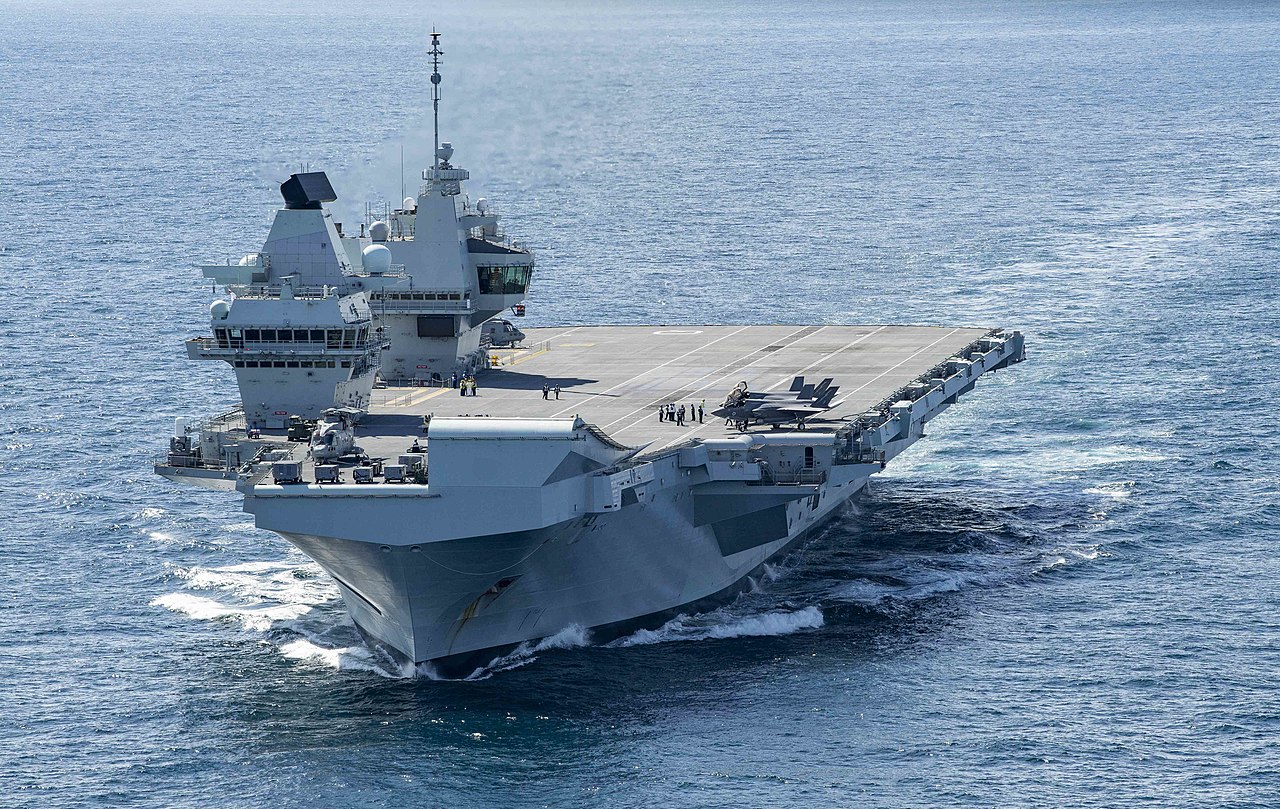
Royal Navy aircraft carrier HMS Queen Elizabeth (R08) underway in the Atlantic on 17 October 2019, participating in exercise “WESTLANT 19”.
Photo by Mass Communication Specialist 3rd Class Nathan T. Beard, US Navy, via Wikimedia Commons.
If you look at historical data, then it shows that for decades, flying fast jets was an exceptionally dangerous occupation. In 1956 the RAF lost six Hawker Hunter aircraft in the space of just 45 minutes. These were just six of no less than 380 British military aircraft and helicopters lost in 1956, which averages out at more than one aircraft lost every day of the year – and this was not an unusual year.
Fast jet flying is and always has been an extremely dangerous business, which requires the highest levels of safety, standards and training to carry out. Over the intervening decades there has been a general decline in losses due to changes in equipment, reliability of machinery and different ways of operating, particularly with new technology, but there is still an element of risk. In particular the Martin Baker ejection seat is worth mentioning – this incident reminds us of the many lives this British company is responsible for saving over many decades.
Carrier aviation in particular remains an extremely dangerous occupation, even if crash rates have dropped. It is important to understand that the combination of fast jets, large warships and complex operating conditions can, and do, sometimes go wrong. We must not assume that aircraft will not crash anymore.
The Wikipedia page covering military aviation accidents for the period 2010-2019 is a good read to understand how risky military aviation is, and how many aircraft have been lost globally during this period.
That said, the current crop of modern British fast jets like the F35 and Typhoon have a phenomenal safety record, being operated in hugely demanding conditions around the globe for many years, and with only a handful lost. It is very telling that the loss of an aircraft is something that has gone from the utterly routine and barely newsworthy, to something that can dominate the media cycle for several days and generate huge national media coverage.
The theme on social media has been peculiar — there have been many posters talking about how embarrassing it is for the UK, or that its somehow a national disgrace that the aircraft crashed, particularly with the US embarked as well. This is utter nonsense – there is no embarrassment in a pilot taking a decision to eject in order to save his life. That is absolutely the right thing to do, and anyone who thinks otherwise has clearly never been faced with the decision on whether to eject or not.
There has been some coverage suggesting that the F35 programme is troubled in some way and that this is a setback for it. Again, this is nonsense – the aircraft first flew 15 years ago, and well over 700 have now been produced flying over 400,000 flying hours. In this time, a total of 5 aircraft (3 American, 1 Japanese and 1 British) have been lost – this is an under 1% loss rate, or one aircraft lost for every 80,000 hours in the sky.
By way of contrast, the Sea Vixen, a British jet used for carrier operations was in service from 1959-1971. Of the 145 aircraft built and operated, no less than 55 were lost in accidents in this period – a loss rate of around 38% of the whole force in just 12 years.
Comments Off on A bit of perspective on the loss of the British F-35 from HMS Queen Elizabeth
November 26, 2021
Look at Life — Air Umbrella (1961)
PauliosVids
Published 20 Nov 2018A look at NATO’s international squadrons, with footage of the F104 Starfighter.

Comments Off on Look at Life — Air Umbrella (1961)
November 12, 2021
Britain’s Highly Unusual Crescent-Wing Victor Bomber
Dark Skies
Published 2 Nov 2021The V force was a legendary team of bombers built to serve during the post-war crisis. However, they would not carry ordinary bombs, but nuclear weapons.
As World War II ended, the division between the West and the East became a significant threat to world peace, and shortly before the Cold War began, Britain started working on a modern jet bomber force that could rival any other on the planet.
The Handley Page Victor featured a one-of-kind wing, making it the largest aircraft to break the sound barrier up to that point.
As the British mastered the atomic bomb by the mid-1950s with the exceptional V force and the Victor to deliver it, Britain’s stature among the world’s superpowers significantly solidified.
—
Join Dark Skies as we explore the world of aviation with cinematic short documentaries featuring the biggest and fastest airplanes ever built, top-secret military projects, and classified missions with hidden untold true stories. Including US, German, and Soviet warplanes, along with aircraft developments that took place during World War I, World War 2, the Korean War, the Vietnam War, the Cold War, the Gulf War, and special operations missions in between.
As images and footage of actual events are not always available, Dark Skies sometimes utilizes similar historical images and footage for dramatic effect and soundtracks for emotional impact. We do our best to keep it as visually accurate as possible.
All content on Dark Skies is researched, produced, and presented in historical context for educational purposes. We are history enthusiasts and are not always experts in some areas, so please don’t hesitate to reach out to us with corrections, additional information, or new ideas.

Comments Off on Britain’s Highly Unusual Crescent-Wing Victor Bomber
November 11, 2021
In memoriam
A simple recognition of some of our family members who served in the First and Second World Wars:
The Great War
 Private William Penman, Scots Guards, died 16 May, 1915 at Le Touret, age 25
(Elizabeth’s great uncle)- Private Archibald Turner Mulholland, Argyll & Sutherland Highlanders, mortally wounded 25 September, 1915 at Loos, age 27
(Elizabeth’s great uncle) - Private David Buller, Highland Light Infantry, died 21 October, 1915 at Loos, age 35
(Elizabeth’s great grandfather) - Private Harold Edgar Brand, East Yorkshire Regiment. died 4 June, 1917 at Tournai.
(My first cousin, three times removed) - Private Walter Porteous, Durham Light Infantry, died 4 October, 1917 at Passchendaele, age 18
(my great uncle) - Corporal John Mulholland, Argyll & Sutherland Highlanders, wounded 2 September, 1914 (shortly before the First Battle of the Aisne), wounded again 29 June, 1918, lived through the war.
(Elizabeth’s great uncle)
The Second World War
- Flying Officer Richard Porteous, RAF, survived the defeat in Malaya and lived through the war
(my great uncle) - Able Seaman John Penman, RN, served in the Defensively Equipped Merchant fleet on the Murmansk Run (and other convoy routes), lived through the war
(Elizabeth’s father) - Private Archie Black (commissioned after the war and retired as a Major), Gordon Highlanders, captured at Singapore (aged 15) and survived a Japanese POW camp
(Elizabeth’s uncle) - Elizabeth Buller, “Lumberjill” in the Women’s Land Army in Scotland through the war.
(Elizabeth’s mother) - Trooper Leslie Taplan Russon, 3rd Royal Tank Regiment, died at Tobruk, 19 December, 1942 (aged 23).
Leslie was my father’s first cousin, once removed (and therefore my first cousin, twice removed).
For the curious, the Commonwealth War Graves Commission the Royal British Legion, and the Library and Archives Canada WW1 and WW2 records site provide search engines you can use to look up your family name. The RBL’s Every One Remembered site shows you everyone who died in the Great War in British or Empire service (Canadians, Australians, New Zealanders, South Africans and other Imperial countries). The CWGC site also includes those who died in the Second World War. Library and Archives Canada allows searches of the Canadian Expeditionary Force and the Royal Newfoundland Regiment for all who served during WW1, and including those who volunteered for the CEF but were not accepted.
In Flanders fields the poppies blow
Between the crosses row on row,
That mark our place; and in the sky
The larks, still bravely singing, fly
Scarce heard amid the guns below.We are the Dead. Short days ago
We lived, felt dawn, saw sunset glow,
Loved and were loved, and now we lie
In Flanders fields.Take up our quarrel with the foe:
To you from failing hands we throw
The torch; be yours to hold it high.
If ye break faith with us who die
We shall not sleep, though poppies grow
In Flanders fields.Lieutenant Colonel John McCrae, MD Canadian Army Medical Corps (1872-1918)
Comments Off on In memoriam


