PauliosVids
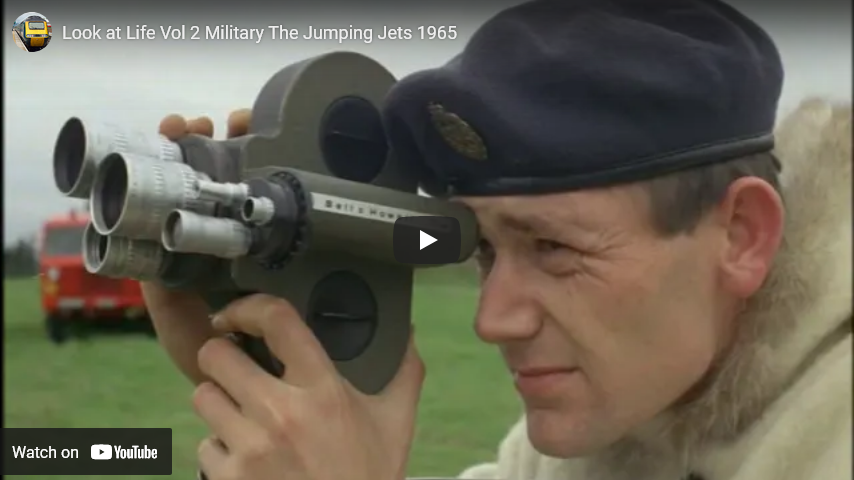
Published 20 Nov 2018The revolutionary vertical take-off capacity of the RAF Kestrel.
[Wikipedia: “The Hawker P.1127 and the Hawker Siddeley Kestrel FGA.1 are the British experimental and development aircraft that led to the Hawker Siddeley Harrier, the first vertical and/or short take-off and landing (V/STOL) jet fighter-bomber.
“Development began in 1957, taking advantage of the Bristol Engine Company’s choice to invest in the creation of the Pegasus vectored-thrust engine. Testing began in July 1960 and by the end of the year the aircraft had achieved both vertical take-off and horizontal flight. The test program also explored the possibility of use upon aircraft carriers, landing on HMS Ark Royal in 1963. The first three aircraft crashed during testing, one at the 1963 Paris Air Show.
“Improvements to future development aircraft, such as swept wings and more powerful Pegasus engines, led to the development of the Kestrel. The Kestrel was evaluated by the Tri-partite Evaluation Squadron, made up of military pilots from the United Kingdom, the United States, and West Germany. Later flights were conducted by the U.S. military and NASA.
“Related work on a supersonic aircraft, the Hawker Siddeley P.1154, was cancelled in 1965. As a result, the P.1127 (RAF), a variant more closely based on the Kestrel, was ordered into production that year, and named Harrier – the name originally intended for the P.1154 – in 1967. The Harrier served with the UK and several nations, often as a carrier-based aircraft.”]
June 27, 2022
Look at Life — The Jumping Jets (1965)
June 26, 2022
Two Hundred Weeks of War – WW2 – 200 – June 25, 1943
World War Two
Published 25 Jun 2022The Allies make some preliminary moves ahead of their next big operation in the Solomon Island as well as a few before their impending invasion of Sicily. Meanwhile, in the Soviet Union, Soviet citizens are laying over a million mines in anticipation of the impending German attack at Kursk.
(more…)
QotD: Breaking the trench stalemate with strategic air power
The first efforts at strategic bombing were made in WWI, though once again the technology wasn’t ready. The range for fixed-wing aircraft was still very limited; the aforementioned Farman F.50 had a range of only 420km, nowhere near enough to really bring entire countries under the threat of bombing. Dirigibles – zeppelins – could manage much longer ranges and the Germans did attempt to bomb British cities with them starting in 1915. The problem was that once aircraft powerful enough to climb to the zeppelin’s altitude were developed, the slow and fragile zeppelins were sitting ducks: lighter than air airships could hardly be armored, after all. Moreover, the bomb loads of zeppelins had always been far too low to make effective strategic bombing possible beyond the initial shock of it.
What no one could have known in WWI was not merely that the technology for effective conventional strategic bombing wasn’t ready, but that it would probably never be ready. Interwar air-power theorists, seeing the potential of strategic airpower to bypass the trench stalemate by flying over it began to try to work out how this would be done. Giulio Douhet (1869-1930) argued that future wars would be fought and won in the air, with fleets of bombers using high explosives and chemical weapons to massacre enemy civilian centers, until civilians forced their governments to surrender. Douhet was not alone; his vision of airpower as shared, for instance, by the “father of the RAF”, Hugh Trenchard (1873-1956).
This concept, “morale bombing” as it is sometimes called, probably deserves its own post discussing its failures. But in brief, the concept was tested, with far larger amounts of bombs than Douhet or any other interwar theorist could have ever dreamed of, during WWII. The argument by air theorists that high altitude bombers could not be stopped was proved false when the British did exactly this, stopping German bombers over Britain in 1940. Moreover, terror bombing against civilian targets in Britain didn’t lead to surrender, but hardened resolve. Likewise, “morale” bombing against German targets by the allies didn’t lead to surrender, but hardened resolve. Later efforts to demoralize the North Vietnamese through a American bombing campaign in the Vietnam War didn’t lead to surrender, but hardened resolve. More recent efforts to demoralize or destroy terrorists and the Taliban through the use of airpower hasn’t lead to surrender, but rather hardened resolve. Likewise, efforts by the Syrian regime to defeat various opposition groups in Syria through the use of chemical weapon-based terror bombing didn’t lead to surrender (siege-and-starve tactics did), but hardened resolve.
It turns out the fundamental premise of the entire idea of morale bombing – that being bombed will make people want to stop fighting – was flawed. Morale bombing has been, depending on how hard you squint at the US air campaign over Japan in WWII (including the use of nuclear weapons) successful either once (out of many attempts) or never. In most cases, the sustained bombing of civilian centers has been shown to increase a population’s willingness to resist, making the strategy worse than useless.
The case for strategic bombing against industrial targets is marginally better, but only marginally. While airpower advocates, particularly in the United States promised throughout WWII that bombing campaigns against German industry could lead to the collapse of the German war machine, in the end many historians posit that the real achievement of the campaign was to lure the Luftwaffe into the air where it could be destroyed, thus denying the German army of air cover and close air support, particularly on the Eastern Front. Some dimunition of German industrial capabilities was accomplished (though it is not clear that this ever approached the vast resources poured into producing the large numbers of extremely expensive bombers used to do it, though the allies had such an industrial advantage over Germany, forcing the Germans to fight in expensive ways in the sky was a winning trade anyway), but the collapse of German industry never happened. As Richard Overy notes, German industrial output continued to rise during strategic bombing and only began to fall as a result of the loss of territory on the ground. Needless to say, “strategic bombing can sucker the enemy into wasting their close air support” was not the result that airpower advocates had promised, nor could it have broken the stalemate.
I don’t want to oversimplify the continued debate over the efficacy of strategic airpower here too much so let’s just say that the jury is still very much out as to if strategic airpower works even with modern technology; it certainly wouldn’t have worked with WWI era technology.
Bret Devereaux, “Collections: No Man’s Land, Part II: Breaking the Stalemate”, A Collection of Unmitigated Pedantry, 2021-09-24.
June 8, 2022
The Story Behind the Dambuster Raid – WW2 Special
World War Two
Published 7 Jun 2022The thousand-bomber offensive was about to begin as Air-Marshall Harris was assembling his forces. Yet one man was to challenge his strategy. The aircraft designer Barnes Wallis thought: “What if there was a way to destroy Germany’s industrial might not by simply dropping thousands of bombs over its cities, but by a precision strike against its dams?” For this, a new kind of bouncing bomb was to be delivered.
(more…)
May 30, 2022
The Deadliest Job in World War Two – WAH 062 – May 29, 1943
World War Two
Published 29 May 2022Arthur Harris and the RAF set another record in bombing Germany, and the outnumbered Yugoslav Partisans show the Axis that numbers mean little when you’re clever.
(more…)
May 16, 2022
Heaviest Air Raid in Human History – WAH 060 – May 15, 1943
World War Two
Published 15 May 2022As the Warsaw Ghetto Uprising is being quashed, there are renewed Japanese atrocities in China, and the RAF sets a world record by bombing German civilians.
(more…)
May 4, 2022
Allies on Amphetamines – WW2 Special
World War Two
Published 3 May 2022We’ve heard how German forces are fuelled by stimulants like Pervitin. But are the Allies doing the same thing? Of course! Their drug of choice is Benzedrine. It’s in use as the RAF bomb German cities, as Monty’s tanks push Rommel back, and as US Marines take the fight to the Japanese.
(more…)
April 24, 2022
Ladies and Gentlemen, We Got Him – Yamamoto – WW2 – 191 – April 23, 1943
World War Two
Published 23 Apr 2022The mastermind of Pearl Harbor meets his fate this week in the Solomons, as do a great many Italian airmen and sailors in the Mediterranean in the Palm Sunday Massacre trying to supply the desperate Axis forces in Tunisia.
(more…)
April 15, 2022
Look at Life – Thunder in Waiting (1960)
PauliosVids
Published 20 Nov 2018The deadly cargo of the Vulcan Bomber is a crucial part of Britain’s deterrent force.
April 5, 2022
Tower Bridge Fighter Jet Incident | Tales From the Bottle
Qxir
Published 26 Nov 2021This jet pilot decided to stage a protest in the skies of London, but his actions became more well known for an incident that occurred on his journey home.
“The Hawker Hunter Tower Bridge incident occurred on 5 April 1968 when Royal Air Force (RAF) Hawker Hunter pilot Alan Pollock performed unauthorised low flying over several London landmarks and then flew through the span of Tower Bridge on the Thames. His actions were to mark the 50th anniversary of the founding of the RAF and as a demonstration against the Ministry of Defence for not recognising it.
Upon landing he was arrested and later invalided out of the RAF on medical grounds, which avoided a court martial.”
More on Wikipedia:
https://en.wikipedia.org/wiki/Hawker_…Merch: teespring.com/stores/qxir
Patreon: https://www.patreon.com/qxir
Twitter: https://twitter.com/QxirYT
Discord: https://discord.gg/jZzvvwJ
Twitch: https://www.twitch.tv/qxiryt/
Subreddit: https://www.reddit.com/r/Qxir/
From the comments:
Qxir
3 weeks ago (edited)
Yes, I know it’s pronounced “Tems” lol
February 24, 2022
Got Wood? – The de Havilland Mosquito
World War Two
Published 23 Feb 2022What if there was a plane that the enemy could neither catch nor reach? One that fully relied on speed instead of defensive armaments? The de Havilland DH.98 Mosquito was the first multi-role aircraft developed during World War Two. Made mostly out of wood, the “Wooden Wonder” could be easily converted into different roles — a fighter, a fighter-bomber, a bomber, and a reconnaissance aircraft.
(more…)
February 15, 2022
Krieghoff: Lugers for the Luftwaffe
Forgotten Weapons
Published 20 Oct 2021http://www.patreon.com/ForgottenWeapons
https://www.floatplane.com/channel/Fo…
Cool Forgotten Weapons merch! http://shop.forgottenweapons.com
One of the scarce, small-production manufacturers of the Luger is Krieghoff — Heinrich Krieghoff to be exact. Kreighoff Waffenfabrik was a smallish arms company that wanted to get into major contracts with the rearming German military in the 1930s. They began by bidding on a contract for 10,000 Luger pistols for the Luftwaffe, and won. Krieghoff had previously worked as a subcontractor for the Simson company rebuilding Lugers under the Weimar government. Kreighoff got control of the Simson Luger tooling, and used it to manufacture a new set themselves.
Krieghoff built a total of 13,825 Luger pistols. The first 10,000 were delivered to the Luftwaffe between 1935 and 1937. A further 2,000 were delivered in small batches between 1940 and 1944, with a final 200 in 1945. In addition to these, 1,625 were sold commercially, including a few highly embellished examples. They are renowned for their excellent quality, and have always attracted particular collector interest.
Contact:
Forgotten Weapons
6281 N. Oracle 36270
Tucson, AZ 85740
December 19, 2021
Canada’s almost functional flying saucer; the story of the Avro Canada VZ-9 Avrocar
Polyus Studios
Published 14 Jul 2018Support me on Patreon – https://www.patreon.com/polyusstudios
The Avro Canada VZ-9AV Avrocar: Canada’s first attempt at vertical take off and landing aircraft. Although the concept ultimately turned out to be a dead-end, the engineers and designers at Avro experimented with bold new ideas. Their concepts would push the limits of the imagination and reflected the extreme technological optimism of its time.
Music:
Denmark – Portland Cello ProjectResearch Sources:
“Declassified: America’s Secret Flying Saucer” – https://www.popularmechanics.com/mili…
Avro Canada VZ-9 Avrocar – https://www.aviationsmilitaires.net/v…
Avrocar: Canada’s Flying Saucer: The Story of Avro Canada’s Secret Projects by Bill Zuk (2001)
How to Build a FLYING SAUCER – https://declassification.blogs.archiv…
LaesieWorks – AVROCAR VZ-9AV – http://www.laesieworks.com/ifo/lib/AV…
The Living Moon – Project Silverbug – The Avrocar – http://www.thelivingmoon.com/49ufo_fi…Footage Sources:
Avrocar I Progress Report 01/02/1958 – 05/1959 – US National Archives (~1959)
Disc Flight Development, Avrocar I Progress Report, 05/02/1959 – 04/12/1960 – US National Archives (~1960)
Avrocar Continuation Test Program and Terrain Test Program, 06/01/1960 – 06/14/1961 – US National Archives (~1959)
Tiltwing Versatility – San Diego Air and Space Museum (~1971)Aircraft mentioned:
Project Y
Project Y-2
Project PV 704
Project 1794
Project Silverbug
Weapon System 606A
VZ-9AV Avrocar
CL-84 Dynavert#Avrocar #CanadianAerospace #Polyus
December 16, 2021
Supersonic Firsts
The History Guy: History Deserves to Be Remembered
Published 20 Aug 2021On August 20, 1955, United States Air Force Colonel Horace A Hanes set the world’s first supersonic world speed record in a North American Aviation F-100C Super Sabre. Although we are well into the supersonic age, aircraft that can exceed the speed of sound are still rare machines, and marvels of engineering and pilot prowess. The early aviation pioneers who tested the terrifying sound barrier have helped scientists better understand the dynamics of superfast speeds.
This is original content based on research by The History Guy. Images in the Public Domain are carefully selected and provide illustration. As very few images of the actual event are available in the Public Domain, images of similar objects and events are used for illustration.
You can purchase the bow tie worn in this episode at The Tie Bar:
https://www.thetiebar.com/?utm_campai…All events are portrayed in historical context and for educational purposes. No images or content are primarily intended to shock and disgust. Those who do not learn from history are doomed to repeat it. Non censuram.
Find The History Guy at:
Patreon: https://www.patreon.com/TheHistoryGuy
Please send suggestions for future episodes: Suggestions@TheHistoryGuy.netThe History Guy: History Deserves to Be Remembered is the place to find short snippets of forgotten history from five to fifteen minutes long. If you like history too, this is the channel for you.
Awesome The History Guy merchandise is available at:
teespring.com/stores/the-history-guyScript by THG
#history #thehistoryguy #airforce
November 28, 2021
A bit of perspective on the loss of the British F-35 from HMS Queen Elizabeth
At the Thin Pinstriped Line, Sir Humphrey offers a bit of historical perspective on peacetime aircraft losses:

Royal Navy aircraft carrier HMS Queen Elizabeth (R08) underway in the Atlantic on 17 October 2019, participating in exercise “WESTLANT 19”.
Photo by Mass Communication Specialist 3rd Class Nathan T. Beard, US Navy, via Wikimedia Commons.
If you look at historical data, then it shows that for decades, flying fast jets was an exceptionally dangerous occupation. In 1956 the RAF lost six Hawker Hunter aircraft in the space of just 45 minutes. These were just six of no less than 380 British military aircraft and helicopters lost in 1956, which averages out at more than one aircraft lost every day of the year – and this was not an unusual year.
Fast jet flying is and always has been an extremely dangerous business, which requires the highest levels of safety, standards and training to carry out. Over the intervening decades there has been a general decline in losses due to changes in equipment, reliability of machinery and different ways of operating, particularly with new technology, but there is still an element of risk. In particular the Martin Baker ejection seat is worth mentioning – this incident reminds us of the many lives this British company is responsible for saving over many decades.
Carrier aviation in particular remains an extremely dangerous occupation, even if crash rates have dropped. It is important to understand that the combination of fast jets, large warships and complex operating conditions can, and do, sometimes go wrong. We must not assume that aircraft will not crash anymore.
The Wikipedia page covering military aviation accidents for the period 2010-2019 is a good read to understand how risky military aviation is, and how many aircraft have been lost globally during this period.
That said, the current crop of modern British fast jets like the F35 and Typhoon have a phenomenal safety record, being operated in hugely demanding conditions around the globe for many years, and with only a handful lost. It is very telling that the loss of an aircraft is something that has gone from the utterly routine and barely newsworthy, to something that can dominate the media cycle for several days and generate huge national media coverage.
The theme on social media has been peculiar — there have been many posters talking about how embarrassing it is for the UK, or that its somehow a national disgrace that the aircraft crashed, particularly with the US embarked as well. This is utter nonsense – there is no embarrassment in a pilot taking a decision to eject in order to save his life. That is absolutely the right thing to do, and anyone who thinks otherwise has clearly never been faced with the decision on whether to eject or not.
There has been some coverage suggesting that the F35 programme is troubled in some way and that this is a setback for it. Again, this is nonsense – the aircraft first flew 15 years ago, and well over 700 have now been produced flying over 400,000 flying hours. In this time, a total of 5 aircraft (3 American, 1 Japanese and 1 British) have been lost – this is an under 1% loss rate, or one aircraft lost for every 80,000 hours in the sky.
By way of contrast, the Sea Vixen, a British jet used for carrier operations was in service from 1959-1971. Of the 145 aircraft built and operated, no less than 55 were lost in accidents in this period – a loss rate of around 38% of the whole force in just 12 years.