
The new TV series Ozark has the best explanation of this I’ve seen in popular culture. To paraphrase: Say you have $1 million in cash. What can you actually do with it?
If you try to deposit it in the bank, they will file a report, and you will shortly be explaining to the government where that money came from. Unless you have a good explanation, you will then be desperately trying to hire a lawyer in order to avoid a trip to the pokey.
Nor can you simply buy a house or a car with that cash, which will raise many, many eyebrows at the bank, and then at the government that bank reports to. You basically can’t make any large purchase in cash without raising a lot of questions. This is why drug dealers spend so much effort figuring out how to launder their ill-gotten gains. Unless you can find some way to put the money in a bank without the government getting suspicious, then all you have, in the words of Jason Bateman’s character, is (approximately) “groceries and gas for the rest of your life.”
And that’s dollars, which are indisputably legal tender. Your cryptocurrency will be even harder to spend. Who wants to trade you legal cash for scrip that’s only good for buying on the black market? How do you find that person? What discount will they demand for giving up their cash?
Bitcoin is currently good for transferring money out of failing states like Venezuela, because in those places, the local currency is so worthless that you’re better off trading it for bitcoin, or for that matter, cans of mackerel. But that presumes there are countries elsewhere with stable governments and strong economies where bitcoins can be turned into real goods. If bitcoins become a good way to evade those governments, those governments will ban them, and desperate people will go back to smuggling diamonds and dollars.
Megan McArdle, “Bitcoin Is an Implausible Currency”, Bloomberg View, 2017-12-27.
March 12, 2020
QotD: Cryptocurrency versus cash in a modern economy
March 11, 2020
Carton de Wiart – A Man For All Seasons – WW2 Biography Special
World War Two
Published 10 Mar 2020Carton de Wiart was a remarkable figure in World War One, but his story continues in World War Two, where he rolls from one adventure into the next.
Join us on Patreon: https://www.patreon.com/TimeGhostHistory
Or join The TimeGhost Army directly at: https://timeghost.tvFollow WW2 day by day on Instagram @World_war_two_realtime https://www.instagram.com/world_war_t…
Between 2 Wars: https://www.youtube.com/playlist?list…
Source list: http://bit.ly/WW2sourcesHosted by: Indy Neidell
Written by: Francis van Berkel
Produced and Directed by: Spartacus Olsson and Astrid Deinhard
Executive Producers: Bodo Rittenauer, Astrid Deinhard, Indy Neidell, Spartacus Olsson
Creative Producer: Joram Appel
Post-Production Director: Wieke Kapteijns
Research by: Keith Kevelson
Edited by: Mikołaj CackowskiColorizations by:
Julius Jääskeläinen – https://www.facebook.com/JJcolorization/Sources:
IWM Q 101768, Q 82958, Q 15472, Q 53680, Q 92257, Q 4511, Q 11429, Q 92207, Q 92214, N 228, N 110, N 68, H 7393, HU 128168, E(MOS) 1315, SE 3547, A 31225, A 20588, Q 92218
Skull by Mahmure Alp from the Noun Project
foot bone by Maxicons from the Noun Project
Ear by Vectors Market from the Noun Project
Hip Bones by ProSymbols from the Noun Project
Collection of Auckland Museum Tamaki Paenga Hira, 2001.25.480 Brent Mackrell Collection
Narodowe Archiwum Cyfrowe
Picture of Combe, Carton de Wiart, Todhunter and Gambier-Parry in Vincigliata Castle Prison, courtesy Michael TodhunterSoundtracks from the Epidemic Sound:
Hakan Eriksson – “Epic Adventure Theme 3”
Jo Wandrini – “Dawn of Civilization”
Rannar Sillard – “March of the Brave 4”
Johannes Bornlof – “Death And Glory 3”
Farrell Wooten – “Blunt Object”
Philip Ayers – “Trapped in a Maze”
Phoenix Tail – “At the Front”Archive by Screenocean/Reuters https://www.screenocean.com.
A TimeGhost chronological documentary produced by OnLion Entertainment GmbH.
From the comments:
World War Two
40 minutes ago (edited)
This episode was made thanks to our research volunteer Keith Kevelson. It is also the first of its kind, being the first proper Biography Special of our World War Two series. We will do one of these every other week, so be prepared to get to know the main protagonists of the Second World War up close and personal. Please support us on Patreon so we can continue making these. Sign up at www.patreon.com/timeghosthistory or https://timeghost.tv.Cheers,
Joram
How Does It Work: Roller Locking
Forgotten Weapons
Published 10 Mar 2020http://www.patreon.com/ForgottenWeapons
https://www.floatplane.com/channel/Fo…
Cool Forgotten Weapons merch! http://shop.bbtv.com/collections/forg…
Roller locking is a system that is not used in many guns and often confused with roller-delayed blowback — which is understandable, given the similarities between the systems. Roller locking was first developed as a modification of the German G43 rifle, and it is really a sub-type of flapper locking mechanism. It was most significantly used in the MG42, and also in the Czech vz.52 pistol. In essence, it uses rollers in place of flaps to lock the bolt and barrel securely together during firing, and depends on an external system (short recoil, in the case of the MG42 and vz.52) to unlock before it can cycle.
Contact:
Forgotten Weapons
6281 N. Oracle #36270
Tucson, AZ 85740

Canadian National’s perfect storm
In Trains, Bill Stephens highlights the terrible time Canada’s largest railway has been having since the beginning of the year:

“DSC02285” by Bengt 1955 is licensed under CC BY-NC 2.0


It would be hard to imagine a worse start to the year for Canadian National, whose volume is down 16% due to a string of events that’s mostly odd, unrelated, and unrelenting. CN is taking it on the chin, as no other North American railroad has seen its volume fall by more than 10% this year and rival Canadian Pacific’s traffic is up 10%.
First, there was Mother Nature. Winter arrived in January with eight days of deep cold in Western Canada, forcing CN to restrict train length. Then powerful rainstorms lashed southern British Columbia starting Jan. 30, washing out CN’s main to Vancouver for six days.
The major washouts occurred in the rugged Fraser River canyon directional running zone where CN and CP share trackage, with CN hosting westbounds and CP carrying eastbounds. The railways had to resort to running directional fleets of 15 to 20 trains at a time over CP’s line. The single-track bottleneck caused eastbound traffic to stack up at the Port of Vancouver and westbounds to be staged as far away as the Prairies. The directional running zone ranks among the top three freight mains by tonnage in North America, alongside BNSF Railway’s Southern Transcon in the Southwest and Union Pacific’s triple track across Nebraska. So this blockage was, by itself, a big deal.
Then came nearly a month of civil protests. On Feb. 6, as CN began digging out from the washout backlog, the first of several First Nations blockades set up camp on CN’s tracks. The blockades, protesting a proposed natural gas pipeline in British Columbia, halted traffic on CN’s Montreal-Toronto mainline in the East. Also ultimately affected: CN’s line to Prince Rupert, British Columbia, which was blocked by protests for six days. Other protests came and went in Edmonton, Alberta; Winnipeg, Manitoba; Quebec; and British Columbia. CP was affected, too, but to a much lesser extent. CP even hosted detour traffic for CN between Montreal and Toronto.
As if that wasn’t enough, then came regulatory woes. The same day the protests began, a CP crude oil train derailed and caught fire in Guernsey, Sask., the second such wreck in the area since December. Hours later Transport Canada issued a ministerial order that restricted key trains – those with 20 or more cars of hazardous materials – to 20 mph in metropolitan areas and 25 mph elsewhere. With the stroke of a pen, Transport Minister Marc Garneau’s knee-jerk reaction effectively reduced CN’s overall capacity by a third. You could call this slowdown “Whoa Canada!”
A Bridge Too Far | Military History Book Review
TIK
Published 22 Feb 2016The classic history book looking at the battle of Arnhem and Operation Market Garden. Cornelius Ryan’s A Bridge Too Far.
Have you seen my popular Operation Market Garden Documentary?
https://youtu.be/vTUC79o4KmcAlso, if you haven’t done already, follow me on Twitter!
https://twitter.com/TIKhistory

QotD: Orthorexia
Our culture accepts as a scientific fact that organic food is healthier than non-organic food. You can watch TV, read popular magazines, or listen to healthy-living gurus, and overwhelmingly you will be told that organic food is healthier than non-organic food. Recipes tend to call for organic produce and ingredients. And it goes beyond organic foods. Genetically-modified foods are slandered as “frankenfoods” concocted by mad scientists in a laboratory. Further, we are admonished to avoid anything that is not “natural.”
OK then. Vaccines are genetically modified, lab-made, and certainly not natural. Being anti-vax seems a logical extension of the natural, organic lifestyle.
I know several people — including family members — who have so completely bought into the natural-organic hype that they genuinely believe GMO and non-organic foods are poisonous. They would rather starve themselves and their children to death than ingest a gram of non-organic food. They look at the shelves of a regular grocery store and see rows and rows of poison. There is a medical term for this fear of safe healthy food — it’s called “orthorexia.” I am not shocked that some of these individuals are anti-vaxxers. Instead, I am shocked (and relieved) that some of the orthorexics I know actually do vaccinate themselves and their children.
Buck Throckmorton, “Organic Food & Anti-Vaxxers – Does The Fear of Safe Food Lead to Fear of Safe Vaccines”, Ace of Spades H.Q., 2019-12-08.
March 10, 2020
The Hitchhiker’s Guide to the Galaxy turns 42
In The Register, Richard Speed notes a significant anniversary:
The weekend marked the 42nd anniversary of the first broadcast of The Hitchhiker’s Guide to the Galaxy, the hugely influential BBC radio show.
42 is a significant number for fans of the innovative series by Douglas Adams so (carefully) pour yourself a Pan Galactic Gargle Blaster, wrap yourself in a towel and join The Register for a trip back to 1978, when the BBC decided to do something quite different.
Writing in the introduction to the Pan Books’ 1985 publication of the radio scripts (which differ from the books, which differ from the television series, which differ from the film …), series producer Geoffrey Perkins described his first meeting with the author. Adams was giving a speech despite being aggressively heckled by the cast members of the Cambridge Footlights show he’d just directed.
He’d also elected to stand on a rickety chair to deliver the speech.
“Here,” recalled Perkins, “was someone prepared to stick his neck out further than most people, someone who would carry on in the face of adversity, and someone who would shortly fall off a chair.
“I was right on all three counts.”
Perkins went on to join the BBC, while Adams worked with the Monty Python team as well as contributing to Doctor Who as the 1970s went on. He pitched the idea for a science-fiction comedy radio series to radio producer Simon Brett. Brett recommended Perkins to the BBC as a potential producer and the series was given the go-ahead on 31 August 1977 (after the first episode was commissioned on 1 March 1977).
“We both owe him an enormous debt,” said Perkins of Brett.

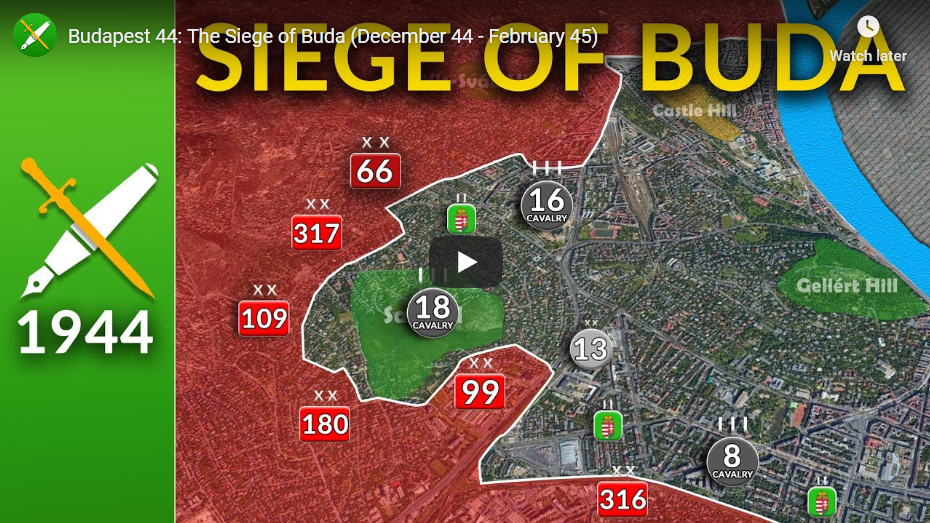
Budapest 44: The Siege of Buda (December 44 – February 45)
Historigraph
Published 7 Mar 2020Buy Siege of Budapest Poster here: https://teespring.com/en-GB/siege-of-…
Support the channel on Patreon: https://www.patreon.com/historigraph
Follow me on Twitch: https://www.twitch.tv/historigraph#SiegeOfBudapest #SiegeOfBuda #Historigraph
►Twitter: https://twitter.com/historigraph
►Instagram: https://www.instagram.com/historigraph
►Patreon: https://www.patreon.com/historigraphThe Siege of Budapest and the battles that led to it have had precious little written about them (in English!), so the bulk of this video comes from one book:
Krisztián Ungváry, Battle for Budapest: 100 Days in World War 2
This is by far the most detailed account of the battle that I could find.
Music:
“Crypto”, Incompetech https://incompetech.com
“Rynos Theme”, Incompetech
“Stormfront”, Incompetech
Thought-saving inventions
In the latest issue of his Age of Invention newsletter, Anton Howes considers the innovations that helped provide short-cuts for thought, rather than labour:

The world on Mercator projection between 85°3’4″S and 85°3’4″N, such that image is square. 15° graticule. Imagery is a derivative of NASA’s Blue Marble summer month composite with oceans lightened to enhance legibility and contrast. Image created with the Geocart map projection software.
Image by Strebe via Wikimedia Commons.
When we think of labour-saving inventions, the kind of labour that springs to mind tends to be manual. We think of machines replacing the muscle of limbs and the dexterity of fingers, and we worry about their effects on unemployment and unrest. But there’s a subset of labour-saving inventions that rarely gets discussed. They might best be called thought-saving.
A few weeks ago I mentioned the introduction of mathematical techniques to navigation. Before the mid-sixteenth century in England, pilots very rarely even knew how to calculate their latitude, let alone their longitude. But over the course of just a few decades, England became one of the world leaders in navigational improvements. A handful of mathematicians saved pilots the trouble of calculation, by coming up with tables, instruments, diagrams, and rules of thumb. In the process, they improved navigation’s accuracy, and ushered in an age of English dominance of the high seas.
The historian Eric H. Ash gives a few great examples. In the 1590s, the explorer John Davis shared a way to calculate the time of high tide, without requiring multiplication. Likewise, William Bourne, a self-taught mathematician and gunner, in the 1560s provided an easy means of calculating the linear distance in one degree of longitude, at any given latitude. He provided a diagram — really an instrument, even if it wasn’t made of wood or brass — which with just a simple piece of string could be used to derive the answer without needing to understand cosines, or really any trigonometry.
The mathematicians did the same with maps, too (after all, aren’t all maps thought-saving?) The sixteenth-century cartographic innovations simplified the pilot’s ability to chart a route, for example by taking away all need to worry about the curvature of the earth. The famous 1560s map projection of Gerardus Mercator stretched the distance between the lines of latitude as they got closer to the poles, so that charting a course on such a map was a simple matter of drawing straight lines rather than complex trigonometry. The Mercator projection may well make Africa look smaller than Greenland — it’s actually almost fifteen times as large — but it made life significantly easier for mariners. For similar reasons, the mathematician John Dee designed a special chart — what he called the “paradoxall compass” — to aid the English explorers who in the 1550s went in search of a northeast and northwest passage to Asia. Conventional charts made navigating high latitudes confusing, as the north pole was a straight line — the map’s top border. Dee’s map made things easier by putting the pole at the centre, as a point, with the lines of latitude as concentric circles.
The Birth of a Nation | Based on a True Story
The Cynical Historian
Published 7 Oct 2016The Birth of a Nation was the first major motion picture success, and because of its historical inaccuracy, the Ku Klux Klan was revived for another round of terror. This is the worst case of a “Based on a True Story” film. So today is a prime time to go into why it was so bad, and get some President Wilson bashing in.
Through YouTube’s cowardice, this video has been demonetized.
————————————————————
references:
Blee, Kathleen M. Women of the Klan: Racism and Gender in the 1920s. Berkeley: University of California Press, 1991. https://amzn.to/2NzeHblhttp://www.npr.org/sections/codeswitc…
https://en.wikipedia.org/wiki/The_Bir…
https://en.wikipedia.org/wiki/The_Bir…
https://en.wikipedia.org/wiki/The_Cla…
https://en.wikipedia.org/wiki/Ku_Klux…
https://en.wikipedia.org/wiki/Reconst…
https://en.wikipedia.org/wiki/Woodrow…
https://en.wikipedia.org/wiki/1804_Ha…
https://en.wikipedia.org/wiki/Nat_Tur…
————————————————————
contribute to my Patreon:
https://www.patreon.com/CynicalHistorianLET’S CONNECT:
https://twitter.com/Cynical_History
—————————————–
Wiki:
The Birth of a Nation (originally called The Clansman) is a 1915 American silent epic drama film directed and co-produced by D. W. Griffith and starring Lillian Gish. The screenplay is adapted from the novel and play The Clansman, both by Thomas Dixon Jr. Griffith co-wrote the screenplay (with Frank E. Woods), and co-produced the film (with Harry Aitken). It was released on February 8, 1915.Three hours long, the film was originally presented in two parts separated by an intermission; it was the first 12-reel film in America. The film chronicles the relationship of two families in the American Civil War and Reconstruction era over the course of several years: the pro-Union Northern Stonemans and the pro-Confederacy Southern Camerons. The assassination of President Abraham Lincoln by John Wilkes Booth is dramatized.
The film was a commercial success, though it was highly controversial for its portrayal of black men (many played by white actors in blackface) as unintelligent and sexually aggressive towards white women, and the portrayal of the Ku Klux Klan (KKK) (whose original founding is dramatized) as a heroic force. There were widespread African-American protests against The Birth of a Nation, such as in Boston, while thousands of white Bostonians flocked to see the film. The NAACP spearheaded an unsuccessful campaign to ban the film. Griffith’s indignation at efforts to censor or ban the film motivated him to produce Intolerance the following year.
The film’s release is also credited as being one of the events that inspired the formation of the “second era” Ku Klux Klan at Stone Mountain, Georgia, in the same year. The Birth of a Nation, along with the trial and lynching of Leo Frank for the 1913 murder of Mary Phagan in Atlanta, was used as a recruiting tool for the KKK. Under President Woodrow Wilson, it was the first American motion picture to be screened at the White House.
Griffith’s innovative techniques and storytelling power have made The Birth of a Nation one of the landmarks of film history. In 1992, the United States Library of Congress deemed the film “culturally, historically, or aesthetically significant” and selected it for preservation in the National Film Registry.
————————————————————
Hashtags: #History #BirthOfANation #KKK #Review #BasedOnATrueStory #WoodrowWilson #DWGriffith

QotD: Free trade versus protectionism
People trade freely countless times, each and every day. Yes, yes, I’m well aware that such trade isn’t ideally free. Occupational-licensing restrictions, for example, unjustly and harmfully obstruct domestic trade. But the fact remains that today within each country – including within the U.S. – trade is not typically obstructed based on geographic location or political boundaries. And therefore people buy and sell freely within countries. If the case for a policy of free trade were not practical – if it were only a theoretical curiosity – then it would be true that ordinary people would be even richer if the state obstructed their abilities to trade with each other domestically.
It’s a myth also that the economic case for a policy of free trade in any one country requires that other governments also practice free trade. The case for a policy of free trade is, at bottom, a case for unilateral free trade: while nearly everyone in the world would be better off if all governments adopted policies of free trade, nearly everyone in the home country would be better off if the home government adopts a policy of free trade regardless of the policies of other governments.
Protectionism is a nasty mash of logical fallacies, half-truths, hubris, economic ignorance, and cronyist apologetics.
Don Boudreaux, “Quotation of the Day…”, Café Hayek, 2017-12-18.
March 9, 2020
How To Edge Joint Panels by Hand | The Cabinet Project #1 | Free Online Woodworking School
Matt Estlea
Published 6 Mar 2020In this video, I show you how to edge joint the side panels of the cabinet by hand. The tips and techniques shared in this video are built upon skills that were taught in my previous series where we made a dovetailed box by hand.
If you feel lost at any point in this video, please refer to this lesson on my website where you will get access to supporting resources. These will teach you everything from sharpening, setting up and using a plane, to creating seamless joints in edge panels.
View the FULL lesson here:
https://mattestlea.com/free-online-wo…
_________________________________________________________________Support what I do by becoming a Patron! This will help fund new tools, equipment and cover my overheads. Meaning I can continue to bring you regular, high quality, free content. Thank you so much for your support! https://www.patreon.com/mattestlea
Don’t want to commit to a monthly direct debit but still want to help out? That’s fine!
You can make a one time donation here: www.mattestlea.com/donate
You can donate us biscuits here: www.mattestlea.com/wishlist
_________________________________________________________________
BUY THE WOODWORKING BIBLE HERE:
www.mattestlea.com/the-woodworkers-manual
_________________________________________________________________SOCIAL MEDIA
Instagram: www.instagram.com/mattestlea
Facebook: www.facebook.com/mattestleafurniture
Twitter: www.twitter.com/mattestlea
Patreon: www.patreon.com/mattestlea
Pinterest: www.pinterest.com/mattestlea
LinkedIn: www.linkedin.com/in/matt-estlea-b6414b11a/
_________________________________________________________________
See what tools I use here: www.mattestlea.com/equipment
My Website: www.mattestlea.com
_________________________________________________________________My name is Matt Estlea, I’m a 24 year old Woodworker from Basingstoke in England and my aim is to make your woodworking less s***.
I come from 5 years tuition at Rycotewood Furniture Centre with a further 1 year working as an Artist in Residence at the Sylva Foundation. I now teach City and Guilds Furniture Making at Rycotewood as of September 2018.
If you’re interested in studying at Rycotewood, view their courses here:
www.mattestlea.com/rycotewoodI also had 5 years of experience working at Axminster Tools and Machinery where I helped customers with purchasing tools, demonstrated in stores and events, and gained extensive knowledge about a variety of tools and brands. I discontinued this at the start of 2019 to focus solely on video creation and teaching.
During the week, I film woodworking projects, tutorials, reviews and a viewer favourite ‘Tool Duel’ where I compare two competitive manufacturers tools against one another to find out which is best. I also have a Free Online Woodworking School which you should definitely check out!
www.mattestlea.com/school
I like to have a laugh and my videos are quite fast paced BUT you will learn a lot, I assure you.
Lets go make a mess.

One of the economic effects of the Coronavirus outbreak might actually be bottom-line positive
Tim Worstall explains:

“Trade Show Portfolio – Guy Lewis Photography” by Guy Lewis is licensed under CC BY-NC 4.0
One notable thing about tech events is that they tend to be in interesting places like Amsterdam and Barcelona, and you don’t get many self-employed attending. Because someone self-employed loses days of paid hours, has to pay for the flights and the tickets. And they can get the same stuff from YouTube or various learning sites like Lynda.com. Tech events are mostly a jolly for employees in bloated companies. You get 3 days out of the office, have some fun and the boss picks up the tab. Losing this will probably improve the bottom line. And “business conferences” are mostly the same.
For people working more from home, that’s a good thing. Reduced travel costs (time and petrol), less tiredness. This is gradually happening anyway, but Coronavirus has given it a boost.
And maybe everyone realises that a system of education inherited from the time before Gutenberg, when books were a scarce resource, is perhaps in need of reform. OK, you probably need to be at a university for cutting up cadavers in medicine, but for history or computer science you can probably do most of it from your parent’s spare room.
One thing about the way people work is that they often fall into habits. Change often comes from startups and small businesses because they don’t have habits. Sometimes, they’re even anti-habit. Someone in a large company sees something as wasteful and scraps it in the new company. Microsoft let their people wear what they wanted for work, rather than suits. And gradually, those new businesses replace the old. But there’s also sometimes crises that break habits. Someone is forced to do something and gets their eyes opened. They perhaps realise that the alternative works fine, or maybe better.
British Submachine Gun Overview: Lanchester, Sten, Sterling, and More!
Forgotten Weapons
Published 12 Mar 2017Armament Research Services (ARES) is a specialist technical intelligence consultancy, offering expertise and analysis to a range of government and non-government entities in the arms and munitions field. For detailed photos of the guns in this video, don’t miss the ARES companion blog post:
http://armamentresearch.com/british-sub-machine-gun-development-an-overview/
Great Britain was one of the few countries that went into World War Two with virtually no submachine gun development. Not every country had an issued SMG by 1939, but virtually everyone had at least been working on experimental concepts — except the British. It was only with the outbreak of hostilities that the need for such a weapon suddenly became apparent and its acquisition became a military priority.
This was solved by acquiring and copying the German MP28/II, which was quickly followed by a simplification program that would lead to the MkI, MkI*, and ultimately MkII and MkIII Sten guns. The Stens were truly exceptional studies in simplification, getting down to a mere 5.5 man-hours of production time. Only after the threat of immediate German land invasion had subsided was the Sten allowed to become a little bit user-friendly, in the MkV guise.
At the end of WW2, the British were finally able to scrap the Sten (known to be a compromise gun all along) and replace it with something with more finesse. Tests were run on the MCEM series, on BSA guns, on interesting prototypes like the double-stack-magazine Vesely V42 — but it was George Patchett’s much improved Sten which would be chosen and come to be known as the Sterling SMG (named after its manufacturer).
A couple of corrections to the video:
— The MP28 was designed by Schmeisser, not Bergmann.
— The MCEM-2 was designed by Polish engineer Lt. Jerzy Podsendkowski. The -2 version of the MCEM was completed during WW2; it was the -4 and -6 versions that were post-war.
— George Lanchester was chief engineer at Sterling and ran the Lanchester project, but was not actually the lead designer himself.
http://www.patreon.com/ForgottenWeapons
Cool Forgotten Weapons merch! http://shop.bbtv.com/collections/forg…
If you enjoy Forgotten Weapons, check out its sister channel, InRangeTV! http://www.youtube.com/InRangeTVShow

QotD: The wrong lessons learned from World War II
Lyndon Johnson led the country into a massive military commitment in South Vietnam in part because of misplaced faith in what the United States could accomplish by force of arms. The Johnson administration convinced itself that fighting modern wars was a branch of management science, akin to running a large corporation like General Motors, and that America’s military was a versatile instrument that could be dialed up or down to deliver precisely calibrated levels of violence, tailored to meet any foreign policy challenge. World War II also led many Americans to conclude that liberal democracy could be imposed on foreign peoples through the application of what George W. Bush’s administration would later call “shock and awe.”
It turns out that, even in the age of precision weapons, military power is a blunt instrument, ill-suited to nation-building, except in rare circumstances and at great cost. Germany and Japan — our preferred examples — are highly idiosyncratic. Liberal democracy flourished in each only after the deaths of millions of citizens and the reduction of their societies to rubble. Americans haven’t shown much stomach for projects of this scope after 1945.
E. M. Oblomov, “The Greatest Generation and the Greatest Illusion: Success in World War II led Americans to put too much faith in government—and we still do.”, City Journal, 2017-12-28.


