Quotulatiousness

January 2, 2021

Victor Davis Hanson’s 2020 review

Filed under: Government, Health, History, Media, USA — Tags: , , , , — Nicholas @ 05:00

I’m not normally prone to weak puns, but I think it’s not unfair to call 2020 an Anus horribilis rather than an Annus horribilis, because the last twelve months have been utter ass:

The year 2020 is now commonly dubbed the annus horribilis — “the horrible year.” The last 10 months certainly have been awful.

But then so was 1968, when both Martin Luther King Jr. and Bobby Kennedy were assassinated. The Tet Offensive escalated the Vietnam War and tore America apart. Race and anti-war riots rocked our major cities. Protesters fought with police at the Democratic National Convention in Chicago. A new influenza virus, H3N2 (the “Hong Kong flu”), killed some 100,000 Americans.

But an even worse 2020 saw the COVID-19 outbreak reach global pandemic proportions by March. Chinese officials mislead the world about the origins of the disease — without apologies.

Authorities here in the U.S. were sometimes contradictory in declaring quarantines either effective or superfluous. Masks were discouraged and then mandated. Researchers initially did not know how exactly the virus spread, only that it could be lethal to those over 65 or with comorbidities.

Initial forecasts of 1 million to 2 million Americans dying from the virus unduly panicked the population. But earlier assurances that the death toll wouldn’t reach 100,000 falsely reassured them.

[…]

For the first time in American history, given the lockdowns and the cold-weather viral resurgence, there was neither a traditional Thanksgiving nor Christmas for many people.

Yet amid the death, destruction and dissension, history will show that America did not fall apart.

In remarkable fashion, researchers created a viable and safe COVID-19 vaccine in less than a year — a feat earlier described as impossible by experts.

The nation went into recession but avoided the forecasted depression. This was partly because America in early 2020 was booming by historical standards, and partly because the Trump administration and Congress quickly infused some $4 trillion of liquidity into the inert economy.

For all the charges and counter-charges of voter fraud and Trump being a sore loser, President-elect Joe Biden will eventually take office. And Donald Trump will leave it.

History Summarized: Mesopotamia — The Bronze Age

Overly Sarcastic Productions
Published 22 Feb 2019

Let’s spin the clock way back to the beginning of urbanized civilization, and learn about the long history of Mesopotamia from the dawn of the city to the collapse of the last Sumerian empire.

This video is part of The Bronze Age collaboration.
Find 10 other great videos with this playlist: https://goo.gl/4JLV8s
Previous video — Cynical Historian: https://youtu.be/xSDn0HSXjgo
Next video — Epimetheus: https://youtu.be/-RrAoL_PVmo

Further reading: “Babylon: Mesopotamia and the Birth of Civilization” By Paul Kriwaczek: https://goo.gl/nyQAdS

PATREON: www.patreon.com/OSP

MERCH LINKS:
Shirts – https://overlysarcasticproducts.threa…
All the other stuff – http://www.cafepress.com/OverlySarcas…

This is the dawning of the Age of the Putz

Filed under: Government, Health, Liberty — Tags: , , — Nicholas @ 03:00

At least, that’s how David Warren sees it:

“Covid 19 Masks” by baldeaglebluff is licensed under CC BY-SA 2.0

… the spirit of Resolution has been dying in our society, and that is among the principal reasons that our public life has been down-trending. It is what we may call the Age of the Putz, using the term with its full Yiddish vigour, yet in English where we may say it in the presence of women and children. Yes, it means stupid, foolish, worthless, idle and so forth. But as I understand, at the fulcrum, it means “easy to swing around.” It means being led by one’s rope, as it were. A putz (understandably confused with a schmuck, or a nebbish) does what he has been told by the authorities, and oddly like the brave, he does not hesitate. But this is because he can’t endure pain. He can be agreeable, yet without charm. (Reader warning: my Yiddish may be defective.)

This would be acceptable, in the sense that there is nothing we can do about a putz — he has already surrendered — but a line must be drawn somewhere, if only for our own edification. This is where, in current jargon, we cross over from a putz, to a Karen. In my apartment building alone, there must be a dozen who have made this “transition.”

They are the ones who think they will die, if you’ve forgotten your bat-muzzle, or threaten to step within seventy inches of them, in an elevator. They may appear to be making a threat, by the shrieks of complaint they utter, but really it is only fear. It is, to be plain, the opposite of Resolution. The authorities, taking them for putzes, have easily instilled the “public health” terror, with “science” they have made up, and may yank them here or there as they want.

Could I make videos, I would record a snide little number that composed itself in my head, last May (when we were only two months into “fifteen days to flatten the curve”). It was entitled, “You’re Going To Kill People!” The dance component was a variation on the hippie-days twist, in which Walmart shoppers try to stay two feet clear of each other, while looting modest consumer durables.

Lee Metford and Lee Enfield Carbines for the Cavalry

Filed under: Britain, History, Military, Weapons — Tags: , , , , — Nicholas @ 02:00

Forgotten Weapons
Published 28 Sep 2020

http://www.patreon.com/ForgottenWeapons

https://www.floatplane.com/channel/Fo…

Cool Forgotten Weapons merch! http://shop.bbtv.com/collections/forg…

When the Lee magazine rifle was adopted for British military service, it was initially produced as a long rifle for the infantry. To accommodate the cavalry on horseback, a much more compact carbine version was produced. These were initially Lee Metford pattern, but changed to Lee Enfield pattern rifling when the long rifles made the same shift. The carbines were the origin of the cocking-piece-mounted safety, as the Lee Metford rifles in service at the time had no manual safety at all. The cavalry service wanted one, and the safety they came up with was added to later patterns of infantry rifle.

The Lee carbines are designed to be sleek and handy, to easily fit into a cavalry scabbard. The bolt handles are swooped forward slightly and flattened against the receiver. The front sight wings are rounded and the magazine was reduced to 6 rounds, barely extending beyond the receiver. Early examples were fitted with a D-ring on the left side of the receiver socket for use with a single point sling, but this was removed quickly and it is very rare to find carbines with intact sling rings today.

Contact:
Forgotten Weapons
6281 N. Oracle #36270
Tucson, AZ 85740

QotD: The Opposite Rule of Progressives

Filed under: Politics, Quotations, USA — Tags: , , — Nicholas @ 01:00

At various times, I’ve rolled out my rule about how to interpret statements by liberals regarding non-liberals […] it goes like this. Take whatever they say, assume the opposite and you will get close to the truth. When liberals said the Tea Party was “AstroTurf” and liberal groups were genuine grassroots, you could flip it around to mean their gang was a rent-a-mob and the weirdos in the 17th century outfits were just regular folks pissed off and making some noise.

That was in fact the case. The Left has well funded “volunteer” operations to bus in protesters when needed. Often they are paid by their union, like we saw in Wisconsin with the teacher unions. It is a form of projection, for the most part, but in politics it is a way to shift the focus away from whatever crooked stuff they’re doing. One of the oldest tricks in politics is to falsely accuse your opponent of something, so the story is about the other guy denying it, not about whatever you are doing. […] For as long as I’ve been alive, there have been theories about why there is a Left and Right in American politics. All of these theories claim the mantel of science and all of them come from the Left. The reason for this is, at some level, the Left knows they are not working from facts and reason, but rather a set of beliefs. Rather than confront that, they accuse everyone that opposes them of holding irrational beliefs and acting from emotion.

The formula goes like this. They assign to themselves qualities they wish they possessed, but don’t. “Open minded” always makes the list along with “smart” and “unconventional.” Who would not want to be a smart, open minded guy, who is a little off-beat? Gosh that sounds just like the protagonist of every cool TV show and movie! Then they usually assign some bad qualities to the mythical right-winger or conservative. Then they produce a “study” that confirms all of this as science!

I’ll note that liberals have a long list of words for the people on the other side of the hive walls. You never hear liberals talk about the differences between libertarians and paleo-cons or neocons and paleos. To the liberal, they are part of the undifferentiated other on the other side of the wall. Often they avoid this and rely on their cartoon version of the conservative, which is usually a blend of the 1950’s sitcom dad and a prison guard. It’s Ward Cleaver with a closet full of Nazi uniforms.

The Z Man, “The Opposite Rule of Liberalism”, The Z Blog, 2013-11-15.

January 1, 2021

“Wolfpack” Pt. 2 – The Torpedoing – Sabaton History 100 [Official]

Filed under: Germany, History, Media, Military, WW2 — Tags: , , , , — Nicholas @ 04:00

Sabaton History
Published 31 Dec 2020

The Allies had cracked the secret codes, deprived the German Kriegsmarine of their best U-Boat aces, and sunk more submarines than the Germans could replace. Yet the Wolfpacks returned. From the depth of the sea they continued their hunt, even far away from the busy routes of the Atlantic. On their way south, along the coast of Africa, Wolfpack “Eisbär” would engage in a fateful encounter. An encounter that would demonstrate how the old rules of conduct, honor and mercy had become a thing of the past.

Support Sabaton History on Patreon: https://www.patreon.com/sabatonhistory

Listen to “Wolfpack” on the album Primo Victoria: https://music.sabaton.net/PrimoVictoria

Listen to Sabaton on Spotify: http://smarturl.it/SabatonSpotify
Official Sabaton Merchandise Shop: http://bit.ly/SabatonOfficialShop

Hosted by: Indy Neidell
Written by: Markus Linke and Indy Neidell
Directed by: Astrid Deinhard and Wieke Kapteijns
Produced by: Pär Sundström, Astrid Deinhard and Spartacus Olsson
Creative Producer: Maria Kyhle
Executive Producers: Pär Sundström, Joakim Brodén, Tomas Sunmo, Indy Neidell, Astrid Deinhard, and Spartacus Olsson
Community Manager: Maria Kyhle
Post-Production Director: Wieke Kapteijns
Editor: Iryna Dulka
Sound Editor: Marek Kaminski
Maps by: Eastory — https://www.youtube.com/c/eastory
Archive: Reuters/Screenocean — https://www.screenocean.com

Sources:
– Design vector of baseball elements created by macrovector official – www.freepik.com

All music by: Sabaton

An OnLion Entertainment GmbH and Raging Beaver Publishing AB co-Production.

© Raging Beaver Publishing AB, 2019 – all rights reserved.

The paradox of innovation – the more you have, the less impact each individual innovation has

Filed under: Britain, Economics, History, Technology — Tags: , , — Nicholas @ 03:00

In the latest Age of Invention newsletter, Anton Howes considers the oddity that as the British economy expanded during the early Industrial Revolution, each new discovery had less and less direct impact on the economy as a whole:

What this means is that when there were even some slight improvements in agriculture alone, the effects on living standards could be dramatic. But absent such improvements, a rich culture of innovation affecting everything from clothes to watches to books, wine, glassware, metals, and pottery would have been almost entirely masked from the figures. Importantly, the same applies not only to the composition of average notional consumption baskets, but to the contributions of different sectors to the economy as a whole. While the total amount of food has increased dramatically for the past few hundred years, for example, agriculture’s share of the economy steadily fell (from over 40% of the English economy in 1600, and an even greater share of total employment, to less than 1% today, with a similar trend repeated worldwide). So the relative importance of your typical agricultural innovation for overall growth rates has fallen dramatically. Perhaps it’s no wonder that twentieth-century agricultural pioneers like Norman Borlaug still don’t really get their due.

The same goes, more recently, for manufacturing. The reason the textbooks always name Kay, Hargreaves, Crompton, Cartwright and Arkwright, is because they made improvements to what was already one of the most important sectors of the economy: textiles. In the eighteenth century, textiles as a whole accounted for a whopping 16-17% of the British economy. So any growth in the value of wool, linen, and increasingly cotton goods, had an appreciable impact on overall economic growth. Today, by contrast, you’d be hard pressed to find many sectors that account for even 5% of the country’s economy (except construction, and possibly financial services, depending on how broadly you define them). And while Britain may have long lost its role as the workshop of the world, textile production in China today still only accounts for about 7% of the country’s economy. To put it another way, the modern Arkwrights and Cartwrights and Cromptons of China, to have any comparable effect on national statistics, would have to make productivity improvements to their industry that are at least three times as impressive.

And impressive they are, though you won’t have heard of them. Arkwright and Crompton multiplied the number of threads that a single machine could spin, from one to dozens. Today, thread is spun by the thousands, at speeds they could have scarcely comprehended, and with entire factories hardly needing a single pair of human hands. Automatic sensors monitor the yarn’s tension and detect any defects while it is being spun, with robots even whizzing along to repair any snaps, able to find a loose end and piece the yarn together again — a task that once required the nimble fingers of small children. From an eighteenth-century perspective, our textile machines routinely now do magic, and are getting ever more fantastical every day. Imagine showing Arkwright the use of lasers in fading and cutting jeans.

But by replacing human labour, innovation has become ever more hidden. Many people don’t realise that British manufacturing is actually larger and more valuable than ever. It’s just that it employs fewer people than ever, so hardly anybody gets to witness its great strides forwards (to witness a flavour of manufacturing’s modern marvels, I recommend checking out MachinePix).

And more importantly, the overall effect of each innovation has also been steadily diluted — itself the result of growth. Innovation has, in a sense, been the victim of its own success. By creating ever more products, sprouting new industries, and diversifying them into myriad specialisms, we have shrunk the impact that any single improvement can have. When cotton was king, a handful of inventors might hope to affect the entire national textile industry in some way. Nowadays, there’s not a chance. Doubling the productivity of cotton spinning is all well and good, but what about nylon, polyester, rayon, and the host of other fibres we have since invented? And which kind of spinning machine would you improve? An old-fashioned ring-spinner, a newer rotor spinner, or perhaps even one of the brand new air-jet types?

If you make an improvement, it’s not going to be to the industry as a whole — it’ll be specific. And actually improvements have always been specific; it’s just that the industries have since multiplied and narrowed. Inventors once made drops into a puddle, but the puddle then expanded into an ocean. It doesn’t make the drops any less innovative. This paradox of progress affects all innovation, such that it is no wonder that the number of researchers has been increasing while national-level productivity growth has appeared fairly stagnant. Even general-purpose technologies, like the recent dramatic improvements to telecommunications, computing, and software, have had a muted effect, being applied more slowly than we’d have liked. I expect that all future general-purpose technologies will fare even worse, for it takes still further effort and innovation to apply a technology to a given industry, and those industries will continue to multiply. All future general-purpose technologies, that is, except improvements to energy.


The Dutch Fleet and the Raid on the Medway

Filed under: Britain, Europe, History, Military — Tags: , , , — Nicholas @ 02:00

The History Guy: History Deserves to Be Remembered
Published 3 Nov 2018

Two of the world’s greatest sea powers compete for control of the world’s shipping lanes. At the height of the Age of Sail, the Dutch fleet makes one of the most daring naval raids in history. The History Guy remembers the raid on the Medway.

This is original content based on research by The History Guy. Images in the Public Domain are carefully selected and provide illustration. As photographs of actual events are sometimes not available, photographs of similar objects and events are used for illustration.

The episode relates events that occurred during a period of conflict. All information is provided within historical context and is intended for educational purposes. Those who do not learn from history are doomed to repeat it.

Patreon: https://www.patreon.com/TheHistoryGuy

The History Guy: History Deserves to Be Remembered is the place to find short snippets of forgotten history from five to fifteen minutes long. If you like history too, this is the channel for you.

Awesome The History Guy merchandise is available at:
teespring.com/stores/the-history-guy

#worldhistory #militaryhistory #thehistoryguy

QotD: Buying “organic” food

… every time I buy “organic”, I feel like I’m sending a reinforcement to several different forms of vicious stupidity, beginning with the term “organic” itself. Duh! Actually, all food is “organic”; the term just means “chemistry based on carbon chains”.

Take “no GMOs” for starters. That’s nonsense; it’s barely even possible. Humans have been genetically modifying since the invention of stockbreeding and agriculture; it’s what we do, and hatred of the accelerated version done in a genomics lab is pure Luddism. It’s vicious nonsense, too; poor third-worlders have already starved because their governments refused food aid that might contain GMOs. And without GMOs it’s more than possible that the new wave of wheat rust, once it really gets going, might condemn billions to death.

Vegan? I’ve long since had it up to here with the tissue of ignorance and sanctimony that is evangelical veganism. Comparing our dentition and digestive tracts with those of cows, chimps, gorillas, and bears tells the story: humans are designed to be unspecialized omnivores, and the whole notion that vegetarianism is “natural” is so much piffle. It’s not even possible except at the near end of 4000 years of GMOing staple crops for higher calorie density, and even now you can’t be a vegan in a really cold climate (like, say, Tibet) because it’ll kill you. In warmer ones, you better be taking carnitine and half a dozen vitamins or you’re going to have micronutrient issues sneak up on you over a period of years.

OK, I give on gluten-free. Some people do have celiac disease; that’s a real need. But “no trans fat”? Pure faddery, or the next thing to it. The evidence indicting trans fats is extremely slim and surrounded by a cloud of food-nannyist hype. I hate helping to keep that sort of balloon inflated with my dollars.

Who could be against “fair trade”? Well, me … because the “fair trade” crowd pressures individual growers to join collectives with “managed” pricing. If you’re betting that this means lazy but politically adept growers with poor resource management and productivity prosper at the expense of more efficient and harder-working ones, you’ve broken the code.

Finally, “pesticide-free”. Do I like toxic chemicals on my food? No … but I also don’t fool myself about what happens when you don’t use them. This ties straight back to the general cluster of issues around factory farming. Without the productivity advantages of pesticides, synthetic fertilizer, and other non-“organic” methods, farm productivity would plummet. Relatively wealthy people like me would cope with reduced availability by paying higher prices, but huge numbers of the world’s poor would starve.

I buy “organic” food because it tastes better and I can, but I feel guilty about reinforcing all the kinds of delusion and superstition and viciousness that are tied up in that label. We simply cannot feed a world population of 6.6 billion without pesticides and factory farming and GMOs and preservatives in most bread; now, and probably forever, “organic” food will remain a luxury good.

Try telling its political partisans that, though. Hyped on their belief in their own virtue, and blissfully ignorant about scale problems, they have already engineered policies that have cost thousands of lives during spot famines. The potential death toll from (especially) anti-GMO policies is three orders of magnitude higher.

And my problem reduces to this: how can I buy the kind of food I want without supporting dangerous delusions?

Eric S. Raymond, “Organic guilt”, Armed and Dangerous, 2010-08-23.

December 31, 2020

Louis Armstrong and the Beginning of the Jazz Age | BETWEEN 2 WARS: ZEITGEIST! I E.08 – Summer 1920

Filed under: Economics, History, Media, Sports, USA — Tags: , , , , , , , , — Nicholas @ 04:00

TimeGhost History
Published 30 Dec 2020

Louis Armstrong will be one of the greats of the American Century. But before that, others have to blaze a trail for him. No mean feat in a land of racial tension…

Join us on Patreon: https://www.patreon.com/TimeGhostHistory

Hosted by: Indy Neidell
Written by: Indy Neidell and Francis van Berkel
Director: Astrid Deinhard
Producers: Astrid Deinhard and Spartacus Olsson
Executive Producers: Astrid Deinhard, Indy Neidell, Spartacus Olsson, Bodo Rittenauer
Creative Producer: Maria Kyhle
Post-Production Director: Wieke Kapteijns
Research by: Indy Neidell and Francis van Berkel
Edited by: Michał Zbojna
Sound design: Marek Kamiński
Colorizations: Mikołaj Uchman and Spartacus Olsson

Sources:
Some images from the Library of Congress

From the Noun Project:
world by Arafat Uddin
Stamp by Made
questions by Gregor Cresnar
Money by DARAYANI
Money Bag by HAMEL KHALED
people by Florent Lenormand

Soundtracks from Epidemic Sound:
“Epic Adventure Theme 3” – Håkan Eriksson
“You’re Trouble” – Rich in Rags
“1920s Chicago 2” – Magnus Ringblom
“It’s Not a Game” – Philip Ayers
“Weapon of Choice” – Fabien Tell
“On the Edge of Change” – Brightarm Orchestra
“For the Many STEMS INSTRUMENTS” – Jon Bjork
“Easy Target” – Rannar Sillard
“Step on It” – Golden Age Radio

Archive by Screenocean/Reuters https://www.screenocean.com.

A TimeGhost chronological documentary produced by OnLion Entertainment GmbH.

The limiting factor that holds back the green dream of electric cars everywhere

Filed under: Economics, Technology — Tags: , , , — Nicholas @ 03:00

I’m not actually against the spread of electric vehicles — where appropriate — but we’re a long way technically speaking from an all-electric future on the roads. Alongside the vast increase in our electric generation and distribution infrastructure such a change would require, there’s also the practical limitation of what is currently possible in battery technology, and hoped-for improvements will require significant breakthroughs which seem more than just a step beyond our current capabilities:

Nissan Leaf electric vehicle charging.
Photo by Nissan UK

“There are liars, damned liars, and battery guys” – or some variation thereof – is an aphorism commonly attributed to US electro-whizz Thomas Edison.

Edison’s anecdotal frustrations remain valid today because scarcely a month goes by without a promised battery revolution, and scarcely a month goes by without that revolution arriving.

In October, for example, The Register encountered Jagdeep Singh, CEO of QuantumScape, a battery startup that boasted a new type of battery that could double the range of electric vehicles, charge in 15 minutes, and is safer than the lithium-ion that dominates the rechargeable market.

“Ten years ago, we embarked on an ambitious goal that most thought was impossible,” Singh said in a canned statement. “Through tireless work, we have developed a new battery technology that is unlike anything else in the world.”

Singh might disprove Edison’s aphorism and deliver the better batteries the world will so clearly appreciate. But to do so he’ll have to buck a 30-year trend that has seen lithium-ion reign supreme.

Why has the industry stalled? The short answer is that chemistry hasn’t found a way to build a better battery.

“The basic concept of what a battery is hasn’t shifted since the 18th century,” says Professor Thomas Maschmeyer, a chemist at the University of Sydney and founding chairman of Gelion Technology, a battery developer. All batteries, Maschmeyer explains, consist of three main building blocks: a positive electrode, called a cathode; a negative electrode, called an anode; and an electrolyte that acts as a catalyst between the two sides. “These three elements cannot change. So, if you want a breakthrough, it must come from a fundamental change in the chemistry,” Maschmeyer says.

Better living through chemistry
Battery boffins have proposed a periodic table’s worth of alternative compounds that could surpass lithium-ion batteries.

These largely fall into two categories. First, batteries that are trying to surpass the energy densities that lithium offers, such as solid-state batteries, lithium-sulphur, and lithium-air. The other is batteries comprised of more abundant materials such as sodium-ion batteries, aluminium-ion, and magnesium-ion batteries.

But changing the chemistry of batteries is easier said than done, says Professor Jacek Jasieniak, a professor of material sciences and engineering at Monash University. He compares changing one element in a battery to changing a chemical in a pharmaceutical. “Often solving one problem exacerbates another,” he says.

How To Make a Bench Without a Bench – Beginner Woodworking Project

Filed under: Tools, Woodworking — Tags: , — Nicholas @ 02:00

Wood By Wright How 2
Published 3 Oct 2020

Watch the How to version here: https://youtu.be/siawb_7JI8g

Sarah is making her first bench, without a bench, with just basic hand tools, and we get to follow along. This is the perfect beginner woodworking project. The bench will be made from poplar and red oak, all purchased from the big box store.

Vice Used on this bench: https://amzn.to/3nghMPi

—Tools I Suggest—
https://www.woodbywright.com/tool-sug…

—Find Antique tools near you—
http://www.HandToolFinder.com

Top Patreon Supporters:
DFM tool Works: https://dfmtoolworks.com/
Poor Man
Travis Reese
Alan Smith – http://www.flourishinggrace.org/listen/
Andrew Wilson
Tomás Kelly
Ken Strohmeyer
Adam Nester
Bryan Fulmer
Aaron Fenn

////Help this channel grow\\\\
https://www.woodbywright.com/support/

////You Can find me:\\\\
https://www.woodbywright.com/contact-me/

Intro music: Tim Sway http://timsway.net/

background music: Udo Stehle https://www.upwork.com/freelancers/~0…
Instagram: @udostehle

QotD: The “noble savage” belief system

… the whole weeks-long saga, which featured urban protestors appearing alongside their Indigenous counterparts at road and rail barricades throughout Canada, tapped into a strongly held noble-savage belief system within progressive circles. Various formulations of this mythology have become encoded in public land acknowledgments, college courses, and even journalism. The overall theme is that Indigenous peoples traditionally lived their lives in harmony with the land and its creatures, and so their land-use demands transcend the realm of politics, and represent quasi-oracular revealed truths. As has been pointed out by others, this mythology now has a severe, and likely negative, distorting effect on public policy, one that hurts Indigenous peoples themselves. In recent years, Indigenous groups have finally gotten a fair cut of the proceeds of industrial-development and commodity-extraction revenues originating on their lands. And increasingly, they are telling white policy makers to stop listening to those activists who seek to portray them as perpetual children of the forest. It is for their benefit, as much as anyone else’s, to explore the truth about the myth of harmonious Indigenous conservationism.

***

When the ancestors of North America’s Indigenous peoples entered the New World some 16,000 years ago via Siberia, they hunted many of the mammals, reptiles, and birds, from the Arctic down to Tierra del Fuego. Mammoths, mastodons, and enormous ground-dwelling sloths, as well as giant bears, giant tortoises, and enormous teratorn birds with 16-foot wingspans — animals that had never had a chance to evolve in the presence of humans — were among the many species that disappeared from the Americas. Some medium-sized animals — such as horse, peccary, and antelope species — were also wiped out. But others survived: Bison and deer species, tree sloths, tapirs, jaguars, bear species, alligators, and big birds such as rheas and condors are, at least for the time being, still with us. The existence of these survivors, along with the relatively unspoiled forests, grasslands, and rivers seen by the first Europeans to enter the Americas, served to support the illusion that America’s first peoples had been maintaining what popular environmentalist David Suzuki calls a “sacred balance” with the natural world. Throughout history, however, humans killed animals that were tasty, numerous, and huntable. For kin-groups, staying alive meant making life-and-death cost-benefit calculations about where to send your berry-pickers and hunters. “Sacredness” had nothing to do with it.

This is not to say that the Indigenous peoples who migrated from Asia to the Americas were especially bloodthirsty (though Europeans typically reported that their hunting and fishing skills were excellent). In every known case where humans entered continents formerly uninhabited by our species, the bigger animals tended to disappear, since they provided the most sustenance per kill. The first humans to enter Australia some 70,000 years ago wiped out giant kangaroo species, rhino-sized marsupial herbivores, jaguar-sized marsupial carnivores, big flightless birds, and many other megafauna. The same thing would happen in Europe: After sapiens completed its occupation of that sub-continent some 30,000 years ago, the mammoths, woolly rhinos, giant deer, and lions they recorded in their cave paintings and carvings also disappeared.

Baz Edmeades, “The Myth of Harmonious Indigenous Conservationism”, Quillette, 2020-09-06.

December 30, 2020

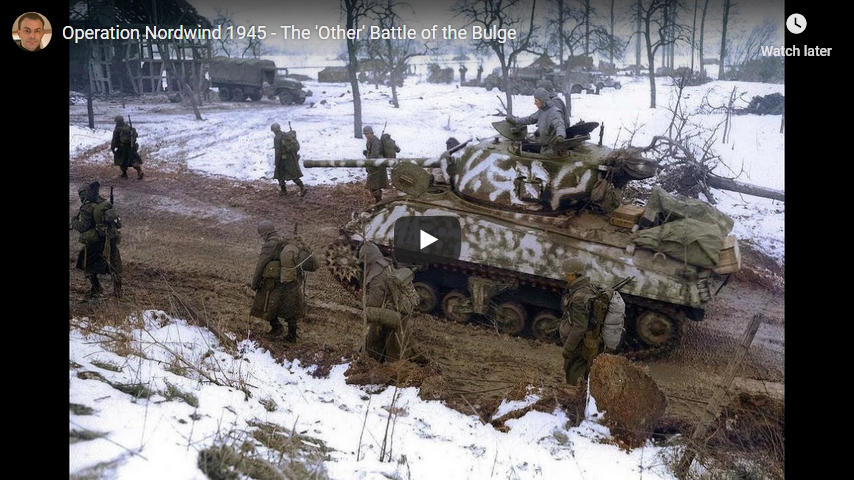
Operation Nordwind 1945 – The ‘Other’ Battle of the Bulge

Filed under: France, Germany, History, Military, USA, WW2 — Tags: , , — Nicholas @ 04:00

Mark Felton Productions
Published 29 Dec 2020

The stories of the last big German offensives on the Western Front in WWII — Operations Nordwind and Sonnenwende in Alsace, France, January 1945.

Dr. Mark Felton is a well-known British historian, the author of 22 non-fiction books, including bestsellers Zero Night and Castle of the Eagles, both currently being developed into movies in Hollywood. In addition to writing, Mark also appears regularly in television documentaries around the world, including on The History Channel, Netflix, National Geographic, Quest, American Heroes Channel and RMC Decouverte. His books have formed the background to several TV and radio documentaries. More information about Mark can be found at: https://en.wikipedia.org/wiki/Mark_Fe…

Help support my channel:
https://www.paypal.me/markfeltonprodu…
https://www.patreon.com/markfeltonpro…

Disclaimer: All opinions and comments expressed in the ‘Comments’ section do not reflect the opinions of Mark Felton Productions. All opinions and comments should contribute to the dialogue. Mark Felton Productions does not condone written attacks, insults, racism, sexism, extremism, violence or otherwise questionable comments or material in the ‘Comments’ section, and reserves the right to delete any comment violating this rule or to block any poster from the channel.

This is why the word “unexpectedly” gets such a workout in media these days

David Warren on “unexpectedly” negative results from policies born of virtue-signalling “good intentions” by self-styled progressives:

The expression, “unintended consequences,” is a charitable dodge. It is what old-fashioned, polite, civic-minded people say about the fallout from progressive social policies. It implies that their authors have overlooked something, or made some innocent mistake. For unfortunately, the policies do the exact opposite of what was promised. Surely the “reformers” didn’t mean to force decent, reasonable people to do things that any decent, reasonable person would consider to be satanic. Yet somehow, that was the result.

By contrast, these reformers despise the tactics of the bourgeois. Rather than argue, they prefer to drown out their opponents with slogans. Rather than coherently reply, they characterize any asking questions as “fascist,” “misogynist,” “racist,” “hate criminals,” &c. Those who have exposed scandals are personally smeared, slandered, doxxed. This isn’t new. It is the way the Left has always “debated,” going back long before Lenin. Once they have the police working for them, opponents get the knock in the middle of the night.

There are, incidentally, two kinds of “reform,” corresponding to the two political persuasions. One happens without planning, and is an organic response to things no longer working properly. Try, in good faith, to make the old system work, and it will subtly change. The “problems” fix themselves, when they are allowed to. The other kind is “reform” according to a theory. A huge, mostly imaginary “problem” is created, so a “solution” may be imposed. Every tool must be applied, to get everyone onside for the task: fake news, fake science, fake history, and miscellaneous fakery. For as every godless person knows, “the end justifies the means.”

Luckier than most, raised in “liberal” environments, I was able to discern this from an early age. By chance I acquired many friends who were refugees from Communist (especially Soviet-occupied) countries. But it was not just that. Having been trained counter-culturally, by non-conformist “classically liberal” teachers, and also having learnt to read for myself, I was already fairly alert. The clincher for me was a native disposition, not only to think independently, but to resist being a putz. It was not in my nature to assume that the enemies of real liberalism (which requires honesty) had good intentions. Reason, and experiment, demonstrated that they had not.

For instance, I early realized that leftwing factions formed a Party of Privilege. Every policy they advanced favoured individuals with relatively more wealth and power, against individuals with less. Unions were a good example. They represented the better-paid. The labour laws they advocated were designed to exclude the young and the poor from labour-market competition. They secured the allegiance of thuggish union members through crassly self-interested schemes. They opposed legitimate rewards for labour; for skill and hard work. Instead they enforced universal mediocrity, and punished intelligent enterprise. Legitimate labour interests, once represented by cooperative and self-managing guilds, were replaced by the interests of (untalented) union organizers.

« Newer PostsOlder Posts »

Powered by WordPress