Big Car
Published 1 Nov 2020Toyota’s best-selling vehicle is the long-running Toyota Corolla, but second is Toyota’s resilient pickup the Hilux that’s been sold for over 50 years. No matter where you are in the world, you’ll likely find one moving up to a ton of cargo down a dusty lane. In the process it’s turned into a bit of a Jekyll and Hyde vehicle. On the one hand it’s the basic indestructible commercial vehicle that thousands of businesses rely on every day. On the other it’s become a well-specced weekend leisure vehicle. And in some cases it’s a bit of both! So why did this unassuming vehicle get a place of honour at the Top Gear studio, and what other successful vehicles have been born out of this long-running pickup?
If you’d like to support what I do, and get early access to advert-free videos and exclusive channel updates, please consider supporting the channel from just $1 or 80p a month: http://patreon.com/bigcar
January 30, 2021
Toyota’s Invincible Truck
QotD: Positional goods and social signalling
PC-brigadiers behave exactly like owners of a positional good who panic because wider availability of that good threatens their social status. The PC brigade has been highly successful in creating new social taboos, but their success is their very problem. Moral superiority is a prime example of a positional good, because we cannot all be morally superior to each other. Once you have successfully exorcised a word or an opinion, how do you differentiate yourself from others now? You need new things to be outraged about, new ways of asserting your imagined moral superiority.
You can do that by insisting that the no real progress has been made, that your issue is as real as ever, and just manifests itself in more subtle ways. Many people may imitate your rhetoric, but they do not really mean it, they are faking it, they are poseurs … You can also hugely inflate the definition of an existing offense … Or you can move on to discover new things to label “offensive”, new victim groups, new patterns of dominance and oppression.
If I am right, then Political Correctness is really just a special form of conspicuous consumption, leading to a zero-sum status race. The fact that PC fans are still constantly outraged, despite the fact that PC has never been so pervasive, would then just be a special form of the Easterlin Paradox.
Kristian Niemietz, “The economics of political correctness”, Institute of Economic Affairs, 2014-04-30.
January 29, 2021
Did 90 Minutes Decide the Fate of the Jews? – The Wannsee Conference – WAH 027 – January 1942 Pt. 2
World War Two
Published 28 Jan 2021To most, the Wannsee Conference is synonymous with the moment the Holocaust started. In fact, the meeting is mainly designed to formalise policy, and to involve political and governmental organisations in the crime.
Join us on Patreon: https://www.patreon.com/TimeGhostHistory
Or join The TimeGhost Army directly at: https://timeghost.tvFollow WW2 day by day on Instagram @ww2_day_by_day – https://www.instagram.com/ww2_day_by_day
Between 2 Wars: https://www.youtube.com/playlist?list…
Source list: http://bit.ly/WW2sourcesHosted by: Spartacus Olsson
Written by: Joram Appel
Director: Astrid Deinhard
Producers: Astrid Deinhard and Spartacus Olsson
Executive Producers: Astrid Deinhard, Indy Neidell, Spartacus Olsson, Bodo Rittenauer
Creative Producer: Maria Kyhle
Post-Production Director: Wieke Kapteijns
Research by: Joram Appel
Edited by: Miki Cackowski
Sound design: Marek Kamiński
Map animations: Eastory (https://www.youtube.com/c/eastory)Colorizations by:
Jaris Almazani (Artistic Man), https://instagram.com/artistic.man
Daniel Weiss
Mikołaj UchmanSources:
USHMM
Bundesarchiv
Narodowe Archiwum Cyfrowe
IWM SE 4819
Yad Vashem 75FO4, 4613/139, 5138/98, 2695/7, 3955/109, 4613/873, 3955/104, 14FO2, 4062/234, 4216/18, 3186/61, 16GO3, 10334/28, 6343/16, 3955/421, 4613/65
Moreshet Archive, No. D.1.4630.
Picture of Jewish and Lithuanian police guarding the entrance to the Vilnius ghetto, courtesy of USHMM, William Begell
Picture of Jews from Kamenets-Podolsk collected by Germans before being taken to the murder site, courtesy of USHMM, Ivan Sved
Picture of the Wannsee Villa, courtesy of JoJans, Wikimedia Commons
Picture of bodies of Auschwitz prisoners in Block 11, courtesy of USHMM, Instytut Pamięci NarodowejSoundtracks from the Epidemic Sound:
Skrya – “First Responders”
Farell Wooten – “Blunt Object”
Philip Ayers – “Trapped in a Maze”
Fabien Tell – “Last Point of Safe Return”
Rannar Sillard – “March Of The Brave 9”
Andreas Jamsheree – “Guilty Shadows 4”
Johan Hynynen – “Dark Beginning”
Farell Wooten – “Rainy Landscapes”
Fabien Tell – “Never Forget”
Jon Bjork – “Disposal”Archive by Screenocean/Reuters https://www.screenocean.com.
A TimeGhost chronological documentary produced by OnLion Entertainment GmbH.
Nailed joinery is MUCH better than you think
Rex Krueger
Published 27 Jan 2021Are nails the work holding solution for your next project?
More video and exclusive content: http://www.patreon.com/rexkrueger
Make the Mitten Box: https://youtu.be/E4wCJGNb6yU
(more…)
Costs of keeping Biden’s promise to forgive student debt
Antony Davies and James R. Harrigan consider the frequently issued campaign promise by Joe Biden and what it will cost to implement:
Given the results of the recent election, it should come as no surprise that we’re poised for the next big expansion: student debt forgiveness, a promise Joe Biden made frequently as he campaigned for the presidency. Like the big ideas that came before it, this idea will cost us more than we can afford from day one, and far more than its proponents will admit. Biden’s plan as currently envisioned would cost over $300 billion. But that’s just this year. The plan will set in motion unintended consequences that will doubtlessly persist for generations.
First, next year’s crop of new students will — understandably — demand that their loans be forgiven too. And so will those of the year after that, and so on. This program will quickly become a sort of college UBI, where the government just hands out $10,000 to every college student. Some argue that if this results in a better educated populace, then it’s worth the cost. But it won’t result in a better educated populace; it will result in a whole bunch of students majoring in things the market doesn’t value, and another batch simply taking a four-year vacation on the taxpayer’s dime. Heretofore, graduates knew they needed marketable skills in order to repay their college loans. But when student loans are forgiven as a matter of course, graduates bear no cost for wasting our collective resources by studying things the market doesn’t value, or by not studying at all.
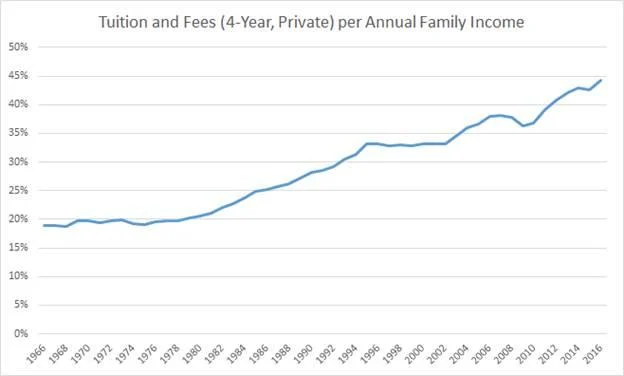
Second, colleges and universities will respond to this new reality by raising tuition commensurately. Tuition and fees were a pretty constant 18 to 19 percent of family income from the 1960s until 1978. In 1965, the federal government started guaranteeing student loans. In 1973, Congress established Sallie Mae and charged it with providing subsidized students loans. And by 1978, tuition and fees had started a steady march to 45 percent of family income today. When the government makes it less painful for students to borrow, whether by guaranteeing, subsidizing, or forgiving loans, it takes away some of the pain of student borrowing, which makes it easier for colleges and universities to raise tuition.
Third, expect many taxpayers to cry foul. Homeowners will quite sensibly wonder why the government is not forgiving their mortgages. After all, student loans add up to about $1.4 trillion, while American mortgages total more than $16 trillion. If relieving students from the burden of their debts is a good idea, it should be an even better idea to relieve homeowners of theirs.
What about students who worked multiple jobs or attended less prestigious schools so they could avoid going into debt? Why aren’t they being rewarded? What about students who diligently paid off their debt and are now debt free? Will they receive nothing? What about, fantastically, people in the trades? Is it reasonable to charge people — via the higher taxes loan forgiveness will bring — who did not go to college to subsidize those who do? Regardless of the answers to these questions, implementing this plan will be fraught with difficulty.
Ancient Aryans: The History of Crackpot N@zi Archaeology
Atun-Shei Films
Published 22 Nov 2019Thanks to Indiana Jones, everybody knows that German archaeologists in the 1930s were searching for occult ancient artifacts … but that’s just the tip of the iceberg. In this educational video, I explore how the N@zis turned the discipline of prehistoric archaeology into a cog in their propaganda machine, and how their crazy conspiracy theories about lost civilizations continue to haunt us to this day.
Support Atun-Shei Films on Patreon ► https://www.patreon.com/atunsheifilms
Leave a Tip via Paypal ► https://www.paypal.me/atunsheifilms (All donations made here will go toward the production of The Sudbury Devil, our historical feature film)
Buy Merch ► teespring.com/stores/atun-shei-films
#WW2 #Archaeology #History
Reddit ► https://www.reddit.com/r/atunsheifilms
Twitter ► https://twitter.com/atun_shei
QotD: Banishing racism
The simple, powerful truth that banishes racist prejudice is this: the individual is not the mass. Statistical distributions do not predict the traits of individuals. It’s OK to acknowledge that (for example) Ashkenazic Jews average significantly brighter than gentile whites, because the difference in the means of those bell curves tells us nothing about where any single Jew or gentile falls on them.
We can – we must, in fact – learn to judge individuals as individuals, not as members of racial or other ascriptive groups. This has always been the right thing to do; as knowledge about genetic group differences becomes more detailed and widespread, we will need to learn how to focus rigorously on individuals with the same discipline (and the same justified fear of failure) that we now apply to averting our eyes from genetic group differences.
Part of the reason this evolution won’t be easy is that so much of our politics has been distorted by racial grievance-mongering. It’s not only the obvious bad guys like neo-Nazis, Black separatists like Louis Farrakhan, and Bharatiya Janata who are invested in racialist categorization as a lever to power. The political Left has fallen into a lazy habit of screaming “racist!” at anyone who disagrees with them, won’t readily relinquish that rhetorical club, and have a lot invested in the present system of taboo, resentment, “disparate impact” legislation, and racial identity politics; expect them, too, to be part of the problem rather than part of the solution.
Still, the right strategy is clear. Actual knowledge makes both prejudice and repression unsustainable. “Know thyself!” said the oracle, and behavioral genetics will allow – actually, force us – to know ourselves in ways we never have before. That way lies the pain of revelation, but also the path of redemption.
Eric S. Raymond, “A Specter is Haunting Genetics”, Armed and Dangerous, 2010-06-19.
January 28, 2021
Blade Runner 1921?! – Robot Apocalypse Now | B2W: ZEITGEIST! | E.10 – Winter 1921
TimeGhost History
Published 27 Jan 20201Modern technology promises a lot, but it can also bring unprecedented horror. This season, the people of Czechoslovakia get to see that for themselves.
Join us on Patreon: https://www.patreon.com/TimeGhostHistory
Hosted by: Indy Neidell
Written by: Francis van Berkel
Director: Astrid Deinhard
Producers: Astrid Deinhard and Spartacus Olsson
Executive Producers: Astrid Deinhard, Indy Neidell, Spartacus Olsson, Bodo Rittenauer
Creative Producer: Maria Kyhle
Post-Production Director: Wieke Kapteijns
Research by: Francis van Berkel
Edited by: Michał Zbojna
Sound design: Marek KamińskiColorizations:
Daniel Weiss – https://www.facebook.com/TheYankeeCol…
Mikołaj Uchman
Norman Stewart – https://oldtimesincolor.blogspot.com/
Mikołaj Cackowski
KlimbimSources:
Some images from the Library of Congress
Bibliotheque nationale de FranceIcons from The Noun Project:
– noun_Sound_3530255
– Microphone by Agung Cahyo sSoundtracks from Epidemic Sound:
“Epic Adventure Theme 3” – Håkan Eriksson
“I Am Unbreakable” – Niklas Johansson
“Waiting like the Storm” – Rand Aldo
“Le Chat Noir 1” – Martin Landh
“A Single Grain Of Rice” – Yi Nantiro
“Alleys of Buenos Aires” – Tiki Tiki
“Age Of Men” – Jo WandriniArchive by Screenocean/Reuters https://www.screenocean.com.
A TimeGhost chronological documentary produced by OnLion Entertainment GmbH.
From the comments:
TimeGhost History
1 day ago (edited)
Episode 10 of the series and for the first time we’re looking at a decidedly negative outcome that people imagined might come with further technological progress. Over 100 years later and it’s still something people are fearful of, and it often feels like Artificial Intelligence providing a real threat to humanity’s existence is just around the corner.We’d be interested to know what you guys all think. Is there a chance that something along the lines of what Čapek imagined actually happening? Let us know in the comments.
NOTE: Unfortunately an error has snuck into this week’s episode. The portrait that is supposed to show Herbert Hoover is in fact of his son, Herbert Hoover Jr. We are working on getting this fixed as fast as possible, and we apologize for the inconvenience in the meantime.
GameStop in a very different kind of game
In the NP Platformed newsletter, Colby Cosh looks at the fascinating gyrations of GameStop’s share price in the grip of an unexpected group of players in the market:

“GameStop” by JeepersMedia is licensed under CC BY 2.0
GameStop has long been seen by institutional investors as following down the road of Blockbuster Video: it’s a bricks-and-mortar retailer whose main product is downloadable from your sofa. For that reason, it is heavily shorted by professional funds who normally eschew short-selling, which does have the risky feature of potentially infinite negative downside.
Enter Reddit, the website for special-interest user forums of all kinds. A Reddit “Wall Street bets” board uncovered evidence in regulatory filings that some hedge funds had legitimately dangerous large short positions representing bets against GameStop’s flaccid share price. A few hobby investors began to buy GameStop out of a sense of adventure and perhaps nostalgic loyalty. More importantly, they began to preach the gospel to others.
This is explicit “market manipulation,” but done in the open; it is surely as legal as any other conversation. GameStop’s price (NYSE symbol: GME) surged upward as word spread amongst day traders and other amateur investors. And as the random-looking rise in price got noticed, the whole scheme, itself rather reminiscent of a video game, went viral.
As of Jan. 12, GME was below $20, which is about where most analysts thought it belonged on merit, or lack thereof. The price as I type this particular sentence is $328.81. The backs of some funds with heavy short positions have been broken.
High finance seems somewhat terrified, as amateur investing websites — ones pioneered by the financial industry itself — begin to throw roadblocks in front of late-arriving GME buyers. For itself, Wall Street will invest billions replacing copper wire with fiber optics to gain microsecond arbitrage advantages in the market; for you and I, the good old portfolio can get conveniently 404ed for an afternoon.
This suggests that Wall Street may not have reckoned with the full possibilities of a world of proletarian shareholders. The stock market has proverbially been a playground of “animal spirits” since long before John Maynard Keynes used that phrase in 1936. What happens to an ecosystem when new animals show up? One can surely count on at least a minimum of chaos; maybe the surprise is that it took so long to take this game-like, combative form.
Japan’s Big Asian Gamble – WW2 Special
World War Two
Published 27 Jan 2021Access to scarce natural resources and labor was a big reason for the Japanese to invade numerous South-East asian countries. But was that necessary? And did the benefits outweigh the risk? Let’s find out!
Join us on Patreon: https://www.patreon.com/TimeGhostHistory
Hosted by: Indy Neidell
Written by: Joram Appel
Director: Astrid Deinhard
Producers: Astrid Deinhard and Spartacus Olsson
Executive Producers: Astrid Deinhard, Indy Neidell, Spartacus Olsson, Bodo Rittenauer
Creative Producer: Maria Kyhle
Post-Production Director: Wieke Kapteijns
Research by: Joram Appel
Image Research by: Michał Zbojna
Edited by: Michał Zbojna
Sound design: Marek KamińskiColorizations:
Julius Jääskeläinen – https://www.facebook.com/JJcolorization/Icons from The Noun Project:
asia by Ted Grajeda
clothing by Adnen Kadri
Coal by Eucalyp
Wire by Arthur Shlain
noun_Wool_2842881
noun_rock_12609
noun_rock_481051
noun_hemp_2183488
Iron Ingot by Jetro Cabau Quirós
rock by Bakunetsu Kaito
Medicine by Ladalle CS
noun_rock_481016
noun_silk_3492403
noun_Oil_3319962
Paper by Sergey Demushkin
rock by Aline Escobar
tire by Juan León
soap by Roman
noun_Wood_2177037
noun_Metal_3369307
rock by Bakunetsu Kaito
noun_Mineral_3517065Soundtracks from Epidemic Sound:
“Sights of the Tokyo Tower” – Sight of Wonders
“Paths of a Samurai” – Mandala Dreams
“Pacific Shores” – Mandala Dreams
“Sights of the Tokyo Tower” – Sight of Wonders
“Save Her” – Jon BjorkSources:
Archive by Screenocean/Reuters https://www.screenocean.com.
A TimeGhost chronological documentary produced by OnLion Entertainment GmbH.
From the comments:
World War Two
4 hours ago
Japan wasn’t the only nation that went to war over Asia’s natural resources. Indonesia was a big source of wealth for the Dutch ever since it became a colony, so The Netherlands went to war after World War Two, when the Indonesians declared their independence. We have made a whole series about the Indonesian War of Independence, including a prologue covering the colonial context (including WW2 occupation) of Indonesia. You can watch that prologue right here: https://youtu.be/IkKJSRaeOik
The economic impact of a US national minimum wage of $15 per hour
I missed this post by Warren Meyer last week, but it’s still very topical:
I have talked a lot about the negative effects of higher minimum wages on low-skill workers. Two good example background posts are here and here. I covered how a broad range of labor regulation hurts unskilled workers in a cover story for Regulation magazine a few years back. Unfortunately, in a country where the average American buys about $1000 in lottery tickets each year, the willingness to believe we can get something for nothing is strong.
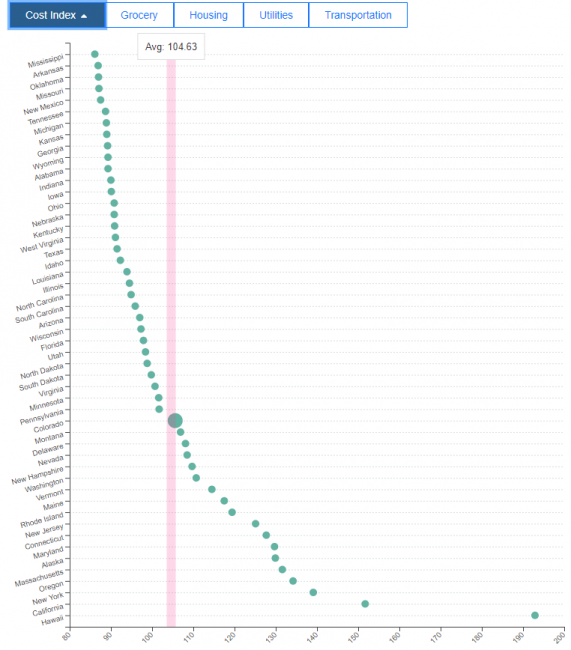
But I want to talk specifically about a Federal minimum wage increase, where one other problem emerges. The best way to state this is — how can one possibly set the same minimum wage for San Francisco at the same rate as one does for rural Mississippi? Here is one source for comparative state cost of living. Doing this by county would make the curve even wider.
Cost of living in Hawaii is more than 2x that of Mississippi. CA and NY are not far behind. A minimum wage that might comfortably be accommodated in San Francisco (and note even there the rise to $15 was ending service jobs in that city long before COVID), would be an economic disaster for rural Alabama. I don’t tend to think primarily along racial lines as seems to be the case on the Left today, but basically this is a policy driven by rich white tech guys in San Francisco that is going to devastate the employment prospects of rural blacks.
Whatever one’s misgivings about minimum wages, it is certainly true that allowing states to take the lead on setting minimum wages (counties would make even more sense) makes a lot more sense that trying to take action at the national level. Even with state action there are disparities.
Doughboy Bringback MP-18,I on the Range
Forgotten Weapons
Published 21 Oct 2020http://www.patreon.com/ForgottenWeapons
https://www.floatplane.com/channel/Fo…
Cool Forgotten Weapons merch! http://shop.bbtv.com/collections/forg…
The MP-18,I was most likely the first true submachine gun to see combat use, issued in the final months of World War One to German Sturmtruppen. These guns were originally fitted with 32-round drum magazines form the Artillery Luger, but they were almost all quickly changed to standard System Schmeisser box magazines shortly after the war ended. This is a rare example of one still in its original configuration, as brought home by a US soldier as a war trophy.
The MP-18,I set the standard for basically all future SMGs. It has remarkably gentle to shoot, with a low rate of fire and nice big sights. The drum does throw the balance substantially off to the left side, but it has few other serious problems.
Contact:
Forgotten Weapons
6281 N. Oracle #36270
Tucson, AZ 85740
QotD: Art for art’s sake
Théophile Gautier didn’t actually say “Art for art’s sake,” but even if he did, it was only about 100 years ago. The notion that a true ahr-teeeeeste would never sully his hands with shekels comes from the fin de siècle, when a bunch of nancy boys sponging off their parents decided their works could only be properly appreciated by other useless mooches. William Shakespeare — a true artist, the finest writer in the history of the English language — would’ve laughed right in these guys’ mincing little faces, because as Larry Correia says, the writer’s prime directive is GET PAID. Shakespeare worked for a living, which means he wasn’t above a fart joke. Whatever got the job done. Ditto Mozart — The Magic Flute was the Bill and Ted’s Excellent Adventure of its day — and all the rest. The “artist” who trumpets his intention to produce “art” is a poseur, always and everywhere.
Severian, “The Entertainer”, Rotten Chestnuts, 2020-10-08.
January 27, 2021
Behind the Scenes of WW2 – TimeGhost Cribs
World War Two
Published 26 Jan 2021This week we will start a series of videos where you get to know the team that makes this magnificent content.
Join us on Patreon: https://www.patreon.com/TimeGhostHistory
Or join The TimeGhost Army directly at: https://timeghost.tvFollow WW2 day by day on Instagram @ww2_day_by_day – https://www.instagram.com/ww2_day_by_day
Between 2 Wars: https://www.youtube.com/playlist?list…
Source list: http://bit.ly/WW2sourcesHosted by: Indy Neidell & Spartacus Olsson
Director: Astrid Deinhard
Producers: Astrid Deinhard and Spartacus Olsson
Executive Producers: Astrid Deinhard, Indy Neidell, Spartacus Olsson, Bodo Rittenauer
Creative Producer: Maria Kyhle
Post-Production Director: Wieke Kapteijns
Edited by: Karolina Dołęga
Sound design: Marek KamińskiA TimeGhost chronological documentary produced by OnLion Entertainment GmbH.
Australia’s aboriginal people
On Australia Day, which progressives want to rename as “Invasion Day”, a look at the aboriginal culture(s) who had inhabited the continent for thousands of years before contact with Europeans:

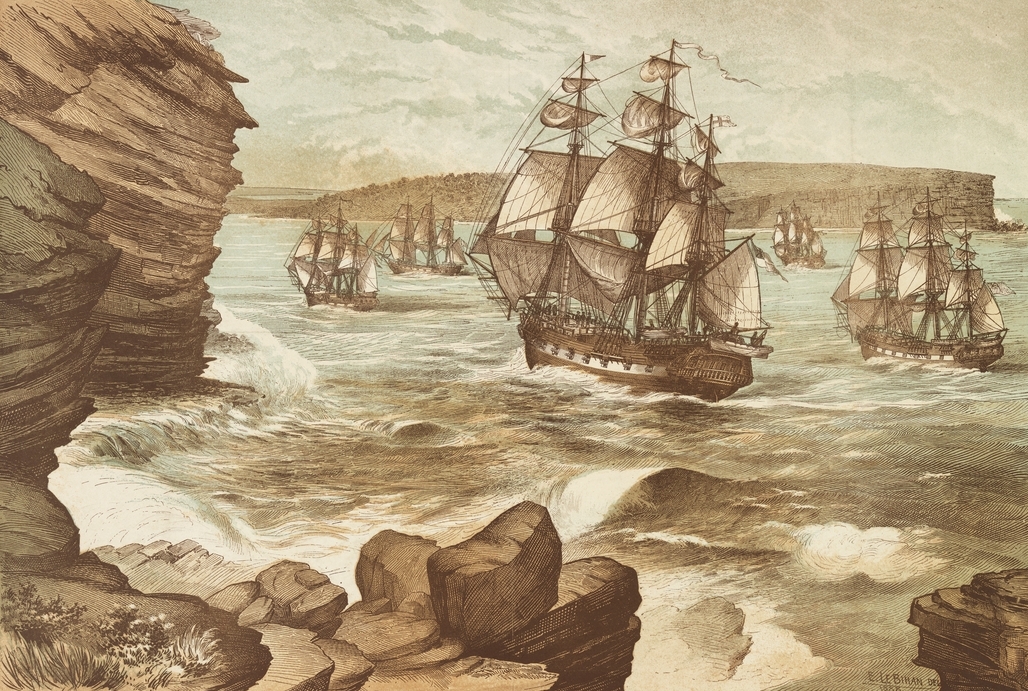
Colour lithograph of the First Fleet entering Port Jackson on January 26 1788, drawn in 1888.
Original by E. Le Bihan via Wikimedia Commons.
Liam Hemsworth and others are spruiking nonsense which is also being taught to school children as they protest against “invasion day”:
We are spiritually and culturally connected to this country.
This country was criss-crossed by generations of brilliant Nations.
Aboriginal and Torres Strait Islander people were Australia’s first explorers, first navigators, first engineers, first farmers, first botanists, first scientists, first diplomats, first astronomers and first artists.
Australia has the world’s oldest oral stories. The First Peoples engraved the world’s first maps, made the earliest paintings of ceremony and invented unique technologies. We built and engineered structures – structures on Earth – predating well-known sites such as the Egyptian Pyramids and Stonehenge.
Our adaptation and intimate knowledge of Country enabled us to endure climate change, catastrophic droughts and rising sea levels.
Always Was, Always Will Be. acknowledges that hundreds of Nations and our cultures covered this continent. All were managing the land – the biggest estate on earth – to sustainably provide for their future.This statement is a work of poorly written fiction. All humans are descended from ancestors that roamed Africa. At some stage – perhaps 50,000 to 60,000 years ago according to archaeological records – some Homo Sapiens (so far as we know, Homo Erectus do not appear to have migrated to the land mass now know as Australia) moved to this continent during the Pleistocene (ice age) when sea levels were much lower allowing transit without seafaring. Later the ice age abated, ice melted and the Australian continent became separate and its inhabitants isolated.
In Jared Diamond’s book Guns, Germs and Steel – the Fates of Human Societies, he argues that circumstances (pressure on resources etc) lead to innovations and changes to society. On Australia he wrote:
Australia is the sole continent where, in modern times, all native peoples still lived without any of the hallmarks of so-called civilization – without farming, herding, metal, bows and arrows, substantial buildings, settled villages, writing, chiefdoms or states. Instead Australian Aborigines were nomadic or semi-nomadic hunter-gatherers, organised into bands, living in temporary shelters or huts and still dependent on stone-tools. – (p. 297).
Compared with Native Australians, New Guineans rate as culturally “advanced” … most New Guineans … were farmers and swineherds. They lived in settled villages and were organised politically into tribes rather than as bands. All New Guineans had bows and arrows, and many used pottery. – (p. 297-8).
While New Guinea … developed both animal husbandry and agriculture, … Australia … developed neither. – (p. 308).
Isolated from other populations, and lacking little in the way of resources, Australia’s first inhabitants were not pressured into changing their ways of life and remained essentially hunter gatherers and nomadic societies. I make no judgement on whether this is good or bad, merely that despite the lack of competition over resources, life wasn’t always rosy and violence and skirmishes, murder and rape occurred as much among those humans as it did elsewhere.
It was inevitable that this isolation would not persist – it is perhaps surprising that it persisted as long as it did. But contact with other humans was inevitable and the outcome of that contact would be widely varying depending on whether the contact was made by the Portuguese, Spanish, Dutch, Chinese, British or others. The fact that Australia became a British colony is probably the best of the many alternatives that could have sprung from colonialisation. And we are all affected, mostly positively, by that contact – there would be few Aboriginal Australians (perhaps none) who today could say that they have no ancestry at all from settlers who arrived after 1787. We are all of mixed blood and we all descend from those original Homo Sapiens who evolved in Africa. It is time to talk about unity rather than division.